One-dimensional self-organization of water molecules in proton conducting Andersson-Wadsley titanates
Pith reviewed 2026-06-25 23:18 UTC · model grok-4.3
The pith
Water molecules form one-dimensional double chains that enable superionic proton conduction along the b-axis in Andersson-Wadsley titanates.
A machine-rendered reading of the paper's core claim, the machinery that carries it, and where it could break.
Core claim
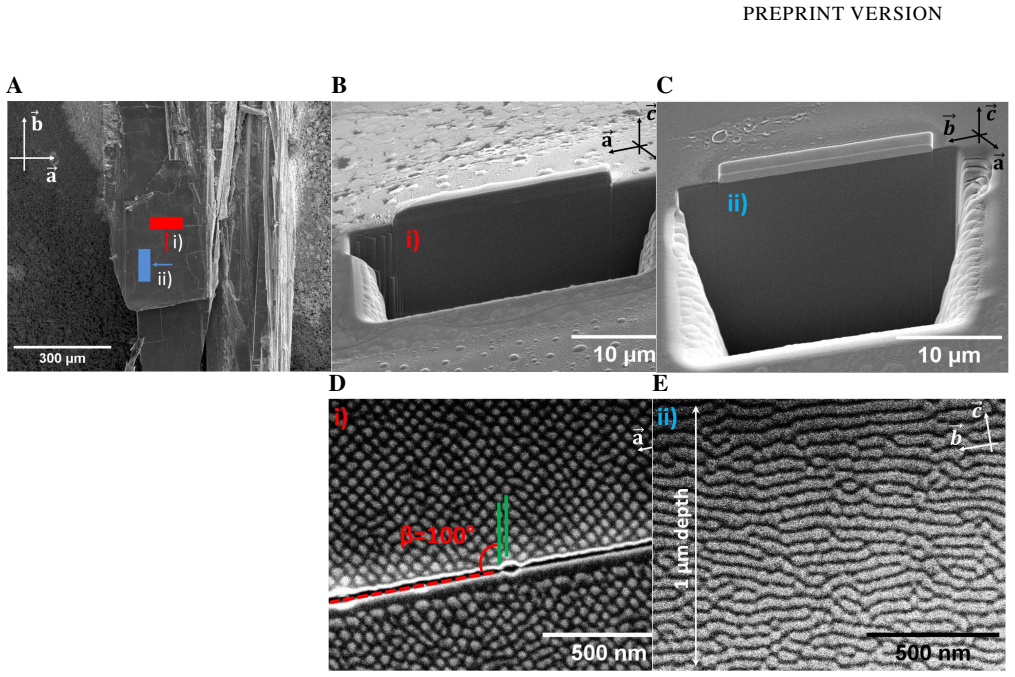
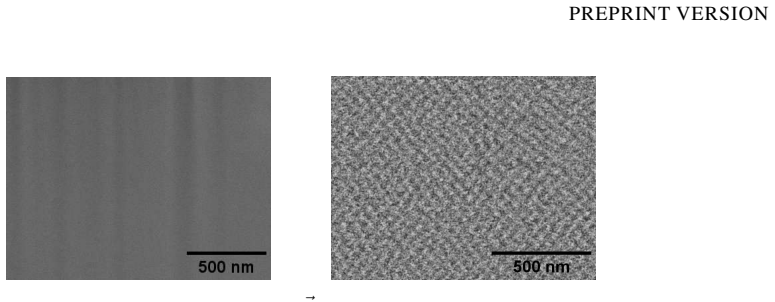
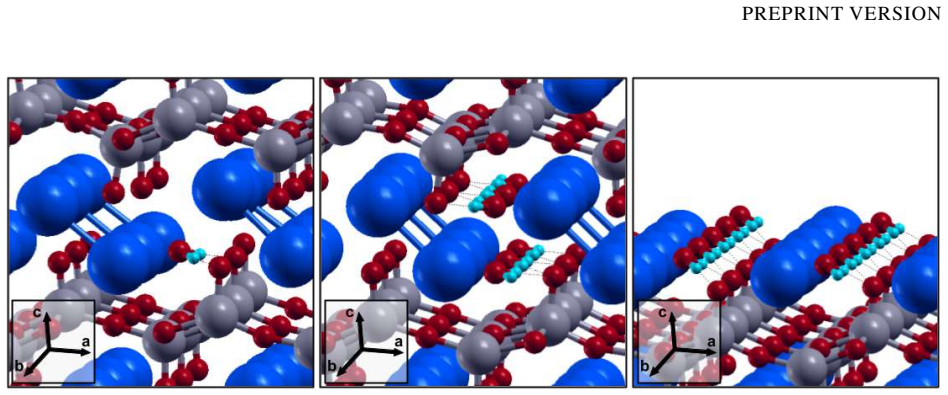
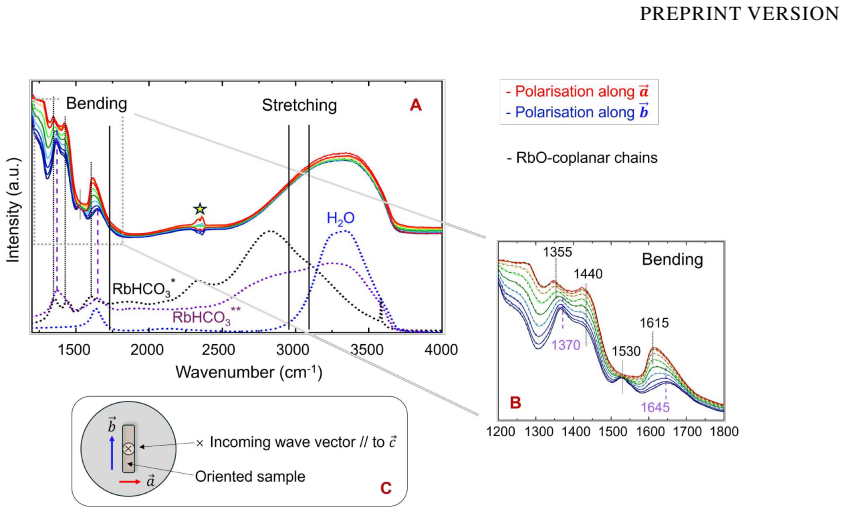
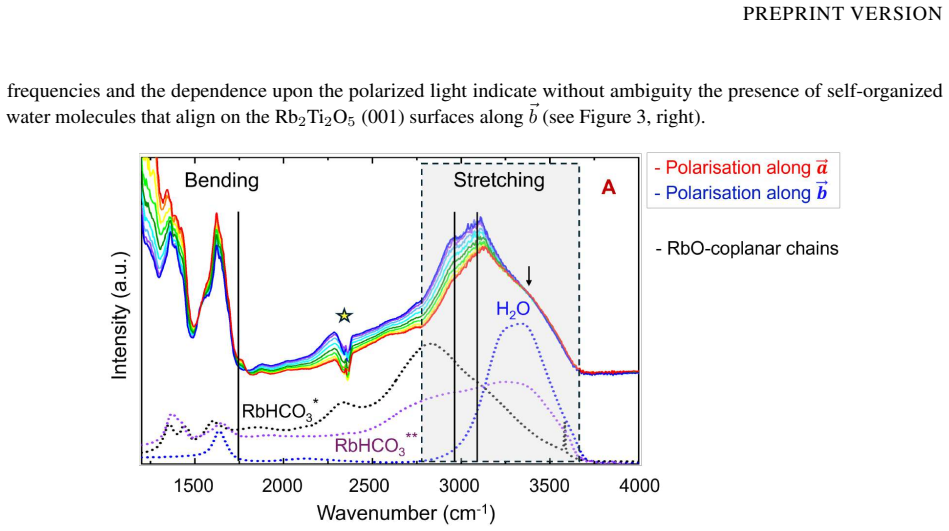
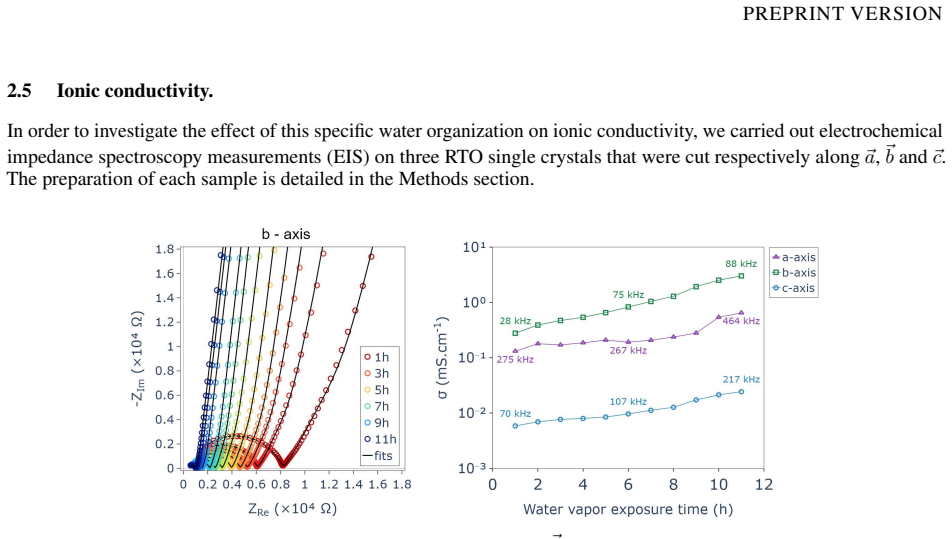
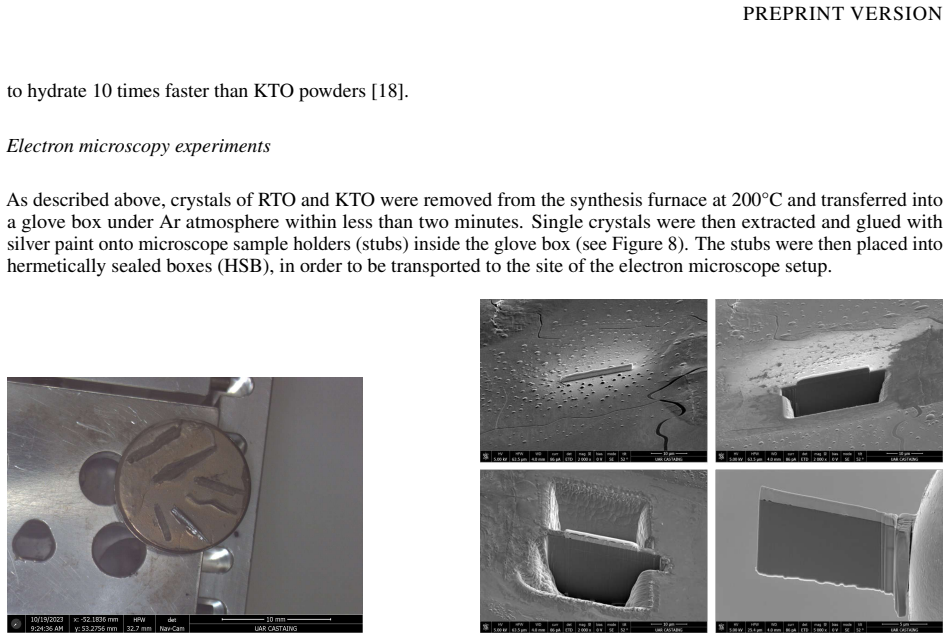
In Rb2Ti2O5 at low hydration x, DFT calculations show water molecules self-organize into one-dimensional double chains along b with strong hydrogen bonds to apical oxygens of the titanate layers. SEM images reveal matching one-dimensional heterogeneous patterns oriented along b, while further hydration creates hydrated (001) surfaces of packed water chains matching infrared spectra. The hydrated material exhibits highly anisotropic proton conductivity with super-ionic values along b, indicating that the water chains are the root of fast conduction likely via a Grotthuss-like process.
What carries the argument
The self-organized one-dimensional double chains of water molecules along the b crystallographic direction, stabilized by hydrogen bonds to the host crystal's apical oxygen atoms.
Load-bearing premise
The one-dimensional patterns seen by SEM at low hydration are produced by the DFT-predicted water double chains, and these chains are the main cause of the measured anisotropic conductivity rather than defects or other structural features.
What would settle it
Measuring superionic conductivity along b in a hydrated sample where SEM shows no one-dimensional patterns at low hydration levels.
Figures
read the original abstract
Layered alkali titanates with M 2 Ti 2 O 5 chemical formula (MTO, M=K,Rb) belonging to the Andersson-Wadsley perovskite family spontaneously incorporate water to form MTO.(H 2 O) x compounds, which exhibit superionic conductivity. At very low hydration x, scanning electron microscopy evidences one-dimensional heterogeneous patterns oriented along ___ b that are arranged in an orderly manner. At higher hydration, the material is observed to spontaneously exfoliate by creating (001) surfaces. Simulations carried out using Density Functional Theory reveal an ordered arrangement of the guest water molecules in Rb 2 Ti 2 O 5 , with strong hydrogen bonds between the water molecules and the apical oxygen of the host crystal. At low hydration x, the water molecules form self-organized one dimensional (1D) double chains along ___ b. Further increase of the water content leads to the creation of hydrated (001)-surfaces that are made of densely packed water chains in agreement with the infrared spectroscopy measurements. Rb 2 Ti 2 O 5 exhibits highly anisotropic proton conductivity, with respect to the crystal orientation, with super-ionic conductivity along ___ b reaching 3 mS/cm at room temperature after hydration. The combined observations and simulations suggest that these water chains are thus at the root of fast proton conduction, which is likely powered by a Grotthuss-like mechanism.
Editorial analysis
A structured set of objections, weighed in public.
Referee Report
Summary. The manuscript examines water incorporation in layered Andersson-Wadsley titanates M₂Ti₂O₅ (M = K, Rb). At low hydration, SEM reveals ordered 1D heterogeneous patterns along the b direction; at higher hydration, spontaneous exfoliation occurs along (001). DFT calculations on Rb₂Ti₂O₅ show guest water molecules forming 1D double chains along b at low x via strong H-bonds to apical oxygens, transitioning to densely packed chains on hydrated (001) surfaces at higher x, consistent with IR data. The material exhibits highly anisotropic proton conductivity, reaching 3 mS/cm along b at room temperature after hydration. The authors conclude that the water chains underlie the fast conduction, likely via a Grotthuss mechanism.
Significance. If the proposed structural-conductivity link holds, the work would identify a concrete structural motif (self-organized 1D water double chains) responsible for superionic behavior in this family, offering a design principle for proton conductors. The integration of SEM, IR, conductivity, and DFT is a positive feature; however, the mechanistic interpretation rests on static structures and correlation rather than dynamical evidence.
major comments (3)
- [Abstract; DFT results section] The central claim that the DFT-predicted 1D water double chains are 'at the root' of the observed anisotropic conductivity (Abstract and concluding paragraph) is load-bearing but supported only by correlation. The manuscript provides no direct experimental signature (e.g., diffraction, site-specific spectroscopy, or conductivity measurements on samples where chains are deliberately disrupted) linking the SEM patterns specifically to the DFT chains rather than defects or other features.
- [DFT simulations; concluding paragraph] DFT calculations (described in the simulations section) are limited to static minimum-energy structures of water arrangements. No molecular-dynamics trajectories, NEB barriers for proton hopping, or evidence of Grotthuss-type transfer are reported, so the statement that conduction 'is likely powered by a Grotthuss-like mechanism' remains an untested hypothesis rather than a demonstrated process.
- [Conductivity measurements section] The reported conductivity value of 3 mS/cm along b (Abstract) is presented without error bars, number of samples, or explicit description of how crystal orientation was confirmed and aligned for measurement; this weakens the quantitative support for the anisotropy claim that underpins the chain-conductivity connection.
minor comments (2)
- [Abstract] The abstract contains placeholder text '___ b' in multiple places; these should be replaced with the intended crystallographic direction.
- [Figure captions; Results] Figure captions and text should explicitly state the hydration levels (x values) corresponding to the SEM images and DFT models to allow direct comparison.
Simulated Author's Rebuttal
We thank the referee for their thoughtful and constructive review of our manuscript. We address each major comment below and have revised the manuscript accordingly where feasible to strengthen the presentation and clarify the scope of our claims.
read point-by-point responses
-
Referee: [Abstract; DFT results section] The central claim that the DFT-predicted 1D water double chains are 'at the root' of the observed anisotropic conductivity (Abstract and concluding paragraph) is load-bearing but supported only by correlation. The manuscript provides no direct experimental signature (e.g., diffraction, site-specific spectroscopy, or conductivity measurements on samples where chains are deliberately disrupted) linking the SEM patterns specifically to the DFT chains rather than defects or other features.
Authors: We agree that the proposed connection rests on correlation among SEM patterns (1D features along b), DFT-optimized 1D double chains along b, and anisotropic conductivity along b, rather than a single direct experimental signature such as diffraction confirming the chain motif in the low-hydration phase. In the revised manuscript we have changed the abstract and concluding paragraph to state that the water chains 'are consistent with' and 'likely contribute to' the observed conduction, and we have added a short discussion paragraph acknowledging the correlative nature of the evidence and the possibility that defects or other structural features may also play a role. revision: partial
-
Referee: [DFT simulations; concluding paragraph] DFT calculations (described in the simulations section) are limited to static minimum-energy structures of water arrangements. No molecular-dynamics trajectories, NEB barriers for proton hopping, or evidence of Grotthuss-type transfer are reported, so the statement that conduction 'is likely powered by a Grotthuss-like mechanism' remains an untested hypothesis rather than a demonstrated process.
Authors: The referee correctly notes that the DFT work consists of static geometry optimizations. No molecular-dynamics simulations or transition-state calculations are presented. The suggestion of a Grotthuss-like process is an inference drawn from the hydrogen-bond network and precedents in related materials. We have revised the relevant sentence in the conclusion to read 'which we propose may be powered by a Grotthuss-like mechanism' to reflect the hypothetical character. Performing the requested dynamical calculations lies outside the scope of the present study. revision: partial
-
Referee: [Conductivity measurements section] The reported conductivity value of 3 mS/cm along b (Abstract) is presented without error bars, number of samples, or explicit description of how crystal orientation was confirmed and aligned for measurement; this weakens the quantitative support for the anisotropy claim that underpins the chain-conductivity connection.
Authors: We have expanded the conductivity measurements section to report data from five independent crystals, include error bars (revised value 3.0 ± 0.4 mS cm^{-1}), and provide a step-by-step description of crystal orientation verification by single-crystal XRD together with the electrode alignment protocol used for the anisotropic measurements. revision: yes
Circularity Check
No significant circularity; experiments and DFT are independent inputs
full rationale
The paper reports independent experimental measurements (SEM patterns at low hydration, IR spectra at higher hydration, anisotropic conductivity along b) alongside separate DFT static optimizations that locate minimum-energy water arrangements. No equation, parameter fit, or self-citation reduces the conductivity value, the Grotthuss suggestion, or the chain-conductivity link to a quantity defined from the same data. The central inference remains a correlation between two distinct data sources rather than a definitional or fitted reduction. This is the normal non-circular case.
Axiom & Free-Parameter Ledger
Reference graph
Works this paper leans on
-
[1]
Meng, H.-N
X. Meng, H.-N. Wang, S.-Y . Song, H.-J. Zhang, Chem. Soc. Rev. 2017, 46 464
2017
-
[2]
S. Fop, J. Mater . Chem. A2021, 9 18836
-
[3]
Y . Xu, X. Wu, X. Ji, Small Structures 2021, 2, 5 2000113
2021
-
[4]
Huang, W
C. Huang, W. Zhang, W. Zheng, Energy Storage Materials 2023, 61 102913
2023
-
[5]
de Grotthuss, Ann
C. de Grotthuss, Ann. Chim. 1806, 58 54
-
[6]
Agmon, Chemical Physics Letters 1995, 244, 5 456
N. Agmon, Chemical Physics Letters 1995, 244, 5 456. 13 PREPRINT VERSION
1995
-
[7]
G. K. H. Shimizu, J. M. Taylor, S. Kim, Science 2013, 341, 6144 354
2013
-
[8]
X. B. Xiang Zhao, Chengyu Mao, P. Feng, Chem. Mat. 2014, 26
2014
-
[9]
Chandra, T
S. Chandra, T. Kundu, S. Kandambeth, R. Babarao, Y . Marathe, S. M. Kunjir, R. Banerjee,J. Am. Chem. Soc. 2014, 136 6570
2014
-
[10]
K. L. Yeung, W. Han, Catalysis Today 2014, 236 182
2014
-
[11]
P. Sun, R. Ma, T. Sasaki, Chem. Sci. 2018, 9 33
2018
-
[12]
Andersson, A
S. Andersson, A. D. Wadsley, Nature 1960, 187 499
1960
-
[13]
Federicci, S
R. Federicci, S. Holé, A. F. Popa, L. Brohan, B. Baptiste, S. Mercone, B. Leridon, Phys. Rev. Mater .2017, 1 032001
2017
-
[14]
R. Federicci, S. Holé, V . Démery, B. Leridon, Journal of Applied Physics 2018, 124, 15 152104, _eprint: https://pubs.aip.org/aip/jap/article-pdf/doi/10.1063/1.5036841/15216969/152104_1_online.pdf
work page doi:10.1063/1.5036841/15216969/152104_1_online.pdf 2018
-
[15]
De Sousa Coutinho, R
S. De Sousa Coutinho, R. Federicci, S. Holé, B. Leridon, Solid State Ionics 2019, 333 72
2019
-
[16]
R. Rani, S. De Sousa Coutinho, S. Holé, B. Leridon, Materials Letters 2020, 258 126784
2020
-
[17]
De Sousa Coutinho, D
S. De Sousa Coutinho, D. Bérardan, G. Lang, R. Federicci, P. Giura, K. Beneut, N. Dragoe, S. Holé, B. Leridon, Solid State Ionics 2021, 364 115630
2021
-
[18]
Meziani, M
N. Meziani, M. Parent, G. Rousse, B. Leridon, D. Berardan, P. Giura, Inorganic Chemistry 2024, 63, 38 17513, pMID: 39225367
2024
-
[19]
Federicci, B
R. Federicci, B. Baptiste, F. Finocchi, F. Popa, L. Brohan, K. Béneut, P. Giura, G. Rousse, A. Descamps-Mandine, T. Douillard, A. Shukla, B. Leridon, Acta Crystallographica Section B 2017, 73, 6 1142
2017
-
[20]
Kokalj, Journal of Molecular Graphics and Modelling 1999, V olume 17, Issues 3–4
A. Kokalj, Journal of Molecular Graphics and Modelling 1999, V olume 17, Issues 3–4
1999
-
[21]
C. Yoon, H. Han, Y . Kim, H.-J. Shin, Applied Surface Science 2025, 689 162507
2025
-
[22]
Benas, S
G. Benas, S. De Sousa Coutinho, B. Leridon, F. Finocchi, Phys. Chem. Chem. Phys. 2025, –
2025
-
[23]
Larvor, B
C. Larvor, B. Stöger, Acta Crystallographica Section E 2017, 73, 7 975
2017
-
[24]
Odin, Magnetic Resonance in Chemistry 2004, 42, 4 381
C. Odin, Magnetic Resonance in Chemistry 2004, 42, 4 381
2004
-
[25]
M. G. Münst, M. On ˇcák, M. K. Beyer, C. van der Linde, The Journal of Chemical Physics 2021, 154, 8
2021
-
[26]
R. A. Huggins, Ionics 2002, 8, 3 300
2002
-
[27]
S. Kang, A. Singh, K. G. Reeves, J.-C. Badot, S. Durand-Vidal, C. Legein, M. Body, O. Dubrunfaut, O. J. Borkiewicz, B. Tremblay, C. Laberty-Robert, D. Dambournet, Chemistry of Materials 2020, 32, 21 9458
2020
-
[28]
Larfaillou, D
S. Larfaillou, D. Guy-Bouyssou, F. le Cras, S. Franger, Journal of Power Sources 2016, 319 139
2016
-
[29]
Vadhva, J
P. Vadhva, J. Hu, M. J. Johnson, R. Stocker, M. Braglia, D. J. L. Brett, A. J. E. Rettie, ChemElectroChem 2021, 8, 11 1930
2021
-
[30]
A. C. Lazanas, M. I. Prodromidis, ACS Measurement Science Au 2023, 3
2023
-
[31]
Dragoe, Materials Lab 2023, 2
N. Dragoe, Materials Lab 2023, 2
2023
-
[32]
Giannozzi, O
P. Giannozzi, O. Andreussi, T. Brumme, O. Bunau, M. B. Nardelli, M. Calandra, R. Car, C. Cavazzoni, D. Ceresoli, M. Cococcioni, N. Colonna, I. Carnimeo, A. D. Corso, S. de Gironcoli, P. Delugas, R. A. DiStasio, A. Ferretti, A. Floris, G. Fratesi, G. Fugallo, R. Gebauer, U. Gerstmann, F. Giustino, T. Gorni, J. Jia, M. Kawamura, H.-Y . Ko, A. Kokalj, E. Küç...
2017
-
[33]
J. P. Perdew, K. Burke, M. Ernzerhof, Phys. Rev. Lett. 1996, 77 3865
1996
-
[34]
Zhang, W
Y . Zhang, W. Yang,Phys. Rev. Lett. 1998, 80 890
1998
-
[35]
D. R. Hamann, Phys. Rev. B 2013, 88 085117
2013
-
[36]
Baroni, S
S. Baroni, S. de Gironcoli, A. Dal Corso, P. Giannozzi, Rev. Mod. Phys. 2001, 73 515
2001
-
[37]
Shimanouchi, Tables of molecular vibrational frequencies, National Bureau of Standards, 1972
T. Shimanouchi, Tables of molecular vibrational frequencies, National Bureau of Standards, 1972
1972
-
[38]
RbO-coplanar
A. Kokalj, Comp. Mater . Sci.2003, 28 155. 14 Supplementary Information 15 Supplementary Information : One-dimensional self-organization of water molecules in proton conducting Andersson-Wadsley titanates. 1 Electron microscopy observations Figure S1 shows a typical SEM image taken on RTO1b as well as its Fourier transform. A long-range quasi-quadratic ne...
2003
discussion (0)
Sign in with ORCID, Apple, or X to comment. Anyone can read and Pith papers without signing in.