ATRIA: Adaptive Traceable ECG Reporting with Iterative Agents
Pith reviewed 2026-07-01 06:53 UTC · model grok-4.3
The pith
ATRIA is a multi-agent system that generates ECG reports by binding each claim to evidence and supporting iterative clinician revisions.
A machine-rendered reading of the paper's core claim, the machinery that carries it, and where it could break.
Core claim
We present ATRIA, a multi-agent ECG reporting system that mirrors the clinician's iterative workflow: it binds every report claim to its supporting evidence, flags statements unsupported by that evidence, incorporates additional context mid-session, and lets clinicians verify and revise individual findings rather than accept one opaque output. Because its agents use ECG analysis models already in clinical use, the underlying findings are clinically trustworthy; and as a cloud-based web service, ATRIA is ready for immediate deployment.
What carries the argument
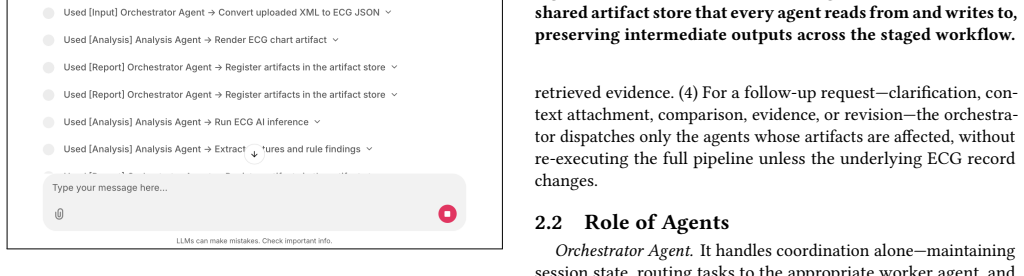
The multi-agent architecture that decouples tasks while enabling evidence binding, unsupported-statement flagging, mid-session context integration, and selective revision of findings.
If this is right
- Every report claim becomes traceable to specific evidence from the ECG analysis models.
- Unsupported statements are automatically identified and surfaced for review.
- New clinical context can be added during an ongoing session without restarting the entire process.
- Clinicians can verify and revise individual findings rather than the full report output.
- The system is available immediately as a cloud-based web service.
Where Pith is reading between the lines
- The same evidence-binding and iterative-revision structure could be tested on other diagnostic report types such as radiology or pathology notes.
- The flagging mechanism might create audit trails useful for training or liability review in AI-assisted diagnostics.
- Deployment data could show how frequently clinicians actually supply mid-session context changes in real workflows.
Load-bearing premise
The assumption that ECG analysis models already in clinical use supply reliable base findings that the agents can reliably build upon.
What would settle it
A controlled test case in which the system produces a report containing a claim that has no matching evidence in the input ECG data yet fails to flag that claim as unsupported.
Figures
read the original abstract
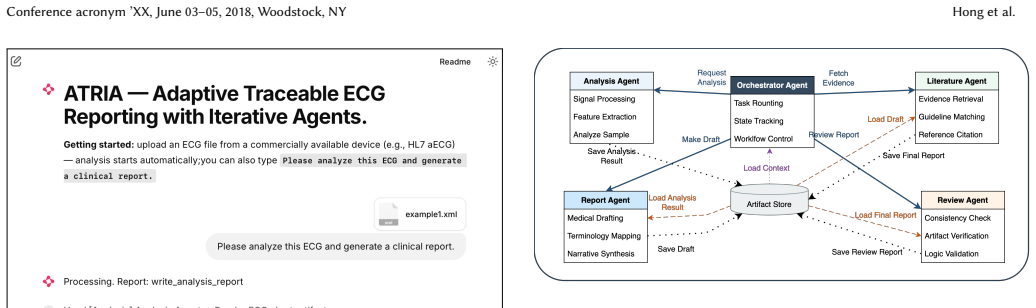
Existing ECG report generation is tightly coupled -- interpretation and reporting fused end-to-end, so errors propagate without stage-level recourse -- while agent-based systems decouple tasks but remain single-pass, never revisiting earlier outputs. Clinical ECG reporting instead unfolds iteratively, requiring progressive context integration and bidirectional editing. We present \textsc{ATRIA}, a multi-agent ECG reporting system that mirrors the clinician's iterative workflow: it binds every report claim to its supporting evidence, flags statements unsupported by that evidence, incorporates additional context mid-session, and lets clinicians verify and revise individual findings rather than accept one opaque output. Because its agents use ECG analysis models already in clinical use, the underlying findings are clinically trustworthy; and as a cloud-based web service, \textsc{ATRIA} is ready for immediate deployment. We demonstrate \textsc{ATRIA} through four interaction cases, with a live demo and video available.
Editorial analysis
A structured set of objections, weighed in public.
Referee Report
Summary. The paper introduces ATRIA, a multi-agent ECG reporting system designed to emulate clinicians' iterative workflow. It decouples interpretation and reporting to enable binding each claim to supporting evidence, flagging unsupported statements, incorporating additional context mid-session, and allowing verification/revision of individual findings. The system is claimed to be clinically trustworthy because its agents invoke existing ECG analysis models, and it is presented as ready for immediate cloud-based deployment, with demonstration via four qualitative interaction cases and a live demo.
Significance. If the iterative binding, flagging, and revision mechanisms can be shown to preserve or improve upon the reliability of the underlying ECG models without introducing new error modes, ATRIA could address a practical limitation in current AI-assisted reporting by providing stage-level recourse and traceability. The absence of any quantitative evaluation, however, prevents assessment of whether these features deliver measurable clinical benefit.
major comments (2)
- [Abstract] Abstract: The assertion that 'the underlying findings are clinically trustworthy' because agents use ECG analysis models already in clinical use is presented without any error analysis, ablation study, or comparison showing that the multi-agent orchestration, evidence binding, and flagging steps preserve base-model reliability or reduce propagated errors.
- [Abstract] Abstract (final sentence): The claim of readiness for immediate deployment rests on the four interaction cases, which are described only qualitatively; no metrics, user studies, or validation experiments are supplied to demonstrate that the iterative features improve report quality, reduce errors, or outperform single-pass or end-to-end baselines.
Simulated Author's Rebuttal
We thank the referee for the constructive comments on the abstract claims. We agree that the current wording makes assertions that exceed the quantitative evidence supplied in the manuscript and will revise the abstract to reflect the work's scope as a system demonstration.
read point-by-point responses
-
Referee: [Abstract] Abstract: The assertion that 'the underlying findings are clinically trustworthy' because agents use ECG analysis models already in clinical use is presented without any error analysis, ablation study, or comparison showing that the multi-agent orchestration, evidence binding, and flagging steps preserve base-model reliability or reduce propagated errors.
Authors: The manuscript provides no error analysis, ablation studies, or comparisons demonstrating that the multi-agent orchestration, evidence binding, or flagging preserve base-model reliability or reduce new error modes. The original phrasing relied on the use of established clinical models for interpretation but does not address orchestration effects. We will revise the abstract to remove or qualify this assertion. revision: yes
-
Referee: [Abstract] Abstract (final sentence): The claim of readiness for immediate deployment rests on the four interaction cases, which are described only qualitatively; no metrics, user studies, or validation experiments are supplied to demonstrate that the iterative features improve report quality, reduce errors, or outperform single-pass or end-to-end baselines.
Authors: The manuscript demonstrates ATRIA via four qualitative interaction cases, a live demo, and video, without metrics, user studies, or baseline comparisons. We agree this does not support claims of immediate deployment readiness or measurable improvements from the iterative features. We will revise the final sentence to describe the demonstration without asserting deployment readiness. revision: yes
Circularity Check
No circularity: system architecture with no derivations or fitted quantities
full rationale
The paper presents an architectural description of a multi-agent ECG reporting system. No equations, parameters, or derivations appear in the provided text. The central claim that outputs are clinically trustworthy rests on the assumption that base ECG models remain reliable under orchestration, but this is not a self-referential reduction or fitted prediction; it is an external premise. No steps match any enumerated circularity pattern.
Axiom & Free-Parameter Ledger
Reference graph
Works this paper leans on
-
[1]
Hyunseung Chung, Jungwoo Oh, Daeun Kyung, Jiho Kim, Yeonsu Kwon, Min- Gyu Kim, and Edward Choi. 2026. ECG-Agent: On-Device Tool-Calling Agent for ECG Multi-Turn Dialogue.IEEE Xplore(2026). https://ieeexplore.ieee.org/ document/11464123 IEEE Xplore document 11464123; corresponding arXiv preprint: arXiv:2601.20323
-
[2]
ECGwaves. [n. d.]. The ECG Book. https://ecgwaves.com/course/the-ecg-book/. Accessed: 2026-06-02
2026
-
[3]
Awni Y Hannun, Pranav Rajpurkar, Masoumeh Haghpanahi, Geoffrey H Tison, Colin Bourn, Mintu P Turakhia, and Andrew Y Ng. 2019. Cardiologist-level arrhythmia detection and classification in ambulatory electrocardiograms using a deep neural network.Nature Medicine25, 1 (2019), 65–69
2019
-
[4]
Joo Hee Jeong, Sora Kang, Hak Seung Lee, Min Sung Lee, Jeong Min Son, Joon- Myung Kwon, Hyoung Seok Lee, Yun Young Choi, So Ree Kim, Dong-Hyuk Cho, Yun Gi Kim, Mi-Na Kim, Jaemin Shim, Seong-Mi Park, Young-Hoon Kim, and Jong-Il Choi. 2024. Deep learning algorithm for predicting left ventricular systolic dysfunction in atrial fibrillation with rapid ventric...
-
[5]
Joon-Myoung Kwon, Soo Youn Lee, Ki-Hyun Jeon, Yeha Lee, Kyung-Hee Kim, Jinsik Park, Byung-Hee Oh, and Myong-Mook Lee. 2020. Deep Learning-Based Algorithm for Detecting Aortic Stenosis Using Electrocardiography.Journal of the American Heart Association9, 7 (2020), e014717. doi:10.1161/JAHA.119.014717
-
[6]
Xiang Lan, Feng Wu, Kai He, Qinghao Zhao, Shenda Hong, and Mengling Feng
- [7]
-
[8]
Min Sung Lee, Tae Gun Shin, Youngjoo Lee, Dong Hoon Kim, Sung Hyuk Choi, Hanjin Cho, Mi Jin Lee, Ki Young Jeong, Won Young Kim, Young Gi Min, Chul Han, Jae Chol Yoon, Eujene Jung, Woo Jeong Kim, Chiwon Ahn, Jeong Yeol Seo, Tae Ho Lim, Jae Seong Kim, Jeff Choi, Joon-Myoung Kwon, and Kyuseok Kim. 2025. Artificial intelligence applied to electrocardiogram to...
-
[9]
Life in the Fast Lane. [n. d.]. ECG Library. https://litfl.com/ecg-library/. Accessed: 2026-06-02
2026
-
[10]
Jaehyun Lim, Min Sung Lee, Jung Ho Suh, Sora Kang, Hak Seung Lee, Jong-Hwan Jang, Jeong Min Son, Joon-Myoung Kwon, Yong-Jin Kim, Kyung-Hee Kim, and Seung-Pyo Lee. 2026. Artificial Intelligence-Enabled ECG for Elevated E/e’ on Echocardiography: Hemodynamic Relevance and Prognostic Value.Journal of the American Heart Association15, 9 (2026), e046989. doi:10...
-
[11]
J. Warren Mason, E. William Hancock, Leonard S. Gettes, James J. Bailey, Rory Childers, Barbara J. Deal, Mark Josephson, Paul Kligfield, Jan A. Kors, Peter Macfarlane, Olle Pahlm, David M. Mirvis, Peter Okin, Pentti Rautaharju, Gerard van Herpen, Galen S. Wagner, and Hein Wellens. 2007. Recommendations for the Standardization and Interpretation of the Ele...
-
[12]
Jaeho Park, TaeJun Park, Joon-myoung Kwon, and Yong-Yeon Jo. 2025. Bench- marking ECG Delineation using Deep Neural Network-based Semantic Seg- mentation Models. InProceedings of the sixth Conference on Health, Inference, and Learning (Proceedings of Machine Learning Research, Vol. 287), Xuhai Or- son Xu, Edward Choi, Pankhuri Singhal, Walter Gerych, Shen...
2025
-
[13]
Tae-Min Rhee, Sora Kang, Min Sung Lee, Ga In Han, Ah-Hyun Yoo, Jong-Hwan Jang, Yong-Yeon Jo, Jeong Min Son, Joon-Myoung Kwon, Su-Yeon Choi, Hak Se- ung Lee, and Heesun Lee. 2026. Artificial Intelligence-Driven Electrocardiogram Screening for Asymptomatic Left Ventricular Systolic Dysfunction in the General Population.JACC: Advances5, 4 (2026), 102660. doi...
-
[14]
António H Ribeiro, Manoel H Ribeiro, Gabriele M M Paixão, Derick M Oliveira, Paulo R Gomes, José A Canazart, M Ferreira, Carl R Andersson, Peter W Macfar- lane, Patrick Wagner, et al. 2020. Automatic diagnosis of the 12-lead ECG using a deep neural network.Nature Communications11, 1 (2020), 1760
2020
-
[15]
Jürg Schläpfer and Hein J. Wellens. 2017. Computer-Interpreted Electrocardio- grams: Benefits and Limitations.Journal of the American College of Cardiology 70, 9 (2017), 1183–1192. doi:10.1016/j.jacc.2017.07.723
- [16]
-
[17]
UC Irvine and ASU and CSU authors. 2026. CARE-ECG: Causal Agent- based Reasoning for Explainable and Counterfactual ECG Interpretation. arXiv:2604.10420 [cs.LG] https://arxiv.org/abs/2604.10420
work page internal anchor Pith review Pith/arXiv arXiv 2026
-
[18]
Zhongwei Wan, Che Liu, Xin Wang, Chaofan Tao, Hui Shen, Zhenwu Peng, Jie Fu, Rossella Arcucci, Huaxiu Yao, and Mi Zhang. 2024. MEIT: Multi-Modal Electrocardiogram Instruction Tuning on Large Language Models for Report Generation.arXiv preprint arXiv:2403.04945(2024). https://arxiv.org/abs/2403. 04945
-
[19]
WikiDoc. [n. d.]. ECG Criteria. https://www.wikidoc.org/index.php/ECG_ Criteria. Accessed: 2026-06-02
2026
-
[20]
Han Yu, Peikun Guo, and Akane Sano. 2023. Zero-Shot ECG Diagnosis with Large Language Models and Retrieval-Augmented Generation. InProceedings of the 3rd Machine Learning for Health Symposium (Proceedings of Machine Learning Research, Vol. 225). PMLR, 650–663. https://proceedings.mlr.press/v225/yu23b. html
2023
- [21]
discussion (0)
Sign in with ORCID, Apple, or X to comment. Anyone can read and Pith papers without signing in.