Interaction-Enhanced Ergotropy in Phase-Driven Andreev Bound State Quantum Batteries
Pith reviewed 2026-06-26 05:38 UTC · model grok-4.3
The pith
Interactions between two Andreev bound states enhance extractable work under a superconducting phase ramp.
A machine-rendered reading of the paper's core claim, the machinery that carries it, and where it could break.
Core claim
In the high-transparency regime relevant for graphene SNS junctions, the interaction enhances the stored extractable work and generates pronounced oscillatory charging dynamics associated with coherent redistribution between coupled ABS sectors. The phase-resolved evolution further reveals optimal charging windows during the Josephson cycle, indicating the possibility of phase-programmable energy extraction through partial-cycle operation. Interaction-assisted avoided-crossing dynamics serve as the microscopic mechanism for controllable energy storage in this superconducting quantum battery platform.
What carries the argument
The interplay between avoided-crossing excitation and interaction-induced hybridization in a minimal model of two interacting Andreev bound state units driven by a superconducting phase ramp.
If this is right
- Interaction increases stored extractable work in the high-transparency regime.
- Coherent redistribution between ABS sectors produces pronounced oscillatory charging.
- Optimal charging windows appear during the Josephson cycle.
- Partial-cycle operation enables phase-programmable energy extraction.
- Interaction-assisted avoided-crossing dynamics provide a mechanism for controllable superconducting energy storage.
Where Pith is reading between the lines
- The same hybridization mechanism might appear in multi-unit extensions or other Josephson-based devices.
- Low-decoherence graphene junctions could serve as a direct testbed for the predicted oscillations.
- Phase programming might combine with existing qubit control techniques for hybrid quantum energy systems.
- Disorder or finite-temperature effects left out of the model would need separate checks before device scaling.
Load-bearing premise
The minimal model of two interacting ABS units under a superconducting phase ramp accurately captures the relevant physics of real graphene SNS junctions without additional decoherence or disorder effects.
What would settle it
Experimental measurement of ergotropy in a graphene SNS junction realizing two coupled ABS units that shows no interaction-induced increase or no oscillatory charging dynamics under a controlled phase ramp would falsify the central claim.
Figures
read the original abstract
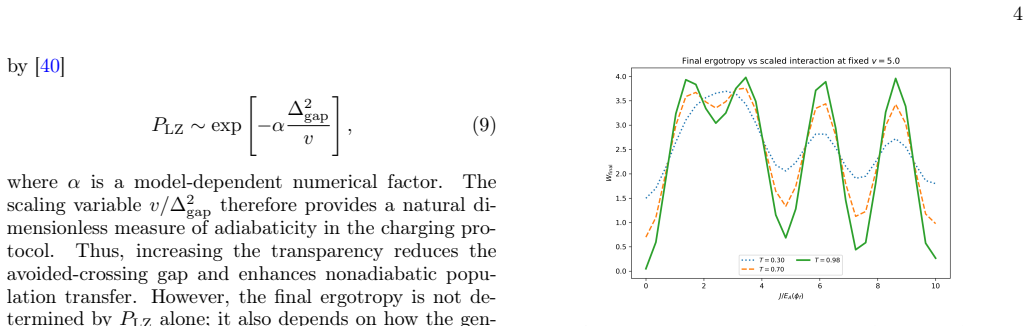
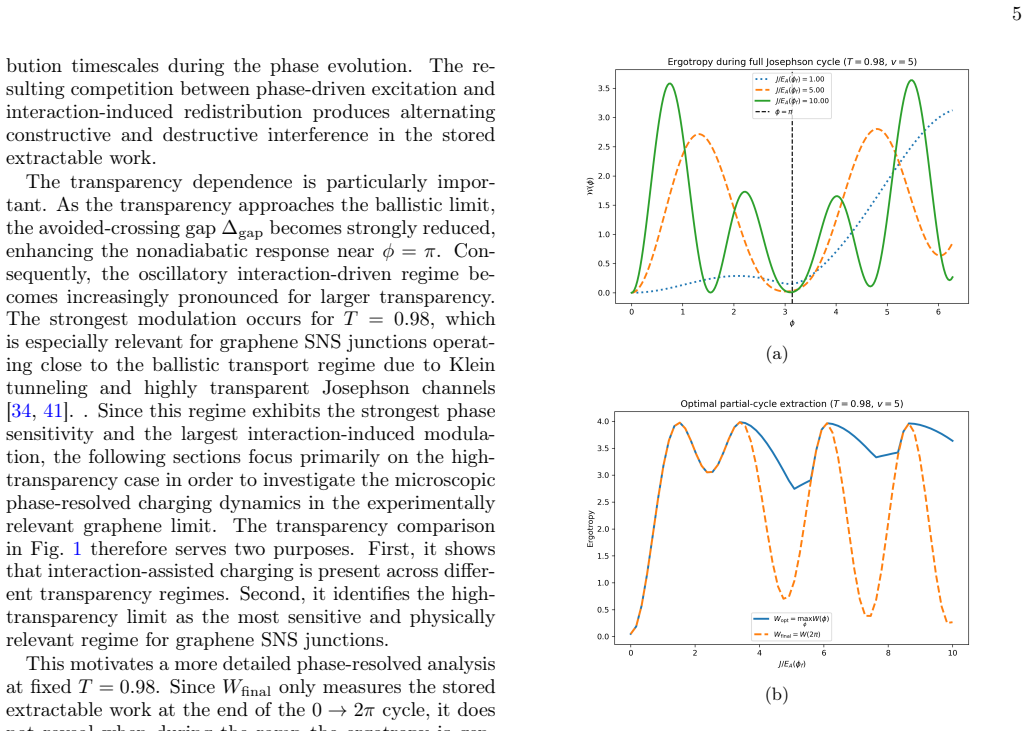
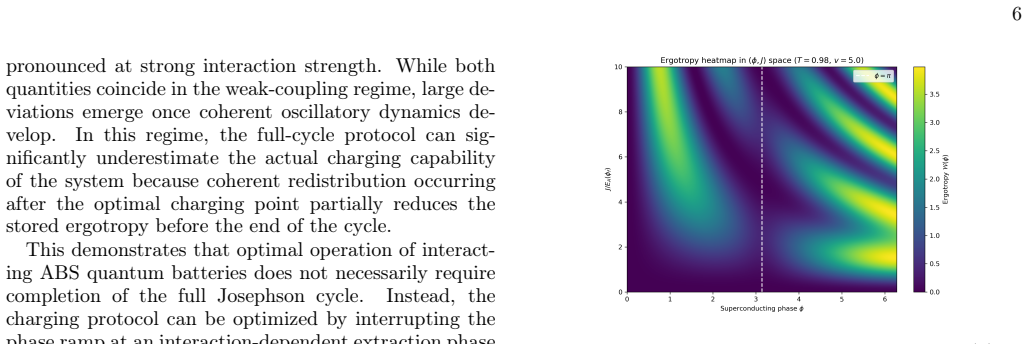
We investigate a phase-driven quantum battery composed of two interacting Andreev bound state (ABS) units, providing a minimal superconducting platform for coherent energy storage. By analyzing the ergotropy dynamics under a superconducting phase ramp, we show that the interplay between avoided-crossing excitation and interaction-induced hybridization strongly modifies the charging process. In the high-transparency regime relevant for graphene SNS junctions, the interaction enhances the stored extractable work and generates pronounced oscillatory charging dynamics associated with coherent redistribution between coupled ABS sectors. The phase-resolved evolution further reveals optimal charging windows during the Josephson cycle, indicating the possibility of phase-programmable energy extraction through partial-cycle operation. Overall, our results identify interaction-assisted avoided-crossing dynamics as a microscopic mechanism for controllable energy storage in superconducting quantum batteries.
Editorial analysis
A structured set of objections, weighed in public.
Referee Report
Summary. The paper investigates a phase-driven quantum battery composed of two interacting Andreev bound state (ABS) units, providing a minimal superconducting platform for coherent energy storage. By analyzing the ergotropy dynamics under a superconducting phase ramp, the interplay between avoided-crossing excitation and interaction-induced hybridization is shown to modify the charging process. In the high-transparency regime relevant for graphene SNS junctions, the interaction enhances the stored extractable work and generates pronounced oscillatory charging dynamics associated with coherent redistribution between coupled ABS sectors. The phase-resolved evolution reveals optimal charging windows during the Josephson cycle for phase-programmable energy extraction.
Significance. If the minimal model accurately captures the relevant physics, the work identifies interaction-assisted avoided-crossing dynamics as a microscopic mechanism for controllable energy storage in superconducting quantum batteries. The analytical treatment of ergotropy under phase drive yields concrete, falsifiable predictions for enhancement and oscillations that could be tested in high-transparency SNS devices. The paper does not mention machine-checked proofs or open reproducible code, but the minimal two-unit model allows clear isolation of the interaction effect on charging dynamics.
major comments (1)
- [Abstract] Abstract: The assertion that the high-transparency regime is 'relevant for graphene SNS junctions' is load-bearing for the applied significance but lacks any parameter mapping, disorder-averaged calculation, or decoherence estimate. This raises a correctness-risk concern for the extrapolation to real devices; a concrete test would be to compute the predicted oscillation period from the model and compare it against typical quasiparticle decoherence times or level-broadening scales in graphene SNS junctions.
minor comments (1)
- The abstract is concise but would benefit from a brief parenthetical reference to the form of the two-ABS Hamiltonian or the phase-ramp protocol to make the dynamical claims more immediately accessible.
Simulated Author's Rebuttal
We thank the referee for their careful reading of the manuscript and for the constructive comment on the abstract. We address the point below and indicate the planned revision.
read point-by-point responses
-
Referee: [Abstract] Abstract: The assertion that the high-transparency regime is 'relevant for graphene SNS junctions' is load-bearing for the applied significance but lacks any parameter mapping, disorder-averaged calculation, or decoherence estimate. This raises a correctness-risk concern for the extrapolation to real devices; a concrete test would be to compute the predicted oscillation period from the model and compare it against typical quasiparticle decoherence times or level-broadening scales in graphene SNS junctions.
Authors: We agree that the applied relevance statement would be strengthened by explicit parameter context. The claim rests on the well-documented high interface transparency achievable in graphene-based SNS junctions (as established in multiple experimental studies), which places the system in the regime where our minimal model applies. However, we acknowledge that the manuscript provides no quantitative mapping or decoherence comparison. In the revised manuscript we will add a short paragraph (with supporting references) that extracts the model's characteristic oscillation period from the interaction-induced hybridization scale and compares it to reported quasiparticle decoherence times and level-broadening values in graphene SNS devices. This addition will directly address the correctness-risk concern while preserving the minimal-model focus of the work. No disorder-averaged calculation is performed, as the present study isolates the coherent interaction effect in a clean two-unit system. revision: yes
Circularity Check
No circularity; derivation chain is self-contained
full rationale
The provided abstract and context describe a minimal two-ABS interacting model under phase ramp, with claims about ergotropy enhancement arising from analysis of avoided crossings and hybridization. No equations, self-citations, or fitted parameters are shown that reduce any prediction to an input by construction. The results are presented as outcomes of the model's dynamics rather than tautological redefinitions or self-referential citations. The central claims rest on the model's independent solution, not on renaming known results or smuggling ansatze via prior self-work. This is the expected non-finding for a paper whose abstract supplies no load-bearing circular steps.
Axiom & Free-Parameter Ledger
Reference graph
Works this paper leans on
-
[1]
A.E.Allahverdyan, R.Balian,andT.M.Nieuwenhuizen, Europhysics Letters67, 565 (2004)
2004
-
[2]
F. C. Binder, S. Vinjanampathy, K. Modi, and J. Goold, New J. Phys.17, 075015 (2015)
2015
-
[3]
Campaioli, F
F. Campaioli, F. A. Pollock, and S. Vinjanampathy, Quantum Batteries(Springer, 2018)
2018
-
[4]
T. P. Le, J. Levinsen, K. Modi, M. M. Parish, and F. A. Pollock, Physical Review A97, 022106 (2018)
2018
-
[5]
F.-Q. Dou, H. Zhou, and J.-A. Sun, Physical Review A 106, 032212 (2022)
2022
-
[6]
Gemme, G
G. Gemme, G. M. Andolina, F. M. D. Pellegrino, M. Sas- setti, and D. Ferraro, Batteries9, 197 (2023)
2023
-
[7]
A. G. Catalano, S. M. Giampaolo, O. Morsch, V. Giovan- netti, and F. Franchini, PRX Quantum5, 030319 (2024)
2024
-
[8]
F. Cavaliere, D. Ferraro, M. Carrega, G. Benenti, and M. Sassetti, arXiv preprint arXiv:2510.24162 (2025)
-
[9]
Grazi, F
R. Grazi, F. Cavaliere, M. Sassetti, D. Ferraro, and N. Traverso Ziani, Chaos, Solitons & Fractals196, 116383 (2025)
2025
-
[10]
Massa, F
N. Massa, F. Cavaliere, and D. Ferraro, Batteries11, 240 (2025)
2025
-
[11]
Z.-G. Lu, G. Tian, X.-Y. Lü, and C. Shang, Physical Review Letters134, 180401 (2025)
2025
-
[12]
Cavaliere, G
F. Cavaliere, G. Gemme, G. Benenti, D. Ferraro, and M. Sassetti, Communications Physics8, 76 (2025)
2025
-
[13]
Charging Quantum Batteries via Dissipative Quenches
R. Grazi, D. Farina, N. Traverso Ziani, and D. Ferraro, arXiv preprint arXiv:2604.08151 (2026)
work page internal anchor Pith review Pith/arXiv arXiv 2026
-
[14]
Chand, R
S. Chand, R. Grazi, N. Traverso Ziani, and D. Ferraro, Entropy28, 396 (2026)
2026
- [15]
-
[16]
Cluster Ising quantum batteries can mimic super-extensive charging power
A. Pavone, F. L. Cavagnaro, M. Carrega, R. Grazi, D. Ferraro, and N. Traverso Ziani, arXiv preprint arXiv:2602.15467 (2026)
work page internal anchor Pith review arXiv 2026
- [17]
-
[18]
Ferraro, Physical Review Letters133, 197001 (2024)
R.Grazi, D.SaccoShaikh, M.Sassetti, N.TraversoZiani, and D. Ferraro, Physical Review Letters133, 197001 (2024)
2024
-
[19]
Verma, V
D. Verma, V. Indrajith, and R. Sankaranarayanan, Phys- ica A: Statistical Mechanics and its Applications659, 130352 (2025)
2025
-
[20]
Alicki and M
R. Alicki and M. Fannes, Physical Review E87, 042123 (2013)
2013
-
[21]
Campaioli, F
F. Campaioli, F. A. Pollock, and S. Vinjanampathy, Phys. Rev. Lett.118, 150601 (2017)
2017
-
[22]
D. Yang, F. Yang, and F.-Q. Dou, Physical Review B 10.1103/physrevb.109.235432 (2023)
-
[23]
Downing and M
C. Downing and M. S. Ukhtary, Communications Physics 6, 1 (2023)
2023
-
[24]
Ahmadi, P
B. Ahmadi, P. Mazurek, P. Horodecki, and S. Barzanjeh, Physical review letters132 21, 210402 (2024)
2024
-
[25]
A. Crescente, M. Carrega, M. Sassetti, and D. Ferraro, New Journal of Physics22, 10.1088/1367-2630/ab91fc (2020)
-
[26]
Blais, R.-S
A. Blais, R.-S. Huang, A. Wallraff, S. M. Girvin, and R. J. Schoelkopf, Phys. Rev. A69, 062320 (2004)
2004
-
[27]
Krantz, M
P. Krantz, M. Kjaergaard, F. Yan,et al., Appl. Phys. Rev.6, 021318 (2019)
2019
-
[28]
Verma, V
D. Verma, V. Indrajith, and R. Sankaranarayanan, Phys- ica E: Low-dimensional Systems and Nanostructures 182, 116574 (2026)
2026
-
[29]
Elghaayda, A
S. Elghaayda, A. Ali, S. Al-Kuwari, A. Czerwinski, M. Mansour, and S. Haddadi, Advanced Quantum Tech- nologies , 2400651 (2025)
2025
-
[30]
Dou and F.-M
F.-Q. Dou and F.-M. Yang, Physical Review A107, 023725 (2023)
2023
-
[31]
C. W. J. Beenakker, Phys. Rev. Lett.67, 3836 (1991)
1991
-
[32]
C. W. J. Beenakker, Phys. Rev. Lett.97, 067007 (2006)
2006
-
[33]
Bretheau andet al., Nat
L. Bretheau andet al., Nat. Phys. (2017)
2017
-
[34]
X. Du, I. Skachko, A. Barker, and E. Y. Andrei, Nat. Nanotechnol.3, 491 (2008)
2008
-
[35]
Pita-Vidal, A
M. Pita-Vidal, A. Bargerbos, S. D. Goswami, M. Kjaer- gaard, C. W. J. Beenakker, and L. P. Kouwenhoven, Nat. Phys. (2024)
2024
-
[36]
Zazunov, V
A. Zazunov, V. S. Shumeiko, and G. Wendin, Phys. Rev. Lett.90, 087003 (2003)
2003
-
[37]
G.-H. Park, W. Lee, S. Park, K. Watanabe, T. Taniguchi, G. Y. Cho, and G.-H. Lee, Physical Review Letters132, 226301 (2024)
2024
-
[38]
Janvier, L
C. Janvier, L. Tosi, L. Bretheau,et al., Science349, 1199 (2015)
2015
-
[39]
S. N. Shevchenko, S. Ashhab, and F. Nori, Phys. Rep. 492, 1 (2010)
2010
-
[40]
Verma and R
D. Verma and R. Sankaranarayanan, Available at SSRN 6659398
-
[41]
Titov and C
M. Titov and C. W. Beenakker, Physical Review B—Condensed Matter and Materials Physics74, 041401 (2006)
2006
discussion (0)
Sign in with ORCID, Apple, or X to comment. Anyone can read and Pith papers without signing in.