Breaking Bottlenecks in Solid Electrolyte Discovery with Large Artificial Intelligence Models
Pith reviewed 2026-06-25 22:46 UTC · model grok-4.3
The pith
Large AI models enable closed-loop autonomous discovery of solid electrolytes by integrating ML interatomic potentials and language models.
A machine-rendered reading of the paper's core claim, the machinery that carries it, and where it could break.
Core claim
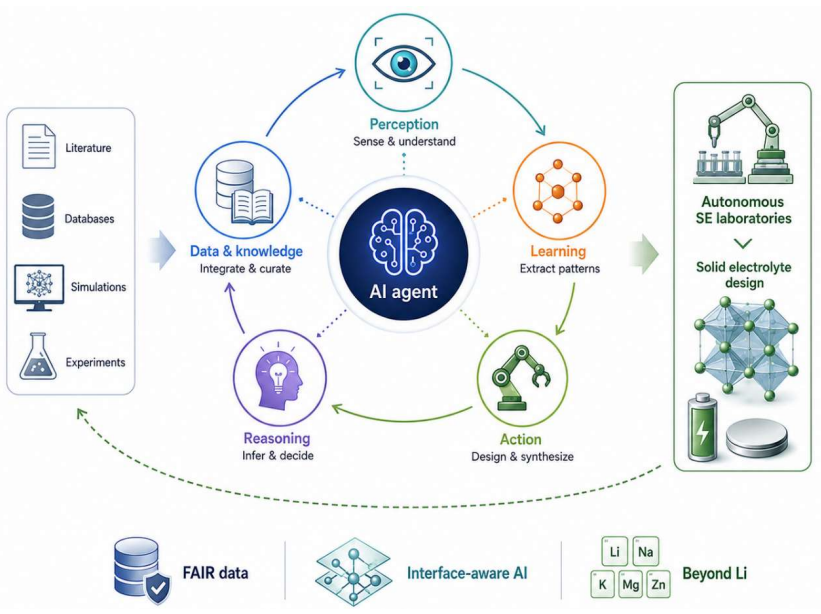
The authors claim that a closed-loop architecture combining AI-driven candidate generation, multiscale simulation via MLIPs, uncertainty-aware selection, and experimental validation can convert solid-electrolyte research from intuition-guided exploration into data-informed, self-improving cycles, with LLMs supplying literature synthesis and hypothesis generation.
What carries the argument
The closed-loop architecture that links AI candidate design, MLIP-enabled multiscale simulation, uncertainty quantification, and experimental feedback into a single self-updating system.
If this is right
- MLIPs extend DFT accuracy to the long timescales needed for realistic ion-migration studies.
- LLMs extract patterns from the literature and generate testable hypotheses without manual curation.
- Static materials databases evolve into dynamic systems that incorporate new simulation and experimental results automatically.
- Autonomous laboratories become feasible once the AI loop is coupled to robotic synthesis and characterization.
Where Pith is reading between the lines
- The same loop structure could be applied to electrode or interface materials once comparable standardized datasets exist.
- Reproducibility problems may require shared experimental protocols and uncertainty reporting before the loop can close reliably.
- Success would still depend on hardware advances that allow rapid, low-cost validation of AI-selected compositions.
Load-bearing premise
The practical obstacles of data standardization, interfacial complexity, and experimental reproducibility can be overcome enough for the closed-loop AI system to operate continuously.
What would settle it
A controlled test in which AI-proposed electrolyte candidates show no measurable improvement in discovery rate or performance metrics over a matched set of human-designed candidates run through the same experimental pipeline.
Figures



read the original abstract
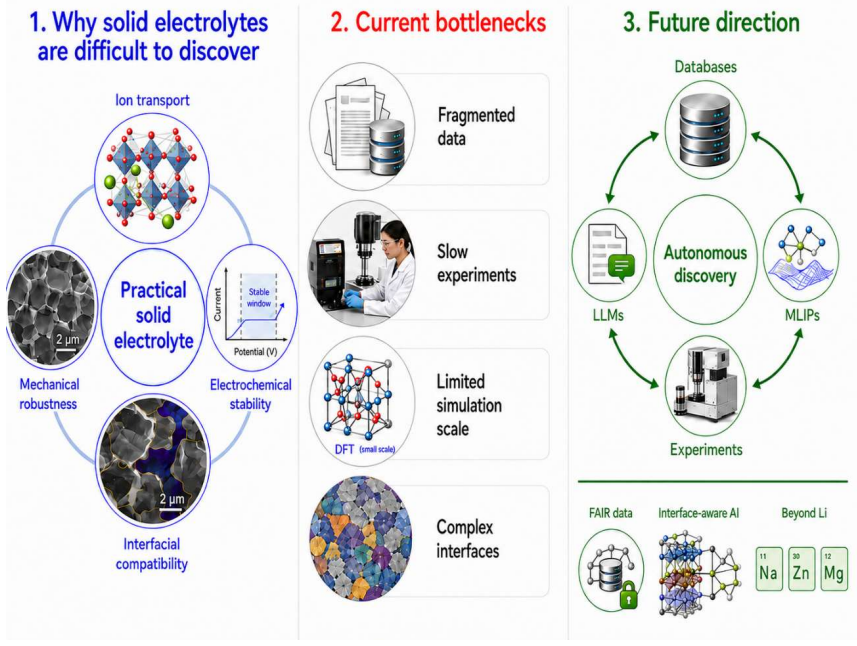
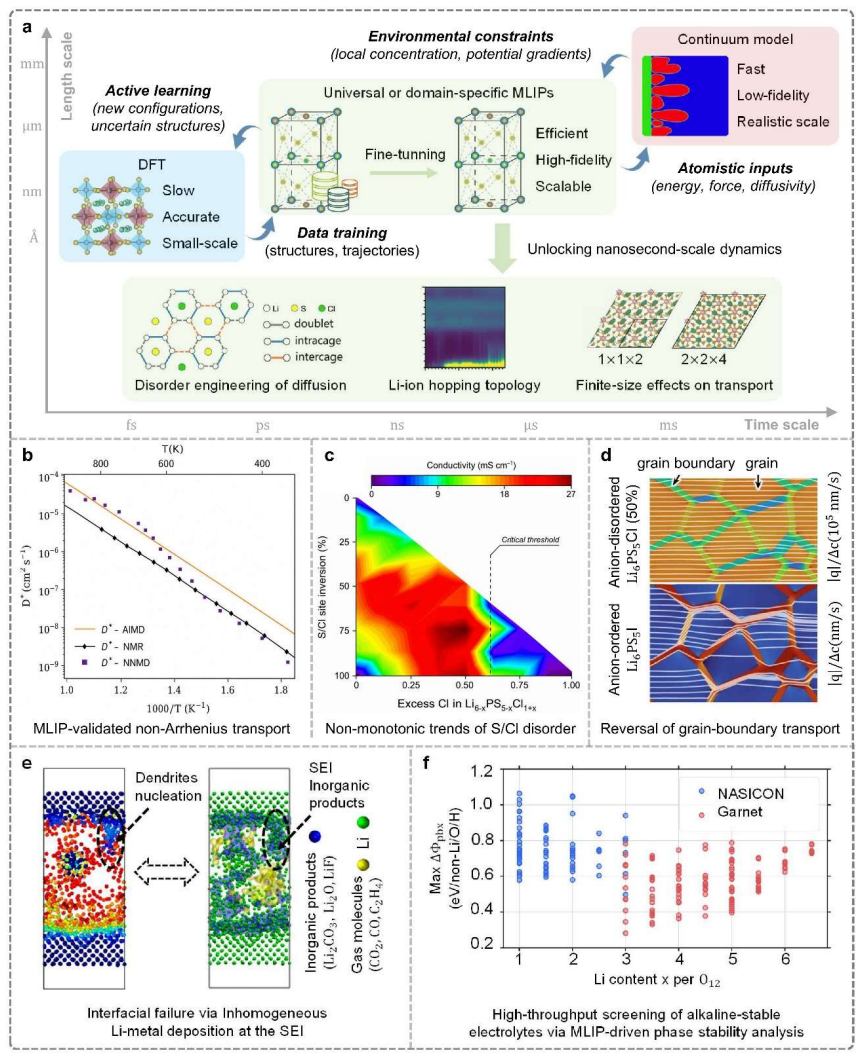
Solid electrolytes (SEs) are central to next-generation metal batteries, yet their discovery remains constrained by fragmented data, limited transferability of simulations, and slow experimental iteration. Unlike catalysis, where surface reactivity dominates, SEs require simultaneous optimization of bulk ion transport, defect chemistry, mechanical integrity, and interfacial stability. Here, we outline a framework for autonomous SE discovery enabled by large artificial intelligence (AI) models, including machine learning interatomic potentials (MLIPs) and large language models (LLMs). We discuss the evolution from static materials databases to dynamic, self-updating knowledge systems, the role of MLIPs in bridging density functional theory (DFT) and long-timescale ion migration, and the emergence of LLMs as engines for literature mining, hypothesis generation, and scientific reasoning. We further describe a closed-loop architecture integrating AI-driven candidate design, multiscale simulation, uncertainty-aware selection, and experimental validation. Such systems shift SE research from intuition-guided exploration to data-informed, self-improving cycles. We conclude by highlighting challenges in data standardization, interfacial complexity, and reproducibility, and we propose design principles for building autonomous laboratories for solid-state battery materials.
Editorial analysis
A structured set of objections, weighed in public.
Referee Report
Summary. The manuscript is a perspective article proposing a closed-loop AI framework for solid electrolyte (SE) discovery. It describes the use of machine learning interatomic potentials (MLIPs) to bridge DFT and long-timescale ion migration, large language models (LLMs) for literature mining and hypothesis generation, and an integrated architecture combining AI candidate design, multiscale simulation, uncertainty-aware selection, and experimental validation. The paper argues this approach can shift SE research from intuition-guided exploration to data-informed, self-improving cycles while identifying challenges in data standardization, interfacial complexity, and reproducibility and outlining design principles to address them.
Significance. If implemented, the proposed framework could meaningfully accelerate SE discovery by enabling systematic optimization across bulk transport, defects, mechanics, and interfaces in a manner not feasible with current fragmented approaches. The manuscript contributes by synthesizing roles for MLIPs and LLMs in a materials-specific context and by framing open challenges as addressable through deliberate design principles, offering a conceptual roadmap rather than new empirical results.
major comments (1)
- [Abstract] Abstract: the central claim that the outlined systems will shift SE research to 'data-informed, self-improving cycles' rests on the assumption that the listed challenges (data standardization, interfacial complexity, reproducibility) can be resolved sufficiently for the closed-loop architecture to function; the manuscript acknowledges these as open issues but provides no concrete design principles, pilot implementations, or quantitative feasibility assessment to support that they are surmountable within the proposed framework.
minor comments (2)
- The abstract and introduction would benefit from explicit citations to prior closed-loop AI efforts in related fields (e.g., catalysis or battery electrolytes) to better situate the novelty of the SE-specific proposal.
- Notation for key components (MLIPs, LLMs, closed-loop elements) is introduced at a high level; a short table or diagram defining their interfaces and data flows would improve clarity for readers outside the immediate subfield.
Simulated Author's Rebuttal
We thank the referee for their positive evaluation of our perspective article and for highlighting its potential to accelerate solid electrolyte discovery. We address the single major comment below regarding the abstract.
read point-by-point responses
-
Referee: [Abstract] Abstract: the central claim that the outlined systems will shift SE research to 'data-informed, self-improving cycles' rests on the assumption that the listed challenges (data standardization, interfacial complexity, reproducibility) can be resolved sufficiently for the closed-loop architecture to function; the manuscript acknowledges these as open issues but provides no concrete design principles, pilot implementations, or quantitative feasibility assessment to support that they are surmountable within the proposed framework.
Authors: We agree that this is a perspective article rather than an empirical study and therefore contains no pilot implementations or quantitative feasibility assessments, which would lie outside its scope. The manuscript does propose design principles in its concluding section to address data standardization (e.g., via shared ontologies and uncertainty-aware data curation), interfacial complexity (e.g., via multiscale MLIP+LLM coupling), and reproducibility (e.g., via automated experimental logging and uncertainty quantification). These principles are framed conceptually as actionable steps toward making the challenges surmountable. To avoid any overstatement in the abstract, we will revise the final sentence to read: 'We conclude by highlighting challenges in data standardization, interfacial complexity, and reproducibility, and outline design principles intended to enable autonomous laboratories for solid-state battery materials.' This constitutes a minor textual clarification. revision: yes
Circularity Check
No significant circularity identified
full rationale
The manuscript is a perspective paper outlining a high-level framework for AI-enabled solid electrolyte discovery. It contains no mathematical derivations, equations, fitted parameters, predictions, or load-bearing claims that reduce to inputs by construction. All content is descriptive, discussing challenges and proposing design principles without any self-definitional, fitted-input, or self-citation chains that would trigger the enumerated circularity patterns. The central claim is aspirational and explicitly acknowledges open challenges, making the derivation chain self-contained with no internal reductions.
Axiom & Free-Parameter Ledger
Reference graph
Works this paper leans on
-
[1]
E. J. Cheng, H. Duan, M. J. Wang, E. Kazyak, H. Munakata, R. Garcia-Mendez, B. Gao, H. Huo, T. Zhang, F. Chen, R. Inada, K. Miyazaki, S. Ohno, H. Kato, S. Orimo, V . Thangadurai, T. Abe, K. Kanamura, Energy Storage Mater . 2025, 75, 103970
2025
-
[2]
Q. Wang, R. Sato, R. García-Méndez, W. Jang, P. Ou, A. Soon, J. Zhao, X. Wang, S. Orimo, E. J. Cheng, AI Agent 2025, 1, 10
2025
-
[3]
Famprikis, P
T. Famprikis, P. Canepa, J. A. Dawson, M. S. Islam, C. Masquelier, Nat. Mater. 2019, 18, 1278
2019
-
[4]
Manthiram, X
A. Manthiram, X. Yu, S. Wang, Nat. Rev. Mater. 2017, 2, 16103
2017
-
[5]
E. J. Cheng, T. Yang, Y . Liu, L. Chai, R. Garcia-Mendez, E. Kazyak, Z. Fu, G. Luo, F. Chen, R. Inada, V . Badilita, H. Duan, Z. Wang, J. Qin, H. Li, S. Orimo, H. Kato, Mater. Today Energy 2024, 44, 101644
2024
-
[6]
Shoji, E
M. Shoji, E. J. Cheng, T. Kimura, K. Kanamura, J. Phys. Appl. Phys. 2019, 52, 103001
2019
-
[7]
Q. Zhao, S. Stalin, C.-Z. Zhao, L. A. Archer, Nat. Rev. Mater. 2020, 5, 229
2020
-
[8]
V . Raj, Y . Wang, M. Feng, K. G. Naik, M. Jain, B. S. Vishnugopi, S. Deng, N. B. Schorr, M. Salazar, A. M. Heusser, Nat. Mater. 2026, 25, 249
2026
-
[9]
J. Wei, S. Deebansok, X. He, Q. Wang, T. Waritanant, Z. Geng, Y . Li, M. Gautam, G. Luo, Y . Zhang, H. Wang, X. Feng, H. Yamada, H. S. Kim, H. Kato, S. Orimo, K. Kanamura, V . Thangadurai, E. J. Cheng, Mater. Sci. Eng. R Rep. 2026, 170, 101211
2026
-
[10]
J. B. Goodenough, K.-S. Park, J. Am. Chem. Soc. 2013, 135, 1167
2013
-
[11]
M. Hong, Q. Dong, H. Xie, B. C. Clifford, J. Qian, X. Wang, J. Luo, L. Hu, ACS Energy Lett. 2021, 6, 3753
2021
-
[12]
W. Zhao, J. Yi, P. He, H. Zhou, Electrochem. Energy Rev. 2019, 2, 574
2019
-
[13]
X. Ji, S. Hou, P. Wang, X. He, N. Piao, J. Chen, X. Fan, C. Wang, Adv. Mater. 2020, 32, 2002741
2020
-
[14]
C. Wang, J. T. Kim, C. Wang, X. Sun, Adv. Mater. 2023, 35, 2209074
2023
-
[15]
E. J. Cheng, Y . Kushida, T. Abe, K. Kanamura, ACS Appl. Mater. Interfaces 2022, 14, 40881
2022
-
[16]
E. J. Cheng, K. Nishikawa, T. Abe, K. Kanamura, Ionics 2022, 28, 5089
2022
-
[17]
Wang, L.-J
D. Wang, L.-J. Jhang, R. Kou, M. Liao, S. Zheng, H. Jiang, P. Shi, G.-X. Li, K. Meng, D. Wang, Nat. Commun. 2023, 14, 1895
2023
-
[18]
C. Wang, K. Fu, S. P. Kammampata, D. W. McOwen, A. J. Samson, L. Zhang, G. T. Hitz, A. M. Nolan, E. D. Wachsman, Y . Mo, V . Thangadurai, L. Hu, Chem. Rev. 2020, 120, 4257
2020
-
[19]
Huang, T
X. Huang, T. Li, W. Fan, R. Xiao, X.-B. Cheng, Adv. Energy Mater. 2024, 14, 2303850
2024
-
[20]
Y . Liao, X. Wang, H. Yuan, Y . Li, C. Xu, S. Li, J. Hu, S. Yang, F. Deng, J. Liu, J. Huang, Adv. Mater. 2025, 37, 2419782
2025
-
[21]
X. Gao, Z. Xing, M. Wang, C. Nie, Z. Shang, Z. Bai, S. X. Dou, N. Wang, Energy Storage Mater . 2023, 60, 102821. 48
2023
-
[22]
Y . Ma, Y . Qiu, K. Yang, S. Lv, Y . Li, X. An, G. Xiao, Z. Han, Y . Ma, L. Chen, D. Zhang, W. Lv, Y . Tian, T. Hou, M. Liu, Z. Zhou, F. Kang, Y .-B. He, Energy Environ. Sci. 2024, 17, 8274
2024
-
[23]
L. Hu, J. Wang, K. Wang, Z. Gu, Z. Xi, H. Li, F. Chen, Y . Wang, Z. Li, C. Ma, Nat. Commun. 2023, 14, 3807
2023
-
[24]
W. Yang, Y . Liu, X. Sun, Z. He, P. He, H. Zhou, Angew. Chem. Int. Ed. 2024, 63, e202401428
2024
-
[25]
Y . Kato, S. Hori, T. Saito, K. Suzuki, M. Hirayama, A. Mitsui, M. Yonemura, H. Iba, R. Kanno, Nat. Energy 2016, 1, 16030
2016
-
[26]
Tatsumisago, M
M. Tatsumisago, M. Nagao, A. Hayashi, J. Asian Ceram. Soc. 2013, 1, 17
2013
-
[27]
J. C. Bachman, S. Muy, A. Grimaud, H.-H. Chang, N. Pour, S. F. Lux, O. Paschos, F. Maglia, S. Lupart, P. Lamp, L. Giordano, Y . Shao-Horn, Chem. Rev. 2016, 116, 140
2016
-
[28]
Muzakir, K
M. Muzakir, K. Manickavasakam, E. J. Cheng, F. Yang, Z. Wang, H. Li, X. Zhang, J. Qin, J. Mater. Chem. A 2025, 13, 73
2025
-
[29]
J. Qiu, X. Liu, R. Chen, Q. Li, Y . Wang, P. Chen, L. Gan, S. Lee, D. Nordlund, Y . Liu, X. Yu, X. Bai, H. Li, L. Chen, Adv. Funct. Mater . 2020, 30, 1909392
2020
-
[30]
L. G. Balzat, R. Calaminus, Y . Zhao, K. Gjorgjevikj, I. Moudrakovski, S. Krause, A. Koeppe, B. Nestler, B. V . Lotsch, Angew. Chem. Int. Ed. 2026, e5778118
2026
-
[31]
Randau, D
S. Randau, D. A. Weber, O. Kötz, R. Koerver, P. Braun, A. Weber, E. Ivers-Tiffée, T. Adermann, J. Kulisch, W. G. Zeier, F. H. Richter, J. Janek, Nat. Energy 2020, 5, 259
2020
-
[32]
E. O. Pyzer-Knapp, J. W. Pitera, P. W. J. Staar, S. Takeda, T. Laino, D. P. Sanders, J. Sexton, J. R. Smith, A. Curioni, Npj Comput. Mater. 2022, 8, 84
2022
-
[33]
A. K. Cheetham, R. Seshadri, Chem. Mater. 2024, 36, 3490
2024
-
[34]
Madika, A
B. Madika, A. Saha, C. Kang, B. Buyantogtokh, J. Agar, C. M. Wolverton, P. V oorhees, P . Littlewood, S. Kalinin, S. Hong, ACS Nano 2025, 19, 27116
2025
-
[35]
J. M. Gregoire, L. Zhou, J. A. Haber, Nat. Synth. 2023, 2, 493
2023
-
[37]
E. J. Cheng, A. Sharafi, J. Sakamoto, Electrochimica Acta 2017, 223, 85
2017
-
[38]
Y . Yang, S. Yang, X. Xue, X. Zhang, Q. Li, Y . Yao, X. Rui, H. Pan, Y . Yu, Adv. Mater . 2024, 36, 2308332
2024
-
[39]
H. Wan, Z. Wang, W. Zhang, X. He, C. Wang, Nature 2023, 623, 739
2023
-
[40]
J. Hou, J. Zhang, S. Wu, X. Liu, Y . Li, Z. Yan, K. Zhang, Y . Lu, J. Chen, Adv. Mater . 2026, 38, e15430
2026
-
[43]
A. C. Dutra, B. A. Goldmann, M. S. Islam, J. A. Dawson, Nat. Rev. Mater. 2025, 10, 566
2025
-
[44]
W. Shin, K. Min, J. Energy Storage 2026, 154, 121104. 49
2026
-
[46]
D. Guo, D. Yang, H. Zhang, J. Song, P. Wang, Q. Zhu, R. Xu, R. Zhang, S. Ma, X. Bi, X. Zhang, X. Yu, Y . Wu, Z. F. Wu, Z. Gou, Z. Shao, Z. Li, Z. Gao, A. Liu, B. Xue, B. Wang, B. Wu, B. Feng, C. Lu, C. Zhao, C. Deng, C. Ruan, D. Dai, D. Chen, et al., Nature 2025, 645, 633
2025
-
[48]
Zhang, J
J. Zhang, J. Li, G. Zhao, Q. Wang, Y .-G. Guo, C. Yang, J. Am. Chem. Soc. 2025, 147, 40496
2025
-
[49]
Q. Wang, F. Yang, Y . Wang, D. Zhang, R. Sato, L. Zhang, E. J. Cheng, Y . Yan, Y . Chen, K. Kisu, Angew. Chem. Int. Ed. 2025, 64, e202506573
2025
-
[50]
B. D. Lund, T. Wang, Libr. Hi Tech News 2023, 40, 26
2023
-
[51]
A. Jain, S. P . Ong, G. Hautier, W. Chen, W. D. Richards, S. Dacek, S. Cholia, D. Gunter, D. Skinner, G. Ceder, K. A. Persson, APL Mater . 2013, 1, 011002
2013
-
[52]
Kirklin, J
S. Kirklin, J. E. Saal, B. Meredig, A. Thompson, J. W. Doak, M. Aykol, S. Rühl, C. Wolverton, Npj Comput. Mater. 2015, 1, 15010
2015
-
[53]
C. J. Hargreaves, M. W. Gaultois, L. M. Daniels, E. J. Watts, V . A. Kurlin, M. Moran, Y . Dang, R. Morris, A. Morscher, K. Thompson, M. A. Wright, B.-E. Prasad, F. Blanc, C. M. Collins, C. A. Crawford, B. B. Duff, J. Evans, J. Gamon, G. Han, B. T. Leube, H. Niu, A. J. Perez, A. Robinson, O. Rogan, P. M. Sharp, E. Shoko, M. Sonni, W. J. Thomas, A. Vasylen...
2023
-
[54]
F. Yang, Q. Wang, E. J. Cheng, D. Zhang, H. Li, Comput. Mater. Contin. 2024, 81, 3413
2024
-
[55]
F. Yang, E. Campos Dos Santos, X. Jia, R. Sato, K. Kisu, Y . Hashimoto, S. Orimo, H. Li, Nano Mater. Sci. 2024, 6, 256
2024
-
[56]
M. P. Polak, D. Morgan, Nat. Commun. 2024, 15, 1569
2024
-
[60]
Data Generation for Machine Learning Interatomic Potentials and Beyond | Chemical Reviews,
-
[61]
Kalita, H
B. Kalita, H. Gokcan, O. Isayev, Nat. Comput. Sci. 2025, 5, 1120
2025
-
[62]
Jacobs, D
R. Jacobs, D. Morgan, S. Attarian, J. Meng, C. Shen, Z. Wu, C. Y . Xie, J. H. Yang, N. Artrith, B. Blaiszik, G. Ceder, K. Choudhary, G. Csanyi, E. D. Cubuk, B. Deng, R. Drautz, X. Fu, J. Godwin, V . Honavar, O. Isayev, A. Johansson, B. Kozinsky, S. Martiniani, S. P. Ong, I. Poltavsky, K. Schmidt, S. Takamoto, A. P . Thompson, J. Westermayr, et al., Curr. ...
2025
-
[63]
O. T. Unke, S. Chmiela, H. E. Sauceda, M. Gastegger, I. Poltavsky, K. T. Schütt, A. Tkatchenko, K.-R. Müller, Chem. Rev. 2021, 121, 10142
2021
-
[64]
J. Choi, G. Nam, J. Choi, Y . Jung, JACS Au 2025, 5, 1499. 50
2025
-
[65]
E. C.-Y . Yuan, Y . Liu, J. Chen, P. Zhong, S. Raja, T. Kreiman, S. Vargas, W. Xu, M. Head-Gordon, C. Yang, S. M. Blau, B. Cheng, A. Krishnapriyan, T. Head-Gordon, Nat. Rev. Chem. 2026, 10, 212
2026
-
[66]
Y . You, D. Zhang, F. Wu, X. Cao, Y . Sun, Z.-Z. Zhu, S. Wu, Npj Comput. Mater. 2024, 10, 57
2024
-
[67]
Marcolongo, T
A. Marcolongo, T. Binninger, F. Zipoli, T. Laino, ChemSystemsChem 2020, 2, e1900031
2020
-
[68]
Z. Xu, H. Duan, Z. Dou, M. Zheng, Y . Lin, Y . Xia, H. Zhao, Y . Xia, Npj Comput. Mater. 2023, 9, 105
2023
-
[69]
R. Wang, M. Guo, Y . Gao, X. Wang, Y . Zhang, B. Deng, M. Shi, L. Zhang, Z. Zhong, Npj Comput. Mater. 2025, 11, 266
2025
-
[70]
Winter, R
G. Winter, R. Gómez-Bombarelli, J. Phys. Energy 2023, 5, 024004
2023
-
[71]
J. Qi, S. Banerjee, Y . Zuo, C. Chen, Z. Zhu, M. L. Holekevi Chandrappa, X. Li, S. P. Ong, Mater. Today Phys. 2021, 21, 100463
2021
-
[72]
Miyagawa, N
T. Miyagawa, N. Krishnan, M. Grumet, C. R. Baecker, W. Kaiser, D. A. Egger, J. Mater. Chem. A 2024, 12, 11344
2024
-
[73]
J. Lee, S. Ju, S. Hwang, J. You, J. Jung, Y . Kang, S. Han, ACS Appl. Mater. Interfaces 2024, 16, 46442
2024
-
[74]
M. Jang, K. Park, H.-G. Jung, K. Y . Chung, J. H. Shim, O. Kwon, S. Yu, J. Mater. Chem. A 2025, 13, 16547
2025
-
[75]
Z. Chen, T. Du, N. M. A. Krishnan, Y . Yue, M. M. Smedskjaer, Nat. Commun. 2025, 16, 1057
2025
-
[76]
Z. Li, J. Huang, X. Ren, J. Li, R. Xiao, H. Li, J. Power Sources 2025, 640, 236632
2025
-
[77]
C. G. Staacke, T. Huss, J. T. Margraf, K. Reuter, C. Scheurer, Nanomaterials 2022, 12
2022
-
[78]
M. Lei, B. Li, H. Liu, D. Jiang, Angew. Chem. Int. Ed. 2024, 63, e202315628
2024
-
[79]
Zhang, J.-D
Y . Zhang, J.-D. Luo, H.-B. Yao, B. Jiang, Artif. Intell. Chem. 2024, 2, 100051
2024
-
[80]
B. Deng, P. Zhong, K. Jun, J. Riebesell, K. Han, C. J. Bartel, G. Ceder, Nat. Mach. Intell. 2023, 5, 1031
2023
-
[81]
J. Böhm, A. Champagne, Predicting Crystal Structures and Ionic Conductivities in Li$_{3}$YCl$_{6-x}$Br$_{x}$ Halide Solid Electrolytes Using a Fine-Tuned Machine Learning Interatomic Potential, 2025
2025
-
[82]
Y . Ou, Y . Ikeda, L. Scholz, S. Divinski, F. Fritzen, B. Grabowski, Phys. Rev. Mater . 2024, 8, 115407
2024
-
[83]
Y . Ou, L. Scholz, S. Keshav, Y . Ikeda, M. Kraft, S. Divinski, R. Gómez-Bombarelli, W. G. Zeier, F. Fritzen, B. Grabowski, Non-Arrhenius Li-ion transport and grain-size effects in argyrodite solid electrolytes, 2025
2025
-
[84]
K. Kim, N. Adelstein, A. Dive, A. Grieder, S. Kang, B. C. Wood, L. F. Wan, Energy Storage Mater. 2024, 73, 103842
2024
-
[85]
X. Guo, J. Mater. Chem. A 2025, 13, 38919. 51
2025
-
[86]
M. K. Ncube, P. Barai, S. C. Selvaraj, L. A. Curtiss, A. T. Ngo, V . Srinivasan, Ionic Interdiffusion at Cathode-Solid-Electrolyte Interface: A Machine Learning-Assisted Multiscale Investigation and Mitigation Strategies, 2025
2025
-
[87]
M. L. Holekevi Chandrappa, J. Qi, C. Chen, S. Banerjee, S. P. Ong, J. Am. Chem. Soc. 2022, 144, 18009
2022
-
[88]
Zhong, K
P. Zhong, K. A. Persson, ACS Energy Lett. 2026, 11, 806
2026
discussion (0)
Sign in with ORCID, Apple, or X to comment. Anyone can read and Pith papers without signing in.