An observationally constrained probabilistic trigger for organized deep convection in an NWP ensemble
Pith reviewed 2026-06-25 21:46 UTC · model grok-4.3
The pith
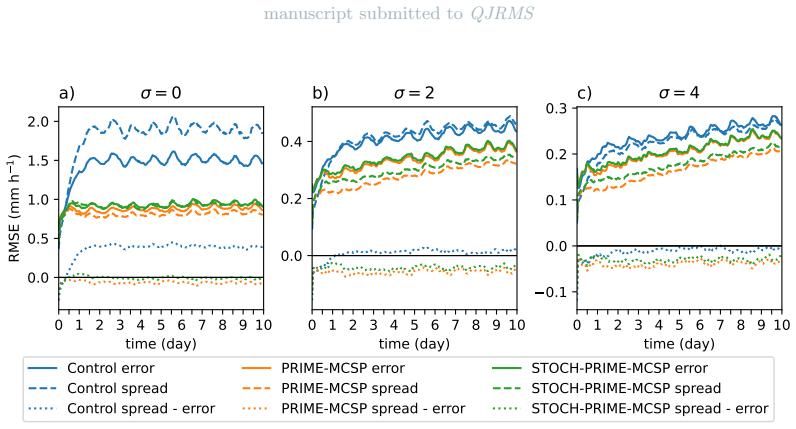
A probabilistic trigger based on total column water vapour improves ensemble spread for tropical precipitation.
A machine-rendered reading of the paper's core claim, the machinery that carries it, and where it could break.
Core claim
The observationally constrained probabilistic trigger for the MCSP scheme, activated in regions of enhanced total column water vapour using given spatiotemporal scales, boosts ensemble spread for tropical precipitation relative to the original MCSP and thereby improves the spread-error relationship.
What carries the argument
The probabilistic trigger for the multiscale coherent structure parametrization (MCSP) that activates in areas of enhanced environmental total column water vapour.
If this is right
- Both the original and new MCSP schemes improve the spatiotemporal scales of tropical precipitation compared to a control.
- The new scheme boosts spread compared to original MCSP.
- This improves the underdispersion of the ensemble seen with the original MCSP.
Where Pith is reading between the lines
- Similar environmental constraints could be tested on other stochastic schemes that currently lack observational anchors.
- The trigger may affect the timing and location statistics of extreme rainfall events beyond the scales already examined.
- Running the scheme in different ensemble sizes or resolutions could reveal whether the spread gain scales with model configuration.
Load-bearing premise
That enhanced total column water vapour provides a reliable observational basis for probabilistically triggering the representation of mesoscale convective systems.
What would settle it
If the new trigger produces no measurable increase in ensemble spread or leaves the spread-error relationship underdispersed for tropical precipitation.
Figures
read the original abstract
A novel stochastic parametrization scheme representing organized convection is described. The effects of mesoscale convective systems (MCSs) are represented in an observationally constrained manner, by probabilistically triggering an MCS scheme in regions of enhanced environmental total column water vapour. In combination with the probabilistic trigger, patterns with given spatiotemporal scales determine where and when the scheme is active. Our scheme builds on the multiscale coherent structure parametrization (MCSP), which represents the top-heavy heating structure associated with MCSs. The original and new MCSP schemes are tested in a numerical weather prediction (NWP) ensemble. Both MCSP schemes improve the spatiotemporal scales of tropical precipitation compared to a control. When the spread-error relationship of tropical precipitation is analysed, the new scheme successfully boosts spread compared to original MCSP, improving the underdispersion of the ensemble seen with the original MCSP.
Editorial analysis
A structured set of objections, weighed in public.
Referee Report
Summary. The paper describes a novel stochastic parametrization for organized deep convection that augments the existing multiscale coherent structure parametrization (MCSP) with a probabilistic trigger active in regions of enhanced total column water vapour (TCWV), combined with prescribed spatiotemporal patterns. The scheme is tested within an NWP ensemble; both original and new MCSP versions improve the spatiotemporal scales of tropical precipitation relative to a control, while the new version additionally increases ensemble spread and reduces underdispersion in the spread-error relationship for tropical precipitation.
Significance. If the reported diagnostics hold after full verification, the work offers a practical route to increase ensemble spread for tropical precipitation by representing mesoscale convective system effects in a manner informed by environmental observations. The probabilistic-trigger approach could be extensible to other stochastic schemes where underdispersion is an issue.
major comments (2)
- [Abstract] Abstract: the claim of an 'observationally constrained' scheme is central to the novelty, yet the abstract (and by extension the scheme description) provides no quantitative details on how the probability function, TCWV threshold, or spatiotemporal patterns were derived from or validated against observations. Without this, it is impossible to judge whether the reported spread improvement is independent of the constraint or follows by construction from the chosen parameters.
- [Results / ensemble experiments] Scheme description and experimental setup: the spread-error diagnostics are presented as the key result demonstrating improvement over original MCSP, but no error bars, sample sizes, or explicit description of the ensemble configuration (member count, resolution, verification period) are supplied. This information is load-bearing for the claim that the new trigger 'successfully boosts spread'.
minor comments (2)
- Define the exact functional form of the probabilistic trigger (e.g., the TCWV dependence and any scaling constants) in an equation or pseudocode block.
- Clarify whether the spatiotemporal patterns are fixed a priori or also tuned; if the latter, state the tuning procedure.
Simulated Author's Rebuttal
We thank the referee for their constructive comments and positive assessment of the work. We address each major comment below and will revise the manuscript to incorporate the requested clarifications.
read point-by-point responses
-
Referee: [Abstract] Abstract: the claim of an 'observationally constrained' scheme is central to the novelty, yet the abstract (and by extension the scheme description) provides no quantitative details on how the probability function, TCWV threshold, or spatiotemporal patterns were derived from or validated against observations. Without this, it is impossible to judge whether the reported spread improvement is independent of the constraint or follows by construction from the chosen parameters.
Authors: We agree that the abstract and scheme description would benefit from explicit quantitative details on the observational basis for the probability function, TCWV threshold, and spatiotemporal patterns. In the revised manuscript we will add these specifics (including the exact TCWV threshold value and its observational source, the functional form of the probability, and the derivation of the pattern scales) to both the abstract and the methods section. This will make clear how the constraint was applied and allow assessment of whether the spread gains are independent of the parameter choices. revision: yes
-
Referee: [Results / ensemble experiments] Scheme description and experimental setup: the spread-error diagnostics are presented as the key result demonstrating improvement over original MCSP, but no error bars, sample sizes, or explicit description of the ensemble configuration (member count, resolution, verification period) are supplied. This information is load-bearing for the claim that the new trigger 'successfully boosts spread'.
Authors: We accept that the current manuscript omits error bars, sample sizes, and a full description of the ensemble configuration. These details are required to substantiate the spread-error results. In the revision we will insert a complete description of the ensemble setup (member count, resolution, verification period) in the experimental setup section and add error bars or confidence intervals to the spread-error diagnostics in the results. revision: yes
Circularity Check
No significant circularity identified
full rationale
The provided abstract and description introduce a new probabilistic MCS trigger based on enhanced TCWV combined with spatiotemporal patterns, building on the existing MCSP scheme. Ensemble tests report improved precipitation scales and spread-error diagnostics versus control and original MCSP. No equations, parameter-fitting steps, or self-citation chains are quoted that reduce any central prediction or result to the inputs by construction. The reported outcomes derive from numerical experiments rather than definitional equivalence or fitted renaming, making the derivation self-contained against external benchmarks.
Axiom & Free-Parameter Ledger
Reference graph
Works this paper leans on
-
[1]
and Colangeli, Matteo and Coleman, Danielle R
Berner, J and Achatz, U and Batte, L and Bengtsson, Lisa and De La Camara, A and Christensen, H M and Colangeli, M and Coleman, D R B and Crommelin, D and Dolaptchiev, S I and others. Stochastic parameterization: towards a new view of weather and climate models. Bulletin of the American Meteorological Society. 2017. doi:10.1175/BAMS-D-15-00268.1
-
[2]
Stochastic representation of model uncertainties in the ECMWF ensemble prediction system
Buizza, Roberto and Milleer, M and Palmer, Tim N. Stochastic representation of model uncertainties in the ECMWF ensemble prediction system. Quarterly Journal of the Royal Meteorological Society. 1999. doi:10.1002/qj.49712556006
-
[3]
Quarterly Journal of the Royal Meteorological Society
Bush, Stephanie J and Turner, Andrew G and Woolnough, Steven J and Martin, Gill M and Klingaman, Nicholas P. Quarterly Journal of the Royal Meteorological Society. 2015. doi:10.1002/qj.2371
-
[4]
2023 , publisher=
Bush, Mike and Boutle, Ian and Edwards, John and Finnenkoetter, Anke and Franklin, Charmaine and Hanley, Kirsty and Jayakumar, Aravindakshan and Lewis, Huw and Lock, Adrian and Mittermaier, Marion and others , journal=. 2023 , publisher=
2023
-
[5]
Effects of organized convection parameterization on the MJO and precipitation in E3SMv1
Chen, C C and Richter, J H and Liu, C and Moncrieff, M W and Tang, Q and Lin, W and Xie, S and Rasch, P J. Effects of organized convection parameterization on the MJO and precipitation in E3SMv1. Part I: Mesoscale heating. Journal of Advances in Modeling Earth Systems. 2021. doi:10.1029/2020MS002401
-
[6]
A spatial view of ensemble spread in convection permitting ensembles
Dey, Seonaid RA and Leoncini, Giovanni and Roberts, Nigel M and Plant, Robert S and Migliorini, Stefano. A spatial view of ensemble spread in convection permitting ensembles. Monthly Weather Review. 2014
2014
-
[7]
Feng, Zhe and Leung, L Ruby and Liu, Nana and Wang, Jingyu and Houze Jr, Robert A and Li, Jianfeng and Hardin, Joseph C and Chen, Dandan and Guo, Jianping. A global high-resolution mesoscale convective system database using satellite-derived cloud tops, surface precipitation, and tracking. Journal of Geophysical Research: Atmospheres. 2021. doi:10.1029/20...
-
[8]
Hersbach, Hans and Bell, Bill and Berrisford, Paul and Hirahara, Shoji and Hor \'a nyi, Andr \'a s and Muñoz-Sabater, Joaqu \' n and Nicolas, Julien and Peubey, Carole and Radu, Raluca and Schepers, Dinand and others. The ERA5 global reanalysis. Quarterly Journal of the Royal Meteorological Society. 2020. doi:10.1002/qj.3803
-
[9]
Houze Jr., Robert A. Mesoscale convective systems. Reviews of Geophysics. 2004. doi:10.1029/2004RG000150
-
[10]
Integrated Multi-satellitE Retrievals for GPM (IMERG) technical documentation
Huffman, George J and Bolvin, David T and Nelkin, Eric J and Tan, Jackson. Integrated Multi-satellitE Retrievals for GPM (IMERG) technical documentation. NASA/GSFC Code. 2020
2020
-
[11]
Inverarity, GW and Tennant, WJ and Anton, L and Bowler, NE and Clayton, AM and Jardak, M and Lorenc, AC and Rawlins, F and Thompson, SA and Thurlow, MS and others. Met Office MOGREPS-G initialisation using an ensemble of hybrid four-dimensional ensemble variational (En-4DEnVar) data assimilations. Quarterly Journal of the Royal Meteorological Society. 202...
-
[12]
Klingaman, Nicholas P and Martin, Gill M and Moise, Aurel F. ASoP (v1. 0): A set of methods for analyzing scales of precipitation in general circulation models. Geoscientific Model Development. 2017. doi:10.5194/gmd-10-57-2017
-
[13]
2016 , doi=
Kober, Kirstin and Craig, George C , journal=. 2016 , doi=
2016
-
[14]
Lock, AP and Whitall, M and Stirling, AJ and Williams, KD and Lavender, SL and Morcrette, C and Matsubayashi, K and Field, PR and Martin, G and Willett, M and others. The performance of the CoMorph-A convection package in global simulations with the Met Office Unified Model. Quarterly Journal of the Royal Meteorological Society. 2024. doi:10.1002/qj.4781
-
[15]
Representing convective organization in prediction models by a hybrid strategy
Moncrieff, Mitchell W and Liu, Changhai. Representing convective organization in prediction models by a hybrid strategy. Journal of the Atmospheric Sciences. 2006. doi:10.1175/JAS3812.1
-
[16]
Moncrieff, Mitchell W and Liu, Changhai and Bogenschutz, Peter. Simulation, modeling, and dynamically based parameterization of organized tropical convection for global climate models. Journal of the Atmospheric Sciences. 2017. doi:10.1175/JAS-D-16-0166.1
-
[17]
Hydrology and Earth System Sciences , volume=
Evaluation of Asian summer precipitation in different configurations of a high-resolution general circulation model in a range of decision-relevant spatial scales , author=. Hydrology and Earth System Sciences , volume=. 2021 , publisher=
2021
-
[18]
Environmental conditions affecting global mesoscale convective system occurrence
Muetzelfeldt, Mark R and Plant, Robert S and Christensen, Hannah M and Zhang, Zhixiao and Woollings, Tim and Feng, Zhe and Li, Puxi. Environmental conditions affecting global mesoscale convective system occurrence. Journal of the Atmospheric Sciences. 2025. doi:10.1175/JAS-D-24-0058.1
-
[19]
Storm morphology and rainfall characteristics of TRMM precipitation features
Nesbitt, Stephen W and Cifelli, Robert and Rutledge, Steven A. Storm morphology and rainfall characteristics of TRMM precipitation features. Monthly Weather Review. 2006. doi:10.1175/MWR3200.1
-
[20]
Stochastic parametrization and model uncertainty
Palmer, Tim N and Buizza, Roberto and Doblas-Reyes, F and Jung, Thomas and Leutbecher, Martin and Shutts, Glenn J and Steinheimer, Martin and Weisheimer, Antje. Stochastic parametrization and model uncertainty. 2009. doi:10.21957/ps8gbwbdv
-
[21]
A stochastic parameterization for deep convection based on equilibrium statistics
Plant, Robert S and Craig, George C. A stochastic parameterization for deep convection based on equilibrium statistics. Journal of the Atmospheric Sciences. 2008. doi:10.1175/2007JAS2263.1
-
[22]
Roberts, Nigel. Assessing the spatial and temporal variation in the skill of precipitation forecasts from an NWP model. Meteorological Applications. 2008. doi:10.1002/met.57
-
[23]
Improved stochastic physics schemes for global weather and climate models
Sanchez, Claudio and Williams, Keith D and Collins, Matthew. Improved stochastic physics schemes for global weather and climate models. Quarterly Journal of the Royal Meteorological Society. 2016. doi:10.1002/qj.2640
-
[24]
Schumacher, Courtney and Houze Jr, Robert A and Kraucunas, Ian. The tropical dynamical response to latent heating estimates derived from the TRMM precipitation radar. Journal of the Atmospheric Sciences. 2004. doi:10.1175/1520-0469(2004)061<1341:TTDRTL>2.0.CO;2
-
[25]
2011 , doi=
Tennant, Warren J and Shutts, Glenn J and Arribas, Alberto and Thompson, Simon A , journal=. 2011 , doi=
2011
-
[26]
Zhang, Zhixiao and Christensen, Hannah M and Muetzelfeldt, Mark R and Woollings, Tim and Plant, Robert S and Stirling, Alison J and Whitall, Michael A and Moncrieff, Mitchell W and Chen, Chih-Chieh and Feng, Zhe. Advancing organized convection representation in the Unified Model: Implementing and enhancing multiscale coherent structure parameterization. J...
discussion (0)
Sign in with ORCID, Apple, or X to comment. Anyone can read and Pith papers without signing in.