Measuring local primordial non-Gaussianity from the clustering of DESI DR1 LRGs and QSOs
Pith reviewed 2026-06-25 23:10 UTC · model grok-4.3
The pith
DESI DR1 LRG and QSO clustering constrains local f_NL to -3 with uncertainty of 12 at 68% CL
A machine-rendered reading of the paper's core claim, the machinery that carries it, and where it could break.
Core claim
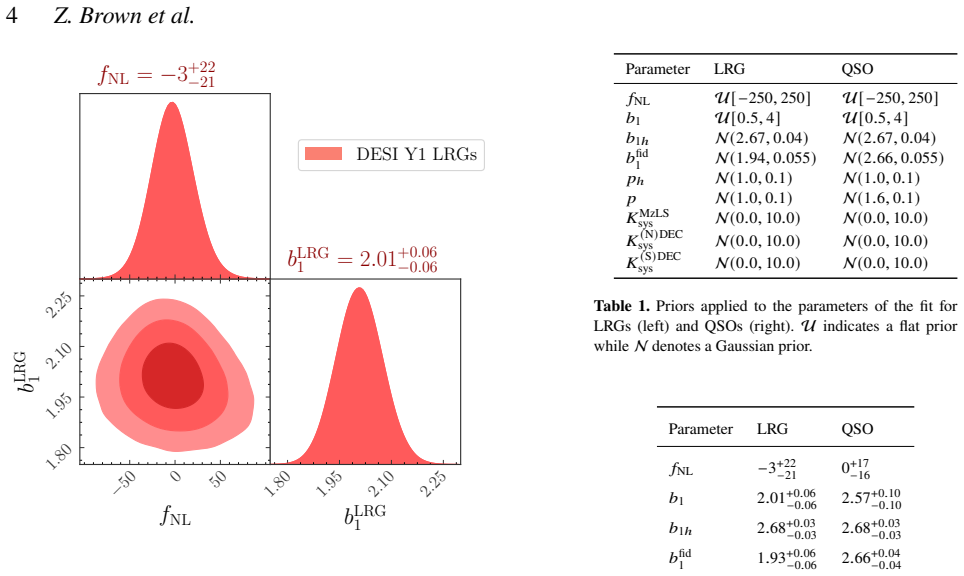
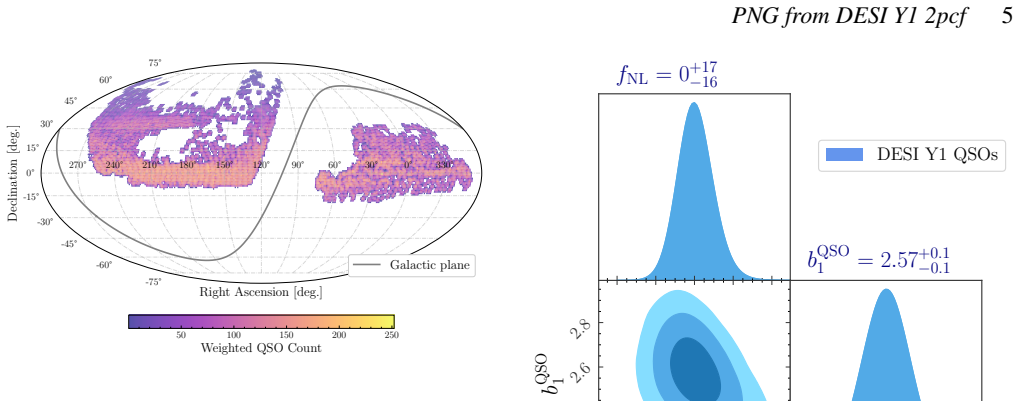
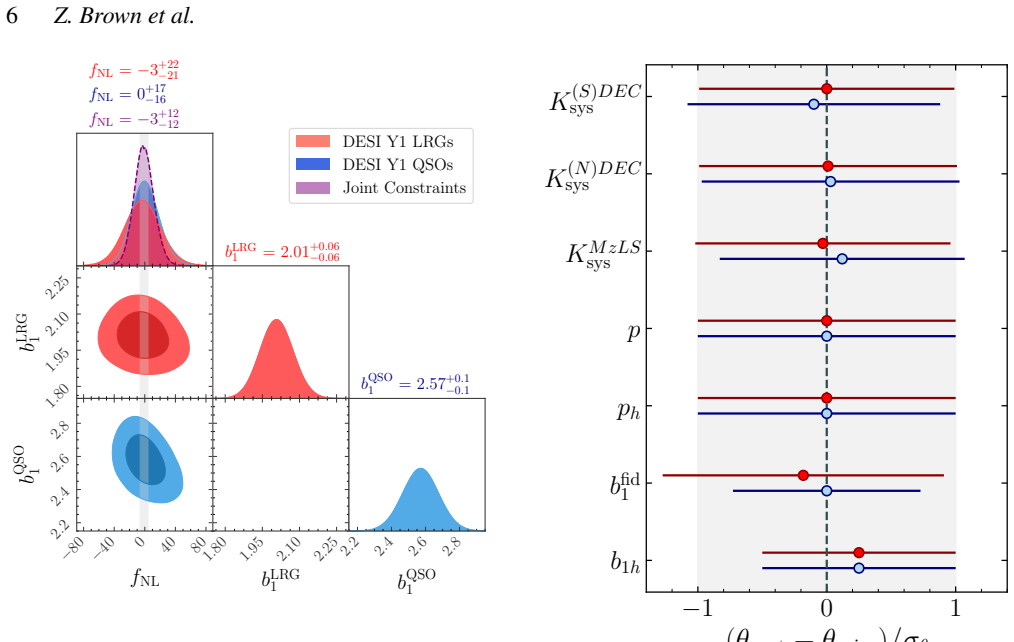
The paper establishes that the configuration-space two-point correlation function measured in DESI DR1 LRG and QSO samples, after simulation-based modeling and imaging-systematics mitigation, yields observed 68% CL intervals f_NL = -3^{+22}_{-21} for LRGs, 0^{+17}_{-16} for QSOs, and -3^{+12}_{-12} jointly when the PNG bias is obtained from the universality relation with Gaussian priors p_LRG = 1.0 ± 0.1 and p_QSO = 1.6 ± 0.1.
What carries the argument
Configuration-space two-point correlation function analyzed with simulation-based inference and the universality relation that defines the PNG bias through the parameter p
If this is right
- The DESI tracers deliver stronger constraints on f_NL than any previous large-scale structure survey.
- The achieved sensitivity approaches that of CMB probes of PNG.
- The measured values remain consistent with Gaussian initial conditions (f_NL = 0) inside the reported uncertainties.
- The pipeline can be applied to later DESI data releases to reduce the error bars further.
Where Pith is reading between the lines
- If future measurements keep f_NL consistent with zero, many single-field slow-roll inflation models would remain viable while multi-field models predicting larger |f_NL| would be disfavored.
- The imaging-systematics mitigation technique developed here could be reused on other photometric or spectroscopic surveys to improve clustering analyses.
- Cross-checks between configuration-space and Fourier-space measurements on the same DESI sample would test whether residual modeling assumptions affect the f_NL result.
Load-bearing premise
The PNG bias is defined via the universality relation with the chosen Gaussian priors on p for the LRG and QSO tracers.
What would settle it
An independent analysis of the full DESI dataset or CMB data that returns an f_NL value lying well outside the current joint 68% interval while using the same bias modeling would falsify the reported constraint.
Figures
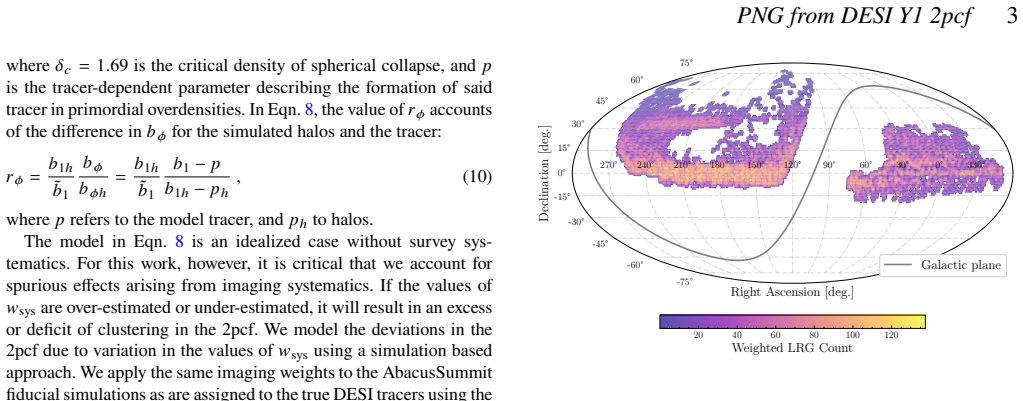
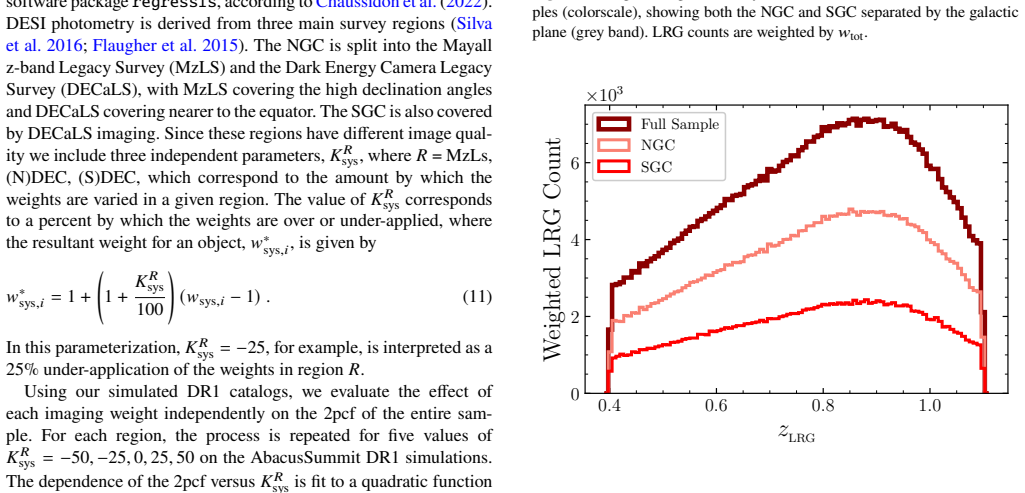
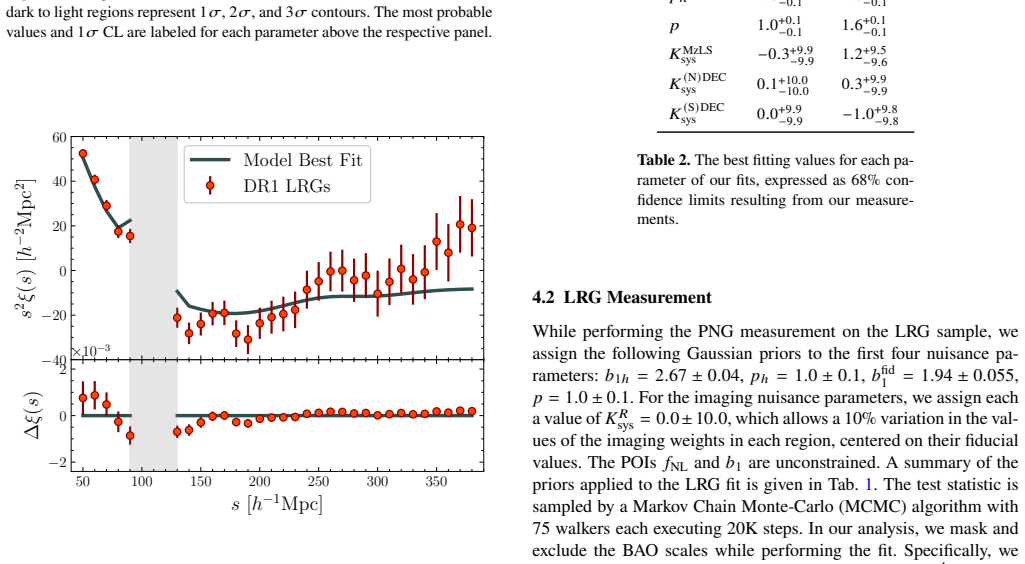


read the original abstract
We report the first measurement of primordial non-Gaussianity (PNG), parameterized by $f_{\mathrm{NL}}$, in the configuration space two-point correlation function (2pcf). We employ simulation based modeling and a novel approach for the mitigation of imaging systematics. We apply this method to samples of luminous red galaxies (LRG) and quasars (QSO) observed by the Dark Energy Spectroscopic Instrument (DESI) during the first year of its observations (DR1). The observed 68\% CL interval on $f_{\mathrm{NL}}$ is $-3^{+22}_{-21}$ using LRGs, and $ 0^{+17}_{-16}$ using QSOs. The joint measurement yields $f_{\mathrm{NL}} = -3^{+12}_{-12}$ at $\ [68\%]$ CL. Our pipeline imposes a Gaussian prior on the value of $p$ (which defines the PNG bias via the Universality relation), with $p_{\rm LRG} = 1.0 \pm 0.1$ and $p_{\rm QSO} = 1.6\pm 0.1$. The observed constraining power of DESI tracers significantly exceeds that of previous large-scale structure (LSS) surveys, and encouragingly, approaches the sensitivity of CMB probes of PNG.
Editorial analysis
A structured set of objections, weighed in public.
Referee Report
Summary. The paper reports the first measurement of local primordial non-Gaussianity parameterized by f_NL from the configuration-space two-point correlation function of DESI DR1 LRG and QSO samples. It employs simulation-based modeling together with a novel approach to mitigate imaging systematics, obtaining 68% CL intervals f_NL = -3^{+22}_{-21} (LRGs), 0^{+17}_{-16} (QSOs), and a joint constraint f_NL = -3^{+12}_{-12}. The pipeline imposes Gaussian priors p_LRG = 1.0 ± 0.1 and p_QSO = 1.6 ± 0.1 on the universality relation that defines the PNG bias term.
Significance. If the central result holds after addressing modeling dependencies, the work would constitute a notable advance: the first configuration-space PNG measurement from DESI data, with statistical power exceeding prior LSS surveys and approaching CMB sensitivity, while demonstrating new systematics-mitigation techniques.
major comments (1)
- [Abstract] Abstract: the reported f_NL intervals are obtained by fitting the PNG-induced scale-dependent bias term b_φ = 2 f_NL (b - p) δ_c after imposing external Gaussian priors on p_LRG and p_QSO rather than deriving p from the tracer properties or marginalizing it. Because the mapping from observed clustering to f_NL is set by these priors, deviations in the true p values (or failure of the universality assumption for these samples) would shift the quoted intervals by amounts comparable to the reported uncertainties; this modeling choice is load-bearing for the central claim.
minor comments (1)
- The abstract states results and methods at high level; the manuscript would benefit from explicit discussion of simulation validation, full error budget, and any cross-checks on the universality relation for these specific tracers.
Simulated Author's Rebuttal
We thank the referee for their careful reading of the manuscript and for the constructive comment. We address the point below.
read point-by-point responses
-
Referee: [Abstract] Abstract: the reported f_NL intervals are obtained by fitting the PNG-induced scale-dependent bias term b_φ = 2 f_NL (b - p) δ_c after imposing external Gaussian priors on p_LRG and p_QSO rather than deriving p from the tracer properties or marginalizing it. Because the mapping from observed clustering to f_NL is set by these priors, deviations in the true p values (or failure of the universality assumption for these samples) would shift the quoted intervals by amounts comparable to the reported uncertainties; this modeling choice is load-bearing for the central claim.
Authors: We agree that the choice of priors on p is central to the f_NL inference. The adopted values p_LRG = 1.0 ± 0.1 and p_QSO = 1.6 ± 0.1 are taken from theoretical expectations for the universality parameter at the typical halo masses of these tracers, as calibrated in the literature and simulations. The prior widths are intended to reflect the associated uncertainty. Full marginalization over p is not performed in the baseline analysis because of degeneracies with the linear bias parameters; deriving p directly from the data would require additional modeling assumptions not justified by the current measurements. In the revised manuscript we will add a dedicated subsection quantifying the sensitivity of the f_NL posteriors to the p priors (including results with wider and narrower widths) and will clarify the role of these priors in the abstract and main text. revision: partial
Circularity Check
No significant circularity; f_NL posterior driven by data under standard modeling assumptions
full rationale
The paper fits the observed configuration-space 2pcf of DESI LRGs and QSOs to a simulation-based model containing the PNG scale-dependent bias term b_φ = 2 f_NL (b - p) δ_c. A Gaussian prior is placed on the auxiliary parameter p (p_LRG = 1.0 ± 0.1, p_QSO = 1.6 ± 0.1) drawn from the universality relation; this is an external modeling choice, not a self-definition or a fitted quantity renamed as a prediction. The reported f_NL intervals are the output of the likelihood fit to the data, not equivalent to the priors or inputs by construction. No self-citation load-bearing step, uniqueness theorem, or ansatz smuggling is present in the provided text. The derivation remains self-contained against external benchmarks once the modeling assumptions are granted.
Axiom & Free-Parameter Ledger
free parameters (2)
- p_LRG =
1.0 ± 0.1
- p_QSO =
1.6 ± 0.1
axioms (1)
- domain assumption Universality relation connects PNG bias to f_NL through parameter p
Reference graph
Works this paper leans on
-
[1]
arXiv preprint arXiv:2201.11518 , year=
Limits on primordial non-Gaussianities from BOSS galaxy-clustering data , author=. arXiv preprint arXiv:2201.11518 , year=
-
[2]
Physical Review D , volume=
Constraints on multifield inflation from the BOSS galaxy survey , author=. Physical Review D , volume=. 2022 , publisher=
2022
-
[3]
Journal of High Energy Physics , volume=
Non-Gaussian features of primordial fluctuations in single field inflationary models , author=. Journal of High Energy Physics , volume=. 2003 , publisher=
2003
-
[4]
The Ninth Marcel Grossmann Meeting: On Recent Developments in Theoretical and Experimental General Relativity, Gravitation and Relativistic Field Theories (In 3 Volumes) , pages=
The cosmic microwave background bispectrum as a test of the physics of inflation and probe of the astrophysics of the low-redshift universe , author=. The Ninth Marcel Grossmann Meeting: On Recent Developments in Theoretical and Experimental General Relativity, Gravitation and Relativistic Field Theories (In 3 Volumes) , pages=. 2002 , organization=
2002
-
[5]
Physical Review D , volume=
Acoustic signatures in the primary microwave background bispectrum , author=. Physical Review D , volume=. 2001 , publisher=
2001
-
[6]
Physics Reports , volume=
Non-Gaussianity from inflation: Theory and observations , author=. Physics Reports , volume=. 2004 , publisher=
2004
-
[7]
Journal of Cosmology and Astroparticle Physics , volume=
The (not so) squeezed limit of the primordial 3-point function , author=. Journal of Cosmology and Astroparticle Physics , volume=. 2011 , publisher=
2011
-
[8]
2014 , institution=
Testing Inflation with Large Scale Structure: Connecting Hopes with Reality , author=. 2014 , institution=
2014
-
[9]
Galaxies , volume=
The Hunt for Primordial Interactions in the Large-Scale Structures of the Universe , author=. Galaxies , volume=. 2019 , publisher=
2019
-
[10]
Journal of Cosmology and Astroparticle Physics , volume=
On the impact of galaxy bias uncertainties on primordial non-Gaussianity constraints , author=. Journal of Cosmology and Astroparticle Physics , volume=. 2020 , publisher=
2020
-
[11]
Journal of Cosmology and Astroparticle Physics , volume=
Predictions for local PNG bias in the galaxy power spectrum and bispectrum and the consequences for f NL constraints , author=. Journal of Cosmology and Astroparticle Physics , volume=. 2022 , publisher=
2022
-
[12]
Journal of Cosmology and Astroparticle Physics , volume=
Assembly bias in the local PNG halo bias and its implication for f NL constraints , author=. Journal of Cosmology and Astroparticle Physics , volume=. 2023 , publisher=
2023
-
[13]
Physical Review D , volume=
Imprints of primordial non-Gaussianities on large-scale structure: Scale-dependent bias and abundance of virialized objects , author=. Physical Review D , volume=. 2008 , publisher=
2008
-
[14]
Physics reports , volume=
Large-scale galaxy bias , author=. Physics reports , volume=. 2018 , publisher=
2018
-
[15]
Physical Review D , volume=
Primordial non-Gaussianity from the covariance of galaxy cluster counts , author=. Physical Review D , volume=. 2010 , publisher=
2010
-
[16]
Journal of Cosmology and Astroparticle Physics , volume=
Quantifying the rareness of extreme galaxy clusters , author=. Journal of Cosmology and Astroparticle Physics , volume=. 2011 , publisher=
2011
-
[17]
arXiv preprint arXiv:2106.13725 , year=
The clustering of galaxies in the completed SDSS-IV extended Baryon Oscillation Spectroscopic Survey: Primordial non-Gaussianity in Fourier Space , author=. arXiv preprint arXiv:2106.13725 , year=
-
[18]
Physical Review D , volume=
Primordial non-Gaussianity: large-scale structure signature in the perturbative bias model , author=. Physical Review D , volume=. 2008 , publisher=
2008
-
[19]
Constraints on inflation , author=
Planck 2015 results-XX. Constraints on inflation , author=. Astronomy & Astrophysics , volume=. 2016 , publisher=
2015
-
[20]
arXiv preprint arXiv:1611.00036 , year=
The DESI experiment part I: science, targeting, and survey design , author=. arXiv preprint arXiv:1611.00036 , year=
-
[21]
Monthly Notices of the Royal Astronomical Society , volume=
The clustering of galaxies in the completed SDSS-III Baryon Oscillation Spectroscopic Survey: Observational systematics and baryon acoustic oscillations in the correlation function , author=. Monthly Notices of the Royal Astronomical Society , volume=. 2017 , publisher=
2017
-
[22]
Monthly Notices of the Royal Astronomical Society , volume=
The clustering of galaxies in the SDSS-III Baryon Oscillation Spectroscopic Survey: BAO measurement from the LOS-dependent power spectrum of DR12 BOSS galaxies , author=. Monthly Notices of the Royal Astronomical Society , volume=. 2016 , publisher=
2016
-
[23]
Monthly Notices of the Royal Astronomical Society , volume=
The clustering of galaxies in the completed SDSS-III Baryon Oscillation Spectroscopic Survey: cosmological analysis of the DR12 galaxy sample , author=. Monthly Notices of the Royal Astronomical Society , volume=. 2017 , publisher=
2017
-
[24]
Monthly Notices of the Royal Astronomical Society , volume=
FastPM: a new scheme for fast simulations of dark matter and haloes , author=. Monthly Notices of the Royal Astronomical Society , volume=. 2016 , publisher=
2016
-
[25]
Monthly Notices of the Royal Astronomical Society , volume=
Validating galaxy clustering models with fixed and paired and matched-ICs simulations: application to primordial non-Gaussianities , author=. Monthly Notices of the Royal Astronomical Society , volume=. 2023 , publisher=
2023
-
[26]
Monthly Notices of the Royal Astronomical Society , volume=
ABACUSSUMMIT: a massive set of high-accuracy, high-resolution N-body simulations , author=. Monthly Notices of the Royal Astronomical Society , volume=. 2021 , publisher=
2021
-
[27]
Monthly Notices of the Royal Astronomical Society , volume=
The ABACUS cosmological N-body code , author=. Monthly Notices of the Royal Astronomical Society , volume=. 2021 , publisher=
2021
-
[28]
Monthly Notices of the Royal Astronomical Society , volume=
Constructing high-fidelity halo merger trees in ABACUSSUMMIT , author=. Monthly Notices of the Royal Astronomical Society , volume=. 2022 , publisher=
2022
-
[29]
Astronomy & Astrophysics , volume=
ConKer: An algorithm for evaluating correlations of arbitrary order , author=. Astronomy & Astrophysics , volume=. 2022 , publisher=
2022
-
[30]
Astronomy & Astrophysics , volume=
An algorithm to locate the centers of baryon acoustic oscillations , author=. Astronomy & Astrophysics , volume=. 2021 , publisher=
2021
-
[31]
Astron.J
nbodykit: an open-source, massively parallel toolkit for large-scale structure , author=. Astron.J. , volume=. 2018 , publisher=
2018
-
[32]
Oliver H. E. Philcox and Zachary Slepian and Jiamin Hou and Craig Warner and Robert N. Cahn and Daniel J. Eisenstein , year=. ENCORE: Estimating Galaxy N -point Correlation Functions in. 2105.08722 , archivePrefix=
-
[33]
Journal of Cosmology and Astroparticle Physics , volume=
Joint analysis of anisotropic power spectrum, bispectrum and trispectrum: application to N-body simulations , author=. Journal of Cosmology and Astroparticle Physics , volume=. 2021 , publisher=
2021
-
[34]
Planck 2018 results. IX. Constraints on primordial non-Gaussianity , author=. Astron. Astrophys , volume=
2018
-
[35]
arXiv preprint arXiv:2306.06307 , year=
Validation of the Scientific Program for the Dark Energy Spectroscopic Instrument , author=. arXiv preprint arXiv:2306.06307 , year=
-
[36]
Monthly Notices of the Royal Astronomical Society , volume=
Clustering in real space and in redshift space , author=. Monthly Notices of the Royal Astronomical Society , volume=. 1987 , publisher=
1987
-
[37]
Monthly Notices of the Royal Astronomical Society , volume=
Modelling the large-scale redshift-space 3-point correlation function of galaxies , author=. Monthly Notices of the Royal Astronomical Society , volume=. 2017 , publisher=
2017
-
[38]
Journal of Cosmology and Astroparticle Physics , volume=
Redshift-weighted constraints on primordial non-Gaussianity from the clustering of the eBOSS DR14 quasars in Fourier space , author=. Journal of Cosmology and Astroparticle Physics , volume=. 2019 , publisher=
2019
-
[39]
Monthly Notices of the Royal Astronomical Society , volume=
Optimizing primordial non-Gaussianity measurements from galaxy surveys , author=. Monthly Notices of the Royal Astronomical Society , volume=. 2019 , publisher=
2019
-
[40]
arXiv preprint astro-ph/9312033 , year=
The Three--Point Correlation Function of the Cosmic Microwave Background in Inflationary Models , author=. arXiv preprint astro-ph/9312033 , year=
-
[41]
arXiv e-prints , keywords =
The DESI Experiment Part II: Instrument Design. arXiv e-prints , keywords =
-
[42]
The Optical Corrector for the Dark Energy Spectroscopic Instrument. arXiv e-prints , keywords =. doi:10.48550/arXiv.2306.06310 , archivePrefix =. 2306.06310 , primaryClass =
-
[43]
arXiv e-prints , keywords =
The DESI Experiment Part I: Science,Targeting, and Survey Design. arXiv e-prints , keywords =
-
[44]
The Early Data Release of the Dark Energy Spectroscopic Instrument. arXiv e-prints , keywords =. doi:10.48550/arXiv.2306.06308 , archivePrefix =. 2306.06308 , primaryClass =
-
[45]
Survey Operations for the Dark Energy Spectroscopic Instrument. arXiv e-prints , keywords =. doi:10.48550/arXiv.2306.06309 , archivePrefix =. 2306.06309 , primaryClass =
-
[46]
Validation of the Scientific Program for the Dark Energy Spectroscopic Instrument. arXiv e-prints , keywords =. doi:10.48550/arXiv.2306.06307 , archivePrefix =. 2306.06307 , primaryClass =
-
[47]
The Target-selection Pipeline for the Dark Energy Spectroscopic Instrument. , keywords =. doi:10.3847/1538-3881/aca5f9 , archivePrefix =. 2208.08518 , primaryClass =
-
[48]
arXiv e-prints , keywords =
Overview of the DESI Milky Way Survey. arXiv e-prints , keywords =
-
[49]
Performance of the Quasar Spectral Templates for the Dark Energy Spectroscopic Instrument. arXiv e-prints , keywords =. doi:10.48550/arXiv.2305.10426 , archivePrefix =. 2305.10426 , primaryClass =
-
[50]
Research Notes of the American Astronomical Society , keywords =
Preliminary Target Selection for the DESI Emission Line Galaxy (ELG) Sample. Research Notes of the American Astronomical Society , keywords =. doi:10.3847/2515-5172/abc078 , archivePrefix =. 2010.11281 , primaryClass =
-
[51]
Research Notes of the American Astronomical Society , keywords =
Preliminary Target Selection for the DESI Luminous Red Galaxy (LRG) Sample. Research Notes of the American Astronomical Society , keywords =. doi:10.3847/2515-5172/abc0f4 , archivePrefix =. 2010.11282 , primaryClass =
-
[52]
Overview of the DESI Legacy Imaging Surveys
Overview of the DESI Legacy Imaging Surveys. , keywords =. doi:10.3847/1538-3881/ab089d , archivePrefix =. 1804.08657 , primaryClass =
work page internal anchor Pith review Pith/arXiv arXiv doi:10.3847/1538-3881/ab089d
-
[53]
Research Notes of the American Astronomical Society , keywords =
Preliminary Target Selection for the DESI Quasar (QSO) Sample. Research Notes of the American Astronomical Society , keywords =. doi:10.3847/2515-5172/abc01a , archivePrefix =. 2010.11280 , primaryClass =
-
[54]
Research Notes of the American Astronomical Society , keywords =
Preliminary Target Selection for the DESI Bright Galaxy Survey (BGS). Research Notes of the American Astronomical Society , keywords =. doi:10.3847/2515-5172/abc25a , archivePrefix =. 2010.11283 , primaryClass =
-
[55]
The Robotic Multiobject Focal Plane System of the Dark Energy Spectroscopic Instrument (DESI). , keywords =. doi:10.3847/1538-3881/ac9ab1 , archivePrefix =. 2205.09014 , primaryClass =
-
[56]
Overview of the Instrumentation for the Dark Energy Spectroscopic Instrument
Overview of the Instrumentation for the Dark Energy Spectroscopic Instrument. , keywords =. doi:10.3847/1538-3881/ac882b , archivePrefix =. 2205.10939 , primaryClass =
work page internal anchor Pith review Pith/arXiv arXiv doi:10.3847/1538-3881/ac882b
-
[57]
Research Notes of the American Astronomical Society , keywords =
Preliminary Target Selection for the DESI Milky Way Survey (MWS). Research Notes of the American Astronomical Society , keywords =. doi:10.3847/2515-5172/abc1dc , archivePrefix =. 2010.11284 , primaryClass =
-
[58]
arXiv e-prints , keywords =
The DESI Experiment, a whitepaper for Snowmass 2013. arXiv e-prints , keywords =
2013
-
[59]
Project Overview of the Beijing-Arizona Sky Survey
Project Overview of the Beijing-Arizona Sky Survey. , keywords =. doi:10.1088/1538-3873/aa65ba , archivePrefix =. 1702.03653 , primaryClass =
work page internal anchor Pith review Pith/arXiv arXiv doi:10.1088/1538-3873/aa65ba
-
[60]
Target Selection and Validation of DESI Quasars. , keywords =. doi:10.3847/1538-4357/acb3c2 , archivePrefix =. 2208.08511 , primaryClass =
-
[61]
arXiv e-prints , keywords =
DESI Bright Galaxy Survey: Final Target Selection, Design, and Validation. arXiv e-prints , keywords =
-
[62]
Target Selection and Validation of DESI Emission Line Galaxies. , keywords =. doi:10.3847/1538-3881/acb213 , archivePrefix =. 2208.08513 , primaryClass =
-
[63]
Target Selection and Validation of DESI Luminous Red Galaxies. , keywords =. doi:10.3847/1538-3881/aca5fb , archivePrefix =. 2208.08515 , primaryClass =
-
[64]
The DESI Survey Validation: Results from Visual Inspection of Bright Galaxies, Luminous Red Galaxies, and Emission-line Galaxies. , keywords =. doi:10.3847/1538-4357/aca5fa , archivePrefix =. 2208.08516 , primaryClass =
-
[65]
The Spectroscopic Data Processing Pipeline for the Dark Energy Spectroscopic Instrument. , keywords =. doi:10.3847/1538-3881/acb212 , archivePrefix =. 2209.14482 , primaryClass =
-
[66]
The DESI Survey Validation: Results from Visual Inspection of the Quasar Survey Spectra. , keywords =. doi:10.3847/1538-3881/acacfc , archivePrefix =. 2208.08517 , primaryClass =
-
[67]
Journal of Cosmology and Astroparticle Physics , volume=
Constraints on local primordial non-Gaussianity from large scale structure , author=. Journal of Cosmology and Astroparticle Physics , volume=. 2008 , publisher=
2008
-
[68]
Monthly Notices of the Royal Astronomical Society , volume=
EZmocks: extending the Zel'dovich approximation to generate mock galaxy catalogues with accurate clustering statistics , author=. Monthly Notices of the Royal Astronomical Society , volume=. 2015 , publisher=
2015
-
[69]
arXiv preprint astro-ph/9304022 , year=
Power spectrum analysis of three-dimensional redshift surveys , author=. arXiv preprint astro-ph/9304022 , year=
-
[70]
Monthly Notices of the Royal Astronomical Society , volume=
Primordial non-Gaussianity from the completed SDSS-IV extended Baryon Oscillation Spectroscopic Survey--I: Catalogue preparation and systematic mitigation , author=. Monthly Notices of the Royal Astronomical Society , volume=. 2021 , publisher=
2021
-
[71]
Edmond Chaussidon. 2024
2024
-
[72]
Monthly Notices of the Royal Astronomical Society , volume=
Verifying the consistency relation for the scale-dependent bias from local primordial non-Gaussianity , author=. Monthly Notices of the Royal Astronomical Society , volume=. 2017 , publisher=
2017
-
[73]
Astronomy & Astrophysics , volume=
pFoF: a highly scalable halo-finder for large cosmological data sets , author=. Astronomy & Astrophysics , volume=. 2014 , publisher=
2014
-
[74]
Monthly Notices of the Royal Astronomical Society , volume=
Full forward model of galaxy clustering statistics with AbacusSummit light cones , author=. Monthly Notices of the Royal Astronomical Society , volume=. 2023 , publisher=
2023
-
[75]
Monthly Notices of the Royal Astronomical Society , volume=
Calibration errors unleashed: effects on cosmological parameters and requirements for large-scale structure surveys , author=. Monthly Notices of the Royal Astronomical Society , volume=. 2013 , publisher=
2013
-
[76]
Physical review letters , volume=
Excess clustering on large scales in the MegaZ DR7 photometric redshift survey , author=. Physical review letters , volume=. 2011 , publisher=
2011
-
[77]
Monthly Notices of the Royal Astronomical Society , pages=
Local primordial non-Gaussianity from the large-scale clustering of photometric DESI luminous red galaxies , author=. Monthly Notices of the Royal Astronomical Society , pages=. 2024 , publisher=
2024
-
[78]
Monthly Notices of the Royal Astronomical Society , volume=
Angular clustering properties of the DESI QSO target selection using DR9 Legacy Imaging Surveys , author=. Monthly Notices of the Royal Astronomical Society , volume=. 2022 , publisher=
2022
-
[79]
American Astronomical Society Meeting Abstracts\# 228 , volume=
The mayall z-band legacy survey , author=. American Astronomical Society Meeting Abstracts\# 228 , volume=
-
[80]
The Astronomical Journal , volume=
The dark energy camera , author=. The Astronomical Journal , volume=. 2015 , publisher=
2015
discussion (0)
Sign in with ORCID, Apple, or X to comment. Anyone can read and Pith papers without signing in.