Exploring the Cosmic Dawn through the 21 cm Forest and High-redshift Radio Sources with the SKA
Pith reviewed 2026-06-25 23:07 UTC · model grok-4.3
The pith
The 21 cm forest observed with the Square Kilometre Array can constrain early heating, dark matter properties, neutrino mass and related physics through absorption in high-redshift radio sources.
A machine-rendered reading of the paper's core claim, the machinery that carries it, and where it could break.
Core claim
With the Square Kilometre Array, the 21 cm forest will therefore provide a promising route to study early heating, possible exotic energy injection, dark matter properties, neutrino mass, the running spectral index, and baryon-dark-matter relative velocity.
What carries the argument
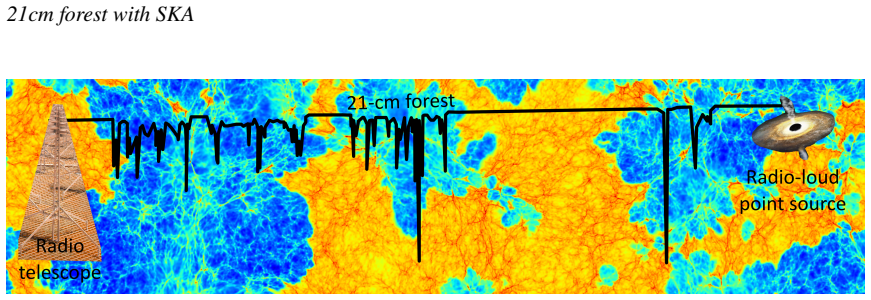
The 21 cm forest: absorption lines produced by intervening neutral hydrogen in the spectra of high-redshift radio sources, sensitive to gas temperature and small-scale density fluctuations.
If this is right
- Individual absorption lines or their statistical distribution become measurable, tightening bounds on the thermal history of the intergalactic medium.
- Astrophysical signals from the first galaxies can be separated from small-scale modifications due to dark matter or neutrinos.
- Joint constraints on neutrino mass and the running of the primordial spectral index become available alongside reionization studies.
- Baryon-dark-matter relative velocity effects can be tested directly through their imprint on the absorption pattern.
Where Pith is reading between the lines
- The same SKA data could be cross-correlated with other 21 cm observables to break degeneracies between heating sources and fundamental physics.
- If the method succeeds, it would supply an independent check on dark matter models already constrained by Lyman-alpha forest or Milky Way satellite counts.
- Non-detection after full SKA operations would force revision of either the expected source population or the assumed level of small-scale power.
Load-bearing premise
That revised radio-source counts combined with statistical observables and deep-learning methods will deliver enough sensitivity to extract the weak absorption signal in practical SKA integration times.
What would settle it
A deep SKA survey that finds far fewer bright high-redshift radio sources than current counts predict, or that yields no detectable 21 cm absorption features after the expected integration time, would show the proposed constraints cannot be reached.
Figures
read the original abstract
The 21~cm forest, seen as absorption features in the spectra of distant radio sources, is produced by intervening neutral hydrogen and offers a direct probe of the neutral intergalactic medium during the epoch of reionization (EoR). Because it is sensitive to small-scale structure and gas temperature, it can constrain the thermal history of the early Universe and physics that affects structure formation. Detecting individual absorption lines is challenging, mainly because of their weakness and the scarcity of high-redshift radio-bright sources. Recent progress, however, has made 21~cm forest studies increasingly feasible: new statistical observables can improve sensitivity within realistic observing times, updated radio-source counts have revised expectations for suitable background quasars, and deep-learning methods can extract physical information more efficiently. In addition, new approaches have been developed to separate astrophysical effects from early galaxies from fundamental-physics effects on small-scale structure. With the Square Kilometre Array (SKA), the 21~cm forest will therefore provide a promising route to study early heating, possible exotic energy injection, dark matter properties, neutrino mass, the running spectral index, and baryon--dark-matter relative velocity. This chapter reviews recent developments in 21~cm forest research and discusses observational strategies and prospects for constraining the first galaxies and fundamental physics with SKA-Low.
Editorial analysis
A structured set of objections, weighed in public.
Referee Report
Summary. This manuscript is a review chapter summarizing the 21 cm forest—absorption features in high-redshift radio source spectra produced by neutral intergalactic hydrogen—as a probe of the epoch of reionization. It covers detection challenges arising from weak lines and scarce bright sources, recent progress in statistical observables, revised radio-source counts, deep-learning extraction methods, and techniques to separate astrophysical effects from fundamental physics influences on small-scale structure. The central claim is that SKA-Low observations will make the 21 cm forest a promising route to constrain early heating, exotic energy injection, dark matter properties, neutrino mass, the running spectral index, and baryon–dark-matter relative velocity, while reviewing observational strategies.
Significance. As a review synthesizing cited literature on statistical methods and SKA prospects, the chapter can provide a useful overview for the community if the summaries of external works are accurate. It explicitly credits advances in source counts and deep-learning approaches as enabling factors, which strengthens its utility for guiding future observations of cosmic dawn physics.
minor comments (2)
- [Abstract] Abstract: the statement that 'new statistical observables can improve sensitivity within realistic observing times' would be strengthened by citing at least one concrete example of an observable and the associated integration time or sensitivity gain from the referenced literature.
- [Conclusion] The manuscript would benefit from a short table or bullet list in the concluding section that maps each listed science target (early heating, dark matter properties, etc.) to the specific statistical observable or separation method discussed earlier.
Simulated Author's Rebuttal
We thank the referee for their positive assessment of the manuscript and for recommending acceptance. We are pleased that the review is viewed as a useful synthesis of recent developments in 21 cm forest studies and SKA prospects.
Circularity Check
No significant circularity: review summarizes external literature without internal derivations
full rationale
The manuscript is a review chapter summarizing cited literature on statistical observables, source counts, and deep-learning techniques. It presents no new quantitative predictions, equations, or derivations that could reduce to self-referential fits or self-citations. The central claim that SKA observations will provide a promising route inherits support entirely from referenced external works. No load-bearing steps match any of the enumerated circularity patterns.
Axiom & Free-Parameter Ledger
Reference graph
Works this paper leans on
-
[1]
, title =
Weinberg, David H. , title =. The Emergence of Cosmic Structure , series =. 2003 , doi =
2003
-
[2]
Formation, Evolution, and Revolution of Galaxies by SKA: Activities of SKA-Japan Galaxy Evolution Sub-SWG. arXiv e-prints , keywords =. doi:10.48550/arXiv.1603.01938 , archivePrefix =. 1603.01938 , primaryClass =
-
[3]
Annual Review of Astronomy and Astrophysics , volume =
McQuinn, Matthew , title =. Annual Review of Astronomy and Astrophysics , volume =. 2016 , doi =
2016
-
[4]
Probing small-scale dark matter clumping with the large-scale 21-cm power spectrum. arXiv e-prints , keywords =. doi:10.48550/arXiv.2509.11175 , archivePrefix =. 2509.11175 , primaryClass =
-
[7]
2019 , eprint=
Anticipated Performance of the Square Kilometre Array -- Phase 1 (SKA1) , author=. 2019 , eprint=
2019
-
[8]
2015 , publisher=
Advancing Astrophysics with the Square Kilometre Array (AASKA14) , author=. 2015 , publisher=
2015
-
[9]
High-dimensional Statistical Analysis and Its Application to an ALMA Map of NGC 253. , keywords =. doi:10.3847/1538-4365/ad2517 , archivePrefix =. 2203.04535 , primaryClass =
-
[11]
, year = 1952, month = jan, volume =
On the excitation mechanism of the 21-cm (radio-frequency) interstellar hydrogen emission line. AJ , year = 1952, month = jan, volume =. doi:10.1086/106661 , adsurl =
-
[12]
Detailed modelling of the 21-cm Forest
Detailed modelling of the 21-cm forest. , keywords =. doi:10.1093/mnras/stv2312 , archivePrefix =. 1510.02296 , primaryClass =
work page internal anchor Pith review Pith/arXiv arXiv doi:10.1093/mnras/stv2312
-
[13]
The detectability of strong 21-cm forest absorbers from the diffuse intergalactic medium in late reionization models. , keywords =. doi:10.1093/mnras/stab1830 , archivePrefix =. 2105.02250 , primaryClass =
-
[14]
Probing quasar lifetimes with proximate 21-centimetre absorption in the diffuse intergalactic medium at redshifts z 6. , keywords =. doi:10.1093/mnras/stac3710 , archivePrefix =. 2211.07655 , primaryClass =
-
[15]
, year = 2025, month = feb, volume =
Prospects of a statistical detection of the 21-cm forest and its potential to constrain the thermal state of the neutral IGM during reionization. , year = 2025, month = feb, volume =. doi:10.1093/mnras/staf026 , adsurl =
-
[23]
The contribution of the IGM and minihaloes to the 21-cm signal of reionization. , keywords =. doi:10.1111/j.1365-2966.2009.15261.x , archivePrefix =. 0906.3105 , primaryClass =
-
[25]
The 21 cm Forest as a Probe of the Reionization and The Temperature of the Intergalactic Medium. , keywords =. doi:10.1088/0004-637X/704/2/1396 , archivePrefix =. 0904.4254 , primaryClass =
-
[26]
The earliest galaxies seen in 21 cm line absorption. , keywords =. doi:10.1111/j.1365-2966.2010.17579.x , archivePrefix =. 1009.1149 , primaryClass =
-
[36]
Statistical Detection of IGM Structures during Cosmic Reionization Using Absorption of the Redshifted 21 cm line by H I against Compact Background Radio Sources. , keywords =. doi:10.3847/1538-4357/ab9e6d , archivePrefix =. 2006.10070 , primaryClass =
-
[38]
Communications Physics , keywords =
Deep learning-driven likelihood-free parameter inference for 21-cm forest observations. Communications Physics , keywords =. doi:10.1038/s42005-025-02139-5 , archivePrefix =. 2407.14298 , primaryClass =
-
[39]
The 21-cm forest as a simultaneous probe of dark matter and cosmic heating history. Nature Astronomy , keywords =. doi:10.1038/s41550-023-02024-7 , archivePrefix =. 2307.04130 , primaryClass =
-
[40]
Analytical modeling of the one-dimensional power spectrum of 21-cm forest based on a halo model method. , keywords =. doi:10.1103/vpd1-1kyj , archivePrefix =. 2411.17094 , primaryClass =
-
[42]
Chronicling the Reionization History at 6 z 7 with Emergent Quasar Damping Wings. , keywords =. doi:10.3847/1538-4357/ad4888 , archivePrefix =. 2401.10328 , primaryClass =
-
[45]
Discovery of a Radio-Selected z ~ 6 Quasar
Discovery of a Radio-selected z -0.5ex 6 Quasar. , keywords =. doi:10.1088/0004-637X/736/1/57 , archivePrefix =. 1105.2047 , primaryClass =
work page internal anchor Pith review Pith/arXiv arXiv doi:10.1088/0004-637x/736/1/57 2047
-
[47]
Exploring Reionization-era Quasars. III. Discovery of 16 Quasars at 6.4 z 6.9 with DESI Legacy Imaging Surveys and the UKIRT Hemisphere Survey and Quasar Luminosity Function at z 6.7. , keywords =. doi:10.3847/1538-4357/ab2be5 , archivePrefix =. 1810.11926 , primaryClass =
-
[51]
Eddington-limited accretion and the black hole mass function at redshift 6
Eddington-limited Accretion and the Black Hole Mass Function at Redshift 6. , keywords =. doi:10.1088/0004-6256/140/2/546 , archivePrefix =. 1006.1342 , primaryClass =
work page internal anchor Pith review Pith/arXiv arXiv doi:10.1088/0004-6256/140/2/546
-
[56]
Nature Astronomy , year = 2024, month = dec, doi =
A blazar in the epoch of reionization. Nature Astronomy , year = 2024, month = dec, doi =
2024
-
[58]
The SRG/eROSITA All-Sky Survey: X-ray beacons at late cosmic dawn. , keywords =. doi:10.1051/0004-6361/202451035 , archivePrefix =. 2406.05118 , primaryClass =
-
[67]
Damping wings in the Lyman- forest: A model-independent measurement of the neutral fraction at 5.4 < z < 6.1. , keywords =. doi:10.1051/0004-6361/202450798 , archivePrefix =. 2405.12273 , primaryClass =
-
[76]
Chasing the Tail of Cosmic Reionization with Dark Gap Statistics in the Ly Forest over 5 < z < 6. , keywords =. doi:10.3847/1538-4357/ac26c2 , archivePrefix =. 2109.06295 , primaryClass =
-
[77]
Long Dark Gaps in the Ly Forest at z < 6: Evidence of Ultra-late Reionization from XQR-30 Spectra. , keywords =. doi:10.3847/1538-4357/ac6e60 , archivePrefix =. 2205.04569 , primaryClass =
-
[78]
Probing Ultralate Reionization: Direct Measurements of the Mean Free Path over 5 < z < 6. , keywords =. doi:10.3847/1538-4357/aceef4 , archivePrefix =. 2308.04614 , primaryClass =
-
[79]
Damping wing-like features in the stacked Ly forest: Potential neutral hydrogen islands at z < 6. , keywords =. doi:10.1093/mnrasl/slae061 , archivePrefix =. 2405.12275 , primaryClass =
-
[85]
Modelling the observed luminosity function and clustering evolution of Ly emitters: growing evidence for late reionization. , keywords =. doi:10.1093/mnras/stz481 , archivePrefix =. 1902.05077 , primaryClass =
work page internal anchor Pith review Pith/arXiv arXiv doi:10.1093/mnras/stz481 1902
-
[93]
Tantalizing evidence of reionization relics in the eBOSS DR16 Ly forest correlations: a preference for early reionization. , keywords =. doi:10.1093/mnras/staf2014 , archivePrefix =. 2503.09971 , primaryClass =
-
[97]
Discovery of a radio galaxy at z = 5.72
Discovery of a radio galaxy at z = 5.72. , keywords =. doi:10.1093/mnras/sty1996 , archivePrefix =. 1806.01191 , primaryClass =
work page internal anchor Pith review Pith/arXiv arXiv doi:10.1093/mnras/sty1996
-
[100]
Probing small-scale cosmological fluctuations with the 21 cm forest: Effects of neutrino mass, running spectral index, and warm dark matter. , keywords =. doi:10.1103/PhysRevD.90.083003 , archivePrefix =. 1403.1605 , primaryClass =
work page internal anchor Pith review Pith/arXiv arXiv doi:10.1103/physrevd.90.083003
-
[101]
Constraining the nature of ultra light dark matter particles with the 21 cm forest. , keywords =. doi:10.1103/PhysRevD.101.043516 , archivePrefix =. 1910.06011 , primaryClass =
-
[102]
21 cm forest probes on axion dark matter in postinflationary Peccei-Quinn symmetry breaking scenarios. , keywords =. doi:10.1103/PhysRevD.102.023522 , archivePrefix =. 2005.05589 , primaryClass =
-
[103]
Impact of dark matter-baryon relative velocity on the 21-cm forest. , keywords =. doi:10.1103/PhysRevD.107.123520 , archivePrefix =. 2212.08409 , primaryClass =
-
[104]
21 cm forest constraints on primordial black holes. , keywords =. doi:10.1093/pasj/psab119 , archivePrefix =. 2104.10695 , primaryClass =
-
[106]
Analyzing the 21cm forest with Wavelet Scattering Transform: Insight into non-Gaussian features of the 21cm forest. arXiv e-prints , keywords =. doi:10.48550/arXiv.2504.14656 , archivePrefix =. 2504.14656 , primaryClass =
-
[107]
High- z radio Quasars in RACS I: Selection, identification, and multi-wavelength properties. arXiv e-prints , keywords =. doi:10.48550/arXiv.2504.10573 , archivePrefix =. 2504.10573 , primaryClass =
-
[111]
Wide-Field InfrarRed Survey Telescope-Astrophysics Focused Telescope Assets WFIRST-AFTA 2015 Report
Wide-Field InfrarRed Survey Telescope-Astrophysics Focused Telescope Assets WFIRST-AFTA 2015 Report. arXiv e-prints , keywords =. doi:10.48550/arXiv.1503.03757 , archivePrefix =. 1503.03757 , primaryClass =
work page internal anchor Pith review Pith/arXiv arXiv doi:10.48550/arxiv.1503.03757 2015
-
[112]
A SPectroscopic Survey of Biased Halos In the Reionization Era (ASPIRE): Broad-line AGN at z = 4‑5 Revealed by JWST/NIRCam WFSS. , keywords =. doi:10.3847/1538-4357/ad6565 , archivePrefix =. 2407.17570 , primaryClass =
-
[113]
DESI z 5 Quasar Survey. I. A First Sample of 400 New Quasars at z 4.7-6.6. , keywords =. doi:10.3847/1538-4365/acf99b , archivePrefix =. 2302.01777 , primaryClass =
-
[120]
Asking Fast Radio Bursts (FRBs) for More than Reionization History. arXiv e-prints , keywords =. doi:10.48550/arXiv.2409.03255 , archivePrefix =. 2409.03255 , primaryClass =
-
[123]
Dispersion Measures of Fast Radio Bursts through the Epoch of Reionization. arXiv e-prints , keywords =. doi:10.48550/arXiv.2411.02699 , archivePrefix =. 2411.02699 , primaryClass =
-
[133]
Sims, Peter H. and Pober, Jonathan C. Testing for calibration systematics in the EDGES low-band data using Bayesian model selection. Mon. Not. Roy. Astron. Soc. 2020. doi:10.1093/mnras/stz3388. arXiv:1910.03165
-
[135]
The 21 cm signal and the interplay between dark matter annihilations and astrophysical processes
Lopez-Honorez, Laura and Mena, Olga and Molin \'e , \'A ngeles and Palomares-Ruiz, Sergio and Vincent, Aaron C. The 21 cm signal and the interplay between dark matter annihilations and astrophysical processes. JCAP. 2016. doi:10.1088/1475-7516/2016/08/004. arXiv:1603.06795
work page internal anchor Pith review Pith/arXiv arXiv doi:10.1088/1475-7516/2016/08/004 2016
-
[136]
and Liu, Hongwan and Mu \ n oz, Julian B
Sun, Yitian and Foster, Joshua W. and Liu, Hongwan and Mu \ n oz, Julian B. and Slatyer, Tracy R. Inhomogeneous energy injection in the 21-cm power spectrum: Sensitivity to dark matter decay. Phys. Rev. D. 2025. doi:10.1103/PhysRevD.111.043015. arXiv:2312.11608
-
[139]
Signatures of particle decay in 21 cm absorptions from first minihalos
Vasiliev, Evgenii O. and Shchekinov, Yuri A. Signatures of particle decay in 21 cm absorptions from first minihalos. Astrophys. J. 2013. doi:10.1088/0004-637X/777/1/8. arXiv:1308.2169
work page internal anchor Pith review Pith/arXiv arXiv doi:10.1088/0004-637x/777/1/8 2013
-
[142]
Investigating primordial black hole accretion through cosmic optical depth
Zhang, Zi-Xuan and Cang, Junsong and Gao, Yu and Li, Hong. Investigating primordial black hole accretion through cosmic optical depth. JCAP. 2025. doi:10.1088/1475-7516/2025/07/027. arXiv:2503.05103
-
[148]
The variance of dispersion measure of high-redshift transient objects as a probe of ionized bubble size during reionization. , keywords =. doi:10.1093/mnras/stx2462 , archivePrefix =. 1709.08012 , primaryClass =
work page internal anchor Pith review Pith/arXiv arXiv doi:10.1093/mnras/stx2462
-
[150]
The Lyman-alpha Forest as a Cosmological Tool
The Lyman- Forest as a Cosmological Tool. The Emergence of Cosmic Structure , year = 2003, editor =. doi:10.1063/1.1581786 , archivePrefix =. astro-ph/0301186 , primaryClass =
work page internal anchor Pith review Pith/arXiv arXiv doi:10.1063/1.1581786 2003
-
[152]
and Daly, Fergus and McConway, K
Hand, David J. and Daly, Fergus and McConway, K. and Lunn, D. and Ostrowski, E. A Handbook of Small Data Sets, 1st edition. 1994
1994
-
[153]
Golub, T. R. and Slonim, D. K. and Tamayo, P. and Huard, C. and Gaasenbeek, M. and Mesirov, J. P. and Coller, H. and Loh, M. L. and Downing, J. R. and Caligiuri, M. A. and Bloomfield, C. D. and Lander, E. S. , title =. 1999 , doi =
1999
-
[154]
Hall, Peter and Marron, J. S. and Neeman, Amnon , title =. Journal of the Royal Statistical Society: Series B (Statistical Methodology) , volume =. doi:10.1111/j.1467-9868.2005.00510.x , year =
-
[155]
Kazuyoshi Yata and Makoto Aoshima. Effective PCA for high-dimension, low-sample-size data with noise reduction via geometric representations. Journal of Multivariate Analysis. 2012. doi:https://doi.org/10.1016/j.jmva.2011.09.002
-
[156]
Aoshima and K
M. Aoshima and K. Yata , Title =. Statistica Sinica , Volume =
-
[157]
Analyzing the 21-cm forest with wavelet scattering transform: Insight into non-Gaussian features of the 21-cm forest. , keywords =. doi:10.1103/nxr4-14gb , archivePrefix =. 2504.14656 , primaryClass =
-
[162]
Beardsley, A. P. and others , title =. The Astrophysical Journal , volume =. 2016 , doi =
2016
-
[163]
and others , title =
Ewall-Wice, A. and others , title =. Monthly Notices of the Royal Astronomical Society , volume =. 2016 , doi =
2016
-
[164]
Patil, A. H. and others , title =. The Astrophysical Journal , volume =. 2017 , doi =
2017
-
[165]
Mertens, F. G. and others , title =. Monthly Notices of the Royal Astronomical Society , volume =. 2020 , doi =
2020
-
[166]
and others , title =
Abdurashidova, Z. and others , title =. The Astrophysical Journal , volume =. 2022 , doi =
2022
-
[167]
and others , title =
Abdurashidova, Z. and others , title =. The Astrophysical Journal , volume =. 2023 , doi =
2023
-
[168]
and Bandura, Kevin and Chang, Tzu-Ching and Gupta, Yashwant and Hirata, Christopher and Odegova, Julia and Pen, Ue-Li and Peterson, Jeffrey B
Paciga, Gregory and Albert, Joshua G. and Bandura, Kevin and Chang, Tzu-Ching and Gupta, Yashwant and Hirata, Christopher and Odegova, Julia and Pen, Ue-Li and Peterson, Jeffrey B. and Roy, Jayanta and Shaw, J. Richard and Sigurdson, Kris and Voytek, Tabitha , title =. Monthly Notices of the Royal Astronomical Society , volume =. 2013 , doi =
2013
-
[169]
Topological Signatures of Heating and Dark Matter in the 21 cm Forest
Topological Signatures of Heating and Dark Matter in the 21 cm Forest. arXiv e-prints , keywords =. doi:doi.org/10.1103/bl2w-crry , archivePrefix =. 2511.13092 , primaryClass =
work page internal anchor Pith review Pith/arXiv arXiv doi:10.1103/bl2w-crry
-
[173]
2026 ,publisher =
Anshuman Acharya and author2 and author3 and author4 and author5 ,title =. 2026 ,publisher =
2026
-
[174]
2026 ,publisher =
Jacobo Burba and author2 and author3 and author4 and author5 ,title =. 2026 ,publisher =
2026
-
[175]
2026 ,publisher =
Eloy de Lera Acedo and author2 and author3 and author4 and author5 ,title =. 2026 ,publisher =
2026
-
[176]
Curtin and author2 and author3 and author4 and author5 ,title =
Alice P. Curtin and author2 and author3 and author4 and author5 ,title =. 2026 ,publisher =
2026
-
[177]
2026 ,publisher =
Manisha Caleb and author2 and author3 and author4 and author5 ,title =. 2026 ,publisher =
2026
-
[178]
2026 ,publisher =
Satadru Bag and author2 and author3 and author4 and author5 ,title =. 2026 ,publisher =
2026
-
[179]
2026 ,publisher =
Renan Barkana and author2 and author3 and author4 and author5 ,title =. 2026 ,publisher =
2026
-
[180]
Aguirre and Paul Alexander and Zaki S
Z. Abdurashidova et al. The Astrophysical Journal, 925 0 (2): 0 221, 2022. doi:10.3847/1538-4357/ac1c78
-
[181]
Z. Abdurashidova et al. The Astrophysical Journal, 945 0 (2): 0 124, 2023. doi:10.3847/1538-4357/acaf50
-
[182]
Acharya et al
A. Acharya et al. In Advancing Astrophysics with the SKA -- II (AASKAII). 2026 a . arXiv search: Report number AASKAII/Acharya01
2026
-
[183]
Acharya et al
A. Acharya et al. In Advancing Astrophysics with the SKA -- II (AASKAII). 2026 b . arXiv search: Report number AASKAII/Acharya02
2026
-
[184]
E. Ba \ n ados et al. , 804 0 (2): 0 118, May 2015. doi:10.1088/0004-637X/804/2/118
-
[185]
E. Ba \ n ados et al. , 861 0 (2): 0 L14, July 2018. doi:10.3847/2041-8213/aac511
-
[186]
E. Ba \ n ados et al. , 909 0 (1): 0 80, Mar. 2021. doi:10.3847/1538-4357/abe239
discussion (0)
Sign in with ORCID, Apple, or X to comment. Anyone can read and Pith papers without signing in.