Nonlinear refractive index of warm rubidium vapor
Pith reviewed 2026-06-25 22:07 UTC · model grok-4.3
The pith
A 6-level optical Bloch equation model accurately predicts the nonlinear refractive index of warm rubidium vapor, matching interferometric experiments with n2 up to 10^{-4} cm²/W.
A machine-rendered reading of the paper's core claim, the machinery that carries it, and where it could break.
Core claim
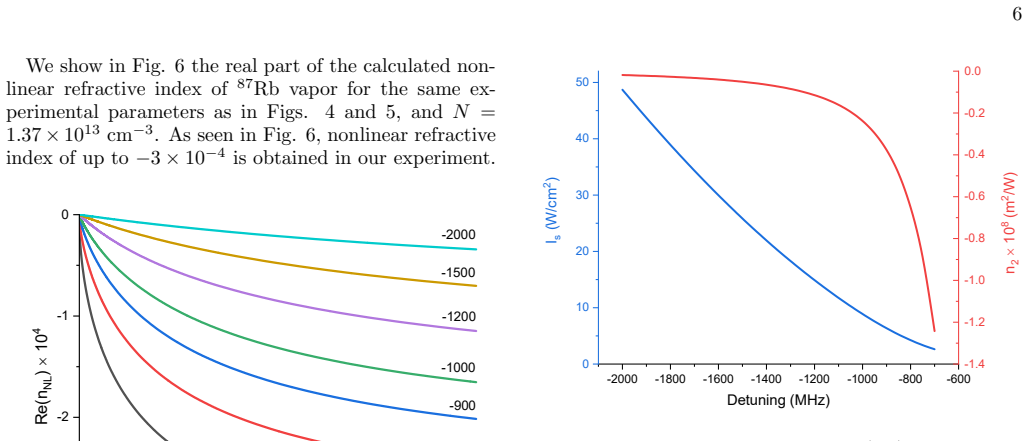
Theoretical calculations based on the optical Bloch equations for 6-level Rb atoms interacting with a probe laser are compared to experimental results from an interferometric technique, showing excellent quantitative agreement and yielding a Kerr nonlinear refractive index n2 of up to 10^{-4} cm²/W. Python scripts are provided for simulating the refractive index including Doppler broadening, transit time broadening, pressure broadening, saturation, optical pumping, and spin-exchange collisions.
What carries the argument
The optical Bloch equations applied to a 6-level model of Rb atoms, used to compute the refractive index while accounting for Doppler broadening, transit time broadening, pressure broadening, saturation, optical pumping, and spin-exchange collisions.
If this is right
- The model can be used to simulate refractive index changes in practical quantum sensor setups.
- Values of n2 reaching 10^{-4} cm²/W indicate strong nonlinear response in warm vapor cells.
- The inclusion of multiple broadening mechanisms ensures applicability to both centimeter-scale and millimeter-scale cells.
- Scripts allow direct integration into simulations for quantum fluids of light experiments.
Where Pith is reading between the lines
- Similar modeling approaches could be applied to other alkali atoms to predict their nonlinear indices without new experiments.
- High n2 values open possibilities for nonlinear optics at lower laser powers than previously considered.
- Validation in varying temperature or density regimes could test the model's limits beyond the presented conditions.
Load-bearing premise
The 6-level optical Bloch equation model, including treatments of Doppler broadening, transit time broadening, pressure broadening, saturation, optical pumping, and spin-exchange collisions, fully captures the relevant physics of the warm Rb vapor.
What would settle it
An experimental measurement of the nonlinear refractive index at a probe laser intensity or atomic density where unaccounted effects like higher-order collisions become dominant would falsify the model if it deviates from the predicted value.
Figures

read the original abstract
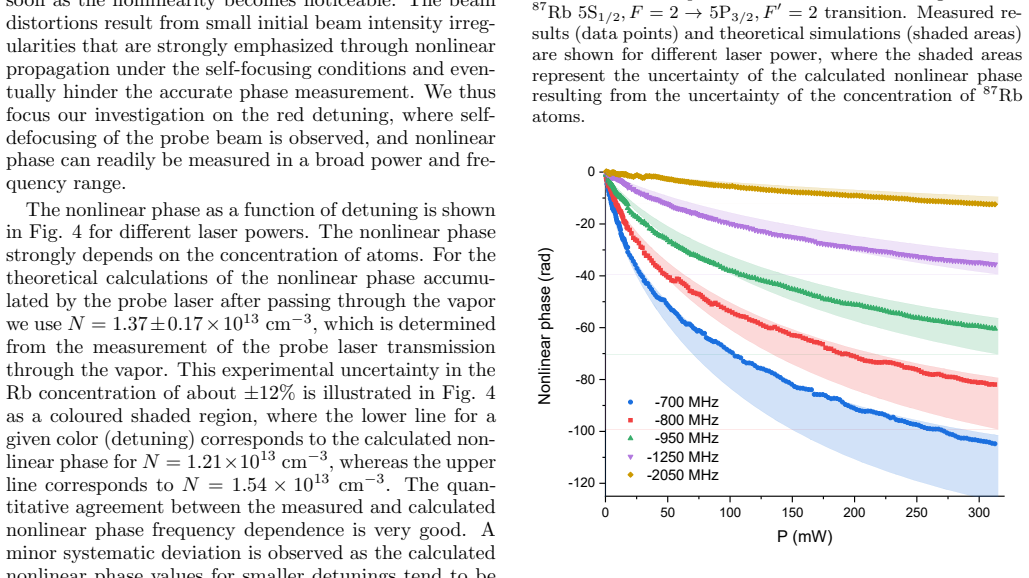
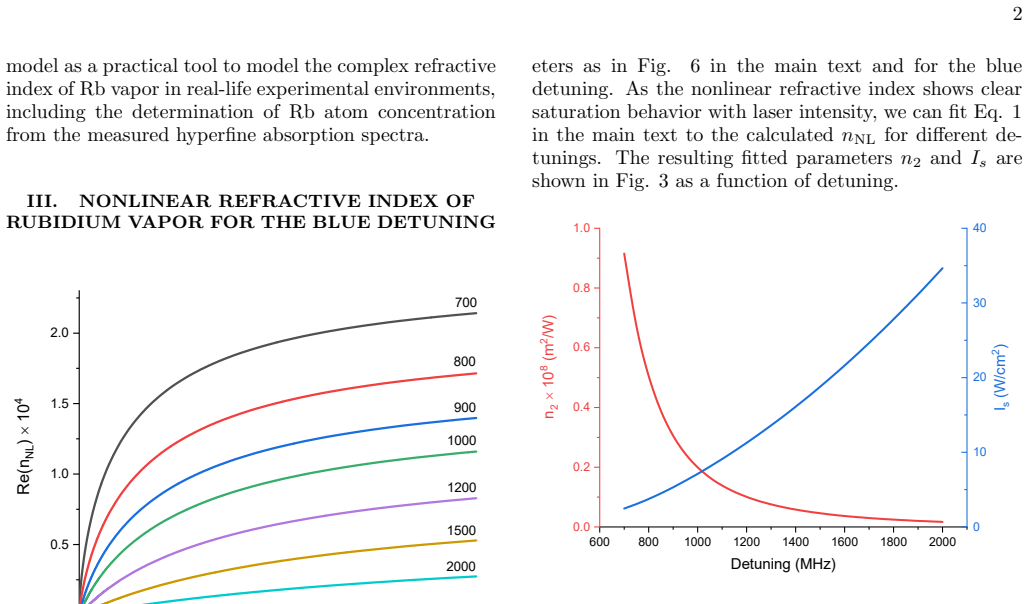
The potential to precisely control both the linear and nonlinear index of refraction through optical manipulation of the atomic states has recently pushed warm alkali vapors to the forefront of research in the field of quantum sensors, quantum memories, and quantum fluids of light. Rubidium (Rb) vapor in centimeter-scale glass cells or millimeter-scale MEMS cells has proven to be a very promising platform for these applications, yet only a handful of research works have been dedicated to the investigation of the (non)linear refractive index of Rb vapor. We present results of theoretical calculations of the (non)linear refractive index of warm Rb vapor, based on the optical Bloch equations for 6-level Rb atoms interacting with a probe laser. They are compared to the experimental results obtained using an interferometric technique, showing excellent quantitative agreement. A Kerr nonlinear refractive index $n_2$ of up to $10^{-4}$ cm$^2$/W is obtained. Python scripts for all theoretical calculations presented in this work are provided, including the refractive index calculation, that can readily be used in practical implementations for simulating the (non)linear refractive index of Rb vapor including the effects of Doppler broadening, transit time broadening, pressure broadening, saturation, optical pumping, and spin-exchange collisions.
Editorial analysis
A structured set of objections, weighed in public.
Referee Report
Summary. The manuscript presents theoretical calculations of the linear and nonlinear refractive index of warm Rb vapor using a 6-level optical Bloch equation model that incorporates Doppler broadening, transit-time broadening, pressure broadening, saturation, optical pumping, and spin-exchange collisions. These calculations are compared to experimental data obtained via an interferometric technique, with the authors reporting excellent quantitative agreement and a Kerr nonlinear index n2 reaching up to 10^{-4} cm²/W. Open Python scripts implementing the full refractive-index calculation are supplied.
Significance. If the reported quantitative agreement is robust, the work supplies a validated, reproducible model for n2 in warm Rb vapor that is directly relevant to quantum sensors, memories, and fluids of light. The provision of complete, inspectable Python code encoding all listed physical effects is a clear strength that allows independent verification of numerical choices and parameter handling.
minor comments (3)
- [Abstract] Abstract and §3: the phrase 'excellent quantitative agreement' is used without stating the metric (e.g., RMS deviation, reduced χ²) or the range of intensities, detunings, and cell parameters over which it was evaluated.
- [Methods] The manuscript states that parameters are fixed by independent measurements, yet no table or dedicated subsection lists the exact literature sources or measured values adopted for pressure-broadening coefficients, spin-exchange rates, and transit-time parameters.
- [Results] Figure captions and §4: error bars on the experimental n2 data and on the theoretical curves are not shown or discussed; this makes it difficult to judge the statistical significance of the reported agreement.
Simulated Author's Rebuttal
We thank the referee for their positive evaluation of our manuscript, including the recognition of the quantitative agreement between the 6-level optical Bloch model and experiment, the relevance to quantum sensors and fluids of light, and the value of the open Python scripts. We are pleased with the recommendation for minor revision.
Circularity Check
No significant circularity
full rationale
The derivation rests on solving the standard optical Bloch equations for a 6-level Rb system, with explicit inclusion of Doppler, transit-time, pressure, saturation, optical-pumping and spin-exchange terms whose functional forms are taken from the literature and whose numerical values are stated to be fixed by independent measurements. The resulting refractive-index expressions are then compared to separate interferometric data; the supplied Python implementation encodes the identical equations, permitting direct inspection that no fitted parameter from the target dataset is renamed as a prediction. No load-bearing step reduces by construction to the reported n2 values, and no self-citation chain is invoked to justify uniqueness or an ansatz.
Axiom & Free-Parameter Ledger
axioms (1)
- domain assumption Optical Bloch equations for a 6-level Rb atom interacting with a probe laser accurately describe the linear and nonlinear response including Doppler, transit time, pressure broadening, saturation, optical pumping, and spin-exchange collisions
Reference graph
Works this paper leans on
-
[1]
Kitching, Appl
J. Kitching, Appl. Phys. Rev.5, 031302 (2018)
2018
-
[2]
J. Ries, B. Brezger, and A. I. Lvovsky, Phys. Rev. A68, 025801 (2003)
2003
-
[3]
Mottola, G
R. Mottola, G. Buser, and P. Treutlein, Phys. Rev. Lett. 131, 260801 (2023)
2023
-
[4]
ˇSanti´ c, A
N. ˇSanti´ c, A. Fusaro, S. Salem, J. Garnier, A. Picozzi, and R. Kaiser, Phys. Rev. Lett.120, 055301 (2018)
2018
-
[5]
Glorieux, T
Q. Glorieux, T. Aladjidi, P. D. Lett, and R. Kaiser, New J. Phys.25, 051201 (2023)
2023
-
[6]
Vuli´ c, N.ˇSanti´ c, H
V. Vuli´ c, N.ˇSanti´ c, H. Buljan, and D. Aumiler, to be published (2026)
2026
-
[7]
C. F. McCormick, D. R. Solli, and R. Y. Chiao, Phys. Rev. A69, 023804 (2004)
2004
-
[8]
C. F. McCormick, D. R. Solli, R. Y. Chiao, and J. M. Hickmann, J. Opt. Soc. Am. B20, 2480 (2003)
2003
-
[9]
Jia, S.Wang, X.Wang, J
J.Wu, P. Jia, S.Wang, X.Wang, J. Yuan, L.Wang, Y. Hu, Z. Chen, and J. Xu, Opt. Express30, 43012 (2022)
2022
-
[10]
S. Wang, J. Yuan, L. Wang, L. Xiao, and S. Jia, Opt. Express28, 38334 (2020)
2020
-
[11]
Z. H. Levine and Z. Du, J. Opt. Soc. Am. B40, 3190 (2023)
2023
-
[12]
Z. H. Levine, J. Opt. Soc. Am. B42, 1310 (2025)
2025
-
[13]
Steck,Alkali d line data, URLhttps://steck.us/ alkalidata/
D. Steck,Alkali d line data, URLhttps://steck.us/ alkalidata/
-
[14]
Sagle, R
J. Sagle, R. K. Namiotka, and J. Huennekens, J. Phys. B: At. Mol. Opt. Phys.29, 2629 (1996)
1996
-
[15]
Weller, R
L. Weller, R. J. Bettles, P. Siddons, C. S. Adams, and I. G. Hughes, J. Phys. B: At. Mol. Opt. Phys.44, 195006 (2011)
2011
-
[16]
H. M. Gibbs and R. J. Hull, Phys. Rev.153, 132 (1967)
1967
-
[17]
G. P. Agrawal,Nonlinear Fiber Optics(Academic Press, 2019)
2019
-
[18]
T. Aladjidi, M. Abuzarli, G. Brochier, T. Bienaim´ e, T. Picot, A. Bramati, and Q. Glorieux, URLhttps: //arxiv.org/abs/2202.05764
-
[19]
Siddons, C
P. Siddons, C. S. Adams, C. Ge, and I. G. Hughes, J. Phys. B: At. Mol. Opt. Phys.41, 155004 (2008). Supporting Information Nonlinear refractive index of warm rubidium vapor L. Kardum, 1 G. Premec, 1 N. ˇSanti´ c,1 and D. Aumiler 1 1Institute of Physics, Bijeniˇ cka cesta 46, 10000 Zagreb, Croatia (Dated: June 12, 2026) I. TRANSIT TIME BROADENING Γt in Eqs...
2008
-
[20]
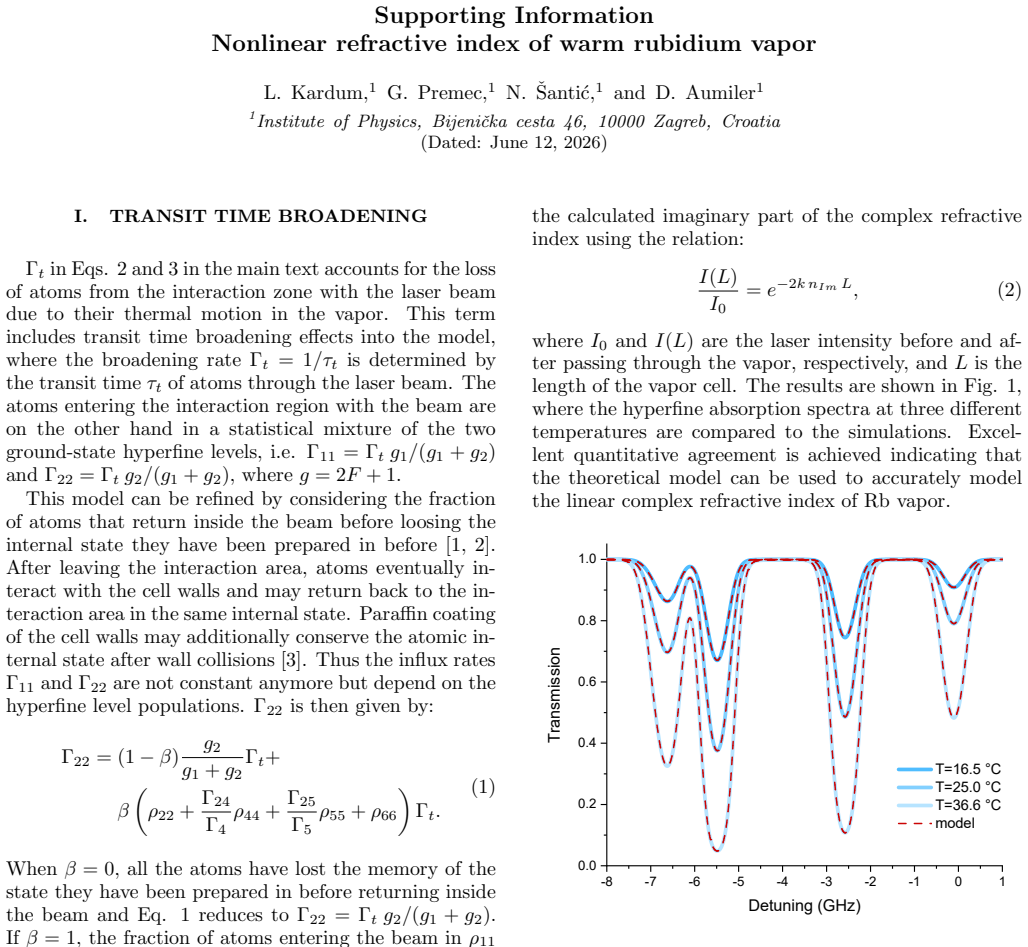
are used. Transmission spectra are simulated using the calculated imaginary part of the complex refractive index using the relation: I(L) I0 =e −2k nIm L,(2) whereI 0 andI(L) are the laser intensity before and af- ter passing through the vapor, respectively, andLis the length of the vapor cell. The results are shown in Fig. 1, where the hyperfine absorpti...
2000
-
[21]
Ghosh, R
J. Ghosh, R. Ghosh, F. Goldfarb, J.-L. L. Gou¨ et, and F. Bretenaker, Phys. Rev. A80, 023817 (2009)
2009
-
[22]
Fontaine, Ph.D
Q. Fontaine, Ph.D. thesis, Sorbonne Universit´ e (2020)
2020
-
[23]
Klein, M
M. Klein, M. Hohensee, D. Phillips, and R. Walsworth, Phys. Rev. A83, 013826 (2011)
2011
-
[24]
Siddons, C
P. Siddons, C. S. Adams, C. Ge, and I. G. Hughes, J. Phys. B: At. Mol. Opt. Phys.41, 155004 (2008)
2008
-
[25]
A. N. Nesmeyanov,Vapor Pressure of the Chemical Ele- ments(Elsevier, Amsterdam, 1963). 10
1963
discussion (0)
Sign in with ORCID, Apple, or X to comment. Anyone can read and Pith papers without signing in.