Vertex Superalgebras for Hypertoric Varieties and 3d Abelian Gauge Theories
Pith reviewed 2026-06-25 21:29 UTC · model grok-4.3
The pith
An ħ-adic sheaf of vertex operator superalgebras on smooth hypertoric varieties has global sections whose associated affine variety recovers the singular hypertoric variety.
A machine-rendered reading of the paper's core claim, the machinery that carries it, and where it could break.
Core claim
The ħ-adic sheaf of vertex operator superalgebras is constructed over any smooth hypertoric variety so that its global sections reproduce the A-twisted boundary of the corresponding 3d gauge theory; the associated affine variety of these global sections is then shown to be exactly the singular hypertoric variety, proving the 3d Higgs branch conjecture for this class and establishing that the superalgebras are quasi-lisse.
What carries the argument
The ħ-adic sheaf of vertex operator superalgebras over a smooth hypertoric variety, whose global sections give the A-twisted boundary.
If this is right
- The vertex operator superalgebras are quasi-lisse.
- They arise as fermionic simple-current extensions of the earlier hypertoric vertex operator superalgebras.
- Their characters are quasimodular forms.
- The 3d Higgs branch conjecture holds for this large class of boundary vertex operator superalgebras.
Where Pith is reading between the lines
- The same sheaf construction might supply a template for producing quasi-lisse vertex operator superalgebras on other classes of symplectic singularities.
- The upgrade from partial theta functions to quasimodular forms suggests a direct link between the fermionic extension and modular properties of the characters.
- Symplectic duality statements could be rephrased in terms of the simple-current extension data rather than the original even algebras.
Load-bearing premise
The ħ-adic sheaf of vertex operator superalgebras can be constructed over any smooth hypertoric variety and its global sections exactly reproduce the A-twisted boundary of the corresponding 3d gauge theory.
What would settle it
For any explicit smooth hypertoric variety, compute the associated affine variety of the global sections of the constructed sheaf and check whether it fails to equal the singular hypertoric variety.
Figures
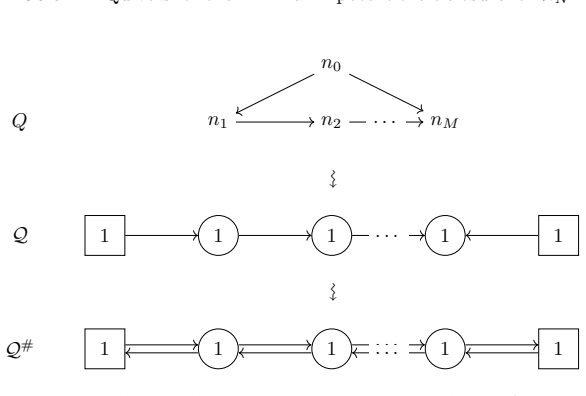
read the original abstract
Hypertoric (or toric hyperk\"ahler) varieties are a class of symplectic singularities and their resolutions, obtained as Hamiltonian reductions of a symplectic vector space acted on by a torus. In physics, they appear as Higgs (and Coulomb) branches of 3d $\mathcal{N}=4$ supersymmetric quantum field theories with abelian gauge group. In this work, we construct an $\hbar$-adic (in the sense of microlocalisation) sheaf of vertex operator superalgebras over a given smooth hypertoric variety. Its global sections give the $A$-twisted boundary of the corresponding 3d gauge theory. We use this to prove that the associated affine variety of this hypertoric vertex operator superalgebra recovers the singular hypertoric variety. This proves the 3d Higgs branch conjecture for a large class of boundary vertex operator superalgebras. In particular, these vertex operator superalgebras are quasi-lisse. This is in contrast to the (purely even) hypertoric vertex operator superalgebras (and their $\hbar$-adic localisations) constructed previously by Kuwabara as global sections of sheaves on families of universal Poisson deformations of the hypertoric varieties. These are generally not quasi-lisse. We show that the vertex operator superalgebras defined in this paper are (fermionic) simple-current extensions of those defined by Kuwabara, and investigate the consequences for symplectic duality and characters. We observe that the latter are upgraded from partial (or false) theta functions to quasimodular forms.
Editorial analysis
A structured set of objections, weighed in public.
Referee Report
Summary. The manuscript constructs an ħ-adic sheaf of vertex operator superalgebras on any smooth hypertoric variety via fermionic simple-current extensions of Kuwabara's sheaves. Global sections recover the A-twisted boundary VOSA of the corresponding 3d N=4 abelian gauge theory. It proves that the associated affine variety of this VOSA is the singular hypertoric variety, thereby establishing the 3d Higgs branch conjecture for this class of boundary VOSAs. The resulting VOSAs are shown to be quasi-lisse, in contrast to the purely even constructions of Kuwabara, and the paper investigates consequences for symplectic duality and shows that characters upgrade from partial theta functions to quasimodular forms.
Significance. If the central construction and identification hold, the work supplies an explicit sheaf-theoretic realization linking vertex operator superalgebras to the Higgs branches of 3d abelian gauge theories. The proof of the Higgs branch conjecture for a large class, the quasi-lisse property via simple-current extension, and the upgrade of characters to quasimodular forms constitute substantive advances. The explicit fermionic correction and direct verification of the associated-variety map are strengths that distinguish the result from prior work.
minor comments (2)
- [§2] Notation for the ħ-adic topology and microlocalisation should be introduced with a brief reminder of the relevant completion in the first section where the sheaf is defined, to aid readers unfamiliar with the Kuwabara setup.
- [§4] The statement that the extension is a simple-current extension would benefit from an explicit reference to the precise definition of simple-current used (e.g., the grading or the fusion rules employed).
Simulated Author's Rebuttal
We thank the referee for their positive assessment of the manuscript, the detailed summary of its contributions, and the recommendation to accept. No major comments were raised.
Circularity Check
No significant circularity; derivation self-contained via explicit construction
full rationale
The paper's central claim—that the associated affine variety of the constructed hypertoric VOSA recovers the singular hypertoric variety, proving the 3d Higgs branch conjecture—rests on an explicit new construction of an ħ-adic sheaf of VOSAs over smooth hypertoric varieties via fermionic simple-current extensions of Kuwabara's sheaves, followed by direct verification that global sections recover the A-twisted boundary VOSA and that the associated variety map yields the expected singular variety. No load-bearing step reduces by definition, fitted input, or self-citation chain to the paper's own inputs; the quasi-lisse property follows immediately from the simple-current extension and base objects. The cited Kuwabara work is external prior art, not a self-referential load-bearing premise, and the argument supplies independent content through the new sheaf and verification steps.
Axiom & Free-Parameter Ledger
axioms (2)
- domain assumption Hypertoric varieties arise as Hamiltonian reductions and admit smooth resolutions.
- domain assumption A-twisted boundary of 3d N=4 abelian gauge theory is captured by global sections of a vertex superalgebra sheaf.
Reference graph
Works this paper leans on
-
[1]
Andrews and Bruce C
George E. Andrews and Bruce C. Berndt. Ramanujan's lost notebook. P art I . Springer, 2005
2005
-
[2]
Andrews and Bruce C
George E. Andrews and Bruce C. Berndt. Ramanujan's lost notebook. P art II . Springer, 2009
2009
-
[3]
Classification of irreducible modules of certain subalgebras of free boson vertex algebra
Dra z en Adamovi\'c. Classification of irreducible modules of certain subalgebras of free boson vertex algebra. J. Algebra , 270(1):115--132, 2003. (arXiv:math/0207155v1 [math.QA] http://arxiv.org/abs/math/0207155v1)
Pith/arXiv arXiv 2003
-
[4]
Chiral differential operators on classical invariant rings via BRST reduction
Tomoyuki Arakawa, Xuanzhong Dai and Bailin Song. Chiral differential operators on classical invariant rings via BRST reduction. In preparation, 2026
2026
-
[5]
Quasi-lisse vertex algebras and modular linear differential equations
Tomoyuki Arakawa and Kazuya Kawasetsu. Quasi-lisse vertex algebras and modular linear differential equations. In Lie groups, geometry, and representation theory , volume 326 of Progr. Math. , pages 41--57. Birkh\" a user, 2018. (arXiv:1610.05865v4 [math.QA] http://arxiv.org/abs/1610.05865v4)
Pith/arXiv arXiv 2018
-
[6]
Tomoyuki Arakawa, Toshiro Kuwabara and Fyodor G. Malikov. Localization of affine W -algebras. Comm. Math. Phys. , 335(1):143--182, 2015. (arXiv:1112.0089v1 [math.AG] http://arxiv.org/abs/1112.0089v1)
Pith/arXiv arXiv 2015
-
[7]
Hilbert schemes of points in the plane and quasi-lisse vertex algebras with N =4 symmetry
Tomoyuki Arakawa, Toshiro Kuwabara and Sven M\" o ller. Hilbert schemes of points in the plane and quasi-lisse vertex algebras with N =4 symmetry. (arXiv:2309.17308v1 [math.RT] http://arxiv.org/abs/2309.17308v1), 2023
arXiv 2023
-
[8]
Andrews, Richard P
George E. Andrews, Richard P. Lewis and Zhi-Guo Liu. An identity relating a theta function to a sum of L ambert series. Bull. London Math. Soc. , 33(1):25--31, 2001
2001
-
[9]
Some applications and constructions of intertwining operators in logarithmic conformal field theory
Dra z en Adamovi\'c and Antun Milas. Some applications and constructions of intertwining operators in logarithmic conformal field theory. In Lie algebras, vertex operator algebras, and related topics , volume 695 of Contemp. Math. , pages 15--27. Amer. Math. Soc., 2017. (arXiv:1605.05561v1 [math.QA] http://arxiv.org/abs/1605.05561)
Pith/arXiv arXiv 2017
-
[10]
Sheets and associated varieties of affine vertex algebras
Tomoyuki Arakawa and Anne Moreau. Sheets and associated varieties of affine vertex algebras. Adv. Math. , 320:157--209, 2017. (arXiv:1601.05906v4 [math.RT] http://arxiv.org/abs/1601.05906v4)
Pith/arXiv arXiv 2017
-
[11]
On some vertex algebras related to V_ -1 ( sl (n)) and their characters
Dra z en Adamovi\'c and Antun Milas. On some vertex algebras related to V_ -1 ( sl (n)) and their characters. Transform. Groups , 26(1):1--30, 2021. (arXiv:1805.09771v2 [math.QA] http://arxiv.org/abs/1805.09771v2)
Pith/arXiv arXiv 2021
-
[12]
Arc spaces and vertex algebras
Tomoyuki Arakawa and Anne Moreau. Arc spaces and vertex algebras. (https://www.imo.universite-paris-saclay.fr/ anne.moreau/Arc_space-vertex_algebras-BOOK_version.pdf), 2024
2024
-
[13]
George E. Andrews. Hecke modular forms and the K ac- P eterson identities. Trans. Amer. Math. Soc. , 283(2):451--458, 1984
1984
-
[14]
Fusion rules and complete reducibility of certain modules for affine L ie algebras
Dra z en Adamovi\'c and Ozren Per s e. Fusion rules and complete reducibility of certain modules for affine L ie algebras. J. Algebra Appl. , 13(1):1350062, 2014. (arXiv:1207.7177v2 [math.QA] http://arxiv.org/abs/1207.7177v2)
Pith/arXiv arXiv 2014
-
[15]
A remark on the C_2 -cofiniteness condition on vertex algebras
Tomoyuki Arakawa. A remark on the C_2 -cofiniteness condition on vertex algebras. Math. Z. , 270(1--2):559--575, 2012. (arXiv:1004.1492v2 [math.QA] http://arxiv.org/abs/1004.1492v2)
Pith/arXiv arXiv 2012
-
[16]
Localisation de g -modules
Alexandre Beilinson and Joseph Bernstein. Localisation de g -modules. C. R. Acad. Sci. Paris S\'er. I Math. , 292(1):15--18, 1981
1981
-
[17]
3d mirror symmetry of braided tensor categories
Andrew Ballin, Thomas Creutzig, Tudor Dimofte and Wenjun Niu. 3d mirror symmetry of braided tensor categories. (arXiv:2304.11001v1 [hep-th] http://arxiv.org/abs/2304.11001v1), 2023
arXiv 2023
-
[18]
Roger Bielawski and Andrew S. Dancer. The geometry and topology of toric hyperk\"ahler manifolds. Comm. Anal. Geom. , 8(4):727--760, 2000
2000
-
[19]
Boundaries, mirror symmetry, and symplectic duality in 3d N =4 gauge theory
Mathew Bullimore, Tudor Dimofte, Davide Gaiotto and Justin Hilburn. Boundaries, mirror symmetry, and symplectic duality in 3d N =4 gauge theory. J. High Energy Phys. , (10):108, 2016. (arXiv:1603.08382v3 [hep-th] http://arxiv.org/abs/1603.08382v3)
Pith/arXiv arXiv 2016
-
[20]
Representations of a class of lattice type vertex algebras
Stephen Berman, Chongying Dong and Shaobin Tan. Representations of a class of lattice type vertex algebras. J. Pure Appl. Algebra , 176(1):27--47, 2002. (arXiv:math/0109215v1 [math.QA] http://arxiv.org/abs/math/0109215v1)
Pith/arXiv arXiv 2002
-
[21]
Arnaud Beauville. Symplectic singularities. Invent. Math. , 139(3):541--549, 2000. (arXiv:math/9903070v1 [math.AG] http://arxiv.org/abs/math/9903070v1)
Pith/arXiv arXiv 2000
-
[22]
Christopher Beem and Andrea E. V. Ferrari. Free field realisation of boundary vertex algebras for A belian gauge theories in three dimensions. Comm. Math. Phys. , 406(5):117, 2025. (arXiv:2304.11055v2 [hep-th] http://arxiv.org/abs/2304.11055v2)
arXiv 2025
-
[23]
Towards a mathematical definition of C oulomb branches of 3-dimensional N =4 gauge theories, II
Alexander Braverman, Michael Finkelberg and Hiraku Nakajima. Towards a mathematical definition of C oulomb branches of 3-dimensional N =4 gauge theories, II . Adv. Theor. Math. Phys. , 22(5):1071--1147, 2018. (arXiv:1601.03586v8 [math.RT] http://arxiv.org/abs/1601.03586v8)
arXiv 2018
-
[24]
Kathrin Bringmann, Amanda Folsom and Robert C. Rhoades. Partial theta functions and mock modular forms as q -hypergeometric series. Ramanujan J. , 29(1-3):295--310, 2012. (arXiv:1109.6560v1 [math.NT] http://arxiv.org/abs/1109.6560v1)
Pith/arXiv arXiv 2012
-
[25]
On the semi-infinite cohomology of graded-unitary vertex algebras
Christopher Beem and Niklas Garner. On the semi-infinite cohomology of graded-unitary vertex algebras. J. Algebra , 698:172--223, 2026. (arXiv:2509.10364v1 [math.QA] http://arxiv.org/pdf/2509.10364)
arXiv 2026
-
[26]
On deformation quantizations of hypertoric varieties
Gwyn Bellamy and Toshiro Kuwabara. On deformation quantizations of hypertoric varieties. Pacific J. Math. , 260(1):89--127, 2012. (arXiv:1005.4645v3 [math.RT] http://arxiv.org/abs/1005.4645v3)
Pith/arXiv arXiv 2012
-
[27]
Christopher Beem, Madalena Lemos, Pedro Liendo, Wolfger Peelaers, Leonardo Rastelli and Balt C. van Rees. Infinite chiral symmetry in four dimensions. Comm. Math. Phys. , 336(3):1359--1433, 2015. (arXiv:1312.5344v3 [hep-th] http://arxiv.org/abs/1312.5344v3)
Pith/arXiv arXiv 2015
-
[28]
Tom C. Braden, Anthony M. Licata, Nicholas J. Proudfoot and Ben Webster. Gale duality and K oszul duality. Adv. Math. , 225(4):2002--2049, 2010. (arXiv:0806.3256v2 [math.RT] http://arxiv.org/abs/0806.3256v2)
arXiv 2002
-
[29]
Tom C. Braden, Anthony M. Licata, Nicholas J. Proudfoot and Ben Webster. Hypertoric category O . Adv. Math. , 231(3-4):1487--1545, 2012. (arXiv:1010.2001v5 [math.RT] http://arxiv.org/abs/1010.2001)
arXiv 2012
-
[30]
Tom C. Braden, Anthony M. Licata, Nicholas J. Proudfoot and Ben Webster. Quantizations of conical symplectic resolutions I : local and global structure. Ast\' e risque , (384):1--73, 2016. (arXiv:1208.3863v6 [math.RT] http://arxiv.org/abs/1208.3863v6)
arXiv 2016
-
[31]
Tom C. Braden, Anthony M. Licata, Nicholas J. Proudfoot and Ben Webster. Quantizations of conical symplectic resolutions II : category O and symplectic duality. Ast\' e risque , (384):75--179, 2016. With an appendix by Ivan Losev. (arXiv:1407.0964v5 [math.RT] http://arxiv.org/abs/1407.0964v5)
arXiv 2016
-
[32]
Borcherds
Richard E. Borcherds. Problems in M oonshine. In First international congress of C hinese mathematicians , volume 20 of AMS/IP Stud. Adv. Math. , pages 3--10. Amer. Math. Soc., 2001
2001
-
[33]
Lev A. Borisov. Vertex algebras and mirror symmetry. Comm. Math. Phys. , 215(3):517--557, 2001. (arXiv:math/9809094v2 [math.AG] http://arxiv.org/abs/math/9809094v2)
Pith/arXiv arXiv 2001
-
[34]
Vertex operator algebras, H iggs branches, and modular differential equations
Christopher Beem and Leonardo Rastelli. Vertex operator algebras, H iggs branches, and modular differential equations. J. High Energy Phys. , (8):114, 2018. (arXiv:1707.07679v4 [hep-th] http://arxiv.org/abs/1707.07679v4)
arXiv 2018
-
[35]
Higgs and C oulomb branches from vertex operator algebras
Kevin Costello, Thomas Creutzig and Davide Gaiotto. Higgs and C oulomb branches from vertex operator algebras. J. High Energy Phys. , (3):066, 2019. (arXiv:1811.03958v1 [hep-th] http://arxiv.org/abs/1811.03958v1)
Pith/arXiv arXiv 2019
-
[36]
Vertex O perator A lgebras and 3d N=4 gauge theories
Kevin Costello and Davide Gaiotto. Vertex O perator A lgebras and 3d N=4 gauge theories. J. High Energy Phys. , (5):018, 2019. (arXiv:1804.06460v1 [hep-th] http://arxiv.org/abs/1804.06460v1)
Pith/arXiv arXiv 2019
-
[37]
Thomas Creutzig, Shashank Kanade, Andrew R. Linshaw and David Ridout. S chur- W eyl duality for H eisenberg cosets. Transform. Groups , 24(2):301--354, 2019. (arXiv:1611.00305v1 [math.QA] http://arxiv.org/abs/1611.00305v1)
arXiv 2019
-
[38]
On ribbon categories for singlet vertex algebras
Thomas Creutzig, Robert McRae and Jinwei Yang. On ribbon categories for singlet vertex algebras. Comm. Math. Phys. , 387(2):865--925, 2021. (arXiv:2007.12735v2 [math.QA] http://arxiv.org/abs/2007.12735v2)
arXiv 2021
-
[39]
Ribbon tensor structure on the full representation categories of the singlet vertex algebras
Thomas Creutzig, Robert McRae and Jinwei Yang. Ribbon tensor structure on the full representation categories of the singlet vertex algebras. Adv. Math. , 413:108828, 2023. (arXiv:2202.05496v2 [math.QA] http://arxiv.org/abs/2202.05496v2)
arXiv 2023
-
[40]
Superconformal index, BPS monodromy and chiral algebras
Sergio Cecotti, Jaewon Song, Cumrun Vafa and Wenbin Yan. Superconformal index, BPS monodromy and chiral algebras. J. High Energy Phys. , (11):013, 2017. (arXiv:1511.01516v2 [hep-th] http://arxiv.org/abs/1511.01516v2)
Pith/arXiv arXiv 2017
-
[41]
Affine W -algebras and M iura maps from 3d N =4 non- A belian quiver gauge theories
Ioana Coman, Myungbo Shim, Masahito Yamazaki and Yehao Zhou. Affine W -algebras and M iura maps from 3d N =4 non- A belian quiver gauge theories. Comm. Math. Phys. , 406(6):122, 2025. (arXiv:2312.13363v1 [hep-th] http://arxiv.org/abs/2312.13363v1)
arXiv 2025
-
[42]
Chiralization of quiver varieties
Ioana Coman, Myungbo Shim, Masahito Yamazaki and Yehao Zhou. Chiralization of quiver varieties. 2026
2026
-
[43]
Frenkel and David Ben-Zvi
Edward V. Frenkel and David Ben-Zvi. Vertex Algebras and Algebraic Curves , volume 88 of Math. Surveys Monogr. Amer. Math. Soc., 2nd edition, 2004
2004
-
[44]
Vanda Farsad, Azat M. Gainutdinov and Ingo Runkel. The symplectic fermion ribbon quasi- H opf algebra and the SL(2, Z ) -action on its centre. Adv. Math. , 400:108247, 2022. (arXiv:1706.08164v3 [math.QA] http://arxiv.org/abs/1706.08164v3)
arXiv 2022
-
[45]
Michael A. I. Flohr. On modular invariant partition functions of conformal field theories with logarithmic operators. Internat. J. Modern Phys. A , 11(22):4147--4172, 1996. (arXiv:hep-th/9509166v2 http://arxiv.org/abs/hep-th/9509166v2)
Pith/arXiv arXiv 1996
-
[46]
Amanda Folsom, Ken Ono and Robert C. Rhoades. Mock theta functions and quantum modular forms. Forum Math. Pi , 1:e2, 2013
2013
-
[47]
Boris L. Feigin and Alexei M. Semikhatov. W ^ (2) _n algebras. Nuclear Phys. B , 698(3):409--449, 2004. (arXiv:math/0401164v1 [math.QA] http://arxiv.org/abs/math/0401164v1)
Pith/arXiv arXiv 2004
-
[48]
Andrea E. V. Ferrari and Aiden Suter. L_1( psl _ n|n ) from BRST reductions, associated varieties and nilpotent orbits. (arXiv:2409.13028v1 [math.QA] http://arxiv.org/abs/2409.13028v1), 2024
arXiv 2024
-
[49]
Twisted compactifications of 3d N =4 theories and conformal blocks
Davide Gaiotto. Twisted compactifications of 3d N =4 theories and conformal blocks. J. High Energy Phys. , (2):061, 2019. (arXiv:1611.01528v2 [hep-th] http://arxiv.org/abs/1611.01528v2)
Pith/arXiv arXiv 2019
-
[50]
Computing G -crossed extensions and orbifolds of vertex operator algebras
C\' e sar Galindo, Simon Lentner and Sven M \"o ller. Computing G -crossed extensions and orbifolds of vertex operator algebras. (arXiv:2409.16357v2 [math.QA] http://arxiv.org/abs/2409.16357v2), 2024
arXiv 2024
-
[51]
Supersymmetric boundary conditions in N =4 super Y ang- M ills theory
Davide Gaiotto and Edward Witten. Supersymmetric boundary conditions in N =4 super Y ang- M ills theory. J. Stat. Phys. , 135(5-6):789--855, 2009. (arXiv:0804.2902v2 [hep-th] http://arxiv.org/abs/0804.2902v2)
Pith/arXiv arXiv 2009
-
[52]
om and Martin Ro c ek. Hyper- K \
Nigel J. Hitchin, Anders Karlhede, Ulf G. Lindstr\"om and Martin Ro c ek. Hyper- K \"ahler metrics and supersymmetry. Comm. Math. Phys. , 108(4):535--589, 1987
1987
-
[53]
Gerald H \"o hn and Sven M \"o ller. Classification of self-dual vertex operator superalgebras of central charge at most 24. (arXiv:2303.17190v2 [math.QA] http://arxiv.org/abs/2303.17190v2), 2023
arXiv 2023
-
[54]
Toric hyper K \"ahler varieties
Tam\'as Hausel and Bernd Sturmfels. Toric hyper K \"ahler varieties. Doc. Math. , 7:495--534, 2002. (arXiv:math/0203096v2 [math.AG] http://arxiv.org/abs/math/0203096v2)
Pith/arXiv arXiv 2002
-
[55]
Mirror symmetry in three-dimensional gauge theories
Kenneth Intriligator and Nathan Seiberg. Mirror symmetry in three-dimensional gauge theories. Phys. Lett. B , 387(3):513--519, 1996. (arXiv:hep-th/9607207v1 http://arxiv.org/abs/hep-th/9607207v1)
Pith/arXiv arXiv 1996
-
[56]
Victor G. Kac. Vertex Algebras for Beginners , volume 10 of Univ. Lecture Ser. Amer. Math. Soc., 2nd edition, 1998
1998
-
[57]
Dmitry B. Kaledin. Symplectic singularities from the P oisson point of view. J. Reine Angew. Math. , 600:135--156, 2006. (arXiv:math/0310186v4 [math.AG] http://arxiv.org/abs/math/0310186v4)
Pith/arXiv arXiv 2006
-
[58]
Symplectic resolutions, symplectic duality, and C oulomb branches
Joel Kamnitzer. Symplectic resolutions, symplectic duality, and C oulomb branches. Bull. Lond. Math. Soc. , 54(5):1515--1551, 2022. (arXiv:2202.03913v3 [math.RT] http://arxiv.org/abs/2202.03913v3)
arXiv 2022
-
[59]
Quiver representations and quiver varieties , volume 174 of Grad
Alexander Kirillov, Jr. Quiver representations and quiver varieties , volume 174 of Grad. Stud. Math. Amer. Math. Soc., 2016
2016
-
[60]
The geometry of toric hyperkähler varieties
Hiroshi Konno. The geometry of toric hyperkähler varieties. (arXiv:0709.1252v1 [math.DG] http://arxiv.org/abs/0709.1252v1), 2007
Pith/arXiv arXiv 2007
-
[61]
Microlocalization of rational C herednik algebras
Masaki Kashiwara and Rapha\" e l Rouquier. Microlocalization of rational C herednik algebras. Duke Math. J. , 144(3):525--573, 2008. (arXiv:0705.1245v2 [math.RT] http://arxiv.org/abs/0705.1245v2)
Pith/arXiv arXiv 2008
-
[62]
B RST cohomologies for symplectic reflection algebras and quantizations of hypertoric varieties
Toshiro Kuwabara. B RST cohomologies for symplectic reflection algebras and quantizations of hypertoric varieties. Transform. Groups , 20(2):437--461, 2015. (arXiv:1311.1787v1 [math.QA] http://arxiv.org/abs/1311.1787v1)
Pith/arXiv arXiv 2015
-
[63]
Vertex algebras associated with hypertoric varieties
Toshiro Kuwabara. Vertex algebras associated with hypertoric varieties. Int. Math. Res. Not. IMRN , (18):14316--14378, 2021. (arXiv:1706.02203v1 [math.QA] http://arxiv.org/abs/1706.02203)
Pith/arXiv arXiv 2021
-
[64]
Dmitry B. Kaledin and Misha S. Verbitsky. Period map for non-compact holomorphically symplectic manifolds. Geom. Funct. Anal. , 12(6):1265--1295, 2002. (arXiv:math/0005007v2 [math.AG] http://arxiv.org/abs/math/0005007v2)
Pith/arXiv arXiv 2002
-
[65]
Victor G. Kac and Minoru Wakimoto. Integrable highest weight modules over affine superalgebras and number theory. In Jean-Luc Brylinski, Ranee K. Brylinski, Victor W. Guillemin and Victor G. Kac, editors, Lie theory and geometry , volume 123 of Progr. Math. , pages 415--456. Birkhäuser, 1994. (arXiv:hep-th/9407057v1 http://arxiv.org/abs/hep-th/9407057v1)
Pith/arXiv arXiv 1994
-
[66]
Vertex algebras and vertex P oisson algebras
Haisheng Li. Vertex algebras and vertex P oisson algebras. Commun. Contemp. Math. , 6(1):61--110, 2004. (arXiv:math/0209310v2 [math.QA] http://arxiv.org/abs/math/0209310v2)
Pith/arXiv arXiv 2004
-
[67]
Haisheng Li. Abelianizing vertex algebras. Comm. Math. Phys. , 259(2):391--411, 2005. (arXiv:math/0409140v1 [math.QA] http://arxiv.org/abs/math/0409140v1)
Pith/arXiv arXiv 2005
-
[68]
Quasi-lisse vertex (super)algebras
Hao Li. Quasi-lisse vertex (super)algebras. (arXiv:2308.04993v1 [math.QA] http://arxiv.org/abs/2308.04993v1), 2023
arXiv 2023
-
[69]
Andrew R. Linshaw. Invariant chiral differential operators and the W _3 algebra. J. Pure Appl. Algebra , 213(5):632--648, 2009. (arXiv:0710.0194v4 [math.RT] http://arxiv.org/abs/0710.0194v4)
arXiv 2009
-
[70]
Ivan V. Losev. Isomorphisms of quantizations via quantization of resolutions. Adv. Math. , 231(3-4):1216--1270, 2012. (arXiv:1010.3182v3 [math.QA] http://arxiv.org/abs/1010.3182v3)
Pith/arXiv arXiv 2012
-
[71]
Ivan V. Losev. Deformations of symplectic singularities and orbit method for semisimple L ie algebras. Selecta Math. (N.S.) , 28(2):30, 2022. (arXiv:1605.00592v4 [math.RT] http://arxiv.org/abs/1605.00592v4)
arXiv 2022
-
[72]
Malikov, Vadim Schechtman and Arkady Vaintrob
Fyodor G. Malikov, Vadim Schechtman and Arkady Vaintrob. Chiral de R ham complex. Comm. Math. Phys. , 204(2):439--473, 1999. (arXiv:math/9803041v7 [math.AG] http://arxiv.org/abs/math/9803041v7)
Pith/arXiv arXiv 1999
-
[73]
Musson and Michel Van den Bergh
Ian M. Musson and Michel Van den Bergh. Invariants under tori of rings of differential operators and related topics. Mem. Amer. Math. Soc. , 136(650), 1998
1998
-
[74]
The universal P oisson deformation of hypertoric varieties and some classification results
Takahiro Nagaoka. The universal P oisson deformation of hypertoric varieties and some classification results. Pacific J. Math. , 313(2):459--508, 2021. (arXiv:1810.02961v2 [math.AG] http://arxiv.org/abs/1810.02961v2)
arXiv 2021
-
[75]
Instantons on ALE spaces, quiver varieties, and K ac- M oody algebras
Hiraku Nakajima. Instantons on ALE spaces, quiver varieties, and K ac- M oody algebras. Duke Math. J. , 76(2):365--416, 1994
1994
-
[76]
Quiver varieties and K ac- M oody algebras
Hiraku Nakajima. Quiver varieties and K ac- M oody algebras. Duke Math. J. , 91(3):515--560, 1998
1998
-
[77]
Representation Theory, Algebraic Geometry and Supersymmetric Field Theories in Low Dimensions
Wenjun Niu. Representation Theory, Algebraic Geometry and Supersymmetric Field Theories in Low Dimensions . Ph.D. thesis , University of California, Davis, 2023
2023
-
[78]
On bosonic vertex algebras associated with 3D reductions of Argyres-Douglas theories
Takahiro Nishinaka and Hikaru Sasaki. On bosonic vertex algebras associated with 3D reductions of Argyres-Douglas theories. (arXiv:2508.15315v1 [hep-th] http://arxiv.org/abs/2508.15315v1), 2025
arXiv 2025
-
[79]
Nicholas J. Proudfoot. A survey of hypertoric geometry and topology. In Toric topology , volume 460 of Contemp. Math. , pages 323--338. Amer. Math. Soc., 2008. (arXiv:0705.4236v1 [math.AG] http://arxiv.org/abs/0705.4236v1)
Pith/arXiv arXiv 2008
-
[80]
Intersection cohomology of hypertoric varieties
Nicholas Proudfoot and Ben Webster. Intersection cohomology of hypertoric varieties. J. Algebraic Geom. , 16(1):39--63, 2007. (arXiv:math/0411350v5 [math.AG] http://arxiv.org/abs/math/0411350v5)
arXiv 2007
discussion (0)
Sign in with ORCID, Apple, or X to comment. Anyone can read and Pith papers without signing in.