Stellar Wind Driven Alfv\'en Wing Dynamics in Planetary and Exoplanetary Magnetospheres
Pith reviewed 2026-06-25 22:18 UTC · model grok-4.3
The pith
Planetary magnetospheres change shape with the Alfvén Mach number of the stellar wind.
A machine-rendered reading of the paper's core claim, the machinery that carries it, and where it could break.
Core claim
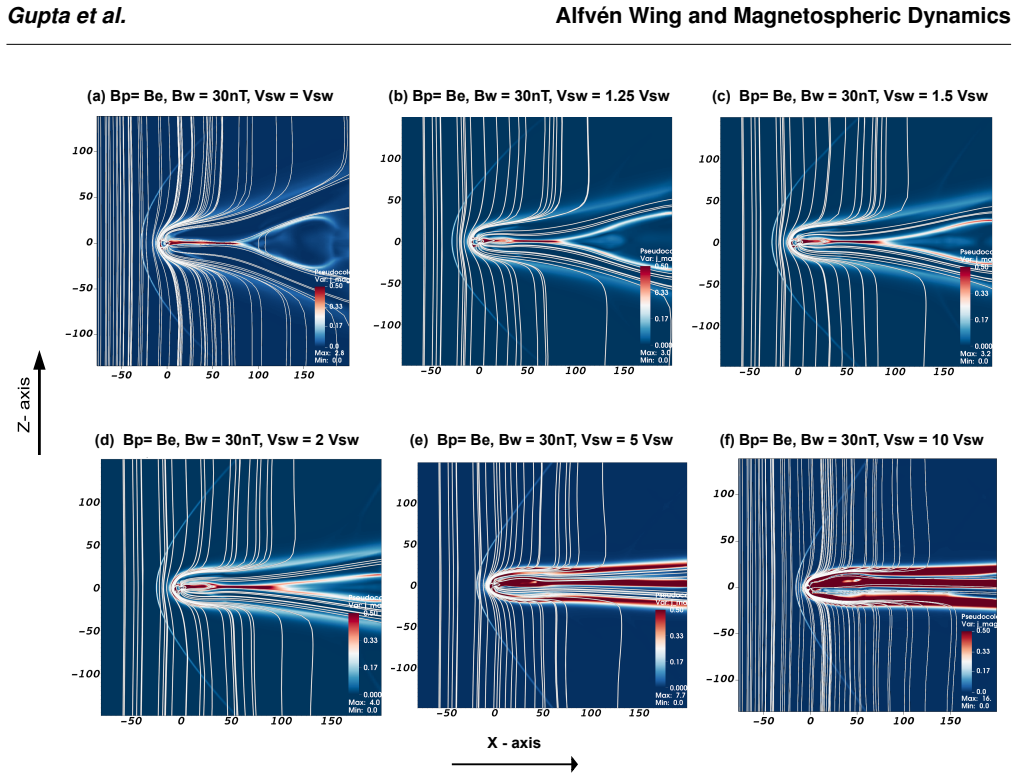
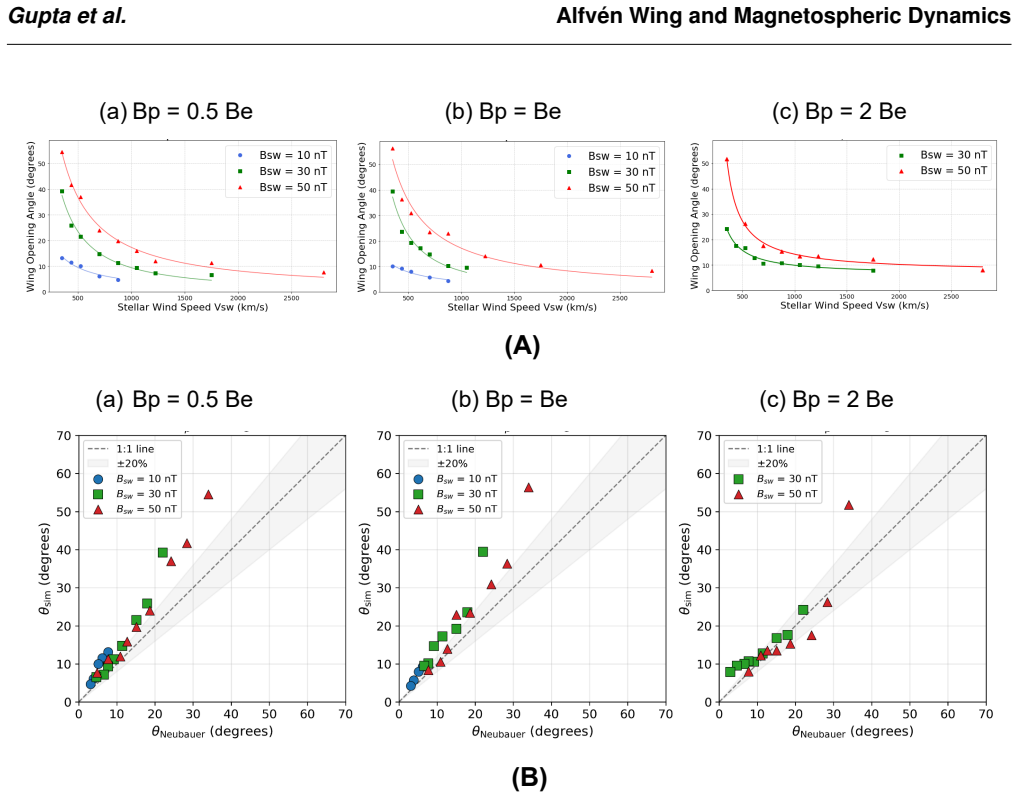
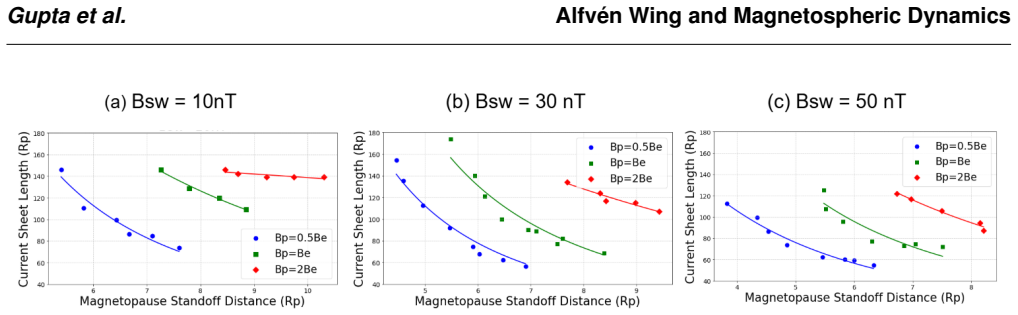
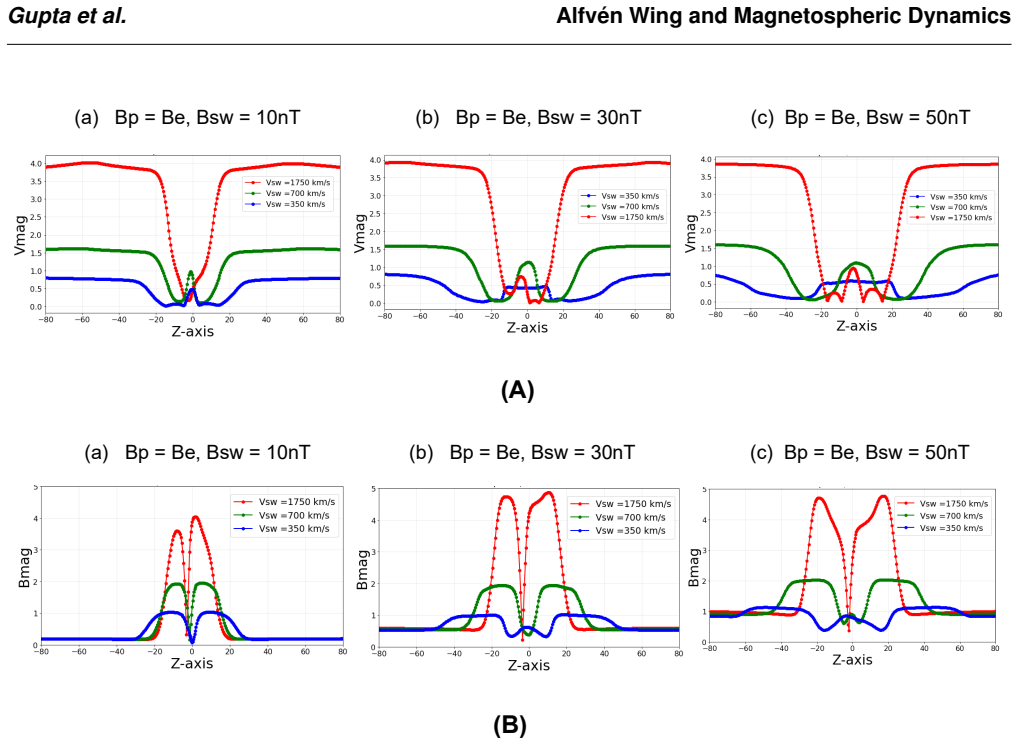
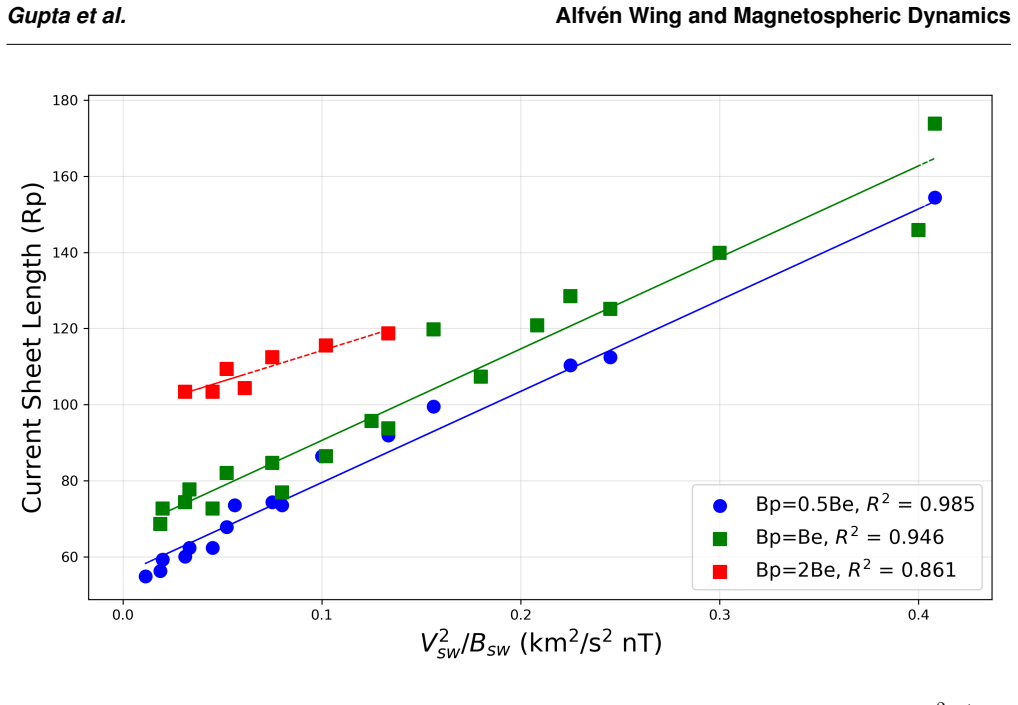
Systematic simulations across wide ranges of stellar wind speed, magnetic field, and planetary dipole field show that the global magnetospheric configuration is highly sensitive to the upstream Alfvén Mach number. Increasing stellar wind speed produces systematic closure and narrowing of Alfvén wing structures while stronger stellar magnetic fields open them. Wing opening angle depends on wind speed, internal plasma velocity drops with magnetic-flux accumulation, and magnetotail dynamics scale linearly with upstream forcing. Day-side magnetopause stand-off distance and night-side magnetotail current sheet length are interdependent.
What carries the argument
Alfvén wings, magnetohydrodynamic structures that serve as conduits for momentum and energy transfer between a magnetized body and surrounding plasma flow.
If this is right
- Alfvén wing opening angle varies systematically with stellar wind speed.
- Plasma velocity decreases and magnetic flux accumulates inside the wings.
- Day-side magnetopause stand-off distance and night-side magnetotail current sheet length remain interdependent.
- Magnetotail dynamics follow a linear scaling with upstream stellar wind parameters.
- Earth-like magnetospheres can shift into wing-dominated forms under extreme stellar events or sub-Alfvénic conditions.
Where Pith is reading between the lines
- The reported Mach-number control may affect how much stellar wind energy reaches close-in exoplanet atmospheres.
- Similar wing structures could appear in other plasma-obstacle interactions such as stellar coronae or binary systems.
- Radio or transit observations of exoplanets might reveal signatures of closed versus open wing configurations.
Load-bearing premise
Three-dimensional resistive magnetohydrodynamics alone captures the essential formation and response of Alfvén wings and magnetotails without kinetic-scale physics or extra non-ideal effects.
What would settle it
A kinetic plasma simulation or in-situ observation at fixed upstream Alfvén Mach number that produces markedly different wing opening angles or magnetotail lengths would contradict the reported sensitivity.
Figures
read the original abstract
Magnetized obstacles embedded within a plasma flow generate magnetohydrodynamic structures known as Alfv\'en wings, which act as primary conduits for the transfer of momentum and energy between the body and the surrounding medium. This study employs three-dimensional resistive magnetohydrodynamic simulations to explore how these wings and the magnetosphere respond to diverse stellar wind conditions. Our results, gleaned from a large number of systematic simulations spanning a wide range of stellar wind speed and magnetic field -- and planetary dipole field -- show that the global magnetospheric configuration is highly sensitive to the upstream Alfv\'en Mach number. We find that increasing stellar wind speed leads to a systematic closure and narrowing of Alfv\'en wing structures, while stronger stellar magnetic fields facilitate their opening. Analysis of the Alfv\'en wing morphology demonstrates a distinct dependence of wing opening angle on stellar wind speed, with internal wing analysis showing a reduction in plasma velocity and significant magnetic-flux accumulation. Our results exhibit a clear interdependence between the day-side magnetopause stand-off distance and the night-side magnetotail current sheet length. We find a linear scaling between the magnetotail dynamics and upstream forcing parameters. This study bridges the gap between solar system observations and (exo)planetary systems by demonstrating how Earth-like magnetospheres might transform into wing-dominated configurations during extreme stellar events or within the sub-Alfv\'enic regimes of close-in (exo)planets. Our findings can aid the interpretation of Alfv\'en wing signatures in observational data and enhance our understanding of how (exo)planetary magnetospheres respond to dynamic stellar wind forcing.
Editorial analysis
A structured set of objections, weighed in public.
Referee Report
Summary. The paper employs three-dimensional resistive MHD simulations to study Alfvén wing formation and magnetospheric responses for planets and exoplanets under varying stellar wind speeds, magnetic fields, and planetary dipole strengths. It concludes that global magnetospheric configuration is highly sensitive to the upstream Alfvén Mach number, with increasing wind speed causing systematic closure and narrowing of wings, stronger stellar fields promoting opening, a distinct dependence of wing opening angle on wind speed, reduced internal plasma velocity with magnetic flux accumulation, interdependence between dayside magnetopause standoff and nightside magnetotail current sheet length, and linear scaling of magnetotail dynamics with upstream parameters. The work positions these findings as bridging solar-system observations to exoplanetary regimes, including sub-Alfvénic close-in planets.
Significance. If the simulation trends prove robust, the results would offer a useful parameter survey for interpreting Alfvén-wing signatures in observations and for understanding how Earth-like magnetospheres transition to wing-dominated states under extreme stellar forcing or in sub-Alfvénic flows, extending solar-system knowledge to exoplanet contexts.
major comments (2)
- [Numerical Methods / Simulation Setup] The abstract and simulation description supply no information on grid resolution, convergence tests, boundary conditions, or direct comparison to analytic limits or observations. This absence is load-bearing for the central claim that trends in wing closure, opening angle, and magnetotail length are robust outcomes of the parameter survey.
- [Results] The reported 'linear scaling between the magnetotail dynamics and upstream forcing parameters' is stated without an explicit fit, slope value, correlation coefficient, or reference to a specific figure or table, preventing quantitative evaluation of the claimed interdependence between magnetopause standoff distance and magnetotail length.
minor comments (2)
- [Abstract] The abstract refers to 'a large number of systematic simulations spanning a wide range' without stating the actual number of runs or the precise ranges explored for stellar wind speed, magnetic field, and planetary dipole strength.
- [Introduction] Notation for the upstream Alfvén Mach number and related quantities should be defined at first use to improve readability for readers outside the immediate subfield.
Simulated Author's Rebuttal
We thank the referee for their constructive review and for highlighting areas where additional detail would strengthen the manuscript. We address each major comment below and will revise the paper accordingly to improve transparency on numerical methods and quantitative presentation of results.
read point-by-point responses
-
Referee: [Numerical Methods / Simulation Setup] The abstract and simulation description supply no information on grid resolution, convergence tests, boundary conditions, or direct comparison to analytic limits or observations. This absence is load-bearing for the central claim that trends in wing closure, opening angle, and magnetotail length are robust outcomes of the parameter survey.
Authors: We agree that the abstract omits these specifics, as is typical for a concise summary. The simulation description in the Methods section would benefit from explicit inclusion of grid resolution, convergence tests, boundary conditions, and comparisons to analytic Alfvén wing solutions or prior observations to fully substantiate the robustness of the reported trends. We will expand the Methods section with these details in the revision. revision: yes
-
Referee: [Results] The reported 'linear scaling between the magnetotail dynamics and upstream forcing parameters' is stated without an explicit fit, slope value, correlation coefficient, or reference to a specific figure or table, preventing quantitative evaluation of the claimed interdependence between magnetopause standoff distance and magnetotail length.
Authors: We acknowledge that the linear scaling statement lacks the requested quantitative metrics. In the revised manuscript we will supply the explicit linear fit parameters (slope, intercept), correlation coefficient, and a direct reference to the relevant figure or table demonstrating the scaling and the interdependence with dayside magnetopause standoff distance. revision: yes
Circularity Check
No significant circularity
full rationale
The paper reports outcomes from a parameter survey of 3D resistive MHD simulations spanning ranges of stellar wind speed, magnetic field, and planetary dipole strength. All stated results (wing closure with speed, opening with stellar field strength, linear scaling of magnetotail length, interdependence of magnetopause standoff and tail length) are presented as direct numerical findings rather than analytic derivations, fitted parameters renamed as predictions, or reductions via self-citation. No equations, ansatzes, or uniqueness theorems appear in the supplied text that would allow any claim to collapse to its own inputs by construction. The work is therefore self-contained against external benchmarks.
Axiom & Free-Parameter Ledger
Reference graph
Works this paper leans on
-
[5]
Ridley, A. J. , TITLE =. Annales Geophysicae , VOLUME =. 2007 , NUMBER =
2007
-
[25]
Monthly Notices of the Royal Astronomical Society , year=
The evolution of Earth’s magnetosphere during the solar main sequence , author=. Monthly Notices of the Royal Astronomical Society , year=
-
[26]
Monthly Notices of the Royal Astronomical Society , author=
Effects of the stellar wind on the ly α transit of close-in planets , volume=. Monthly Notices of the Royal Astronomical Society , author=. 2020 , month=. doi:10.1093/mnras/staa3431 , number=
-
[27]
Dong, X.-C. and Dunlop, M. W. and Wang, T.-Y. and Trattner, K. J. and Russell, C. T. and Giles, B. , title =. Geophysical Research Letters , volume =. doi:https://doi.org/10.1029/2020GL089075 , url =. https://agupubs.onlinelibrary.wiley.com/doi/pdf/10.1029/2020GL089075 , note =
-
[29]
Slavin, James A. and DiBraccio, Gina A. and Gershman, Daniel J. and Imber, Suzanne M. and Poh, Gang Kai and Raines, Jim M. and Zurbuchen, Thomas H. and Jia, Xianzhe and Baker, Daniel N. and Glassmeier, Karl-Heinz and Livi, Stefano A. and Boardsen, Scott A. and Cassidy, Timothy A. and Sarantos, Menelaos and Sundberg, Torbjorn and Masters, Adam and Johnson,...
-
[39]
Plasma interactions of exoplanets with their parent star and associated radio emissions , journal =
Philippe Zarka , keywords =. Plasma interactions of exoplanets with their parent star and associated radio emissions , journal =. 2007 , note =. doi:https://doi.org/10.1016/j.pss.2006.05.045 , url =
-
[48]
S., Barnes, R., Cohen, O., Collinson, G
Airapetian, V. S., Barnes, R., Cohen, O., Collinson, G. A., Danchi, W. C., Dong, C. F., et al. (2020). Impact of space weather on climate and habitability of terrestrial-type exoplanets. International Journal of Astrobiology 19, 136–194. doi:10.1017/S1473550419000132 Airapetian_2020
-
[49]
Arridge, C., McAndrews, H., Jackman, C., Forsyth, C., Walsh, A., Sittler, E., et al. (2009). Plasma electrons in saturn's magnetotail: Structure, distribution and energisation. Planetary and Space Science 57, 2032--2047. doi:https://doi.org/10.1016/j.pss.2009.09.007 Arridge_2009
-
[50]
Basak, A. and Nandy, D. (2021). Modelling the imposed magnetospheres of mars-like exoplanets: Star–planet interactions and atmospheric losses. Monthly Notices of the Royal Astronomical Society 502, 3569–3581. doi:10.1093/mnras/stab225 basak_nandy_2021
-
[51]
Beedle, J. M. H., Chen, L.-J., Shuster, J. R., Gurram, H., Gershman, D. J., Chen, Y., et al. (2024). Field-aligned current structures during the terrestrial magnetosphere's transformation into alfvén wings and recovery. Geophysical Research Letters 51, e2024GL108839. doi:https://doi.org/10.1029/2024GL108839. E2024GL108839 2024GL108839 Beedle_2024
-
[52]
Bowers, C. F., Jackman, C. M., Jia, X., Hadid, L. Z., Sun, W., Hayes, L. A., et al. (2025). Mercury's altered magnetosphere during a sub-alfvénic icme event: Messenger observations and inferred asymmetric alfvén wing formation from global mhd simulations. Journal of Geophysical Research: Space Physics 130, e2025JA034248. doi:https://doi.org/10.1029/2025JA...
-
[53]
L., Chen, L.-J., Sarantos, M., Gershman, D
Burkholder, B. L., Chen, L.-J., Sarantos, M., Gershman, D. J., Argall, M. R., Chen, Y., et al. (2024). Global magnetic reconnection during sustained sub-alfvénic solar wind driving. Geophysical Research Letters 51, e2024GL108311. doi:https://doi.org/10.1029/2024GL108311. E2024GL108311 2024GL108311 Burkholder_2024
-
[54]
A., Loesch, C., and Coogan, P
Carolan, S., Vidotto, A. A., Loesch, C., and Coogan, P. (2019). The evolution of earth’s magnetosphere during the solar main sequence. Monthly Notices of the Royal Astronomical Society Carolan_2019
2019
-
[55]
Chané, E., Saur, J., Neubauer, F. M., Raeder, J., and Poedts, S. (2012). Observational evidence of alfvén wings at the earth. Journal of Geophysical Research: Space Physics 117. doi:https://doi.org/10.1029/2012JA017628 chane_2012
-
[56]
Chen, L.-J., Gershman, D., Burkholder, B., Chen, Y., Sarantos, M., Jian, L., et al. (2024). Earth's alfvén wings driven by the april 2023 coronal mass ejection. Geophysical Research Letters 51, e2024GL108894. doi:https://doi.org/10.1029/2024GL108894. E2024GL108894 2024GL108894 chen_2024
-
[57]
Cohen, O., Drake, J. J., Glocer, A., Garraffo, C., Poppenhaeger, K., Bell, J. M., et al. (2014). Magnetospheric structure and atmospheric joule heating of habitable planets orbiting m-dwarf stars. The Astrophysical Journal 790, 57. doi:10.1088/0004-637X/790/1/57 Cohen_2014
-
[58]
Corso, N. J. and Lai, D. (2026). Simulations of a conducting sphere moving through magnetized plasma: Alfvén wings, slow magnetosonic wings, and drag force. The Astrophysical Journal 1002, 1. doi:10.3847/1538-4357/ae5817 Corso_2026
-
[59]
B., Basak, A., Nandy, D., and Vaidya, B
Das, S. B., Basak, A., Nandy, D., and Vaidya, B. (2019). Modeling star planet interactions in far-out planetary and exoplanetary systems. The Astrophysical Journal 877, 80. doi:10.3847/1538-4357/ab18ad Das_2019
-
[60]
Drell, S. D., Foley, H. M., and Ruderman, M. A. (1965). Drag and propulsion of large satellites in the ionosphere: An alfvén propulsion engine in space. Journal of Geophysical Research (1896-1977) 70, 3131--3145. doi:https://doi.org/10.1029/JZ070i013p03131 drell_1965
-
[61]
Dungey, J. W. (1961). Interplanetary magnetic field and the auroral zones. Phys. Rev. Lett. 6, 47--48. doi:10.1103/PhysRevLett.6.47 Dungey_1961
-
[62]
Ganushkina, N. Y., Liemohn, M. W., and Dubyagin, S. (2018). Current systems in the earth's magnetosphere. Reviews of Geophysics 56, 309--332. doi:https://doi.org/10.1002/2017RG000590 Ganushkina_2018
-
[63]
J., Cohen, O., Alvarado-Gómez, J
Garraffo, C., Drake, J. J., Cohen, O., Alvarado-Gómez, J. D., and Moschou, S. P. (2017). The threatening magnetic and plasma environment of the trappist-1 planets. The Astrophysical Journal Letters 843, L33. doi:10.3847/2041-8213/aa79ed Garraffo_2017
-
[64]
Gupta, S., Basak, A., and Nandy, D. (2023). Impact of changing stellar and planetary magnetic fields on (exo)planetary environments and atmospheric mass loss. The Astrophysical Journal 953, 70. doi:10.3847/1538-4357/acd93b Gupta_2023
-
[65]
R., Chen, L.-J., Hasegawa, H., Denton, R
Gurram, H., Shuster, J. R., Chen, L.-J., Hasegawa, H., Denton, R. E., Burkholder, B. L., et al. (2025). Earth's alfvén wings: Unveiling dynamic variations of field-line topologies with electron distributions. Geophysical Research Letters 52, e2024GL111931. doi:https://doi.org/10.1029/2024GL111931. E2024GL111931 2024GL111931 Gurram_2025
-
[66]
Jia, X., Walker, R. J., Kivelson, M. G., Khurana, K. K., and Linker, J. A. (2008). Three-dimensional mhd simulations of ganymede’s magnetosphere. Journal of Geophysical Research: Space Physics 113. doi:https://doi.org/10.1029/2007JA012748 jia_2008
-
[67]
Kivelson, M. G., Khurana, K. K., Coroniti, F. V., Joy, S., Russell, C. T., Walker, R. J., et al. (1997). The magnetic field and magnetosphere of ganymede. Geophysical Research Letters 24, 2155--2158. doi:https://doi.org/10.1029/97GL02201 Kivelson_1997
-
[68]
Komar, C. M., Cassak, P. A., Dorelli, J. C., Glocer, A., and Kuznetsova, M. M. (2013). Tracing magnetic separators and their dependence on imf clock angle in global magnetospheric simulations. Journal of Geophysical Research: Space Physics 118, 4998--5007. doi:https://doi.org/10.1002/jgra.50479 Komar_2013
-
[69]
Lammer, H., Lichtenegger, H. I., Kulikov, Y. N., Grießmeier, J.-M., Terada, N., Erkaev, N. V., et al. (2007). Coronal mass ejection (cme) activity of low mass m stars as an important factor for the habitability of terrestrial exoplanets. ii. cme-induced ion pick up of earth-like exoplanets in close-in habitable zones. Astrobiology 7, 185--207. doi:10.1089...
-
[70]
Lockwood, M. (1995). Large-scale fields and flows in the magnetosphere-ionosphere system. Surveys in Geophysics 16, 389–441. doi:10.1007/bf01044574 Lockwood_1995
-
[71]
Lugaz, N., Farrugia, C. J., Huang, C.-L., Winslow, R. M., Spence, H. E., and Schwadron, N. A. (2016). Earth’s magnetosphere and outer radiation belt under sub-alfvénic solar wind. Nature Communications 7. doi:10.1038/ncomms13001 Lugaz_2016
-
[72]
Mignone , A., Bodo , G., Massaglia , S., Matsakos , T., Tesileanu , O., Zanni , C., et al. (2007). PLUTO: A Numerical Code for Computational Astrophysics . 170, 228--242. doi:10.1086/513316 Mignone2007
-
[73]
Milan, S. E., Carter, J. A., Sangha, H., Bower, G. E., and Anderson, B. J. (2021). Magnetospheric flux throughput in the dungey cycle: Identification of convection state during 2010. Journal of Geophysical Research: Space Physics 126, e2020JA028437. doi:https://doi.org/10.1029/2020JA028437. E2020JA028437 2020JA028437 Milan_2021
-
[74]
Nandy, D. and Martens, P. (2007). Space climate and the solar–stellar connection: What can we learn from the stars about long-term solar variability? Advances in Space Research 40, 891--898. doi:https://doi.org/10.1016/j.asr.2007.01.079 NANDY2007891
-
[75]
Neubauer, F. (1980). Nonlinear standing alfvén wave current system at io: Theory. Journal of Geophysical Research: Space Physics 85, 1171--1178. doi:https://doi.org/10.1029/JA085iA03p01171 Neubauer_1980
-
[76]
Nichols, J. D. and Milan, S. E. (2016). Stellar wind–magnetosphere interaction at exoplanets: computations of auroral radio powers. Monthly Notices of the Royal Astronomical Society 461, 2353--2366. doi:10.1093/mnras/stw1430 Nichols_2016
-
[77]
P\'erez-Torres, M. , G\'omez, J. F. , Ortiz, J. L. , Leto, P. , Anglada, G. , G\'omez, J. L. , et al. (2021). Monitoring the radio emission of proxima centauri. A&A 645, A77. doi:10.1051/0004-6361/202039052 Torres_2021
-
[78]
Pineda, J. S. and Villadsen, J. (2023). Coherent radio bursts from known m-dwarf planet-host yz ceti. Nature Astronomy 7, 569--578. doi:10.1038/s41550-023-01914-0 Pineda2023
-
[79]
Presa, A., Driessen, F. A., and Vidotto, A. A. (2024). Atmospheric escape in hot jupiters under sub-alfvénic interactions. Monthly Notices of the Royal Astronomical Society 534, 3622--3636. doi:10.1093/mnras/stae2325 presa_2024
-
[80]
Raeder, J. (1999). Modeling the magnetosphere for northward interplanetary magnetic field: Effects of electrical resistivity. Journal of Geophysical Research: Space Physics 104, 17357--17367. doi:https://doi.org/10.1029/1999JA900159 Raeder_1999
-
[81]
Ridley, A. J. (2007). Alfvén wings at earth's magnetosphere under strong interplanetary magnetic fields. Annales Geophysicae 25, 533--542. doi:10.5194/angeo-25-533-2007 Ridley_2007
-
[82]
Roy, S. and Nandy, D. (2023). A time-efficient, data-driven modeling approach for predicting the geomagnetic impact of coronal mass ejections. The Astrophysical Journal Letters 950, L11. doi:10.3847/2041-8213/acd77c Roy_2023
-
[83]
Saur, J. , Grambusch, T. , Duling, S. , Neubauer, F. M. , and Simon, S. (2013). Magnetic energy fluxes in sub-alfvénic planet star and moon planet interactions⋆. A&A 552, A119. doi:10.1051/0004-6361/201118179 saur_2013
-
[84]
See, V. , Jardine, M. , Vidotto, A. A. , Petit, P. , Marsden, S. C. , Jeffers, S. V. , et al. (2014). The effects of stellar winds on the magnetospheres and potential habitability of exoplanets ⋆. A&A 570, A99. doi:10.1051/0004-6361/201424323 see_2014
-
[85]
A., Angelopoulos, V., and Nakamura, R
Sergeev, V. A., Angelopoulos, V., and Nakamura, R. (2012). Recent advances in understanding substorm dynamics. Geophysical Research Letters 39. doi:https://doi.org/10.1029/2012GL050859 Sergeev_2012
-
[86]
Slavin, J. A., Smith, E. J., Spreiter, J. R., and Stahara, S. S. (1985). Solar wind flow about the outer planets: Gas dynamic modeling of the jupiter and saturn bow shocks. Journal of Geophysical Research: Space Physics 90, 6275--6286. doi:https://doi.org/10.1029/JA090iA07p06275 Slavin_1985
-
[87]
R., Bagenal, F., Allegrini, F., Bonfond, B., Clark, G., Connerney, J
Szalay, J. R., Bagenal, F., Allegrini, F., Bonfond, B., Clark, G., Connerney, J. E. P., et al. (2020). Proton acceleration by io's alfvénic interaction. Journal of Geophysical Research: Space Physics 125, e2019JA027314. doi:https://doi.org/10.1029/2019JA027314. E2019JA027314 2019JA027314 Szalay_2020
-
[88]
Varela, J. , Brun, A. S. , Strugarek, A. , R\'eville, V. , Zarka, P. , and Pantellini, F. (2022). Mhd study of the planetary magnetospheric response during extreme solar wind conditions: Earth and exoplanet magnetospheres applications. A&A 659, A10. doi:10.1051/0004-6361/202141181 Varela_2022
-
[89]
Vidotto, A. A. and Cleary, A. (2020). Stellar wind effects on the atmospheres of close-in giants: a possible reduction in escape instead of increased erosion. Monthly Notices of the Royal Astronomical Society 494, 2417--2428. doi:10.1093/mnras/staa852 vidotto_2020
-
[90]
, year = 2014, month = jul, volume =
Vidotto , A. A., Gregory , S. G., Jardine , M., Donati , J. F., Petit , P., Morin , J., et al. (2014). Stellar magnetism: empirical trends with age and rotation . 441, 2361--2374. doi:10.1093/mnras/stu728 Vidotto_2014
discussion (0)
Sign in with ORCID, Apple, or X to comment. Anyone can read and Pith papers without signing in.