Assessing Distribution Shift in Human Activity Recognition for Domain Generalization
Pith reviewed 2026-06-25 23:19 UTC · model grok-4.3
The pith
Diversity shifts define all distribution shifts in human activity recognition, revealing unique unshared features across domains.
A machine-rendered reading of the paper's core claim, the machinery that carries it, and where it could break.
Core claim
Diversity shifts predominantly define all types of shifts, indicating the existence of unique features that are not shared across different domains. Domain generalization methods marginally outperform the empirical risk minimization baseline.
What carries the argument
A uniform HAR-based distribution shift benchmark that measures the four shift types and runs head-to-head tests of domain generalization algorithms against empirical risk minimization.
If this is right
- Cross-domain performance in HAR cannot rely on features shared by all domains.
- Standard training leaves performance gaps that current generalization techniques close only slightly.
- Any deployed HAR system must account for device, placement, rate, and behavior differences from the start.
Where Pith is reading between the lines
- Real deployments will need either much larger and more varied training collections or runtime adaptation mechanisms beyond today's domain generalization methods.
- The benchmark approach could be applied to other sensor-driven tasks such as fall detection or gesture interfaces to check whether diversity shifts dominate there as well.
- Algorithm designers could target time-series sensor properties explicitly rather than importing image or text domain generalization techniques unchanged.
Load-bearing premise
The four chosen distribution shifts and the selected datasets are representative enough of real-world HAR variability that conclusions about diversity shifts and DG method performance will generalize beyond the tested cases.
What would settle it
Running the same evaluation protocol on a fresh collection of HAR datasets where non-diversity shifts predominate or where at least one domain generalization method shows large, consistent gains over the baseline.
Figures
read the original abstract
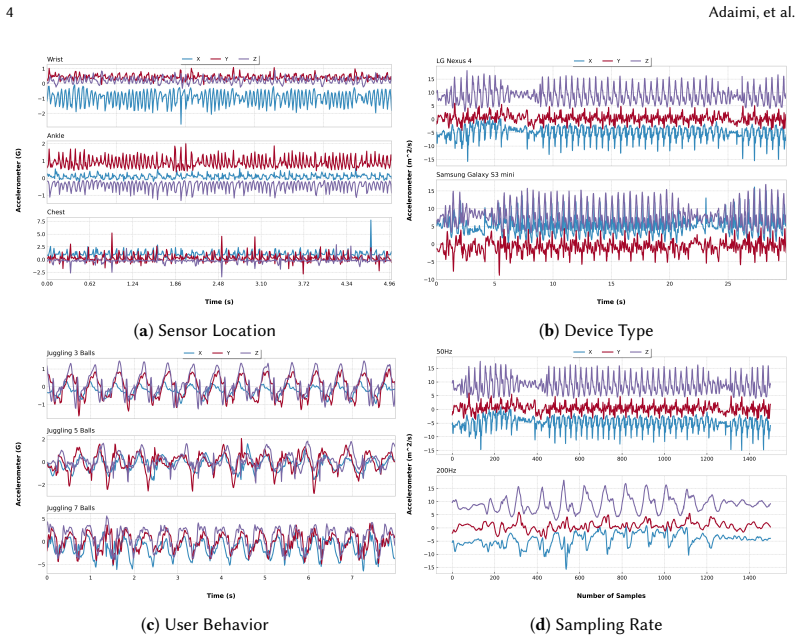
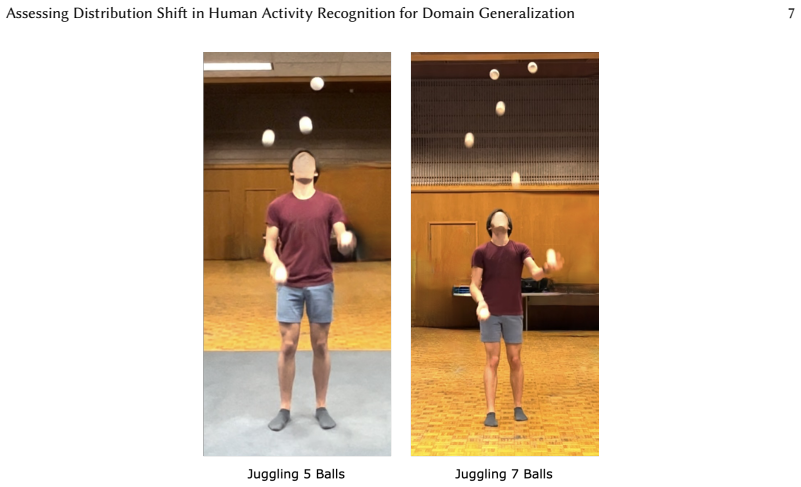
While the field of Human Activity Recognition (HAR) continues to draw interest from researchers and advance in important ways, some key challenges remain. One of the most difficult aspects of building HAR models that show good performance in real-world settings is dealing with data diversity from device and sensor heterogeneity, and contextual changes that are intrinsic to real-world applications. While data diversity in HAR has been well-acknowledged in the literature, there remains a gap in understanding the effect of various types of distribution shifts on HAR models and the domain generalization problem that arises. Towards that end, this paper systematically evaluates 4 different types of distribution shifts, including variations in device type, sensor placement, sampling rate, and user behavior. Quantifying their effects, we illustrate that diversity shifts predominantly define all types of shifts, indicating the existence of unique features that are not shared across different domains. We then introduce a uniform HAR-based distribution shift benchmarks and conduct a comprehensive evaluation of up to 28 domain generalization methods. Our analysis exposes the limitations of current domain generalization algorithms in achieving model generalizability, marginally outperforming the empirical risk minimization baseline. This work represents the first systematic exploration of domain generalization and adaptation concerning specific distribution shifts in sensor-based HAR, offering an open-source benchmark platform and datasets to spur further research.
Editorial analysis
A structured set of objections, weighed in public.
Referee Report
Summary. The manuscript systematically evaluates four types of distribution shifts in sensor-based Human Activity Recognition (device type, sensor placement, sampling rate, user behavior) across datasets. It concludes that diversity shifts predominate, indicating unique non-shared features across domains. The authors introduce a uniform benchmark and evaluate up to 28 domain generalization methods, reporting that they marginally outperform the empirical risk minimization baseline. The work positions itself as the first systematic study of DG/DA for specific shifts in HAR and releases an open-source benchmark platform and datasets.
Significance. If the empirical results hold, this provides a useful benchmark for the HAR community by quantifying shift impacts and exposing limitations of existing DG algorithms relative to ERM. The open-source release strengthens reproducibility and follow-on work. The representativeness concern (whether the four shifts and datasets capture real-world HAR variability) is an external-validity issue rather than an internal inconsistency in the argument; the paper's internal claims rest on the reported comparisons rather than untestable assumptions.
major comments (2)
- [§5 (Benchmark Evaluation)] §5 (Benchmark Evaluation) and associated results: the claim that 'diversity shifts predominantly define all types of shifts' is central but lacks an explicit quantitative metric or decision rule for determining predominance; without this, it is unclear how interactions between shift types were handled or whether the conclusion is robust to alternative aggregation methods.
- [DG method comparison tables/results] DG method comparison tables/results: the reported marginal outperformance over ERM is presented without statistical significance tests, confidence intervals, or multi-seed variance; this makes it impossible to determine whether the gap is reliable or could be explained by baseline implementation details or random variation.
minor comments (3)
- [Abstract] Abstract: 'up to 28' DG methods should be replaced with the exact count and a brief enumeration or reference to the full list for immediate clarity.
- [§3] Notation and terminology: consistent use of 'diversity shift' versus other shift categories would benefit from an early definitional table or paragraph.
- [Figures in §4-5] Figure captions and axis labels in the shift quantification plots could include explicit dataset and shift-type identifiers to improve standalone readability.
Simulated Author's Rebuttal
We thank the referee for the constructive feedback and positive recommendation. We address the two major comments below and will revise the manuscript to strengthen the presentation of results.
read point-by-point responses
-
Referee: [§5 (Benchmark Evaluation)] §5 (Benchmark Evaluation) and associated results: the claim that 'diversity shifts predominantly define all types of shifts' is central but lacks an explicit quantitative metric or decision rule for determining predominance; without this, it is unclear how interactions between shift types were handled or whether the conclusion is robust to alternative aggregation methods.
Authors: We agree that an explicit quantitative metric would improve clarity. In the revision we will add a formal predominance score defined as the fraction of total performance drop (relative to in-domain ERM) that is uniquely attributable to each shift type after subtracting shared components via a simple additive decomposition. We will also report results under two alternative aggregation schemes (weighted by dataset size and by shift severity) to demonstrate robustness. Interactions between shift types will be handled by including both single-shift and combined-shift experiments with the new metric applied to each. revision: yes
-
Referee: [DG method comparison tables/results] DG method comparison tables/results: the reported marginal outperformance over ERM is presented without statistical significance tests, confidence intervals, or multi-seed variance; this makes it impossible to determine whether the gap is reliable or could be explained by baseline implementation details or random variation.
Authors: We acknowledge this limitation. The revision will include results averaged over five random seeds with reported standard deviations, 95% confidence intervals, and paired t-tests (or Wilcoxon tests where normality assumptions fail) comparing each DG method against ERM on the same splits. This will allow readers to assess whether the observed marginal gains are statistically distinguishable from zero or from implementation noise. revision: yes
Circularity Check
No significant circularity; empirical benchmark only
full rationale
The paper performs an empirical evaluation of distribution shifts and domain generalization methods on HAR datasets. No mathematical derivation, fitted parameters renamed as predictions, self-definitional constructs, or load-bearing self-citations appear in the abstract or described methodology. All claims rest on direct experimental comparisons (28 DG methods vs. ERM baseline across four shift types) that are externally falsifiable via the released benchmarks and datasets. The central finding that diversity shifts predominate is a measured outcome, not a reduction to inputs by construction.
Axiom & Free-Parameter Ledger
axioms (2)
- domain assumption The four distribution shift types and chosen datasets capture the dominant sources of variability in real-world sensor-based HAR.
- standard math Standard i.i.d. assumptions within each domain and the validity of ERM as a baseline hold for the evaluation protocol.
Reference graph
Works this paper leans on
-
[1]
Rebecca Adaimi, Howard Yong, and Edison Thomaz. 2021. Ok Google, What Am I Doing? Acoustic Activity Recognition Bounded by Conversational Assistant Interactions. Proceedings of the ACM on Interactive, Mobile, Wearable and Ubiquitous Technologies 5, 1 (2021), 1–24
2021
-
[2]
Kartik Ahuja, Ethan Caballero, Dinghuai Zhang, Jean-Christophe Gagnon-Audet, Yoshua Bengio, Ioannis Mitliagkas, and Irina Rish. 2021. Invariance principle meets information bottleneck for out-of-distribution generalization.Advances in Neural Information Processing Systems 34 (2021), 3438–3450
2021
-
[3]
Ali Akbari and Roozbeh Jafari. 2019. Transferring activity recognition models for new wearable sensors with deep generative domain adaptation. In Proceedings of the 18th International Conference on Information Processing in Sensor Networks. 85–96. Assessing Distribution Shift in Human Activity Recognition for Domain Generalization 19
2019
-
[4]
Kerem Altun and Billur Barshan. 2010. Human activity recognition using inertial/magnetic sensor units. In Human Behavior Understanding: First International Workshop, HBU 2010, Istanbul, Turkey, August 22, 2010. Proceedings 1 . Springer, 38–51
2010
-
[5]
Martin Arjovsky, Léon Bottou, Ishaan Gulrajani, and David Lopez-Paz. 2019. Invariant risk minimization. arXiv preprint arXiv:1907.02893 (2019)
work page internal anchor Pith review Pith/arXiv arXiv 2019
-
[6]
Sarnab Bhattacharya, Rebecca Adaimi, and Edison Thomaz. 2022. Leveraging Sound and Wrist Motion to Detect Activities of Daily Living with Commodity Smartwatches. Proc. ACM Interact. Mob. Wearable Ubiquitous Technol. 6, 2, Article 42 (jul 2022), 28 pages. https://doi.org/10.1145/3534582
-
[7]
Gilles Blanchard, Aniket Anand Deshmukh, Ürun Dogan, Gyemin Lee, and Clayton Scott. 2021. Domain generalization by marginal transfer learning. The Journal of Machine Learning Research 22, 1 (2021), 46–100
2021
-
[8]
Hennie Brugman, Albert Russel, and Xd Nijmegen. 2004. Annotating Multi-media/Multi-modal Resources with ELAN.. In LREC. 2065–2068
2004
-
[9]
Ayse S Cakmak, Nina Thigpen, Garrett Honke, Erick Perez Alday, Ali Bahrami Rad, Rebecca Adaimi, Chia Jung Chang, Qiao Li, Pramod Gupta, Thomas Neylan, et al. 2020. Using Convolutional Variational Autoencoders to Predict Post-Trauma Health Outcomes from Actigraphy Data. In Machine Learning for Mobile Health Workshop at NeurIPS
2020
-
[10]
Avijoy Chakma, Abu Zaher Md Faridee, Md Abdullah Al Hafiz Khan, and Nirmalya Roy. 2021. Activity recognition in wearables using adversarial multi-source domain adaptation. Smart Health 19 (2021), 100174
2021
-
[11]
Youngjae Chang, Akhil Mathur, Anton Isopoussu, Junehwa Song, and Fahim Kawsar. 2020. A systematic study of unsupervised domain adaptation for robust human-activity recognition. Proceedings of the ACM on Interactive, Mobile, Wearable and Ubiquitous Technologies 4, 1 (2020), 1–30
2020
-
[12]
Ricardo Chavarriaga, Hesam Sagha, Alberto Calatroni, Sundara Tejaswi Digumarti, Gerhard Tröster, José del R Millán, and Daniel Roggen. 2013. The Opportunity challenge: A benchmark database for on-body sensor-based activity recognition. Pattern Recognition Letters 34, 15 (2013), 2033–2042
2013
-
[13]
Changhao Chen, Yishu Miao, Chris Xiaoxuan Lu, Linhai Xie, Phil Blunsom, Andrew Markham, and Niki Trigoni. 2019. Motiontransformer: Transferring neural inertial tracking between domains. In Proceedings of the AAAI conference on artificial intelligence, Vol. 33. 8009–8016
2019
- [14]
-
[15]
Yi-Ting Chiang, Ching-Hu Lu, and Jane Yung-Jen Hsu. 2017. A Feature-Based Knowledge Transfer Framework for Cross-Environment Activity Recognition Toward Smart Home Applications. IEEE Transactions on Human-Machine Systems 47, 3 (2017), 310–322. https://doi.org/10.1109/THMS.2016.2641679
-
[16]
Sanders, Rebecca Adaimi, Necole Streeper, David E
Keum San Chun, Ashley B. Sanders, Rebecca Adaimi, Necole Streeper, David E. Conroy, and Edison Thomaz. 2019. Towards a Generalizable Method for Detecting Fluid Intake with Wrist-Mounted Sensors and Adaptive Segmentation. In Proceedings of the 24th International Conference on Intelligent User Interfaces (Marina del Ray, California) (IUI ’19). Association f...
- [17]
-
[18]
Yaroslav Ganin, Evgeniya Ustinova, Hana Ajakan, Pascal Germain, Hugo Larochelle, François Laviolette, Mario Marchand, and Victor Lempitsky. 2016. Domain-adversarial training of neural networks. The journal of machine learning research 17, 1 (2016), 2096–2030
2016
-
[19]
Martin Gjoreski, Stefan Kalabakov, Mitja Luštrek, Matjaž Gams, and Hristijan Gjoreski. 2019. Cross-dataset deep transfer learning for activity recognition. In Adjunct Proceedings of the 2019 ACM International Joint Conference on Pervasive and Ubiquitous Computing and Proceedings of the 2019 ACM International Symposium on Wearable Computers . 714–718
2019
- [20]
-
[21]
Zeyi Huang, Haohan Wang, Eric P Xing, and Dong Huang. 2020. Self-challenging improves cross-domain generalization. In Computer Vision–ECCV 2020: 16th European Conference, Glasgow, UK, August 23–28, 2020, Proceedings, Part II 16 . Springer, 124–140
2020
-
[22]
Naoto Inoue, Ryosuke Furuta, Toshihiko Yamasaki, and Kiyoharu Aizawa. 2018. Cross-domain weakly-supervised object detection through progressive domain adaptation. In Proceedings of the IEEE conference on computer vision and pattern recognition. 5001–5009
2018
-
[23]
Md Abdullah Al Hafiz Khan, Nirmalya Roy, and Archan Misra. 2018. Scaling human activity recognition via deep learning-based domain adaptation. In 2018 IEEE international conference on pervasive computing and communications (PerCom). IEEE, 1–9. 20 Adaimi, et al
2018
-
[24]
Daehee Kim, Youngjun Yoo, Seunghyun Park, Jinkyu Kim, and Jaekoo Lee. 2021. Selfreg: Self-supervised contrastive regularization for domain generalization. In Proceedings of the IEEE/CVF International Conference on Computer Vision . 9619–9628
2021
-
[25]
Pang Wei Koh, Shiori Sagawa, Henrik Marklund, Sang Michael Xie, Marvin Zhang, Akshay Balsubramani, Weihua Hu, Michihiro Yasunaga, Richard Lanas Phillips, Irena Gao, et al. 2021. Wilds: A benchmark of in-the-wild distribution shifts. In International Conference on Machine Learning . PMLR, 5637–5664
2021
- [26]
-
[27]
David Krueger, Ethan Caballero, Joern-Henrik Jacobsen, Amy Zhang, Jonathan Binas, Dinghuai Zhang, Remi Le Priol, and Aaron Courville. 2021. Out-of-distribution generalization via risk extrapolation (rex). In International Conference on Machine Learning. PMLR, 5815–5826
2021
-
[28]
Da Li, Yongxin Yang, Yi-Zhe Song, and Timothy Hospedales. 2018. Learning to generalize: Meta-learning for domain generalization. In Proceedings of the AAAI conference on artificial intelligence , Vol. 32
2018
-
[29]
Haoliang Li, Sinno Jialin Pan, Shiqi Wang, and Alex C Kot. 2018. Domain generalization with adversarial feature learning. (2018), 5400–5409
2018
-
[30]
Haoliang Li, YuFei Wang, Renjie Wan, Shiqi Wang, Tie-Qiang Li, and Alex Kot. 2020. Domain generalization for medical imaging classification with linear-dependency regularization. Advances in Neural Information Processing Systems 33 (2020), 3118–3129
2020
-
[31]
Jing Li, Shuo Shang, and Lisi Chen. 2020. Domain generalization for named entity boundary detection via metalearning. IEEE Transactions on Neural Networks and Learning Systems 32, 9 (2020), 3819–3830
2020
-
[32]
Pan Li, Da Li, Wei Li, Shaogang Gong, Yanwei Fu, and Timothy M Hospedales. 2021. A simple feature augmentation for domain generalization. In Proceedings of the IEEE/CVF International Conference on Computer Vision . 8886–8895
2021
-
[33]
Xinyu Li, Yuan He, J Andrew Zhang, and Xiaojun Jing. 2021. Supervised domain adaptation for few-shot radar-based human activity recognition. IEEE Sensors Journal 21, 22 (2021), 25880–25890
2021
-
[34]
Ya Li, Xinmei Tian, Mingming Gong, Yajing Liu, Tongliang Liu, Kun Zhang, and Dacheng Tao. 2018. Deep domain generalization via conditional invariant adversarial networks. In Proceedings of the European conference on computer vision (ECCV). 624–639
2018
-
[35]
Wang Lu, Jindong Wang, Yiqiang Chen, Sinno Jialin Pan, Chunyu Hu, and Xin Qin. 2022. Semantic-discriminative mixup for generalizable sensor-based cross-domain activity recognition. Proceedings of the ACM on Interactive, Mobile, Wearable and Ubiquitous Technologies 6, 2 (2022), 1–19
2022
-
[36]
Francisco Javier Ordóñez Morales and Daniel Roggen. 2016. Deep Convolutional Feature Transfer across Mobile Activity Recognition Domains, Sensor Modalities and Locations. In Proceedings of the 2016 ACM International Symposium on Wearable Computers (Heidelberg, Germany) (ISWC ’16). Association for Computing Machinery, New York, NY, USA, 92–99. https://doi....
-
[37]
Hyeonseob Nam, HyunJae Lee, Jongchan Park, Wonjun Yoon, and Donggeun Yoo. 2021. Reducing domain gap by reducing style bias. In Proceedings of the IEEE/CVF Conference on Computer Vision and Pattern Recognition . 8690–8699
2021
-
[38]
Shirin Nilizadeh, Hojjat Aghakhani, Eric Gustafson, Christopher Kruegel, and Giovanni Vigna. 2019. Think outside the dataset: Finding fraudulent reviews using cross-dataset analysis. In The World Wide Web Conference. 3108–3115
2019
- [39]
-
[40]
Mohammad Pezeshki, Oumar Kaba, Yoshua Bengio, Aaron C Courville, Doina Precup, and Guillaume Lajoie. 2021. Gradient starvation: A learning proclivity in neural networks. Advances in Neural Information Processing Systems 34 (2021), 1256–1272
2021
-
[41]
Xin Qin, Jindong Wang, Yiqiang Chen, Wang Lu, and Xinlong Jiang. 2022. Domain Generalization for Activity Recognition via Adaptive Feature Fusion. ACM Transactions on Intelligent Systems and Technology 14, 1 (2022), 1–21
2022
-
[42]
Mohamed Ragab, Emadeldeen Eldele, Wee Ling Tan, Chuan-Sheng Foo, Zhenghua Chen, Min Wu, Chee-Keong Kwoh, and Xiaoli Li. 2023. Adatime: A benchmarking suite for domain adaptation on time series data. ACM Transactions on Knowledge Discovery from Data 17, 8 (2023), 1–18
2023
-
[43]
Sreenivasan Ramasamy Ramamurthy and Nirmalya Roy. 2018. Recent trends in machine learning for human activity recognition—A survey. Wiley Interdisciplinary Reviews: Data Mining and Knowledge Discovery 8, 4 (2018), e1254
2018
-
[44]
Attila Reiss and Didier Stricker. 2012. Creating and benchmarking a new dataset for physical activity monitoring. In Proceedings of the 5th International Conference on PErvasive Technologies Related to Assistive Environments . 1–8
2012
-
[45]
Pappas, and Hamed Hassani
Alexander Robey, George J. Pappas, and Hamed Hassani. 2021. Model-Based Domain Generalization. In Advances in Neural Information Processing Systems , M. Ranzato, A. Beygelzimer, Y. Dauphin, P.S. Liang, and J. Wortman Vaughan (Eds.), Vol. 34. Curran Associates, Inc., 20210–20229. https://proceedings.neurips.cc/paper_files/paper/2021/file/ a8f12d9486cbcc2fe...
2021
-
[46]
Maddison
Yangjun Ruan, Yann Dubois, and Chris J. Maddison. 2022. Optimal Representations for Covariate Shift. InInternational Conference on Learning Representations . https://openreview.net/forum?id=Rf58LPCwJj0
2022
-
[47]
Shiori Sagawa, Pang Wei Koh, Tatsunori B Hashimoto, and Percy Liang. 2019. Distributionally robust neural networks for group shifts: On the importance of regularization for worst-case generalization. arXiv preprint arXiv:1911.08731 (2019)
work page internal anchor Pith review Pith/arXiv arXiv 2019
-
[48]
Keum San Chun, Hyoyoung Jeong, Rebecca Adaimi, and Edison Thomaz. 2020. Eating episode detection with jawbone- mounted inertial sensing. In 2020 42nd Annual International Conference of the IEEE Engineering in Medicine & Biology Society (EMBC). IEEE, 4361–4364
2020
-
[49]
Soroosh Shahtalebi, Jean-Christophe Gagnon-Audet, Touraj Laleh, Mojtaba Faramarzi, Kartik Ahuja, and Irina Rish
-
[50]
arXiv preprint arXiv:2106.02266 (2021)
Sand-mask: An enhanced gradient masking strategy for the discovery of invariances in domain generalization. arXiv preprint arXiv:2106.02266 (2021)
- [51]
-
[52]
Allan Stisen, Henrik Blunck, Sourav Bhattacharya, Thor Siiger Prentow, Mikkel Baun Kjærgaard, Anind Dey, Tobias Sonne, and Mads Møller Jensen. 2015. Smart devices are different: Assessing and mitigatingmobile sensing hetero- geneities for activity recognition. In Proceedings of the 13th ACM conference on embedded networked sensor systems . 127–140
2015
-
[53]
Baochen Sun and Kate Saenko. 2016. Deep coral: Correlation alignment for deep domain adaptation. (2016), 443–450
2016
-
[54]
Shiliang Sun, Honglei Shi, and Yuanbin Wu. 2015. A survey of multi-source domain adaptation. Information Fusion 24 (2015), 84–92
2015
-
[55]
Timo Sztyler and Heiner Stuckenschmidt. 2016. On-body localization of wearable devices: An investigation of position-aware activity recognition. In 2016 IEEE International Conference on Pervasive Computing and Communications (PerCom). IEEE, 1–9
2016
-
[56]
Bernd Thomas. 2022. SensorLog. App Store. https://apps. apple. com/us/app/sensorlog/id388014573 (accessed Nov. 13,
2022
-
[57]
Eric Tzeng, Judy Hoffman, Trevor Darrell, and Kate Saenko. 2015. Simultaneous deep transfer across domains and tasks. In Proceedings of the IEEE international conference on computer vision . 4068–4076
2015
-
[58]
Vladimir N Vapnik. 1999. An overview of statistical learning theory. IEEE transactions on neural networks 10, 5 (1999), 988–999
1999
-
[59]
Jindong Wang, Cuiling Lan, Chang Liu, Yidong Ouyang, Tao Qin, Wang Lu, Yiqiang Chen, Wenjun Zeng, and Philip Yu. 2022. Generalizing to unseen domains: A survey on domain generalization. IEEE Transactions on Knowledge and Data Engineering (2022)
2022
-
[60]
Jindong Wang, Vincent W Zheng, Yiqiang Chen, and Meiyu Huang. 2018. Deep transfer learning for cross-domain activity recognition. In proceedings of the 3rd International Conference on Crowd Science and Engineering . 1–8
2018
-
[61]
Shujun Wang, Lequan Yu, Caizi Li, Chi-Wing Fu, and Pheng-Ann Heng. 2020. Learning from extrinsic and intrinsic supervisions for domain generalization. InComputer Vision–ECCV 2020: 16th European Conference, Glasgow, UK, August 23–28, 2020, Proceedings, Part IX . Springer, 159–176
2020
-
[62]
Xuhai Xu, Xin Liu, Han Zhang, Weichen Wang, Subigya Nepal, Yasaman Sefidgar, Woosuk Seo, Kevin S Kuehn, Jeremy F Huckins, Margaret E Morris, et al. 2023. GLOBEM: Cross-Dataset Generalization of Longitudinal Human Behavior Modeling. Proceedings of the ACM on Interactive, Mobile, Wearable and Ubiquitous Technologies 6, 4 (2023), 1–34
2023
- [63]
- [64]
-
[65]
Yi Yao and Gianfranco Doretto. 2010. Boosting for transfer learning with multiple sources. In 2010 IEEE computer society conference on computer vision and pattern recognition . IEEE, 1855–1862
2010
-
[66]
Nanyang Ye, Kaican Li, Haoyue Bai, Runpeng Yu, Lanqing Hong, Fengwei Zhou, Zhenguo Li, and Jun Zhu. 2022. Ood-bench: Quantifying and understanding two dimensions of out-of-distribution generalization. In Proceedings of the IEEE/CVF Conference on Computer Vision and Pattern Recognition . 7947–7958
2022
-
[67]
Guojun Zhang, Han Zhao, Yaoliang Yu, and Pascal Poupart. 2021. Quantifying and improving transferability in domain generalization. Advances in Neural Information Processing Systems 34 (2021), 10957–10970
2021
-
[68]
Hongyi Zhang, Moustapha Cisse, Yann N Dauphin, and David Lopez-Paz. 2017. mixup: Beyond empirical risk minimization. arXiv preprint arXiv:1710.09412 (2017)
work page internal anchor Pith review Pith/arXiv arXiv 2017
-
[69]
Marvin Zhang, Henrik Marklund, Nikita Dhawan, Abhishek Gupta, Sergey Levine, and Chelsea Finn. 2021. Adaptive risk minimization: Learning to adapt to domain shift. Advances in Neural Information Processing Systems 34 (2021), 23664–23678. 22 Adaimi, et al
2021
-
[70]
Jiachen Zhao, Fang Deng, Haibo He, and Jie Chen. 2020. Local domain adaptation for cross-domain activity recognition. IEEE Transactions on Human-Machine Systems 51, 1 (2020), 12–21
2020
-
[71]
Kaiyang Zhou, Ziwei Liu, Yu Qiao, Tao Xiang, and Chen Change Loy. 2022. Domain generalization: A survey. IEEE Transactions on Pattern Analysis and Machine Intelligence (2022). Received 20 February 2007; revised 12 March 2009; accepted 5 June 2009
2022
discussion (0)
Sign in with ORCID, Apple, or X to comment. Anyone can read and Pith papers without signing in.