Radiative Signature of New Scalar Boson Decays in the m_(ell ell γ) Spectrum at the LHC
Pith reviewed 2026-06-25 23:11 UTC · model grok-4.3
The pith
A 2.7 sigma excess appears in the dilepton-photon mass spectrum at 152 GeV, consistent with a narrow scalar decaying to W W gamma.
A machine-rendered reading of the paper's core claim, the machinery that carries it, and where it could break.
Core claim
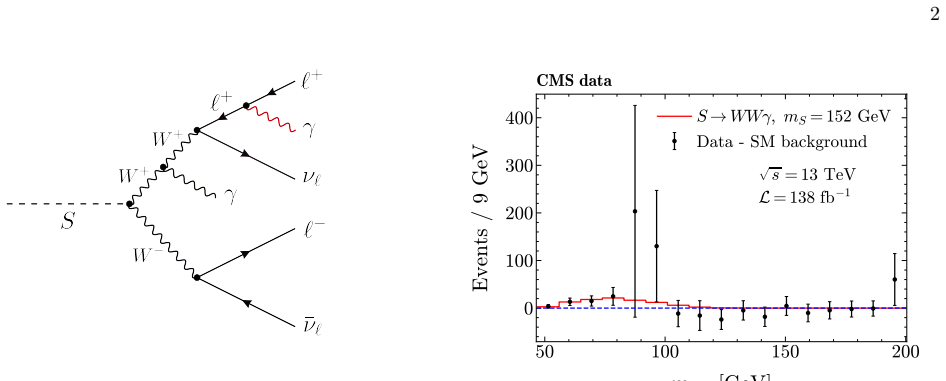
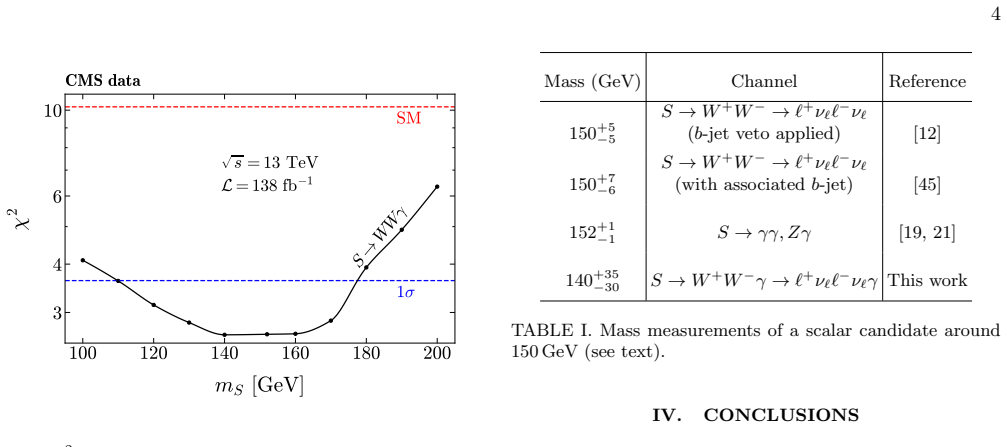
The authors investigate the radiative decay S to W+ W- gamma in the context of multi-lepton anomalies and indications of a narrow scalar resonance at 152 plus or minus 1 GeV. Using the m_ℓℓγ spectrum in b-jet events and tt gamma background shapes from CMS differential cross-section data, they observe a localized excess compatible with the scalar hypothesis at 2.7 sigma global significance. The ratio sigma(S to W+ W- gamma) over sigma(S to W+ W-) is extracted as 2.14 plus or minus 0.77 percent, compatible with an enhanced radiative contribution in beyond-Standard-Model scenarios.
What carries the argument
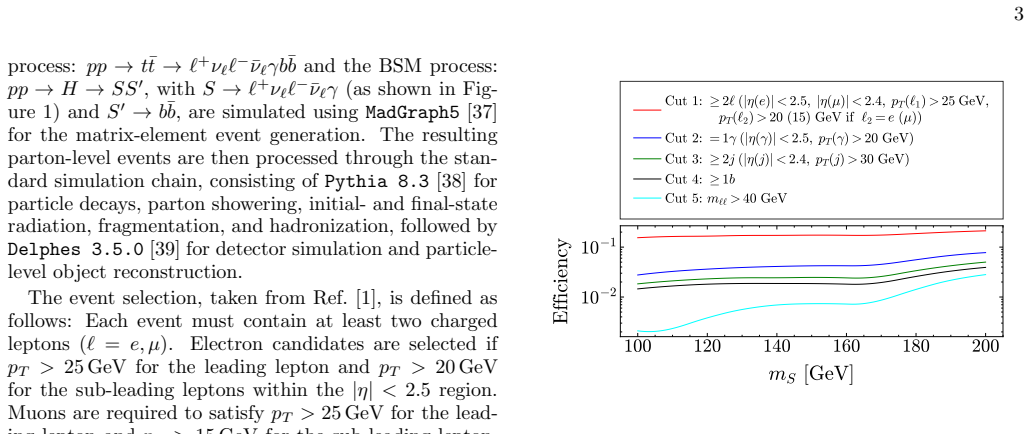
The m_ℓℓγ invariant-mass distribution in b-jet-associated events, used to isolate a possible peak from S to W+ W- gamma against the tt gamma background shape.
If this is right
- The excess adds support for the narrow resonance hypothesis across multiple decay channels.
- The extracted 2.14 percent ratio shows the radiative mode is present at a level that may require physics beyond the Standard Model.
- The analysis illustrates how existing differential cross-section measurements can be repurposed to search for radiative resonances in lepton-plus-photon final states.
Where Pith is reading between the lines
- Combining this result with the other reported channels could tighten constraints on the resonance production rate and couplings.
- Higher-statistics LHC runs could test whether the same excess persists or grows in the radiative channel.
- The measured ratio might guide model building toward scenarios with enhanced photon emission from the scalar.
Load-bearing premise
The background shape in the m_ℓℓγ spectrum near 152 GeV is accurately given by the cited CMS tt gamma differential cross-section measurement with no significant mismodeling or extra contributions that could create a fake localized excess.
What would settle it
An independent dataset or alternative background estimation that produces no excess at 152 GeV under the same event selection would falsify the resonance interpretation.
Figures
read the original abstract
We investigate the radiative decay $S \to W^+W^-\gamma$ in the context of the multi-lepton anomalies and recent indications of a narrow scalar resonance near $m_S = 152 \pm 1~\text{GeV}$ in the $\gamma\gamma$, $Z\gamma$, and $W^+W^-$ channels at the Large Hadron Collider. These excesses arise in final states containing leptons, missing transverse momentum, and associated $b$-jets, and motivate a search for a corresponding localized excess in the invariant-mass spectrum of the dilepton--photon system, $m_{\ell\ell\gamma}$, in events with associated $b$-jets. We use recent CMS measurements of the ${t\bar{t}}\gamma$ differential cross sections~\cite{CMS:2025zbe} to study the $m_{\ell\ell\gamma}$ spectrum and perform a search for a scalar-resonance contribution. A localized excess is observed, compatible with the scalar-resonance hypothesis, with a global significance of $2.7\sigma$ at $m_S = 152~\text{GeV}$. This result provides additional support for the hypothesis of a narrow resonance. The ratio $\sigma(S \to W^+W^-\gamma)/\sigma(S \to W^+W^-) = (2.14 \pm 0.77)$\% is extracted. This value is compatible with an enhanced radiative contribution that could arise in scenarios beyond the Standard Model.
Editorial analysis
A structured set of objections, weighed in public.
Referee Report
Summary. The paper investigates the radiative decay S → W⁺W⁻γ of a narrow scalar boson near 152 GeV motivated by multi-lepton anomalies. Using CMS ttγ differential cross-section data as a background template in the m_ℓℓγ spectrum (with b-jets), it reports a localized excess at m_S = 152 GeV with 2.7σ global significance. This is interpreted as additional support for the resonance hypothesis, and the ratio σ(S → W⁺W⁻γ)/σ(S → W⁺W⁻) = (2.14 ± 0.77)% is extracted.
Significance. If the background template accurately reproduces the shape with no unaccounted structure near 152 GeV and the significance calculation is robust, the result would provide modest incremental support for a narrow scalar in a radiative channel. The extracted ratio offers a quantitative handle on possible BSM enhancements. The analysis makes use of public CMS measurements, which is a positive aspect for reproducibility, though no machine-checked elements or falsifiable predictions beyond the reported excess are included.
major comments (2)
- [Abstract] Abstract: The claim of a 2.7σ global significance is presented without any description of the background parametrization (e.g., whether the CMS differential cross section is used directly or reweighted), the fit procedure, the m_ℓℓγ fit range, data-selection cuts, or systematic uncertainties; these details are load-bearing for evaluating whether the excess is genuine or an artifact.
- [Background modeling] Background modeling: The m_ℓℓγ spectrum is modeled solely from the cited CMS:2025zbe ttγ measurement with no mention of floating shape parameters, sideband validation, or checks for mismodeling in the 140–170 GeV window; a few-percent shape discrepancy in this region would directly affect both the reported significance and the extracted ratio of (2.14 ± 0.77)%.
minor comments (1)
- [Abstract] The abstract refers to 'recent indications' from prior channels without a brief recap of the mass and width values used to fix m_S = 152 GeV in the present search.
Simulated Author's Rebuttal
We thank the referee for the careful reading of our manuscript and the constructive comments. We respond to each major comment below and have made revisions to improve the clarity and documentation of the analysis.
read point-by-point responses
-
Referee: [Abstract] Abstract: The claim of a 2.7σ global significance is presented without any description of the background parametrization (e.g., whether the CMS differential cross section is used directly or reweighted), the fit procedure, the m_ℓℓγ fit range, data-selection cuts, or systematic uncertainties; these details are load-bearing for evaluating whether the excess is genuine or an artifact.
Authors: The abstract is a concise summary and cannot accommodate all technical details. The background is taken directly from the CMS ttγ differential cross-section measurement (no reweighting), the fit is performed over the m_ℓℓγ spectrum in events with b-jets, and the quoted significance incorporates the experimental uncertainties reported by CMS. These elements are described in Sections 2 and 3 of the manuscript. To address the concern, we have added a brief clause to the abstract indicating that the background template is the published CMS ttγ spectrum and that the fit is performed in the m_ℓℓγ distribution. revision: yes
-
Referee: [Background modeling] Background modeling: The m_ℓℓγ spectrum is modeled solely from the cited CMS:2025zbe ttγ measurement with no mention of floating shape parameters, sideband validation, or checks for mismodeling in the 140–170 GeV window; a few-percent shape discrepancy in this region would directly affect both the reported significance and the extracted ratio of (2.14 ± 0.77)%.
Authors: The spectrum is modeled directly from the CMS ttγ differential cross-section measurement as a fixed, data-driven template; no shape parameters are floated in order to keep the background estimate independent of the signal hypothesis. We have added explicit documentation in the revised manuscript of sideband validation outside the 140–170 GeV window and direct comparisons that confirm the absence of significant mismodeling in the signal region. The systematic uncertainties quoted by CMS are propagated into both the significance and the extracted ratio. We agree that these checks should be stated clearly and have incorporated them. revision: yes
Circularity Check
Mass and context imported from overlapping prior publications creates moderate self-citation dependence
specific steps
-
self citation load bearing
[Abstract]
"We investigate the radiative decay $S \to W^+W^-\gamma$ in the context of the multi-lepton anomalies and recent indications of a narrow scalar resonance near $m_S = 152 \pm 1~\text{GeV}$ in the $\gamma\gamma$, $Z\gamma$, and $W^+W^-$ channels at the Large Hadron Collider. These excesses arise in final states containing leptons, missing transverse momentum, and associated $b$-jets, and motivate a search for a corresponding localized excess in the invariant-mass spectrum of the dilepton--photon system, $m_{\ell\ell\gamma}$"
The specific mass value 152 GeV and the motivation for targeting that exact location are imported from prior publications whose author lists overlap with the present paper; the claimed 'additional support' for the resonance hypothesis is therefore partly justified by self-citation rather than standing on fully independent external evidence.
full rationale
The paper's search is performed at a fixed mass taken directly from earlier claims by overlapping authors, and the interpretation as 'additional support' for the narrow resonance hypothesis therefore inherits dependence on those prior results. The new analysis itself applies an external CMS ttγ differential cross-section measurement as background template and reports an excess in independent data, so the central claim retains independent empirical content. No self-definitional equations, fitted inputs renamed as predictions, ansatz smuggling, or renaming of known results are present. The background-shape assumption is a standard modeling choice whose failure would affect the result but does not constitute circularity by construction.
Axiom & Free-Parameter Ledger
free parameters (2)
- m_S =
152 GeV
- radiative ratio =
2.14 ± 0.77 %
axioms (1)
- domain assumption The differential ttγ background in m_ℓℓγ is accurately described by the CMS measurement without new-physics contributions or mismodeling at 152 GeV.
invented entities (1)
-
Narrow scalar boson S
no independent evidence
Reference graph
Works this paper leans on
-
[1]
A. Hayrapetyanet al.(CMS), Inclusive and differential measurements of the t¯tγcross section and the t¯tγ/t¯t cross section ratio in proton-proton collisions at √s= 13 TeV, (2025), arXiv:2511.01995 [hep-ex]
Pith/arXiv arXiv 2025
-
[2]
Weinberg, A Model of Leptons, Phys
S. Weinberg, A Model of Leptons, Phys. Rev. Lett.19, 1264 (1967)
1967
-
[3]
Takahashiet al.(Particle Data Group), Review of Par- ticle Physics, Int
F. Takahashiet al.(Particle Data Group), Review of Par- ticle Physics, Int. J. Mod. Phys. A41, 2630011 (2026)
2026
-
[4]
G. Aadet al.(ATLAS), Observation of a new particle in the search for the Standard Model Higgs boson with the ATLAS detector at the LHC, Phys. Lett. B716, 1 (2012), arXiv:1207.7214 [hep-ex]
Pith/arXiv arXiv 2012
-
[5]
S. Chatrchyanet al.(CMS), Observation of a New Bo- son at a Mass of 125 GeV with the CMS Experiment at the LHC, Phys. Lett. B716, 30 (2012), arXiv:1207.7235 [hep-ex]
Pith/arXiv arXiv 2012
-
[6]
A. Tumasyanet al.(CMS), A portrait of the Higgs boson by the CMS experiment ten years after the discovery., Nature607, 60 (2022), [Erratum: Nature 623, (2023)], arXiv:2207.00043 [hep-ex]
arXiv 2022
-
[7]
G. Aadet al.(ATLAS), A detailed map of Higgs boson interactions by the ATLAS experiment ten years after the discovery, Nature607, 52 (2022), [Erratum: Nature 612, E24 (2022)], arXiv:2207.00092 [hep-ex]
arXiv 2022
-
[8]
Aghanimet al.(Planck), Planck 2018 results
N. Aghanimet al.(Planck), Planck 2018 results. VI. Cosmological parameters, Astron. Astrophys.641, A6 (2020), [Erratum: Astron.Astrophys. 652, C4 (2021)], arXiv:1807.06209 [astro-ph.CO]
Pith/arXiv arXiv 2018
-
[9]
S. Abubakaret al.(T2K, NOvA), Joint neutrino oscil- lation analysis from the T2K and NOvA experiments, Nature646, 818 (2025), arXiv:2510.19888 [hep-ex]
arXiv 2025
-
[10]
A. D. Sakharov, Violation of CP Invariance, C asymme- try, and baryon asymmetry of the universe, Pisma Zh. Eksp. Teor. Fiz.5, 32 (1967)
1967
- [11]
-
[12]
S. von Buddenbrock, A. S. Cornell, A. Fadol, M. Kumar, B. Mellado, and X. Ruan, Multi-lepton signatures of ad- ditional scalar bosons beyond the Standard Model at the LHC, J. Phys. G45, 115003 (2018), arXiv:1711.07874 [hep-ph]
Pith/arXiv arXiv 2018
-
[13]
S. Buddenbrock, A. S. Cornell, Y. Fang, A. Fadol Mo- hammed, M. Kumar, B. Mellado, and K. G. Tomiwa, The emergence of multi-lepton anomalies at the LHC and their compatibility with new physics at the EW scale, JHEP10, 157, arXiv:1901.05300 [hep-ph]
arXiv 1901
-
[14]
Y. Hernandez, M. Kumar, A. S. Cornell, S.-E. Dahbi, Y. Fang, B. Lieberman, B. Mellado, K. Monnakgotla, X. Ruan, and S. Xin, The anomalous production of multi- lepton and its impact on the measurement ofW hpro- duction at the LHC, Eur. Phys. J. C81, 365 (2021), arXiv:1912.00699 [hep-ph]
arXiv 2021
-
[15]
S. von Buddenbrock, R. Ruiz, and B. Mellado, Anatomy of inclusivet ¯tWproduction at hadron colliders, Phys. Lett. B811, 135964 (2020), arXiv:2009.00032 [hep-ph]
arXiv 2020
-
[16]
Fischeret al., Unveiling hidden physics at the LHC, Eur
O. Fischeret al., Unveiling hidden physics at the LHC, Eur. Phys. J. C82, 665 (2022), arXiv:2109.06065 [hep- ph]
arXiv 2022
-
[17]
A. Crivellin and B. Mellado, Anomalies in particle physics and their implications for physics beyond the standard model, Nature Rev. Phys.6, 294 (2024), arXiv:2309.03870 [hep-ph]
arXiv 2024
-
[18]
S. von Buddenbrock, N. Chakrabarty, A. S. Cor- nell, D. Kar, M. Kumar, T. Mandal, B. Mellado, B. Mukhopadhyaya, R. G. Reed, and X. Ruan, Phe- nomenological signatures of additional scalar bosons at the LHC, Eur. Phys. J. C76, 580 (2016), arXiv:1606.01674 [hep-ph]
Pith/arXiv arXiv 2016
-
[19]
A. Crivellin, Y. Fang, O. Fischer, S. Bhattacharya, M. Kumar, E. Malwa, B. Mellado, N. Rapheeha, X. Ruan, and Q. Sha, Accumulating evidence for the as- sociated production of a new Higgs boson at the LHC, Phys. Rev. D108, 115031 (2023), arXiv:2109.02650 [hep- ph]
arXiv 2023
-
[20]
G. Coloretti, A. Crivellin, S. Bhattacharya, and B. Mellado, Searching for low-mass resonances decay- ing into W bosons, Phys. Rev. D108, 035026 (2023), arXiv:2302.07276 [hep-ph]
arXiv 2023
-
[21]
S. Bhattacharya, B. Lieberman, M. Kumar, A. Criv- ellin, Y. Fang, R. Mazini, and B. Mellado, Emerg- ing Excess Consistent with a Narrow Resonance at 152 GeV in High-Energy Proton-Proton Collisions, (2025), arXiv:2503.16245 [hep-ph]
arXiv 2025
-
[22]
G. Aadet al.(ATLAS), Search for dark matter in events with missing transverse momentum and a Higgs bo- son decaying into two photons in pp collisions at √s = 13 TeV with the ATLAS detector, JHEP10, 013, arXiv:2104.13240 [hep-ex]
-
[23]
G. Aadet al.(ATLAS), Model-independent search for the presence of new physics in events includingH→γγwith√s= 13 TeV pp data recorded by the ATLAS detector 6 at the LHC, JHEP07, 176, arXiv:2301.10486 [hep-ex]
-
[24]
G. Aadet al.(ATLAS), Measurements of Higgs boson production by gluon-gluon fusion and vector-boson fusion usingH→W W ∗ →eνµνdecays inppcollisions at√s= 13 TeV with the ATLAS detector, Phys. Rev. D 108, 032005 (2023), arXiv:2207.00338 [hep-ex]
arXiv 2023
-
[25]
A. M. Sirunyanet al.(CMS), Search for the decay of a Higgs boson in theℓℓγchannel in proton-proton collisions at √s= 13 TeV, JHEP11, 152, arXiv:1806.05996 [hep- ex]
-
[26]
A. Tumasyanet al.(CMS), Search for Higgs boson decays to a Z boson and a photon in proton-proton collisions at√s= 13 TeV, JHEP05, 233, arXiv:2204.12945 [hep-ex]
-
[27]
A. Tumasyanet al.(CMS), Measurements of the Higgs boson production cross section and couplings in the W boson pair decay channel in proton-proton collisions at √s= 13 TeV, Eur. Phys. J. C83, 667 (2023), arXiv:2206.09466 [hep-ex]
arXiv 2023
-
[28]
P. Fileviez Perez, H. H. Patel, M. J. Ramsey-Musolf, and K. Wang, Triplet Scalars and Dark Matter at the LHC, Phys. Rev. D79, 055024 (2009), arXiv:0811.3957 [hep- ph]
Pith/arXiv arXiv 2009
-
[29]
G. Coloretti, A. Crivellin, and B. Mellado, Combined explanation of LHC multilepton, diphoton, and top- quark excesses, Phys. Rev. D110, 073001 (2024), arXiv:2312.17314 [hep-ph]
arXiv 2024
-
[30]
G. Aadet al.(ATLAS), Observation of top-quark pair production in association with a photon and measure- ment of thet ¯tγproduction cross section in pp collisions at √s= 7 TeV using the ATLAS detector, Phys. Rev. D 91, 072007 (2015), arXiv:1502.00586 [hep-ex]
Pith/arXiv arXiv 2015
-
[31]
M. Aaboudet al.(ATLAS), Measurement of thet tγ production cross section in proton-proton collisions at√s= 8 TeV with the ATLAS detector, JHEP11, 086, arXiv:1706.03046 [hep-ex]
-
[32]
A. M. Sirunyanet al.(CMS), Measurement of the semileptonic tt +γproduction cross section in pp colli- sions at √s= 8 TeV, JHEP10, 006, arXiv:1706.08128 [hep-ex]
-
[33]
A. Tumasyanet al.(CMS), Measurement of the inclu- sive and differential ttγcross sections in the single-lepton channel and EFT interpretation at √s= 13 TeV, JHEP 12, 180, arXiv:2107.01508 [hep-ex]
-
[34]
M. Aaboudet al.(ATLAS), Measurements of inclusive and differential fiducial cross-sections oft ¯tγproduction in leptonic final states at √s= 13 TeV in ATLAS, Eur. Phys. J. C79, 382 (2019), arXiv:1812.01697 [hep-ex]
Pith/arXiv arXiv 2019
-
[35]
G. Aadet al.(ATLAS), Measurements of inclusive and differential cross-sections oft tγproduction in pp colli- sions at √s= 13 TeV with the ATLAS detector, JHEP 10, 191, arXiv:2403.09452 [hep-ex]
-
[36]
G. Aadet al.(ATLAS), Measurement of the charge asym- metry in top-quark pair production in association with a photon with the ATLAS experiment, Phys. Lett. B843, 137848 (2023), arXiv:2212.10552 [hep-ex]
arXiv 2023
-
[37]
J. Alwall, M. Herquet, F. Maltoni, O. Mattelaer, and T. Stelzer, MadGraph 5 : Going Beyond, JHEP06, 128, arXiv:1106.0522 [hep-ph]
-
[38]
T. Sj¨ ostrand, S. Ask, J. R. Christiansen, R. Corke, N. De- sai, P. Ilten, S. Mrenna, S. Prestel, C. O. Rasmussen, and P. Z. Skands, An introduction to PYTHIA 8.2, Comput. Phys. Commun.191, 159 (2015), arXiv:1410.3012 [hep- ph]
Pith/arXiv arXiv 2015
-
[39]
J. de Favereau, C. Delaere, P. Demin, A. Giammanco, V. Lemaˆ ıtre, A. Mertens, and M. Selvaggi (DELPHES 3), DELPHES 3, A modular framework for fast simu- lation of a generic collider experiment, JHEP02, 057, arXiv:1307.6346 [hep-ex]
-
[40]
A. Hayrapetyanet al.(CMS), Observation of a pseudoscalar excess at the top quark pair produc- tion threshold, Rept. Prog. Phys.88, 087801 (2025), arXiv:2503.22382 [hep-ex]
arXiv 2025
-
[41]
G. Aadet al.(ATLAS), Observation of a cross-section enhancement near thet ¯tproduction threshold in √s= 13 TeVppcollisions with the ATLAS detector, (2026), arXiv:2601.11780 [hep-ex]
Pith/arXiv arXiv 2026
- [42]
-
[43]
T. Flacke, B. Fuks, D. Kim, J. Kim, S. J. Lee, and L. Munoz-Aillaud, New physics in toponium’s shadow?, (2025), arXiv:2512.03220 [hep-ph]
Pith/arXiv arXiv 2025
-
[44]
A. M. Sirunyanet al.(CMS), Measurement of the pro- duction cross section for single top quarks in association with W bosons in proton-proton collisions at √s= 13 TeV, JHEP10, 117, arXiv:1805.07399 [hep-ex]
- [45]
-
[46]
B. A. Kniehl, Radiative corrections forH→W +W − (γ) in the standard model, Nucl. Phys. B357, 439 (1991)
1991
-
[47]
A. Bredenstein, A. Denner, S. Dittmaier, and M. M. We- ber, Precise predictions for the Higgs-boson decay H —> WW/ZZ —>4 leptons, Phys. Rev. D74, 013004 (2006), arXiv:hep-ph/0604011
Pith/arXiv arXiv 2006
-
[48]
S. Dawson and P. P. Giardino, Electroweak corrections to Higgs boson decays toγγandW +W − in standard model EFT, Phys. Rev. D98, 095005 (2018), arXiv:1807.11504 [hep-ph]
Pith/arXiv arXiv 2018
-
[49]
F. Egle, M. M¨ uhlleitner, R. Santos, and J. Viana, Elec- troweak corrections to Higgs boson decays in a Complex Singlet extension of the SM and their phenomenological impact, JHEP11, 116, arXiv:2306.04127 [hep-ph]
-
[50]
C. Degrande, K. Hartling, and H. E. Logan, Scalar decays toγγ,Zγ, andW γin the Georgi-Machacek model, Phys. Rev. D96, 075013 (2017), [Erratum: Phys.Rev.D 98, 019901 (2018)], arXiv:1708.08753 [hep-ph]
Pith/arXiv arXiv 2017
-
[51]
G. Bevilacqua, H. B. Hartanto, M. Kraus, T. Weber, and M. Worek, Hard Photons in Hadroproduction of Top Quarks with Realistic Final States, JHEP10, 158, arXiv:1803.09916 [hep-ph]
-
[52]
G. Bevilacqua, H. B. Hartanto, M. Kraus, T. Weber, and M. Worek, Off-shell vs on-shell modelling of top quarks in photon associated production, JHEP03, 154, arXiv:1912.09999 [hep-ph]
arXiv 1912
- [53]
-
[54]
T. C. Yuan, Anomalous radiative decay of heavy Higgs boson, (1992), arXiv:hep-ph/9205239
Pith/arXiv arXiv 1992
-
[55]
T. G. Rizzo, Radiative decay of heavy higgs bosons, Phys. Rev. D31, 2366 (1985)
1985
-
[56]
R. L. Workmanet al.(Particle Data Group), Review of Particle Physics, PTEP2022, 083C01 (2022)
2022
-
[57]
P. W. Higgs, Broken Symmetries and the Masses of Gauge Bosons, Phys. Rev. Lett.13, 508 (1964). 7
1964
-
[58]
Englert and R
F. Englert and R. Brout, Broken Symmetry and the Mass of Gauge Vector Mesons, Phys. Rev. Lett.13, 321 (1964)
1964
-
[59]
Trevisani (CMS), Higgs measurements from CMS, PoSDISCRETE2022, 056 (2024)
N. Trevisani (CMS), Higgs measurements from CMS, PoSDISCRETE2022, 056 (2024)
2024
-
[60]
Aadet al.(ATLAS), Characterising the Higgs bo- son with ATLAS data from the LHC Run-2, Phys
G. Aadet al.(ATLAS), Characterising the Higgs bo- son with ATLAS data from the LHC Run-2, Phys. Rept. 1116, 4 (2025), arXiv:2404.05498 [hep-ex]
arXiv 2025
-
[61]
I. Brivio and M. Trott, The Standard Model as an Effective Field Theory, Phys. Rept.793, 1 (2019), arXiv:1706.08945 [hep-ph]
Pith/arXiv arXiv 2019
-
[62]
L. Roszkowski, E. M. Sessolo, and S. Trojanowski, WIMP dark matter candidates and searches—current status and future prospects, Rept. Prog. Phys.81, 066201 (2018), arXiv:1707.06277 [hep-ph]
Pith/arXiv arXiv 2018
-
[63]
C. Giganti, S. Lavignac, and M. Zito, Neutrino oscilla- tions: The rise of the PMNS paradigm, Prog. Part. Nucl. Phys.98, 1 (2018), arXiv:1710.00715 [hep-ex]
Pith/arXiv arXiv 2018
-
[64]
B. Garbrecht, Why is there more matter than anti- matter? Calculational methods for leptogenesis and electroweak baryogenesis, Prog. Part. Nucl. Phys.110, 103727 (2020), arXiv:1812.02651 [hep-ph]
arXiv 2020
-
[65]
D. Bodeker and W. Buchmuller, Baryogenesis from the weak scale to the grand unification scale, Rev. Mod. Phys.93, 035004 (2021), arXiv:2009.07294 [hep-ph]
arXiv 2021
-
[66]
G. Aadet al.(ATLAS), Measurement of light-by- light scattering and search for axion-like particles with 2.2 nb −1 of Pb+Pb data with the ATLAS detector, JHEP03, 243, [Erratum: JHEP 11, 050 (2021)], arXiv:2008.05355 [hep-ex]
arXiv 2021
-
[67]
A combination of measurements of Higgs boson produc- tion and decay using up to 139 fb −1 of proton–proton collision data at √s= 13 TeV collected with the ATLAS experiment, (2020)
2020
-
[68]
J. Alwall, R. Frederix, S. Frixione, V. Hirschi, F. Maltoni, O. Mattelaer, H. S. Shao, T. Stelzer, P. Torrielli, and M. Zaro, The automated computation of tree-level and next-to-leading order differential cross sections, and their matching to parton shower simulations, JHEP07, 079, arXiv:1405.0301 [hep-ph]
-
[69]
R. Frederix, S. Frixione, V. Hirschi, D. Pagani, H. S. Shao, and M. Zaro, The automation of next-to-leading order electroweak calculations, JHEP07, 185, [Erratum: JHEP 11, 085 (2021)], arXiv:1804.10017 [hep-ph]
arXiv 2021
-
[70]
B. Fuks, K. Hagiwara, K. Ma, and Y.-J. Zheng, Signa- tures of toponium formation in LHC run 2 data, Phys. Rev. D104, 034023 (2021), arXiv:2102.11281 [hep-ph]
arXiv 2021
discussion (0)
Sign in with ORCID, Apple, or X to comment. Anyone can read and Pith papers without signing in.