THz-induced phonon mode mixing and collective dynamics in a polar nanolattice
Pith reviewed 2026-06-25 22:03 UTC · model grok-4.3
The pith
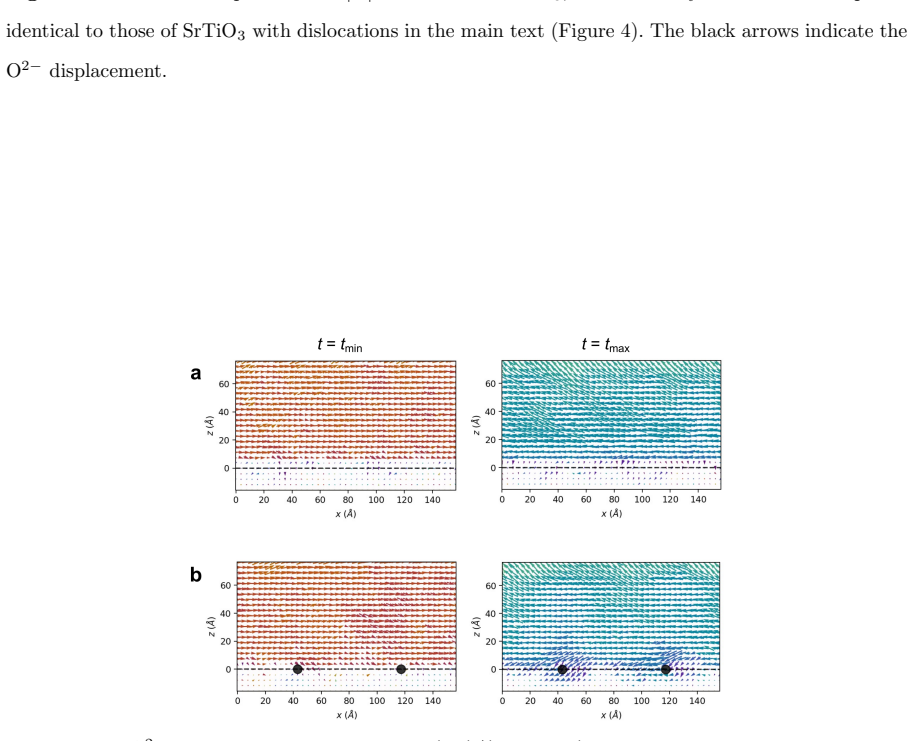
Symmetry breaking at all scales via a nanoscale dislocation network in SrTiO3 creates dynamical electric polarization and new collective THz phonon modes with circular vortex-like displacements.
A machine-rendered reading of the paper's core claim, the machinery that carries it, and where it could break.
Core claim
Symmetry breaking at all scales is an effective approach to create a dynamical electric polarization and to control phonon mixing that generates previously unreported collective modes in the THz regime with circular vortex-like displacements.
What carries the argument
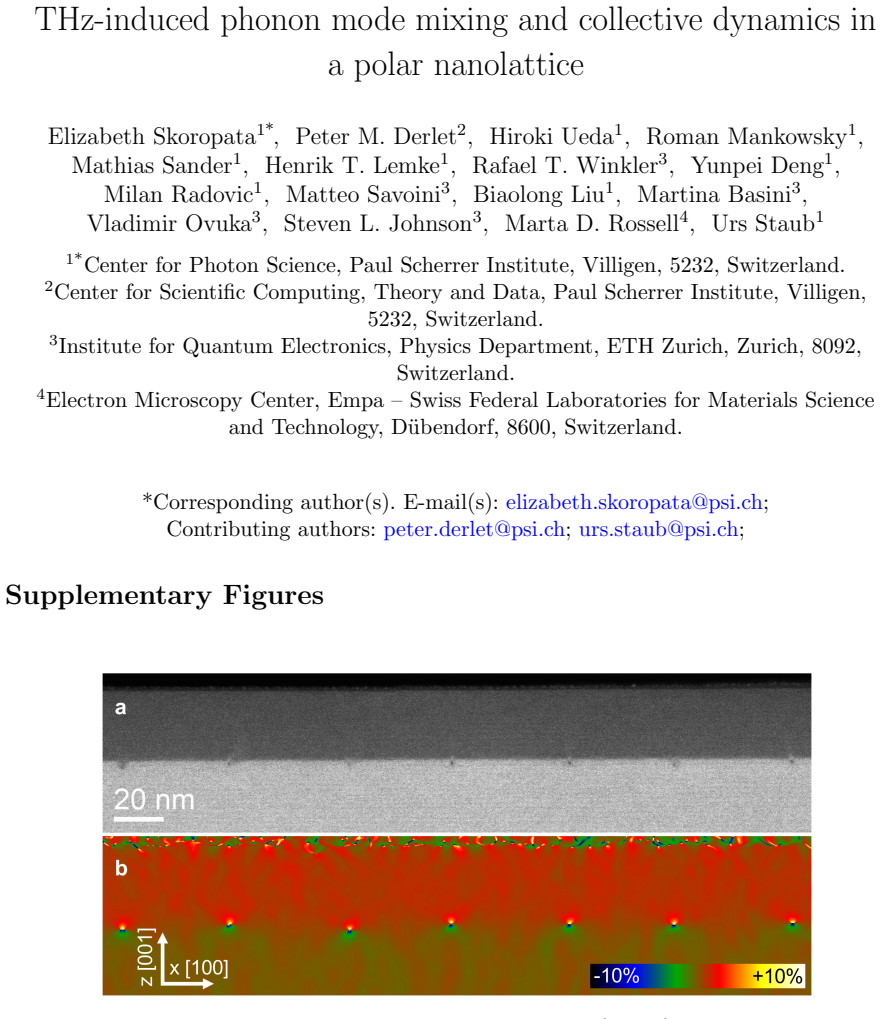
The nanoscale ordered interfacial dislocation network, which imposes symmetry breaking across length scales and enables controlled phonon mode mixing under THz excitation.
If this is right
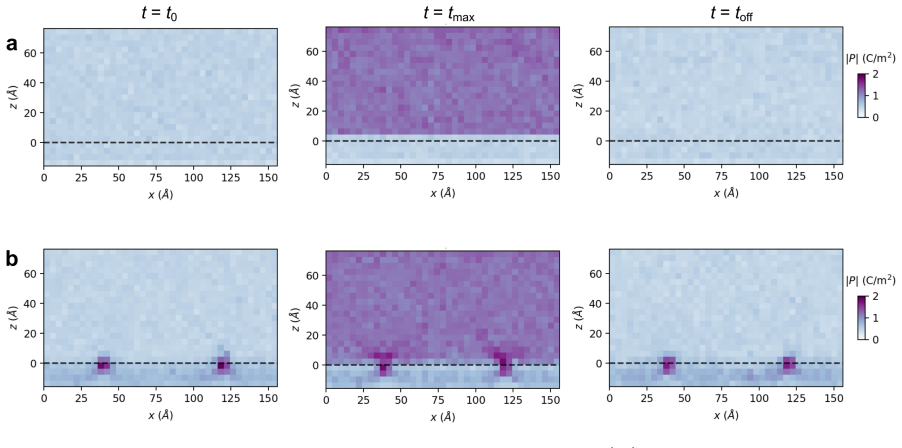
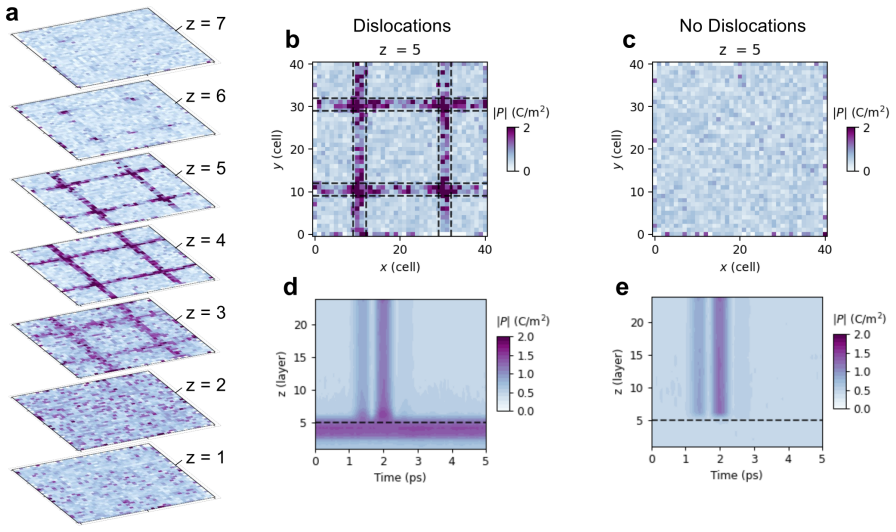
- Dynamical electric polarization appears in the film under THz drive due to the mixed modes.
- Collective modes with circular vortex-like displacements emerge only when the dislocation network is present.
- The same symmetry-breaking approach can be extended to magnetic, electric, and ferroelectric epitaxial systems.
- Real-space topology controlled by epitaxy becomes a design handle for THz functional properties.
Where Pith is reading between the lines
- Varying dislocation spacing or ordering during growth could tune the frequency or polarization of the new modes.
- Similar dislocation networks in other perovskite films might produce analogous mode mixing without requiring chemical doping.
- The circular displacements suggest possible coupling to orbital or spin degrees of freedom if the film is made magnetic.
Load-bearing premise
The observed phonon mode mixing and collective dynamics arise specifically from the nanoscale ordered interfacial dislocation network rather than other film properties or experimental factors.
What would settle it
Absence of the new collective modes and dynamical polarization in an otherwise identical SrTiO3 film that lacks the ordered dislocation network under the same THz excitation and diffraction measurement.
Figures
read the original abstract
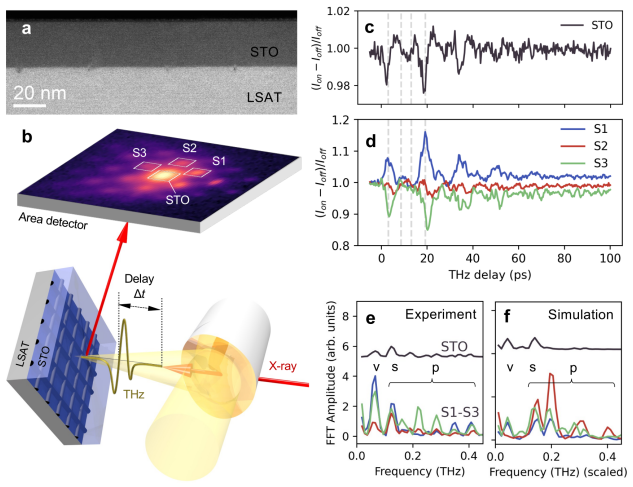
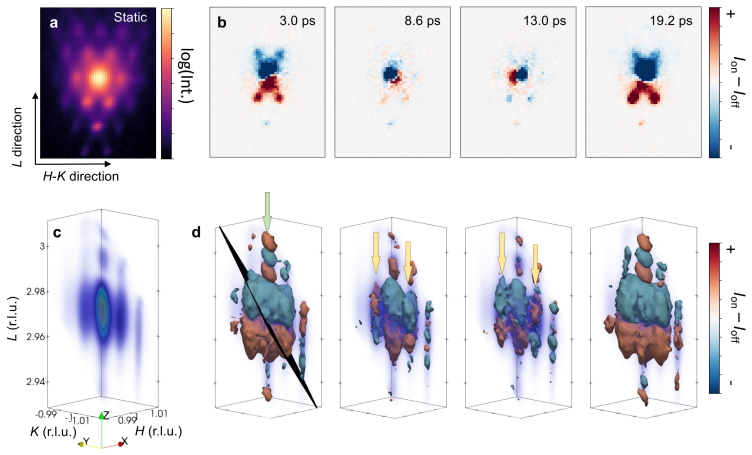
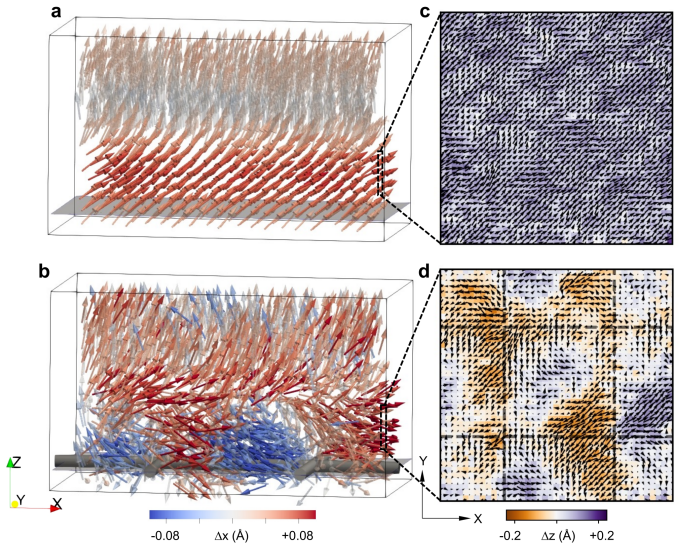
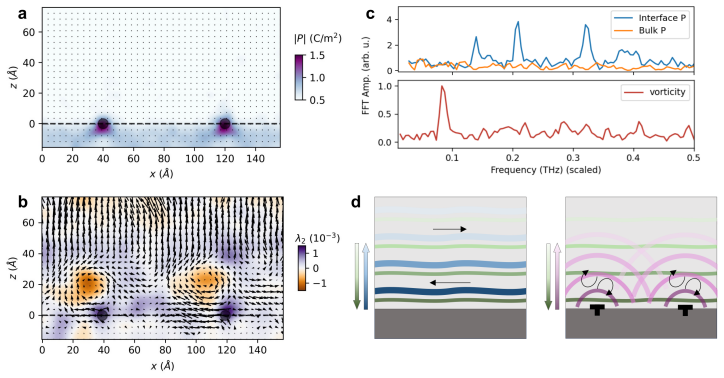
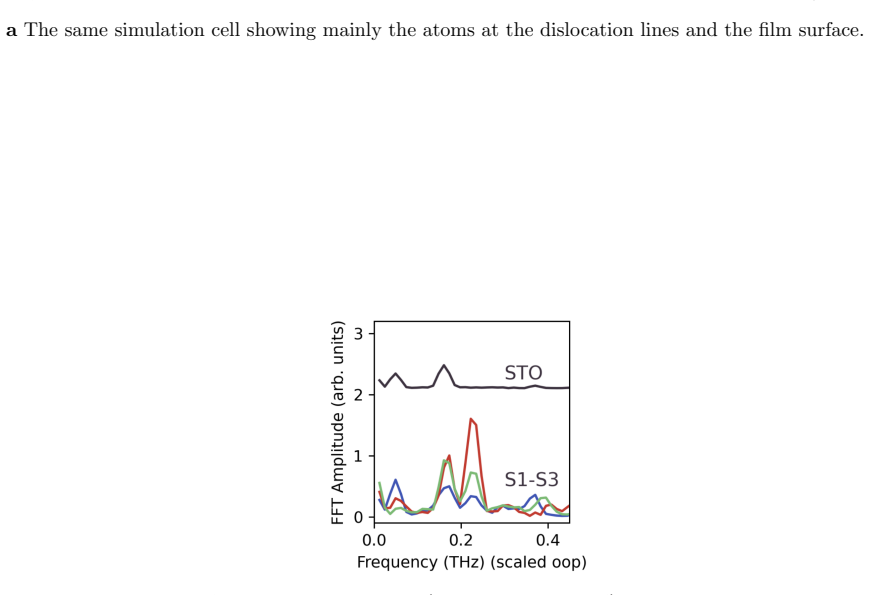
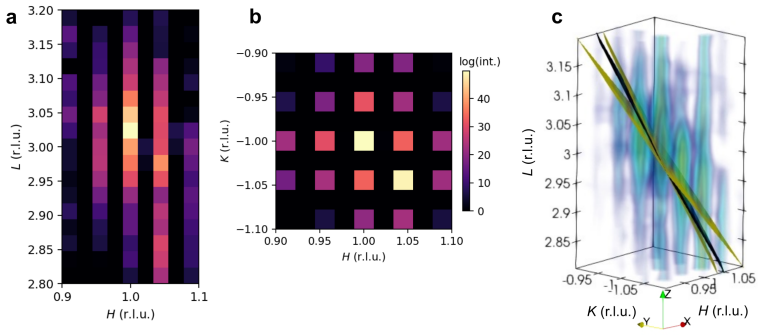
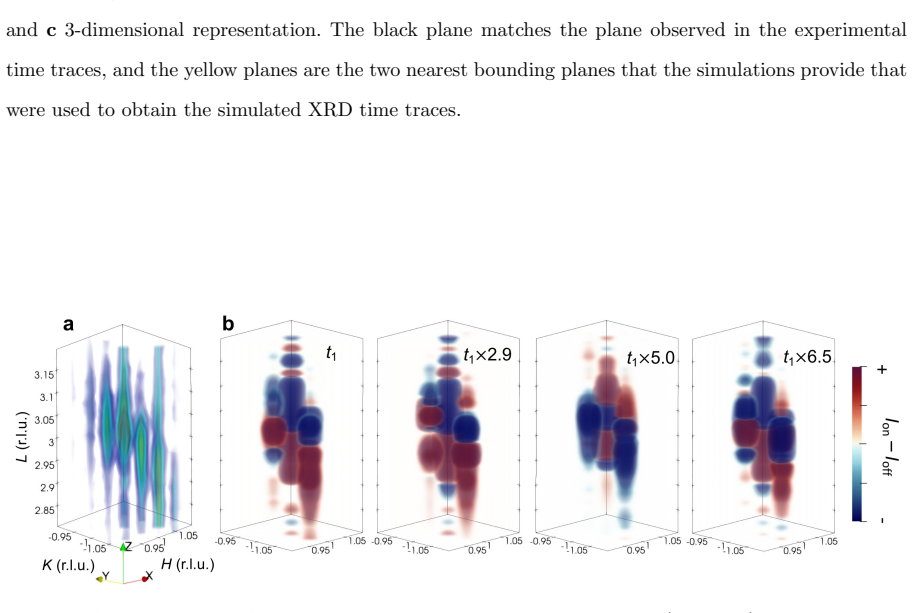
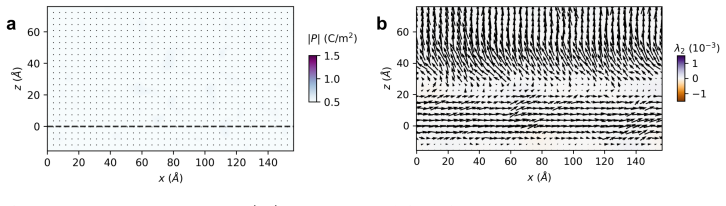
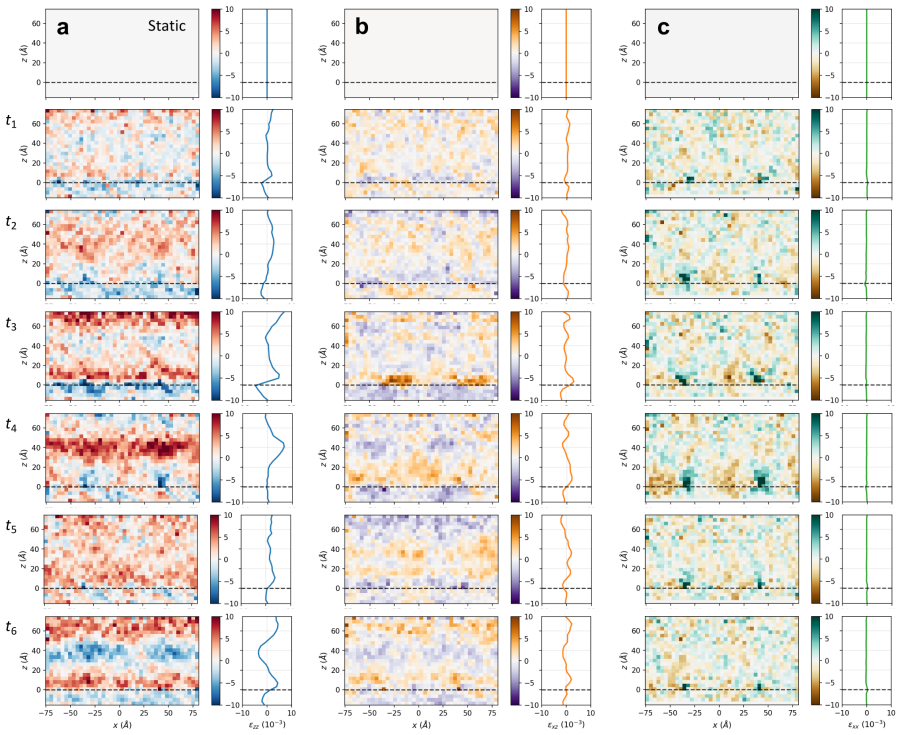
Manipulating phonons through symmetry is a fundamental approach to alter the dynamic responses of materials. Most often new phases are sought through control of the unit-cell (e.g. via strain, doping, light, etc.). By comparison, there is vast potential to look beyond the unit-cell into higher-order architectures to control wave scattering and interference effects that remains less explored. We describe the THz-induced dynamics of an SrTiO$_{3}$ thin film with a nanoscale ordered interfacial dislocation network probed with 2- and 3-dimensional time-resolved x-ray diffraction and classical molecular dynamics simulations. We find that symmetry breaking at all scales is an effective approach to create a dynamical electric polarization and to control phonon mixing that generates previously unreported collective modes in the THz regime with circular vortex-like displacements. This work opens a new pathway to explore dynamical functional properties that can be extended to magnetic, electric, and ferroelectric systems by controlling the real-space topology via epitaxy.
Editorial analysis
A structured set of objections, weighed in public.
Referee Report
Summary. The manuscript examines THz-driven phonon dynamics in an SrTiO3 thin film with a nanoscale ordered interfacial dislocation network. Using time-resolved 2D and 3D x-ray diffraction and molecular dynamics simulations, the authors report that symmetry breaking across scales induces dynamical electric polarization and phonon mode mixing, leading to new collective modes characterized by circular vortex-like atomic displacements in the THz regime.
Significance. If substantiated, the work shows that controlling real-space topology via epitaxy can generate dynamical polarization and previously unreported collective THz modes, offering a route to functional properties beyond unit-cell engineering that could extend to magnetic and ferroelectric systems.
major comments (1)
- [Methods and Results (dislocation network attribution)] The central claim attributes the phonon mode mixing and vortex-like collective modes specifically to the nanoscale ordered interfacial dislocation network as the source of multi-scale symmetry breaking. However, the manuscript does not present a control comparison (e.g., coherently strained STO film on lattice-matched substrate lacking the dislocation array) or a quantitative decomposition demonstrating that the 2D/3D diffraction signatures and MD trajectories vanish when the dislocation network is removed while holding thickness, strain, and THz drive fixed. This isolation is load-bearing for the interpretation.
minor comments (1)
- [Abstract] The abstract states that the modes are 'previously unreported'; adding a short sentence contrasting with known THz phonon responses in bulk or strained STO would strengthen the novelty claim.
Simulated Author's Rebuttal
We thank the referee for their detailed and constructive review of our manuscript. Their concern regarding the attribution of the observed phonon mode mixing and vortex-like modes specifically to the interfacial dislocation network is important, and we address it directly below.
read point-by-point responses
-
Referee: [Methods and Results (dislocation network attribution)] The central claim attributes the phonon mode mixing and vortex-like collective modes specifically to the nanoscale ordered interfacial dislocation network as the source of multi-scale symmetry breaking. However, the manuscript does not present a control comparison (e.g., coherently strained STO film on lattice-matched substrate lacking the dislocation array) or a quantitative decomposition demonstrating that the 2D/3D diffraction signatures and MD trajectories vanish when the dislocation network is removed while holding thickness, strain, and THz drive fixed. This isolation is load-bearing for the interpretation.
Authors: We agree that isolating the contribution of the dislocation network is essential to substantiate the central claim. An experimental control sample consisting of a coherently strained STO film on a lattice-matched substrate without the dislocation array is not available, as the ordered interfacial dislocation network is an intrinsic feature of the specific epitaxial growth conditions used in this study. However, the classical molecular dynamics simulations incorporated in the work are constructed from the experimentally characterized structure that includes the dislocation network. These simulations can be extended to perform the requested isolation by comparing dynamics in the full model versus an otherwise identical model with uniform strain (dislocation network removed) under fixed thickness, average strain, and THz drive. Such a comparison would demonstrate suppression of the vortex-like displacements and associated phonon mixing. We will add these comparative MD results together with a quantitative decomposition of the simulated 2D/3D diffraction signatures in the revised manuscript. revision: yes
Circularity Check
No circularity; experimental and simulation results are independent of inputs
full rationale
The paper reports THz-driven dynamics in an SrTiO3 film observed via 2D/3D time-resolved x-ray diffraction and classical MD simulations. Claims of symmetry breaking, dynamical polarization, and collective vortex-like modes are presented as direct outcomes of these measurements and trajectories. No equations or procedures reduce a claimed prediction to a fitted parameter by construction, no self-citations are invoked as load-bearing uniqueness theorems, and no ansatz is smuggled via prior work. The central attribution to the dislocation network is an interpretive step resting on experimental contrast rather than a definitional loop. The derivation chain is therefore self-contained against external data.
Axiom & Free-Parameter Ledger
axioms (2)
- domain assumption Time-resolved x-ray diffraction resolves THz-scale phonon displacements and mode mixing
- domain assumption Classical molecular dynamics simulations accurately capture the induced collective dynamics
Reference graph
Works this paper leans on
-
[1]
& MacDonald, A
Wu, F., Lovorn, T. & MacDonald, A. Topological exciton bands in Moir´ e heterojunctions.Phys. Rev. Lett.118, 147401 (2017)
2017
-
[2]
Nature556, 80–84 (2018)
Cao, Y.et al.Correlated insulator behaviour at half-filling in magic-angle graphene superlattices. Nature556, 80–84 (2018)
2018
-
[3]
Wang, P.et al.Localization and delocalization of light in photonic Moir´ e lattices.Nature577, 42–46 (2019)
2019
-
[4]
Yankowitz, M.et al.Tuning superconductivity in twisted bilayer graphene.Science363, 1059–1064 (2019)
2019
-
[5]
R., Efetov, D
Balents, L., Dean, C. R., Efetov, D. K. & Young, A. F. Superconductivity and strong correlations in Moir´ e flat bands.Nat. Phys.16, 725–733 (2020)
2020
-
[6]
Nature580, 472–477 (2020)
Shimazaki, Y.et al.Strongly correlated electrons and hybrid excitons in a Moir´ e heterostructure. Nature580, 472–477 (2020)
2020
-
[7]
Science374, 1140–1144 (2021)
Song, T.et al.Direct visualization of magnetic domains and Moir´ e magnetism in twisted 2d magnets. Science374, 1140–1144 (2021)
2021
-
[8]
Xie, H.et al.Evidence of non-collinear spin texture in magnetic Moir´ e superlattices.Nat. Phys. 19, 1150–1155 (2023)
2023
-
[9]
Nanotechnol
Yokouchi, T.et al.Creation of magnetic skyrmions by surface acoustic waves.Nat. Nanotechnol. 15, 361–366 (2020)
2020
-
[10]
& Onose, Y
Nii, Y., Yamamoto, K., Kanno, M., Maekawa, S. & Onose, Y. Observation of nonreciprocal diffraction of surface acoustic wave.Phys. Rev. Lett.134, 027001 (2025)
2025
-
[11]
Graczykowski, B.et al.Phonon dispersion in hypersonic two-dimensional phononic crystal membranes.Phys. Rev. B91, 075414 (2015)
2015
-
[12]
& Chan, C
Ma, G., Xiao, M. & Chan, C. T. Topological phases in acoustic and mechanical systems.Nat. Rev. Phys.1, 281 (2019)
2019
-
[13]
& Tamura, S
Tanaka, Y., Tomoyasu, Y. & Tamura, S. I. Band structure of acoustic waves in phononic lattices: Two-dimensional composites with large acoustic mismatch.Phys. Rev. B62, 7387 (2000)
2000
-
[14]
Nanotechnol.17, 947 (2022)
Florez, O.et al.Engineering nanoscale hypersonic phonon transport.Nat. Nanotechnol.17, 947 (2022)
2022
-
[15]
Nature520, 205–208 (2015)
Bencivenga, F.et al.Four-wave mixing experiments with extreme ultraviolet transient gratings. Nature520, 205–208 (2015)
2015
-
[16]
R.et al.Hard x-ray transient grating spectroscopy on bismuth germanate.Nat
Rouxel, J. R.et al.Hard x-ray transient grating spectroscopy on bismuth germanate.Nat. Photonics 15, 499–503 (2021)
2021
-
[17]
K.et al.Observation of polar vortices in oxide superlattices.Nature530, 198–201 (2016)
Yadav, A. K.et al.Observation of polar vortices in oxide superlattices.Nature530, 198–201 (2016)
2016
-
[18]
A.et al.Optical creation of a supercrystal with three-dimensional nanoscale periodicity
Stoica, V. A.et al.Optical creation of a supercrystal with three-dimensional nanoscale periodicity. Nat. Mater.18, 377–383 (2019)
2019
-
[19]
Das, S.et al.Observation of room-temperature polar skyrmions.Nature568, 368–372 (2019). 13
2019
-
[20]
Li, Q.et al.Subterahertz collective dynamics of polar vortices.Nature592, 376–380 (2021)
2021
-
[21]
H.et al.Terahertz-field activation of polar skyrons.Nat
Wang, H. H.et al.Terahertz-field activation of polar skyrons.Nat. Commun.16, 8994 (2025)
2025
-
[22]
Phys.21, 1965 (2025)
Li, W.et al.Terahertz excitation of collective dynamics of polar skyrmions over a broad temperature range.Nat. Phys.21, 1965 (2025)
1965
-
[23]
Xu, T.et al.Ultrasmall polar skyrmions and merons in SrTiO 3 heterostructures by polaron engineering.ACS Nano17, 10836–10843 (2023)
2023
-
[24]
Xu, T.et al.Mechanical rippling for diverse ferroelectric topologies in otherwise nonferroelectric SrTiO3 nanofilms.Phys. Rev. Lett.132, 086801 (2024)
2024
-
[25]
Commun.15, 10915 (2024)
Sha, H.et al.Polar vortex hidden in twisted bilayers of paraelectric SrTiO 3.Nat. Commun.15, 10915 (2024)
2024
-
[26]
Mater.(2026)
Tenreiro, I.et al.Flexoelectrically induced polar topology in twisted SrTiO 3 membranes.Adv. Mater.(2026)
2026
-
[27]
Nature626, 529–534 (2024)
S´ anchez-Santolino, G.et al.A 2D ferroelectric vortex pattern in twisted BaTiO3 freestanding layers. Nature626, 529–534 (2024)
2024
-
[28]
A.et al.Raman study of oxygen reduced and re-oxidized strontium titanate.Phys
Tenne, D. A.et al.Raman study of oxygen reduced and re-oxidized strontium titanate.Phys. Rev. B76, 024303 (2007)
2007
-
[29]
Evarestov, R.et al.Jahn-teller effect in the phonon properties of defective SrTiO 3 from first principles.Phys. Rev. B85(2012)
2012
-
[30]
Mater.21, 54–61 (2021)
Hameed, S.et al.Enhanced superconductivity and ferroelectric quantum criticality in plastically deformed strontium titanate.Nat. Mater.21, 54–61 (2021)
2021
-
[31]
Fauqu´ e, B.et al.Mesoscopic fluctuating domains in strontium titanate.Phys. Rev. B106, L140301 (2022)
2022
-
[32]
Phys.21, 961–965 (2025)
Orenstein, G.et al.Observation of polarization density waves in SrTiO 3.Nat. Phys.21, 961–965 (2025)
2025
-
[33]
Burian, M.et al.Buried moir´ e supercells through SrTiO 3 nanolayer relaxation.Phys. Rev. Res.3, 013225 (2021)
2021
-
[34]
Synchrotron Radiat.26, 874–886 (2019)
Ingold, G.et al.Experimental station bernina at swissfel: Condensed matter physics on femtosecond time scales investigated by x-ray diffraction and spectroscopic methods.J. Synchrotron Radiat.26, 874–886 (2019)
2019
-
[35]
Phys.: Condens
Mankowsky, R.et al.New insights into correlated materials in the time domain — Combining far- infrared excitation with x-ray probes at cryogenic temperatures.J. Phys.: Condens. Matter33, 374001 (2021)
2021
-
[36]
Details are given in the materials and methods section
-
[37]
Li, X.et al.Terahertz field–induced ferroelectricity in quantum paraelectric SrTiO 3.Science364, 1079–1082 (2019)
2019
-
[38]
Phys.15, 387–392 (2019)
Kozina, M.et al.Terahertz-driven phonon upconversion in SrTiO 3.Nat. Phys.15, 387–392 (2019)
2019
-
[39]
Marsik, P.et al.Terahertz ellipsometry study of the soft mode behavior in ultrathin srtio 3 films. Appl. Phys. Lett.108, 052901 (2016). 14
2016
-
[40]
Mattern, M.et al.Concepts and use cases for picosecond ultrasonics with x-rays.Photoacoustics 31, 100503 (2023)
2023
-
[41]
Bell, R. O. & Rupprecht, G. Elastic constants of strontium titanate.Phys. Rev.129, 90–94 (1963)
1963
-
[42]
R., Chrosch, J
Locherer, K. R., Chrosch, J. & Salje, E. K. H. Diffuse x-ray scattering in WO 3.Phase Transitions 67, 51–63 (1998)
1998
-
[43]
& Shirane, G
Xu, G., Zhong, Z., Bing, Y., Ye, Z.-G. & Shirane, G. Electric-field-induced redistribution of polar nano-regions in a relaxor ferroelectric.Nat. Mater.5, 134–140 (2006)
2006
-
[44]
Zatterin, E.et al.Assessing the ubiquity of bloch domain walls in ferroelectric lead titanate superlattices.Physical Review X14, 041052 (2024)
2024
-
[45]
Direct detection of electric-field-induced microscopic structural changes in LiNbO 3 by modulation x-ray diffraction.Phys
Fujimoto, I. Direct detection of electric-field-induced microscopic structural changes in LiNbO 3 by modulation x-ray diffraction.Phys. Rev. Lett.40, 941–944 (1978)
1978
-
[46]
Rep.6, 20829 (2016)
Gorfman, S.et al.Simultaneous resonant x-ray diffraction measurement of polarization inversion and lattice strain in polycrystalline ferroelectrics.Sci. Rep.6, 20829 (2016)
2016
-
[47]
& Migoni, R
Sepliarsky, M., Asthagiri, A., Phillpot, S., Stachiotti, M. & Migoni, R. Atomic-level simulation of ferroelectricity in oxide materials.Curr. Opin. Solid State Mater. Sci.9, 107–113 (2005)
2005
-
[48]
& Monacelli, L
Libbi, F., Johansson, A., Kozinsky, B. & Monacelli, L. Nonequilibrium quantum dynamics in SrTiO3 under impulsive THz radiation with machine learning.Sci. Adv.11, eadw1634 (2025)
2025
-
[49]
Moffatt, H. K. The degree of knottedness of tangled vortex lines.J. Fluid Mech.35, 117–129 (1969)
1969
-
[50]
& Hussain, F
Jeong, J. & Hussain, F. On the identification of a vortex.J. Fluid Mech.285, 69–94 (1995)
1995
-
[51]
& Theisel, H
Otto, M. & Theisel, H. Vortex analysis in uncertain vector fields.Comput. Graphics Forum31, 1035–1044 (2012)
2012
-
[52]
Chen, Y.et al.Resilient and customized polar vortices through dislocation engineering.J. Phys. D: Appl. Phys.58, 355303 (2025)
2025
-
[53]
Chen, Y.et al.From the flow to the polarization field: A cognitive way for ferroelectric vortex structures.Appl. Phys. Lett.120, 242905 (2022)
2022
-
[54]
Gao, P.et al.Atomic-scale measurement of flexoelectric polarization at SrTiO 3 dislocations.Phys. Rev. Lett.120, 267601 (2018)
2018
-
[55]
Mater.33, 2008316 (2021)
Li, T.et al.Strong room-temperature ferroelectricity in strained SrTiO 3 homoepitaxial film.Adv. Mater.33, 2008316 (2021)
2021
-
[56]
Commun.14, 162 (2023)
Sha, H.et al.Sub-nanometer-scale mapping of crystal orientation and depth-dependent structure of dislocation cores in SrTiO 3.Nat. Commun.14, 162 (2023)
2023
-
[57]
& Bj¨ orck, M
Glavic, A. & Bj¨ orck, M. GenX 3: The latest generation of an established tool.J. Appl. Cryst.55, 1063–1071 (2022)
2022
-
[58]
R.et al.The materials science beamline upgrade at the swiss light source.J
Willmott, P. R.et al.The materials science beamline upgrade at the swiss light source.J. Synchrotron Radiat.20, 667–682 (2013)
2013
-
[59]
& Stangl, J
Kriegner, D., Wintersberger, E. & Stangl, J. xrayutilities: a versatile tool for reciprocal space conversion of scattering data recorded with linear and area detectors.J. Appl. Cryst.46, 1162–1170 (2013). 15
2013
-
[60]
Visualization and analysis of atomistic simulation data with ovito–the open visualization tool.Modell
Stukowski, A. Visualization and analysis of atomistic simulation data with ovito–the open visualization tool.Modell. Simul. Mater. Sci. Eng.18, 015012 (2009)
2009
-
[61]
& Law, C
Ahrens, J., Geveci, B. & Law, C. Paraview: An end-user tool for large data visualization, visualization handbook, elsevier, isbn-13: 9780123875822 (2005). Methods Sample growth A SrTiO 3 film was grown on LSAT using pulsed laser deposition, and is the same as used in the experiments[33, 38]. To create the interfacial dislocation network, the sample was an...
2005
discussion (0)
Sign in with ORCID, Apple, or X to comment. Anyone can read and Pith papers without signing in.