World Models in Pieces: Structural Certification for General Agents
Pith reviewed 2026-06-25 23:01 UTC · model grok-4.3
The pith
Structural certification maps an agent's bounded performance on deep compositional goals to entry-wise guarantees on its internal world model with an O(1/n) + O(δ) error bound.
A machine-rendered reading of the paper's core claim, the machinery that carries it, and where it could break.
Core claim
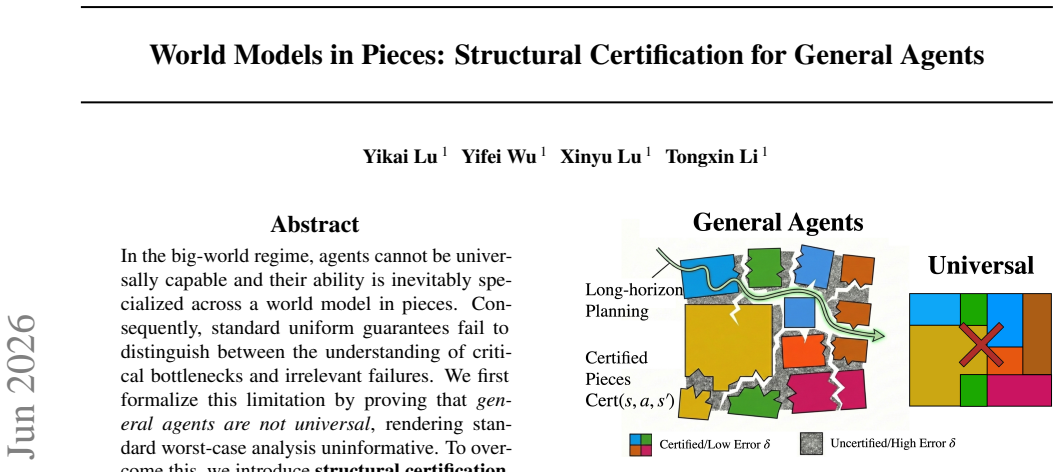
We provide algorithms that filter specific transitions using deep compositional goals and prove that a general agent on these goals has a structural world model with a O(1/n) + O(δ) error bound. Conversely, this bound is tight in the small-δ regime, whose existence is explicitly guaranteed by our certification. These results enable the certifiable deployment of general agents by localizing the specific transitions where long-horizon planning is reliable.
What carries the argument
structural certification, a transition-local framework that maps bounded goal-conditioned performance to entry-wise guarantees on the agent's internal world model
If this is right
- Standard uniform guarantees become uninformative for agents whose capabilities are specialized across a world model in pieces.
- Entry-wise accuracy on the internal world model follows directly from bounded performance on the chosen deep compositional goals.
- The O(1/n) + O(δ) bound is tight in the small-δ regime.
- Reliable long-horizon planning can be localized to the certified transitions.
Where Pith is reading between the lines
- Certification could be used to restrict deployment to only those transitions where the bound holds, rather than requiring global reliability.
- The same transition-filtering approach might extend to certifying other internal representations beyond world models.
- Empirical checks would require constructing the deep compositional goals for a concrete agent and measuring the resulting δ.
Load-bearing premise
Bounded goal-conditioned performance on deep compositional goals can be mapped to entry-wise guarantees on the agent's internal world model.
What would settle it
An agent that meets the bounded performance requirement on the deep compositional goals yet exhibits entry-wise errors larger than O(1/n) + O(δ) on the corresponding transitions.
Figures



read the original abstract
In the big-world regime, agents cannot be universally capable and their ability is inevitably specialized across a world model in pieces. Consequently, standard uniform guarantees fail to distinguish between the understanding of critical bottlenecks and irrelevant failures. We first formalize this limitation by proving that general agents are not universal, rendering standard worst-case analysis uninformative. To overcome this, we introduce structural certification, a transition-local framework that maps bounded goal-conditioned performance to entry-wise guarantees on the agent's internal world model. Our main contribution is constructive. We provide algorithms that filter specific transitions using deep compositional goals and prove that a general agent on these goals has a structural world model with a $\mathcal{O}(1/n) + \mathcal{O}(\delta)$ error bound. Conversely, this bound is tight in the small-$\delta$ regime, whose existence is explicitly guaranteed by our certification. These results enable the certifiable deployment of general agents by localizing the specific transitions where long-horizon planning is reliable.
Editorial analysis
A structured set of objections, weighed in public.
Referee Report
Summary. The paper argues that in the big-world regime general agents necessarily specialize across a world model in pieces, proves that such agents cannot be universal (rendering uniform worst-case analysis uninformative), and introduces structural certification: a transition-local framework that maps bounded goal-conditioned performance on deep compositional goals to entry-wise guarantees on the agent's internal world model. The central constructive contribution is a set of algorithms that filter specific transitions together with a proof that any general agent satisfying the performance bound on those goals possesses a structural world model whose entry-wise error is at most O(1/n) + O(δ); the bound is shown to be tight for small δ, thereby enabling localized certification of reliable long-horizon planning.
Significance. If the claimed algorithms and error-bound proof are correct, the work supplies a concrete mechanism for certifying localized reliability inside otherwise general agents, which would be a substantive advance over uniform PAC-style or worst-case guarantees. The explicit construction of the filtering algorithms and the tightness result in the small-δ regime are genuine strengths that, once fully documented, could support certifiable deployment arguments.
major comments (1)
- [Abstract] Abstract (and presumably the main technical sections): the manuscript asserts the existence of algorithms that filter transitions via deep compositional goals and a proof that bounded goal-conditioned performance yields an entry-wise O(1/n) + O(δ) guarantee on the structural world model, yet supplies neither the algorithm statements, the definitions of the key objects (structural certification, deep compositional goals, structural world model), nor any derivation steps or verification details. Because these elements are load-bearing for the central claim, their absence prevents any assessment of soundness.
Simulated Author's Rebuttal
We thank the referee for their careful reading and for identifying the central elements that require explicit documentation. We address the single major comment below.
read point-by-point responses
-
Referee: [Abstract] Abstract (and presumably the main technical sections): the manuscript asserts the existence of algorithms that filter transitions via deep compositional goals and a proof that bounded goal-conditioned performance yields an entry-wise O(1/n) + O(δ) guarantee on the structural world model, yet supplies neither the algorithm statements, the definitions of the key objects (structural certification, deep compositional goals, structural world model), nor any derivation steps or verification details. Because these elements are load-bearing for the central claim, their absence prevents any assessment of soundness.
Authors: The referee correctly observes that the submitted manuscript does not contain the explicit algorithm statements, formal definitions of the key objects, or derivation steps. The abstract summarizes the claims at a high level, but the main text as provided lacks the required technical detail. We will revise the manuscript to add: (i) formal definitions of structural certification, deep compositional goals, and the structural world model in a dedicated preliminary section; (ii) pseudocode and descriptions of the transition-filtering algorithms; and (iii) the full proof of the O(1/n) + O(δ) entry-wise bound together with the tightness argument for small δ. These additions will be placed in the main body rather than appendices. revision: yes
Circularity Check
No significant circularity; derivation presented as independent proof
full rationale
The abstract and stated claims describe a constructive proof that maps bounded goal-conditioned performance on deep compositional goals to entry-wise error bounds O(1/n) + O(δ) on the agent's world model via transition-filtering algorithms. No equations, self-citations, or steps are exhibited that reduce the claimed bound or mapping to a fitted parameter, self-defined quantity, or prior result by the same authors. The framework is introduced as overcoming limitations of uniform guarantees, with the bound derived from the certification rather than presupposed by it. This matches the default expectation of a non-circular theoretical paper.
Axiom & Free-Parameter Ledger
axioms (2)
- domain assumption General agents are not universal in the big-world regime
- domain assumption Bounded goal-conditioned performance maps to entry-wise guarantees on the internal world model
invented entities (1)
-
structural certification
no independent evidence
Reference graph
Works this paper leans on
-
[1]
Forty-second International Conference on Machine Learning , year=
General agents need world models , author=. Forty-second International Conference on Machine Learning , year=
-
[2]
, year =
Puterman, Martin L. , year =
-
[3]
and Barto, Andrew G
Sutton, Richard S. and Barto, Andrew G. , year =
-
[4]
and Tweedie, Richard L
Meyn, Sean P. and Tweedie, Richard L. , year =
-
[5]
Proceedings of the 18th Annual Symposium on Foundations of Computer Science (
Pnueli, Amir , title =. Proceedings of the 18th Annual Symposium on Foundations of Computer Science (. 1977 , doi =
1977
-
[6]
Principles of Model Checking , publisher =
Baier, Christel and Katoen, Joost. Principles of Model Checking , publisher =
-
[7]
Temporal-Logic-Based Reactive Mission and Motion Planning , journal =
Kress. Temporal-Logic-Based Reactive Mission and Motion Planning , journal =
-
[8]
Logically-Constrained Reinforcement Learning
Hasanbeig, Mohammadhosein and Abate, Alessandro and Kroening, Daniel , title =. arXiv preprint arXiv:1801.08099 , year =. doi:10.48550/arXiv.1801.08099 , eprint =
work page internal anchor Pith review Pith/arXiv arXiv doi:10.48550/arxiv.1801.08099
-
[9]
Formal Modeling and Analysis of Timed Systems (
Hasanbeig, Mohammadhosein and Kroening, Daniel and Abate, Alessandro , title =. Formal Modeling and Analysis of Timed Systems (
-
[10]
and Toro Icarte, Rodrigo A
Vaezipoor, Pashootan and Li, Andrew C. and Toro Icarte, Rodrigo A. and McIlraith, Sheila A. , title =. Proceedings of the 38th International Conference on Machine Learning (. 2021 , editor =
2021
-
[11]
Proceedings of the 32nd International Conference on Machine Learning (
Schaul, Tom and Horgan, Daniel and Gregor, Karol and Silver, David , title =. Proceedings of the 32nd International Conference on Machine Learning (. 2015 , editor =
2015
-
[12]
and Wolper, Pierre , title =
Vardi, Moshe Y. and Wolper, Pierre , title =. Proceedings of the First Annual. 1986 , publisher =
1986
-
[13]
Operations Research , year =
Nilim, Arnab and El Ghaoui, Laurent , title =. Operations Research , year =
-
[14]
Distributionally Robust Markov Decision Processes , url =
Xu, Huan and Mannor, Shie , booktitle =. Distributionally Robust Markov Decision Processes , url =
-
[15]
Safe Reinforcement Learning via Shielding , booktitle =
Mohammed Alshiekh and Roderick Bloem and R. Safe Reinforcement Learning via Shielding , booktitle =. 2018 , url =
2018
-
[16]
and Lee, Insup , title =
Hasanbeig, Mohammadhosein and Kantaros, Yiannis and Abate, Alessandro and Kroening, Daniel and Pappas, George J. and Lee, Insup , title =. 2019. 2019 , publisher =
2019
-
[17]
Advances in Neural Information Processing Systems , editor=
Policy Optimization with Linear Temporal Logic Constraints , author=. Advances in Neural Information Processing Systems , editor=. 2022 , url=
2022
-
[18]
Proceedings of the Thirty-Second International Joint Conference on Artificial Intelligence (
Shao, Daqian and Kwiatkowska, Marta , title =. Proceedings of the Thirty-Second International Joint Conference on Artificial Intelligence (
-
[19]
Proceedings of the 16th International Conference on Agents and Artificial Intelligence (
Gross, Dennis and Spieker, Helge , title =. Proceedings of the 16th International Conference on Agents and Artificial Intelligence (. 2024 , volume =
2024
-
[20]
, title =
Iyengar, Garud N. , title =. Mathematics of Operations Research , year =
-
[21]
Liu, M. and Zhu, M. and Zhang, W. , title =. arXiv preprint arXiv:2201.08299 , year =. 2201.08299 , archivePrefix =
-
[22]
arXiv preprint arXiv:2302.03770 , year =
Provably Efficient Offline Goal-Conditioned Reinforcement Learning with General Function Approximation and Single-Policy Concentrability , author =. arXiv preprint arXiv:2302.03770 , year =
-
[23]
arXiv preprint arXiv:2402.10820 , year =
Learning Goal-Conditioned Policies from Sub-Optimal Datasets , author =. arXiv preprint arXiv:2402.10820 , year =
-
[24]
2025 , eprint=
From Word to World: Can Large Language Models be Implicit Text-based World Models? , author=. 2025 , eprint=
2025
-
[25]
2024 , eprint=
AgentGym: Evolving Large Language Model-based Agents across Diverse Environments , author=. 2024 , eprint=
2024
-
[26]
The Twelfth International Conference on Learning Representations (
Robust agents learn causal world models , author =. The Twelfth International Conference on Learning Representations (. 2024 , url =
2024
-
[27]
NeurIPS , year =
World models , author =. NeurIPS , year =
-
[28]
Behavioral and brain sciences , volume =
Building machines that learn and think like people , author =. Behavioral and brain sciences , volume =. 2017 , publisher=
2017
-
[29]
, title =
Sutton, Richard S. , title =. Proceedings of the Seventh International Conference (1990) on Machine Learning , pages =. 1990 , isbn =
1990
-
[30]
2021 , eprint=
When to Trust Your Model: Model-Based Policy Optimization , author=. 2021 , eprint=
2021
-
[31]
PMLR , year=
Objective Mismatch in Model-based Reinforcement Learning , author=. PMLR , year=
-
[32]
Recurrent World Models Facilitate Policy Evolution , url =
Ha, David and Schmidhuber, J\". Recurrent World Models Facilitate Policy Evolution , url =. Advances in Neural Information Processing Systems , editor =
-
[33]
International Conference on Learning Representations , year=
Dream to Control: Learning Behaviors by Latent Imagination , author=. International Conference on Learning Representations , year=
-
[34]
2020 , eprint=
Offline Reinforcement Learning: Tutorial, Review, and Perspectives on Open Problems , author=. 2020 , eprint=
2020
-
[35]
System Identification: Theory for the User, 2nd Edition (Ljung, L.; 1999) [On the Shelf] , year=
Simpkins, Alex , journal=. System Identification: Theory for the User, 2nd Edition (Ljung, L.; 1999) [On the Shelf] , year=
1999
-
[36]
1972 , edition =
The Foundations of Statistics , author =. 1972 , edition =
1972
-
[37]
Proceedings of the Seventeenth International Conference on Machine Learning (ICML) , pages =
Algorithms for Inverse Reinforcement Learning , author =. Proceedings of the Seventeenth International Conference on Machine Learning (ICML) , pages =
-
[38]
Proceedings of the AAAI Conference on Artificial Intelligence (AAAI) , year =
Maximum Entropy Inverse Reinforcement Learning , author =. Proceedings of the AAAI Conference on Artificial Intelligence (AAAI) , year =
-
[39]
Advances in Neural Information Processing Systems (NeurIPS) , year =
Predictive Representations of State , author =. Advances in Neural Information Processing Systems (NeurIPS) , year =
-
[40]
and Macready, William G
Wolpert, David H. and Macready, William G. , title =. IEEE Transactions on Evolutionary Computation , year =
-
[41]
Wiesemann, Wolfram and Kuhn, Daniel and Rustem, Ber. Robust. Mathematics of Operations Research , year =
-
[42]
2024 , eprint=
Subjective Causality , author=. 2024 , eprint=
2024
-
[43]
and Dhariwal, Prafulla and Neelakantan, Arvind and Shyam, Pranav and Sastry, Girish and Askell, Amanda and others , title =
Brown, Tom and Mann, Benjamin and Ryder, Nick and Subbiah, Melanie and Kaplan, Jared D. and Dhariwal, Prafulla and Neelakantan, Arvind and Shyam, Pranav and Sastry, Girish and Askell, Amanda and others , title =. Advances in Neural Information Processing Systems , volume =. 2020 , eprint =
2020
-
[44]
The Eleventh International Conference on Learning Representations , year=
Emergent World Representations: Exploring a Sequence Model Trained on a Synthetic Task , author=. The Eleventh International Conference on Learning Representations , year=
-
[45]
Abdou, M. and Kulmizev, A. and Hershcovich, D. and Frank, S. and Pavlick, E. and S. arXiv preprint arXiv:2109.06129 , year =
-
[46]
International Conference on Machine Learning , pages =
Learning Latent Dynamics for Planning from Pixels , author =. International Conference on Machine Learning , pages =
-
[47]
Advances in Neural Information Processing Systems , volume =
Deep Reinforcement Learning in a Handful of Trials using Probabilistic Dynamics Models , author =. Advances in Neural Information Processing Systems , volume =
-
[48]
International Conference on Learning Representations (ICLR) , year =
Interpreting Emergent Planning in Model-Free Reinforcement Learning , author =. International Conference on Learning Representations (ICLR) , year =
-
[49]
The 2023 Conference on Empirical Methods in Natural Language Processing , year=
Reasoning with Language Model is Planning with World Model , author=. The 2023 Conference on Empirical Methods in Natural Language Processing , year=
2023
-
[50]
Forty-second International Conference on Machine Learning , year=
The Limits of Predicting Agents from Behaviour , author=. Forty-second International Conference on Machine Learning , year=
-
[51]
and Precup, Doina and Singh, Satinder , journal =
Sutton, Richard S. and Precup, Doina and Singh, Satinder , journal =. Between
-
[52]
, title =
McGovern, Amy and Barto, Andrew G. , title =. Proceedings of the Eighteenth International Conference on Machine Learning , pages =. 2001 , publisher =
2001
-
[53]
Advances in Neural Information Processing Systems , year =
Skill Characterization Based on Betweenness , author =. Advances in Neural Information Processing Systems , year =
-
[54]
OpenReview , year =
A Path Towards Autonomous Machine Intelligence , author =. OpenReview , year =
-
[55]
The Complexity of Propositional Linear Temporal Logics in Simple Cases , journal =
St. The Complexity of Propositional Linear Temporal Logics in Simple Cases , journal =. 2002 , url =
2002
-
[56]
Self-Correcting Models for Model-Based Reinforcement Learning
Self-Correcting Models for Model-Based Reinforcement Learning , author =. arXiv preprint arXiv:1612.06018 , year =
work page internal anchor Pith review Pith/arXiv arXiv
-
[57]
Advances in Neural Information Processing Systems (NeurIPS) , year =
When to Trust Your Model: Model-Based Policy Optimization , author =. Advances in Neural Information Processing Systems (NeurIPS) , year =
-
[58]
Advances in Neural Information Processing Systems (NeurIPS) , year =
Deep Reinforcement Learning in a Handful of Trials using Probabilistic Dynamics Models , author =. Advances in Neural Information Processing Systems (NeurIPS) , year =
-
[59]
Nature , volume =
Mastering Atari, Go, Chess and Shogi by Planning with a Learned Model , author =. Nature , volume =. 2020 , doi =
2020
-
[60]
Advances in Neural Information Processing Systems (NeurIPS) , year =
MOPO: Model-Based Offline Policy Optimization , author =. Advances in Neural Information Processing Systems (NeurIPS) , year =
-
[61]
Advances in Neural Information Processing Systems (NeurIPS) , year =
MOReL: Model-Based Offline Reinforcement Learning , author =. Advances in Neural Information Processing Systems (NeurIPS) , year =
-
[62]
Seo, Younggyo and Lee, Kimin and Shin, Jinwoo and Abbeel, Pieter and Lee, Honglak and others , booktitle =
-
[63]
Journal of Machine Learning Research , volume =
A Comprehensive Survey on Safe Reinforcement Learning , author =. Journal of Machine Learning Research , volume =
-
[64]
Proceedings of the 34th International Conference on Machine Learning (ICML) , year =
Constrained Policy Optimization , author =. Proceedings of the 34th International Conference on Machine Learning (ICML) , year =
-
[65]
arXiv preprint , year =
Shielding Reinforcement Learning: A Survey and Future Directions , author =. arXiv preprint , year =
-
[66]
Communications of the ACM , volume =
Shields for Safe Reinforcement Learning , author =. Communications of the ACM , volume =. 2025 , doi =
2025
-
[67]
Proceedings of the AAAI Conference on Artificial Intelligence (AAAI) , year =
Safe Reinforcement Learning via Shielding under Partial Observability , author =. Proceedings of the AAAI Conference on Artificial Intelligence (AAAI) , year =
-
[68]
2021 , eprint =
Shielding Atari Games with Bounded Prescience , author =. 2021 , eprint =
2021
-
[69]
Advances in Neural Information Processing Systems (NeurIPS) , year =
WebShop: Towards Scalable Real-World Web Interaction with Grounded Language Agents , author =. Advances in Neural Information Processing Systems (NeurIPS) , year =
-
[70]
2023 , eprint =
WebArena: A Realistic Web Environment for Building Autonomous Agents , author =. 2023 , eprint =
2023
-
[71]
Proceedings of the 36th International Conference on Machine Learning (ICML) , year =
Quantifying Generalization in Reinforcement Learning , author =. Proceedings of the 36th International Conference on Machine Learning (ICML) , year =
-
[72]
Finding the Frame Workshop at the Reinforcement Learning Conference (RLC 2024) , year =
The Big World Hypothesis and its Ramifications for Artificial Intelligence , author =. Finding the Frame Workshop at the Reinforcement Learning Conference (RLC 2024) , year =
2024
-
[73]
2024 , url=
Haohong Lin and Wenhao Ding and Jian Chen and Laixi Shi and Jiacheng Zhu and Bo Li and Ding Zhao , booktitle=. 2024 , url=
2024
-
[74]
Is Value Learning Really the Main Bottleneck in Offline
Seohong Park and Kevin Frans and Sergey Levine and Aviral Kumar , booktitle=. Is Value Learning Really the Main Bottleneck in Offline. 2024 , url=
2024
-
[75]
International Conference on Learning Representations (ICLR) , year =
Maximum Entropy Model Correction in Reinforcement Learning , author =. International Conference on Learning Representations (ICLR) , year =
-
[76]
International Conference on Machine Learning (ICML) , year =
Calibrated Value-Aware Model Learning with Probabilistic Environment Models , author =. International Conference on Machine Learning (ICML) , year =
-
[77]
Which Agent Causes Task Failures and When? On Automated Failure Attribution of
Shaokun Zhang and Ming Yin and Jieyu Zhang and Jiale Liu and Zhiguang Han and Jingyang Zhang and Beibin Li and Chi Wang and Huazheng Wang and Yiran Chen and Qingyun Wu , booktitle=. Which Agent Causes Task Failures and When? On Automated Failure Attribution of. 2025 , url=
2025
-
[78]
arXiv preprint arXiv:2411.11451 , year =
Robust Markov Decision Processes: A Place Where AI and Formal Methods Meet , author =. arXiv preprint arXiv:2411.11451 , year =
-
[79]
International Conference on Learning Representations (ICLR) , year =
WebArena: A Realistic Web Environment for Building Autonomous Agents , author =. International Conference on Learning Representations (ICLR) , year =
-
[80]
Annual Meeting of the Association for Computational Linguistics (ACL) , year =
VisualWebArena: Evaluating Multimodal Agents on Realistic Visual Web Tasks , author =. Annual Meeting of the Association for Computational Linguistics (ACL) , year =
discussion (0)
Sign in with ORCID, Apple, or X to comment. Anyone can read and Pith papers without signing in.