Mechanism of Band Gap Formation in Beam Networks
Pith reviewed 2026-06-25 22:43 UTC · model grok-4.3
The pith
Axial-bending coupling at lattice nodes sets band gap onset in beam networks and scales with the axial cutoff frequency of a one-dimensional beam.
A machine-rendered reading of the paper's core claim, the machinery that carries it, and where it could break.
Core claim
Band gap onset in beam networks arises from axial-bending coupling at lattice nodes and scales with the axial cutoff frequency of a one-dimensional periodic beam, whereas band gap termination is primarily governed by high-frequency rotational branches associated with beam geometry. This mechanism holds for both periodic and disordered beam networks. In periodic lattices it manifests through beam orientations at lattice nodes, whereas in disordered networks it manifests through short-beam statistics arising from variations in beam length.
What carries the argument
geometry-induced coupling between axial and bending deformation modes at lattice nodes
If this is right
- The same node-level coupling produces band gaps in disordered networks through short-beam statistics.
- Band-gap edges can be predicted from the axial cutoff of individual beams and the rotational branches set by beam geometry.
- Periodicity is unnecessary; the mechanism operates through local node geometry or length distributions alone.
- High-frequency gap termination is controlled by rotational branches independent of the lower-edge scaling.
Where Pith is reading between the lines
- Tuning the distribution of beam lengths in disordered networks could adjust gap width without changing overall connectivity.
- The reported scaling supplies a design rule in which increasing axial stiffness shifts the entire gap upward in frequency.
- Analogous axial-bending or axial-shear couplings may govern gaps in plate or shell networks under comparable node conditions.
Load-bearing premise
Axial-bending coupling at the nodes is the dominant cause of the observed band gaps rather than Bragg scattering or local resonance.
What would settle it
A measured or computed band-gap onset frequency that fails to match the axial cutoff frequency of the constituent one-dimensional beams, or the continued presence of gaps after node conditions are altered to suppress axial-bending coupling.
Figures
read the original abstract
Band gaps are commonly attributed to Bragg scattering or local resonance, yet it remains unclear whether these mechanisms govern band gap formation in beam networks. In this work, we explain band gap formation in beam networks in terms of a new mechanism, geometry-induced coupling between deformation modes. Specifically, band gap onset arises from axial-bending coupling at lattice nodes and scales with the axial cutoff frequency of a one-dimensional periodic beam, whereas band gap termination is primarily governed by high-frequency rotational branches associated with beam geometry. This mechanism holds for both periodic and disordered beam networks. In periodic lattices, it manifests through beam orientations at lattice nodes, whereas in disordered networks it manifests through short-beam statistics arising from variations in beam length. Together, these results establish a unified mechanism for band gap formation across both periodic and disordered beam networks, providing new insight into the physical origin of band gaps in beam-network materials.
Editorial analysis
A structured set of objections, weighed in public.
Referee Report
Summary. The manuscript claims that band gaps in beam networks arise from a geometry-induced coupling between axial and bending deformation modes at lattice nodes, rather than Bragg scattering or local resonance. Band-gap onset scales with the axial cutoff frequency of a one-dimensional periodic beam, while termination is set by high-frequency rotational branches tied to beam geometry. The mechanism is asserted to apply equally to periodic lattices (via node orientations) and disordered networks (via short-beam length statistics).
Significance. If the scaling relation and dominance of axial-bending coupling are rigorously demonstrated, the work would supply a unified, geometry-based account of band gaps that spans both ordered and disordered beam networks, offering a concrete alternative to conventional mechanisms and potential design rules for phononic metamaterials.
major comments (2)
- [Abstract] Abstract: the central claim that axial-bending coupling at nodes is the dominant and sufficient cause of the observed band gaps, with onset scaling directly to the 1D axial cutoff frequency, cannot be evaluated because no dispersion relations, finite-element results, or analytic derivations are supplied in the provided text.
- [Abstract] Abstract: the assertion that band-gap termination is governed by high-frequency rotational branches is stated without reference to any specific dispersion diagram, cutoff-frequency calculation, or comparison that would establish this as the primary termination mechanism rather than other high-frequency features.
Simulated Author's Rebuttal
We thank the referee for their review. The abstract provides a concise summary of the findings; the full manuscript contains the supporting analytic derivations, finite-element results, and dispersion diagrams as detailed in the responses below.
read point-by-point responses
-
Referee: [Abstract] Abstract: the central claim that axial-bending coupling at nodes is the dominant and sufficient cause of the observed band gaps, with onset scaling directly to the 1D axial cutoff frequency, cannot be evaluated because no dispersion relations, finite-element results, or analytic derivations are supplied in the provided text.
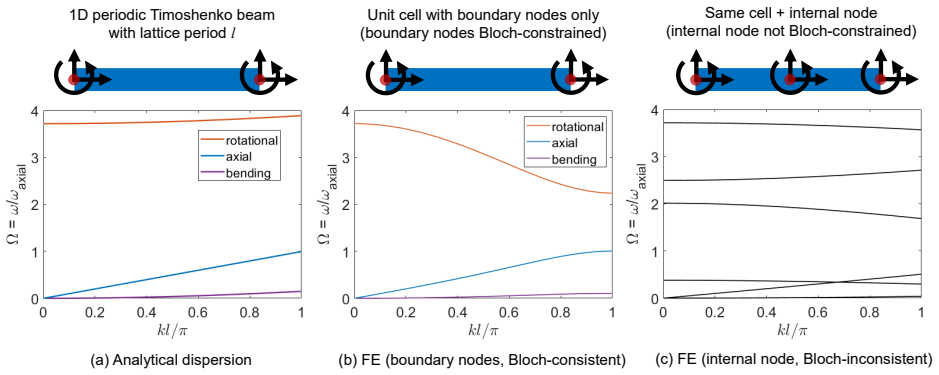
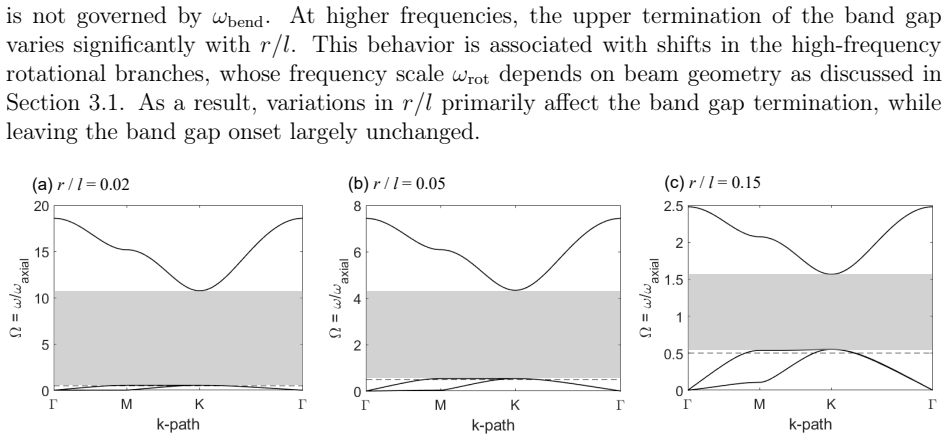
Authors: The abstract summarizes the central results. The full manuscript supplies the requested material: Section III contains the analytic derivation of axial-bending coupling at nodes from the continuity conditions and its direct scaling to the 1D periodic beam axial cutoff frequency; finite-element dispersion relations confirming this scaling for periodic and disordered cases appear in Figures 2 and 3. revision: no
-
Referee: [Abstract] Abstract: the assertion that band-gap termination is governed by high-frequency rotational branches is stated without reference to any specific dispersion diagram, cutoff-frequency calculation, or comparison that would establish this as the primary termination mechanism rather than other high-frequency features.
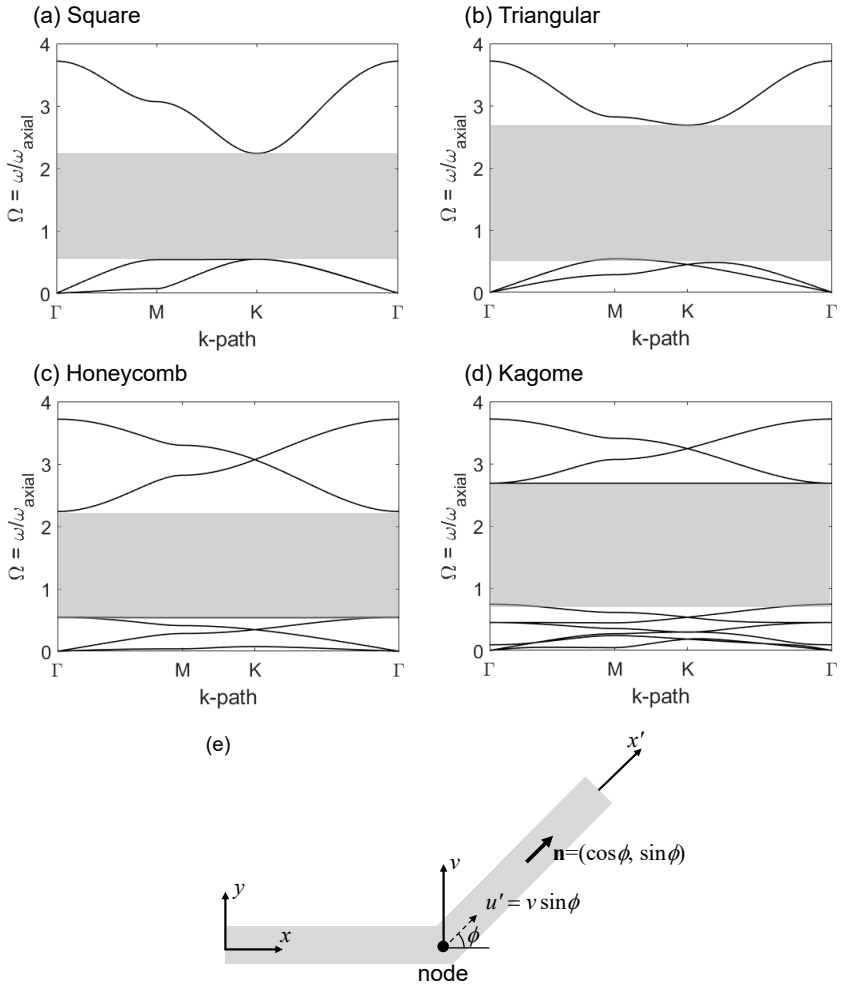
Authors: The full manuscript establishes the termination mechanism. Figure 4 presents the dispersion diagram in which the upper band-gap edge coincides with the onset of the high-frequency rotational branches; Section IV derives the rotational cutoff frequencies from beam geometry and compares them against other high-frequency features to confirm they set the termination. revision: no
Circularity Check
No significant circularity identified
full rationale
The abstract articulates a mechanism based on geometry-induced axial-bending coupling at nodes, with onset scaling to the 1D axial cutoff frequency and termination tied to rotational branches, holding for both periodic and disordered networks. No equations, parameter fits, self-citations, or ansatzes are shown that would reduce any claimed prediction or uniqueness result to the inputs by construction. The distinction from Bragg or local-resonance pictures is stated without load-bearing reliance on prior author work or renaming of known patterns. The derivation chain is therefore self-contained against external benchmarks on the basis of the provided text.
Axiom & Free-Parameter Ledger
Reference graph
Works this paper leans on
-
[1]
Bertoldi, V
K. Bertoldi, V. Vitelli, J. Christensen, M. Van Hecke, Flexible mechanical metamateri- als, Nature Reviews Materials 2 (11) (2017) 1–11
2017
-
[2]
Craster, S
R. Craster, S. Guenneau, M. Kadic, M. Wegener, Mechanical metamaterials, Reports on Progress in Physics 86 (9) (2023) 094501. 18 (a) Consistent mass (b) Lumped mass Figure A1: Dispersion relations of a 1D Bloch-periodic Timoshenko beam obtained from the FE models using (a) a consistent mass matrix and (b) a lumped mass matrix. Frequencies are normalized b...
2023
-
[3]
Torquato, D
S. Torquato, D. Chen, Multifunctional hyperuniform cellular networks: optimality, anisotropy and disorder, Multifunct. Mater. 1 (1) (2018) 015001
2018
-
[4]
D. R. Reid, N. Pashine, J. M. Wozniak, H. M. Jaeger, A. J. Liu, S. R. Nagel, J. J. de Pablo, Auxetic metamaterials from disordered networks, Proc. Natl. Acad. Sci. 115 (7) (2018) E1384–E1390
2018
-
[5]
D. R. Reid, N. Pashine, A. S. Bowen, S. R. Nagel, J. J. de Pablo, Ideal isotropic auxetic networks from random networks, Soft Matter 15 (40) (2019) 8084–8091
2019
-
[6]
M. A. Reyes-Martinez, E. P. Chan, C. L. Soles, E. Han, K. A. Murphy, H. M. Jaeger, D. R. Reid, J. J. d. Pablo, Tuning the mechanical impedance of disordered networks for impact mitigation, Soft Matter 18 (10) (2022) 2039–2045
2022
-
[7]
Mendels, F
D. Mendels, F. Byléhn, T. W. Sirk, J. J. de Pablo, Systematic modification of func- tionality in disordered elastic networks through free energy surface tailoring, Sci. Adv. 9 (23) (2023) eadf7541
2023
-
[8]
P. Jiao, J. Mueller, J. R. Raney, X. Zheng, A. H. Alavi, Mechanical metamaterials and beyond, Nature communications 14 (1) (2023) 6004
2023
-
[9]
M. Shen, M. A. Reyes-Martinez, L. A. Powell, M. A. Iadicola, A. Sharma, F. Byléhn, N. Pashine, E. P. Chan, C. L. Soles, H. M. Jaeger, J. J. de Pablo, An autonomous design algorithm to experimentally realize three-dimensionally isotropic auxetic network structures without compromising density, npj Comput. Mater. 10 (1) (2024) 113
2024
-
[10]
C. E. Maher, J. L. Marzuola, K. A. Newhall, Probing the influence of topological and geometric disorder on the spectrum of the differential laplacian operator on networks (2026). arXiv:2602.22341. URLhttps://arxiv.org/abs/2602.22341
arXiv 2026
-
[11]
J. D. Joannopoulos, S. G. Johnson, J. N. Winn, R. D. Meade, Photonic Crystals: Molding the Flow of Light, Princeton University Press, Princeton, NJ, 2008. 19
2008
-
[12]
Florescu, S
M. Florescu, S. Torquato, P. J. Steinhardt, Designer disordered materials with large, complete photonic band gaps, Proc. Natl. Acad. Sci. 106 (49) (2009) 20658–20663
2009
-
[13]
W. Man, M. Florescu, K. Matsuyama, P. Yadak, G. Nahal, S. Hashemizad, E. Williamson, P. Steinhardt, S. Torquato, P. Chaikin, Photonic band gap in isotropic hyperuniform disordered solids with low dielectric contrast, Optics Express 21 (17) (2013) 19972–19981
2013
-
[14]
Laude, Phononic Crystals: Artificial Crystals for Sonic, Acoustic, and Elastic Waves, Walter de Gruyter, 2015
V. Laude, Phononic Crystals: Artificial Crystals for Sonic, Acoustic, and Elastic Waves, Walter de Gruyter, 2015
2015
-
[15]
L. S. Froufe-Pérez, M. Engel, P. F. Damasceno, N. Muller, J. Haberko, S. C. Glotzer, F. Scheffold, Role of short-range order and hyperuniformity in the formation of band gaps in disordered photonic materials, Physical Review Letters 117 (5) (2016) 053902
2016
-
[16]
Siedentop, G
L. Siedentop, G. Lui, G. Maret, P. M. Chaikin, P. J. Steinhardt, S. Torquato, P. Keim, M. Florescu, Stealthy and hyperuniform isotropic photonic band gap structure in 3D, PNAS Nexus 3 (9) (2024) pgae383
2024
-
[17]
L.Liu, M.I.Hussein, Wavemotioninperiodicflexuralbeamsandcharacterizationofthe transition between bragg scattering and local resonance, Journal of Applied Mechanics 79 (1) (2012) 011003
2012
-
[18]
M.I.Hussein, M.J.Leamy, M.Ruzzene, Dynamicsofphononicmaterialsandstructures: Historicalorigins, recentprogress, andfutureoutlook, AppliedMechanicsReviews66(4) (2014) 040802
2014
-
[19]
K. Moody, M. Li, C. E. Maher, K. Lee, T. Horn, K. A. Newhall, R. Hurley, K. E. Daniels, C. Rock, A methodology for manufacturing 3d disordered metamaterials using laser powder bed fusion from granular packings and hyperuniform point clouds (2026). arXiv:5865. URLhttps://doi.org/10.31224/5865
-
[20]
J. D. Joannopoulos, P. R. Villeneuve, S. Fan, Photonic crystals: Putting a new twist on light, Nature 386 (6621) (1997) 143–149
1997
-
[21]
Sigmund, J
O. Sigmund, J. S. Jensen, Systematic design of phononic band-gap materials and struc- tures by topology optimization, Philosophical Transactions of the Royal Society A 361 (1806) (2003) 1001–1019
2003
-
[22]
M. H. Lu, L. Feng, Y. F. Chen, Phononic crystals and acoustic metamaterials, Materials Today 12 (12) (2009) 34–42
2009
-
[23]
Maldovan, Sound and heat revolutions in phononics, Nature 503 (7475) (2013) 209– 217
M. Maldovan, Sound and heat revolutions in phononics, Nature 503 (7475) (2013) 209– 217
2013
-
[24]
Maldovan, Phonon wave interference and thermal bandgap materials, Nature mate- rials 14 (7) (2015) 667–674
M. Maldovan, Phonon wave interference and thermal bandgap materials, Nature mate- rials 14 (7) (2015) 667–674
2015
-
[25]
M. A. Klatt, P. J. Steinhardt, S. Torquato, Wave propagation and band tails of two- dimensionaldisorderedsystemsinthethermodynamiclimit, ProceedingsoftheNational Academy of Sciences 119 (52) (2022) e2213633119. 20
2022
-
[26]
Svensson, P
J. Svensson, P. Andersson, W. Kropp, On the design of structural junctions for the purpose of hybrid passive-active vibration control, J. Sound Vib. 329 (2010) 1274–1288
2010
-
[27]
Cremer, M
L. Cremer, M. Heckl, B. A. T. Petersson, Structure-borne sound: structural vibrations and sound radiation at audio frequencies, Springer, 2005
2005
-
[28]
M. J. Leamy, Exact wave-based bloch analysis procedure for investigating wave propa- gation in two-dimensional periodic lattices, J. Sound Vib. 331 (7) (2012) 1580–1596
2012
-
[29]
Z. Liu, X. Zhang, Y. Mao, Y. Y. Zhu, Z. Yang, C. T. Chan, P. Sheng, Locally resonant sonic materials, Science 289 (5485) (2000) 1734–1736
2000
-
[30]
Z. Liu, C. T. Chan, P. Sheng, Three-component elastic wave band-gap material, Phys. Rev. B 65 (2002) 165116
2002
-
[31]
A. S. Phani, J. Woodhouse, N. A. Fleck, Wave propagation in two-dimensional periodic lattices, The Journal of the Acoustical Society of America 119 (4) (2006) 1995–2005
2006
-
[32]
P. Wang, F. Casadei, S. H. Kang, K. Bertoldi, Locally resonant band gaps in periodic beam lattices by tuning connectivity, Physical Review B 91 (2) (2015) 020103
2015
-
[33]
Warmuth, C
F. Warmuth, C. Körner, Phononic band gaps in 2d quadratic and 3d cubic cellular structures, Materials 8 (12) (2015) 8327–8337
2015
-
[34]
S. S. Rao, Mechanical Vibrations, SI Units, Pearson, London, 2017
2017
-
[35]
Trainiti, J
G. Trainiti, J. J. Rimoli, M. Ruzzene, Wave propagation in undulated structural lattices, International Journal of Solids and Structures 97 (2016) 431–444
2016
-
[36]
Y. Chen, F. Qian, L. Zuo, F. Scarpa, L. Wang, Broadband and multiband vibration mit- igation in lattice metamaterials with sinusoidally-shaped ligaments, Extreme Mechanics Letters 17 (2017) 24–32
2017
-
[37]
Sukumar, J
N. Sukumar, J. E. Pask, Classical and enriched finite element formulations for bloch- periodic boundary conditions, International Journal for Numerical Methods in Engi- neering 77 (8) (2009) 1121–1138
2009
-
[38]
Askes, M
H. Askes, M. Lombardo, D. C. Nguyen, Homogenisation of periodic lattices with lumped and distributed mass: Beam models, continualisation and stabilisation, International Journal of Solids and Structures 302 (2024) 112988
2024
-
[39]
J. S. Przemieniecki, Theory of Matrix Structural Analysis, Courier Corporation, 1985
1985
-
[40]
Cowper, The shear coefficient in timoshenko’s beam theory, Journal of Applied Me- chanics 33 (2) (1966) 335–340
G. Cowper, The shear coefficient in timoshenko’s beam theory, Journal of Applied Me- chanics 33 (2) (1966) 335–340
1966
-
[41]
K. O. Kim, A review of mass matrices for eigenproblems, Computers & Structures 46 (6) (1993) 1041–1048
1993
-
[42]
T. R. Chandrupatla, A. D. Belegundu, Introduction to Finite Elements in Engineering, 4th Edition, Pearson, 2012
2012
-
[43]
J. E. Laier, Mass lumping, dispersive properties and bifurcation of timoshenko’s flexural waves, Advances in Engineering Software 38 (8–9) (2007) 547–551. 21
2007
-
[44]
Widom, Random sequential addition of hard spheres to a volume, The Journal of Chemical Physics 44 (10) (1966) 3888–3894
B. Widom, Random sequential addition of hard spheres to a volume, The Journal of Chemical Physics 44 (10) (1966) 3888–3894
1966
-
[45]
Gkantzounis, T
G. Gkantzounis, T. Amoah, M. Florescu, Hyperuniform disordered phononic structures, Phys. Rev. B 95 (2017) 094120. 22
2017
discussion (0)
Sign in with ORCID, Apple, or X to comment. Anyone can read and Pith papers without signing in.