Attractive and Repulsive Pattern Control in Sequence Generation
Pith reviewed 2026-06-26 13:10 UTC · model grok-4.3
The pith
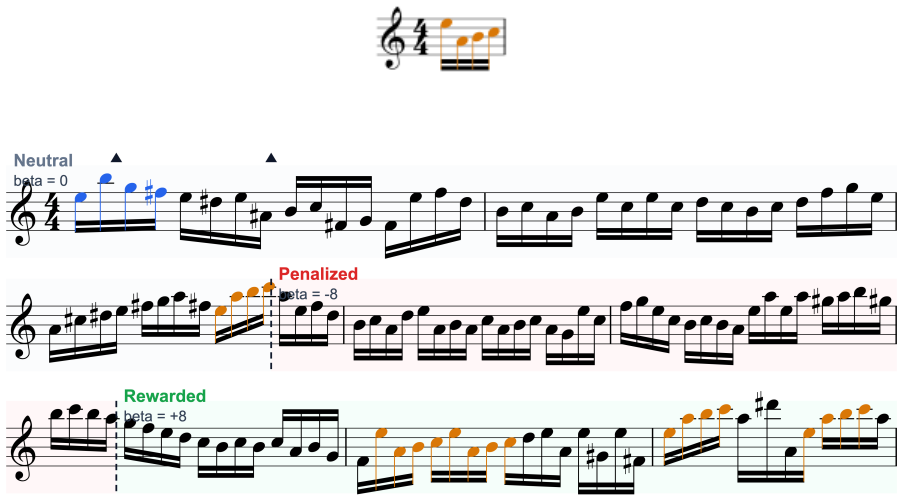
Signed pattern control via weighted recurrence automata lets variable-order Markov models repel overactive patterns to cut high-order self-reuse.
A machine-rendered reading of the paper's core claim, the machinery that carries it, and where it could break.
Core claim
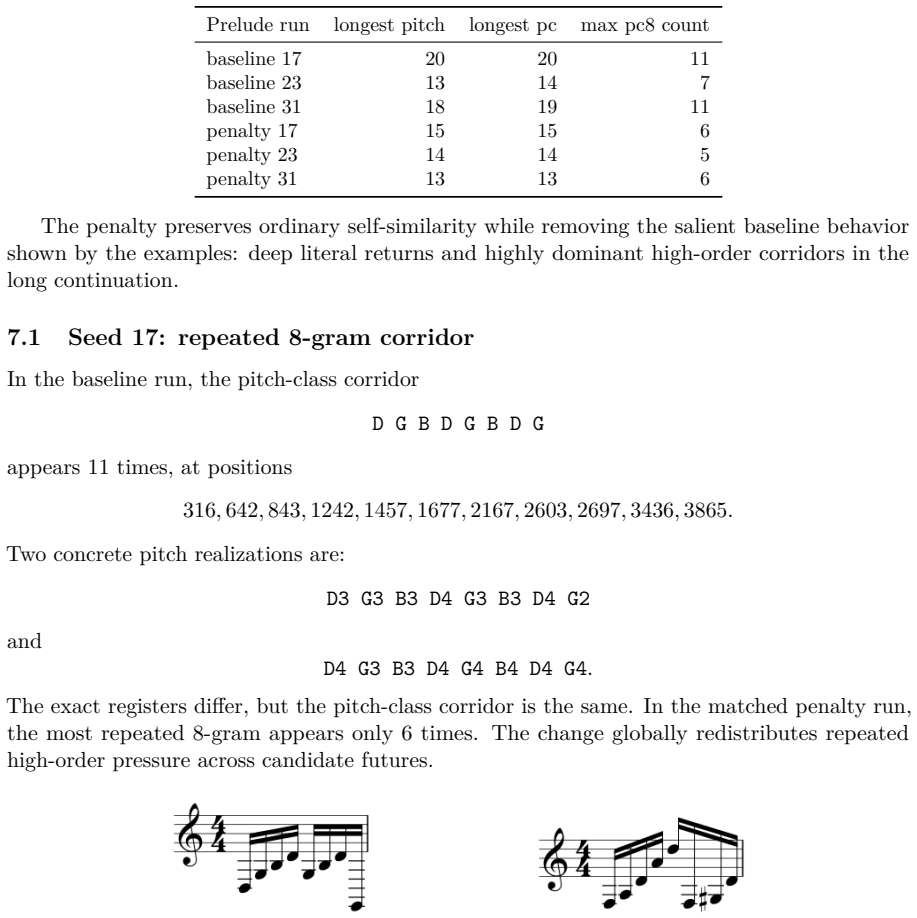
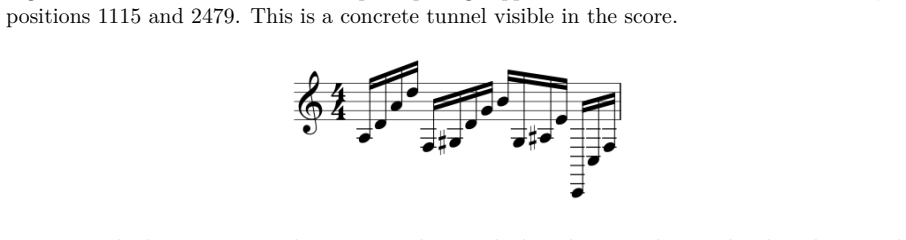
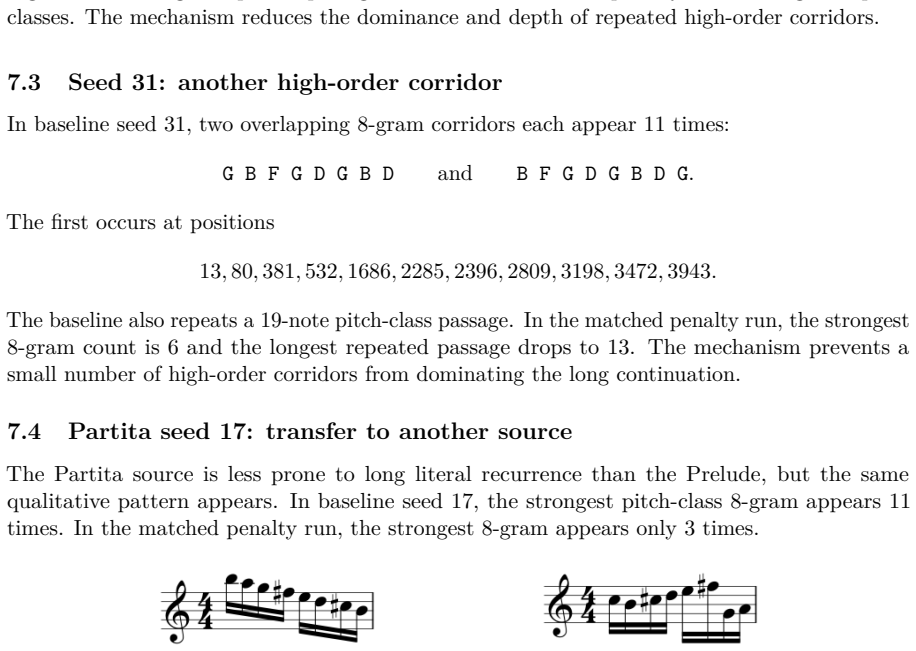
A weighted recurrence automaton computes an activation R for a family of target patterns, and BP-Regular sampling draws exactly from P_beta(x) proportional to P_0(x) exp(beta R(x)). Negative coupling penalizes the targets during generation; positive coupling rewards them. On six monophonic sources the negative branch reduces 8-gram self-reuse, raises the count of distinct 8-grams produced, and widens coverage of training-supported 4-gram contexts while retaining substantial lower-order support. The identical signed mechanism on five Weimar Jazz solos reproduces the anti-reuse effect outside Baroque material.
What carries the argument
The signed coupling beta applied to the activation R of a weighted recurrence automaton inside BP-Regular sampling.
If this is right
- Negative control increases the number of distinct 8-grams generated from the same model.
- Coverage of training-supported 4-gram contexts rises while lower-order statistics remain largely intact.
- The same signed mechanism supplies a positive branch for controlled attractor probing and phase-transition studies.
- The approach transfers from Baroque monophonic material to Weimar jazz solos with the same anti-reuse signature.
Where Pith is reading between the lines
- The mechanism could be applied to text or symbolic sequence tasks outside music by mining different pattern families.
- Supplying patterns from an external style vocabulary instead of online mining would test whether the control remains effective when targets are chosen independently of the generation history.
- Extending the recurrence automaton to track polyphonic or multi-stream patterns would reveal whether the signed control generalizes beyond monophonic duration sequences.
Load-bearing premise
The online homeostatic selection of target patterns from overactive generated material produces a representative and unbiased family that the automaton can penalize without distorting the underlying variable-order statistics.
What would settle it
Re-running the negative branch on the same six monophonic sources and measuring no drop in 8-gram self-reuse, or no rise in effective 8-gram count, would falsify the reported experimental outcome.
Figures


read the original abstract
Variable-order Markov models preserve local symbolic syntax by adapting context length, but long continuations can enter recurring high-order "tunnels": repeated suffixes, locally periodic passages, or copied fragments longer than the formal Markov order. This paper introduces signed pattern control for variable-order Markov generation with BP-Regular sampling. A weighted recurrence automaton computes an activation R for a chosen family of target patterns, and belief propagation samples exactly from P_beta(x) proportional to P_0(x) exp(beta R(x)). Negative coupling makes the target patterns costly during sampling; positive coupling rewards the same patterns and turns them into controlled attractors. The target family may be mined online from overactive generated material, supplied by a score or style vocabulary, or designed as an experimental probe. The main experiments use the online homeostatic case, choosing patterns that become overactive in the sampling history. On six duration-bearing monophonic sources, including Bach and Telemann material, the negative branch reduces generated 8-gram self-reuse, increases the effective number of generated 8-grams, and increases coverage of training-supported 4-gram contexts while preserving substantial lower-order support. A pitch-sequence replication on five Weimar Jazz Database solos gives the same anti-reuse signature outside Baroque material. The same signed mechanism also provides a positive branch for probing attractor basins, phase transitions, and hysteresis in the underlying variable-order model.
Editorial analysis
A structured set of objections, weighed in public.
Referee Report
Summary. The manuscript introduces signed pattern control for variable-order Markov models using BP-Regular sampling. A weighted recurrence automaton computes activation R(x) for a family of target patterns (mined online from overactive generated material in the main regime), and sequences are sampled exactly from P_beta(x) proportional to P_0(x) exp(beta R(x)). Negative beta penalizes the patterns to reduce self-reuse; positive beta rewards them as attractors. On six duration-bearing monophonic sources (Bach, Telemann, etc.) and a Weimar Jazz pitch replication, the negative branch is reported to reduce 8-gram self-reuse, increase the effective number of distinct 8-grams, and improve coverage of training-supported 4-gram contexts while preserving lower-order support.
Significance. If the empirical claims hold after proper controls and statistical validation, the signed mechanism supplies a lightweight, post-training knob for modulating high-order reuse and attractor structure in variable-order generators. This is potentially useful for music and symbolic sequence tasks where one wishes to suppress tunnels or probe phase transitions without retraining. The approach is distinguished by its exact sampling guarantee and the homeostatic online mining option, but the current evidence base is too thin to support strong claims about unbiased pattern control.
major comments (3)
- [Abstract] Abstract: the directional effects (reduced 8-gram self-reuse, increased effective 8-gram count, improved 4-gram context coverage) are stated without error bars, statistical tests, or any description of how the 8-gram counts, effective-number metric, or context-coverage quantities were computed across the six sources; this prevents assessment of whether the reported consistency is robust or an artifact of implementation choices.
- [Abstract / Experiments] Main experimental regime (online homeostatic case): the central claim that negative coupling reduces reuse while preserving lower-order statistics rests on the assumption that patterns mined online from overactive generated material form an unbiased family for the weighted recurrence automaton. No ablation (fixed external pattern set, random selection, or removal of the homeostatic rule) is described to isolate the mining step from the signed coupling R(x), leaving open the possibility that selection preferentially samples patterns already correlated with high-order tunnels and thereby distorts the effective context distribution.
- [Method] Method section: the weighted recurrence automaton and beta are external to the base variable-order model; the reported metrics compare generated statistics against training data rather than against an internal, parameter-free baseline derived from the same model, so the anti-reuse signature could partly reflect the external penalty rather than a genuine change in the variable-order dynamics.
minor comments (1)
- [Method] Notation for the belief-propagation sampler and the precise definition of the effective-number metric should be expanded for reproducibility.
Simulated Author's Rebuttal
We thank the referee for the constructive comments. We address each major point below and indicate the revisions we will make to strengthen the manuscript.
read point-by-point responses
-
Referee: [Abstract] Abstract: the directional effects (reduced 8-gram self-reuse, increased effective 8-gram count, improved 4-gram context coverage) are stated without error bars, statistical tests, or any description of how the 8-gram counts, effective-number metric, or context-coverage quantities were computed across the six sources; this prevents assessment of whether the reported consistency is robust or an artifact of implementation choices.
Authors: We agree that the abstract lacks sufficient detail on metric definitions and variability. In the revised manuscript we will expand the abstract to briefly describe the computation of the 8-gram self-reuse, effective-number, and context-coverage metrics, and we will state that results are aggregated across sources with standard deviations reported in the main text and figures. Statistical significance tests will be added to the experiments section. revision: yes
-
Referee: [Abstract / Experiments] Main experimental regime (online homeostatic case): the central claim that negative coupling reduces reuse while preserving lower-order statistics rests on the assumption that patterns mined online from overactive generated material form an unbiased family for the weighted recurrence automaton. No ablation (fixed external pattern set, random selection, or removal of the homeostatic rule) is described to isolate the mining step from the signed coupling R(x), leaving open the possibility that selection preferentially samples patterns already correlated with high-order tunnels and thereby distorts the effective context distribution.
Authors: The online homeostatic mining is presented as an integral component of the method rather than an optional add-on. To directly address the concern about possible selection bias, the revised version will include an ablation study that compares the homeostatic case against (i) a fixed external pattern set and (ii) random pattern selection, while keeping the signed coupling fixed. This will isolate the contribution of the mining rule. revision: yes
-
Referee: [Method] Method section: the weighted recurrence automaton and beta are external to the base variable-order model; the reported metrics compare generated statistics against training data rather than against an internal, parameter-free baseline derived from the same model, so the anti-reuse signature could partly reflect the external penalty rather than a genuine change in the variable-order dynamics.
Authors: We will revise the experiments section to make the internal baseline explicit: all reported metrics will be shown relative to the base variable-order model at beta = 0 (the same model without the weighted recurrence automaton). This comparison will be added alongside the training-data reference to clarify that the observed changes are attributable to the signed control rather than solely to the external penalty term. revision: yes
Circularity Check
No circularity in derivation or empirical claims
full rationale
The paper introduces an explicit sampling procedure (weighted recurrence automaton computing R(x), then exact sampling from P_beta(x) ∝ P_0(x) exp(beta R(x))) and applies it to external monophonic corpora. Reported metrics (8-gram self-reuse, effective 8-gram count, 4-gram context coverage) are computed by direct comparison of generated output against the same training data used to build the base variable-order model; these quantities are not algebraically forced by the definition of R(x) or the homeostatic mining rule. No self-citation supplies a uniqueness theorem, no parameter is fitted then relabeled as a prediction, and no ansatz is smuggled via prior work. The derivation chain therefore remains self-contained against external benchmarks.
Axiom & Free-Parameter Ledger
free parameters (1)
- beta
axioms (1)
- standard math Belief propagation exactly samples from P_beta(x) proportional to P_0(x) exp(beta R(x))
invented entities (1)
-
weighted recurrence automaton
no independent evidence
Reference graph
Works this paper leans on
-
[1]
D. J. Amit, G. Parisi, and L. Peliti. Asymptotic behavior of the “true” self-avoiding walk. Physical Review B, 27(3):1635–1645, 1983. https://doi.org/10.1103/PhysRevB.27.1635
-
[2]
Papadopoulos, F
A. Papadopoulos, F. Pachet, P. Roy, and J. Sakellariou. Exact sampling for regular and Markov constraints with belief propagation. InPrinciples and Practice of Constraint Programming, 2015
2015
-
[3]
F. Pachet. Exact regular-constrained variable-order Markov generation via sparse context- state belief propagation.arXiv preprint arXiv:2605.07839, 2026. https://doi.org/10.48550/ arXiv.2605.07839
Pith/arXiv arXiv 2026
-
[4]
Papadopoulos, P
A. Papadopoulos, P. Roy, and F. Pachet. Avoiding plagiarism in Markov sequence generation. InProceedings of the Twenty-Eighth AAAI Conference on Artificial Intelligence, 2014
2014
-
[5]
D. Conklin. Antipattern discovery in folk tunes.Journal of New Music Research, 42(2):161– 169, 2013. https://doi.org/10.1080/09298215.2013.809125
-
[6]
D. Conklin and S. Weisser. Pattern and antipattern discovery in Ethiopian bagana songs. In D. Meredith, editor,Computational Music Analysis, pages 425–443. Springer, 2016. https://doi.org/10.1007/978-3-319-25931-4_16. 15
-
[7]
G. Ritchie. Some empirical criteria for attributing creativity to a computer program.Minds and Machines, 17:67–99, 2007. https://doi.org/10.1007/s11023-007-9066-2
-
[8]
J. Sakellariou, F. Tria, V. Loreto, and F. Pachet. Maximum entropy models capture melodic styles.Scientific Reports, 7:9172, 2017. https://doi.org/10.1038/s41598-017-08028-4
-
[9]
doi: 10.1109/TAMD.2010.2056368
J. Schmidhuber. Formal theory of creativity, fun, and intrinsic motivation (1990–2010). IEEE Transactions on Autonomous Mental Development, 2(3):230–247, 2010. https://doi. org/10.1109/TAMD.2010.2056368
-
[10]
Pfleiderer, K
M. Pfleiderer, K. Frieler, J. Abeßer, W.-G. Zaddach, and B. Burkhart, editors.Inside the Jazzomat: New Perspectives for Jazz Research. Schott Campus, 2017. Weimar Jazz Database: https://jazzomat.hfm-weimar.de/
2017
-
[11]
The power of amnesia: learning probabilistic automata with variable memory length.Machine Learning, 1996
Ron, D., Singer, Y., and Tishby, N. The power of amnesia: learning probabilistic automata with variable memory length.Machine Learning, 1996
1996
-
[12]
Pearce, M. T. and Wiggins, G. A. Improved methods for statistical modelling of monophonic music.Journal of New Music Research, 2004. 16
2004
discussion (0)
Sign in with ORCID, Apple, or X to comment. Anyone can read and Pith papers without signing in.