A Minimal Active-Particle Realization of Non-Hermitian Chern Bulk-Boundary Correspondence
Pith reviewed 2026-06-26 10:02 UTC · model grok-4.3
The pith
A minimal frustrated Vicsek-Kuramoto model of active particles realizes non-Hermitian Chern bulk-boundary correspondence.
A machine-rendered reading of the paper's core claim, the machinery that carries it, and where it could break.
Core claim
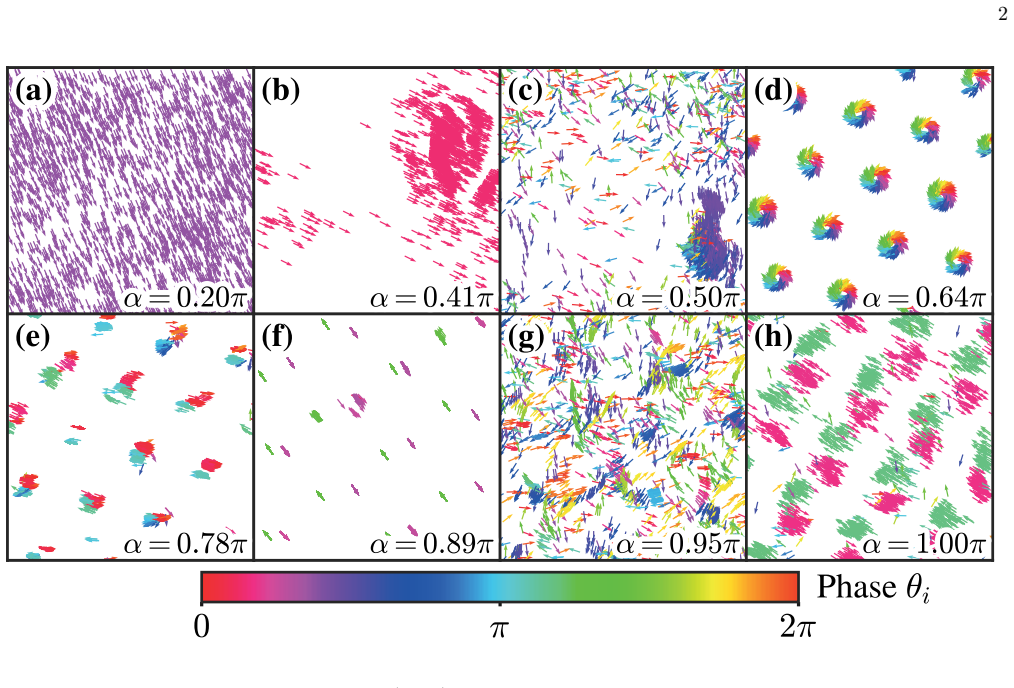
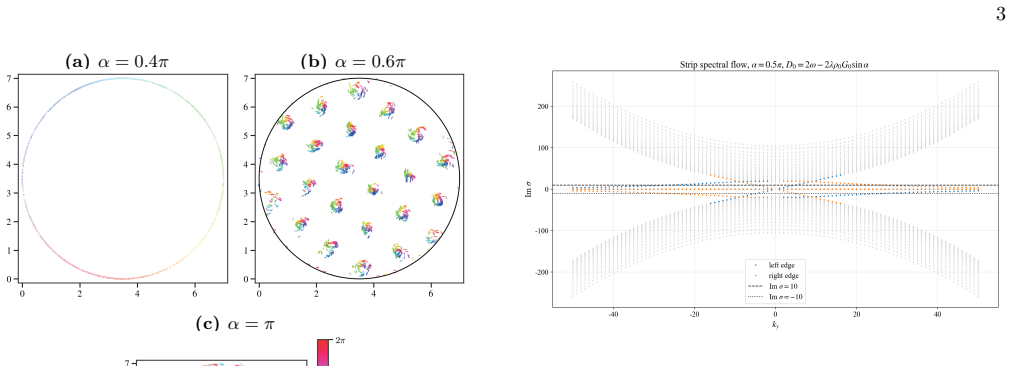
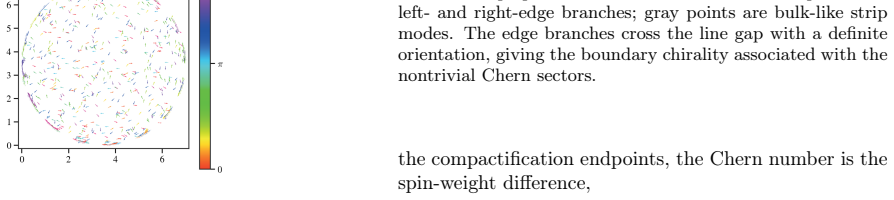
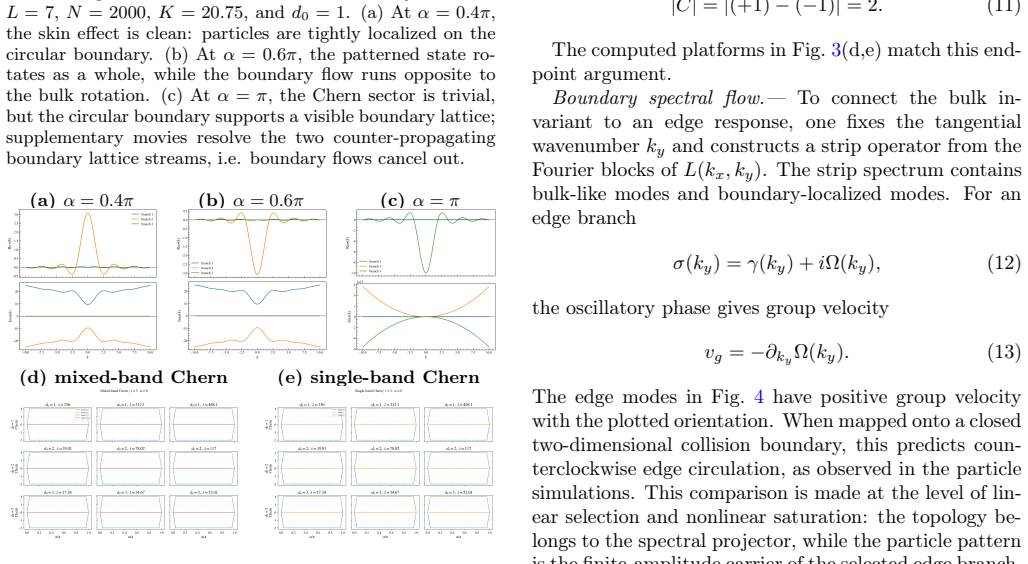
The isotropic continuum spectrum compactifies the wave-number plane and supports spectral projectors with Chern numbers C=±2, fixed by the spin structure of the dispersion matrix. Strip spectral flow then predicts chiral edge propagation, in agreement with particle simulations in the nontrivial sectors. The organizing principle is a nonlinear saturation ansatz in which the linearized hydrodynamic operator selects the unstable wavelength and spectral topology while nonlinear particle dynamics saturates the selected mode.
What carries the argument
The nonlinear saturation ansatz, where the linearized hydrodynamic operator selects the unstable wavelength and spectral topology while nonlinear particle dynamics saturates the selected mode.
If this is right
- The Sakaguchi-type phase lag generates finite-wavenumber bulk instabilities.
- Under collision boundaries, the system exhibits robust one-way boundary flow.
- The bulk spectrum has Chern numbers C=±2 determined by the dispersion matrix spin structure.
- Strip spectral flow accurately predicts the chiral edge propagation observed in simulations.
Where Pith is reading between the lines
- This approach could extend to other active matter systems with alignment interactions and delays to search for similar topological edge states.
- Measuring the direction and robustness of boundary flows in experiments with active particles could test the predicted Chern numbers.
- The compactification of the wave-number plane suggests a general way to define topology in continuum active systems without discrete lattices.
Load-bearing premise
The nonlinear saturation ansatz in which the linearized hydrodynamic operator selects the unstable wavelength and spectral topology while nonlinear particle dynamics saturates the selected mode.
What would settle it
Particle simulations in the nontrivial sectors failing to show the predicted chiral edge propagation, or the dispersion matrix yielding Chern numbers other than ±2.
Figures
read the original abstract
We show that a minimal frustrated Vicsek--Kuramoto active-particle model realizes a non-Hermitian Chern bulk-boundary correspondence. A Sakaguchi-type phase lag in the local heading alignment generates finite-wavenumber bulk instabilities and, under collision boundaries, robust one-way boundary flow. The organizing principle is a nonlinear saturation ansatz: the linearized hydrodynamic operator selects the unstable wavelength and spectral topology, while nonlinear particle dynamics saturates the selected mode. The isotropic continuum spectrum compactifies the wave-number plane and supports spectral projectors with Chern numbers $C=\pm2$, fixed by the spin structure of the dispersion matrix. Strip spectral flow then predicts chiral edge propagation, in agreement with particle simulations in the nontrivial sectors.
Editorial analysis
A structured set of objections, weighed in public.
Referee Report
Summary. The manuscript claims that a minimal frustrated Vicsek-Kuramoto active-particle model with Sakaguchi-type phase lag realizes non-Hermitian Chern bulk-boundary correspondence. The linearized hydrodynamic operator selects finite-wavenumber bulk instabilities whose spectral projectors carry Chern numbers C=±2 fixed by the spin structure of the dispersion matrix after wave-number plane compactification; nonlinear particle dynamics then saturates the selected mode, producing robust chiral edge flow under collision boundaries that matches direct simulations.
Significance. If the nonlinear saturation ansatz holds without renormalization of the effective dispersion operator, the work supplies an explicit, minimal active-matter realization of non-Hermitian topological bulk-boundary correspondence whose topology is determined by the linear operator's algebraic structure rather than fitted parameters. The reported agreement between strip spectral-flow predictions and particle simulations constitutes a concrete, falsifiable test of the framework.
major comments (2)
- [section stating the organizing principle / nonlinear saturation ansatz] The organizing principle (nonlinear saturation ansatz) asserts that the linearized hydrodynamic operator fixes both the unstable wavelength and the Chern numbers C=±2 while nonlinear dynamics merely saturates the mode. No derivation is supplied showing that the saturated nonlinear state retains the same effective dispersion operator or spectral projectors; active-particle nonlinearities are known to renormalize couplings and can shift selected bands, directly threatening the survival of the claimed topology.
- [continuum spectrum and Chern-number calculation] The compactification of the isotropic continuum spectrum that yields spectral projectors with C=±2 is stated to be fixed by the spin structure of the dispersion matrix, yet the manuscript provides no explicit construction of the projectors or verification that the compactification map preserves the Chern number under the active-particle collision rules.
minor comments (2)
- Notation for the hydrodynamic operator and the Sakaguchi phase lag should be introduced with a single equation block rather than scattered across the text.
- Figure captions for the strip-geometry simulations should explicitly state the system size, boundary conditions, and averaging procedure used to extract edge flow.
Simulated Author's Rebuttal
We thank the referee for the careful reading and constructive comments on our manuscript. We address each major comment point by point below, providing the strongest honest defense of the work while acknowledging where revisions are needed to strengthen the presentation.
read point-by-point responses
-
Referee: [section stating the organizing principle / nonlinear saturation ansatz] The organizing principle (nonlinear saturation ansatz) asserts that the linearized hydrodynamic operator fixes both the unstable wavelength and the Chern numbers C=±2 while nonlinear dynamics merely saturates the mode. No derivation is supplied showing that the saturated nonlinear state retains the same effective dispersion operator or spectral projectors; active-particle nonlinearities are known to renormalize couplings and can shift selected bands, directly threatening the survival of the claimed topology.
Authors: We agree that the nonlinear saturation ansatz is a central assumption and that the manuscript does not supply a rigorous derivation proving the effective dispersion operator and spectral projectors remain unchanged after nonlinear saturation. Active-particle systems can indeed exhibit renormalization. The strongest support in the current work is the quantitative agreement between linear spectral-flow predictions and direct particle simulations across multiple parameter regimes. In revision we will add an expanded discussion of the ansatz, including estimates of renormalization effects in this minimal frustrated Vicsek-Kuramoto model and additional numerical tests that probe the robustness of the selected wavelength and topology under varying collision rules. revision: partial
-
Referee: [continuum spectrum and Chern-number calculation] The compactification of the isotropic continuum spectrum that yields spectral projectors with C=±2 is stated to be fixed by the spin structure of the dispersion matrix, yet the manuscript provides no explicit construction of the projectors or verification that the compactification map preserves the Chern number under the active-particle collision rules.
Authors: The manuscript states that the Chern numbers C=±2 are fixed by the spin structure of the dispersion matrix after isotropic compactification of the wave-number plane. We acknowledge that an explicit construction of the spectral projectors and a direct verification that the compactification preserves the Chern number under the specific collision rules are not supplied. In the revised version we will include the explicit projector construction, the compactification map, and a short calculation confirming invariance of the Chern number, together with the existing simulation evidence that the predicted chiral edge flows survive under the model's collision boundaries. revision: yes
Circularity Check
No significant circularity; explicit ansatz and simulation verification keep derivation self-contained
full rationale
The paper states the nonlinear saturation ansatz explicitly as its organizing principle rather than deriving the survival of linear spectral topology through nonlinear saturation. Chern numbers C=±2 are obtained from the spin structure of the dispersion matrix of the linearized hydrodynamic operator, which is constructed from the model equations. Strip spectral flow predictions are then compared to direct particle simulations for agreement. No load-bearing step reduces by construction to its own inputs, no self-citations are invoked for uniqueness or ansatz smuggling, and the central claim rests on model construction plus numerical confirmation rather than a closed loop. This is the normal case of an assumption stated openly with external checks.
Axiom & Free-Parameter Ledger
axioms (2)
- domain assumption The isotropic continuum spectrum compactifies the wave-number plane and supports spectral projectors with Chern numbers C=±2 fixed by the spin structure of the dispersion matrix.
- ad hoc to paper The linearized hydrodynamic operator selects the unstable wavelength and spectral topology while nonlinear particle dynamics saturates the selected mode.
Reference graph
Works this paper leans on
-
[1]
Kato, Perturbation Theory for Linear Operators, Springer, Berlin, 1995
T. Kato, Perturbation Theory for Linear Operators, Springer, Berlin, 1995
1995
-
[2]
D. J. Thouless, M. Kohmoto, M. P. Nightingale, and M. den Nijs, Quantized Hall conductance in a two-dimensional periodic potential, Physical Review Letters 49, 405--408 (1982)
1982
-
[3]
Hatsugai, Chern number and edge states in the integer quantum Hall effect, Physical Review Letters 71, 3697--3700 (1993)
Y. Hatsugai, Chern number and edge states in the integer quantum Hall effect, Physical Review Letters 71, 3697--3700 (1993)
1993
-
[4]
Fukui, Y
T. Fukui, Y. Hatsugai, and H. Suzuki, Chern numbers in discretized Brillouin zone: Efficient method of computing spin Hall conductances, Journal of the Physical Society of Japan 74, 1674--1677 (2005)
2005
-
[5]
Kellendonk, T
J. Kellendonk, T. Richter, and H. Schulz-Baldes, Edge current channels and Chern numbers in the integer quantum Hall effect, Reviews in Mathematical Physics 14, 87--119 (2002)
2002
-
[6]
G. M. Graf and M. Porta, Bulk-edge correspondence for two-dimensional topological insulators, Communications in Mathematical Physics 324, 851--895 (2013)
2013
-
[7]
Prodan and H
E. Prodan and H. Schulz-Baldes, Bulk and Boundary Invariants for Complex Topological Insulators: From K-Theory to Physics, Springer, Cham, 2016
2016
-
[8]
Non-Hermitian Physics , author =. Advances in Physics , year =. doi:10.1080/00018732.2021.1876991 , url =
-
[9]
2026 , note =
Zhu, Tong , title =. 2026 , note =
2026
-
[10]
Physical Review Letters , volume =
Anomalous Topological Active Matter , author =. Physical Review Letters , volume =. 2019 , doi =
2019
-
[11]
Physical Review Letters , volume =
Topological Field Theory of Non-Hermitian Systems , author =. Physical Review Letters , volume =. 2021 , doi =
2021
-
[12]
Nature Reviews Physics , volume =
Topological Active Matter , author =. Nature Reviews Physics , volume =. 2022 , doi =
2022
-
[13]
Physical Review Letters , volume =
Topological Band Theory for Non-Hermitian Hamiltonians , author =. Physical Review Letters , volume =. 2018 , doi =
2018
-
[14]
Physical Review Letters , volume =
Topological Waves in Fluids with Odd Viscosity , author =. Physical Review Letters , volume =. 2019 , doi =
2019
-
[15]
Physical Review X , volume =
Topology Protects Chiral Edge Currents in Stochastic Systems , author =. Physical Review X , volume =. 2021 , doi =
2021
-
[16]
Physical Review B , volume =
Non-Bloch Band Theory for Non-Hermitian Continuum Systems , author =. Physical Review B , volume =. 2024 , doi =
2024
-
[17]
Physical Review B , volume =
Non-Bloch Dynamics and Topology in a Classical Nonequilibrium Process , author =. Physical Review B , volume =. 2024 , doi =
2024
-
[18]
2016 , eprint=
Lectures on the Quantum Hall Effect , author=. 2016 , eprint=
2016
-
[19]
Reviews of Modern Physics , volume =
Baconnier, Paul and Dauchot, Olivier and Demery, Vincent and others , title =. Reviews of Modern Physics , volume =. 2025 , doi =
2025
-
[20]
Marchetti, M. C. and Joanny, J. F. and Ramaswamy, S. and others , title =. Reviews of Modern Physics , volume =. 2013 , doi =
2013
-
[21]
Annual Review of Condensed Matter Physics , volume =
Ramaswamy, Sriram , title =. Annual Review of Condensed Matter Physics , volume =. 2010 , doi =
2010
-
[22]
Novel Type of Phase Transition in a System of Self-Driven Particles , journal =
Vicsek, Tam. Novel Type of Phase Transition in a System of Self-Driven Particles , journal =. 1995 , doi =
1995
-
[23]
Physical Review Letters , volume =
Toner, John and Tu, Yuhai , title =. Physical Review Letters , volume =. 1995 , doi =
1995
-
[24]
Annals of Physics , volume =
Toner, John and Tu, Yuhai and Ramaswamy, Sriram , title =. Annals of Physics , volume =. 2005 , doi =
2005
-
[25]
1984 , doi =
Kuramoto, Yoshiki , title =. 1984 , doi =
1984
-
[26]
and Shinomoto, S
Sakaguchi, H. and Shinomoto, S. and Kuramoto, Y. , title =. Progress of Theoretical Physics , volume =. 1988 , doi =
1988
-
[27]
, title =
Strogatz, Steven H. , title =. Physica D: Nonlinear Phenomena , volume =. 2000 , doi =
2000
-
[28]
Acebr. The. Reviews of Modern Physics , volume =. 2005 , doi =
2005
-
[29]
and Hong, Hyunsuk and Strogatz, Steven H
O'Keeffe, Kevin P. and Hong, Hyunsuk and Strogatz, Steven H. , title =. Nature Communications , volume =. 2017 , doi =
2017
-
[30]
Hydrodynamics of the Kuramoto-Vicsek model of rotating self-propelled particles
Degond, Pierre and Dimarco, Giacomo and Mac, Thi Bich Ngoc , title =. arXiv preprint arXiv:1306.3372 , year =. doi:10.48550/arXiv.1306.3372 , url =. 1306.3372 , archivePrefix =
work page internal anchor Pith review Pith/arXiv arXiv doi:10.48550/arxiv.1306.3372
-
[31]
and Hohenberg, Pierre C
Cross, Mark C. and Hohenberg, Pierre C. , title =. Reviews of Modern Physics , volume =. 1993 , doi =
1993
-
[32]
and Knobloch, Edgar , title =
Crawford, John D. and Knobloch, Edgar , title =. Annual Review of Fluid Mechanics , volume =. 1991 , doi =
1991
-
[33]
Thouless, D. J. and Kohmoto, M. and Nightingale, M. P. and den Nijs, M. , title =. Physical Review Letters , volume =. 1982 , doi =
1982
-
[34]
Physical Review Letters , volume =
Hatsugai, Yasuhiro , title =. Physical Review Letters , volume =. 1993 , doi =
1993
-
[35]
Physical Review Letters , volume =
Yao, Shunyu and Wang, Zhong , title =. Physical Review Letters , volume =. 2018 , doi =
2018
-
[36]
and Edvardsson, Elisabet and Budich, Jan Carl and Bergholtz, Emil J
Kunst, Flore K. and Edvardsson, Elisabet and Budich, Jan Carl and Bergholtz, Emil J. , title =. Physical Review Letters , volume =. 2018 , doi =
2018
-
[37]
Physical Review Letters , volume =
Okuma, Nobuyuki and Kawabata, Kohei and Shiozaki, Ken and Sato, Masatoshi , title =. Physical Review Letters , volume =. 2020 , doi =
2020
-
[38]
and Budich, Jan Carl and Kunst, Flore K
Bergholtz, Emil J. and Budich, Jan Carl and Kunst, Flore K. , title =. Reviews of Modern Physics , volume =. 2021 , doi =
2021
-
[39]
Chinese Physics Letters , volume =
Lu, Yi-Chen and Guo, Ying-Shan and Zhang, Yi-Yi and Zhu, Tong and Zheng, Zhi-Gang , title =. Chinese Physics Letters , volume =. 2026 , doi =
2026
-
[40]
Entropy , volume =
Lu, Yichen and Zhu, Tong and Guo, Yingshan and Li, Yunyun and Zheng, Zhigang , title =. Entropy , volume =. 2026 , doi =
2026
-
[41]
1995 , doi =
Kato, Tosio , title =. 1995 , doi =
1995
-
[42]
Journal of the Physical Society of Japan , volume =
Fukui, Takahiro and Hatsugai, Yasuhiro and Suzuki, Hiroshi , title =. Journal of the Physical Society of Japan , volume =. 2005 , doi =
2005
-
[43]
2016 , doi =
Prodan, Emil and Schulz-Baldes, Hermann , title =. 2016 , doi =
2016
discussion (0)
Sign in with ORCID, Apple, or X to comment. Anyone can read and Pith papers without signing in.