Adaptive Joint Compression and Synchronisation in Federated Split Learning for IoT Rainfall Prediction
Pith reviewed 2026-06-25 23:55 UTC · model grok-4.3
The pith
A latency-driven scheduler jointly tunes activation compression and synchronisation interval in federated split learning to cut IoT communication costs by 87 percent with stable prediction quality.
A machine-rendered reading of the paper's core claim, the machinery that carries it, and where it could break.
Core claim
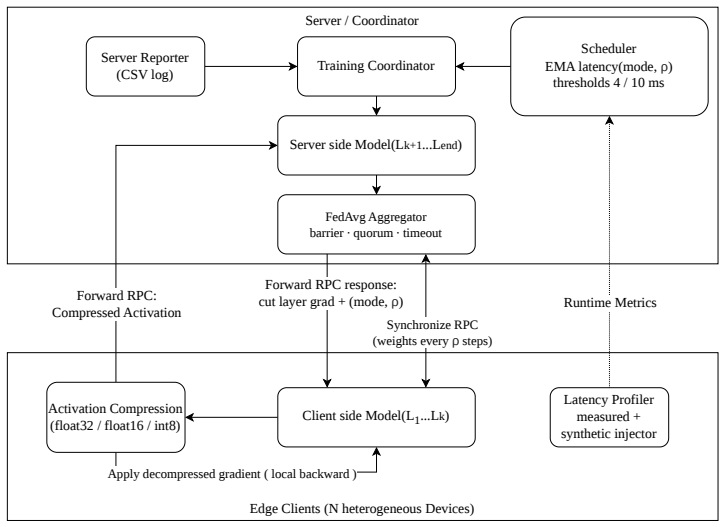
The FSL framework jointly regulates activation compression and the synchronisation interval rho via a latency driven scheduler on a server with per client EMA smoothing. Evaluated on hourly ERA5 data from 11 weather stations, the simulation matrix and Pi deployment show that the selected int8 with rho=3 endpoint delivers the payload and traffic reductions while AUPRC varies only slightly across configurations.
What carries the argument
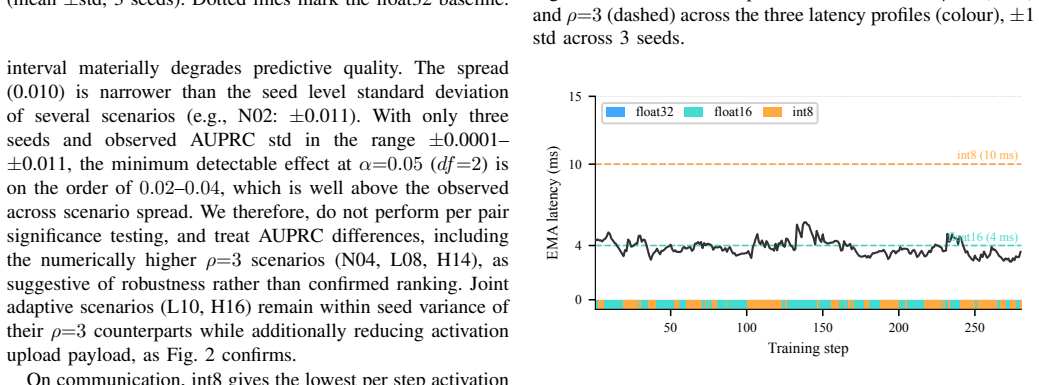
The latency-driven scheduler that selects compression levels and synchronisation interval rho based on per-client EMA-smoothed latency profiles.
If this is right
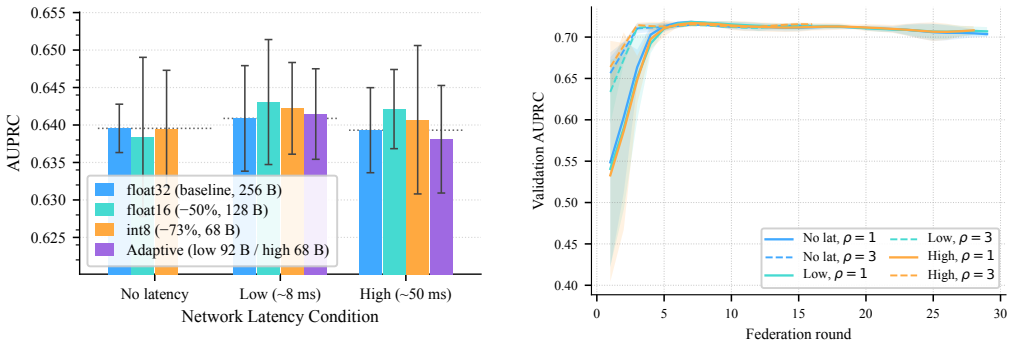
- Aggressive quantisation combined with sparser aggregation does not materially degrade predictive quality for this rainfall task.
- The scheduler successfully switches across low, high, and mixed latency profiles in simulation.
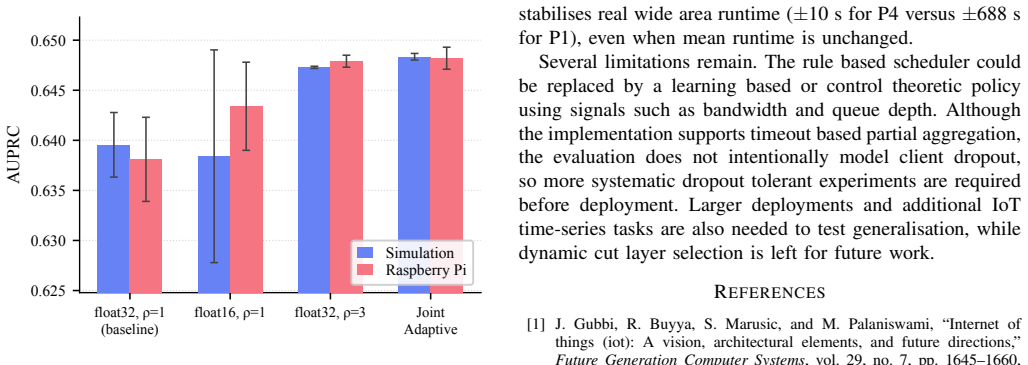
- The high-latency endpoint selected by the policy delivers the stated 87 percent payload cut and 54 percent traffic cut on real hardware.
- Runtime jitter drops from plus or minus 688 seconds to plus or minus 10 seconds under the chosen configuration.
Where Pith is reading between the lines
- The same joint scheduler structure could be applied to other sensor-driven IoT prediction tasks that face variable network conditions.
- If real-world latency distributions shift, the EMA smoothing parameters may require re-calibration to preserve the observed stability.
- Separate optimisation of compression and synchronisation frequency may leave additional communication savings on the table compared with coordinated control.
Load-bearing premise
That the tested latency profiles and EMA smoothing represent the target IoT deployment conditions and that AUPRC stability holds under different data distributions or unseen latency patterns.
What would settle it
Deploy the system on devices experiencing latency patterns outside the low-high-mixed set or on rainfall data from regions not represented in the 11-station ERA5 collection and check whether AUPRC remains within 0.011 of the reported range.
Figures
read the original abstract
Federated split learning (FSL) enables collaborative training across bandwidth-constrained IoT devices, but repeated activation and gradient exchange creates a communication bot-tleneck. Prior work optimises either activation compression or synchronisation frequency in isolation. This paper presents an FSL framework for IoT rainfall prediction that jointly regulates activation compression and the synchronisation interval \r{ho} via a latency driven scheduler on a server with per client EMA smoothing. The system is evaluated on hourly ERA5 data from 11 weather stations through a 17 scenario simulation matrix and a four scenario Raspberry Pi deployment over a real wide-area link. The simulation matrix validates scheduler switching across low, high, and mixed latency profiles, while the Pi deployment validates the high latency endpoint selected by the same policy. AUPRC varies only slightly across configurations (0.6381-0.6484 in simulation; within 0.011 on Pi), indicating that aggressive quantisation and sparser aggregation do not materially degrade predictive quality in this setting. On Pi, the selected endpoint (int8 with rho=3) achieves an 87% reduction in activation upload payload and a 54% reduction in synchronisation traffic relative to the float32 baseline, while reducing runtime jitter from +/-688 s to +/-10 s.
Editorial analysis
A structured set of objections, weighed in public.
Referee Report
Summary. The paper proposes an adaptive federated split learning framework for IoT rainfall prediction that jointly controls activation compression (via quantization levels) and the synchronization interval ρ through a latency-driven scheduler employing per-client EMA smoothing. It evaluates the system on hourly ERA5 data from 11 weather stations using a 17-scenario simulation matrix (low/high/mixed latency profiles) and a four-scenario Raspberry Pi deployment over a real wide-area link. Key results include stable AUPRC values (0.6381–0.6484 in simulation; variation ≤0.011 on hardware) and, at the scheduler-selected int8/ρ=3 endpoint, an 87% reduction in activation upload payload, 54% reduction in synchronization traffic, and jitter reduction from ±688 s to ±10 s relative to the float32 baseline.
Significance. If the empirical results generalize, the work provides a concrete, hardware-validated approach to mitigating communication bottlenecks in federated split learning for bandwidth-limited IoT settings by showing that joint, latency-adaptive compression and synchronization can yield large efficiency gains with negligible impact on predictive quality. The combination of a 17-scenario simulation matrix and direct Raspberry Pi deployment over real links supplies direct empirical measurements rather than fitted or derived quantities, which strengthens the evidential basis.
major comments (2)
- [Experimental evaluation] Experimental evaluation (17-scenario matrix and Pi deployment sections): The headline claims of 87% payload reduction, 54% traffic reduction, and jitter improvement at the int8/ρ=3 endpoint rest on the assumption that the chosen latency profiles and EMA smoothing are representative of target IoT conditions; however, the manuscript contains no sensitivity analysis, hold-out latency traces, or tests for burstier/cross-client correlated patterns that could alter scheduler decisions or realized savings.
- [Results] Results reporting (AUPRC ranges and performance tables): The reported AUPRC intervals (0.6381–0.6484 in simulation; within 0.011 on Pi) are presented without error bars, standard deviations across runs, or statistical significance tests, so it is not possible to determine whether the observed stability is distinguishable from measurement noise or data-partition effects.
minor comments (2)
- [Abstract] Abstract contains the typographical error "bot-tleneck" (should be "bottleneck").
- [Abstract] Notation for the synchronization interval is rendered as \r{ho} in the abstract; consistent use of ρ or explicit definition in the main text would improve readability.
Simulated Author's Rebuttal
We thank the referee for the constructive comments. We address each major comment below.
read point-by-point responses
-
Referee: [Experimental evaluation] Experimental evaluation (17-scenario matrix and Pi deployment sections): The headline claims of 87% payload reduction, 54% traffic reduction, and jitter improvement at the int8/ρ=3 endpoint rest on the assumption that the chosen latency profiles and EMA smoothing are representative of target IoT conditions; however, the manuscript contains no sensitivity analysis, hold-out latency traces, or tests for burstier/cross-client correlated patterns that could alter scheduler decisions or realized savings.
Authors: The 17-scenario matrix was constructed to span low, high, and mixed latency profiles with per-client EMA smoothing, and the Raspberry Pi experiments use real wide-area links to validate the scheduler-selected endpoint. We agree that explicit sensitivity analysis for burstier or cross-client correlated patterns is absent and would strengthen the work. In revision we will add a dedicated limitations paragraph discussing how such patterns could affect scheduler decisions and realized savings. revision: partial
-
Referee: [Results] Results reporting (AUPRC ranges and performance tables): The reported AUPRC intervals (0.6381–0.6484 in simulation; within 0.011 on Pi) are presented without error bars, standard deviations across runs, or statistical significance tests, so it is not possible to determine whether the observed stability is distinguishable from measurement noise or data-partition effects.
Authors: We acknowledge that the AUPRC ranges are reported without error bars or statistical tests. The values derive from the simulation matrix and hardware runs described in the manuscript. In the revised manuscript we will add standard deviations for configurations with repeated trials and include a brief note on stability relative to the observed variation. revision: yes
Circularity Check
No circularity: all reported metrics are direct empirical measurements from experiments
full rationale
The paper describes a latency-driven scheduler using per-client EMA smoothing to jointly select activation compression and synchronisation interval ρ. However, the central claims (87% activation payload reduction, 54% synchronisation traffic reduction, jitter reduction from +/-688 s to +/-10 s) are presented as observed outcomes from a 17-scenario simulation matrix and four-scenario Raspberry Pi deployment on ERA5 data. No equations, fitted parameters, or derivations are shown that would make any 'prediction' equivalent to its inputs by construction. No self-citations are invoked as load-bearing for uniqueness or ansatz. The evaluation is self-contained against external benchmarks (real wide-area links, hourly weather data) with no reduction of results to scheduler internals.
Axiom & Free-Parameter Ledger
Reference graph
Works this paper leans on
-
[1]
Internet of things (iot): A vision, architectural elements, and future directions,
J. Gubbi, R. Buyya, S. Marusic, and M. Palaniswami, “Internet of things (iot): A vision, architectural elements, and future directions,” Future Generation Computer Systems, vol. 29, no. 7, pp. 1645–1660, 2013, including Special sections: Cyber-enabled Distributed Computing for Ubiquitous Cloud and Network Services & Cloud Computing and Scientific Applicat...
2013
-
[2]
Internet of things for smart cities,
A. Zanella, N. Bui, A. Castellani, L. Vangelista, and M. Zorzi, “Internet of things for smart cities,”IEEE Internet of Things Journal, vol. 1, no. 1, pp. 22–32, 2014
2014
-
[3]
New extreme rainfall projections for improved climate resilience of urban drainage systems,
S. C. Chan, E. J. Kendon, H. J. Fowler, B. D. Youngman, M. Dale, and C. Short, “New extreme rainfall projections for improved climate resilience of urban drainage systems,”Climate Services, vol. 30, p. 100375, 2023
2023
-
[4]
Improving monthly precipitation prediction accuracy using machine learning models: a multi-view stacking learning technique,
M. El Hafyani, K. El Himdi, and S.-E. El Adlouni, “Improving monthly precipitation prediction accuracy using machine learning models: a multi-view stacking learning technique,”Frontiers in Water, vol. 6, 2024
2024
-
[5]
Communication-Efficient Learning of Deep Networks from Decentralized Data,
B. McMahan, E. Moore, D. Ramage, S. Hampson, and B. A. y. Arcas, “Communication-Efficient Learning of Deep Networks from Decentralized Data,” inProceedings of the 20th International Conference on Artificial Intelligence and Statistics, ser. Proceedings of Machine Learning Research, A. Singh and J. Zhu, Eds., vol. 54. PMLR, 20–22 Apr 2017, pp. 1273–1282. [...
2017
-
[6]
Advances and Open Problems in Federated Learning,
P. Kairouz, H. B. McMahan, B. Aventet al., “Advances and Open Problems in Federated Learning,”arXiv e-prints, p. arXiv:1912.04977, Dec. 2019
arXiv 1912
-
[7]
Splitfed: When federated learning meets split learning,
C. Thapa, M. A. P. Chamikara, S. Camtepe, and L. Sun, “Splitfed: When federated learning meets split learning,” 2022. [Online]. Available: https://arxiv.org/abs/2004.12088
arXiv 2022
-
[8]
Split learning for health: Distributed deep learning without sharing raw patient data,
P. Vepakomma, O. Gupta, T. Swedish, and R. Raskar, “Split learning for health: Distributed deep learning without sharing raw patient data,”
-
[9]
Available: https://arxiv.org/abs/1812.00564
[Online]. Available: https://arxiv.org/abs/1812.00564
-
[10]
Splitfedzip: Learned compression for data transfer reduction in split-federated learning,
C. Shiranthika, H. Hadizadeh, P. Saeedi, and I. V . Baji ´c, “Splitfedzip: Learned compression for data transfer reduction in split-federated learning,” 2024. [Online]. Available: https://arxiv.org/abs/2412.17150
arXiv 2024
-
[11]
Sl-acc: A communication-efficient split learning framework with adaptive channel-wise compression,
Z. Lin, Z. Lin, M. Yang, J. Huang, Y . Zhang, Z. Fang, X. Du, Z. Chen, S. Zhu, and W. Ni, “Sl-acc: A communication-efficient split learning framework with adaptive channel-wise compression,”IEEE Transactions on Vehicular Technology, pp. 1–6, 2026
2026
-
[12]
Sl-fac: A communication- efficient split learning framework with frequency-aware compression,
Z. Lin, M. Yang, H. Zhu, Z. Lin, J. Huang, J. Yang, G. Pan, D. Luan, Z. Fang, S. Zhu, W. Ni, and J. Thompson, “Sl-fac: A communication- efficient split learning framework with frequency-aware compression,”
-
[13]
Available: https://arxiv.org/abs/2604.07316
[Online]. Available: https://arxiv.org/abs/2604.07316
-
[14]
Communication-and-Computation Efficient Split Federated Learning in Wireless Networks: Gradient Aggregation and Resource Management,
Y . Liang, Q. Chen, R. Li, G. Zhu, M. Kaleem Awan, and H. Jiang, “Communication-and-Computation Efficient Split Federated Learning in Wireless Networks: Gradient Aggregation and Resource Management,” IEEE Transactions on Wireless Communications, vol. 25, pp. 1981– 1995, Jan. 2026
1981
-
[15]
Splitcom: Communication-efficient split federated fine-tuning of llms via temporal compression,
T. Li, Y . Tang, Y . Song, C. Wu, X. Liu, P. Li, and X. Chen, “Splitcom: Communication-efficient split federated fine-tuning of llms via temporal compression,” 2026. [Online]. Available: https: //arxiv.org/abs/2602.10564
arXiv 2026
-
[16]
Federated split learning with model pruning and gradient quantization in wireless networks,
J. Zhang, W. Ni, and D. Wang, “Federated split learning with model pruning and gradient quantization in wireless networks,”IEEE Transac- tions on Vehicular Technology, vol. 74, no. 4, pp. 6850–6855, 2025
2025
-
[17]
Rainfall prediction using machine learning techniques: A systematic review,
S. Saeedet al., “Rainfall prediction using machine learning techniques: A systematic review,”IEEE Access, vol. 9, pp. 141 353–141 371, 2021
2021
-
[18]
On the convergence of FedAvg on non-IID data,
X. Li, K. Huang, W. Yang, S. Wang, and Z. Zhang, “On the convergence of FedAvg on non-IID data,” inInternational Conference on Learning Representations (ICLR), 2020
2020
-
[19]
Federated learning with buffered asynchronous aggregation,
J. Nguyen, K. Malik, H. Zhan, A. Yousefpour, M. Rabbat, M. Malek, and D. Huba, “Federated learning with buffered asynchronous aggregation,” inInternational Conference on Artificial Intelligence and Statistics (AISTATS), 2022
2022
-
[20]
A survey on mobile edge computing: The communication perspective,
Y . Mao, C. You, J. Zhang, K. Huang, and K. B. Letaief, “A survey on mobile edge computing: The communication perspective,”IEEE Communications Surveys & Tutorials, vol. 19, no. 4, pp. 2322–2358, 2017
2017
discussion (0)
Sign in with ORCID, Apple, or X to comment. Anyone can read and Pith papers without signing in.