Nuclear Gluon Gravitational Form Factors and Neutron Skins at the Electron-Ion Collider
Pith reviewed 2026-06-25 22:47 UTC · model grok-4.3
The pith
Coherent J/psi production at the EIC measures nuclear gluon radii to constrain neutron skins, with precision limited by gluon density calibration rather than luminosity.
A machine-rendered reading of the paper's core claim, the machinery that carries it, and where it could break.
Core claim
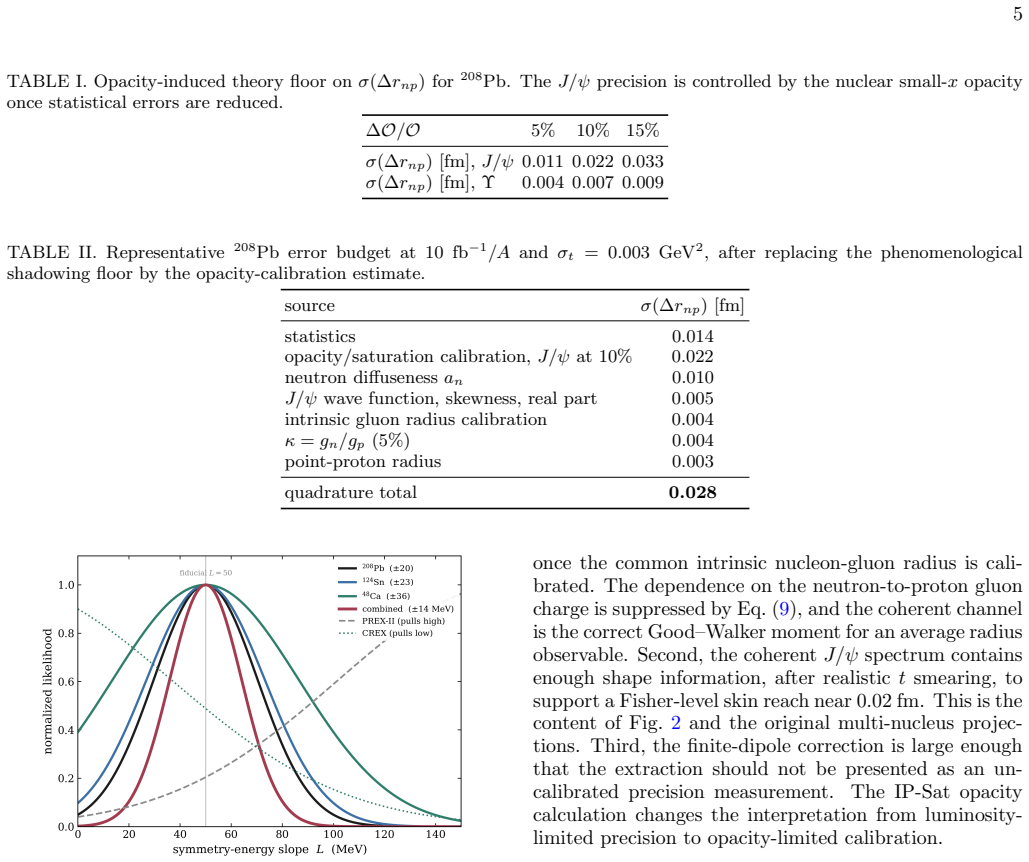
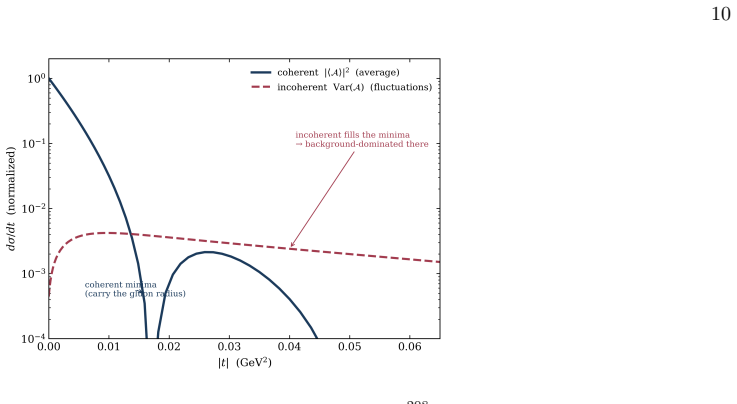
Coherent quarkonium production at the Electron-Ion Collider can image the average small-x gluon radius of nuclei. A calibrated radius-sum-rule framework connects this gluonic radius to neutron skins while quantifying limitations from finite-dipole saturation, nuclear opacity, and instrumental resolution. The central result is that coherent J/psi production contains sufficient shape information for a competitive neutron-skin program, but its precision is controlled by the calibration of the nuclear small-x gluon density, while the cleaner Upsilon channel remains statistically limited at early EIC luminosities. The framework identifies what an EIC measurement can robustly add to symmetry-energ
What carries the argument
Calibrated radius-sum-rule framework that maps the gluonic radius imaged by coherent J/psi and Upsilon production to neutron skins after accounting for saturation, opacity, and resolution effects.
If this is right
- Coherent J/psi production supplies enough shape information for neutron-skin measurements competitive with existing methods.
- Measurement precision is controlled by calibration of the nuclear small-x gluon density.
- The Upsilon channel remains statistically limited at early EIC luminosities.
- The framework specifies the theoretical and experimental controls needed before the results can be treated as precision nuclear-structure data.
- It identifies the concrete contribution an EIC neutron-skin measurement can make to symmetry-energy studies.
Where Pith is reading between the lines
- Global fits that tighten the small-x gluon density would directly raise the precision reachable for neutron skins.
- Cross-checks against parity-violating scattering in the same nuclei and kinematics would test the sum-rule assumptions.
- The method could be extended to other vector mesons to verify consistency across production channels.
- Results would feed into models of nuclear matter that link gluon distributions to neutron-proton asymmetry.
Load-bearing premise
The radius-sum-rule framework accurately maps the measured gluonic radius to neutron skins once finite-dipole saturation, nuclear opacity, and instrumental resolution are accounted for.
What would settle it
A measurement in which the neutron skin extracted from calibrated coherent J/psi data differs from the value obtained by parity-violating electron scattering by more than the combined uncertainty after gluon-density calibration would falsify the mapping.
Figures
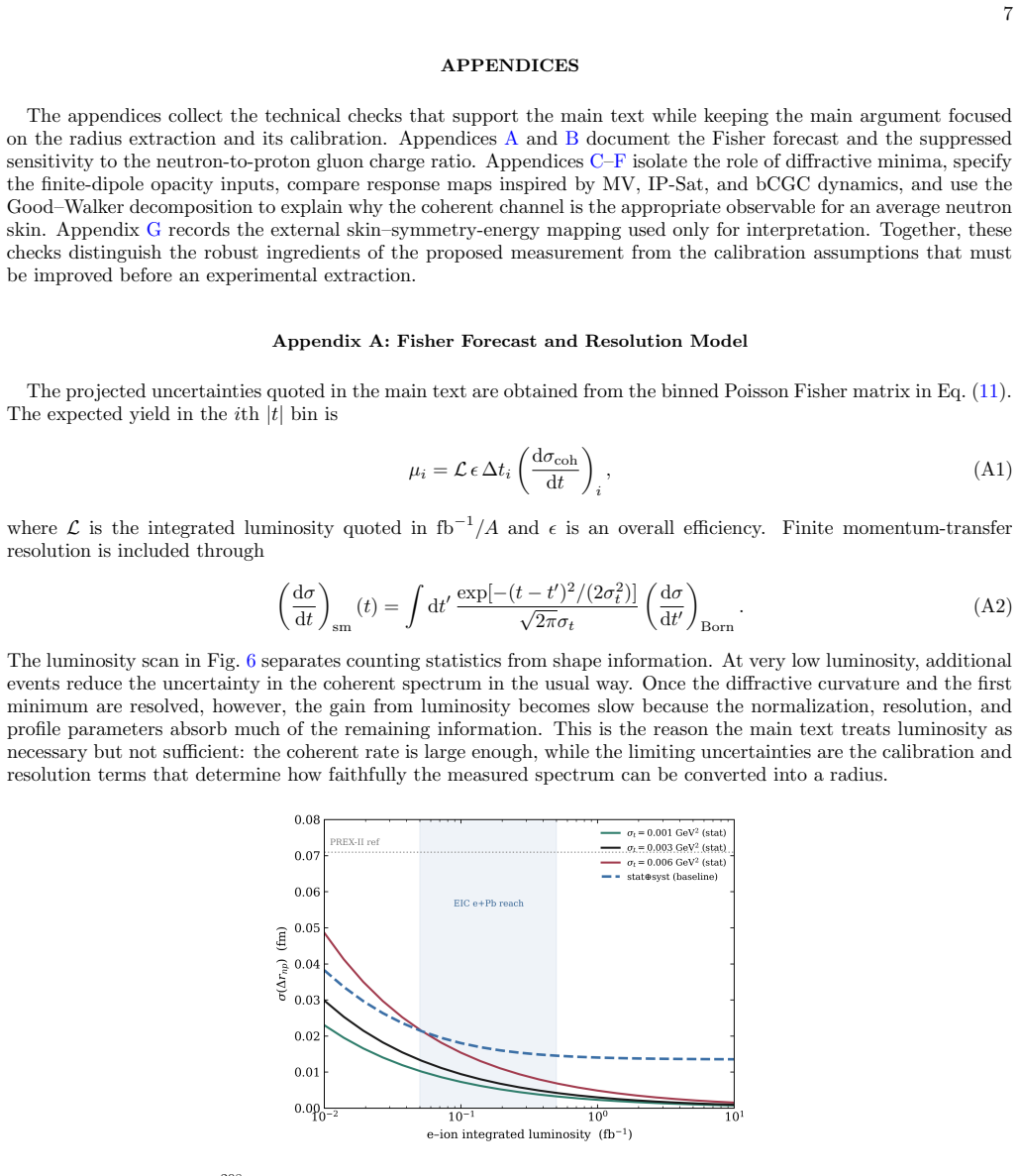
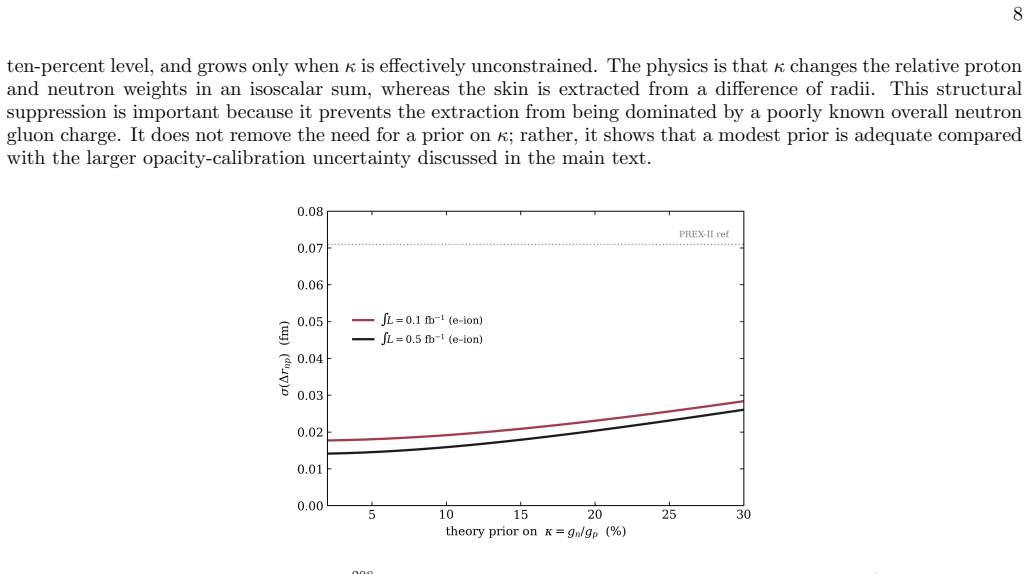
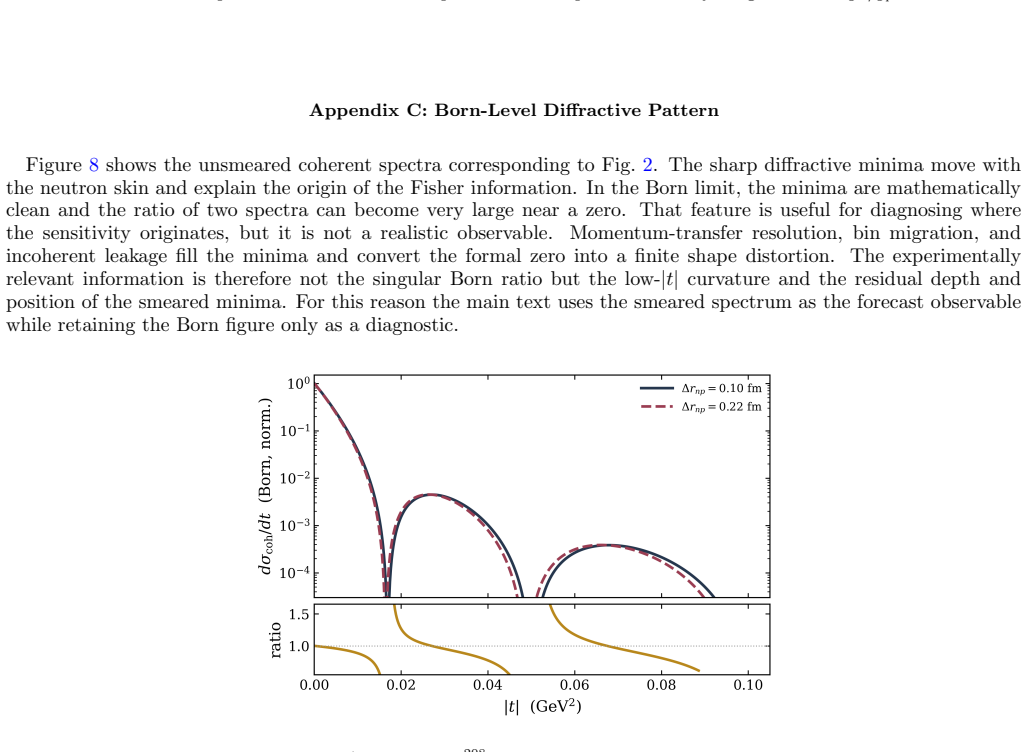
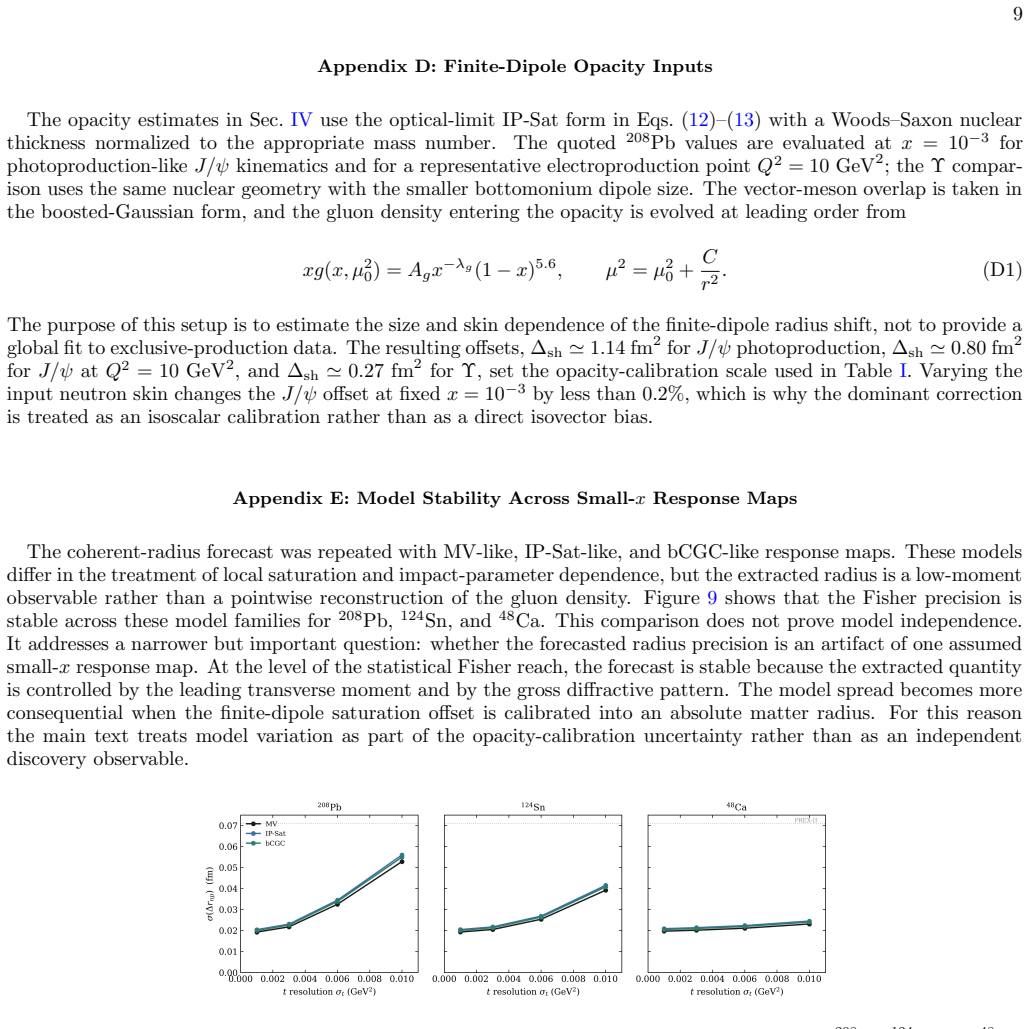
read the original abstract
Coherent quarkonium production at the Electron--Ion Collider can image the average small-$x$ gluon radius of nuclei, providing a reaction mechanism complementary to parity-violating electron scattering. We develop a calibrated radius-sum-rule framework that connects this gluonic radius to neutron skins and quantify the leading limitations from finite-dipole saturation, nuclear opacity, and instrumental resolution. The central result is that coherent $\Jpsi$ production contains sufficient shape information for a competitive neutron-skin program, but its precision is not limited by luminosity alone. It is instead controlled by the calibration of the nuclear small-$x$ gluon density, while the cleaner $\Ups$ channel remains statistically limited at early EIC luminosities. This framework identifies what an EIC neutron-skin measurement can robustly add to symmetry-energy studies and which theoretical and experimental controls are required before such a measurement can be interpreted as precision nuclear-structure information.
Editorial analysis
A structured set of objections, weighed in public.
Referee Report
Summary. The manuscript develops a calibrated radius-sum-rule framework that maps the average small-x gluon radius extracted from coherent J/psi (and Upsilon) production at the EIC to neutron skins, after corrections for finite-dipole saturation, nuclear opacity, and instrumental resolution. The central claim is that coherent J/psi production contains sufficient shape information for a competitive neutron-skin program whose precision is set by the calibration of the nuclear small-x gluon density rather than by luminosity alone, while the Upsilon channel remains statistically limited at early EIC luminosities. The framework is presented as identifying what an EIC measurement can robustly add to symmetry-energy studies.
Significance. If the result holds, the work supplies a gluon-based complement to parity-violating electron scattering for neutron-skin extraction, directly relevant to symmetry-energy constraints. A clear strength is the explicit identification of gluon-density calibration as the dominant uncertainty, with the sum-rule mapping treated as the quantity to be calibrated rather than asserted to be independent of input data.
Simulated Author's Rebuttal
We thank the referee for the positive review and recommendation to accept the manuscript.
Circularity Check
No significant circularity; derivation self-contained
full rationale
The paper develops a calibrated radius-sum-rule framework mapping gluonic radius from coherent quarkonium production to neutron skins, but explicitly flags the gluon-density calibration step as the dominant uncertainty rather than deriving the sum-rule output from itself. No load-bearing step reduces by construction to fitted inputs or self-citations; the central claim treats the sum-rule as an independent mapping whose precision is limited by external calibration. The provided abstract and description contain no self-definitional equations, fitted predictions, or uniqueness theorems imported from prior author work. This is the normal case of an honest non-finding.
Axiom & Free-Parameter Ledger
axioms (2)
- domain assumption A radius-sum-rule exists that maps the average small-x gluon radius extracted from coherent quarkonium production to neutron skin thickness.
- domain assumption Finite-dipole saturation, nuclear opacity, and instrumental resolution can be quantified and do not invalidate the shape information in J/psi data.
Forward citations
Cited by 1 Pith paper
-
Sub-eikonal stress and model dependence of the small-$x$ gluon D-term
The gluon D-term at small x is a next-to-eikonal stress observable whose sign is not determined by the dipole or saturation profile.
Reference graph
Works this paper leans on
-
[1]
shadowing residual
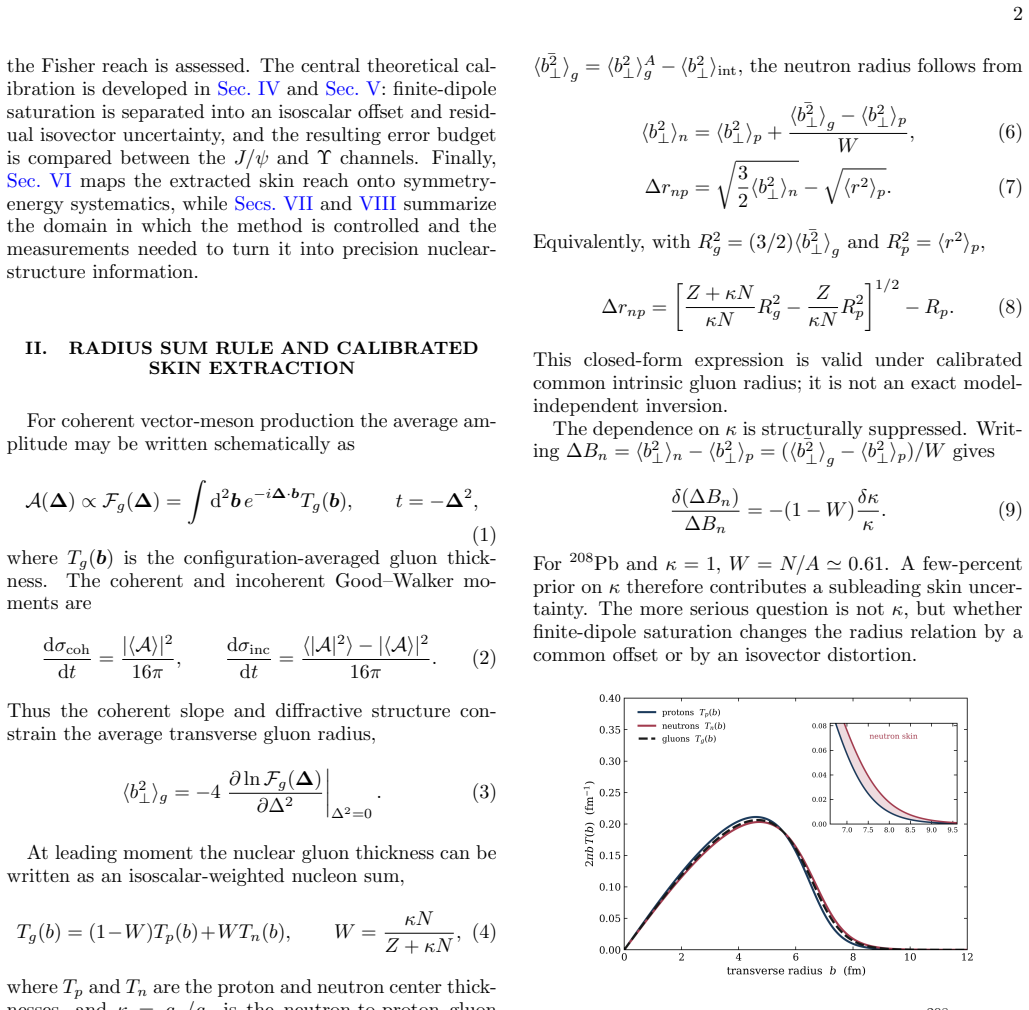
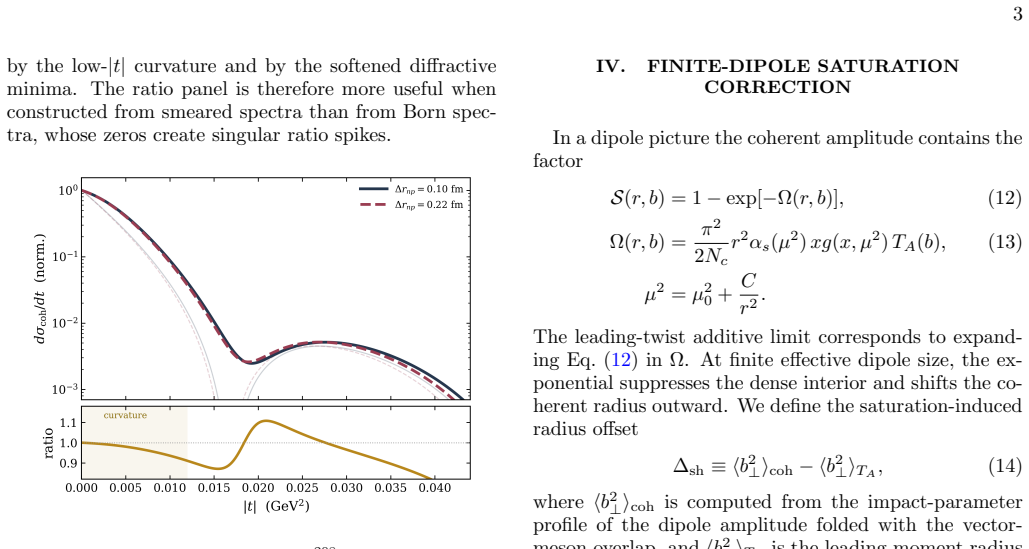
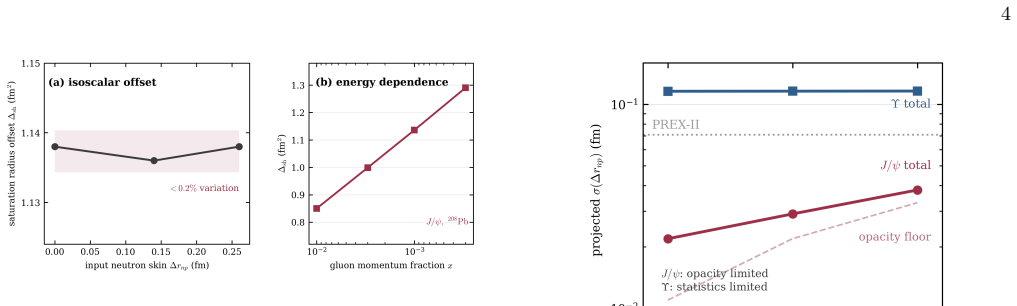
=A gx−λg(1−x) 5.6. Its purpose is not to replace a global exclusive-production analysis, but to quantify the correction that the original Fisher forecast treated as a small shadowing residual. For 208Pb atx= 10 −3, the correction is large forJ/ψ: ∆sh(J/ψ)≃1.14 fm 2,(15) about 5.4% of the additive radius and comparable to the neutron-skin signal in⟨b 2 ⊥⟩n...
-
[2]
The resulting offsets, ∆sh ≃1.14 fm 2 forJ/ψphotoproduction, ∆ sh ≃0.80 fm 2 forJ/ψatQ 2 = 10 GeV 2, and ∆ sh ≃0.27 fm 2 for Υ, set the opacity-calibration scale used in Table I
=A gx−λg(1−x) 5.6, µ 2 =µ 2 0 + C r2 .(D1) The purpose of this setup is to estimate the size and skin dependence of the finite-dipole radius shift, not to provide a global fit to exclusive-production data. The resulting offsets, ∆sh ≃1.14 fm 2 forJ/ψphotoproduction, ∆ sh ≃0.80 fm 2 forJ/ψatQ 2 = 10 GeV 2, and ∆ sh ≃0.27 fm 2 for Υ, set the opacity-calibra...
-
[3]
B. A. Brown, Phys. Rev. Lett.85, 5296 (2000)
2000
-
[4]
Typel and B
S. Typel and B. A. Brown, Phys. Rev. C64, 027302 (2001)
2001
-
[5]
C. J. Horowitz and J. Piekarewicz, Phys. Rev. Lett.86, 5647 (2001)
2001
-
[6]
Reinhard and W
P.-G. Reinhard and W. Nazarewicz, Phys. Rev. C81, 051303 (2010)
2010
-
[7]
Roca-Maza, M
X. Roca-Maza, M. Centelles, X. Vi˜ nas, and M. Warda, Phys. Rev. Lett.106, 252501 (2011)
2011
-
[8]
M. B. Tsanget al., Phys. Rev. C86, 015803 (2012)
2012
-
[9]
Thiel, C
M. Thiel, C. Sfienti, J. Piekarewicz, C. J. Horowitz, and M. Vanderhaeghen, J. Phys. G46, 093003 (2019)
2019
-
[10]
B. T. Reed, F. J. Fattoyev, C. J. Horowitz, and J. Piekarewicz, Phys. Rev. Lett.126, 172503 (2021)
2021
-
[11]
J. M. Lattimer and M. Prakash, Astrophys. J.550, 426 (2001)
2001
-
[12]
Oertel, M
M. Oertel, M. Hempel, T. Kl¨ ahn, and S. Typel, Rev. Mod. Phys.89, 015007 (2017)
2017
-
[13]
T. E. Rileyet al., Astrophys. J. Lett.918, L27 (2021)
2021
-
[14]
M. C. Milleret al., Astrophys. J. Lett.918, L28 (2021)
2021
-
[15]
B. P. Abbottet al.(LIGO Scientific and Virgo), Phys. Rev. Lett.119, 161101 (2017)
2017
-
[16]
B. P. Abbottet al.(LIGO Scientific and Virgo), Phys. Rev. Lett.121, 161101 (2018)
2018
-
[17]
Adhikariet al.(PREX), Phys
D. Adhikariet al.(PREX), Phys. Rev. Lett.126, 172502 (2021)
2021
-
[18]
Adhikariet al.(CREX), Phys
D. Adhikariet al.(CREX), Phys. Rev. Lett.129, 042501 (2022)
2022
-
[19]
M. G. Ryskin, Z. Phys. C57, 89 (1993)
1993
-
[20]
S. J. Brodsky, L. Frankfurt, J. F. Gunion, A. H. Mueller, and M. Strikman, Phys. Rev. D50, 3134 (1994)
1994
-
[21]
Kowalski and D
H. Kowalski and D. Teaney, Phys. Rev. D68, 114005 (2003)
2003
-
[22]
Kowalski, L
H. Kowalski, L. Motyka, and G. Watt, Phys. Rev. D74, 074016 (2006)
2006
-
[23]
Ji, Phys
X.-D. Ji, Phys. Rev. Lett.78, 610 (1997)
1997
-
[24]
A. V. Radyushkin, Phys. Rev. D56, 5524 (1997)
1997
-
[25]
M. V. Polyakov and P. Schweitzer, Int. J. Mod. Phys. A33, 1830025 (2018)
2018
-
[26]
V. D. Burkert, L. Elouadrhiri, F.-X. Girod, C. Lorc´ e, P. Schweitzer, and P. E. Shanahan, Rev. Mod. Phys.95, 041002 (2023)
2023
-
[27]
V. D. Burkert, L. Elouadrhiri, and F.-X. Girod, Nature557, 396 (2018)
2018
-
[28]
Y.-B. Yang, J. Liang, Y.-J. Bi, Y. Chen, T. Draper, K.-F. Liu, and Z. Liu, Phys. Rev. Lett.121, 212001 (2018)
2018
-
[29]
P. E. Shanahan and W. Detmold, Phys. Rev. Lett.122, 072003 (2019)
2019
-
[30]
A. Metz, B. Pasquini, and S. Rodini, Phys. Rev. D102, 114042 (2020)
2020
-
[31]
Lorc´ e, A
C. Lorc´ e, A. Metz, B. Pasquini, and S. Rodini, JHEP2021(11), 121
-
[32]
D. C. Hackett, D. A. Pefkou, and P. E. Shanahan, Phys. Rev. Lett.132, 251904 (2024)
2024
-
[33]
Duran, Z.-E
B. Duran, Z.-E. Meziani, S. Joosten, M. K. Jones, S. Prasad, C. Peng, W. Armstrong, H. Atac,et al., Nature615, 813 (2023)
2023
-
[34]
Hagiwara, X.-B
Y. Hagiwara, X.-B. Tong, B.-W. Xiao, and H. Zhou, Phys. Rev. D111, L051503 (2025)
2025
-
[35]
M. L. Good and W. D. Walker, Phys. Rev.120, 1857 (1960)
1960
-
[36]
Lappi and H
T. Lappi and H. M¨ antysaari, Phys. Rev. C83, 065202 (2011)
2011
-
[37]
M¨ antysaari and B
H. M¨ antysaari and B. Schenke, Phys. Rev. D94, 034042 (2016)
2016
-
[38]
M¨ antysaari and B
H. M¨ antysaari and B. Schenke, Phys. Rev. Lett.117, 052301 (2016)
2016
-
[39]
M¨ antysaari, B
H. M¨ antysaari, B. Schenke, C. Shen, and W. Zhao, Phys. Rev. Lett.131, 062301 (2023)
2023
-
[40]
E. A. Kuraev, L. N. Lipatov, and V. S. Fadin, Sov. Phys. JETP44, 443 (1976)
1976
-
[41]
L. V. Gribov, E. M. Levin, and M. G. Ryskin, Phys. Rept.100, 1 (1983)
1983
-
[42]
A. H. Mueller and J.-w. Qiu, Nucl. Phys. B268, 427 (1986)
1986
-
[43]
L. D. McLerran and R. Venugopalan, Phys. Rev. D49, 2233 (1994)
1994
-
[44]
L. D. McLerran and R. Venugopalan, Phys. Rev. D49, 3352 (1994)
1994
-
[45]
Balitsky, Nucl
I. Balitsky, Nucl. Phys. B463, 99 (1996)
1996
-
[46]
Y. V. Kovchegov, Phys. Rev. D60, 034008 (1999)
1999
-
[47]
Jalilian-Marian, A
J. Jalilian-Marian, A. Kovner, A. Leonidov, and H. Weigert, Nucl. Phys. B504, 415 (1997)
1997
-
[48]
Weigert, Nucl
H. Weigert, Nucl. Phys. A703, 823 (2002)
2002
-
[49]
Iancu, A
E. Iancu, A. Leonidov, and L. D. McLerran, Phys. Lett. B510, 133 (2001)
2001
-
[50]
Gelis, E
F. Gelis, E. Iancu, J. Jalilian-Marian, and R. Venugopalan, Ann. Rev. Nucl. Part. Sci.60, 463 (2010)
2010
-
[51]
Y. V. Kovchegov and E. Levin,Quantum Chromodynamics at High Energy(Cambridge University Press, 2012)
2012
-
[52]
J. L. Albacete and C. Marquet, Phys. Lett. B687, 174 (2010)
2010
-
[53]
J. L. Albacete, A. Dumitru, H. Fujii, and Y. Nara, Nucl. Phys. A897, 1 (2013)
2013
-
[54]
Lappi and H
T. Lappi and H. Mantysaari, Phys. Rev. D88, 114020 (2013)
2013
-
[55]
Duclou´ e, T
B. Duclou´ e, T. Lappi, and Y. Zhu, Phys. Rev. D93, 114016 (2016)
2016
-
[56]
Duclou´ e, E
B. Duclou´ e, E. Iancu, T. Lappi, A. H. Mueller, G. Soyez, and D. N. Triantafyllopoulos, Phys. Rev. D97, 054020 (2018)
2018
-
[57]
Marquet, Nucl
C. Marquet, Nucl. Phys. A796, 41 (2007)
2007
-
[58]
Dominguez, B.-W
F. Dominguez, B.-W. Xiao, and F. Yuan, Phys. Rev. Lett.106, 022301 (2011)
2011
-
[59]
Dominguez, C
F. Dominguez, C. Marquet, B.-W. Xiao, and F. Yuan, Phys. Rev. D83, 105005 (2011)
2011
-
[60]
G. A. Chirilli, B.-W. Xiao, and F. Yuan, Phys. Rev. Lett.108, 122301 (2012)
2012
-
[61]
G. A. Chirilli, B.-W. Xiao, and F. Yuan, Phys. Rev. D86, 054005 (2012). 12
2012
-
[62]
Iancu, A
E. Iancu, A. H. Mueller, D. N. Triantafyllopoulos, and S.-Y. Wei, JHEP2021(07), 196
-
[63]
Hatta, B.-W
Y. Hatta, B.-W. Xiao, and F. Yuan, Phys. Rev. D106, 094015 (2022)
2022
-
[64]
Caucal, F
P. Caucal, F. Salazar, and R. Venugopalan, JHEP2021(11), 222
-
[65]
Caucal, F
P. Caucal, F. Salazar, B. Schenke, and R. Venugopalan, JHEP2022(11), 169
-
[66]
Taels, T
P. Taels, T. Altinoluk, G. Beuf, and C. Marquet, JHEP2022(10), 184
-
[67]
Bergabo and J
F. Bergabo and J. Jalilian-Marian, Phys. Rev. D106, 054035 (2022)
2022
-
[68]
Bergabo and J
F. Bergabo and J. Jalilian-Marian, Phys. Rev. D107, 054036 (2023)
2023
-
[69]
Tong, B.-W
X.-B. Tong, B.-W. Xiao, and Y.-Y. Zhang, Phys. Rev. Lett.130, 151902 (2023)
2023
-
[70]
Liu, Z.-B
H.-Y. Liu, Z.-B. Kang, and X. Liu, Phys. Rev. D102, 051502 (2020)
2020
-
[71]
H.-Y. Liu, K. Xie, Z.-B. Kang, and X. Liu, JHEP2022(07), 041
-
[72]
S. R. Klein and J. Nystrand, Phys. Rev. C60, 014903 (1999)
1999
-
[73]
C. A. Bertulani, S. R. Klein, and J. Nystrand, Ann. Rev. Nucl. Part. Sci.55, 271 (2005)
2005
-
[74]
A. J. Baltzet al., Phys. Rept.458, 1 (2008)
2008
-
[75]
Abbaset al.(ALICE), Eur
E. Abbaset al.(ALICE), Eur. Phys. J. C73, 2617 (2013)
2013
-
[76]
Acharyaet al.(ALICE), Phys
S. Acharyaet al.(ALICE), Phys. Lett. B798, 134926 (2019)
2019
-
[77]
Toll and T
T. Toll and T. Ullrich, Phys. Rev. C87, 024913 (2013)
2013
-
[78]
Inakura and H
T. Inakura and H. Nakada, Phys. Rev. C92, 064302 (2015)
2015
discussion (0)
Sign in with ORCID, Apple, or X to comment. Anyone can read and Pith papers without signing in.