The new era of Lyman alpha emitters (LAEs): Typical star formation histories of LAEs in the ILLUSTRIS simulation
Pith reviewed 2026-06-25 23:04 UTC · model grok-4.3
The pith
Simulations show the classical single-burst LAE picture describes the largest single class at 35 percent while 65 percent have earlier star-formation bursts.
A machine-rendered reading of the paper's core claim, the machinery that carries it, and where it could break.
Core claim
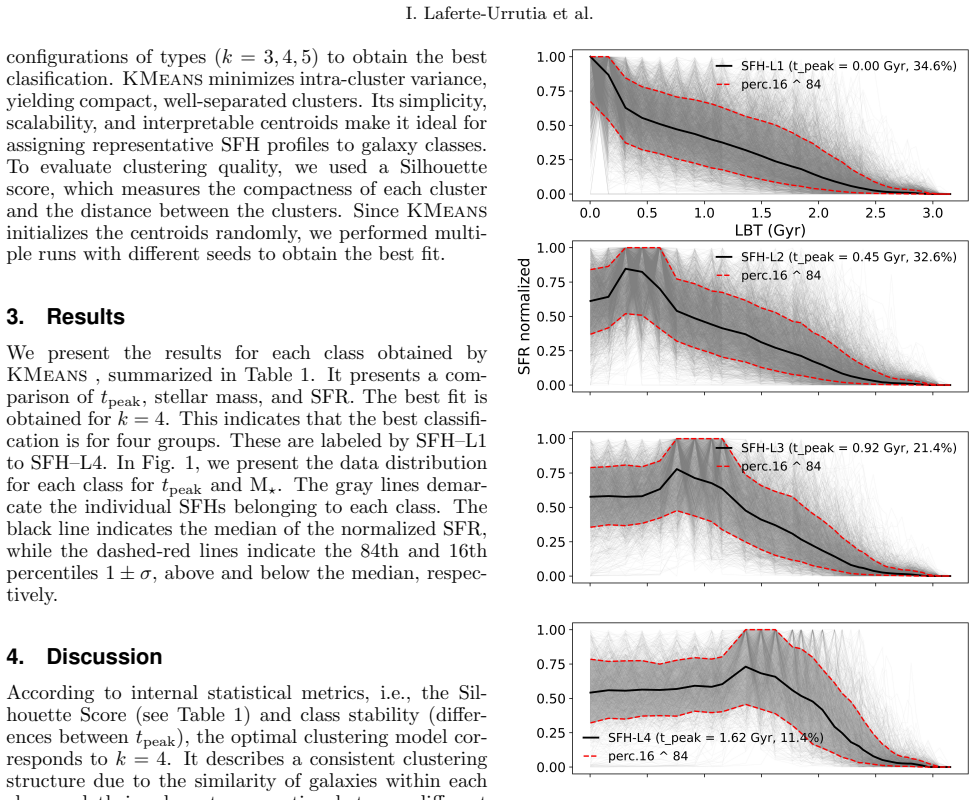
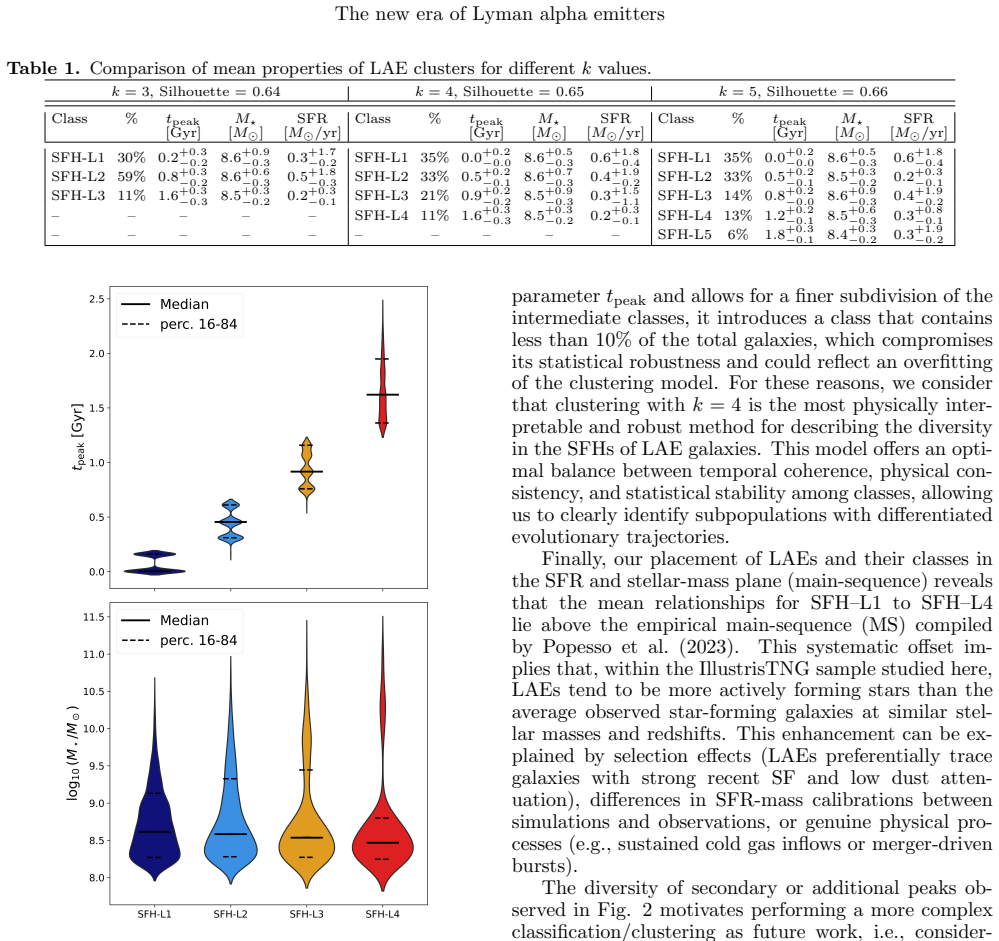
In the IllustrisTNG100 simulation at z=2, KMeans clustering applied to the star-formation histories of 6051 Lyman-alpha emitters selected by a recent criterion divides the sample into four classes with fractions 35 percent, 33 percent, 21 percent, and 11 percent. The 35 percent class exhibits its most intense star formation at the time of observation and consists of galaxies with lower mass, lower Lyman-alpha luminosity, and lower total star-formation rate, thereby reproducing the classical LAE properties of low mass, low dust, and a single dominant burst, whereas the other classes show their primary bursts 0.3, 0.7, and 1.3 Gyr before observation.
What carries the argument
KMeans clustering applied to star-formation histories of galaxies selected as Lyman-alpha emitters in the simulation.
If this is right
- The classical definition of low-mass, low-dust, single-burst LAEs still applies to the single largest class, which is 35 percent of the population.
- Three additional classes with star-formation bursts offset by 0.3 to 1.3 Gyr before observation together comprise 65 percent of LAEs.
- Lower-mass galaxies are more likely to belong to the recent-burst class with lower Lyman-alpha luminosity.
- LAE samples contain a broader range of star-formation history types than the traditional single-burst model assumes.
Where Pith is reading between the lines
- If the simulation is realistic, selection criteria based on current Lyman-alpha luminosity may miss a substantial fraction of galaxies whose bursts occurred earlier and are now less luminous or dustier.
- The four classes may correspond to different stages in galaxy assembly and could be tested by measuring dust content or gas metallicity in observed LAE samples.
- Connecting these classes to large-scale environment or clustering strength would show whether they trace different cosmic structures.
Load-bearing premise
The simulation accurately reproduces the Lyman-alpha emission properties and star-formation histories of real galaxies at redshift 2 so the simulated sample represents the cosmological population.
What would settle it
An observational census at z=2 that finds the fraction of Lyman-alpha emitters with peak star formation exactly at the observation epoch to be substantially different from 35 percent, or that shows the simulated sample's mass and luminosity distributions do not match those measured in real surveys.
Figures
read the original abstract
This work seeks to understand the nature of Lyman-alpha emitting galaxies in a cosmological context by analyzing their star-formation histories in the IllustrisTNG100 simulation, applying a recent selection criterion. The sample at z = 2.0 includes 6051 Lyman-alpha emitters, classified into four classes (35%, 33%, 21%, and 11%) using KMeans, an unsupervised machine-learning clustering method. The first class reproduces the typical star-formation history, characterized by the most intense star formation at the time of observation. The remaining classes exhibit atypical star-formation histories, with bursts occurring 0.3, 0.7, and 1.3 Gyr before the time of observation. The first class corresponds to galaxies with lower mass, Lyman-alpha luminosity, and total star-formation rate. We conclude that the classical definition of Lyman-alpha emitting galaxies-low mass, low dust content, and a single dominant burst-remains the most representative population (35% of the total sample), although other classes account for the remaining 65% of the cosmological sample.
Editorial analysis
A structured set of objections, weighed in public.
Referee Report
Summary. The paper analyzes star-formation histories of 6051 LAEs at z=2 selected from IllustrisTNG100 using a recent criterion. KMeans clustering on the SFHs yields four classes (35%, 33%, 21%, 11%), with the 35% class showing the classical history of peak star formation at observation time and corresponding to lower-mass, lower-Lyα-luminosity, lower-SFR galaxies. The authors conclude that the classical LAE definition remains the most representative population even though atypical histories account for 65% of the sample.
Significance. If the IllustrisTNG LAE sample is representative of the real z=2 population, the result quantifies the diversity of SFHs among LAEs and shows that the classical single-burst population, while still the largest single class, is not the majority. The work supplies a concrete, simulation-based decomposition of the cosmological LAE sample into SFH classes.
major comments (2)
- [Abstract] Abstract: the LAE selection criterion is described only as 'recent' with no explicit definition, no justification for the choice of four KMeans clusters, no validation metrics for the clustering, and no error estimates on the reported class fractions (35/33/21/11 %). These omissions make it impossible to assess whether the 35 % classical fraction is robust or sensitive to analysis choices.
- [Abstract] Abstract and conclusion: the claim that the 35 % fraction 'represents the cosmological sample' rests on the untested assumption that the IllustrisTNG100 LAE selection (which does not include on-the-fly Lyα radiative transfer) reproduces the observed LAE luminosity function, equivalent-width distribution, and number density at z=2. No such comparison is reported, so the reported fractions may reflect the simulation's sub-grid dust and escape-fraction prescriptions rather than cosmological reality.
Simulated Author's Rebuttal
We thank the referee for their thoughtful and constructive report. We address each major comment below and will revise the manuscript accordingly where appropriate.
read point-by-point responses
-
Referee: [Abstract] Abstract: the LAE selection criterion is described only as 'recent' with no explicit definition, no justification for the choice of four KMeans clusters, no validation metrics for the clustering, and no error estimates on the reported class fractions (35/33/21/11 %). These omissions make it impossible to assess whether the 35 % classical fraction is robust or sensitive to analysis choices.
Authors: We agree that the abstract is too concise on methodological details. In the revised manuscript we will expand the abstract to (i) explicitly name and briefly define the LAE selection criterion (the 'recent' burst threshold taken from the cited recent literature), (ii) state that the number of clusters was chosen via the elbow method and silhouette analysis (which we will add to the methods section if not already present), (iii) report the silhouette score or equivalent validation metric, and (iv) include bootstrap-derived uncertainties on the class fractions. These changes will make the robustness of the 35 % fraction directly assessable from the abstract. revision: yes
-
Referee: [Abstract] Abstract and conclusion: the claim that the 35 % fraction 'represents the cosmological sample' rests on the untested assumption that the IllustrisTNG100 LAE selection (which does not include on-the-fly Lyα radiative transfer) reproduces the observed LAE luminosity function, equivalent-width distribution, and number density at z=2. No such comparison is reported, so the reported fractions may reflect the simulation's sub-grid dust and escape-fraction prescriptions rather than cosmological reality.
Authors: We acknowledge the limitation. The selection criterion is taken from recent observational-calibrated work, but IllustrisTNG100 indeed lacks on-the-fly Lyα RT. We will revise the abstract and conclusion to replace the phrasing 'represents the cosmological sample' with 'in this simulated sample selected by the adopted criterion' and add a short paragraph in the discussion section that (a) notes the absence of full RT, (b) states that the reported fractions are therefore specific to the simulation's sub-grid prescriptions, and (c) cites literature comparisons of TNG LAE number densities where available. This qualifies the claim without requiring new simulations. revision: partial
Circularity Check
No significant circularity; derivation is data-driven clustering on simulation outputs.
full rationale
The paper selects 6051 LAEs at z=2 from IllustrisTNG100 using an external recent criterion, then applies unsupervised KMeans clustering directly to their star-formation histories to obtain four classes with fractions 35/33/21/11 %. The central claim that the classical population is the most representative (35 %) is an output of this clustering, not a fitted parameter or self-referential definition. No equations reduce the result to its inputs by construction, no self-citation is invoked as a uniqueness theorem or load-bearing premise, and no ansatz is smuggled in. The analysis is self-contained against the simulation data; external validity of the simulation is a separate assumption, not a circularity in the reported derivation chain.
Axiom & Free-Parameter Ledger
free parameters (1)
- Number of KMeans clusters
axioms (1)
- domain assumption The IllustrisTNG simulation accurately models the physics of Lyman alpha emission and star formation in galaxies at z=2.
Reference graph
Works this paper leans on
-
[1]
Radiative Processes in Astrophysics, by George B
Radiative Processes in Astrophysics. Radiative Processes in Astrophysics, by George B. Rybicki, Alan P. Lightman, pp. 400. ISBN 0-471-82759-2. Wiley-VCH , June 1986. , year = 1986, month = jun, adsurl =
1986
-
[2]
Proceedings of the National Academy of Science , year = 1929, month = mar, volume = 15, pages =
A Relation between Distance and Radial Velocity among Extra-Galactic Nebulae. Proceedings of the National Academy of Science , year = 1929, month = mar, volume = 15, pages =. doi:10.1073/pnas.15.3.168 , adsurl =
-
[4]
A Measurement of Excess Antenna Temperature at 4080 Mc/s. FALSE. , keywords =. doi:10.1086/148307 , adsurl =
-
[5]
A Universal Density Profile from Hierarchical Clustering. ApJ , eprint =. doi:10.1086/304888 , adsurl =
-
[6]
Observational Evidence from Supernovae for an Accelerating Universe and a Cosmological Constant. , eprint =. doi:10.1086/300499 , adsurl =
work page internal anchor Pith review doi:10.1086/300499
-
[7]
Planck 2015 results. XIII. Cosmological parameters. , keywords =. doi:10.1051/0004-6361/201525830 , primaryClass =
-
[8]
Boletín de la Asociación Argentina de Astronomía , keywords =
Emission line galaxies around protoclusters in a galaxy formation model. Boletín de la Asociación Argentina de Astronomía , keywords =
-
[9]
The persistent cosmic web and its filamentary structure - I. Theory and implementation. Monthly Notices of the Royal Astronomical Society , keywords =. doi:10.1111/j.1365-2966.2011.18394.x , archivePrefix =. 1009.4015 , primaryClass =
-
[10]
Lee, Kyoung-Soo and Gawiser, Eric and Park, Changbom and Yang, Yujin and Valdes, Francisco and Lang, Dustin and Ramakrishnan, Vandana and Moon, Byeongha and Firestone, Nicole and Appleby, Stephen and Artale, Maria Celeste and Andrews, Moira and Bauer, Franz and Benda, Barbara and Broussard, Adam and Chiang, Yi-Kuan and Ciardullo, Robin and Dey, Arjun and ...
-
[11]
ODIN: Improved Narrowband Ly Emitter Selection Techniques for z = 2.4, 3.1, and 4.5 , author=. 2024 , eprint=. doi:https://doi.org/10.3847/1538-4357/ad71c9 , url=
-
[12]
ODIN: Star Formation Histories Reveal Formative Starbursts Experienced by Ly -emitting Galaxies at Cosmic Noon. , keywords =. doi:10.3847/2041-8213/adbf8c , archivePrefix =. 2501.08568 , primaryClass =
-
[13]
ODIN: Identifying Protoclusters and Cosmic Filaments Traced by Ly -emitting Galaxies. AJL , keywords =. doi:10.3847/1538-4357/ad83cb , archivePrefix =. 2406.08645 , primaryClass =
-
[14]
Observations of the Lyman- Universe. ARA&A, , keywords =. doi:10.1146/annurev-astro-032620-021859 , archivePrefix =. 2012.07960 , primaryClass =
-
[15]
The Physical Nature of Ly -emitting Galaxies at z=3.1. AJL , keywords =. doi:10.1086/504467 , archivePrefix =. astro-ph/0603244 , primaryClass =
-
[16]
Galaxy populations in protoclusters at cosmic noon. A&A , keywords =. doi:10.1051/0004-6361/202452628 , archivePrefix =. 2410.08412 , primaryClass =
-
[17]
Vogelsberger, Mark and Nelson, Dylan and Pillepich, Annalisa and Shen, Xuejian and Marinacci, Federico and Springel, Volker and Pakmor, Rüdiger and Tacchella, Sandro and Weinberger, Rainer and Torrey, Paul and Hernquist, Lars , title =. Monthly Notices of the Royal Astronomical Society , volume =. 2020 , month =. doi:10.1093/mnras/staa137 , url =
-
[18]
The star formation activity of IllustrisTNG galaxies: main sequence, UVJ diagram, quenched fractions, and systematics. Monthly Notices of the Royal Astronomical Society , keywords =. doi:10.1093/mnras/stz712 , archivePrefix =. 1812.07584 , primaryClass =
work page internal anchor Pith review Pith/arXiv arXiv doi:10.1093/mnras/stz712
-
[19]
ODIN: Where Do Ly Blobs Live? Contextualizing Blob Environments within Large-scale Structure. The Astrophysical Journal , keywords =. doi:10.3847/1538-4357/acd341 , archivePrefix =. 2302.07860 , primaryClass =
-
[20]
The Illustris Simulation: Public Data Release
The illustris simulation: Public data release. Astronomy and Computing , keywords =. doi:10.1016/j.ascom.2015.09.003 , archivePrefix =. 1504.00362 , primaryClass =
work page internal anchor Pith review Pith/arXiv arXiv doi:10.1016/j.ascom.2015.09.003 2015
-
[21]
Monthly Notices of the Royal Astronomical Society , author =
Vogelsberger, Mark and Genel, Shy and Springel, Volker and Torrey, Paul and Sijacki, Debora and Xu, Dandan and Snyder, Greg and Nelson, Dylan and Hernquist, Lars , title =. Monthly Notices of the Royal Astronomical Society , volume =. 2014 , month =. doi:10.1093/mnras/stu1536 , url =
-
[22]
Introducing the Illustris project: the evolution of galaxy populations across cosmic time , volume=
Genel, Shy and Vogelsberger, Mark and Springel, Volker and Sijacki, Debora and Nelson, Dylan and Snyder, Greg and Rodriguez-Gomez, Vicente and Torrey, Paul and Hernquist, Lars , year=. Introducing the Illustris project: the evolution of galaxy populations across cosmic time , volume=. Monthly Notices of the Royal Astronomical Society , publisher=. doi:10....
-
[23]
Y., V¨ ais¨ anen, P., Whitelock, P
E pur si muove: Galilean-invariant cosmological hydrodynamical simulations on a moving mesh. , keywords =. doi:10.1111/j.1365-2966.2009.15715.x , archivePrefix =. 0901.4107 , primaryClass =
-
[24]
An empirical study of the relationship between Ly and UV-selected galaxies: do theorists and observers 'select' the same objects?. , keywords =. doi:10.1111/j.1365-2966.2011.19958.x , archivePrefix =. 1108.3840 , primaryClass =
-
[25]
Connecting faint-end slopes of the Lyman emitter and Lyman-break galaxy luminosity functions. , keywords =. doi:10.1093/mnras/stv329 , archivePrefix =. 1502.00022 , primaryClass =
work page internal anchor Pith review Pith/arXiv arXiv doi:10.1093/mnras/stv329
-
[26]
A Comprehensive Study of Ly$\alpha$ Emission in the High-redshift Galaxy Population
A Comprehensive Study of Ly Emission in the High-redshift Galaxy Population. , keywords =. doi:10.3847/1538-4357/aa7552 , archivePrefix =. 1706.01886 , primaryClass =
work page internal anchor Pith review Pith/arXiv arXiv doi:10.3847/1538-4357/aa7552
-
[27]
The Universe Is Reionizing at z 7: Bayesian Inference of the IGM Neutral Fraction Using Ly Emission from Galaxies. , keywords =. doi:10.3847/1538-4357/aab0a7 , archivePrefix =. 1709.05356 , primaryClass =
work page internal anchor Pith review Pith/arXiv arXiv doi:10.3847/1538-4357/aab0a7
-
[28]
Im, Sang Hyeok and Hwang, Ho Seong and Park, Jaehong and Lee, Jaehyun and Song, Hyunmi and Appleby, Stephen and Dubois, Yohan and Few, C. Gareth and Gibson, Brad K. and Kim, Juhan and Kim, Yonghwi and Park, Changbom and Pichon, Christophe and Shin, Jihye and Snaith, Owain N. and Artale, M. Celeste and Gawiser, Eric and Guaita, Lucia and Jeong, Woong-Seob ...
-
[30]
2023, MNRAS, 519, 1526, doi: 10.1093/mnras/stac3214
The main sequence of star-forming galaxies across cosmic times. , keywords =. doi:10.1093/mnras/stac3214 , archivePrefix =. 2203.10487 , primaryClass =
-
[31]
Planck 2013 results. XVI. Cosmological parameters , DOI= "10.1051/0004-6361/201321591", url= "https://doi.org/10.1051/0004-6361/201321591", journal =
discussion (0)
Sign in with ORCID, Apple, or X to comment. Anyone can read and Pith papers without signing in.