Finite Elements for Helmholtz Scattering with Infinity as a Computational Boundary
Pith reviewed 2026-06-25 22:35 UTC · model grok-4.3
The pith
Hyperboloidal compactification maps infinity to a finite boundary for H1-conforming finite-element solution of the exterior Helmholtz equation.
A machine-rendered reading of the paper's core claim, the machinery that carries it, and where it could break.
Core claim
We develop an H1-conforming finite-element formulation of hyperboloidal compactification for the exterior Helmholtz equation. A change of coordinates maps infinity to a finite outer boundary, and a rescaling removes the leading oscillatory decay. We derive the transformed equation and a global sesquilinear weak formulation with bounded coefficients. The compactified boundary contributes an explicit boundary mass term, and its trace gives the far-field pattern up to a known normalization.
What carries the argument
Hyperboloidal compactification via coordinate change and rescaling that produces bounded coefficients and a global weak form whose outer trace yields the far-field pattern.
Load-bearing premise
A coordinate change and rescaling exist that map infinity to a finite boundary while producing bounded coefficients and admitting a global sesquilinear weak formulation.
What would settle it
A numerical test on the unit-disk scattering problem in which the far-field pattern extracted from the compactified boundary deviates from the known analytic value by more than the expected discretization error.
Figures



read the original abstract
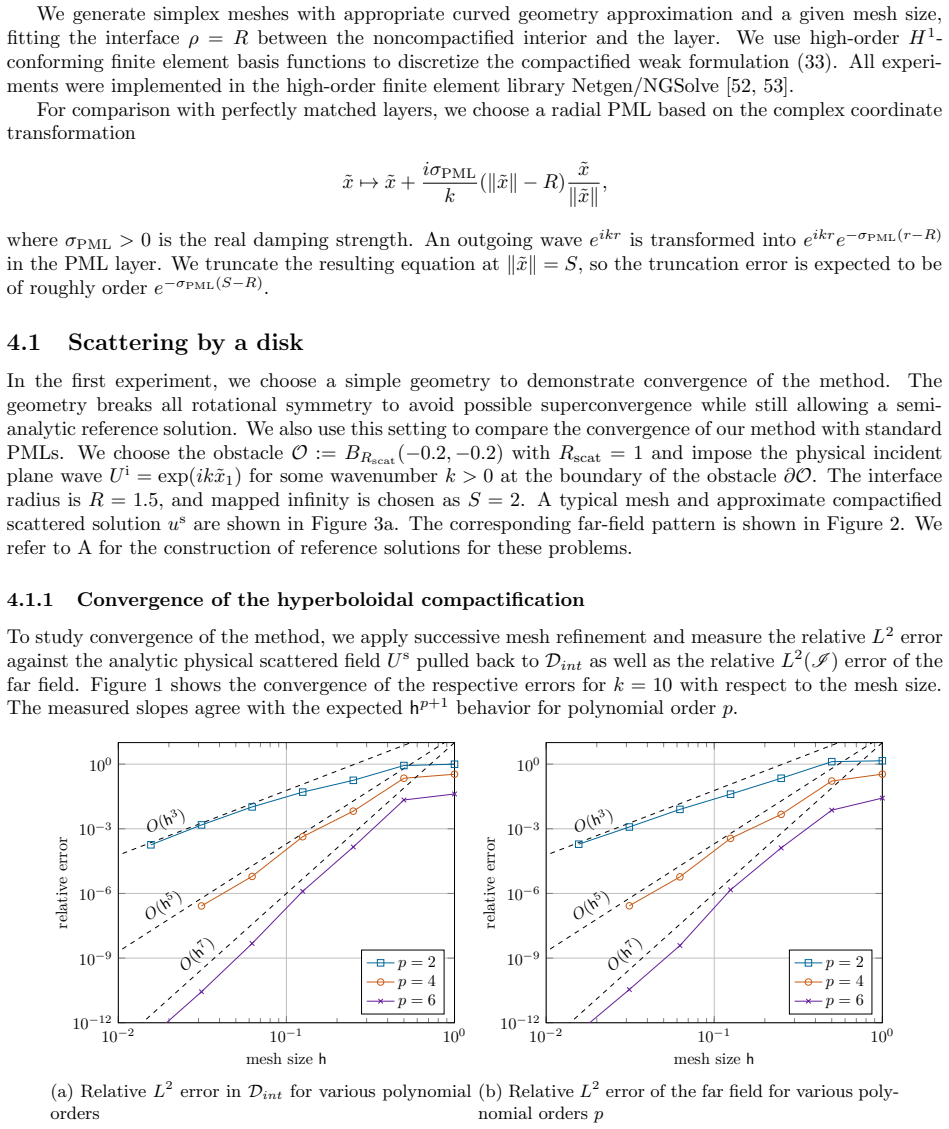
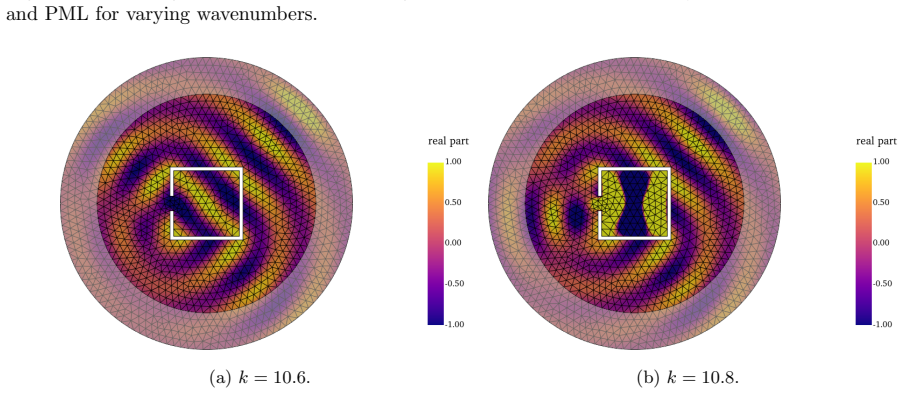
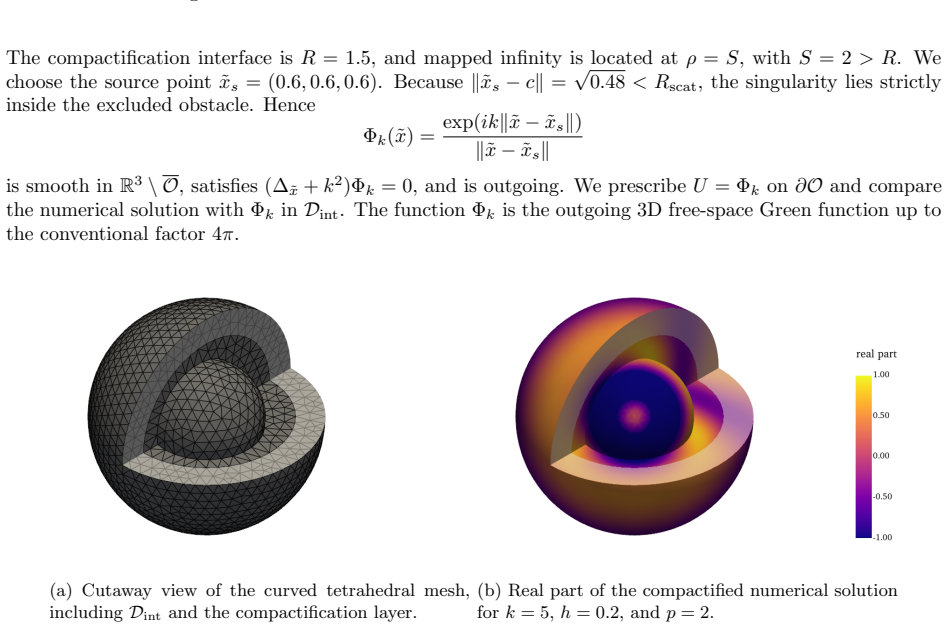
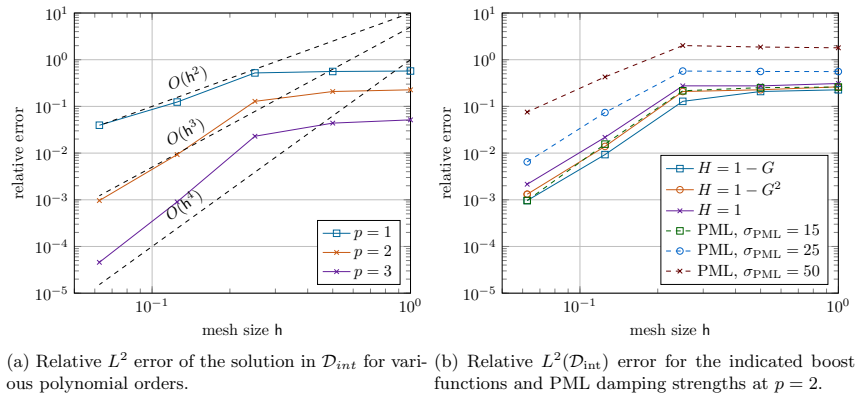
Building on the null-infinity-layer construction, we develop an H1-conforming finite-element formulation of hyperboloidal compactification for the exterior Helmholtz equation. A change of coordinates maps infinity to a finite outer boundary, and a rescaling removes the leading oscillatory decay. We derive the transformed equation and a global sesquilinear weak formulation with bounded coefficients. The compactified boundary contributes an explicit boundary mass term, and its trace gives the far-field pattern up to a known normalization. We compare the resulting method with finite-element discretizations using perfectly matched layers (PML) and report benchmark results in two and three dimensions. Numerical experiments include scattering by a unit disk, resonance in a trapping geometry, a manufactured benchmark in three dimensions, and a submarine benchmark.
Editorial analysis
A structured set of objections, weighed in public.
Referee Report
Summary. The manuscript develops an H1-conforming finite-element formulation for the exterior Helmholtz equation via hyperboloidal compactification. A coordinate change maps spatial infinity to a finite outer boundary; a subsequent rescaling removes the leading oscillatory decay, producing a transformed equation asserted to have bounded coefficients. The authors derive a global sesquilinear weak form that incorporates an explicit boundary mass term on the compactified surface; the trace on this surface yields the far-field pattern up to a known normalization. Numerical comparisons with PML discretizations are presented for scattering by a unit disk, resonance in a trapping geometry, a manufactured 3D benchmark, and a submarine problem in two and three dimensions.
Significance. If the transformed operator indeed admits bounded coefficients and the weak formulation is well-posed in H1, the method supplies a practical alternative to PML truncation that directly furnishes the far-field pattern without post-processing. The reported benchmarks indicate competitive accuracy and the use of standard conforming elements is attractive for implementation. The explicit boundary mass term and normalization for far-field extraction constitute concrete, testable contributions.
major comments (2)
- [§3] §3 (transformed equation): the claim that the rescaled coefficients remain bounded as the compactified radius approaches the outer boundary requires an explicit verification that the leading 1/r decay terms cancel after the coordinate change; without this step the global sesquilinear form may not be coercive on the stated space.
- [Table 2] Table 2 (unit-disk scattering): the reported L2 errors for the compactification method are given without mesh-size dependence or comparison to the expected convergence rate for the chosen polynomial degree; this weakens the claim that the method matches PML accuracy.
minor comments (2)
- [§2] Notation for the rescaling factor ρ(r) is introduced without a displayed equation; a single-line definition would improve readability.
- [§5.3] The manufactured-solution test in three dimensions lacks a statement of the exact solution used; adding this would allow independent reproduction.
Simulated Author's Rebuttal
We thank the referee for the positive overall assessment and the specific comments on the transformed equation and the numerical results. We address each major comment below.
read point-by-point responses
-
Referee: [§3] §3 (transformed equation): the claim that the rescaled coefficients remain bounded as the compactified radius approaches the outer boundary requires an explicit verification that the leading 1/r decay terms cancel after the coordinate change; without this step the global sesquilinear form may not be coercive on the stated space.
Authors: We agree that an explicit verification of the cancellation is necessary for rigor. The manuscript states that the rescaled coefficients are bounded, but does not display the cancellation calculation. In the revised manuscript we will insert, in §3, the detailed expansion showing that the leading 1/r terms cancel identically after the coordinate change and rescaling, thereby confirming boundedness up to the outer boundary and supporting the claimed coercivity on H¹. revision: yes
-
Referee: [Table 2] Table 2 (unit-disk scattering): the reported L2 errors for the compactification method are given without mesh-size dependence or comparison to the expected convergence rate for the chosen polynomial degree; this weakens the claim that the method matches PML accuracy.
Authors: We acknowledge that Table 2 presents L² errors without listing the underlying mesh sizes or comparing observed rates to the theoretical rate for the polynomial degree. In the revision we will augment the table (or its caption) with the mesh-size parameter h for each entry and add a short paragraph discussing the observed convergence rates relative to the expected rate, permitting a clearer comparison with the PML results. revision: yes
Circularity Check
Minor self-citation; derivation remains independent
full rationale
The central steps—coordinate change mapping infinity to a finite boundary, rescaling to remove oscillatory decay, derivation of the transformed equation with bounded coefficients, and the resulting global sesquilinear form with explicit boundary mass term—are presented as direct consequences of the transformation. No fitted parameters are relabeled as predictions, no uniqueness theorem is imported from the authors' prior work to force the formulation, and the far-field extraction follows from the trace operator after rescaling. The reference to the null-infinity-layer construction is acknowledged but does not carry the load of the new H1-conforming discretization or the numerical benchmarks against PML. The derivation chain is therefore self-contained against external verification.
Axiom & Free-Parameter Ledger
axioms (1)
- domain assumption The rescaled and compactified equation possesses bounded coefficients and admits a global sesquilinear weak formulation suitable for H1-conforming elements.
Reference graph
Works this paper leans on
-
[1]
Hyperboloidal layers for hyperbolic equations on unbounded domains.Journal of Computational Physics, 230:2286–2302, 2011
Anıl Zengino˘ glu. Hyperboloidal layers for hyperbolic equations on unbounded domains.Journal of Computational Physics, 230:2286–2302, 2011
2011
-
[2]
A Null Infinity Layer for Wave Scattering.SIAM Journal on Scientific Computing, 48(3):A1075–A1100, 2026
Anıl Zengino˘ glu. A Null Infinity Layer for Wave Scattering.SIAM Journal on Scientific Computing, 48(3):A1075–A1100, 2026
2026
-
[3]
Anıl Zengino˘ glu. From Penrose to Melrose: Computing Scattering Amplitudes at Infinity for Unbounded Media.arXiv preprint arXiv:2601.04167, 2026
-
[4]
Eighty years of Sommerfeld’s radiation condition.Historia mathematica, 19(4):385–401, 1992
Steven H Schot. Eighty years of Sommerfeld’s radiation condition.Historia mathematica, 19(4):385–401, 1992
1992
-
[5]
Semyon V. Tsynkov. Numerical solution of problems on unbounded domains. A review.Applied Nu- merical Mathematics, 27(4):465 – 532, 1998. Special Issue on Absorbing Boundary Conditions
1998
-
[6]
Radiation boundary conditions for the numerical simulation of waves.Acta Numer- ica, 8:47–106, 1999
Thomas Hagstrom. Radiation boundary conditions for the numerical simulation of waves.Acta Numer- ica, 8:47–106, 1999
1999
-
[7]
Steven G. Johnson. Notes on Perfectly Matched Layers (PMLs), 2021. Originally developed as MIT course notes
2021
-
[8]
R. J. Astley. Infinite elements for wave problems: A review of current formulations and an assessment of accuracy.International Journal for Numerical Methods in Engineering, 49(7):951–976, 2000
2000
-
[9]
Absorbing boundary conditions for the numerical simulation of waves.Mathematics of computation, 31(139):629–651, 1977
Bjorn Engquist and Andrew Majda. Absorbing boundary conditions for the numerical simulation of waves.Mathematics of computation, 31(139):629–651, 1977
1977
-
[10]
Radiation boundary conditions for wave-like equations.Communications on Pure and applied Mathematics, 33(6):707–725, 1980
Alvin Bayliss and Eli Turkel. Radiation boundary conditions for wave-like equations.Communications on Pure and applied Mathematics, 33(6):707–725, 1980
1980
-
[11]
A formulation of asymptotic and exact boundary conditions using local operators.Applied Numerical Mathematics, 27(4):403–416, 1998
Thomas Hagstrom and SI Hariharan. A formulation of asymptotic and exact boundary conditions using local operators.Applied Numerical Mathematics, 27(4):403–416, 1998
1998
-
[12]
High-order nonreflecting boundary conditions without high-order derivatives.Journal of Computational Physics, 170(2):849–870, 2001
Dan Givoli. High-order nonreflecting boundary conditions without high-order derivatives.Journal of Computational Physics, 170(2):849–870, 2001
2001
-
[13]
Local absorbing boundary conditions on fixed domains give order-one errors for high-frequency waves.IMA Journal of Numerical Analysis, 44(4):1946–2069, 2024
Jeffrey Galkowski, David Lafontaine, and Euan A Spence. Local absorbing boundary conditions on fixed domains give order-one errors for high-frequency waves.IMA Journal of Numerical Analysis, 44(4):1946–2069, 2024
1946
-
[14]
A perfectly matched layer for the absorption of electromagnetic waves.Journal of Computational Physics, 114(2):185–200, 1994
Jean-Pierre B´ erenger. A perfectly matched layer for the absorption of electromagnetic waves.Journal of Computational Physics, 114(2):185–200, 1994
1994
-
[15]
Perfectly-matched-layer truncation is exponen- tially accurate at high frequency.SIAM Journal on Mathematical Analysis, 55(4):3344–3394, 2023
Jeffrey Galkowski, David Lafontaine, and Euan Spence. Perfectly-matched-layer truncation is exponen- tially accurate at high frequency.SIAM Journal on Mathematical Analysis, 55(4):3344–3394, 2023. 23
2023
-
[16]
Non-reflecting boundary conditions.Journal of Computational Physics, 94(1):1–29, 1991
Dan Givoli. Non-reflecting boundary conditions.Journal of Computational Physics, 94(1):1–29, 1991
1991
-
[17]
Grote and Joseph B
Marcus J. Grote and Joseph B. Keller. On nonreflecting boundary conditions.Journal of Computational Physics, 122(2):231–243, 1995
1995
-
[18]
Alpert, Leslie Greengard, and Thomas Hagstrom
Bradley K. Alpert, Leslie Greengard, and Thomas Hagstrom. Rapid evaluation of nonreflecting bound- ary kernels for time-domain wave propagation.SIAM Journal on Numerical Analysis, 37(4):1138–1164, 2000
2000
-
[19]
Society for Industrial and Applied Mathematics, Philadelphia, PA, 2013
David Colton and Rainer Kress.Integral Equation Methods in Scattering Theory, volume 72 ofClassics in Applied Mathematics. Society for Industrial and Applied Mathematics, Philadelphia, PA, 2013
2013
-
[20]
Boundary integral equations in time-harmonic acoustic scattering.Mathematical and Computer Modelling, 15(3–5):229–243, 1991
Rainer Kress. Boundary integral equations in time-harmonic acoustic scattering.Mathematical and Computer Modelling, 15(3–5):229–243, 1991
1991
-
[21]
K. Gerdes. A summary of infinite element formulations for exterior Helmholtz problems.Computer Methods in Applied Mechanics and Engineering, 164(1–2):95–105, 1998
1998
-
[22]
A few new (?) facts about infinite elements.Computer Methods in Applied Mechanics and Engineering, 195(29–32):3572–3590, 2006
Leszek Demkowicz and Jie Shen. A few new (?) facts about infinite elements.Computer Methods in Applied Mechanics and Engineering, 195(29–32):3572–3590, 2006
2006
-
[23]
K. Gerdes. The conjugated vs. the unconjugated infinite element method for the Helmholtz equation in exterior domains.Computer Methods in Applied Mechanics and Engineering, 152:125–145, 1998
1998
-
[24]
Hardy Space Infinite Elements for Scattering and Resonance Problems.SIAM Journal on Numerical Analysis, 47(2):972–996, 2009
Thorsten Hohage and Lothar Nannen. Hardy Space Infinite Elements for Scattering and Resonance Problems.SIAM Journal on Numerical Analysis, 47(2):972–996, 2009
2009
-
[25]
Convergence of Hardy Space Infinite Elements for Helmholtz Scattering and Resonance Problems.SIAM Journal on Numerical Analysis, 54(3):1385–1400, 2016
Martin Halla. Convergence of Hardy Space Infinite Elements for Helmholtz Scattering and Resonance Problems.SIAM Journal on Numerical Analysis, 54(3):1385–1400, 2016
2016
-
[26]
Hardy space infinite elements for Helmholtz-type problems with unbounded inhomogeneities.Wave Motion, 48(2):116–129, 2011
Lothar Nannen and Achim Sch¨ adle. Hardy space infinite elements for Helmholtz-type problems with unbounded inhomogeneities.Wave Motion, 48(2):116–129, 2011
2011
-
[27]
Complex-scaled infinite elements for resonance problems in hetero- geneous open systems.Advances in Computational Mathematics, 48(2), 2022
Lothar Nannen and Markus Wess. Complex-scaled infinite elements for resonance problems in hetero- geneous open systems.Advances in Computational Mathematics, 48(2), 2022
2022
-
[28]
Radial Perfectly Matched Layers and Infinite Elements for the Anisotropic Wave Equation.SIAM Journal on Mathematical Analysis, 57(3):3171– 3216, 2025
Martin Halla, Maryna Kachanovska, and Markus Wess. Radial Perfectly Matched Layers and Infinite Elements for the Anisotropic Wave Equation.SIAM Journal on Mathematical Analysis, 57(3):3171– 3216, 2025
2025
-
[29]
Numerical solution of problems in unbounded regions: coordi- nate transforms.Journal of Computational Physics, 25(3):273–295, 1977
Chester E Grosch and Steven A Orszag. Numerical solution of problems in unbounded regions: coordi- nate transforms.Journal of Computational Physics, 25(3):273–295, 1977
1977
-
[30]
The optimization of convergence for Chebyshev polynomial methods in an unbounded domain.Journal of computational physics, 45(1):43–79, 1982
John P Boyd. The optimization of convergence for Chebyshev polynomial methods in an unbounded domain.Journal of computational physics, 45(1):43–79, 1982
1982
-
[31]
Courier Corporation, 2001
John P Boyd.Chebyshev and Fourier spectral methods. Courier Corporation, 2001
2001
-
[32]
Some recent advances on spectral methods for unbounded domains.J
Jie Shen and Li-Lian Wang. Some recent advances on spectral methods for unbounded domains.J. Commun. Comput. Phys, 5:195–241, 2009
2009
-
[33]
Approximations by orthonormal mapped Chebyshev func- tions for higher-dimensional problems in unbounded domains.Journal of Computational and Applied Mathematics, 265:264–275, 2014
Jie Shen, Li-Lian Wang, and Haijun Yu. Approximations by orthonormal mapped Chebyshev func- tions for higher-dimensional problems in unbounded domains.Journal of Computational and Applied Mathematics, 265:264–275, 2014
2014
-
[34]
A Truly Exact Perfect Absorbing Layer for Time-Harmonic Acoustic Wave Scattering Problems.SIAM Journal on Scientific Computing, 43(2):A1027–A1061, 2021
Zhiguo Yang, Li-Lian Wang, and Yang Gao. A Truly Exact Perfect Absorbing Layer for Time-Harmonic Acoustic Wave Scattering Problems.SIAM Journal on Scientific Computing, 43(2):A1027–A1061, 2021. 24
2021
-
[35]
A novel pml-type technique for acoustic scattering prob- lems based on a real coordinate transformation.SIAM Journal on Scientific Computing, 47(1):A153– A180, 2025
Jiangxing Wang, Li-Lian Wang, and Bo Wang. A novel pml-type technique for acoustic scattering prob- lems based on a real coordinate transformation.SIAM Journal on Scientific Computing, 47(1):A153– A180, 2025
2025
-
[36]
Li-Lian Wang and Lu Zhang. A robust helmholtz-decomposition-based real compressed layer method for time-harmonic elastic wave scattering.arXiv preprint arXiv:2606.12974, 2026
work page internal anchor Pith review Pith/arXiv arXiv 2026
-
[37]
Hyperboloidal foliations and scri-fixing.Classical and Quantum Gravity, 25:145002, 2008
Anıl Zengino˘ glu. Hyperboloidal foliations and scri-fixing.Classical and Quantum Gravity, 25:145002, 2008
2008
-
[38]
Asymptotic properties of fields and space-times.Physical Review Letters, 10:66–68, 1963
Roger Penrose. Asymptotic properties of fields and space-times.Physical Review Letters, 10:66–68, 1963
1963
-
[39]
Zero rest-mass fields including gravitation: asymptotic behavior.Proceedings of the Royal Society of London A, 284:159–203, 1965
Roger Penrose. Zero rest-mass fields including gravitation: asymptotic behavior.Proceedings of the Royal Society of London A, 284:159–203, 1965
1965
-
[40]
Robert H. Gowdy. The wave equation in asymptotically retarded time coordinates: Waves as simple, regular functions on a compact manifold.Journal of Mathematical Physics, 22(4):675–678, April 1981
1981
-
[41]
Cauchy problems for the conformal vacuum field equations in general relativity
Helmut Friedrich. Cauchy problems for the conformal vacuum field equations in general relativity. Communications in Mathematical Physics, 91:445–472, 1983
1983
-
[42]
Conformal infinity.Living Reviews in Relativity, 7(1):1, 2004
J¨ org Frauendiener. Conformal infinity.Living Reviews in Relativity, 7(1):1, 2004
2004
-
[43]
A geometric framework for black hole perturbations.Physical Review D—Particles, Fields, Gravitation, and Cosmology, 83(12):127502, 2011
Anıl Zengino˘ glu. A geometric framework for black hole perturbations.Physical Review D—Particles, Fields, Gravitation, and Cosmology, 83(12):127502, 2011
2011
-
[44]
A hyperboloidal study of tail decay rates for scalar and Yang–Mills fields.Classical and quantum gravity, 25(17):175013, 2008
Anıl Zengino˘ glu. A hyperboloidal study of tail decay rates for scalar and Yang–Mills fields.Classical and quantum gravity, 25(17):175013, 2008
2008
-
[45]
Asymptotics of Schwarzschild black hole perturbations.Classical and Quantum Grav- ity, 27(4):045015, 2010
Anıl Zengino˘ glu. Asymptotics of Schwarzschild black hole perturbations.Classical and Quantum Grav- ity, 27(4):045015, 2010
2010
-
[46]
Null infinity waveforms from extreme-mass-ratio inspirals in Kerr spacetime.Physical Review X, 1:021017, 2011
Anıl Zengino˘ glu and Gaurav Khanna. Null infinity waveforms from extreme-mass-ratio inspirals in Kerr spacetime.Physical Review X, 1:021017, 2011
2011
-
[47]
Binary black hole coalescence in the large-mass-ratio limit: The hyperboloidal layer method and waveforms at null infinity.Physical Review D, 84:084026, 2011
Sebastiano Bernuzzi, Alessandro Nagar, and Anıl Zengino˘ glu. Binary black hole coalescence in the large-mass-ratio limit: The hyperboloidal layer method and waveforms at null infinity.Physical Review D, 84:084026, 2011
2011
-
[48]
Spherical symmetry as a test case for uncon- strained hyperboloidal evolution.Classical and Quantum Gravity, 32:175010, 2015
Alex Va˜ n´ o-Vi˜ nuales, Sascha Husa, and David Hilditch. Spherical symmetry as a test case for uncon- strained hyperboloidal evolution.Classical and Quantum Gravity, 32:175010, 2015
2015
-
[49]
Pseudospectrum and black hole quasinormal mode instability.Physical Review X, 11(3):031003, 2021
Jos´ e Luis Jaramillo, Rodrigo Panosso Macedo, and Lamis Al Sheikh. Pseudospectrum and black hole quasinormal mode instability.Physical Review X, 11(3):031003, 2021
2021
-
[50]
Quasinormal modes in kerr spacetime as a 2d eigenvalue problem.Classical and Quantum Gravity, 42(24):245008, 2025
Jamil Assaad and Rodrigo Panosso Macedo. Quasinormal modes in kerr spacetime as a 2d eigenvalue problem.Classical and Quantum Gravity, 42(24):245008, 2025
2025
-
[51]
Hyperboloidal approach to quasinormal modes.Frontiers in Physics, 12:1497601, 2025
Rodrigo Panosso Macedo and Anıl Zengino˘ glu. Hyperboloidal approach to quasinormal modes.Frontiers in Physics, 12:1497601, 2025
2025
-
[52]
Sch¨ oberl
J. Sch¨ oberl. Netgen - an advancing front 2d/3d-mesh generator based on abstract rules.Comput. Visual. Sci, 1:41–52, 1997
1997
-
[53]
Sch¨ oberl
J. Sch¨ oberl. C++11 implementation of finite elements in ngsolve. Preprint 30/2014, Institute of Analysis and Scientific Computing, TU Wien, 2014. 25
2014
-
[54]
Computing scattering resonances using perfectly matched layers with frequency dependent scaling functions.BIT, 58(2):373–395, 2018
Lothar Nannen and Markus Wess. Computing scattering resonances using perfectly matched layers with frequency dependent scaling functions.BIT, 58(2):373–395, 2018
2018
-
[55]
H. G. Schneider, R. Berg, L. Gilroy, I. Karasalo, I. MacGillivray, M. ter Morshuizen, and A. Volker. Acoustic scattering by a submarine: Results from a benchmark target strength simulation workshop. In Proceedings of the Tenth International Congress on Sound and Vibration, pages 2475–2482, Stockholm, Sweden, 2003
2003
-
[56]
Benchmark target strength simulation models
Jon Vegard Ven˚ as. Benchmark target strength simulation models. Data set, 2019. File used: BeTSSi mod.stp
2019
-
[57]
Isogeometric boundary element method for acoustic scattering by a submarine.Computer Methods in Applied Mechanics and Engineering, 359:112670, 2020
Jon Vegard Ven˚ as and Trond Kvamsdal. Isogeometric boundary element method for acoustic scattering by a submarine.Computer Methods in Applied Mechanics and Engineering, 359:112670, 2020. 26
2020
discussion (0)
Sign in with ORCID, Apple, or X to comment. Anyone can read and Pith papers without signing in.