Unique Science Opportunities for Space VLBI Systems with the SKA Telescopes
Pith reviewed 2026-06-25 22:20 UTC · model grok-4.3
The pith
The phased SKA-Mid will anchor future space VLBI missions to advance into unexplored resolution-sensitivity space.
A machine-rendered reading of the paper's core claim, the machinery that carries it, and where it could break.
Core claim
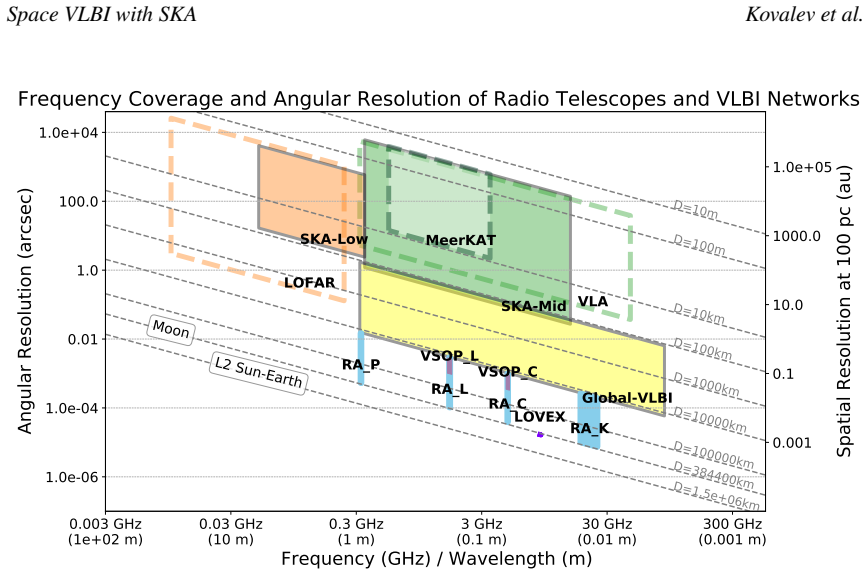
The phased SKA-Mid, with its exceptional sensitivity and broad frequency coverage, will form a unique ground-based anchor for future SVLBI missions, driving major advances into previously unexplored regions of the angular resolution-sensitivity parameter space. This enables detailed investigation of extreme brightness temperatures in blazars, studies of plasma stratification in AGN jets through combined cm-mm VLBI, tracing AGN evolution at high redshifts, probing ISM scattering, and ultra-precise astrometry for parallaxes, proper motions, and exoplanet detection.
What carries the argument
The phased SKA-Mid telescope serving as the sensitive ground anchor for space VLBI baselines.
If this is right
- Investigation of particle (re-)acceleration mechanisms in blazars with implications for high-energy neutrino sources.
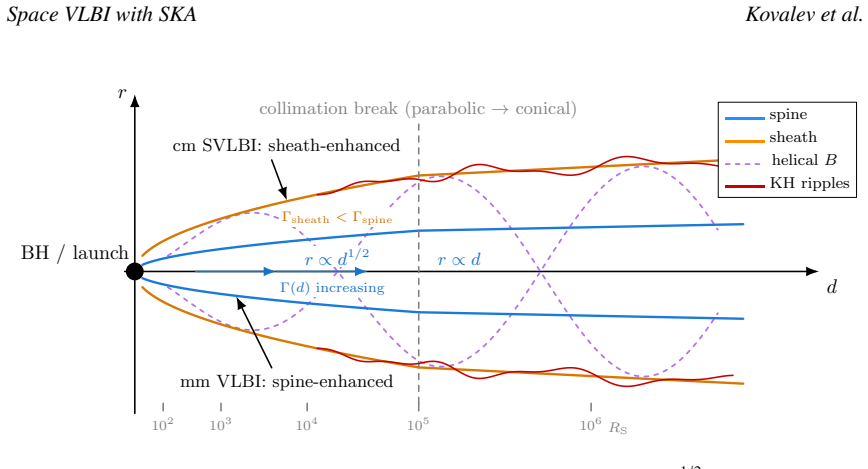
- Detailed studies of plasma stratification, instabilities, jet formation, acceleration, collimation, and magnetic field evolution in AGN jets.
- Observations of AGN to very high redshifts to trace evolution and overcome opacity from frequency shifts.
- Probing scattering in the interstellar medium through observations of pulsars, masers, and AGN.
- Ultra-precise astrometry using MultiView technique to measure extragalactic parallaxes, proper motions of supermassive black holes, and detect exoplanets.
Where Pith is reading between the lines
- Coordination with SKA could require development of new calibration methods for tied-array beams in space-ground interferometry.
- The resulting high-sensitivity long-baseline data might help distinguish between competing models of jet launching in AGN.
Load-bearing premise
Dedicated next-generation space VLBI missions will be successfully developed, launched, and operated in coordination with the SKA telescopes.
What would settle it
Absence of any launched space VLBI mission that successfully uses the phased SKA-Mid as a ground station within the operational lifetime of the SKA, or if such missions do not achieve finer resolution at comparable sensitivity than current SVLBI.
Figures

read the original abstract
To date, two dedicated Space Very Long Baseline Interferometry (SVLBI) missions, the VLBI Space Observatory Programme (VSOP) and RadioAstron, have provided groundbreaking insights into the Universe at angular resolutions as fine as ~10 microarcseconds. The phased SKA-Mid, with its exceptional sensitivity and broad frequency coverage, will form a unique ground-based anchor for future SVLBI missions, driving major advances into previously unexplored regions of the angular resolution-sensitivity parameter space. The discovery of extreme brightness temperatures in blazars by RadioAstron demands detailed investigation with next-generation SVLBI. Such studies are crucial for understanding particle (re-)acceleration mechanisms, with direct implications for the search for high-energy neutrino sources. Combining centimeter-wavelength SVLBI with millimeter ground-based VLBI at comparable resolutions will enable detailed studies of plasma stratification and instabilities in Active Galactic Nuclei (AGN) jets, as well as the processes of jet formation, acceleration, collimation, and magnetic field evolution, for example through Faraday rotation mapping. The unprecedented sensitivity of the SKA-Mid will allow observations of active galactic nuclei to very high redshifts, tracing their evolution and overcoming opacity caused by the (1+z) shift of intrinsic emission frequencies. Future centimeter SVLBI experiments will also probe scattering in the interstellar medium through pulsar, maser, and AGN observations. Finally, the combination of multiple tied-array beams from the SKA telescopes and the extremely long SVLBI baselines will enable ultra-precise astrometry using the next-generation MultiView technique, allowing measurements of extragalactic parallaxes of pulsars and megamasers, proper motions of supermassive black holes, and even the astrometric detection of exoplanets.
Editorial analysis
A structured set of objections, weighed in public.
Referee Report
Summary. The manuscript is a perspective paper outlining potential science opportunities enabled by coordinating future Space VLBI (SVLBI) missions with the phased SKA-Mid telescope. Building on results from VSOP and RadioAstron, it argues that SKA-Mid's sensitivity and frequency coverage will anchor SVLBI observations to explore new regions of the angular resolution-sensitivity parameter space, with applications to blazar brightness temperatures and particle acceleration, AGN jet physics and magnetic fields, high-redshift AGN evolution, interstellar medium scattering via pulsars/masers/AGN, and ultra-precise MultiView astrometry for parallaxes, proper motions, and exoplanet detection.
Significance. If realized, the outlined synergies could guide mission planning and enable advances in AGN physics and astrometry by extending prior SVLBI capabilities. The paper usefully synthesizes existing mission results into forward-looking cases, but its significance is limited by the purely conditional and qualitative nature of the claims, with no new quantitative predictions, simulations, or data to evaluate impact.
minor comments (1)
- [Abstract] The abstract consists of a single dense paragraph; splitting the listed science cases into separate sentences or a structured list would improve readability.
Simulated Author's Rebuttal
We thank the referee for their positive review and recommendation to accept. No major comments were raised in the report.
Circularity Check
No significant circularity
full rationale
The manuscript is a purely descriptive perspective paper outlining conditional science opportunities for future SVLBI missions coordinated with phased SKA-Mid. No derivations, equations, fitted parameters, quantitative models, or predictions are presented anywhere in the text. All statements are framed as possibilities contingent on external future assets, with no load-bearing steps that reduce to self-definition, fitted inputs, or self-citation chains. The central claim is therefore self-contained and externally falsifiable only by the success or failure of those future missions, not by internal construction.
Axiom & Free-Parameter Ledger
Reference graph
Works this paper leans on
-
[1]
T.Anetal.AdvancesinSpaceResearch,65(2):850–855,Jan.2020
T.Anetal.ChineseJournalofSpaceScience,39(2):242,Jan.2019.doi: 10.11728/cjss2019.02.242. T.Anetal.AdvancesinSpaceResearch,65(2):850–855,Jan.2020. doi: 10.1016/j.asr.2019.03.030. K. Asada and M. Nakamura.Astrophysical Journal Letters, 745:L28,
-
[2]
doi: 10.1093/pasj/59.2.397. W. A. Baan et al.Nature Astronomy, 6:976–983, June
-
[3]
doi: 10.1038/s41550-022-01706-y. K. W. Bannister et al.Science, 351(6271):354–356, Jan
-
[4]
doi: 10.1126/science.aac7673. E. Bempong-Manful et al. InAdvancing Astrophysics with the SKA – II (AASKAII)
-
[5]
doi: 10.1051/0004-6361/202347823. N. D. R. Bhat et al.ApJ, 605(2):759–783, Apr
-
[6]
doi: 10.1086/382680. R. Blandford, D. Meier, and A. Readhead.ARA&A, 57:467–509, Aug
-
[7]
doi: 10.1051/0004-6361:20052990. G. Bruni et al.A&A, 654:A27, Oct
-
[8]
doi: 10.1051/0004-6361/202039423. J. M. Cordes and T. J. W. Lazio.ApJ, 549(2):997–1010, Mar
-
[9]
doi: 10.1086/319442. I. K. Dihingia, B. Vaidya, and C. Fendt.MNRAS, 505(3):3596–3615, Aug
-
[10]
doi: 10.1093/ mnras/stab1512. R. Dodson and M. J. Rioja.arXiv e-prints, art. arXiv:0910.1159, Oct
-
[11]
doi: 10.48550/arXiv. 0910.1159. R. Dodson et al.AJ, 145(6):147, June
-
[12]
doi: 10.1088/0004-6256/145/6/147. P. G. Edwards and C. Phillips.Publication of Korean Astronomical Society, 30(2):659–661, Sept
-
[13]
doi: 10.5303/PKAS.2015.30.2.659. S. Frey et al.PASJ, 52:975–L982, Dec
-
[14]
doi: 10.1093/pasj/52.6.975. A. Fuentes et al.Nature Astronomy, 7:1359–1367, Nov
-
[15]
doi: 10.1038/s41550-023-02105-7. S. Ghosh et al.MNRAS, 546(3):stag116, Mar
-
[16]
doi: 10.1093/mnras/stag116. G. Giovannini et al.Nature Astronomy, 2:472–477, Apr
-
[17]
doi: 10.1038/s41550-018-0431-2. J. L. Gómez et al.ApJ, 924(2):122, Jan
-
[18]
doi: 10.3847/1538-4357/ac3bcc. L. I. Gurvits. In M. P. van Haarlem, editor,Perspectives on Radio Astronomy: Science with Large Antenna Arrays, pages 183–190. ASTRON, Jan
-
[19]
History of Electrotechnology Conference
L. I. Gurvits.Proceedings of the IEEE "History of Electrotechnology Conference", art. arXiv:2306.17647,
-
[20]
doi: 10.1109/HISTELCON56357.2023.10365962. L. I. Gurvits et al.Experimental Astronomy, 51(3):559–594, June
-
[21]
doi: 10.1126/science.281.5384.1825. H. Hirabayashi, P. G. Edwards, and D. W. Murphy, editors.Astrophysical Phenomena Revealed by Space VLBI, Proceedings of the VSOP Symposium, January 2000, Apr
-
[22]
doi: 10.1146/annurev.astro.45.051806.110546. X. Hong, Z. Shen, T. An, and Q. Liu.Acta Astronautica, 102:217–225, Sept
-
[23]
doi: 10.1016/ j.actaastro.2014.05.026. X. Hong et al.Science China Physics, Mechanics, and Astronomy, 69(1):219511, Nov
2014
-
[24]
doi: 10.1007/s11433-025-2751-2. T. Hovatta et al.The Astronomical Journal, 144:105,
-
[25]
doi: 10.1088/0004-6256/144/4/105. S. Issaoun et al.ApJ, 915(2):99, July
-
[26]
doi: 10.3847/1538-4357/ac00b0. M. D. Johnson et al.ApJL, 820(1):L10, Mar
-
[27]
doi: 10.3847/2041-8205/820/1/L10. M. D. Johnson et al.ApJL, 922(2):L28, Dec
-
[28]
doi: 10.3847/2041-8213/ac3917. M. D. Johnson et al. In L. E. Coyle, S. Matsuura, and M. D. Perrin, editors,Space Telescopes and Instrumentation 2024: Optical, Infrared, and Millimeter Wave, volume 13092 ofSociety of Photo-Optical Instrumentation Engineers (SPIE) Conference Series, page 130922D, Aug
-
[29]
doi: 10.1117/12.3019835. S. G. Jorstad et al.ApJ, 715(1):362–384, May
-
[30]
W.Junor,J.A.Biretta,andM.Livio.Nature,401(6756):891–892,Oct.1999
doi: 10.1088/0004-637X/715/1/362. W.Junor,J.A.Biretta,andM.Livio.Nature,401(6756):891–892,Oct.1999. doi: 10.1038/44780. M. Kadler et al. InAdvancing Astrophysics with the SKA – II (AASKAII)
-
[31]
doi: 10.1051/0004-6361/201832921. J.-Y. Kim et al.A&A, 640:A69, Aug
-
[32]
doi: 10.1051/0004-6361/202037493. M. Kino et al.ApJ, 973(2):100, Oct
-
[33]
J.Y.KoayandJ.P.Macquart.MNRAS,446(3):2370–2379,Jan.2015
doi: 10.3847/1538-4357/ad639f. J.Y.KoayandJ.P.Macquart.MNRAS,446(3):2370–2379,Jan.2015. doi: 10.1093/mnras/stu2268. T. A. Koryukova, A. B. Pushkarev, A. V. Plavin, and Y. Y. Kovalev.MNRAS, 515(2):1736–1750, Sept
-
[34]
doi: 10.1093/mnras/stac1898. T. A. Koryukova, A. B. Pushkarev, S. Kiehlmann, and A. C. S. Readhead.MNRAS, 526(4): 5932–5948, Dec
-
[35]
doi: 10.1093/mnras/stad3052. P. M. Kouch et al.A&A, 690:A111, Oct
-
[36]
doi: 10.1051/0004-6361/202347624. Y. Y. Kovalev et al.ApJL, 820(1):L9, Mar
-
[37]
doi: 10.3847/2041-8205/820/1/L9. Y. Y. Kovalev et al.MNRAS, 495(4):3576–3591, July
-
[38]
doi: 10.1093/mnras/staa1121. Y. Y. Kovalev et al.A&A, 700:L12, Aug
-
[39]
doi: 10.1051/0004-6361/202555400. E.V.Kravchenko,Y.Y.Kovalev,andK.V.Sokolovsky.MonthlyNoticesoftheRoyalAstronomical Society, 467:83–101,
-
[40]
doi: 10.1093/mnras/stx021. T. P. Krichbaum et al.A&A, 335:L106–L110, July
-
[41]
doi: 10.3847/1538-4357/ad0974. G. S. Levy et al.Science, 234(4773):187–189, Oct
-
[42]
doi: 10.1126/science.234.4773.187. M. Lisakov et al.A&A, 693:A9, Jan
-
[43]
doi: 10.1051/0004-6361/202449636. M. Liska, A. Tchekhovskoy, and E. Quataert.MNRAS, 494(3):3656–3662, May
-
[44]
doi: 10.1086/311726. A. P. Lobanov and J. A. Zensus.Science, 294:128,
-
[45]
doi: 10.1038/s41586-023-05843-w. Y. Mizuno.Universe, 8(2):85, Jan
-
[46]
doi: 10.3390/universe8020085. E. J. Murphy et al. In E. Murphy, editor,Science with a Next Generation Very Large Array, volume 517 ofAstronomical Society of the Pacific Conference Series, page 3, Dec
-
[47]
doi: 10.48550/arXiv.1810.07524. I. D. Novikov et al.Physics Uspekhi, 64(4):386–419, July
work page internal anchor Pith review Pith/arXiv arXiv doi:10.48550/arxiv.1810.07524
-
[48]
doi: 10.3367/UFNe.2020.12. 038898. S. P. O’Sullivan and D. C. Gabuzda.Monthly Notices of the Royal Astronomical Society, 400: 26–42,
-
[49]
doi: 10.1111/j.1365-2966.2009.15428.x. G. F. Paraschos et al.A&A, 682:L3, Feb
-
[50]
doi: 10.1051/0004-6361/202348308. J. Park et al.ApJ, 871(2):257, Feb
-
[51]
doi: 10.3847/1538-4357/aaf9a9. A. V. Plavin, Y. Y. Kovalev, and S. V. Troitsky.ApJ, 991(1):33, Sept
-
[52]
doi: 10.3847/1538-4357/ab5db6. A. B. Pushkarev and Y. Y. Kovalev.MNRAS, 452(4):4274–4282, Oct
-
[53]
doi: 10.1093/mnras/ stv1539. A. B. Pushkarev et al.A&A, 555:A80, July
-
[54]
doi: 10.1051/0004-6361/201321484. M. Rioja, R. Porcas, R. Dodson, and Y. Asaki. In Y. Hagiwara, E. Fomalont, M. Tsuboi, and M.Yasuhiro,editors,ApproachingMicro-ArcsecondResolutionwithVSOP-2: Astrophysicsand Technologies, volume 402 ofAstronomical Society of the Pacific Conference Series, page 486, Aug
-
[55]
doi: 10.1007/s00159-020-00126-z. F. Roelofs et al.A&A, 625:A124, May
-
[56]
doi: 10.1051/0004-6361/201732423. T. Savolainen et al.A&A, 676:A114, Aug
-
[57]
doi: 10.1051/0004-6361/202142594. C. Spingola et al. InAdvancing Astrophysics with the SKA – II (AASKAII)
-
[58]
arXiv search: Report number AASKAII/Spingola01. A.Tamar,B.Hudson,andD.C.M.Palumbo.A&A,699:A193,July2025. doi: 10.1051/0004-6361/ 202452668. E. Traianou et al.A&A, 634:A112, Feb
-
[59]
doi: 10.1051/0004-6361/201935756. E. Traianou et al.A&A, 682:A154, Feb
-
[60]
doi: 10.1051/0004-6361/202347267. E. Traianou et al.A&A, 700:A16, Aug
-
[61]
doi: 10.1051/0004-6361/202554929. S.Trippeetal.arXive-prints,art.arXiv:2304.06482,Apr.2023. doi: 10.48550/arXiv.2304.06482. T.Venturietal.arXive-prints,art.arXiv:2007.02347,July2020. doi: 10.48550/arXiv.2007.02347. Y.Wenetal.Adesigner’sguidetolunarfar-sideinterferometerarray: Powerspectrummeasurement andcosmologicalconstraintsfromthedarkages,2026. URLhttp...
work page internal anchor Pith review Pith/arXiv arXiv doi:10.1051/0004-6361/202554929 2023
-
[62]
doi: 10.3847/1538-4357/ad31a2. 18
discussion (0)
Sign in with ORCID, Apple, or X to comment. Anyone can read and Pith papers without signing in.