The cognitive, affective, and behavioral expression of self-stigma among people who use drugs in online substance use communities
Pith reviewed 2026-06-25 23:32 UTC · model grok-4.3
The pith
Self-stigma among people who use drugs online integrates cognitive, affective, and behavioral signs, with behavioral indicators often appearing before core ones.
A machine-rendered reading of the paper's core claim, the machinery that carries it, and where it could break.
Core claim
Among people who use drugs online, self-stigma is an integrated phenomenon in which behavioral indicators rarely appear without internalized ones and often precede them. Most expressions remain stable over time, but pessimism about change deepens, marking a target for early digital intervention and showing that progressive stage models do not map directly onto textual disclosure.
What carries the argument
A ten-indicator codebook covering cognitive (self-labeling, pessimism/self-defeatism, deservingness/worthlessness), affective (shame, guilt/self-blame, despair/hopelessness), and behavioral (concealment, anticipated rejection, desire to quit, ambivalence) domains, used to classify posts and track co-occurrence plus temporal order.
If this is right
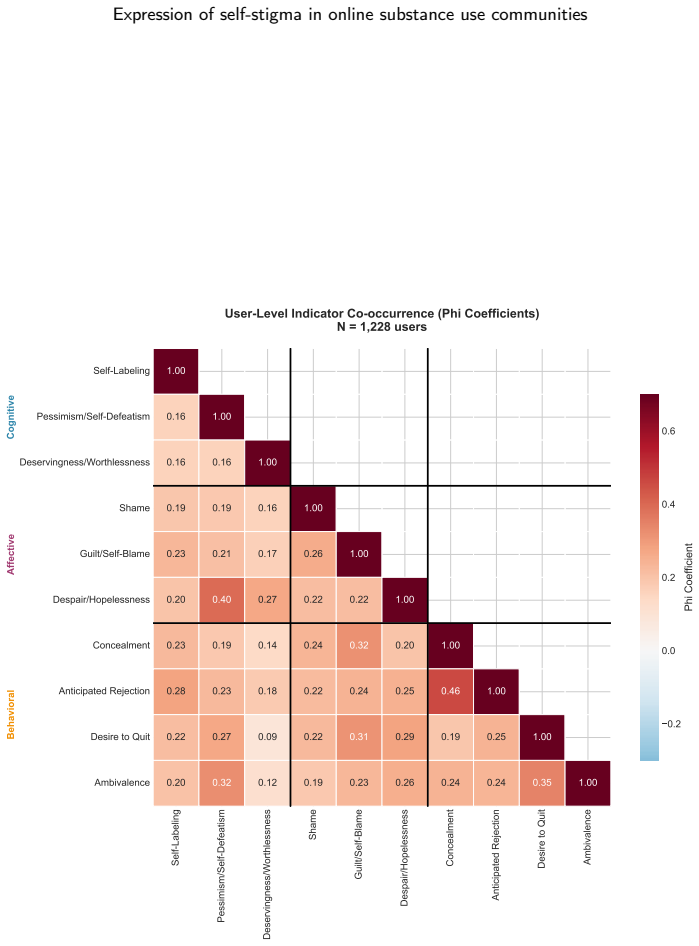
- Behavioral indicators associate strongly with core ones at the user level (OR 4.65).
- 87 percent of posts containing behavioral indicators also contain at least one core indicator.
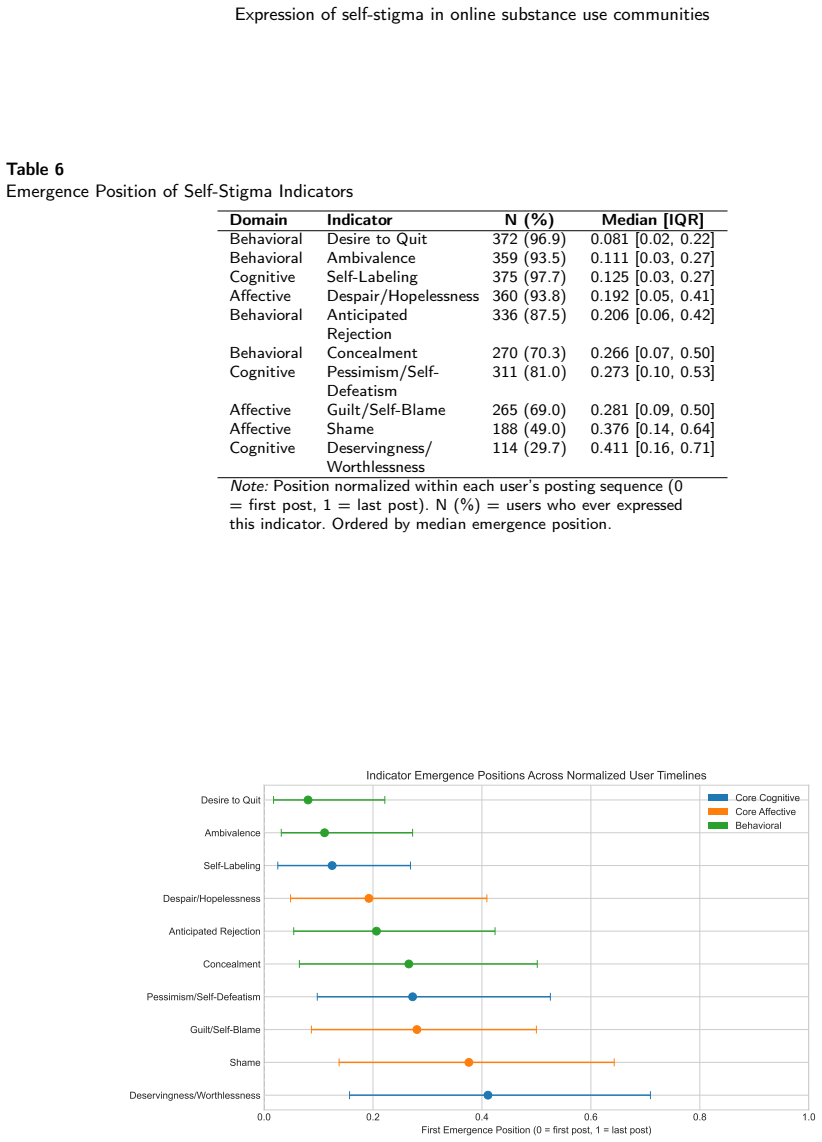
- Desire to quit appears at a median position of 0.08 while shame appears at 0.38.
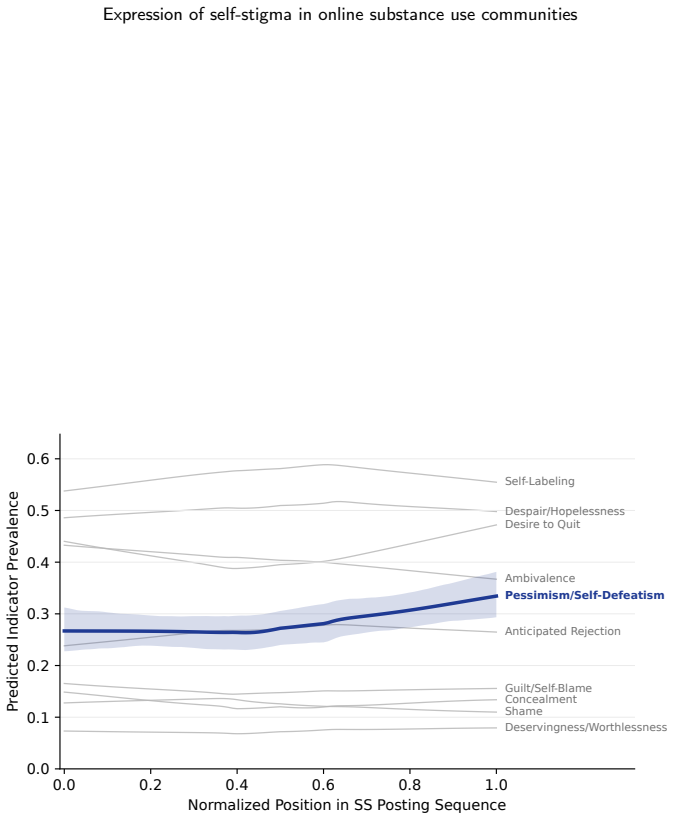
- Nine of the ten indicators stay stable across a user's posting history.
- Only pessimism/self-defeatism rises over time (OR 1.62).
Where Pith is reading between the lines
- Online forums could monitor for rising pessimism to flag users for early support resources.
- Interventions might need to address behavioral and internalized signs together instead of in sequence.
- The same classification approach could be tested on self-stigma expressions in other online health communities.
- Text patterns may reveal when users first voice ambivalence or a desire to quit before full shame sets in.
Load-bearing premise
The median position of each indicator within a user's sequence of posts reflects the real order in which self-stigma components develop.
What would settle it
A dataset of user posting timelines in which core indicators appear before behavioral ones in most cases, or in which pessimism shows no increase over time.
Figures
read the original abstract
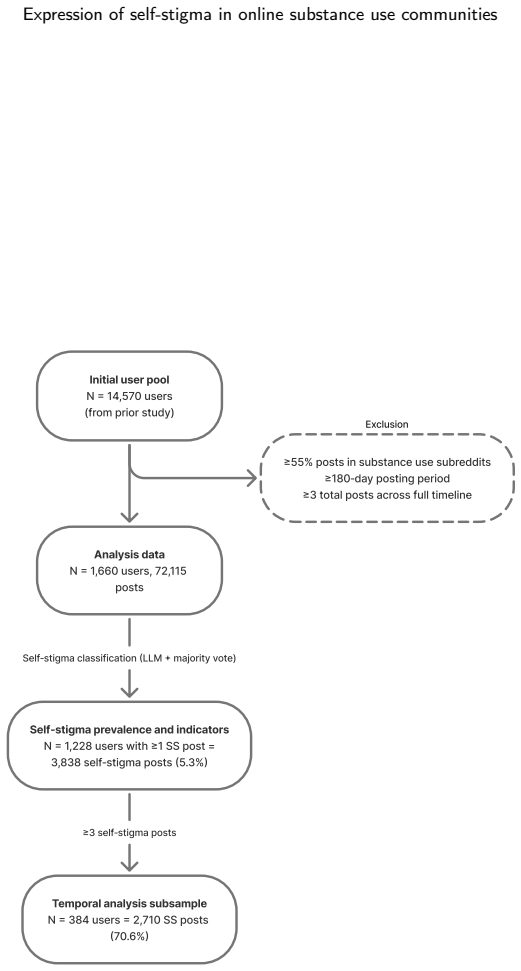
Objectives: To develop a codebook for self-stigma across cognitive, affective, and behavioral domains, and to estimate the prevalence, co-occurrence, and temporal patterns of these indicators in Reddit posts by people who use drugs. Methods: We developed a ten-indicator codebook through consensus-based abductive coding spanning cognitive (self-labeling, pessimism/self-defeatism, deservingness/worthlessness), affective (shame, guilt/self-blame, despair/hopelessness), and behavioral (concealment, anticipated rejection, desire to quit, ambivalence) domains; two coders reached substantial agreement (Cohen's k = 0.72). We then scaled classification with a large language model validated against expert coding (k = 0.73, F1 = 0.80), analyzing 72,115 thread-initiating posts from 1,660 English-language users (2006-2025). Results: 3,838 posts (5.3%) from 1,228 users (74.0%) contained self-stigma; all ten indicators discriminated self-stigma posts (RR 3.6 to 86.2), led by self-labeling (56.0%) and despair/hopelessness (48.5%). Self-stigma was integrated: core and behavioral indicators were strongly associated at the user level (OR = 4.65, 95% CI 3.12-6.94, p < 0.001), and 87.0% of posts with behavioral indicators also contained a core indicator. Contrary to progressive models, behavioral indicators emerged earlier than core ones (desire to quit at median position 0.08 vs. shame at 0.38). Nine of ten indicators were stable across posting trajectories; only pessimism increased (OR = 1.62, 95% CI 1.25-2.10). Conclusion: Among people who use drugs online, self-stigma is an integrated phenomenon in which behavioral indicators rarely appear without internalized ones and often precede them. Most expressions remain stable over time, but pessimism about change deepens, marking a target for early digital intervention and showing that progressive stage models do not map directly onto textual disclosure.
Editorial analysis
A structured set of objections, weighed in public.
Referee Report
Summary. The manuscript develops a ten-indicator codebook for self-stigma across cognitive (self-labeling, pessimism/self-defeatism, deservingness/worthlessness), affective (shame, guilt/self-blame, despair/hopelessness), and behavioral (concealment, anticipated rejection, desire to quit, ambivalence) domains. Through consensus coding (Cohen's k=0.72) and LLM validation (k=0.73, F1=0.80), it analyzes 72,115 Reddit posts from 1,660 users, reporting self-stigma in 5.3% of posts from 74% of users, strong user-level associations between core and behavioral indicators (OR=4.65), 87% co-occurrence in posts, earlier median emergence of behavioral indicators in posting trajectories (e.g., desire to quit at 0.08 vs. shame at 0.38), stability of nine indicators, and increasing pessimism (OR=1.62).
Significance. If the temporal and association findings hold after addressing methodological details, the work provides evidence that self-stigma in online drug-use communities is integrated rather than strictly progressive, with behavioral expressions often preceding internalized ones and most patterns stable except for deepening pessimism. This could inform early digital interventions. The large-scale dataset, reported inter-rater and LLM validation metrics, and direct statistical reporting (ORs, RRs, median positions) are strengths enabling quantification of textual patterns.
major comments (1)
- [Results and Conclusion] Results section: The central claim that behavioral indicators 'often precede' core ones (desire to quit median position 0.08 vs. shame at 0.38), contradicting progressive stage models, rests on treating median normalized positions within each user's posting trajectory as a proxy for emergence order. The manuscript provides no details on position computation, normalization method, handling of short trajectories or users with few posts, or robustness checks against posting selection biases, variable trajectory lengths, or codebook/LLM detection artifacts. This is load-bearing for the temporal conclusion and the integrated-phenomenon interpretation.
minor comments (1)
- [Abstract] Abstract: Lacks detail on post selection criteria, handling of multiple posts per user, and potential platform-specific biases, which would improve reproducibility even if addressed in the full Methods.
Simulated Author's Rebuttal
We thank the referee for their thoughtful and constructive review. The feedback on methodological transparency for the temporal analysis is well-taken, and we address it directly below. We have revised the manuscript to incorporate additional details and checks.
read point-by-point responses
-
Referee: [Results and Conclusion] Results section: The central claim that behavioral indicators 'often precede' core ones (desire to quit median position 0.08 vs. shame at 0.38), contradicting progressive stage models, rests on treating median normalized positions within each user's posting trajectory as a proxy for emergence order. The manuscript provides no details on position computation, normalization method, handling of short trajectories or users with few posts, or robustness checks against posting selection biases, variable trajectory lengths, or codebook/LLM detection artifacts. This is load-bearing for the temporal conclusion and the integrated-phenomenon interpretation.
Authors: We agree that the original Methods section provided insufficient detail on the normalized position metric, which is central to the temporal claims. In the revised manuscript we have added an explicit subsection under Methods describing the computation: for each user, posts are ordered by timestamp; the normalized position of an indicator instance is (post rank - 1) / (total posts by user - 1). Median positions are then taken across users who expressed the indicator. Users with fewer than 10 posts were excluded from the primary temporal analysis (leaving 892 users); we report sensitivity analyses using thresholds of 5 and 20 posts in the supplement, which preserve the ordering (behavioral indicators earlier than core). To address variable trajectory lengths and selection biases we rely on within-user normalization and user-level medians rather than aggregate post-level statistics; we also added a permutation test that randomly reorders posts within each user and confirms the observed median differences exceed chance. Potential codebook/LLM artifacts are mitigated by the reported human agreement (k = 0.72) and LLM validation (k = 0.73, F1 = 0.80) plus manual adjudication of disagreements; we have expanded the Limitations section to discuss residual detection biases. These additions do not change the reported results but make the proxy and its robustness explicit. revision: yes
Circularity Check
No significant circularity detected
full rationale
The paper performs an observational content analysis on Reddit posts using a consensus-developed codebook and LLM classification, then directly reports empirical quantities: prevalence (5.3%), user-level associations (OR 4.65), co-occurrence rates (87%), and median normalized positions within posting sequences. These are computed outputs from the coded data rather than quantities defined in terms of themselves or obtained by fitting parameters that are then relabeled as predictions. No equations, self-citations, or uniqueness theorems appear in the provided text that would reduce any central claim to an input by construction. The temporal-order interpretation rests on a methodological choice (median position) whose validity can be debated on external grounds but does not constitute circularity within the derivation chain.
Axiom & Free-Parameter Ledger
axioms (2)
- domain assumption Reddit posts by self-identified people who use drugs contain readable textual signals of cognitive, affective, and behavioral self-stigma that can be reliably coded.
- domain assumption The median position of an indicator across a user's posts reflects the relative emergence order of that component of self-stigma.
Reference graph
Works this paper leans on
-
[1]
Medication experiences in the treatment of opioid use disorders: Insights from reddit. Addiction 120, 1610–1622. URL:https://onlinelibrary.wiley.com/doi/abs/10.1111/add.70022, doi:https://doi.org/10.1111/add.70022,arXiv:https://onlinelibrary.wiley.com/doi/pdf/10.1111/add.70022. Barry, C.L., McGinty, E.E., Pescosolido, B.A., Goldman, H.H.,
-
[2]
Psychiatric Services 65, 1269–1272
Stigma, Discrimination, Treatment Effectiveness, and Policy: Public Views About Drug Addiction and Mental Illness. Psychiatric Services 65, 1269–1272. URL:https://psychiatryonline.org/doi/10.1176/ appi.ps.201400140, doi:10.1176/appi.ps.201400140. Benjamini, Y., Hochberg, Y.,
-
[3]
Journal of the Royal Statistical Society: Series B (Methodological) 57, 289–300
Controlling the false discovery rate: a practical and powerful approach to multiple testing. Journal of the Royal Statistical Society: Series B (Methodological) 57, 289–300. Bouzoubaa,L.,Aghakhani,E.,Rezapour,R.,2024a. Wordsmatter:Reducingstigmainonlineconversationsaboutsubstanceusewithlargelanguage models, in: Proceedings of the 2024 Conference on Empiri...
2024
-
[4]
Phenotypes of stigma expressed by people who use drugs on Reddit. Social Science & Medicine390,118889.URL:https://linkinghub.elsevier.com/retrieve/pii/S0277953625012201,doi:10.1016/j.socscimed. 2025.118889. Bouzoubaa, L., Aghakhani, E., Song, M., Trinh, Q., Rezapour, S., 2024b. Decoding the narratives: Analyzing personal drug experiences shared on Reddit,...
-
[5]
Drug and Alcohol Dependence Reports 3, 100061
Examining stigma relating to substance use and contextual factors in social media discussions. Drug and Alcohol Dependence Reports 3, 100061. doi:10.1016/j.dadr.2022.100061. Clopper, C.J., Pearson, E.S.,
-
[6]
The use of confidence or fiducial limits illustrated in the case of the binomial. Biometrika 26, 404–413. doi:10.1093/biomet/26.4.404. Corrigan,P.W.,Bink,A.B.,Schmidt,A.,Jones,N.,Rüsch,N.,2016. Whatistheimpactofself-stigma?lossofself-respectandthe“whytry”effect. Journal of Mental Health 25, 10–15. Corrigan, P.W., Larson, J.E., Kuwabara, S.A.,
-
[7]
Self-stigma and the “why try” effect: Impact on life goals and evidence-based practices. World Psychiatry 8, 75–81. doi:10.1002/j.2051-5545.2009.tb00218.x. Corrigan, P.W., Rafacz, J., Rüsch, N.,
-
[8]
Psychiatry research 189, 339–343
Examining a progressive model of self-stigma and its impact on people with serious mental illness. Psychiatry research 189, 339–343. Corrigan,P.W.,Rao,D.,2012. OntheSelf-StigmaofMentalIllness:Stages,Disclosure,andStrategiesforChange. Canadianjournalofpsychiatry. Revue canadienne de psychiatrie 57, 464–469. Corrigan,P.W.,Spicknall,V.,Talluri,S.S.,Manthey,J...
2012
-
[9]
Social networking online to recover from opioid use disorder: A study of community interactions
D’Agostino, A.R., Optican, A.R., Sowles, S.J., Krauss, M.J., Escobar Lee, K., Cavazos-Rehg, P.A., . Social networking online to recover from opioid use disorder: A study of community interactions. Drug and Alcohol Dependence 181, 5–10. URL:https://www.sciencedirect. com/science/article/pii/S037687161730491X, doi:10.1016/j.drugalcdep.2017.09.010. Earnshaw,...
-
[10]
Stigma and Health , 425–35doi:10.1037/ sah0000561
Advancing substance use disorder stigma research: It’s about time. Stigma and Health , 425–35doi:10.1037/ sah0000561. Earnshaw, V.A., Sepucha, K.R., Laurenceau, J.P., Subramanian, S.V., Brousseau, N.M., Chaudoir, S.R., Hill, E.C., Morrison, L.M., Kelly, J.F., . Disclosure processes as predictors of relationship outcomes among people in recovery from opioi...
-
[11]
Nature Reviews Psychology 1, 236–247
Integrating time into stigma and health research. Nature Reviews Psychology 1, 236–247. doi:10.1038/s44159-022-00034-2. Fisher,R.A.,1922. Ontheinterpretationof𝜒2fromcontingencytables,andthecalculationofp. Journaloftheroyalstatisticalsociety85,87–94. Fox, A.B., Qiu, X., Mousavi, M., Earnshaw, V.A.,
-
[12]
Substance Abuse and Rehabilitation 9, 115–136
Review of the effects of self-stigma and perceived social stigma on the treatment-seeking decisions of individuals with drug- and alcohol-use disorders. Substance Abuse and Rehabilitation 9, 115–136. doi:10.2147/SAR.S183256. Hatzenbuehler,M.L.,Phelan,J.C.,Link,B.G.,2013. StigmaasaFundamentalCauseofPopulationHealthInequalities. AmericanJournalofPublic Heal...
-
[13]
Substance Use & Misuse 57, 1511–1522
Types and Sources of Stigma on Opioid Use Treatment and Recovery Communities on Reddit. Substance Use & Misuse 57, 1511–1522. doi:10.1080/10826084.2022.2091786. Krawczyk, N., Miller, M., Gu, E.Y., Irvine, N., Ramirez, E., Santaella-Tenorio, J., Lippincott, T., Bogenschutz, M., Bunting, A.M., Meacham, M.C.,
-
[14]
Self-reported experiences and perspectives on using psychedelics to manage opioid use among participants of two reddit communities. Addiction n/a. URL:https://onlinelibrary.wiley.com/doi/abs/10.1111/add.16767, doi:https://doi.org/10. 1111/add.16767,arXiv:https://onlinelibrary.wiley.com/doi/pdf/10.1111/add.16767. Latkin, C.A., Edwards, C., Davey-Rothwell, ...
-
[15]
Addictive Behaviors 73, 133–136
The relationship between social desirability bias and self-reports of health, substance use, and social network factors among urban substance users in Baltimore, Maryland. Addictive Behaviors 73, 133–136. doi:10.1016/j.addbeh.2017.05.005. Liang, K.Y., Zeger, S.L.,
-
[16]
American Sociological Review 54, 400–423
A Modified Labeling Theory Approach to Mental Disorders: An Empirical Assessment. American Sociological Review 54, 400–423. doi:10.2307/2095613,arXiv:2095613. Livingston, J.D., Boyd, J.E.,
-
[17]
Social Science & Medicine (1982) 71, 2150–2161
Correlates and consequences of internalized stigma for people living with mental illness: A systematic review and meta-analysis. Social Science & Medicine (1982) 71, 2150–2161. doi:10.1016/j.socscimed.2010.09.030. Lu, J., Sridhar, S., Pandey, R., Hasan, M.A., Mohler, G.,
-
[18]
Investigate Transitions into Drug Addiction through Text Mining of Reddit Data, in: Proceedings of the 25th ACM SIGKDD International Conference on Knowledge Discovery & Data Mining, Association for Computing Machinery. pp. 2367–2375. doi:10.1145/3292500.3330737. Luoma,J.B.,Nobles,R.H.,Drake,C.E.,Hayes,S.C.,O’Hair,A.,Fletcher,L.,Kohlenberg,B.S.,2013.Self-S...
-
[19]
Forum77: An Analysis of an Online Health Forum Dedicated to Addiction Recovery, in: Proceedings of the 18th ACM Conference on Computer Supported Cooperative Work & Social Computing, Association for Computing Machinery. pp. 1511–1526. doi:10.1145/2675133.2675146. Marlatt, G.A., Donovan, D.M.,
-
[20]
Clinical Psychological Science 1, 149–155
Nonverbal displays of shame predict relapse and declining health in recovering alcoholics. Clinical Psychological Science 1, 149–155. doi:10.1177/2167702612470645. Roesler, D., Johnny, S., Conway, M., Chen, A.T.,
-
[21]
Smith, L.R., Earnshaw, V.A., Copenhaver, M.M., Cunningham, C.O.,
doi:10.1186/s44247-024-00065-0. Smith, L.R., Earnshaw, V.A., Copenhaver, M.M., Cunningham, C.O.,
-
[22]
Drug and Alcohol Dependence 162, 34–43
Substance use stigma: Reliability and validity of a theory-based scale for substance-using populations. Drug and Alcohol Dependence 162, 34–43. doi:10.1016/j.drugalcdep.2016.02.019. Spata, A., Gupta, I., Lear, M.K., Lunze, K., Luoma, J.B.,
-
[23]
Drug and Alcohol Dependence Reports 11, 100237
Substance use stigma: A systematic review of measures and their psychometric properties. Drug and Alcohol Dependence Reports 11, 100237. doi:10.1016/j.dadr.2024.100237. Substance Abuse and Mental Health Services Administration,
-
[24]
NSDUH Series H-59 HHS Publication No
Key substance use and mental health indicators in the United States: Results from the 2023 National Survey on Drug Use and Health. NSDUH Series H-59 HHS Publication No. PEP24-07-021. Center for Behavioral Health Statistics and Quality, Substance Abuse and Mental Health Services Administration. Rockville, MD. URL:https://www.samhsa. gov/data/report/2024-ns...
2023
-
[25]
Large Language Models for Data Annotation and Synthesis: A Survey
Large language models for data annotation and synthesis: A survey, in: Al-Onaizan, Y., Bansal, M., Chen, Y.N. (Eds.), Proceedings of the 2024 Conference on Empirical Methods in Natural Language Processing, Association for Computational Linguistics, Miami, Florida, USA. pp. 930–957. URL: https://aclanthology.org/2024.emnlp-main.54/, doi:10.18653/v1/2024.em...
-
[26]
URL:https://doi.org/10.1145/3613904.3641960, doi:10.1145/3613904.3641960
Human-llm collaborative annotation through effective verification of llm labels, in: Proceedings of the 2024 CHI Conference on Human Factors in Computing Systems, Association for Computing Machinery, New York, NY, USA. URL:https://doi.org/10.1145/3613904.3641960, doi:10.1145/3613904.3641960. Yang, D., Yao, Z., Kraut, R., . Self-disclosure and channel diff...
-
[27]
Journal of Substance Abuse Treatment 99, 44–51
A new brief opioid stigma scale to assess perceived public attitudes and internalized stigma: Evidence for construct validity. Journal of Substance Abuse Treatment 99, 44–51. URL: https://linkinghub.elsevier.com/retrieve/pii/S0740547218302484, doi:10.1016/j.jsat.2019.01.005. Yu, R., Tracy, D.K., Sinclair, J., Brikell, I., Lichtenstein, P., Larsson, H., Fazel, S.,
-
[28]
Self-harm in individuals with substance use disorders: Predictivefactorsandriskmodel. Addictionn/a. URL:https://onlinelibrary.wiley.com/doi/abs/10.1111/add.70465,doi:https: //doi.org/10.1111/add.70465,arXiv:https://onlinelibrary.wiley.com/doi/pdf/10.1111/add.70465. A. Model Selection and Validation A.1. Model Comparison on Development Set Weevaluatedfourl...
-
[29]
This asymmetric error pattern indicatesthemodelishighlysensitivetopotentialself-stigmamarkersbutoccasionallymisclassifiesrelatedconstructs
The classifier demonstrated perfect recall (1.000), capturing all true self-stigma expressions in the validation sample,butmoderateprecision(0.670).McNemar’stestrevealedsignificantsystematicbiastowardover-classification (𝑝 < .001), with GPT-4.1-mini producing 33 false positives but zero false negatives. This asymmetric error pattern indicatesthemodelishig...
2025
discussion (0)
Sign in with ORCID, Apple, or X to comment. Anyone can read and Pith papers without signing in.