REVIEW 2 major objections 6 minor 1 cited by
Nonlinear Lissajous orbits and particular superintegrability
T0 review · 2 major / 6 minor · reviewed 2026-07-12 · grok-4.5
Pith's one-line read Closed nonlinear Lissajous orbits in anharmonic oscillators are carried by trajectory-dependent particular integrals, not by global superintegrability.
desk verdict Clean, explicit classical examples that make the global-vs-particular superintegrability distinction concrete for a standard family of separable oscillators; solid and useful, not a conceptual breakthrough. read the letter →
The pith
A machine-rendered reading of the paper's core claim, the machinery that carries it, and where it could break.
The reading
What carries the argument
Particular integrals: phase combinations J = p θ_y − q θ_x (or their single-valued cosine/sine representatives, or the corresponding algebraic/hyperelliptic orbit constraints) whose Poisson bracket with the Hamiltonian vanishes only after restriction to the nonlinearly resonant trajectories.
What would settle it
Compute the Poisson bracket of one of the explicit quartic representatives (for example the phase-locked 1:2 or 1:3 quantity) with the Hamiltonian off the resonant energy shell; if the bracket vanishes identically rather than only after restriction, the particular-versus-global distinction collapses.
Extended reading notes
Core claim
For the family V = ½(x^{2N} + A y^{2N}), N ≥ 2, closed configuration-space orbits exist only on resonant submanifolds fixed by the energy-dependent frequency ratio; the associated extra integrals satisfy {I, H} = 0 solely on those submanifolds and are therefore particular, not global.
Load-bearing premise
That single-valued trigonometric functions of the resonant phase combination count as genuine particular integrals once their Poisson bracket vanishes only on the resonant shell, relying on local action-angle variables away from zero-energy points.
Editorial analysis
A structured set of objections, weighed in public.
Referee Report
Summary. The paper studies classical trajectories of the separable family V(x,y)=½(x^{2N}+A y^{2N}) and the associated conserved quantities. For N=1 it recalls that rational frequency ratios yield global superintegrability and ordinary Lissajous figures. For N≥2 the frequencies become energy-dependent, so closed nonlinear Lissajous-type orbits exist only when a nonlinear resonance condition fixed by the partial energies holds. The authors construct the corresponding extra quantities (resonant phase combinations and, for N=2, algebraic orbit representatives) and show that their Poisson brackets with H vanish only after restriction to those resonant sets, hence are particular rather than global integrals. For N≥3 the same resonance mechanism is expressed via hyperelliptic phase constraints.
Significance. The work gives a clean, explicit illustration of how global superintegrability of the anisotropic harmonic oscillator reorganizes under nonlinear deformation into trajectory-dependent (particular) conservation laws selected by energy-dependent resonance. Strengths include: (i) explicit nonlinear resonance conditions (Eqs. 36, 88–90) jointly fixed by A and the partial energies; (ii) concrete algebraic orbit equations for the quartic case obtained from Jacobi multiplication at k=1/√2; (iii) direct Poisson-bracket checks for the lowest resonances showing non-vanishing off the resonant set; and (iv) a careful discussion (§4.4) distinguishing phase-locking invariants from tautological constants on a single orbit. The contribution is primarily conceptual and expository within an already-studied separable family, but the global-versus-particular distinction is drawn with useful geometric detail.
major comments (2)
- Sections 3.2–3.3: there is a mismatch in the strength of the particular-integral claim. The resonant phase J^{(p,q)}=p θ_y−q θ_x (and its single-valued cos/sin representatives) has ˙J=pΩ_y−qΩ_x, which vanishes on the entire resonant shell Ω_x/Ω_y=p/q. By contrast, the algebraic phase-space representatives I^{(0)}_{1:2} and I^{(0)}_{1:3} (Eqs. 71, 75) are only asserted to satisfy {H,I}=0 after restriction to the individual phase-locked trajectory γ^{(0)} (Eqs. 72, 76). For the central claim of particular superintegrability it should be stated clearly which objects are integrals on the full resonant submanifold and which are merely constants along a single closed orbit; otherwise the algebraic I’s risk looking tautological in the sense the authors themselves warn against in §4.4.
- Section 4.3 and the abstract: the phrase “particular superintegrability in the Liouville sense” is slightly imprecise. Liouville integrability is already guaranteed globally by the two partial energies. What is particular is the third (phase) integral on the resonant shell. A short, explicit count—dimension of the resonant set, number of independent particular integrals thereon, and how this exceeds the restricted Liouville bound—would make the terminology load-bearing rather than decorative.
minor comments (6)
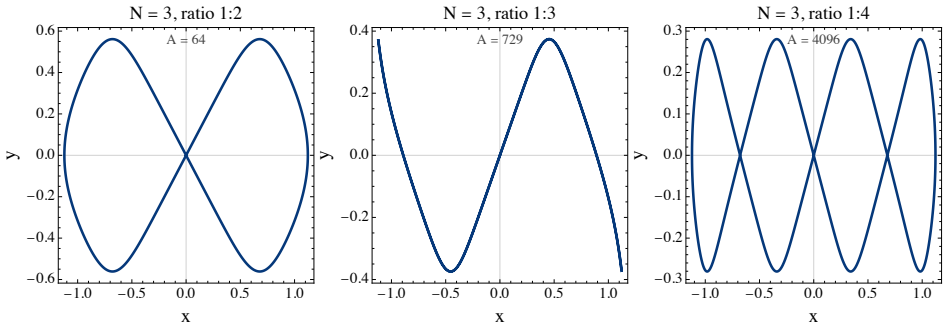
- Figures 1, 2 and 5 are helpful but purely qualitative. A brief numerical check that the constructed I’s remain constant along a resonant orbit while drifting off-resonance would strengthen the Poisson-bracket claims for readers who do not recompute them.
- Notation: the same symbol H^{(N)} is used for the full Hamiltonian and, with subscripts, for partial energies; a consistent H_x^{(N)}, H_y^{(N)} (already used in places) throughout would avoid momentary ambiguity.
- Section 2: the global cubic and quartic integrals for A=4 and A=9 are standard; a pointer to a classical reference (or a one-line derivation sketch) would help non-specialists.
- Eq. (13) and the subsequent polynomial orbit equations for N=1 are written for the zero-relative-phase branch only; the text already notes this, but a single sentence that other Δ yield different algebraic curves of the same degree would prevent misreading.
- References: the self-citation cluster on particular integrability is appropriate as background, but a short comparison with other treatments of resonant tori / action-angle locking in nearly integrable systems (beyond the KAM citations) would situate the geometric claims more broadly.
- Typos / style: “polyno-mial” line break in the abstract; occasional missing spaces before citations; “Bˇ rehov´ a” in the affiliation should be checked for encoding.
Circularity Check
No significant circularity: particular integrals are constructed from separated phases and verified by direct Poisson-bracket restriction, not by re-labeling inputs.
full rationale
The derivation is self-contained. Global Liouville integrals Hx, Hy follow from separability for every N. Frequencies Ωx, Ωy are obtained by quadrature (or elliptic/hyperelliptic periods) and depend on partial energies for N≥2; the resonance condition Ωx/Ωy=p/q is therefore an independent selection of initial data, not a fitted parameter. On those resonant shells the combination J=p heta y-q heta x is constant by construction of the frequencies, and the single-valued representatives cos/sin(J) (or their elliptic/hyperelliptic analogues) satisfy {I,H}=0 only after restriction—explicitly verified for the lowest resonances and for the algebraic orbit equations obtained from Jacobi multiplication (N=2) or hyperelliptic phase constraints (N≥3). Self-citations supply the background definition of particular integrability; they are not used to force the target identities. No fitted input is renamed a prediction, no uniqueness theorem is imported to forbid alternatives, and no known empirical pattern is merely re-coordinatized. Score 1 reflects only the minor, non-load-bearing self-citations that define the terminology.
Assumptions & free parameters
assumptions (3)
- standard math Hamilton’s equations and the Poisson bracket on the standard symplectic phase space of two degrees of freedom.
- domain assumption Existence of local action-angle variables on regular Liouville tori away from zero-energy degeneracies.
- domain assumption A phase-space function I is a particular integral if {I,H} vanishes after restriction to a specified invariant submanifold (resonant trajectory).
Cite this review
Pith. "Pith review of Nonlinear Lissajous orbits and particular superintegrability." pith.science (2026). https://pith.science/paper/ZZTFKXFQ
@misc{pith2026260625145,
  author       = {Pith},
  title        = {Pith review of: Nonlinear Lissajous orbits and particular superintegrability},
  year         = {2026},
  howpublished = {\url{https://pith.science/paper/ZZTFKXFQ}},
  note         = {Machine review of arXiv:2606.25145}
}
abstract
We investigate the geometry of classical trajectories generated by separable two-dimensional polynomial potentials of the form $V(x,y)=\tfrac{1}{2}\big(x^{2N}+A\,y^{2N}\big)$, where $N=1,2,\ldots,$ and $A>0$. Special emphasis is placed on the emergence of nonlinear Lissajous figures and on the distinction between global and particular superintegrability in the Liouville sense. In the harmonic case ($N=1$) closed periodic orbits are a consequence of an additional \emph{global} integral of motion whenever the frequency ratio is rational, rendering the system maximally superintegrable. In contrast, for anharmonic oscillators, already in the quartic case ($N=2$), the oscillation frequencies depend on the partial energies, so periodic Lissajous-type trajectories occur only under nonlinear resonance conditions fixed by the initial data. Accordingly, the extra conserved quantities that characterize these closed orbits are not global invariants but \emph{particular} (trajectory-dependent) integrals that emerge only on the resonant trajectories. For higher-degree potentials $N\geq3$, the resonant trajectories are naturally described by hyperelliptic phase constraints rather than by a universal polynomial orbit equation.
Figures


Figures from the paper (3 more)


Forward citations
Cited by 1 Pith paper
-
Hamiltonian reduction from particular integrals
Systems of particular integrals with linearly closing time derivatives define invariant submanifolds that, when involutive, presymplectically reduce to lower-dimensional Hamiltonian flows.
Reference graph
Works this paper leans on
-
[1]
J. A. Lissajous.M´ emoire sur l’´ etude optique des mouvements vibratoires. Mallet-Bachelier, Paris, 1857. Also published in Annales de Chimie et de Physique, 51, 147–231
-
[2]
V. I. Arnold.Mathematical Methods of Classical Mechanics, volume 60 ofGraduate Texts in Mathematics. Springer, New York, 1978
1978
-
[3]
Goldstein, C
H. Goldstein, C. Poole, and J. Safko.Classical Mechanics. Addison-Wesley, San Francisco, 3 edition, 2002. 15
2002
-
[4]
L. D. Landau and E. M. Lifshitz.Mechanics, volume 1 ofCourse of Theoretical Physics. Butterworth- Heinemann, Oxford, 3 edition, 1976
1976
-
[5]
Doll and G
R. Doll and G. L. Ingold. Lissajous curves and semiclassical theory: The two-dimensional harmonic oscillator.American Journal of Physics, 75(3):208–215, 2007
2007
-
[6]
A. Deprit. The Lissajous transformation I. basics.Celestial Mechanics and Dynamical Astronomy, 51(3):201–225, 1991
1991
-
[7]
Kraso´ n, J
P. Kraso´ n, J. Milewski, W. Bondarewicz, and A. Wojtaszek. On a generalization of Lissajous curves and its applications.Banach Center Publications, 109:83–98, 2016
2016
-
[8]
A. M. Escobar-Ruiz, A. V. Turbiner, and W. Miller. Four-body (an)harmonic oscillator ind-dimensional space:s-states, (quasi)-exact-solvability, hidden algebrasl(7).J. Math. Phys., 62(7):072103, 2021
2021
Show all 34 references
-
[9]
E. Russo. Quantum Lissajous figures via projection. Master’s thesis, Rochester Institute of Technology, 2024
2024
-
[10]
Gallozzi and R
A. Gallozzi and R. M. Strollo. Between mechanics and harmony: The drawing of Lissajous curves. Foundations of Science, 29(1):205–224, 2024
2024
-
[11]
A. V. Turbiner and J. C. del Valle. From quartic anharmonic oscillator to double well potential.Acta Polytechnica, 62(1):208–210, 2022
2022
-
[12]
A. N. Kolmogorov. On the conservation of conditionally periodic motions under small perturbation of the Hamiltonian.Doklady Akademii Nauk SSSR, 98:527–530, 1954
1954
-
[13]
J. M¨ oser. On invariant curves of area-preserving mappings of an annulus.Nachrichten der Akademie der Wissenschaften in G¨ ottingen. II. Mathematisch-Physikalische Klasse, pages 1–20, 1962
1962
-
[14]
V. I. Arnol’d. Small denominators and problems of stability of motion in classical and celestial mechanics. Russian Mathematical Surveys, 18(6):85–191, 1963
1963
-
[15]
M. A. Rodr´ ıguez, P. Tempesta, and P. Winternitz. Reduction of superintegrable systems: The anisotropic harmonic oscillator.Physical Review E, 78(4):046608, 2008
2008
-
[16]
Miller, S
W. Miller, S. Post, and P. Winternitz. Classical and quantum superintegrability with applications.J. Phys. A: Math. Theor., 46(42):423001, 2013
2013
-
[17]
Daskaloyannis and Y
C. Daskaloyannis and Y. Tanoudis. Quantum superintegrable systems with quadratic integrals on a two-dimensional manifold.J. Math. Phys., 48(7):072108, 2007
2007
-
[18]
E. G. Kalnins, J. M. Kress, and W. Miller. Second-order superintegrable systems in conformally flat spaces. I. two-dimensional classical structure theory.J. Math. Phys., 46(5):053509, 2005
2005
-
[19]
J. M. Kress. Equivalence of superintegrable systems in two dimensions.Physics of Atomic Nuclei, 70(3):560–566, 2007
2007
-
[20]
Marquette
I. Marquette. Superintegrability and higher order polynomial algebras.J. Phys. A: Math. Theor., 43(13):135203, 2010
2010
-
[21]
J. C. L´ opez Vieyra and A. V. Turbiner. Tremblay–Turbiner–Winternitz system at integer indexk: Polynomial algebras of integrals.J. Math. Phys., 67(4):042101, 2026
2026
-
[22]
A. M. Escobar-Ruiz, R. Azuaje, and J. Gordiano. Two-dimensional classical superintegrable systems: polynomial algebra of integrals.J. Phys. A: Math. Theor., 59(24):245204, 2026
2026
-
[23]
C. M. Bender and T. T. Wu. Anharmonic oscillator.Physical Review, 184(5):1231–1260, 1969
1969
-
[24]
Banerjee, S
K. Banerjee, S. P. Bhatnagar, V. Choudhry, and S. S. Kanwal. The anharmonic oscillator.Proceedings of the Royal Society of London. Series A, Mathematical and Physical Sciences, 360(1703):575–586, 1978
1978
-
[25]
Banerjee
K. Banerjee. General anharmonic oscillators.Proceedings of the Royal Society of London. Series A, Mathematical and Physical Sciences, 364(1717):265–275, 1978
1978
-
[26]
Sergyeyev
A. Sergyeyev. Exact solvability of superintegrable Benenti systems.J. Math. Phys., 48(5):052114, 2007. 16
2007
-
[27]
A. V. Turbiner and J. C. del Valle. Anharmonic oscillator: a solution.J. Phys. A: Math. Theor., 54(29):295204, 2021
2021
-
[28]
A. V. Turbiner. Particular integrability and (quasi)-exact-solvability.J. Phys. A: Math. Theor., 46(2):025203, 2013
2013
-
[29]
A. M. Escobar-Ruiz and R. Azuaje. On particular integrability in classical mechanics.J. Phys. A: Math. Theor., 57(10):105202, 2024
2024
-
[30]
A. V. Turbiner and J. C. Lopez-Vieyra. Particular superintegrability of 3-body (modified) Newtonian gravity.Modern Physics Letters A, 35(22):2050185, 2020
2020
-
[31]
A. V. Turbiner and J. C. Lopez-Vieyra. Superintegrability of (2n+ 1)-body choreographies,n= 1,2,3, . . . ,∞on the algebraic lemniscate by Bernoulli (inverse problem of classical mechanics).In- ternational Journal of Modern Physics A, 36(17):2150116, 2021
2021
-
[32]
Kleinert and S
H. Kleinert and S. Thoms. Resummation of anisotropic quartic oscillator: Crossover from anisotropic to isotropic large-order behavior.Physical Review A, 55(2):915–930, 1997
1997
-
[33]
A. V. Tsiganov. Addition theorems and the Drach superintegrable systems.J. Phys. A: Math. Theor., 41(33):335204, 2008
2008
-
[34]
A. V. Tsiganov. Leonard Euler: addition theorems and superintegrable systems.Regul. Chaotic Dyn., 14(3):389–406, 2009. 17
2009
Reviewed July 12, 2026 · model on record in the stance chip above.
Discussion (0). Continue with ORCID to comment.