A Neural Surrogate Approach for Simulating Natural Convection Problems
Pith reviewed 2026-06-25 20:38 UTC · model grok-4.3
The pith
A Fourier neural operator trained on paired Boussinesq and compressible simulations corrects per-channel errors in natural convection predictions with one evaluation per run.
A machine-rendered reading of the paper's core claim, the machinery that carries it, and where it could break.
Core claim
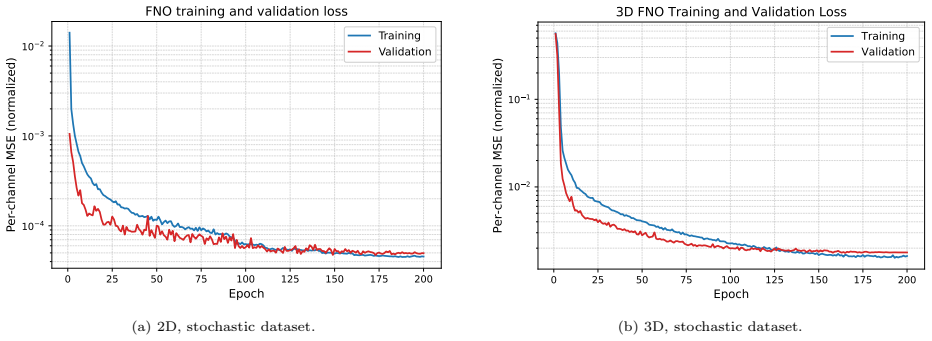
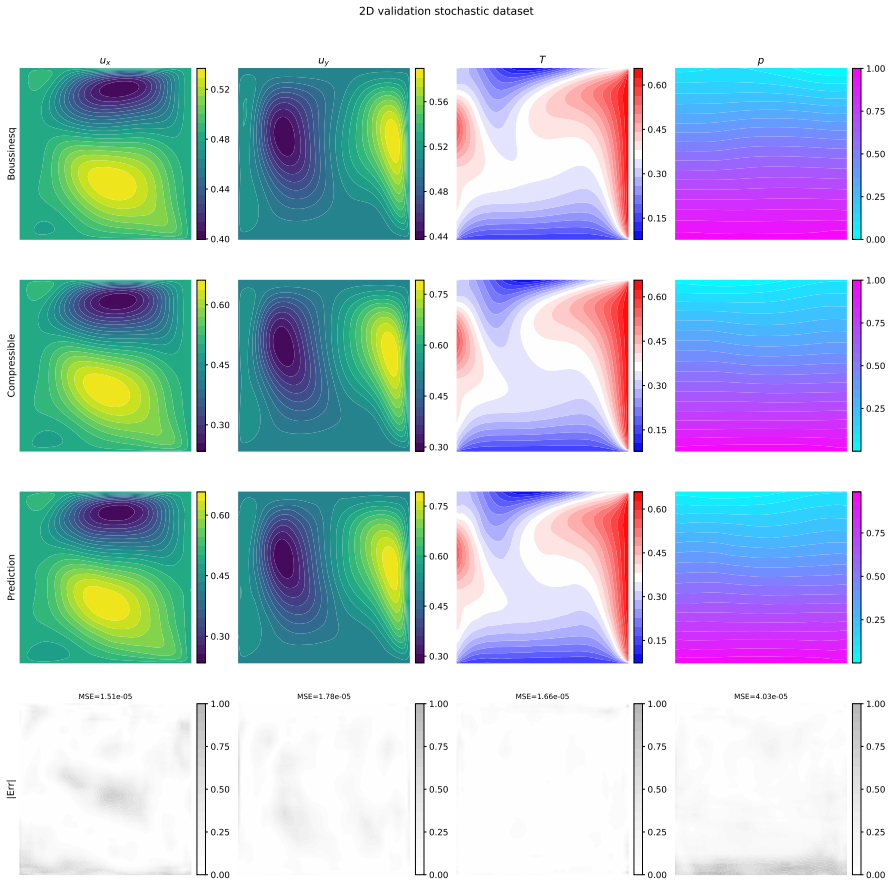
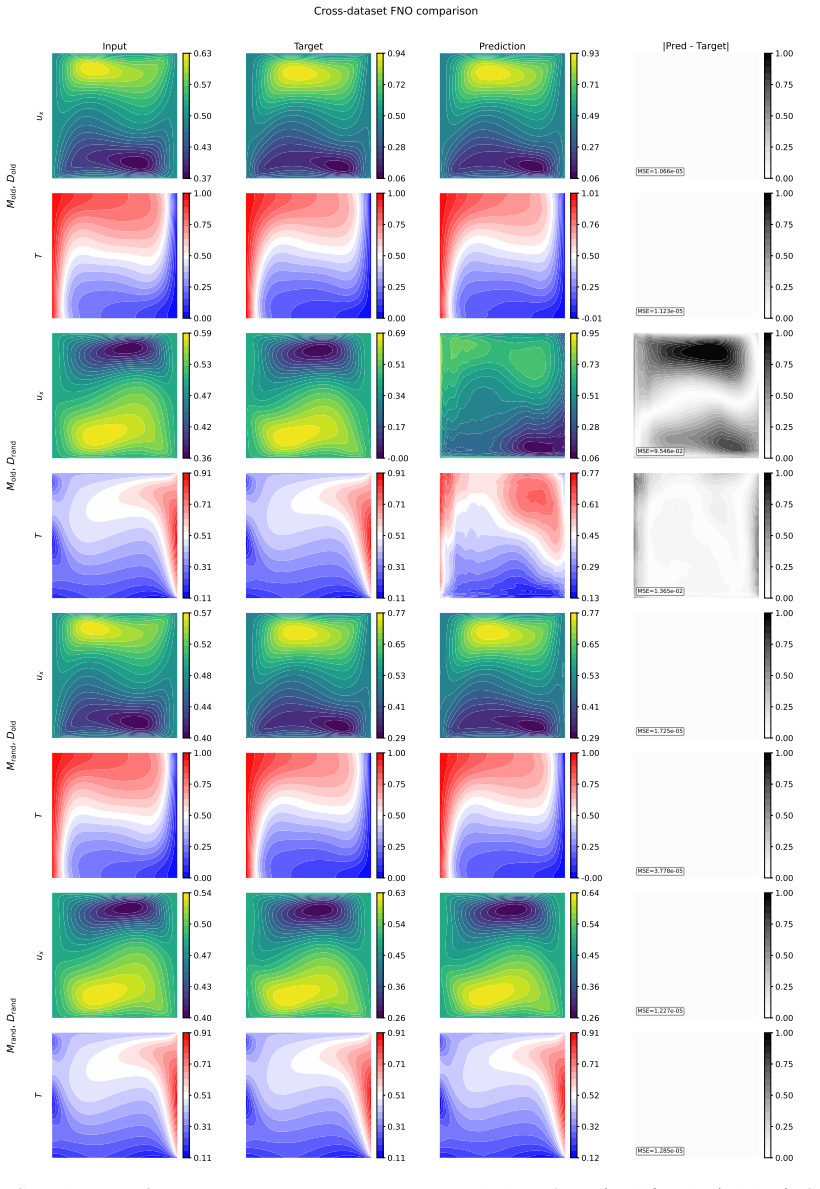
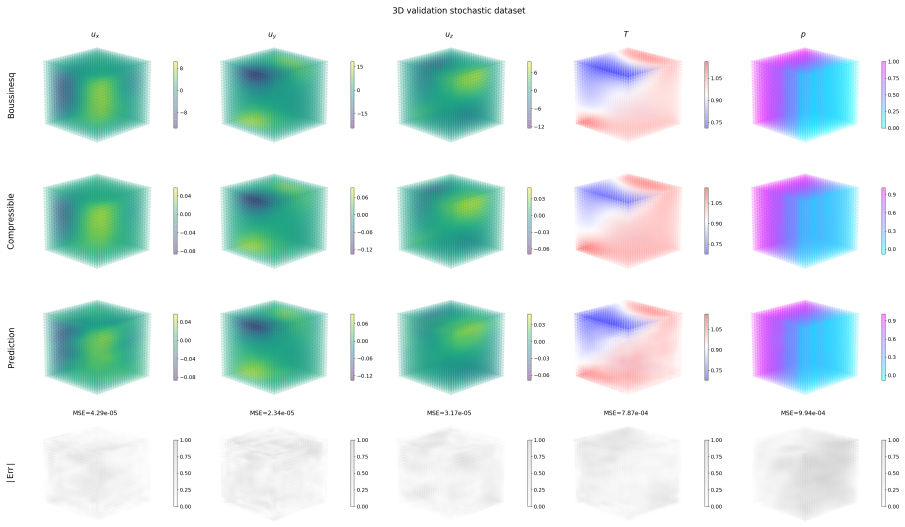
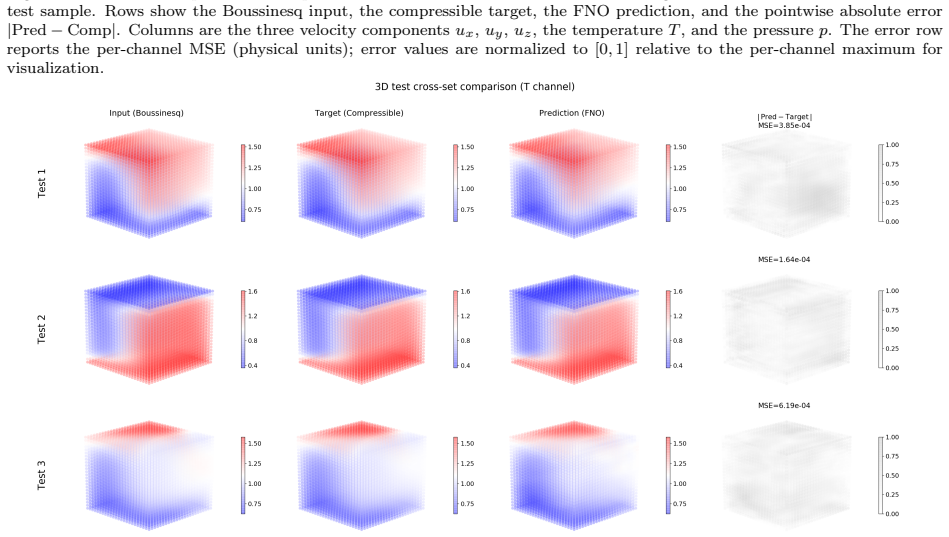
Using compressible-flow results as high-fidelity references, a single evaluation of a Fourier neural operator trained on matched Boussinesq-compressible pairs raises the per-channel accuracy of Boussinesq predictions to SSIM values close to unity for all flow variables and produces corresponding mean-squared-error reductions of one to nearly three orders of magnitude across test distributions in two and three spatial dimensions.
What carries the argument
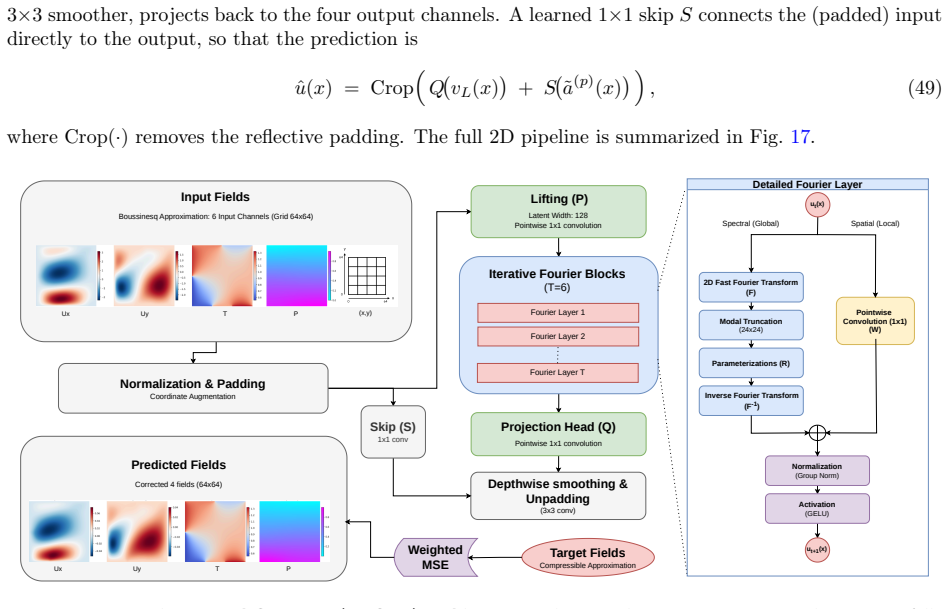
Fourier neural operator trained on paired Boussinesq-compressible simulation snapshots, applied once per new Boussinesq run to map the approximate fields onto the higher-fidelity compressible solution.
If this is right
- Boussinesq-based codes can be post-processed to compressible accuracy without re-deriving or re-solving the full compressible equations.
- The same paired-training strategy applies to other inexpensive flow approximations whose errors can be learned from a more expensive reference model.
- Open-source release of the trained operator and the paired data sets allows immediate reuse on new geometries or boundary conditions within the covered regime.
- Three-dimensional natural-convection problems become practical at the accuracy level previously available only from compressible solvers.
Where Pith is reading between the lines
- The method could be inserted into existing Boussinesq solvers as an optional post-processing step, enabling selective high-fidelity output only where needed.
- Retraining on new parameter ranges would be required for problems far from the original training distribution, such as very high Rayleigh numbers or complex geometries.
- Because the surrogate operates on solution snapshots rather than governing equations, it could be combined with other reduced-order modeling techniques for further speed-ups.
Load-bearing premise
The set of paired Boussinesq and compressible simulations used for training covers the parameter space and flow regimes that will appear in future test cases.
What would settle it
A new natural-convection test case whose Rayleigh or Prandtl numbers lie outside the training ranges, run with both models; if the surrogate fails to reduce mean-squared error by at least one order of magnitude relative to the raw Boussinesq result, the generalization claim is false.
Figures
read the original abstract
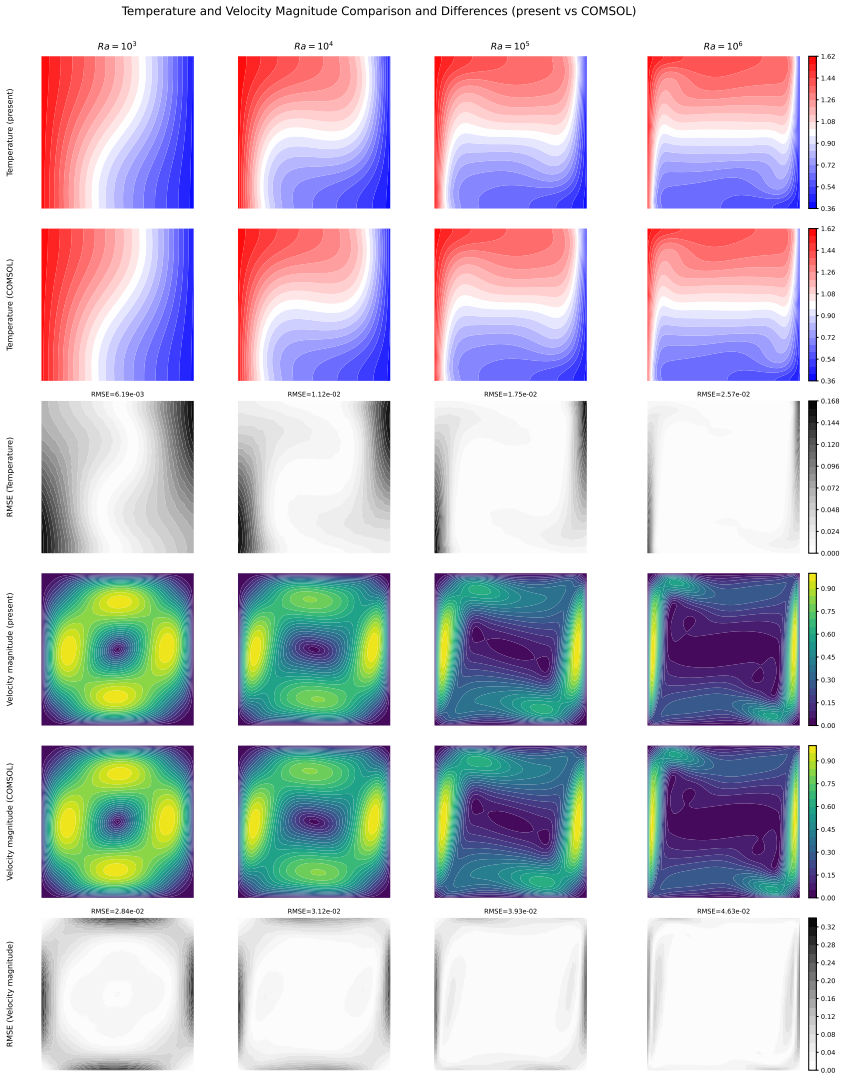
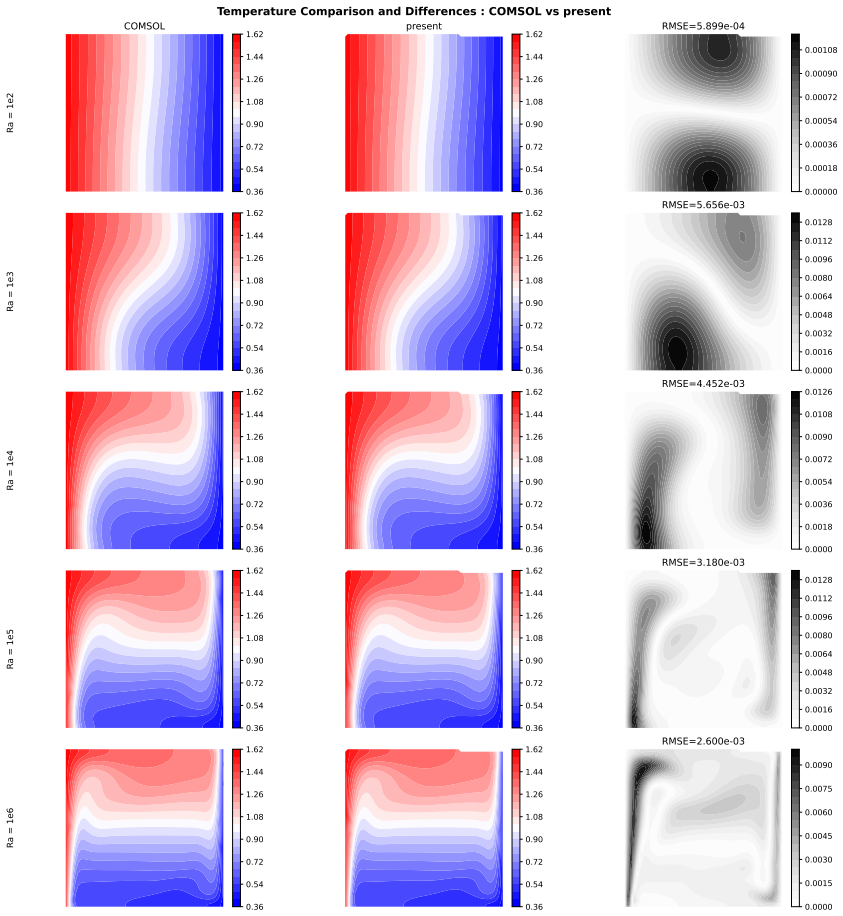
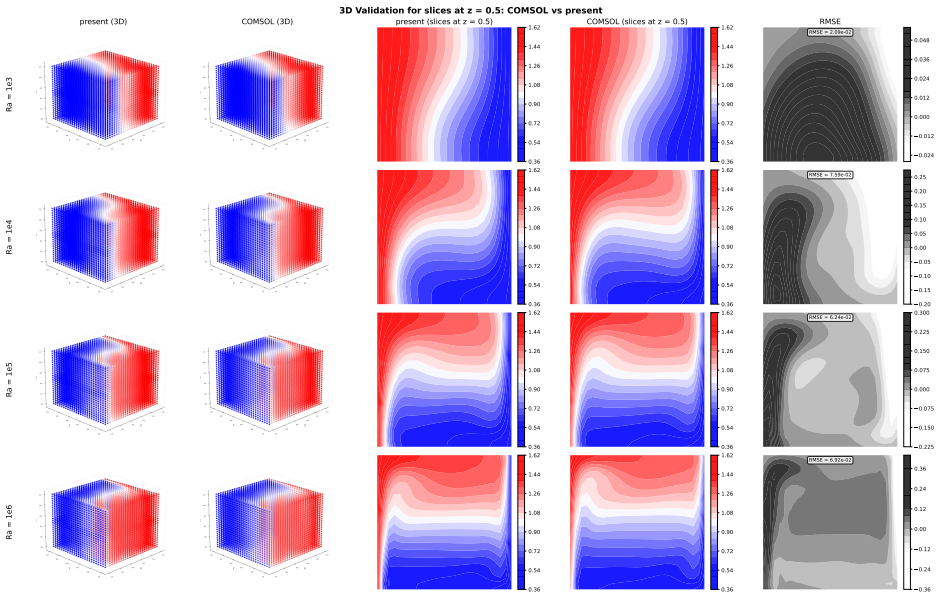
This paper presents a neural surrogate approach for improving the accuracy of natural convection problems simulated with a Boussinesq flow model (incompressible flow with heat transfer). Our approach, based on Fourier neural operators, uses training data consisting of matched pairs of simulations run under the computationally cheaper yet less accurate Boussinesq flow model and a more computationally expensive and more accurate compressible flow model. In both cases, we implement our parallelized simulation codes based on an implicit monolithic mixed finite element method (FEM) approach using the open-source FEniCSx framework. Our implementations are validated against a commercial software package, COMSOL, as well as standard test problems from the literature. We include a careful discussion and analysis of data set generation and present learning results in two and three spatial dimensions. Using compressible flow results as high-fidelity reference solutions, our learning approach, with a single model evaluation per simulation, substantially improves the per-channel accuracy of Boussinesq predictions, with structural similarity (SSIM) close to unity across all flow variables and test distributions and corresponding mean-squared error reductions of one to nearly three orders of magnitude. All code and data is released as open-source.
Editorial analysis
A structured set of objections, weighed in public.
Referee Report
Summary. The paper claims that a Fourier neural operator (FNO) trained on matched pairs of Boussinesq (incompressible) and compressible natural convection simulations, generated via implicit monolithic mixed FEM in FEniCSx, can correct the Boussinesq model to achieve SSIM values near unity and MSE reductions of 1–3 orders of magnitude across flow variables on test distributions, with validation against COMSOL and literature benchmarks; all code and data are released open-source.
Significance. If the reported generalization holds, the approach offers a practical route to high-fidelity natural convection results at the cost of a single low-fidelity simulation plus one FNO evaluation, which would be valuable for parameter studies in computational fluid dynamics. The open-source release of code, data, and the careful validation against independent COMSOL runs and standard test problems are clear strengths that support reproducibility and adoption.
major comments (1)
- [Dataset generation and learning results sections] The central generalization claim (SSIM near 1 and 1–3 order MSE reductions on unseen test distributions) is load-bearing and depends on the paired dataset sufficiently covering the relevant parameter space. The manuscript provides no explicit train/test split statistics, parameter histograms (e.g., Rayleigh/Prandtl number ranges, aspect ratios, boundary conditions), or out-of-distribution protocol, leaving open whether the gains reflect interpolation within the convex hull of training data rather than operator learning that corrects the Boussinesq approximation for new regimes.
Simulated Author's Rebuttal
We thank the referee for their constructive comments and for highlighting the strengths of the open-source release and validation. We address the single major comment below.
read point-by-point responses
-
Referee: [Dataset generation and learning results sections] The central generalization claim (SSIM near 1 and 1–3 order MSE reductions on unseen test distributions) is load-bearing and depends on the paired dataset sufficiently covering the relevant parameter space. The manuscript provides no explicit train/test split statistics, parameter histograms (e.g., Rayleigh/Prandtl number ranges, aspect ratios, boundary conditions), or out-of-distribution protocol, leaving open whether the gains reflect interpolation within the convex hull of training data rather than operator learning that corrects the Boussinesq approximation for new regimes.
Authors: We agree that explicit documentation of dataset coverage is necessary to support the generalization claims. The manuscript contains a discussion of dataset generation, but does not include the requested train/test split statistics, parameter histograms, or a clear out-of-distribution protocol. In the revised version we will add these elements (histograms of Rayleigh and Prandtl numbers, aspect ratios, boundary conditions, and split details) together with a statement clarifying that the reported test cases are held-out samples drawn from the same parameter ranges used for training. This will allow readers to assess whether the observed improvements constitute interpolation within the training convex hull or operator learning that corrects the Boussinesq model. revision: yes
Circularity Check
No circularity: improvements are empirical outputs of training on independent paired simulation data
full rationale
The paper generates training data from independent FEniCSx simulations of Boussinesq and compressible models, trains an FNO on those pairs, and reports empirical SSIM/MSE gains on test cases validated against COMSOL and literature. No equation, ansatz, or self-citation reduces the claimed per-channel accuracy improvement to a quantity defined by the model itself or by prior author work; the derivation chain is self-contained against external benchmarks.
Axiom & Free-Parameter Ledger
free parameters (1)
- Fourier neural operator weights
axioms (2)
- domain assumption The Boussinesq approximation provides a usable base model whose errors are learnable from paired data
- standard math Implicit monolithic mixed finite element discretization accurately solves both flow models
Reference graph
Works this paper leans on
-
[1]
Chapter 1 - introduction
Jiyuan Tu, Guan-Heng Yeoh, and Chaoqun Liu. Chapter 1 - introduction. In Jiyuan Tu, Guan- Heng Yeoh, and Chaoqun Liu, editors,Computational Fluid Dynamics (Third Edition), pages 1–31. Butterworth-Heinemann, third edition edition, 2018. ISBN 978-0-08-101127-0. doi: https://doi.org/10. 1016/B978-0-08-101127-0.00001-5. URLhttps://www.sciencedirect.com/scienc...
2018
-
[2]
Spalart and V
Philippe R. Spalart and V. Venkatakrishnan. On the role and challenges of CFD in the aerospace industry.The Aeronautical Journal, 120:209 – 232, 2016. URLhttps://api.semanticscholar.org/ CorpusID:7731130
2016
-
[3]
Kozo Fujii. Progress and future prospects of CFD in aerospace—wind tunnel and beyond.Progress in Aerospace Sciences, 41(6):455–470, 2005. ISSN 0376-0421. doi: https://doi.org/10.1016/j.paerosci. 2005.09.001. URLhttps://www.sciencedirect.com/science/article/pii/S0376042105001016
-
[4]
Venkateswarlu Chintala and Kallipatti A. Subramanian. A CFD (computational fluid dynamics) study for optimization of gas injector orientation for performance improvement of a dual-fuel diesel engine. Energy, 57:709–721, 2013. ISSN 0360-5442. doi: https://doi.org/10.1016/j.energy.2013.06.009. URL https://www.sciencedirect.com/science/article/pii/S0360544213005070
-
[5]
Dongwei Ye, Valeria Krzhizhanovskaya, and Alfons G. Hoekstra. Data-driven reduced-order modelling for blood flow simulations with geometry-informed snapshots.Journal of Computational Physics, 497: 112639, 2024. ISSN 0021-9991. doi: https://doi.org/10.1016/j.jcp.2023.112639. URLhttps://www. sciencedirect.com/science/article/pii/S0021999123007349
-
[7]
Springer International Publishing, Cham, 2021
Luke Reid.An Introduction to Biomedical Computational Fluid Dynamics, pages 205–222. Springer International Publishing, Cham, 2021. ISBN 978-3-030-76951-2. doi: 10.1007/978-3-030-76951-2_10. URLhttps://doi.org/10.1007/978-3-030-76951-2_10
-
[8]
Meisam Babanezhad, Iman Behroyan, Ali Taghvaie Nakhjiri, Azam Marjani, Mashallah Rezakazemi, and Saeed Shirazian. High-performance hybrid modeling chemical reactors using differential evolution based fuzzy inference system.Scientific Reports, 10(1):21304, 2020. doi: 10.1038/s41598-020-78277-3. URLhttps://doi.org/10.1038/s41598-020-78277-3
-
[9]
Mohd Hafiz Zawawi, A. Saleha, A. Salwa, N.H. Hassan, Nazirul Mubin Zahari, Mohd Zakwan Ramli, and Zakaria Che Muda. A review: Fundamentals of computational fluid dynamics (CFD). InAIP conference proceedings, volume 2030, page 020252. AIP Publishing LLC, 2018. doi: 10.1063/1.5066893. URLhttps://doi.org/10.1063/1.5066893
-
[10]
Sung-Eun Kim and Ferit Boysan. Application of CFD to environmental flows.Journal of Wind Engineering and Industrial Aerodynamics, 81(1):145–158, 1999. ISSN 0167-6105. doi: https://doi. org/10.1016/S0167-6105(99)00013-6. URLhttps://www.sciencedirect.com/science/article/pii/ S0167610599000136
-
[11]
Yoshihide Tominaga. CFD simulations of turbulent flow and dispersion in built environment: A per- spective review.Journal of Wind Engineering and Industrial Aerodynamics, 249:105741, 2024. ISSN 0167-6105. doi: https://doi.org/10.1016/j.jweia.2024.105741. URLhttps://www.sciencedirect.com/ science/article/pii/S0167610524001041
-
[12]
Gauthier-Villars, 1903
Joseph Boussinesq.Théorie analytique de la chaleur mise en harmonic avec la thermodynamique et avec la théorie mécanique de la lumière: Refroidissement et échauffement par rayonnement, conductibilité des tiges, lames et masses cristallines, courants de convection, théorie mécanique de la lumière, volume 2. Gauthier-Villars, 1903. 40
1903
-
[13]
Incompressible flows and the Boussinesq approximation: 50 years of CFD.Comptes Rendus
Marcello Lappa. Incompressible flows and the Boussinesq approximation: 50 years of CFD.Comptes Rendus. Mécanique, 350(S1):75–96, 2022. doi: 10.5802/crmeca.134. URLhttps://doi.org/10.5802/ crmeca.134
-
[14]
Donald D. Gray and Aldo Giorgini. The validity of the Boussinesq approximation for liquids and gases. International Journal of Heat and Mass Transfer, 19(5):545–551, 1976. ISSN 0017-9310. doi: https:// doi.org/10.1016/0017-9310(76)90168-X. URLhttps://www.sciencedirect.com/science/article/ pii/001793107690168X
-
[15]
Toward improving Boussinesq flow simulations by learning with compressible flow
Nurshat Mangnike and David Hyde. Toward improving Boussinesq flow simulations by learning with compressible flow. InProceedings of the Platform for Advanced Scientific Computing Conference, PASC ’24, New York, NY, USA, 2024. Association for Computing Machinery. ISBN 9798400706394. doi: 10.1145/3659914.3659919. URLhttps://doi.org/10.1145/3659914.3659919
-
[16]
Jared Willard, Xiaowei Jia, Shaoming Xu, Michael Steinbach, and Vipin Kumar. Integrating physics- based modeling with machine learning: A survey.arXiv preprint arXiv:2003.04919, 1(1):1–34, 2020. URLhttps://arxiv.org/pdf/2003.04919.pdf
arXiv 2003
-
[17]
Frederic Gibou, David Hyde, and Ron Fedkiw. Sharp interface approaches and deep learning techniques for multiphase flows.Journal of Computational Physics, 380:442–463, 2019. doi: 10.1016/j.jcp.2018.05
-
[18]
URLhttps://www.sciencedirect.com/science/article/pii/S0021999118303371
-
[19]
Baratta, Joseph P
Igor A. Baratta, Joseph P. Dean, Jørgen S. Dokken, Michal Habera, Jack S. Hale, Chris N. Richardson, Marie E. Rognes, Matthew W. Scroggs, Nathan Sime, and Garth N. Wells. DOLFINx: the next generation FEniCS problem solving environment. preprint, 2023. URLhttps://doi.org/10.5281/ zenodo.10447666
2023
-
[20]
Wells.Automated Solution of Differential Equations by the Finite Element Method: The FEniCS Book, volume 84
Anders Logg, Kent-Andre Mardal, and Garth N. Wells.Automated Solution of Differential Equations by the Finite Element Method: The FEniCS Book, volume 84. Springer Science & Business Media, 2012. URLhttps://api.semanticscholar.org/CorpusID:59832704
2012
-
[21]
Cedric M. Taylor and P. Hood. A numerical solution of the navier-stokes equations using the fi- nite element technique.Computers & Fluids, 1(1):73–100, 1973. ISSN 0045-7930. doi: https: //doi.org/10.1016/0045-7930(73)90027-3. URLhttps://www.sciencedirect.com/science/article/ pii/0045793073900273
-
[22]
David Hyde, Chennakesava Kadapa, Abdallah Alalem Albustami, and Ahmad F. Taha. Progress and perils of pinns: Perspectives on applying physics-informed neural networks to science and engineering problems.Computing in Science & Engineering, pages 1–9, 2026. doi: 10.1109/MCSE.2026.3675465. URLhttps://ieeexplore.ieee.org/document/11447375
-
[23]
M.P. Ueckermann and P.F.J. Lermusiaux. Hybridizable discontinuous Galerkin projection methods for Navier–Stokes and Boussinesq equations.Journal of Computational Physics, 306:390–421, 2016. ISSN 0021-9991. doi: https://doi.org/10.1016/j.jcp.2015.11.028. URLhttps://www.sciencedirect.com/ science/article/pii/S0021999115007688
-
[24]
Bernardo Cockburn, Jayadeep Gopalakrishnan, and Raytcho Lazarov. Unified hybridization of dis- continuous galerkin, mixed, and continuous galerkin methods for second order elliptic problems. SIAM Journal on Numerical Analysis, 47(2):1319–1365, 2009. doi: 10.1137/070706616. URLttps: //doi.org/10.1137/070706616
-
[25]
Ngoc Cuong Nguyen, Jaume Peraire, and Bernardo Cockburn. An implicit high-order hybridizable discontinuous Galerkin method for linear convection–diffusion equations.Journal of Computational Physics, 228(9):3232–3254, 2009. doi: https://doi.org/10.1016/j.jcp.2009.01.030. URLhttps://www. sciencedirect.com/science/article/pii/S0021999109000308
-
[26]
Philipp W. Schroeder and Gert Lube. Stabilised dG-FEM for incompressible natural convection flows with boundary and moving interior layers on non-adapted meshes.Journal of Computational Physics, 41 335:760–779, 2017. ISSN 0021-9991. doi: https://doi.org/10.1016/j.jcp.2017.01.055. URLhttps: //www.sciencedirect.com/science/article/pii/S0021999117300712
-
[27]
Zhaosheng Yu, Xueming Shao, and Anthony Wachs. A fictitious domain method for particulate flows withheattransfer.Journal of Computational Physics, 217(2):424–452, 2006. ISSN0021-9991. doi: https: //doi.org/10.1016/j.jcp.2006.01.016. URLhttps://www.sciencedirect.com/science/article/pii/ S0021999106000167
-
[28]
Lower, slower, louder: V ocal cues of sarcasm,
Jian-Guo Liu, Cheng Wang, and Hans Johnston. A fourth order scheme for incompressible Boussinesq equations.Journal of Scientific Computing, 18(2):253–285, 2003. doi: https://doi.org/10.1023/A: 1021168924020. URLhttps://link.springer.com/article/10.1023/A:1021168924020
work page doi:10.1023/a: 2003
-
[29]
H. Damanik, J. Hron, A. Ouazzi, and S. Turek. A monolithic FEM-multigrid solver for non-isothermal incompressible flow on general meshes.Journal of Computational Physics, 228(10):3869–3881, 2009. ISSN 0021-9991. doi: https://doi.org/10.1016/j.jcp.2009.02.024. URLhttps://www.sciencedirect. com/science/article/pii/S0021999109000941
-
[30]
Smethurst, David J
Christopher A. Smethurst, David J. Silvester, and Milan D. Mihajlovic. Unstructured finite element method for the solution of the Boussinesq problem in three dimensions.International Journal for Nu- merical Methods in Fluids, 73, 2013. URLhttps://api.semanticscholar.org/CorpusID:119789681
2013
-
[31]
Shunichi Wakitani. Numerical study of three-dimensional oscillatory natural convection at low prandtl number in rectangular enclosures.Journal of Heat Transfer, 123(1):77–83, 09 2000. ISSN 0022-1481. doi: 10.1115/1.1336508. URLhttps://doi.org/10.1115/1.1336508
-
[32]
Edward A. Miller, Xi Chen, and David M. Williams. Versatile mixed methods for non-isothermal incompressible flows.Computers & Mathematics with Applications, 125:150–175, 2022. ISSN 0898-1221. doi: https://doi.org/10.1016/j.camwa.2022.08.044. URLhttps://www.sciencedirect.com/science/ article/pii/S0898122122003704
-
[33]
Howard Elman, Milan Mihajlović, and David Silvester. Fast iterative solvers for buoyancy driven flow problems.Journal of Computational Physics, 230(10):3900–3914, 2011. ISSN 0021-9991. doi: https: //doi.org/10.1016/j.jcp.2011.02.014. URLhttps://www.sciencedirect.com/science/article/pii/ S0021999111001033
-
[34]
Yongcun Song, Xiaoming Yuan, and Hangrui Yue. A numerical approach to the optimal control of thermally convective flows.Journal of Computational Physics, 494:112458, 2023. ISSN 0021-9991. doi: https://doi.org/10.1016/j.jcp.2023.112458. URLhttps://www.sciencedirect.com/science/ article/pii/S0021999123005533
-
[35]
Aina Rakotondrandisa, Georges Sadaka, and Ionut Danaila. A finite-element toolbox for the simulation of solid–liquid phase-change systems with natural convection.Computer Physics Communications, 253: 107188, 2020. ISSN 0010-4655. doi: https://doi.org/10.1016/j.cpc.2020.107188. URLhttps://www. sciencedirect.com/science/article/pii/S0010465520300151
-
[36]
Georges Sadaka, Aina Rakotondrandisa, Pierre-Henri Tournier, Francky Luddens, Corentin Lothodé, and Ionut Danaila. Parallel finite-element codes for the simulation of two-dimensional and three- dimensional solid–liquid phase-change systems with natural convection.Computer Physics Commu- nications, 257:107492, 2020. ISSN 0010-4655. doi: https://doi.org/10....
-
[37]
Peyman Mayeli and Gregory J. Sheard. Buoyancy-driven flows beyond the Boussinesq approximation: A brief review.International Communications in Heat and Mass Transfer, 125:105316, 2021. doi: https:// doi.org/10.1016/j.icheatmasstransfer.2021.105316. URLhttps://www.sciencedirect.com/science/ article/pii/S0735193321002098
-
[38]
Radyadour Kh. Zeytounian. Joseph Boussinesq and his approximation: a contemporary view.Comptes Rendus Mecanique, 331(8):575–586, 2003. doi: https://doi.org/10.1016/S1631-0721(03)00120-7. URL https://www.sciencedirect.com/science/article/pii/S1631072103001207. 42
-
[39]
Suhas V. Patankar and Dudley B. Spalding. A calculation procedure for heat, mass and momentum transfer in three-dimensional parabolic flows.International Journal of Heat and Mass Transfer, 15 (10):1787–1806, 1972. ISSN 0017-9310. doi: https://doi.org/10.1016/0017-9310(72)90054-3. URL https://www.sciencedirect.com/science/article/pii/0017931072900543
-
[40]
Jeffrey Peter van Doormaal and George D. Raithby. Enhancements of the simple method for pre- dicting incompressible fluid flows.Numerical Heat Transfer, 7(2):147–163, 1984. doi: 10.1080/ 01495728408961817. URLhttps://doi.org/10.1080/01495728408961817
-
[41]
Raad I. Issa. Solution of the implicitly discretised fluid flow equations by operator-splitting.Journal of Computational Physics, 62(1):40–65, 1986. ISSN0021-9991. doi: https://doi.org/10.1016/0021-9991(86) 90099-9. URLhttps://www.sciencedirect.com/science/article/pii/0021999186900999
-
[42]
Chae M. Rhie. Pressure-based navier-stokes solver using the multigrid method.AIAA journal, 27 (8):1017–1018, 1989. doi: 10.2514/6.1986-207. URLhttps://arc.aiaa.org/doi/pdf/10.2514/6. 1986-207
-
[43]
Karki and Suhas V
Kailash C. Karki and Suhas V. Patankar. Pressure based calculation procedure for viscous flows at all speedsin arbitrary configurations.AIAA journal, 27(9):1167–1174, 1989. URLhttps://doi.org/10. 2514/3.10242
1989
-
[44]
Rehm and Howard R
Ronald G. Rehm and Howard R. Baum. The equations of motion for thermally driven, buoyant flows. Journal of Research of the National Bureau of Standards, 83 3:297–308, 1978. URLhttps://api. semanticscholar.org/CorpusID:13971757
1978
-
[45]
Pierce, and Parviz Moin
Clifton Wall, Charles D. Pierce, and Parviz Moin. A semi-implicit method for resolution of acoustic waves in low mach number flows.Journal of Computational Physics, 181(2):545–563, 2002. ISSN 0021-
2002
-
[46]
URLhttps://www.sciencedirect.com/science/ article/pii/S002199910297141X
doi: https://doi.org/10.1006/jcph.2002.7141. URLhttps://www.sciencedirect.com/science/ article/pii/S002199910297141X
-
[47]
Le Quéré, R Masson, and Pierre Perrot
Patrick L. Le Quéré, R Masson, and Pierre Perrot. A Chebyshev collocation algorithm for 2D non-Boussinesq convection.Journal of Computational Physics, 103(2):320–335, 1992. ISSN 0021-
1992
-
[48]
URLhttps://www.sciencedirect.com/ science/article/pii/002199919290404M
doi: https://doi.org/10.1016/0021-9991(92)90404-M. URLhttps://www.sciencedirect.com/ science/article/pii/002199919290404M
-
[49]
Aldo Hennink, Marco Tiberga, and Danny Lathouwers. A pressure-based solver for low-Mach number flow using a discontinuous Galerkin method.Journal of Computational Physics, 425:109877, 2021. ISSN 0021-9991. doi: https://doi.org/10.1016/j.jcp.2020.109877. URLhttps://www.sciencedirect.com/ science/article/pii/S0021999120306513
-
[50]
Hideki Yanaoka and Yuji Sato. A numerical method for low Mach number compressible flows by simultaneous relaxation of dependent variables.arXiv preprint arXiv:2502.08116, 2025. doi: 10.48550/ arXiv.2502.08116. URLhttps://doi.org/10.48550/arXiv.2502.08116
-
[51]
Eli Turkel. Preconditioned methods for solving the incompressible and low speed compressible equations.Journal of Computational Physics, 72(2):277–298, 1987. ISSN 0021-9991. doi: https: //doi.org/10.1016/0021-9991(87)90084-2. URLhttps://www.sciencedirect.com/science/article/ pii/0021999187900842
-
[52]
Eli Turkel. Preconditioning techniques in computational fluid dynamics.Annual Review of Fluid Me- chanics, 31(1):385–416, 1999. doi: 10.1146/annurev.fluid.31.1.385. URLhttps://doi.org/10.1146/ annurev.fluid.31.1.385
-
[53]
Yunho Choi and Charles L. Merkle. The application of preconditioning in viscous flows.Journal of Computational Physics, 105(2):207–223, 1993. ISSN 0021-9991. doi: https://doi.org/10.1006/jcph.1993
-
[54]
URLhttps://www.sciencedirect.com/science/article/pii/S0021999183710697
-
[55]
Weiss and Wayne Smith
Jonathan M. Weiss and Wayne Smith. Preconditioning applied to variable and constant density flows. AIAA Journal, 33:2050–2057, 1995. URLhttps://api.semanticscholar.org/CorpusID:119737915. 43
2050
-
[56]
On the behaviour of upwind schemes in the low mach number limit
Hervé Guillard and Cécile Viozat. On the behaviour of upwind schemes in the low mach number limit. Computers & fluids, 28(1):63–86, 1999. doi: https://doi.org/10.1016/S0045-7930(98)00017-6. URL https://www.sciencedirect.com/science/article/pii/S0045793098000176
-
[57]
Brooks and Thomas J.R
Alexander N. Brooks and Thomas J.R. Hughes. Streamline upwind/Petrov-Galerkin formulations for convection dominated flows with particular emphasis on the incompressible Navier-Stokes equa- tions.Computer Methods in Applied Mechanics and Engineering, 32(1):199–259, 1982. ISSN 0045-
1982
-
[58]
URLhttps://www.sciencedirect.com/ science/article/pii/0045782582900718
doi: https://doi.org/10.1016/0045-7825(82)90071-8. URLhttps://www.sciencedirect.com/ science/article/pii/0045782582900718
-
[59]
Franca, and Marc Balestra
Thomas Joseph Robert Hughes, Leopoldo P. Franca, and Marc Balestra. A new finite element formula- tion for computational fluid dynamics: V. circumventing the babuška-brezzi condition: A stable Petrov- Galerkin formulation of the Stokes problem accommodating equal-order interpolations.Applied Mechan- ics and Engineering, 59:85–99, 1986. URLhttps://api.sema...
1986
-
[60]
Hong Luo, Hidehiro Segawa, and Miguel R. Visbal. An implicit discontinuous Galerkin method for the unsteady compressible Navier–Stokes equations.Computers & Fluids, 53:133–144, 2012. ISSN 0045-
2012
-
[61]
URLhttps://www.sciencedirect.com/ science/article/pii/S0045793011003082
doi: https://doi.org/10.1016/j.compfluid.2011.10.009. URLhttps://www.sciencedirect.com/ science/article/pii/S0045793011003082
-
[62]
Satish Balay, William Gropp, Lois Curfman McInnes, and Barry F. Smith. Efficient management of parallelism in object-oriented numerical software libraries. InModern Software Tools in Scientific Computing, 1997. URLhttps://api.semanticscholar.org/CorpusID:56520908
1997
-
[63]
Mikael Mortensen, Hans Petter Langtangen, and Garth N. Wells. A FEniCS-based programming frame- work for modeling turbulent flow by the Reynolds-averaged Navier–Stokes equations.Advances in Water Resources, 34(9):1082–1101, 2011. ISSN 0309-1708. doi: https://doi.org/10.1016/j.advwatres.2011.02
-
[64]
URLhttps://www.sciencedirect.com/science/article/pii/S030917081100039X
-
[65]
Lyudmyla Vynnytska, Marie E. Rognes, and Stuart R. Clark. Benchmarking FEniCS for mantle convection simulations.Computers & Geosciences, 50:95–105, 2013. ISSN 0098-3004. doi: https: //doi.org/10.1016/j.cageo.2012.05.012. URLhttps://www.sciencedirect.com/science/article/ pii/S0098300412001689
-
[66]
Chao Zhang, Sadiq J. Zarrouk, and Rosalind Archer. A mixed finite element solver for natural convection in porous media using automated solution techniques.Computers & Geosciences, 96: 181–192, 2016. ISSN 0098-3004. doi: https://doi.org/10.1016/j.cageo.2016.08.012. URLhttps: //www.sciencedirect.com/science/article/pii/S0098300416302746
-
[67]
Physics-informed machine learning,
George Em Karniadakis, Ioannis G. Kevrekidis, Lu Lu, Paris Perdikaris, Sifan Wang, and Liu Yang. Physics-informed machine learning.Nature Reviews Physics, 3(6):422–440, 2021. doi: https://doi.org/ 10.1038/s42254-021-00314-5. URLhttps://www.nature.com/articles/s42254-021-00314-5
-
[69]
I.E. Lagaris, A. Likas, and D.I. Fotiadis. Artificial neural networks for solving ordinary and partial differential equations.IEEE Transactions on Neural Networks, 9(5):987–1000, 1998. doi: 10.1109/72. 712178. URLhttps://ieeexplore.ieee.org/document/712178
work page doi:10.1109/72 1998
-
[70]
Gamini Dissanayake and Nhan Phan-Thien
M.W.M. Gamini Dissanayake and Nhan Phan-Thien. Neural-network-based approximations for solving partial differential equations.Communications in Numerical Methods in Engineering, 10(3):195–201,
-
[71]
URLhttps://onlinelibrary.wiley.com/doi/ abs/10.1002/cnm.1640100303
doi: https://doi.org/10.1002/cnm.1640100303. URLhttps://onlinelibrary.wiley.com/doi/ abs/10.1002/cnm.1640100303. 44
-
[72]
A deep conjugate direction method for iteratively solving linear systems
AyanoKaneda, OsmanAkar, JingyuChen, VictoriaAliciaTrevinoKala, DavidHyde, andJosephTeran. A deep conjugate direction method for iteratively solving linear systems. In Andreas Krause, Emma Brunskill, Kyunghyun Cho, Barbara Engelhardt, Sivan Sabato, and Jonathan Scarlett, editors,Proceed- ings of the 40th International Conference on Machine Learning, volume...
2023
-
[73]
Reinforcement learning for adaptive mesh re- finement
Jiachen Yang, Tarik Dzanic, Brenden Petersen, Jun Kudo, Ketan Mittal, Vladimir Tomov, Jean-Sylvain Camier, Tuo Zhao, Hongyuan Zha, Tzanio Kolev, et al. Reinforcement learning for adaptive mesh re- finement. InInternational Conference on Artificial Intelligence and Statistics, pages 5997–6014. PMLR,
-
[74]
URLhttps://proceedings.mlr.press/v206/yang23e.html
-
[75]
Jonathan Viquerat and Elie Hachem. A supervised neural network for drag prediction of arbitrary 2d shapes in laminar flows at low reynolds number.Computers & Fluids, 210:104645, 2020. doi: https://doi.org/10.1016/j.compfluid.2020.104645. URLhttps://www.sciencedirect.com/science/ article/pii/S0045793020302164
-
[76]
Muralikrishnan Gopalakrishnan Meena, Matthew R. Norman, David M. Hall, and Michael S. Pritchard. Spatially local surrogate modeling of subgrid-scale effects in idealized atmospheric flows: A deep learned approach using high-resolution simulation data.Artificial Intelligence for the Earth Systems, 3(4):e230043, 2024. doi: 10.1175/AIES-D-23-0043.1. URLhttps...
-
[77]
Benet Eiximeno, Marcial Sanchis-Agudo, Arnau Miró, Ivette Rodriguez, Ricardo Vinuesa, and Oriol Lehmkuhl. On deep-learning-based closures for algebraic surrogate models of tur- bulent flows.Journal of Fluid Mechanics, 1020:A36, 2025. doi: 10.1017/jfm.2025.10610. URLhttps://www.cambridge.org/core/journals/journal-of-fluid-mechanics/article/ on-deeplearning...
-
[78]
Anirban Bhattacharjee, Luis H. Hatashita, and Suhas S. Jain. A machine learning model for the prediction of sub-grid interfacial area in two-phase turbulent flows. InAIAA SCITECH 2026 Forum, page 1731, 2026. doi: https://doi.org/10.2514/6.2026-1731. URLhttps://arc.aiaa.org/doi/10. 2514/6.2026-1731
-
[79]
Arnold, and Trenton M
Joshua Stuckner, Matthew Piekenbrock, Steven M. Arnold, and Trenton M. Ricks. Optimal experimen- tal design with fast neural network surrogate models.Computational Materials Science, 200:110747,
-
[80]
URLhttps://www.sciencedirect.com/ science/article/pii/S0927025621004742
doi: https://doi.org/10.1016/j.commatsci.2021.110747. URLhttps://www.sciencedirect.com/ science/article/pii/S0927025621004742
-
[81]
Mohammad S. Khorrami, Jaber R. Mianroodi, Nima H. Siboni, Pawan Goyal, Bob Svendsen, Peter Benner, and Dierk Raabe. An artificial neural network for surrogate modeling of stress fields in vis- coplastic polycrystalline materials.npj Computational Materials, 9(1):37, 2023. doi: https://doi.org/ 10.1038/s41524-023-00991-z. URLhttps://www.nature.com/articles...
-
[82]
Wenwen Zhou, Xiaodong Feng, Ling Guo, and Hao Wu. Latent representation learning based model correction and uncertainty quantification for PDEs.arXiv preprint arXiv:2603.24948, 2026. doi: http: //dx.doi.org/10.2139/ssrn.6629548. URLhttps://api.semanticscholar.org/CorpusID:286790070
discussion (0)
Sign in with ORCID, Apple, or X to comment. Anyone can read and Pith papers without signing in.