Rapid and robust laser-frequency auto-locking using Bayesian-optimization and discrete-wavelet-transformation algorithms
Pith reviewed 2026-06-25 21:29 UTC · model grok-4.3
The pith
Bayesian optimization and wavelet analysis let lasers find and lock to atomic references five times faster with over 99.5 percent accuracy despite large disturbances.
A machine-rendered reading of the paper's core claim, the machinery that carries it, and where it could break.
Core claim
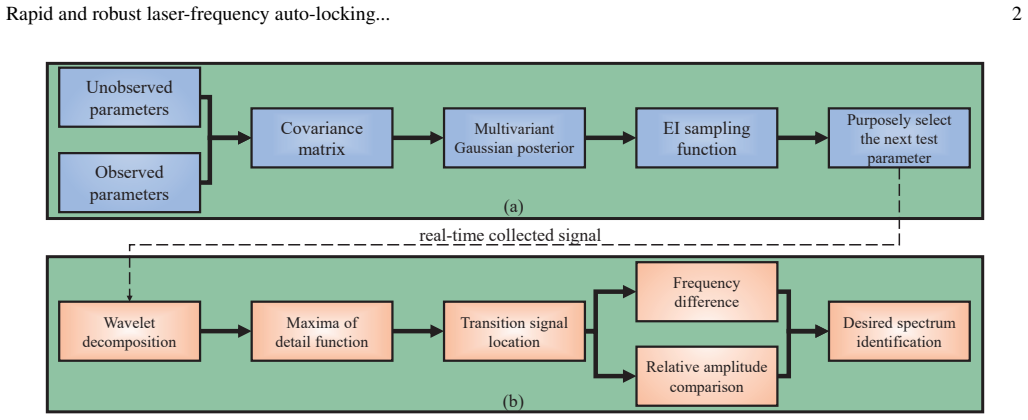
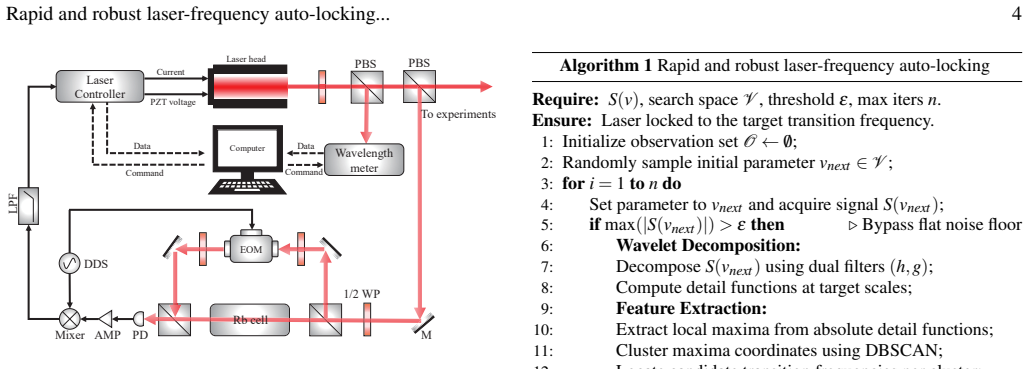
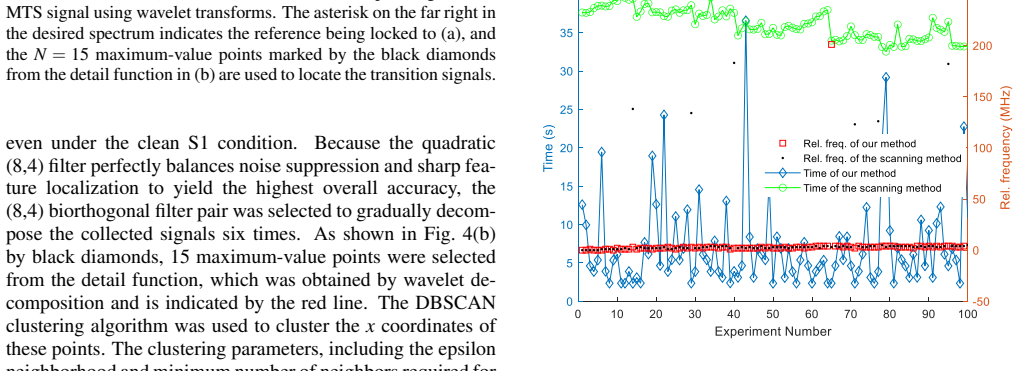
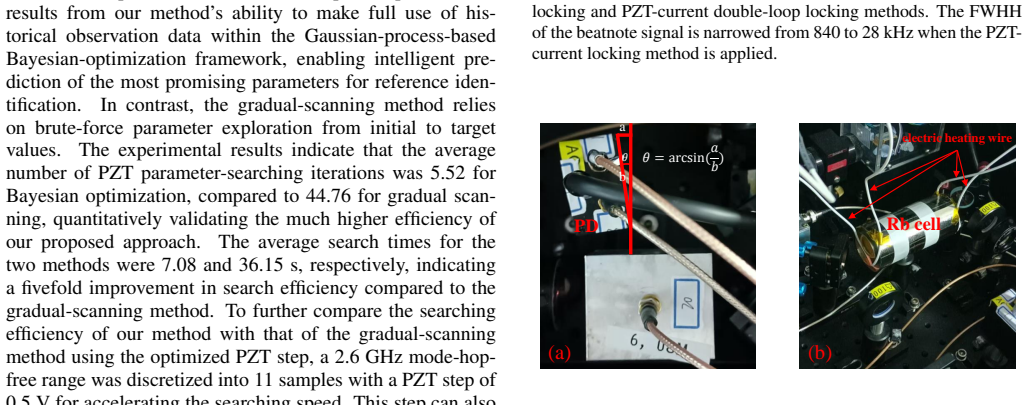
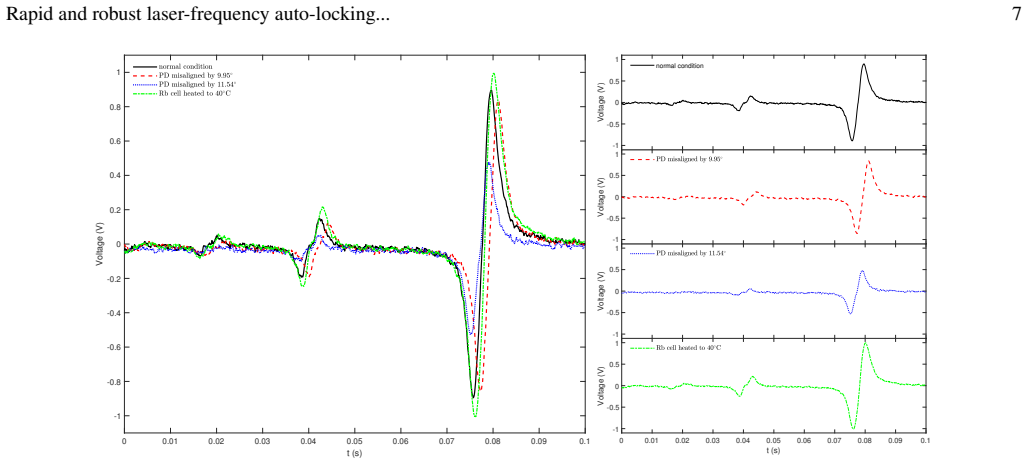
The central claim is that Bayesian optimization for rapid reference searching combined with discrete biorthogonal wavelet transformation for robust signal identification creates an auto-locking scheme that accelerates reference location fivefold over conventional scanning while identifying the correct atomic transition with more than 99.5 percent accuracy under 50 percent laser-intensity fluctuations, 9.95 degree photodiode misalignment, and 18 degree Celsius rubidium cell temperature elevation, after which a lead zirconate titanate-current double-servo loop narrows the locked linewidth to 20 kHz.
What carries the argument
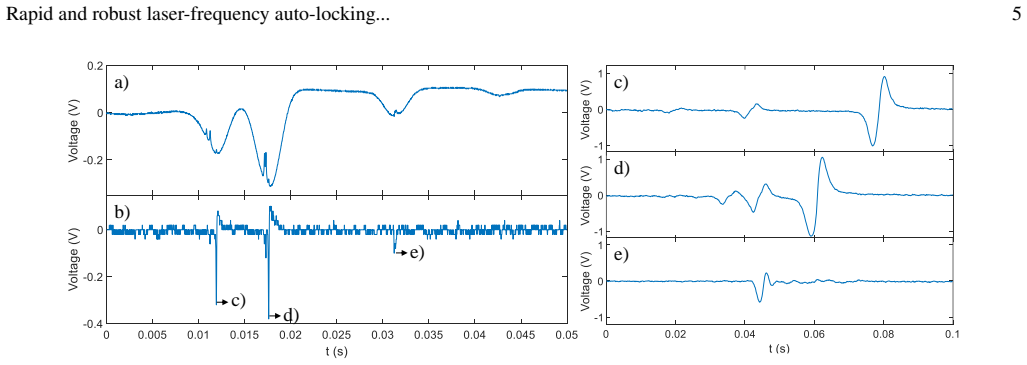
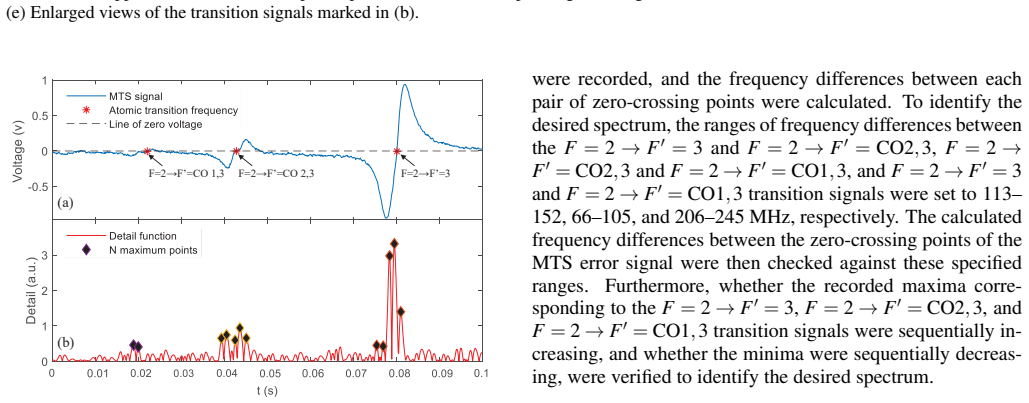
Bayesian optimization that selects the next frequency point from historical data, paired with discrete biorthogonal wavelet transformation that extracts transition signals whose fixed frequency differences and relative magnitudes are set by atomic structure.
If this is right
- Laser systems can reach lock far more quickly after large frequency drifts common in field use.
- The identification step tolerates the intensity, alignment, and temperature variations typical of deployed quantum hardware.
- The final double-servo lock produces a 20 kHz linewidth usable for precision measurements and quantum protocols.
- The overall scheme supports continuous operation of quantum communication and computing devices without frequent manual retuning.
Where Pith is reading between the lines
- The same signal-matching logic could be tested on other atomic or molecular species whose spectra contain similarly distinct, immutable features.
- Combining the Bayesian searcher with additional sensors for real-time drift prediction might shorten search times even further.
- The method might reduce downtime in portable quantum sensors where temperature and mechanical alignment fluctuate.
- If the wavelet step proves stable across different laser types, it could simplify integration into existing commercial laser controllers.
Load-bearing premise
The frequency differences and relative magnitudes of the atomic transition signals remain fixed properties of the atom and do not change with laser intensity, photodiode angle, or cell temperature.
What would settle it
Run the system under 50 percent intensity reduction, 9.95 degree photodiode misalignment, and 18 degree Celsius cell heating; if identification accuracy falls below 99.5 percent or the search time exceeds one-fifth of a full conventional scan, the performance claims do not hold.
Figures
read the original abstract
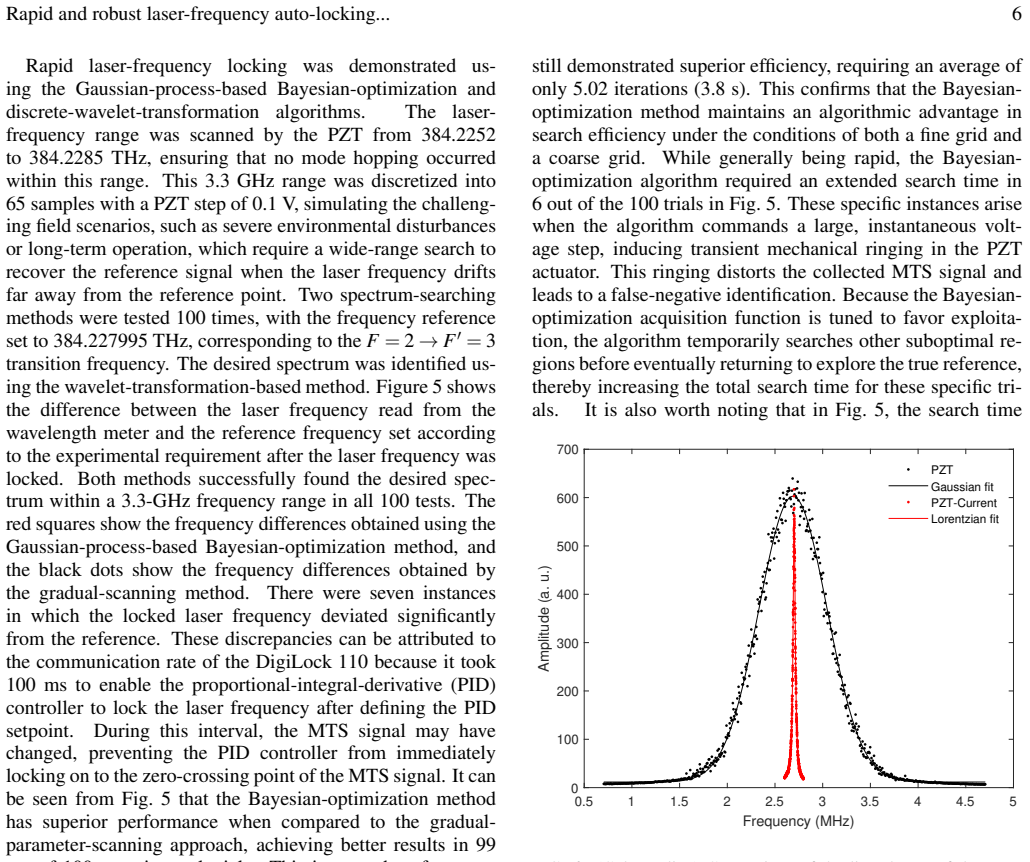
Rapid and robust laser-frequency auto-locking is essential for the field deployment of quantum communications, quantum computing, and precision-measurement technologies; however, achieving this remains a considerable challenge. Here, we propose and demonstrate an auto-locking scheme employing Bayesian optimization and discrete biorthogonal wavelet transformation. First, the reference is rapidly sought by making intelligent use of historical observations, eliminating the inherent blindness of the traditional parameter-scanning method. Second, the frequency reference is robustly identified by pinpointing transition signals with the discrete biorthogonal wavelet transformation and analyzing their immutable frequency differences and relative magnitudes, which are determined by the inherent atomic structure and remain resistant to environmental disturbances. This proposed approach achieves a fivefold acceleration in reference searching compared to conventional scanning methods in the case where the laser frequency drifts far away from the reference. Crucially, it achieves an identification accuracy of more than 99.5 %, even under severe 50 % laser-intensity fluctuations, $9.95^\circ$ photodiode misalignment, and $18^\circ$C Rb cell temperature elevation. Finally, locking the laser frequency to the identified reference with a lead zirconate titanate-current double-servo loop narrows the linewidth to 20 kHz. We believe that this rapid, robust, and high-performance auto-locking technique will be pivotal towards the deployment of the next generation of practical quantum technologies in demanding field environments.
Editorial analysis
A structured set of objections, weighed in public.
Referee Report
Summary. The manuscript proposes and experimentally demonstrates an auto-locking scheme for laser frequency that uses Bayesian optimization to accelerate reference searching and discrete biorthogonal wavelet transformation to identify Rb D-line transitions via their frequency spacings and relative amplitudes. It reports a fivefold speedup over conventional scanning when the laser is far detuned, identification accuracy exceeding 99.5% under 50% intensity fluctuations, 9.95° photodiode misalignment and 18°C cell-temperature rise, and a final locked linewidth of 20 kHz achieved with a PZT-current double-servo loop.
Significance. If the reported performance metrics are substantiated, the method would offer a practical solution to a recurring engineering bottleneck in field-deployed quantum systems, where rapid and disturbance-resistant frequency locking is required. The combination of Bayesian search with wavelet-based feature extraction is a plausible route to robustness, and the claimed immunity to listed environmental variations would be a notable engineering advance if experimentally verified.
major comments (2)
- [Abstract] Abstract: the central claim of >99.5% identification accuracy is stated without any description of the number of independent trials, the precise definition of 'accuracy', the statistical procedure used to obtain the figure, error bars, or comparison against a baseline classifier. This information is load-bearing for the robustness assertion under the listed disturbances.
- [Abstract] Abstract (identification step): the procedure treats frequency differences and relative magnitudes as immutable atomic constants that survive the stated disturbances. The manuscript provides no quantitative assessment of pressure shifts (expected from the 18°C temperature rise via vapor-pressure change), power broadening (from 50% intensity variation), or changes in Doppler profile (from photodiode misalignment), any of which could alter the wavelet feature vector and invalidate the 'immutable' premise.
minor comments (1)
- [Abstract] The abstract refers to a 'lead zirconate titanate-current double-servo loop' but supplies no circuit diagram, servo bandwidths, or noise spectra that would allow independent assessment of the 20 kHz linewidth result.
Simulated Author's Rebuttal
We thank the referee for the constructive feedback on our manuscript. The two major comments both concern the abstract; we address them point by point below and agree that targeted revisions will strengthen the presentation of our results.
read point-by-point responses
-
Referee: [Abstract] Abstract: the central claim of >99.5% identification accuracy is stated without any description of the number of independent trials, the precise definition of 'accuracy', the statistical procedure used to obtain the figure, error bars, or comparison against a baseline classifier. This information is load-bearing for the robustness assertion under the listed disturbances.
Authors: We agree that the abstract would be improved by briefly indicating the statistical basis of the accuracy figure. The main text already contains the full experimental protocol, trial counts, definition of accuracy (correct identification of the target transition via wavelet feature matching), error estimation, and baseline comparisons. To make the abstract self-contained we will add a short clause referencing these details while directing readers to the body of the paper for the complete statistics and methodology. revision: yes
-
Referee: [Abstract] Abstract (identification step): the procedure treats frequency differences and relative magnitudes as immutable atomic constants that survive the stated disturbances. The manuscript provides no quantitative assessment of pressure shifts (expected from the 18°C temperature rise via vapor-pressure change), power broadening (from 50% intensity variation), or changes in Doppler profile (from photodiode misalignment), any of which could alter the wavelet feature vector and invalidate the 'immutable' premise.
Authors: The frequency spacings and relative amplitudes are fixed by Rb atomic structure and therefore remain the primary identifiers; the experimental results demonstrate that identification accuracy stays above 99.5 % under the exact disturbances listed. We acknowledge, however, that a quantitative estimate of secondary effects (pressure shift, power broadening, Doppler-profile change) would strengthen the claim. In the revised manuscript we will insert a concise paragraph providing order-of-magnitude estimates for these effects relative to the hyperfine spacings and explaining why they do not compromise the wavelet-based feature vector. revision: yes
Circularity Check
No circularity in derivation chain
full rationale
The paper presents an empirical method combining Bayesian optimization for reference search and discrete biorthogonal wavelet transformation for feature extraction, with identification based on pre-known atomic transition spacings and amplitudes treated as fixed external inputs. No equation or step reduces a claimed prediction or result to a fitted parameter or self-defined quantity by construction, and the abstract contains no self-citations that bear the central claim. The robustness statements are presented as experimental outcomes rather than derived tautologies, leaving the derivation self-contained against external atomic data.
Axiom & Free-Parameter Ledger
axioms (1)
- domain assumption Atomic transition frequency differences and relative magnitudes are determined solely by inherent atomic structure and remain unchanged by laser intensity, photodiode alignment, or vapor-cell temperature within the tested ranges.
Reference graph
Works this paper leans on
-
[1]
author author T. Y. \ Chen , author J. Kim , author M. Kuzyk , author J. Whitlow , author S. Phiri , author B. Bondurant , author L. Riesebos , author K. R. \ Brown , \ and\ author J. Kim ,\ title title Stable turnkey laser system for a Yb/Ba trapped-ion quantum computer , \ @noop journal journal IEEE Transactions on Quantum Engineering \ volume 3 ,\ page...
2022
-
[2]
o fer , author C. W \
author author I. Pogorelov , author T. Feldker , author C. D. \ Marciniak , author L. Postler , author G. Jacob , author O. Krieglsteiner , author V. Podlesnic , author M. Meth , author V. Negnevitsky , author M. Stadler , author B. H \"o fer , author C. W \"a chter , author K. Lakhmanskiy , author R. Blatt , author P. Schindler , \ and\ author T. Monz ,\...
2021
-
[3]
Miyashita , author T
author author T. Miyashita , author T. Kondo , author K. Ikeda , author K. Yoshii , author F. L. \ Hong , \ and\ author T. Horikiri ,\ title title Offset-locking-based frequency stabilization of external cavity diode lasers for long-distance quantum communication , \ @noop journal journal Japanese Journal of Applied Physics \ volume 60 ,\ pages 122001 ( y...
2021
-
[4]
Bulla , author M
author author L. Bulla , author M. Pivoluska , author K. Hjorth , author O. Kohout , author J. Lang , author S. Ecker , author S. P. \ Neumann , author J. Bittermann , author R. Kindler , author M. Huber , author M. Bohmann , \ and\ author R. Ursin ,\ title title Nonlocal temporal interferometry for highly resilient free-space quantum communication , \ @n...
2023
-
[5]
author author J. K. \ Stockton , author K. Takase , \ and\ author M. A. \ Kasevich ,\ title title Absolute geodetic rotation measurement using atom interferometry , \ @noop journal journal Phys. Rev. Lett. \ volume 107 ,\ pages 133001 ( year 2011 ) NoStop
2011
-
[6]
author author Z. W. \ Yao , author H. H. \ Chen , author S. B. \ Lu , author R. B. \ Li , author Z. X. \ Lu , author X. L. \ Chen , author G. H. \ Yu , author M. Jiang , author C. Sun , author W. T. \ Ni , author J. Wang , \ and\ author M. S. \ Zhan ,\ title title Self-alignment of a large-area dual-atom-interferometer gyroscope using parameter-decoupled ...
2021
-
[7]
Fang , author J
author author J. Fang , author J. G. \ Hu , author X. Chen , author H. R. \ Zhu , author L. Zhou , author J. Q. \ Zhong , author J. Wang , \ and\ author M. S. \ Zhan ,\ title title Realization of a compact one-seed laser system for atom interferometer-based gravimeters , \ @noop journal journal Opt. Express \ volume 26 ,\ pages 1586 ( year 2018 ) NoStop
2018
-
[8]
Zhu , author J
author author L. Zhu , author J. Q. \ Zhong , author X. W. \ Zhang , author W. Lyu , author W. Liu , author W. H. \ Xu , author X. Chen , author J. Wang , \ and\ author M. S. \ Zhan ,\ title title Feedback control of atom trajectories in a horizontal atom gravity gradiometer , \ @noop journal journal Opt. Express \ volume 30 ,\ pages 10071 ( year 2022 ) NoStop
2022
-
[9]
author author W. P. \ Schleich , author K. S. \ Ranade , author C. Anton , author M. Arndt , author M. Aspelmeyer , author M. Bayer , author G. Berg , author T. Calarco , author H. Fuchs , author E. Giacobino , et al. ,\ title title Quantum technology: From research to application , \ @noop journal journal Appl. Phys. B \ volume 122 ,\ pages 1--31 ( year ...
2016
-
[10]
Bongs , author M
author author K. Bongs , author M. Holynski , author J. Vovrosh , author P. Bouyer , author G. Condon , author E. Rasel , author C. Schubert , author W. P. \ Schleich , \ and\ author A. Roura ,\ title title Taking atom interferometric quantum sensors from the laboratory to real- world applications , \ @noop journal journal Nat. Rev. Phys. \ volume 1 ,\ pa...
2019
-
[11]
author author F. A. \ Narducci , author A. T. \ Black , \ and\ author J. H. \ Burke ,\ title title Advances toward fieldable atom interferometers , \ @noop journal journal Adv. Phys.: X \ volume 7 ,\ pages 1946426 ( year 2022 ) NoStop
2022
-
[12]
u ller , author H. M \
author author E. R. \ Elliott , author D. C. \ Aveline , author N. P. \ Bigelow , author P. Boegel , author S. Botsi , author E. Charron , author J. P. \ D'Incao , author P. Engels , author T. Estrampes , author N. Gaaloul , author J. R. \ Kellogg , author J. M. \ Kohel , author N. E. \ Lay , author N. Lundblad , author M. Meister , author M. E. \ Mossman...
2023
-
[13]
He , author X
author author M. He , author X. Chen , author J. Fang , author Q. F. \ Chen , author H. Y. \ Sun , author Y. B. \ Wang , author J. Q. \ Zhong , author L. Zhou , author C. He , author J. T. \ Li , author D. F. \ Zhang , author G. G. \ Ge , author W. Z. \ Wang , author Y. Zhou , author X. Li , author X. W. \ Zhang , author L. Qin , author Z. Y. \ Chen , aut...
2023
-
[14]
author author A. N. \ Dinkelaker , author M. Schiemangk , author V. Schkolnik , author A. Kenyon , author K. Lampmann , author A. Wenzlawski , author P. Windpassinger , author O. Hellmig , author T. Wendrich , author E. M. \ Rasel , author M. Giunta , author C. Deutsch , author C. K \"u rbis , author R. Smol , author A. Wicht , author M. Krutzik , \ and\ ...
2017
-
[15]
Allard , author I
author author F. Allard , author I. Maksimovic , author M. Abgrall , \ and\ author P. Laurent ,\ title title Automatic system to control the operation of an extended cavity diode laser , \ @noop journal journal Rev. Sci. Instrum. \ volume 75 ,\ pages 54--58 ( year 2004 ) NoStop
2004
-
[16]
author author G. J. \ Koch ,\ title title Automatic laser frequency locking to gas absorption lines , \ @noop journal journal Opt. Eng. \ volume 42 ,\ pages 1690--1693 ( year 2003 ) NoStop
2003
-
[17]
Ruksasakchai , author C
author author P. Ruksasakchai , author C. E. \ Cowdell , author L. Sanchez , author M. Weyland , \ and\ author M. F. \ Andersen ,\ title title A microcontroller based self-locking laser system , \ @noop journal journal Rev. Sci. Instrum. \ volume 93 ,\ pages 043008 ( year 2022 ) NoStop
2022
-
[18]
Subhankar , author A
author author S. Subhankar , author A. Restelli , author Y. Wang , author S. L. \ Rolston , \ and\ author J. V. \ Porto ,\ title title Microcontroller based scanning transfer cavity lock for long-term laser frequency stabilization , \ @noop journal journal Rev. Sci. Instrum. \ volume 90 ,\ pages 043115 ( year 2019 ) NoStop
2019
-
[19]
author author Y. X. \ Luo , author H. Y. \ Li , \ and\ author H. C. \ Yeh ,\ title title Note: Digital laser frequency auto-locking for inter-satellite laser ranging , \ @noop journal journal Rev. Sci. Instrum. \ volume 87 ,\ pages 056105 ( year 2016 ) NoStop
2016
-
[20]
author author F. L. \ Zhang , author K. Liu , author Z. Y. \ Li , author F. H. \ Cheng , author X. H. \ Feng , author K. Li , author Z. H. \ Lu , \ and\ author J. Zhang ,\ title title Long-term digital frequency-stabilized laser source for large-scale passive laser gyroscopes , \ @noop journal journal Rev. Sci. Instrum. \ volume 91 ,\ pages 013001 ( year ...
2020
-
[21]
author author C. Z. \ Yan , author H. S. \ Shi , author Y. Yao , author H. F. \ Yu , author Y. Y. \ Jiang , \ and\ author L. S. \ Ma ,\ title title Automatic, long-term frequency-stabilized lasers with sub-hertz linewidth and 10^ -16 frequency instability , \ @noop journal journal Chinese Optics Letters \ volume 20 ,\ pages 070201 ( year 2022 ) NoStop
2022
-
[22]
author author X. Q. \ Guo , author L. B. \ Zhang , author J. Liu , author L. Chen , author L. Fan , author G. J. \ Xu , author T. Liu , author R. F. \ Dong , \ and\ author S. G. \ Zhang ,\ title title An automatic frequency stabilized laser with hertz-level linewidth , \ @noop journal journal Opt. Laser Technol. \ volume 145 ,\ pages 107498 ( year 2022 ) NoStop
2022
-
[23]
Berthiaume , author A
author author R. Berthiaume , author A. Vorozcovs , \ and\ author A. Kumarakrishnan ,\ title title An auto-lock laser system for long term frequency stabilization , \ in\ @noop booktitle APS Division of Atomic, Molecular and Optical Physics Meeting Abstracts ,\ Vol. volume 55 \ ( year 2010 )\ pp.\ pages OPT--11 NoStop
2010
-
[24]
author author Q. X. \ Li , author X. Zhang , author L. X. \ Zhu , author S. H. \ Yan , author A. A. \ Jia , author Y. K. \ Luo , author Y. N. \ Wang , author C. H. \ Wei , author H. K. \ Zhang , author M. J. \ Lv , author G. C. \ Wang , \ and\ author J. Yang ,\ title title Intelligent and automatic laser frequency locking system using pattern recognition ...
2020
-
[25]
Fan , author D
author author L. Fan , author D. D. \ Jiao , author J. Liu , author L. Chen , author G. J. \ Xu , author L. B. \ Zhang , author J. Liu , author R. F. \ Dong , author T. Liu , \ and\ author S. G. \ Zhang ,\ title title Prompt frequency stabilization of ultra-stable laser via improved mean shift algorithm , \ @noop journal journal Electronics \ volume 11 ,\...
2022
-
[26]
author author D. S. \ Durfee , author Y. K. \ Shaham , \ and\ author M. A. \ Kasevich ,\ title title Long-term stability of an area-reversible atom-interferometer Sagnac gyroscope , \ @noop journal journal Phys. Rev. Lett. \ volume 97 ,\ pages 240801 ( year 2006 ) NoStop
2006
-
[27]
author author G. H. \ Li , author X. X. \ Zhou , author L. H. \ Duan , author Z. Y. \ Wang , \ and\ author W. Quan ,\ title title Wavelet-based saturated absorption line detection for laser frequency locking , \ @noop journal journal Meas. Sci. Technol. \ volume 35 ,\ pages 045021 ( year 2024 ) NoStop
2024
-
[28]
Winkler \ and\ author C
author author L. Winkler \ and\ author C. N \"o lleke ,\ title title Artificial neural networks for laser frequency stabilization , \ @noop journal journal Opt. Express \ volume 31 ,\ pages 32188--32199 ( year 2023 ) NoStop
2023
-
[29]
author author C. M. \ Bishop ,\ @noop title Pattern recognition and machine learning \ ( publisher Springer ,\ year 2006 ) NoStop
2006
-
[30]
Maggi , author A
author author L. Maggi , author A. Valcarce , \ and\ author J. Hoydis ,\ title title Bayesian optimization for radio resource management: Open loop power control , \ @noop journal journal IEEE Journal on Selected Areas in Communications \ volume 39 ,\ pages 1858--1871 ( year 2021 ) NoStop
2021
-
[31]
author author D. K. \ Ruch \ and\ author P. J. \ Van Fleet ,\ @noop title Wavelet Theory: An Elementary Approach with Applications \ ( publisher John Wiley & Sons ,\ year 2009 ) NoStop
2009
-
[32]
Ester , author H
author author M. Ester , author H. P. \ Kriegel , author J. Sander , \ and\ author X. W. \ Xu ,\ title title A density-based algorithm for discovering clusters in large spatial databases with noise , \ in\ @noop booktitle KDD-96 Proceedings ,\ Vol. volume 96 \ ( year 1996 )\ pp.\ pages 226--231 NoStop
1996
-
[33]
author author J. M. \ McGuirk , author G. T. \ Foster , author J. B. \ Fixler , \ and\ author M. A. \ Kasevich ,\ title title Low-noise detection of ultracold atoms , \ @noop journal journal Optics Letters \ volume 26 ,\ pages 364--366 ( year 2001 ) NoStop
2001
-
[34]
author author G. W. \ Biedermann , author X. Wu , author L. Deslauriers , author K. Takase , \ and\ author M. A. \ Kasevich ,\ title title Low-noise simultaneous fluorescence detection of two atomic states , \ @noop journal journal Optics Letters \ volume 34 ,\ pages 347--349 ( year 2009 ) NoStop
2009
discussion (0)
Sign in with ORCID, Apple, or X to comment. Anyone can read and Pith papers without signing in.