Routing Codes: High-Rate Quantum LDPC Codes with Short, Parallel Non-Local Connectivity
Pith reviewed 2026-06-25 21:22 UTC · model grok-4.3
The pith
Routing codes achieve high encoding rates comparable to bivariate bicycle codes while enforcing parallel short non-local couplings.
A machine-rendered reading of the paper's core claim, the machinery that carries it, and where it could break.
Core claim
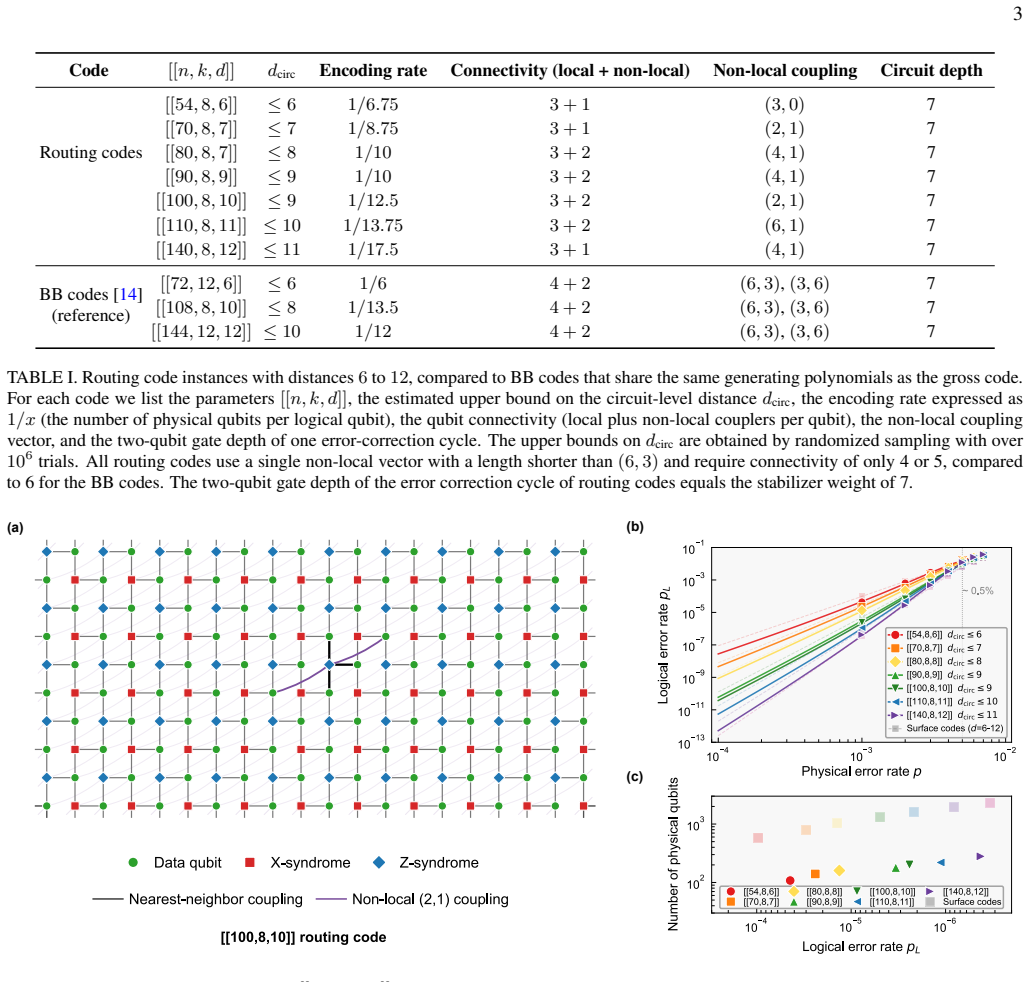
We construct routing codes as a family of qLDPC codes whose non-local couplings are all mutually parallel, with lower connectivity and shorter lengths than prior families, while preserving rates comparable to bivariate bicycle codes; weight-7 instances reduce physical-qubit overhead by a factor of approximately eight relative to surface codes under circuit-level noise.
What carries the argument
The routing code construction that forces every non-local stabilizer coupling to lie along parallel directions.
If this is right
- Encoding rates stay comparable to those of bivariate bicycle codes.
- Qubit connectivity is reduced in a systematic way.
- Lengths of non-local couplings are shortened.
- All non-local couplings become mutually parallel, eliminating wiring crossings.
- Scheduling of atom movement in neutral-atom arrays is simplified.
Where Pith is reading between the lines
- The parallel layout may allow denser 2D qubit packing without crossing constraints.
- Similar parallelism constraints could be applied to other qLDPC constructions to improve their hardware fit.
- If control overhead remains low, routing codes could support larger logical qubits on near-term devices.
Load-bearing premise
That the parallel short non-local couplings can be implemented in hardware without adding error sources or control overheads absent from the circuit-level simulations.
What would settle it
A circuit-level simulation that incorporates explicit costs for realizing the parallel non-local couplings and shows the factor-of-eight overhead reduction disappears or reverses.
Figures
read the original abstract
Quantum low-density parity-check (qLDPC) codes are promising candidates for realizing large-scale fault-tolerant quantum computing. Although many codes with favorable theoretical parameters have been developed, their practical adoption must take hardware implementability into account. For mainstream quantum platforms such as superconductors and neutral atoms, the connectivity, the length of non-local couplings, and the complexity of wiring or atom rearrangement are key factors that dictate the difficulty of hardware realization. Here, we propose a new family of qLDPC codes, termed routing codes. Within this family, we find explicit instances whose encoding rates are comparable to those of bivariate bicycle (BB) codes, while systematically reducing qubit connectivity, shortening the length of non-local couplings, and, crucially, making all non-local couplings mutually parallel. This parallelism fundamentally eliminates wiring crossings in superconducting multi-layer architectures and drastically simplifies the scheduling of atom movement in neutral-atom arrays. Under circuit-level simulation, the weight-7 routing codes reduce the physical qubit overhead by approximately a factor of 8, compared to surface codes achieving a same logical error rate. These results establish routing codes as a hardware-centric qLDPC family that bridges the gap between theoretical optimality and near-term physical feasibility.
Editorial analysis
A structured set of objections, weighed in public.
Referee Report
Summary. The manuscript introduces 'routing codes,' a new family of quantum LDPC codes. Explicit instances achieve encoding rates comparable to bivariate bicycle codes while reducing qubit connectivity, shortening non-local couplings, and ensuring all non-local couplings are mutually parallel. This parallelism is claimed to eliminate wiring crossings in superconducting architectures and simplify atom movement in neutral-atom platforms. Circuit-level simulations of weight-7 routing codes are reported to yield an approximately 8× reduction in physical-qubit overhead relative to surface codes at equivalent logical error rates.
Significance. If the constructions and simulation results hold under realistic hardware noise models, the work would be significant for bridging the gap between high-rate qLDPC theory and near-term hardware constraints on connectivity and wiring. The explicit focus on parallel non-local couplings directly targets implementability bottlenecks in superconducting and neutral-atom systems, and the reported overhead reduction would be a concrete quantitative advance over surface-code baselines.
major comments (1)
- [Abstract] Abstract (final paragraph): The headline claim that weight-7 routing codes reduce physical-qubit overhead by a factor of ~8 rests on circuit-level simulations. No quantitative bound or modified noise model is provided showing that the asserted short, mutually parallel non-local couplings do not introduce additional control, crosstalk, or movement-induced errors beyond those already present in the surface-code comparison; this assumption is load-bearing for the overhead-reduction result.
Simulated Author's Rebuttal
We thank the referee for the detailed review and constructive comment. We address the major point below and will revise the manuscript accordingly.
read point-by-point responses
-
Referee: [Abstract] Abstract (final paragraph): The headline claim that weight-7 routing codes reduce physical-qubit overhead by a factor of ~8 rests on circuit-level simulations. No quantitative bound or modified noise model is provided showing that the asserted short, mutually parallel non-local couplings do not introduce additional control, crosstalk, or movement-induced errors beyond those already present in the surface-code comparison; this assumption is load-bearing for the overhead-reduction result.
Authors: We agree that the circuit-level simulations employ a standard depolarizing noise model in which all gates (local and non-local) are assigned identical error rates, without an explicit quantitative bound on potential additional errors from control, crosstalk, or atom movement. The manuscript argues that the short, mutually parallel non-local couplings are designed to eliminate wiring crossings and simplify scheduling precisely to make such additional errors negligible in the target hardware platforms, but this remains an assumption rather than a derived bound. We will revise the abstract to state explicitly that the reported overhead reduction holds under a standard circuit-level noise model that assumes non-local gates incur no extra error beyond the baseline model, and we will add a clarifying sentence in the main text noting the scope of this assumption. revision: yes
Circularity Check
No significant circularity; constructions and simulations are independent of inputs
full rationale
The paper defines a new family of routing codes via explicit constructions that achieve encoding rates comparable to BB codes while enforcing parallel non-local couplings. These constructions are presented as direct combinatorial designs rather than fits or self-referential definitions. The factor-of-8 overhead reduction is obtained from separate circuit-level simulations against surface codes, which constitute external empirical benchmarks rather than quantities derived by construction from the code parameters themselves. No self-citation chains, ansatzes smuggled via prior work, or renamings of known results appear as load-bearing steps in the derivation. The central claims rest on verifiable code instances and standard simulation protocols that do not reduce to the paper's own inputs.
Axiom & Free-Parameter Ledger
Reference graph
Works this paper leans on
-
[1]
Shor, inProceedings 35th Annual Symposium on Foundations of Computer Science(1994) pp
P. Shor, inProceedings 35th Annual Symposium on Foundations of Computer Science(1994) pp. 124–134
1994
-
[2]
M. H. Freedman, A. Kitaev, and Z. Wang, Communications in Mathematical Physics227, 587 (2002)
2002
-
[3]
Preskill, Proceedings of the Royal Society of London
J. Preskill, Proceedings of the Royal Society of London. Series A: Mathematical, Physical and Engineering Sciences454, 385 (1998)
1998
-
[4]
Gottesman,Stabilizer codes and quantum error correction (California Institute of Technology, 1997)
D. Gottesman,Stabilizer codes and quantum error correction (California Institute of Technology, 1997)
1997
-
[5]
A. G. Fowler, M. Mariantoni, J. M. Martinis, and A. N. Cleland, Phys. Rev. A86, 032324 (2012)
2012
-
[6]
N. P. Breuckmann and J. N. Eberhardt, PRX Quantum2, 040101 (2021)
2021
-
[7]
Baspin and A
N. Baspin and A. Krishna, Quantum6, 711 (2022)
2022
-
[8]
Baspin and A
N. Baspin and A. Krishna, Phys. Rev. Lett.129, 050505 (2022)
2022
-
[9]
Bluvstein, H
D. Bluvstein, H. Levine, G. Semeghini, T. T. Wang, S. Ebadi, M. Kalinowski, A. Keesling, N. Maskara, H. Pichler, M. Greiner, V . Vuleti´c, and M. D. Lukin, Nature604, 451–456 (2022)
2022
-
[10]
C. D. Bruzewicz, J. Chiaverini, R. McConnell, and J. M. Sage, Applied Physics Reviews6, 10.1063/1.5088164 (2019)
-
[11]
F. Yan, P. Krantz, Y . Sung, M. Kjaergaard, D. L. Campbell, T. P. Orlando, S. Gustavsson, and W. D. Oliver, Phys. Rev. Appl.10, 054062 (2018)
2018
-
[12]
Kosen, H.-X
S. Kosen, H.-X. Li, M. Rommel, R. Rehammar, M. Caputo, L. Gr¨onberg, J. Fern´andez-Pend´as, A. F. Kockum, J. Bizn´arov´a, L. Chen,et al., PRX Quantum5, 030350 (2024)
2024
-
[13]
D. Rosenberg, D. Kim, R. Das, D. Yost, S. Gustavsson, D. Hover, P. Krantz, A. Melville, L. Racz, G. O. Samach, S. J. Weber, F. Yan, J. L. Yoder, A. J. Kerman, and W. D. Oliver, npj Quantum Information3, 10.1038/s41534-017-0044-0 (2017)
-
[14]
Bravyi, A
S. Bravyi, A. W. Cross, J. M. Gambetta, D. Maslov, P. Rall, and T. J. Yoder, Nature627, 778 (2024)
2024
-
[15]
M. H. Shaw and B. M. Terhal, Phys. Rev. Lett.134, 090602 (2025)
2025
-
[16]
R. Zhou, F. Zhang, H.-H. Zhao, F. Wu, L. Kong, and J. Chen, npj Quantum Information 10.1038/s41534-026-01306- y (2026)
-
[17]
R. Zhou, F. Zhang, L. Kong, F. Wu, H.-H. Zhao, and J. Chen, Phys. Rev. A113, 032401 (2026)
2026
-
[18]
G. P. Geh ´er, D. Byfield, and A. Ruban, Directional codes: a new family of quantum ldpc codes on hexagonal- and square- grid connectivity hardware (2025)
2025
-
[19]
K. Heya, T. Phung, M. Malekakhlagh, R. Steiner, M. Turchetti, W. Shanks, J. Mamin, W.-S. Lu, Y . P. Kandel, N. Sundaresan, and J. Orcutt, Phys. Rev. Lett.135, 200801 (2025)
2025
-
[20]
X. Deng, W. Zheng, X. Liao, H. Zhou, Y . Ge, J. Zhao, D. Lan, X. Tan, Y . Zhang, S. Li, and Y . Yu, Phys. Rev. Lett.134, 020801 (2025)
2025
-
[21]
Marxer, A
F. Marxer, A. Veps ¨al¨ainen, S. W. Jolin, J. Tuorila, A. Landra, C. Ockeloen-Korppi, W. Liu, O. Ahonen, A. Auer, L. Belzane, et al., PRX Quantum4, 010314 (2023)
2023
-
[22]
K. Wang, Z. Lu, C. Zhang, G. Liu, J. Chen, Y . Wang, Y . Wu, S. Xu, X. Zhu, F. Jin, Y . Gao, Z. Tan, Z. Cui, N. Wang, Y . Zou, 7 A. Zhang, T. Li, F. Shen, J. Zhong, Z. Bao, Z. Zhu, Y . Han, Y . He, J. Shen, H. Wang, J.-N. Yang, Z. Song, J. Deng, H. Dong, Z.-Z. Sun, W. Li, Q. Ye, S. Jiang, Y . Ma, P.-X. Shen, P. Zhang, H. Li, Q. Guo, Z. Wang, C. Song, H. W...
2026
-
[23]
Rosenberg, D
D. Rosenberg, D. Kim, R. Das, D. Yost, S. Gustavsson, D. Hover, P. Krantz, A. Melville, L. Racz, G. Samach,et al., npj quantum information3, 42 (2017)
2017
-
[24]
Field, A
M. Field, A. Q. Chen, B. Scharmann, E. A. Sete, F. Oruc, K. Vu, V . Kosenko, J. Y . Mutus, S. Poletto, and A. Bestwick, Physical Review Applied21, 054063 (2024)
2024
-
[25]
G. J. Norris, K. Dalton, D. C. Zanuz, A. Rommens, A. Flasby, M. B. Panah, F. Swiadek, C. Scarato, C. Hellings, J.-C. Besse, et al., arXiv preprint arXiv:2503.12603 (2025)
arXiv 2025
-
[26]
D.-R. W. Yost, M. E. Schwartz, J. Mallek, D. Rosenberg, C. Stull, J. L. Yoder, G. Calusine, M. Cook, R. Das, A. L. Day, et al., npj Quantum Information6, 59 (2020)
2020
-
[27]
J. L. Mallek, D.-R. W. Yost, D. Rosenberg, J. L. Yoder, G. Calu- sine, M. Cook, R. Das, A. Day, E. Golden, D. K. Kim,et al., arXiv preprint arXiv:2103.08536 (2021)
arXiv 2021
-
[28]
T. M. Hazard, W. Woods, D. Rosenberg, R. Das, C. F. Hir- jibehedin, D. K. Kim, J. Knecht, J. Mallek, A. Melville, B. M. Niedzielski,et al., Applied Physics Letters123(2023)
2023
-
[29]
Bluvstein, S
D. Bluvstein, S. J. Evered, A. A. Geim, S. H. Li, H. Zhou, T. Manovitz, S. Ebadi, M. Cain, M. Kalinowski, D. Hangleiter, et al., Nature626, 58 (2024)
2024
-
[30]
Bluvstein, A
D. Bluvstein, A. A. Geim, S. H. Li, S. J. Evered, J. P. Bonilla Ataides, G. Baranes, A. Gu, T. Manovitz, M. Xu, M. Kalinowski, S. Majidy, C. Kokail, N. Maskara, E. C. Trapp, L. M. Stewart, S. Hollerith, H. Zhou, M. J. Gullans, S. F. Yelin, M. Greiner, V . Vuleti´c, M. Cain, and M. D. Lukin, Nature649, 39–46 (2025)
2025
-
[31]
Y . Sung, L. Ding, J. Braum ¨uller, A. Veps¨al¨ainen, B. Kannan, M. Kjaergaard, A. Greene, G. O. Samach, C. McNally, D. Kim, A. Melville, B. M. Niedzielski, M. E. Schwartz, J. L. Yoder, T. P. Orlando, S. Gustavsson, and W. D. Oliver, Phys. Rev. X 11, 021058 (2021)
2021
-
[32]
L. R. B. Picard, A. J. Park, G. E. Patenotte, S. Gebretsadkan, D. Wellnitz, A. M. Rey, and K.-K. Ni, Nature637, 821–826 (2024)
2024
-
[33]
P. Ildefonso, A. Byun, A. Konovalov, J. Kazemi, M. Schuler, and W. Lechner, Expanding the neutral atom gate set: Native iswap and exchange gates from dipolar rydberg interactions (2025), arXiv:2512.05037 [quant-ph]
Pith/arXiv arXiv 2025
-
[34]
Panteleev and G
P. Panteleev and G. Kalachev, Quantum5, 585 (2021)
2021
-
[35]
D. S. Wang, A. G. Fowler, and L. C. L. Hollenberg, Phys. Rev. A83, 020302(R) (2011)
2011
-
[36]
Higgott, ACM Transactions on Quantum Computing3, 1–16 (2022)
O. Higgott, ACM Transactions on Quantum Computing3, 1–16 (2022)
2022
-
[37]
T. M ¨uller, T. Alexander, M. E. Beverland, M. B ¨uhler, B. R. Johnson, T. Maurer, and D. Vandeth, Improved belief propa- gation is sufficient for real-time decoding of quantum memory (2025), arXiv:2506.01779 [quant-ph]
arXiv 2025
-
[38]
Bausch, A
J. Bausch, A. W. Senior, F. J. H. Heras, T. Edlich, A. Davies, M. Newman, C. Jones, K. Satzinger, M. Y . Niu, S. Black- well, G. Holland, D. Kafri, J. Atalaya, C. Gidney, D. Hassabis, S. Boixo, H. Neven, and P. Kohli, Nature635, 834–840 (2024)
2024
-
[39]
A. W. Senior, T. Edlich, F. J. H. Heras, L. M. Zhang, O. Hig- gott, J. S. Spencer, T. Applebaum, S. Blackwell, J. Ledford, A. ˇZemgulyt˙e, A. ˇZ´ıdek, N. Shutty, A. Cowie, Y . Li, G. Hol- land, P. Brooks, C. Beattie, M. Newman, A. Davies, C. Jones, S. Boixo, H. Neven, P. Kohli, and J. Bausch, A scalable and real-time neural decoder for topological quantum...
arXiv 2026
-
[40]
G. P. Geh ´er, O. Crawford, and E. T. Campbell, PRX Quantum 5, 010348 (2024)
2024
-
[41]
McEwen, D
M. McEwen, D. Bacon, and C. Gidney, Quantum7, 1172 (2023)
2023
- [42]
-
[43]
M. Mathews, L. Pahl, D. Pahl, V . L. Addala, C. Tang, W. D. Oliver, and J. A. Grover, npj Quantum Information 10.1038/s41534-026-01243-w (2026)
-
[44]
Stade, L
Y . Stade, L. Schmid, L. Burgholzer, and R. Wille, in2024 IEEE International Conference on Quantum Computing and Engi- neering (QCE)(IEEE, 2024) p. 784–795
2024
-
[45]
Liang, K
Z. Liang, K. Liu, H. Song, and Y .-A. Chen, PRX Quantum6, 020357 (2025)
2025
-
[46]
Strikis, S
A. Strikis, S. C. Benjamin, and B. J. Brown, Phys. Rev. Appl. 19, 064081 (2023)
2023
-
[47]
Siegel, A
A. Siegel, A. Strikis, T. Flatters, and S. Benjamin, Quantum7, 1065 (2023)
2023
-
[48]
T.-H. Wei, J.-X. Zhang, J.-N. Li, W.-C. Kong, Y .-C. Wu, and G.-P. Guo, Adaptive deformation of color code in square lattices with defects (2026), arXiv:2604.05874 [quant-ph]
Pith/arXiv arXiv 2026
-
[49]
L. Z. Cohen, I. H. Kim, S. D. Bartlett, and B. J. Brown, Science Advances8, 10.1126/sciadv.abn1717 (2022)
-
[50]
N. Khaneja and S. Glaser, Cartan decomposition ofsu(2 n), constructive controllability of spin systems and universal quan- tum computing (2000), arXiv:quant-ph/0010100 [quant-ph]
Pith/arXiv arXiv 2000
-
[51]
R. R. Tucci, An introduction to cartan’s kak decomposition for qc programmers (2005), arXiv:quant-ph/0507171 [quant-ph]
Pith/arXiv arXiv 2005
-
[52]
M. A. Nielsen and I. L. Chuang,Quantum computation and quantum information(Cambridge university press, 2010). [53]Gurobi Optimizer Reference Manual(2026)
2010
-
[53]
Gidney, Quantum5, 497 (2021)
C. Gidney, Quantum5, 497 (2021). VII. METHODS A. Qubit routing with iSW AP gates In prior works, qubit routing is utilized to efficiently over- come hardware connectivity constraints [16, 17]. The central building block of qubit routing is the iSW AP gate, which is equivalent to a CNOT gate followed by a SW AP gate. This operation commonly referred to as ...
2021
discussion (0)
Sign in with ORCID, Apple, or X to comment. Anyone can read and Pith papers without signing in.