Emergence of Quasi-two-dimensional Superconductivity in W-doped Bulk Noncentrosymmetric 3R-TaSe₂
Pith reviewed 2026-06-25 20:13 UTC · model grok-4.3
The pith
W-doped 3R-TaSe2 develops quasi-two-dimensional superconductivity where magnetotransport shows two-fold symmetry breaking the crystal's three-fold symmetry.
A machine-rendered reading of the paper's core claim, the machinery that carries it, and where it could break.
Core claim
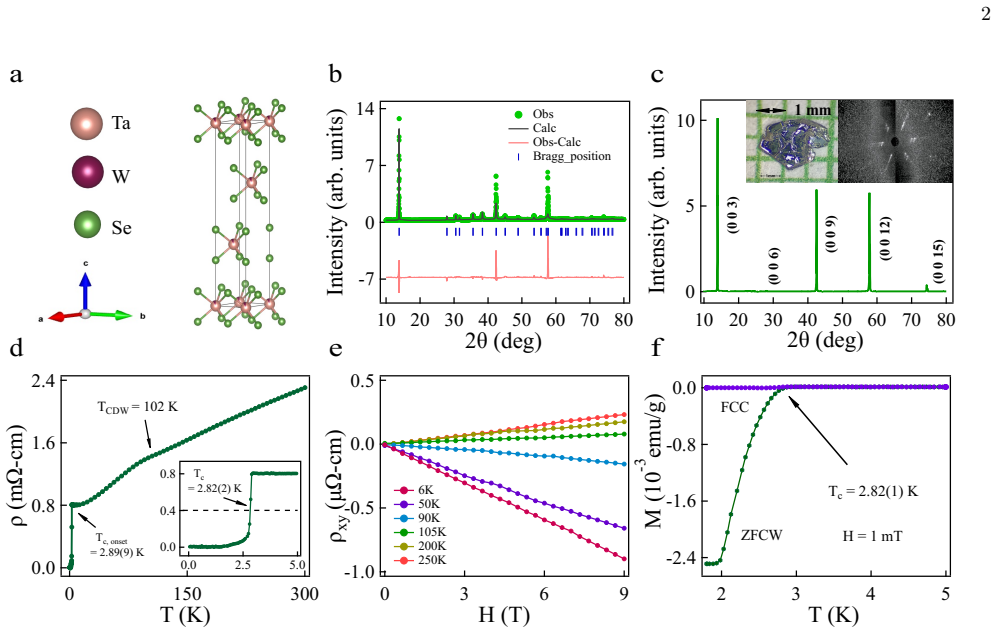
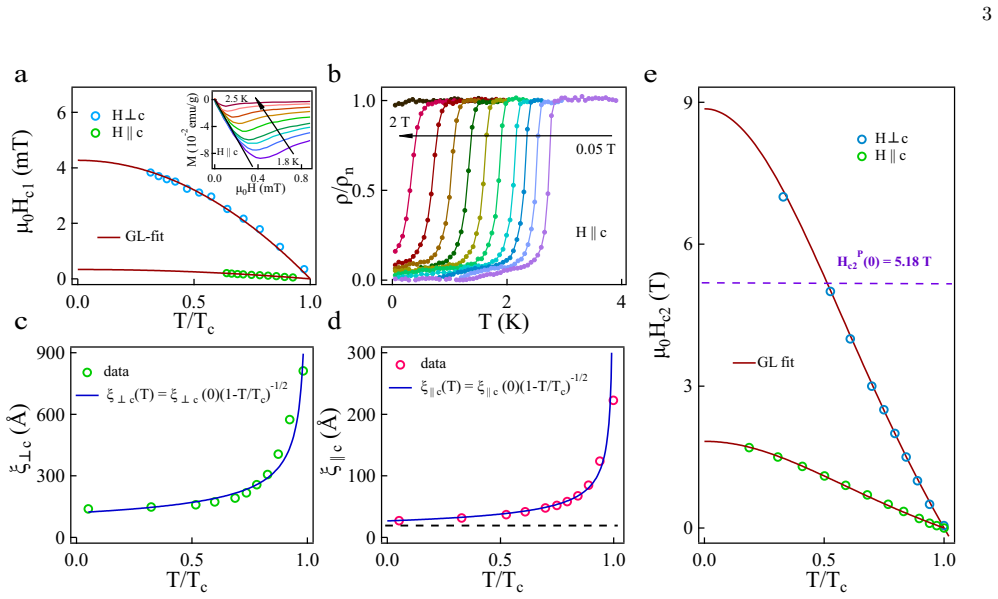
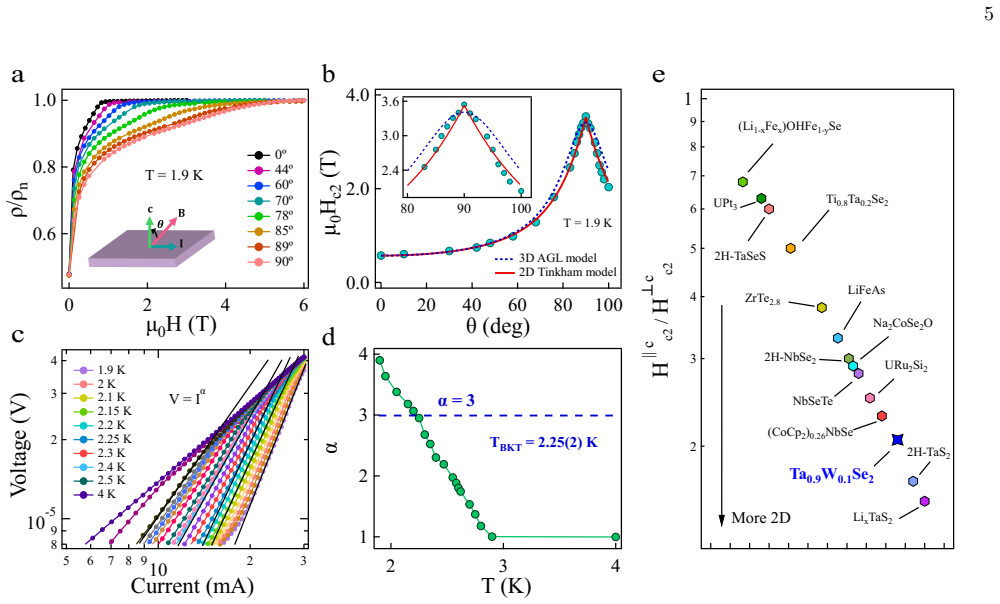
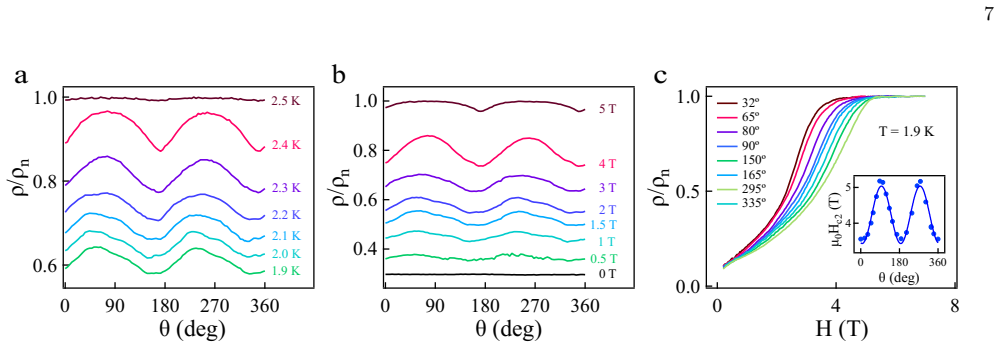
W-doped bulk noncentrosymmetric 3R-TaSe2 hosts weakly coupled anisotropic unconventional superconductivity at Tc = 2.82 K with quasi-two-dimensional nature revealed by BKT transition and Hc2 angular dependence, and crucially exhibits two-fold rotational symmetry in the superconducting state under in-plane fields that breaks the three-fold lattice symmetry.
What carries the argument
The two-fold rotational symmetry observed in magnetotransport within the superconducting state under in-plane fields, which breaks the underlying three-fold lattice symmetry.
Load-bearing premise
The interpretation of intrinsic quasi-two-dimensional superconductivity and symmetry breaking assumes that the single crystals are homogeneous without significant disorder or domain effects producing the observed features.
What would settle it
If high-quality samples show consistent three-fold symmetry in the superconducting state magnetotransport or if the BKT-like transition is absent in cleaner crystals, the claim of intrinsic quasi-2D superconductivity tied to broken symmetry would be challenged.
Figures
read the original abstract
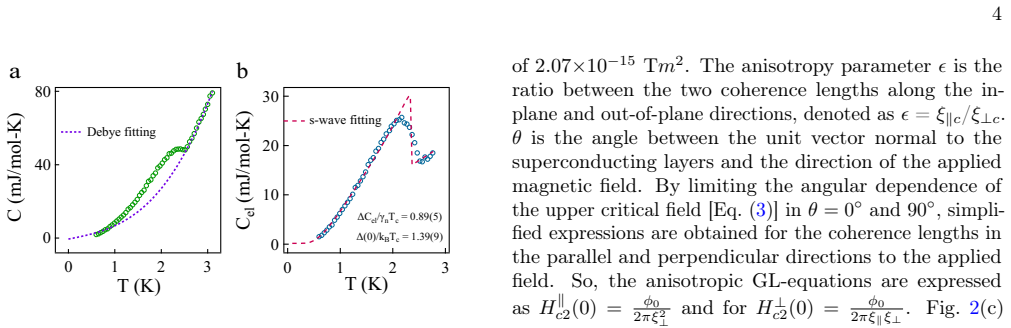
Noncentrosymmetric transition-metal dichalcogenides offer a rich environment for the study of unconventional superconducting phenomena. Here, we present a comprehensive analysis of single-crystalline W-doped 3$R$-TaSe$_2$, revealing weakly coupled anisotropic unconventional superconductivity at $T_c$ = 2.82(2) K, with an in-plane upper critical field exceeding the Pauli limit by 1.7 times. The angular dependence of the upper critical field, along with the observation of a Berezinskii-Kosterlitz-Thouless transition, reveals quasi-two-dimensional superconductivity. Crucially, magnetotransport reveals a distinct two-fold rotational symmetry within the superconducting state under in-plane fields, breaking the underlying three-fold lattice symmetry. These findings establish W-doped $3R\text{-TaSe}_2$ as a bulk model system for exploring intrinsic low-dimensional superconductivity and broken rotational symmetry, thus opening new directions for future quantum technologies.
Editorial analysis
A structured set of objections, weighed in public.
Referee Report
Summary. The manuscript reports experimental results on single-crystalline W-doped 3R-TaSe2, claiming weakly coupled anisotropic unconventional superconductivity with Tc = 2.82(2) K. Key observations include an in-plane upper critical field exceeding the Pauli limit by a factor of 1.7, angular dependence of Hc2 and a BKT-like transition indicating quasi-two-dimensional superconductivity, and crucially a two-fold rotational symmetry in magnetotransport under in-plane fields that breaks the three-fold lattice symmetry. The work positions the material as a bulk model system for intrinsic low-dimensional superconductivity and broken rotational symmetry.
Significance. If the two-fold symmetry is shown to be intrinsic rather than extrinsic, the result would be significant for the field as it supplies a bulk noncentrosymmetric platform exhibiting quasi-2D behavior with unexpected rotational symmetry breaking, potentially relevant to studies of unconventional pairing and low-dimensional quantum phenomena. The paper supplies standard magnetotransport and critical-field data supporting the quasi-2D assignment, which strengthens the case if homogeneity is adequately demonstrated.
major comments (2)
- [Magnetotransport under in-plane fields] Magnetotransport under in-plane fields section: the central claim that the observed two-fold rotational symmetry is intrinsic to the quasi-2D superconducting state (and breaks the three-fold lattice symmetry) is load-bearing for the headline result. The manuscript does not appear to include explicit controls or data (e.g., rocking-curve widths, spatially resolved resistivity maps, or STM/AFM images) demonstrating sample homogeneity and the absence of domain walls or twinning that could produce anisotropic vortex pinning or current distribution effects.
- [BKT transition and Hc2 anisotropy] BKT transition and Hc2 anisotropy subsection: while the BKT identification and Hc2 angular dependence are used to establish the quasi-2D character, the manuscript supplies no quantitative error bars, fitting details, or comparison to alternative (e.g., 3D anisotropic) models in the relevant figures or text, leaving the robustness of the quasi-2D assignment open to question when linked to the symmetry-breaking interpretation.
minor comments (2)
- [Abstract] The abstract states numerical values such as Tc = 2.82(2) K and the 1.7 imes Pauli-limit factor without referencing the corresponding figures or tables; cross-references should be added for clarity.
- [Title and abstract] Notation for the crystal structure (3$R$-TaSe2) is used inconsistently in the title versus the abstract; standardize throughout.
Simulated Author's Rebuttal
We thank the referee for their careful reading of the manuscript and for identifying key points that require clarification. We address each major comment below with point-by-point responses. Revisions will be made to strengthen the presentation of sample homogeneity and the quantitative analysis of the BKT transition and Hc2 anisotropy.
read point-by-point responses
-
Referee: [Magnetotransport under in-plane fields] Magnetotransport under in-plane fields section: the central claim that the observed two-fold rotational symmetry is intrinsic to the quasi-2D superconducting state (and breaks the three-fold lattice symmetry) is load-bearing for the headline result. The manuscript does not appear to include explicit controls or data (e.g., rocking-curve widths, spatially resolved resistivity maps, or STM/AFM images) demonstrating sample homogeneity and the absence of domain walls or twinning that could produce anisotropic vortex pinning or current distribution effects.
Authors: We agree that explicit demonstration of sample homogeneity is important for establishing the intrinsic nature of the two-fold symmetry breaking. The current manuscript relies on the sharp superconducting transition width implied by Tc = 2.82(2) K, reproducibility across multiple crystals, and the fact that the anisotropy is confined to the superconducting state (normal-state magnetotransport shows no such breaking). However, we acknowledge that dedicated controls such as rocking-curve data or spatial mapping are not presented. In the revised manuscript we will add available X-ray diffraction rocking-curve results and a brief discussion of why domain-wall or twinning effects are unlikely given the temperature and field dependence of the observed anisotropy. revision: yes
-
Referee: [BKT transition and Hc2 anisotropy] BKT transition and Hc2 anisotropy subsection: while the BKT identification and Hc2 angular dependence are used to establish the quasi-2D character, the manuscript supplies no quantitative error bars, fitting details, or comparison to alternative (e.g., 3D anisotropic) models in the relevant figures or text, leaving the robustness of the quasi-2D assignment open to question when linked to the symmetry-breaking interpretation.
Authors: We thank the referee for this observation. The BKT transition is identified via the power-law exponent in current-voltage characteristics approaching 3, and the Hc2 angular dependence is compared to the Tinkham 2D model. To improve robustness, the revised manuscript will include error bars on all relevant data points, explicit fitting parameters and uncertainties for both the BKT and Hc2 analyses, and a direct comparison of the angular Hc2 data to a 3D anisotropic Ginzburg-Landau model to quantify why the 2D description is preferred. revision: yes
Circularity Check
No circularity: experimental observations only
full rationale
The paper is a purely experimental report on magnetotransport and superconductivity measurements in W-doped 3R-TaSe2 single crystals. It presents raw data (Tc = 2.82 K, Hc2 anisotropy, BKT-like transition, two-fold symmetry in in-plane fields) and interprets them as evidence for quasi-2D behavior and broken rotational symmetry. No equations, derivations, fitted parameters renamed as predictions, or self-citations appear in the provided text. All claims rest on direct measurement rather than any chain that reduces to its own inputs by construction. This is the expected outcome for an experimental manuscript with no theoretical modeling.
Axiom & Free-Parameter Ledger
Reference graph
Works this paper leans on
-
[1]
(5)) [49]
and the Tinkham model (Eq. (5)) [49]. The for- mer describes the angular variation in three-dimensional (3D) superconductors, with an ellipsoidal form ofHc2(θ), whereas the latter accounts for two-dimensional (2D) thin- film superconductors and predicts a characteristic cusp at θ = 90◦. Therefore, fitting the experimental data to these models allows us to...
2023
-
[2]
Lian,Phys
C.-S. Lian,Phys. Rev. B2023,107, 4 045431. 8
-
[3]
D. Qiu, C. Gong, S. Wang, M. Zhang, C. Yang, X. Wang, J. Xiong,Adv. Mater.2021,33, 18 2006124
2021
-
[4]
Dogra, R
G.Venditti, J.Biscaras, S.Hurand, N.Bergeal, J.Lesueur, A. Dogra, R. C. Budhani, M. Mondal, J. Jesudasan, P. Raychaudhuri, S. Caprara, L. Benfatto,Phys. Rev. B 2019,100064506
2019
-
[5]
X. Xi, Z. Wang, W. Zhao, J.-H. Park, K. T. Law, H. Berger, L. Forró, J. Shan, K. F. Mak,Nat. Phys. 2016,12, 2 139
2016
-
[6]
Patra, T
C. Patra, T. Agarwal, R. Verma, P. Manna, S. Srivastava, R. S. Singh, M. S. Scheurer, B. Singh, R. P. Singh,Phys. Rev. Lett.2025, –
2025
-
[7]
Hamill, B
A. Hamill, B. Heischmidt, E. Sohn, D. Shaffer, K.-T. Tsai, X. Zhang, X. Xi, A. Suslov, H. Berger, L. Forró, et al., Nat. phys.2021,17, 8 949
2021
-
[8]
S. C. De la Barrera, M. R. Sinko, D. P. Gopalan, N. Sivadas, K. L. Seyler, K. Watanabe, T. Taniguchi, A. W. Tsen, X. Xu, D. Xiao, B. M. Hunt,Nat. Commun. 2018,9, 1 1427
2018
-
[9]
Möckli, M
D. Möckli, M. Khodas,Phys. Rev. B2019,99180505(R)
-
[10]
N. F. Q. Yuan, K. F. Mak, K. T. Law,Phys. Rev. Lett. 2014,113097001
2014
-
[11]
Z. Li, P. Lyu, Z. Chen, D. Guan, S. Yu, J. Zhao, P. Huang, X. Zhou, Z. Qiu, H. Fang, M. Hashimoto, D. Lu, F. Song, K. P. Loh, Y. Zheng, Z.-X. Shen, K. S. Novoselov, J. Lu, Adv. Mater.2024,36, 24 2312341
2024
-
[12]
Devarakonda, H
A. Devarakonda, H. Inoue, S. Fang, C. Ozsoy-Keskinbora, T. Suzuki, M. Kriener, L. Fu, E. Kaxiras, D. C. Bell, J. G. Checkelsky,Science2020,370, 6513 231
-
[13]
L. K. Ma, M. Z. Shi, B. L. Kang, K. L. Peng, F. B. Meng, C. S. Zhu, J. H. Cui, Z. L. Sun, D. H. Ma, H. H. Wang, B. Lei, T. Wu, X. H. Chen,Phys. Rev. Mater.2020,4 124803
2020
-
[14]
J. Lu, O. Zheliuk, I. Leermakers, N. F. Yuan, U. Zeitler, K. T. Law, J. Ye,Science2015,350, 6266 1353
-
[15]
Patra, T
C. Patra, T. Agarwal, R. R. Chaudhari, R. P. Singh,Phys. Rev. B2022,106134515
-
[16]
Agarwal, C
T. Agarwal, C. Patra, A. Kataria, R. R. Chowdhury, R. Singh,Phys. Rev. B2023,107, 17 174509
-
[18]
K. Fan, M. Shi, H. Li, Z. Xiang, X. Chen,Phys. Rev. Mater.2025,9, 3 034804
2025
-
[19]
Agarwal, C
T. Agarwal, C. Patra, P. Manna, S. Srivastava, P. Mishra, S. Sharma, R. P. Singh,Phys. Rev. B2025,112014501
-
[20]
Q. Hu, J. Y. Liu, Q. Shi, F. J. Zhang, Y. Zhong, L. Lei, R. Ang,Europhys. Lett.2021,135, 5 57003
2021
-
[21]
H. Wang, Y. Jiao, F. Meng, X. Zhang, D. Dai, C. Tu, C. Zhao, L. Xin, S. Huang, H. Lei, S. Li,Phys. Rev. Lett. 2025,135126002
2025
-
[22]
S.-B. Liu, C. Tian, Y. Fang, H. Rong, L. Cao, X. Wei, H. Cui, M. Chen, D. Chen, Y. Song, J. Cui, J. Li, S. Guan, S. Jia, C. Chen, W. He, F. Huang, Y. Jiang, J. Mao, X. C. Xie, K. T. Law, J.-H. Chen,Nat. Commun.2024,15, 1 7569
2024
-
[23]
S. Roy, A. Kreisel, B. M. Andersen, S. Mukherjee,Phys. Rev. B2026,113014506
-
[24]
Ribak, R
A. Ribak, R. M. Skiff, M. Mograbi, P. K. Rout, M. H. Fischer, J. Ruhman, K. Chashka, Y. Dagan, A. Kanigel, Science Advances2020,6, 13 eaax9480
-
[25]
Z. Xie, Z. Chen, M. Yang, L. Liao, J. Deng, B. Song, X. Chen, Z. Liu, J. Yan, X. Huang, L.-g. Jia, Y. Huang, X. Chen, L. Zhang, Z. Cheng, J.-g. Guo,Adv. Funct. Mater.2025,35, 32 2501453
2025
-
[26]
H. Luo, W. Xie, E. M. Seibel, R. J. Cava,J. Phys.: Condens. Matter2015,27, 36 365701
-
[27]
Y. Deng, Y. Lai, X. Zhao, X. Wang, C. Zhu, K. Huang, C. Zhu, J. Zhou, Q. Zeng, R. Duan, Q. Fu, L. Kang, Y. Liu, S. J. Pennycook, X. R. Wang, Z. Liu,Journal of the American Chemical Society2020,142, 6 2948, pMID: 31961673
-
[28]
D. Bhoi, S. Khim, W. Nam, B. Lee, C. Kim, B.-G. Jeon, B. Min, S. Park, K. H. Kim,Sci. Rep.2016,6, 1 24068
2016
- [29]
-
[30]
H. Bai, M. Wang, X. Yang, Y. Li, J. Ma, X. Sun, Q. Tao, L. Li, Z.-A. Xu,J. Phys.: Condens. Matter2018,30, 9 095703
-
[31]
Lawan Adam, I
M. Lawan Adam, I. Buba Garba, A. Alhaji Bala, A. Aji Suleiman, S. Muhammad Gana, F. Lawan Adam, Phys. Rev. B2023,107104510
-
[32]
H. Luo, W. Xie, J. Tao, H. Inoue, A. Gyenis, J. W. Krizan, A. Yazdani, Y. Zhu, R. J. Cava,Proc. Natl. Acad. of Sci. 2015,112, 11 E1174
2015
-
[33]
Y. Qi, Q. Yang, P. Zhu, D. Hu, X. Chen, H. Ren, P. Duan, J. Xiao, Z. Wang, X. Li,J. Mater. Chem. C2026
-
[34]
Zheng, X
B. Zheng, X. Zhang, K. Wang, R. Li, J. Cao, C. Wang, H. Tan, Z. Li, B. Lin, P. Li, C. Xi, J. Zhang, Y. Lu, W. Zhu, Z. Liu, S. A. Yang, L.-J. Li, F. Liu, B. Xiang, Nano Lett.2025,25, 12 4895
2025
-
[35]
Patra, T
C. Patra, T. Agarwal, S. Srivastava, R. R. Chowdhury, M. Saravanan, R. P. Singh,Adv. Quantum Technol.2024, 7, 2 2300448
2024
-
[36]
Momma, F
K. Momma, F. Izumi,J. Appl. Cryst.2011,44, 6 1272
2011
-
[37]
Rodríguez-Carvajal,Physica B: Condens
J. Rodríguez-Carvajal,Physica B: Condens. Matter1993, 192, 1 55
-
[38]
Bjerkelund, A
E. Bjerkelund, A. Kjekshus, Å. Nilsson, J. Sandström, H. Theorell, R. Blinc, S. Paušak, L. Ehrenberg, J. Du- manović,Acta Chem. Scand.1967,21513
1967
-
[39]
See supplemental material for additional details on powder XRD data, EDAX data, magnetization, resistivity, and Uemura plot, which includes refs. [51-65]
-
[40]
Tinkham,Introduction to superconductivity, Courier Corporation,2004
M. Tinkham,Introduction to superconductivity, Courier Corporation,2004
2004
-
[41]
M. Shi, K. Fan, H. Li, S. Pan, J. Cai, N. Zhang, H. Li, T. Wu, J. Zhang, C. Xi, Z. Xiang, X. Chen,J. Am. Chem. Soc.2024,146, 49 33413
2024
-
[42]
B. S. Chandrasekhar,Appl. Phys. Lett.1962,17
1962
-
[43]
A. M. Clogston,Phys. Rev. Lett.1962,9266
1962
-
[44]
Zhang, A
H. Zhang, A. Rousuli, K. Zhang, L. Luo, C. Guo, X. Cong, Z.Lin, C.Bao, H.Zhang, S.Xu, R.Feng, S.Shen, K.Zhao, W. Yao, Y. Wu, S. Ji, X. Chen, P. Tan, Q.-K. Xue, Y. Xu, W. Duan, P. Yu, S. Zhou,Nat. Phys.2022,18, 12 1425
2022
-
[45]
Palstra, B
T. Palstra, B. Batlogg, L. Schneemeyer, R. Van Dover, J. V. Waszczak,Phys. Rev. B1988,38, 7 5102
-
[46]
J. L. Vicent, S. J. Hillenius, R. V. Coleman,Phys. Rev. Lett.1980,44892
1980
-
[47]
S. Ni, M. Zhou, K. Shi, L. Chen, J. Yi, M. Zhang, Y. Han, J. Wu, Z. Li, Z. Xu, C. Xi, Z.-A. Ren, Z. Wang,Phys. Rev. B2024,110174511
-
[48]
W. Wan, R. Harsh, P. Dreher, F. de Juan, M. M. Ugeda, npj 2D Mater. Appl.2023,7, 1 41
2023
-
[49]
J. M. Pereira, D. Tezze, I. Niehues, Y. Asensio, H. Yang, L. Mester, S. Chen, F. Casanova, A. M. Bittner, M. Or- maza, F. Schiller, B. Martín-García, R. Hillenbrand, L. E. Hueso, M. Gobbi,Adv. Func. Mater.2022,32, 52 2208761
2022
-
[50]
Tinkham,Phys
M. Tinkham,Phys. Rev.1963,1292413. 9
1963
-
[51]
Takiguchi, Y
K. Takiguchi, Y. Krockenberger, Y. Taniyasu, H. Ya- mamoto,Phys. Rev. B2024,110, 2 024516
-
[52]
W. L. McMillan,Phys. Rev.1968,167331
1968
-
[53]
Padamsee, J
H. Padamsee, J. Neighbor, C. Shiffman,J. Low Temp. Phys.1973,12387
1973
-
[54]
Y. J. Uemura, G. M. Luke, B. J. Sternlieb, J. H. Brewer, J. F. Carolan, W. N. Hardy, R. Kadono, J. R. Kempton, R. F. Kiefl, S. R. Kreitzman, P. Mulhern, T. M. Rise- man, D. L. Williams, B. X. Yang, S. Uchida, H. Takagi, J. Gopalakrishnan, A. W. Sleight, M. A. Subramanian, C. L. Chien, M. Z. Cieplak, G. Xiao, V. Y. Lee, B. W. Statt, C. E. Stronach, W. J. K...
1989
-
[55]
Z. Wang, J. Yuan, J. Wosnitza, H. Zhou, Y. Huang, K. Jin, F. Zhou, X. Dong, Z. Zhao,J. Phys. Condens. Matter 2017,29, 2 025701
2017
-
[56]
Keller, J
N. Keller, J. L. Tholence, A. Huxley, J. Flouquet,Phys. Rev. Lett.1994,732364
1994
- [57]
- [58]
-
[59]
J. L. Zhang, L. Jiao, F. F. Balakirev, X. C. Wang, C. Q. Jin, H. Q. Yuan,Phys. Rev. B2011,83174506
-
[60]
Kurita, K
N. Kurita, K. Kitagawa, K. Matsubayashi, A. Kismara- hardja, E.-S. Choi, J. S. Brooks, Y. Uwatoko, S. Uji, T. Terashima,J. Phys. Soc. Jpn.2010,80, 1 013706
2010
-
[61]
F. Soto, H. Berger, L. Cabo, C. Carballeira, J. Mosqueira, D. Pavuna, P. Toimil, F. Vidal,Physica C: Supercon- ductivity2007,460-462789, proceedings of the 8th In- ternational Conference on Materials and Mechanisms of Superconductivity and High Temperature Superconduc- tors
-
[62]
Cheng, J
J. Cheng, J. Bai, B. Ruan, P. Liu, Y. Huang, Q. Dong, Y. Huang, Y. Sun, C. Li, L. Zhang, Q. Liu, W. Zhu, Z. Ren, G. Chen,J. Am. Chem. Soc.2024,146, 9 5908
2024
-
[63]
Keller, J
N. Keller, J. Brison, P. Lejay, J. Tholence, A. Huxley, L. Schmidt, A. Buzdin, J. Flouquet,Physica B: Con- dens. Matter1995,206-207568, proceedings of the In- ternational Conference on Strongly Correlated Electron Systems
-
[64]
Scheidt, M
E.-W. Scheidt, M. Herzinger, A. Fischer, D. Schmitz, J. Reiners, F. Mayr, F. Loder, M. Baenitz, W. Scherer, J. Phys.: Condens. Matter2015,27, 15 155701
-
[65]
Y. Yang, S. Fang, V. Fatemi, J. Ruhman, E. Navarro- Moratalla, K. Watanabe, T. Taniguchi, E. Kaxiras, P. Jarillo-Herrero,Phys. Rev. B2018,98035203
-
[66]
Abdel-Hafiez, X.-M
M. Abdel-Hafiez, X.-M. Zhao, A. A. Kordyuk, Y.-W. Fang, B. Pan, Z. He, C.-G. Duan, J. Zhao, X.-J. Chen, Sci. Rep.2016,6, 1 31824
2016
discussion (0)
Sign in with ORCID, Apple, or X to comment. Anyone can read and Pith papers without signing in.