REVIEW 5 minor 25 references
Strict Fairness at What Cost? Envy-Free Contracts with Subsidies
T0 review · 0 major / 5 minor · reviewed 2026-07-15 · grok-4.5
Pith's one-line read Agent-specific subsidies restore strict envy-freeness in task contracts and bound the principal's revenue loss by n to the power n.
desk verdict Clean theory paper: subsidies restore exact EF with a tight n^{Θ(n)} PoF, versus unbounded for plain EF. read the letter →
The pith
A machine-rendered reading of the paper's core claim, the machinery that carries it, and where it could break.
The reading
What carries the argument
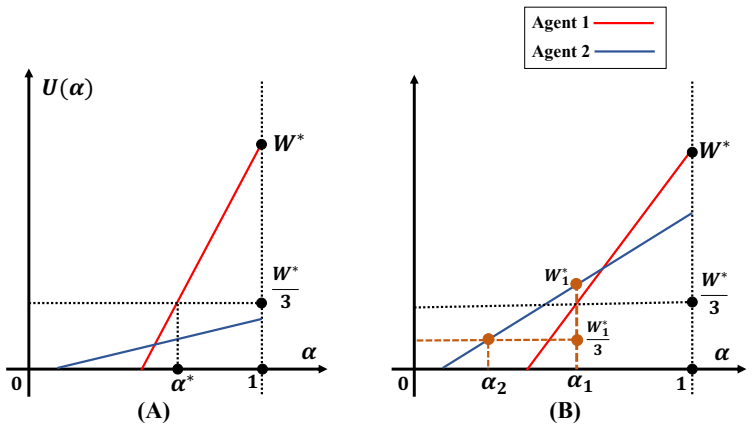
The single-task optimal-subsidy characterization (Lemma 5.1): under a fixed linear share, the task is assigned to the agent with maximal nonnegative utility, that agent receives zero subsidy, and every other agent receives a common subsidy equal to the second-highest utility. An iterative algorithm that repeatedly targets a 1/(n+1) fraction of residual welfare then yields the O((n+1)^n) guarantee, which extends additively across tasks.
What would settle it
Construct a multi-task instance in which complementarities or non-linear contracts force the joint EFS optimum to lose more than a (n+1)^n fraction of unconstrained revenue, or exhibit a family of single-task instances whose EFS-to-unconstrained ratio grows faster than any n^{O(n)}.
Extended reading notes
Core claim
Envy-free contracts with agent-specific subsidies restore exact envy-freeness while keeping the principal's revenue loss bounded by n^{Theta(n)}. In contrast to pure envy-free contracts, whose price of fairness can be unbounded, the price of fairness for EFS contracts is upper-bounded by O((n+1)^n) and lower-bounded by Omega(n^{n-1}); moreover, optimal EFS revenue can exceed optimal envy-free revenue by an arbitrarily large factor.
Load-bearing premise
The revenue and envy comparisons are additive across tasks under task-level linear contracts and every task must be fully allocated, so that independent single-task subsidy solutions can simply be summed.
Editorial analysis
A structured set of objections, weighed in public.
Referee Report
Summary. The paper studies multi-agent multi-task contract design under moral hazard with task-level linear contracts, and introduces Envy-free Contracts with Subsidies (EFS): the principal chooses a full allocation of tasks, success-contingent shares α, and nonnegative agent-specific subsidies so that effort is incentive-compatible and no agent envies another agent’s bundle-plus-subsidy. Relative to exact EF contracts (which can have unbounded price of fairness) and to EF1/ε-EF (which restore revenue only by weakening fairness), EFS restores strict envy-freeness. The main results are: (i) optimal EFS revenue can exceed optimal EF revenue by an arbitrarily large factor (Prop. 3.1 / Ex. 3.2); (ii) a poly-time reduction from EFS to EF (Prop. 4.1 / Claim 4.2); (iii) NP-hardness of optimal EFS via a 3-Partition reduction that forces zero subsidies at the revenue threshold 1/2 (Thm. 4.3, Lemmas 4.4–4.5), with a poly-time LP-enumeration algorithm when the number of tasks is constant (Prop. 4.7); (iv) a tight price-of-fairness bound n^Θ(n) for EFS—upper bound O((n+1)^n) via a single-task iterative construction (Lemma 5.1, Algorithm 1, Thm. 5.2) extended additively to many tasks, and matching lower bound Ω(n^{n-1}) via a carefully ordered single-task exponential instance (Thm. 5.4).
Significance. If the results hold, the paper cleanly resolves a concrete fairness–revenue dilemma left open by Castiglioni et al. (2025b): exact EF can force unbounded revenue loss, while approximate notions sacrifice strict fairness. EFS supplies a third instrument (agent-specific subsidies) that restores exact envy-freeness while keeping PoF finite and tightly characterized as n^Θ(n). The technical core is solid: the single-task optimum structure (Lemma 5.1), the iterative (n+1)^{-n} construction and its multi-task reassembly, the matching exponential lower-bound instance, the EFS o EF reduction, and the 3-Partition hardness with a sharp revenue threshold are all constructive and checkable. Modeling choices (task-level linear contracts, full allocation, additive utilities) are explicit and standard in the algorithmic-contracts literature; under those axioms the central PoF claim is load-bearing and new. The work is a natural and substantial contribution to algorithmic fair contracts and to fair division with subsidies.
minor comments (5)
- Abstract and introduction write the PoF as n^{n+O(1)} / n^Θ(n), while Theorems 5.2 and 5.4 state O((n+1)^n) and Ω(n^{n-1}). A single sentence equating the two asymptotic forms would avoid any reader confusion.
- In the multi-task extension after Lemma 5.3, the reassembly of EFS inequalities from the single-task comparisons (6) is correct but dense; a short displayed inequality chain would make the cancellation of non-assignee subsidies on M\(S_i ∪ S_j) easier to verify.
- Figure 1 is helpful for n=2 but the caption and panel labels are a bit cryptic (W^*, α^*, etc.); expanding the caption to name the two cases of Algorithm 1 would improve readability.
- Notation for utilities is overloaded (U_i(α), U_i(S), U_i(α,j)); a brief glossary or consistent subscripting would help.
- A few typos: “EFS constructs” (Section 4 opening), “S i = 0” for subsidies in Lemma 4.4, and occasional missing articles. None affect correctness.
Circularity Check
No significant circularity: PoF bounds and hardness are self-contained constructive proofs, not fits or definitional renamings.
full rationale
This is a pure algorithmic game-theory paper. The central claims (EFS revenue can dominate EF by an arbitrary factor; PoF of EFS is tightly n^{Θ(n)}; NP-hardness in general and poly-time for constant tasks) are established by explicit constructions, reductions, and algorithms inside a fully stated model (task-level linear contracts, full allocation, additive utilities, Assumption 2.1). Lemma 5.1 derives the single-task optimal assignee and subsidies from the EFS inequalities; Algorithm 1 and the multi-task extension after Lemma 5.3 produce a feasible EFS solution whose revenue is at least (1/(n+1))^n of unconstrained welfare by induction on agent slopes; Theorem 5.4 builds an adversarial single-task instance whose ordered utility-crossing contracts force OPT-EFS = W_n while OPT = W_1, yielding Ω(n^{n-1}). None of these steps fit a parameter to data and then re-label it as a prediction, define the target in terms of itself, or import a uniqueness theorem that forbids alternatives. Self-citations to Castiglioni et al. (2025b) supply the EF baseline (unbounded PoF, existence, NP-hardness of EF) and a motivating example; they are not load-bearing for the EFS PoF proofs or the 3-Partition reduction. No ansatz is smuggled via citation. Score 0 is therefore the correct honest finding.
Assumptions & free parameters
assumptions (6)
- domain assumption Assumption 2.1: for every task j there exists an agent i with p_{i,j} r_j - c_{i,j} ≥ 0 (full-transfer usefulness).
- domain assumption Restriction to task-level linear contracts α_j ∈ [0,1] with binary effort (work/shirk) and success probability 0 on shirk.
- domain assumption Full allocation: every task must be assigned to exactly one agent (Allocation constraints).
- domain assumption Agents evaluate foreign bundles with max{α_k p_{i,k} r_k - c_{i,k}, 0} (can shirk on envied tasks).
- standard math 3-Partition remains strongly NP-complete when B/4 < a_i < B/2 (Garey & Johnson).
- standard math Linear programs are solvable in polynomial time.
invented entities (1)
-
Envy-free Contracts with Subsidies (EFS)
Cite this review
Pith. "Pith review of Strict Fairness at What Cost? Envy-Free Contracts with Subsidies." pith.science (2026). https://pith.science/paper/W2BLKECJ
@misc{pith2026260625431,
  author       = {Pith},
  title        = {Pith review of: Strict Fairness at What Cost? Envy-Free Contracts with Subsidies},
  year         = {2026},
  howpublished = {\url{https://pith.science/paper/W2BLKECJ}},
  note         = {Machine review of arXiv:2606.25431}
}
abstract
We study algorithmic fair contract design, where a principal designs task-level contracts and fairly delegates a set of tasks to a set of agents. Prior work reveals a fairness-revenue dilemma: exact envy-free (EF) contracts may have an unbounded price of fairness (PoF), while approximate notions avoid this unboundedness only by weakening strict fairness. To address this dilemma, we propose a novel scheme, called {\it Envy-free Contracts with Subsidies} (EFS), in which the principal may additionally offer agent-specific subsidies to restore strict fairness. Our main technical result is a tight characterization of the price of fairness for EFS contracts. In sharp contrast to EF contracts, whose PoF can be unbounded, we show that the PoF of EFS contracts is $n^{n+O(1)}$, where $n$ is the number of agents. Moreover, EFS contracts can outperform EF contracts by an arbitrarily large factor in terms of the principal's revenue. Finally, we present the complexity landscape: computing optimal EFS contracts is NP-hard in general, whereas a polynomial-time algorithm exists when the number of tasks is constant.
Figures
Reference graph
Works this paper leans on
-
[1]
Alon, T., Castiglioni, M., Chen, J., Ezra, T., Li, Y., and Talgam-Cohen, I. (2025). Multi-project contracts. InProceedings of the 26th ACM Conference on Economics and Computation, pages 580–598
2025
-
[2]
Alon, T., D¨ utting, P., Li, Y., and Talgam-Cohen, I. (2023). Bayesian analysis of linear contracts. InProceedings of the 24th ACM Conference on Economics and Computation, pages 66–66
2023
-
[3]
Alon, T., D¨ utting, P., and Talgam-Cohen, I. (2021). Contracts with private cost per unit-of-effort. InProceedings of the 22nd ACM Conference on Economics and Computation, pages 52–69
2021
-
[4]
Amanatidis, G., Birmpas, G., Filos-Ratsikas, A., and Voudouris, A. A. (2022). Fair division of indivisible goods: A survey.arXiv preprint arXiv:2202.07551
arXiv 2022
-
[5]
Babaioff, M., Feldman, M., and Nisan, N. (2006). Combinatorial agency. InProceedings of the 7th ACM Conference on Electronic Commerce, pages 18–28
2006
-
[6]
Binns, R., Stein, J., Datta, S., Van Kleek, M., and Shadbolt, N. (2025). Not even nice work if you can get it; a longitudinal study of uber’s algorithmic pay and pricing. InProceedings of the 2025 ACM Conference on Fairness, Accountability, and Transparency, pages 1484–1497
2025
-
[7]
Budish, E. (2011). The combinatorial assignment problem: Approximate competitive equilibrium from equal incomes.Journal of Political Economy, 119(6):1061–1103
2011
-
[8]
D., Shah, N., and Wang, J
Caragiannis, I., Kurokawa, D., Moulin, H., Procaccia, A. D., Shah, N., and Wang, J. (2019). The unreasonable fairness of maximum nash welfare.ACM Transactions on Economics and Computation (TEAC), 7(3):1–32
2019
Show all 25 references
-
[9]
Castiglioni, M., Chen, J., Li, M., Xu, H., and Zuo, S. (2025a). A reduction from multi-parameter to single-parameter bayesian contract design. InProceedings of the 2025 Annual ACM-SIAM Symposium on Discrete Algorithms (SODA), pages 1795–1836. SIAM
2025
-
[10]
Castiglioni, M., Chen, J., and Li, Y. (2025b). Algorithmic fair contracts.arXiv preprint arXiv:2507.11214
-
[11]
Castiglioni, M., Chen, J., and Li, Y. (2025c). Fair team contracts.arXiv preprint arXiv:2512.19388
-
[12]
Castiglioni, M., Marchesi, A., and Gatti, N. (2021). Bayesian agency: Linear versus tractable contracts. InProceedings of the 22nd ACM Conference on Economics and Computation, pages 285–286
2021
-
[13]
Castiglioni, M., Marchesi, A., and Gatti, N. (2022). Designing menus of contracts efficiently: The power of randomization. InProceedings of the 23rd ACM Conference on Economics and Computation, pages 705–735
2022
-
[14]
Ding, K., Li, B., and Sun, A. (2026). Multi-agent non-discriminatory contracts.arXiv preprint arXiv:2601.16835. D¨ utting, P., Ezra, T., Feldman, M., and Kesselheim, T. (2023). Multi-agent contracts. InProceed- ings of the 55th Annual ACM Symposium on Theory of Computing, page...
2026
-
[15]
Suzuki, M., and Yokoo, M. (2025). Whoever said money won’t solve all your problems? weighted envy-free allocation with subsidy.arXiv preprint arXiv:2502.09006. European Parliament and Council of the European Union (2024). Directive (eu) 2024/2831 of the european parliament and...
2025 arXiv
-
[16]
Feldman, M. (2025). Combinatorial contract design: Recent progress and emerging frontiers.arXiv preprint arXiv:2510.15065
2025
-
[17]
Feldman, M., Gal-Tzur, Y., Ponitka, T., and Schlesinger, M. (2026). Equal-pay contracts.arXiv preprint arXiv:2601.15478
2026
-
[18]
Foley, D. K. (1967). Resource allocation and the public sector.Yale Economic Essays, 7:45–98
1967
-
[19]
Garey, M. R. and Johnson, D. S. (1979).Computers and Intractability: A Guide to the Theory of NP-Completeness. W. H. Freeman, New York
1979
-
[20]
Guruganesh, G., Schneider, J., and Wang, J. R. (2021). Contracts under moral hazard and adverse selection. InProceedings of the 22nd ACM Conference on Economics and Computation, pages 563–582
2021
-
[21]
and Shah, N
Halpern, D. and Shah, N. (2019). Fair division with subsidy. InInternational Symposium on Algorithmic Game Theory, pages 374–389. Springer
2019
-
[22]
Hara, K., Adams, A., Milland, K., Savage, S., Callison-Burch, C., and Bigham, J. P. (2018). A data-driven analysis of workers’ earnings on amazon mechanical turk. InProceedings of the 2018 CHI Conference on Human Factors in Computing Systems, pages 1–14
2018
-
[23]
J., Markakis, E., Mossel, E., and Saberi, A
Lipton, R. J., Markakis, E., Mossel, E., and Saberi, A. (2004). On approximately fair allocations of indivisible goods. InProceedings of the 5th ACM Conference on Electronic Commerce, pages 125–131. Lyft (2024). Driving transparency: Clear communication on earnings for drivers...
2004
-
[24]
E., Hugh, G., and Bernstein, M
Whiting, M. E., Hugh, G., and Bernstein, M. S. (2019). Fair work: Crowd work minimum wage with one line of code. InProceedings of the AAAI Conference on Human Computation and Crowdsourcing, volume 7, pages 197–206. 18
2019
-
[25]
Wu, X., Xue, Q., and Zhou, S. (2025). A little subsidy ensures mms allocation for three agents. In Proceedings of the Thirty-Fourth International Joint Conference on Artificial Intelligence, pages 4073–4081. 19
2025
Reviewed July 15, 2026 · model on record in the stance chip above.
Discussion (0). Sign in to comment.