Physical Characteristics of the Asteroid (469219) Kamo'oalewa as a target of the Chinese Tianwen-2 mission
Pith reviewed 2026-06-25 20:15 UTC · model grok-4.3
The pith
Photometry inversion reveals Kamo'oalewa's 28.45-minute spin period, S-type nature, and 163-unit thermal inertia.
A machine-rendered reading of the paper's core claim, the machinery that carries it, and where it could break.
Core claim
By inverting photometric data, the authors derive the asteroid's pole orientation, spin period, and convex shape model. The resulting photometric slope and ANN classification establish S-type taxonomy. The Yarkovsky drift coefficient then yields a thermal inertia value indicating a regolith surface comparable to that of Bennu.
What carries the argument
Photometry inversion techniques applied to light curves, combined with conversion of the Yarkovsky A2 coefficient to thermal inertia via a thermal model.
If this is right
- Mission planners can use the known spin state to optimize observation schedules during the Tianwen-2 encounter.
- The size and shape estimates inform the expected mass and sampling feasibility.
- The thermal inertia value guides expectations for surface temperature variations and regolith behavior.
- S-type classification predicts the mineralogical composition of returned samples.
Where Pith is reading between the lines
- This characterization may help trace the dynamical history of Earth quasi-satellites if similar properties appear in other objects.
- Future spectroscopic data from the mission could test the weathered fragment hypothesis by checking for specific absorption features.
- The surface similarity to Bennu suggests comparable sampling challenges, such as handling fine-grained material.
Load-bearing premise
The Yarkovsky acceleration coefficient A2 can be directly translated into thermal inertia using an independent thermal model without needing to refit it jointly with the photometry.
What would settle it
In-situ measurement of the asteroid's thermal inertia by the Tianwen-2 spacecraft yielding a value substantially different from 163 J m^{-2} K^{-1} s^{-1/2}.
Figures
read the original abstract
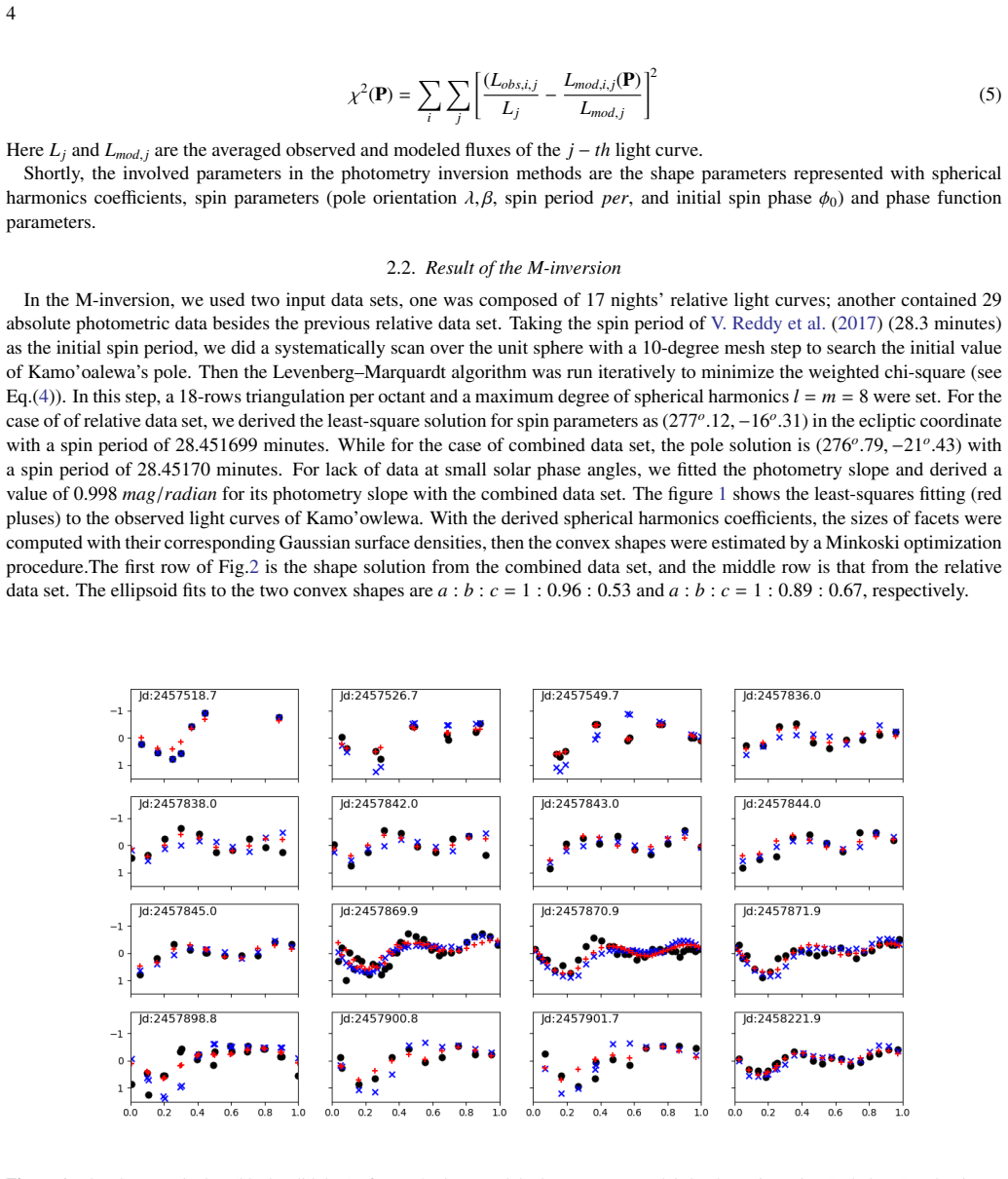
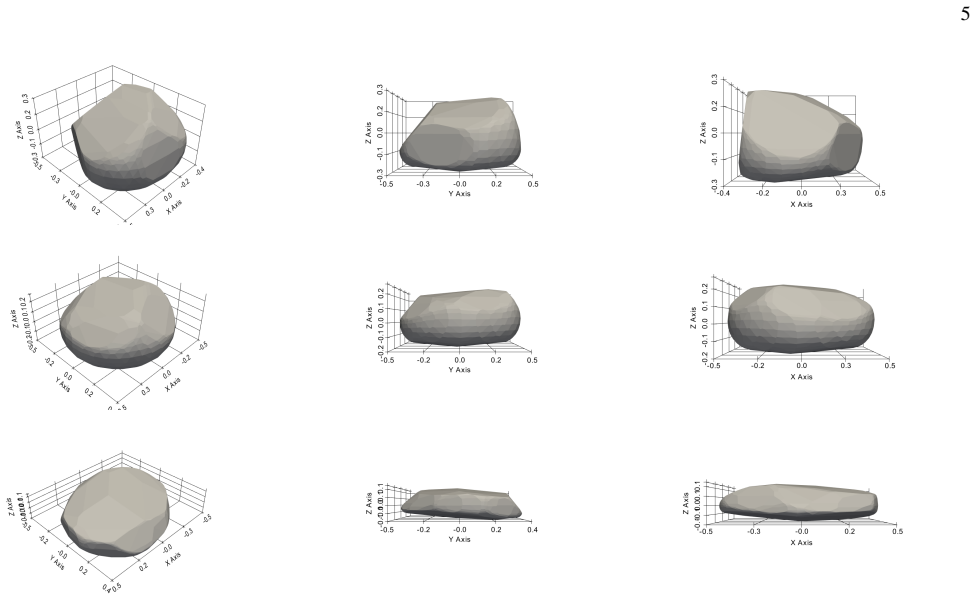
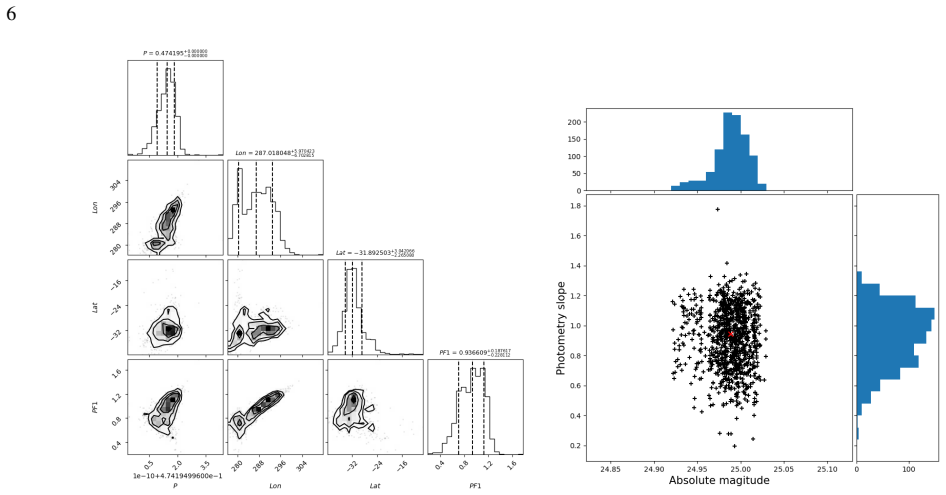
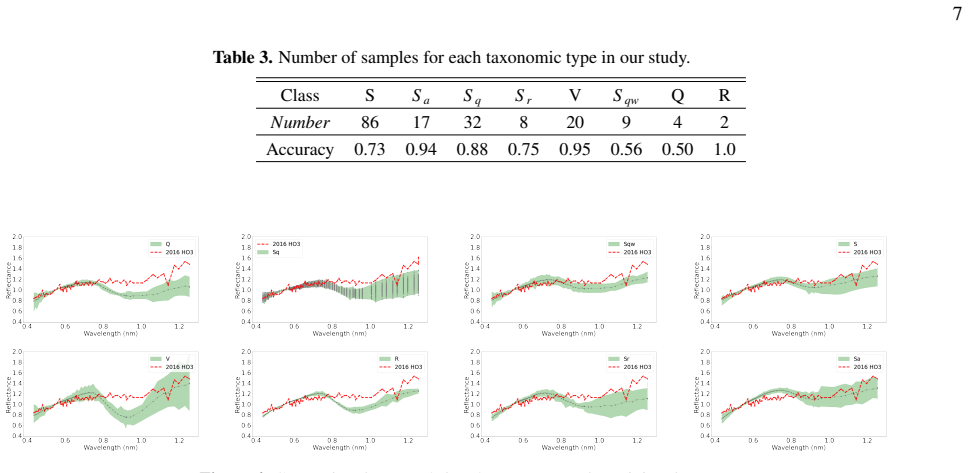
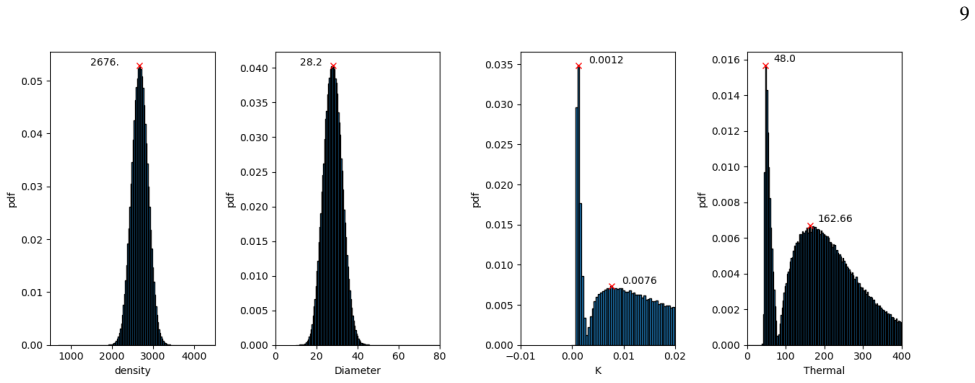
The Near-earth asteroid (469219) Kamo'oalewa, a quasi-satellite of the Earth, is going to be observed in site and sampled by the Chinese space mission Tianwen-2 in near future. Here. we analyze its photometric and spectroscopic data to figure out its basic physical properties, which are very important for the sample return task of the Tianwen-2 mission. With photometry inversion methods, we derived a pole $(276^{o}.79, -21^{o}.43)$ with a spin period of 28.4517 minutes and a slightly flat convex shape. The estimated photometry slope of $0.998 mag/rad$ implies a large albedo of the Kamo'oalewa, i.e. S-type. Using the estimated absolute magnitude of $24.98$ mag, its size could be 27.4m assuming a typical albedo of S-type asteroids. The taxonomy analysis with a constructed ANN tool also supports that the Kamo'oalewa should belong to S-type asreroids, it may be a strong weathering fragment of an A-type or Q-type asteroid. Using derived pole, size and shape information of the target, we estimated its thermal inertia as $163.0 Jm^{-2}K^{-1}s^{-1/2}$ based on the new derived Yarkovski draft $A_2=-13.29349563\times10^{-14}au/day^2$, which means the target has a surface of mixture of grains and small bounds, like the surface of asteroid Bennu.
Editorial analysis
A structured set of objections, weighed in public.
Referee Report
Summary. The manuscript analyzes photometric and spectroscopic data of the near-Earth asteroid (469219) Kamo'oalewa to derive its pole orientation (276°.79, -21°.43), spin period (28.4517 min), slightly flat convex shape, S-type taxonomy via an ANN classifier, absolute magnitude (24.98 mag) implying a ~27.4 m diameter at typical S-type albedo, and thermal inertia (163.0 J m^{-2} K^{-1} s^{-1/2}) from a newly derived Yarkovsky A2 coefficient (-13.29349563×10^{-14} au day^{-2}), concluding a regolith surface similar to Bennu and providing context for the Tianwen-2 mission.
Significance. If the derivations are robust and independently validated, the results would supply useful pre-encounter physical constraints for Tianwen-2 sample-return planning. The photometry-inversion and taxonomy components are standard, but the thermal-inertia value that drives the surface-composition claim is not shown to be an independent measurement.
major comments (2)
- [Abstract] Abstract: the thermal inertia of 163.0 J m^{-2} K^{-1} s^{-1/2} is obtained by feeding the newly derived A2 value into an unspecified thermal model that uses the derived pole, size and shape; no analytic formulation (e.g., Vokrouhlický et al.), numerical thermophysical code, fixed inputs (bulk density, emissivity, conductivity, roughness), or propagation of A2 uncertainty into the TI result is supplied. Because A2 itself is presented as a new fit within the same work, the TI number is not an external benchmark and the surface-mixture conclusion is unsupported.
- [Abstract] Abstract: no error bars, formal uncertainties, covariance information, or goodness-of-fit metrics are reported for the pole, period, shape, photometry slope, or taxonomy classification; the inversion and ANN results are stated without validation against synthetic data or independent observations.
minor comments (3)
- [Abstract] Typo: 'asreroids' should read 'asteroids'.
- [Abstract] 'Yarkovski draft' is presumably intended as 'Yarkovsky drift'.
- [Abstract] 'small bounds' is likely 'small boulders'.
Simulated Author's Rebuttal
We thank the referee for the careful review and constructive comments on our manuscript. We address each major point below and will revise the manuscript to improve clarity and completeness.
read point-by-point responses
-
Referee: [Abstract] Abstract: the thermal inertia of 163.0 J m^{-2} K^{-1} s^{-1/2} is obtained by feeding the newly derived A2 value into an unspecified thermal model that uses the derived pole, size and shape; no analytic formulation (e.g., Vokrouhlický et al.), numerical thermophysical code, fixed inputs (bulk density, emissivity, conductivity, roughness), or propagation of A2 uncertainty into the TI result is supplied. Because A2 itself is presented as a new fit within the same work, the TI number is not an external benchmark and the surface-mixture conclusion is unsupported.
Authors: We agree that the derivation of thermal inertia requires additional detail for reproducibility and to support the surface interpretation. The A2 coefficient was obtained from independent astrometric observations separate from the photometric light-curve data used for pole and shape inversion. In the revised manuscript we will explicitly describe the thermal model employed (including reference to the analytic formulation of Vokrouhlický et al. or the numerical code used), list all fixed parameters (bulk density, emissivity, conductivity, surface roughness), and report how the uncertainty in A2 propagates into the thermal-inertia value. These additions will clarify the basis for the regolith-surface conclusion. revision: yes
-
Referee: [Abstract] Abstract: no error bars, formal uncertainties, covariance information, or goodness-of-fit metrics are reported for the pole, period, shape, photometry slope, or taxonomy classification; the inversion and ANN results are stated without validation against synthetic data or independent observations.
Authors: We acknowledge that the current version does not report formal uncertainties or validation statistics. In the revision we will add error bars and covariance information for the pole orientation, spin period, shape model, and photometry slope, together with goodness-of-fit metrics for the light-curve inversion. For the ANN taxonomy classifier we will include performance metrics on synthetic test spectra and any available independent taxonomic classifications. These changes will be incorporated throughout the text and abstract. revision: yes
Circularity Check
Thermal inertia obtained by feeding newly derived A2 into unspecified model
specific steps
-
fitted input called prediction
[Abstract]
"Using derived pole, size and shape information of the target, we estimated its thermal inertia as 163.0 Jm^{-2}K^{-1}s^{-1/2} based on the new derived Yarkovski draft A_2=-13.29349563 imes10^{-14}au/day^2"
A2 is explicitly presented as newly derived in the same analysis; TI is then obtained from that fitted A2 (plus the paper's own pole/size/shape) via an unspecified conversion. The resulting TI value is therefore statistically dependent on the A2 fit and cannot be treated as an external benchmark supporting the surface-composition claim.
full rationale
The paper derives pole, period, and shape via photometry inversion, then states that thermal inertia is estimated from a newly derived A2 value using those same quantities. Because A2 is fitted within the work and the conversion model, fixed inputs, and uncertainty propagation are not supplied, the TI result reduces to a direct function of the orbital fit rather than an independent measurement. No other load-bearing steps exhibit circularity; the photometry and taxonomy sections remain self-contained.
Axiom & Free-Parameter Ledger
free parameters (1)
- Yarkovsky A2 coefficient =
-13.29349563e-14 au/day^2
axioms (2)
- domain assumption Standard light-curve inversion algorithms recover unique pole and convex shape from the available photometry.
- domain assumption The thermal model relating Yarkovsky drift to thermal inertia is applicable to this 27 m object without additional free parameters.
Reference graph
Works this paper leans on
-
[1]
Binzel, R. P., DeMeo, F. E., Turtelboom, E. V ., et al. 2019, Icarus, 324, 41, doi: 10.1016/j.icarus.2018.12.035 de la Fuente Marcos, C., & de la Fuente Marcos, R. 2016, MNRAS, 462, 3441, doi: 10.1093/mnras/stw1972
-
[2]
DeMeo, F. E., Binzel, R. P., Slivan, S. M., & Bus, S. J. 2009, Icarus, 202, 160, doi: 10.1016/j.icarus.2009.02.005
-
[3]
2023, A&A, 675, A134, doi: 10.1051/0004-6361/202346160
Fenucci, M., Novakovi´c, B., & Marˇceta, D. 2023, A&A, 675, A134, doi: 10.1051/0004-6361/202346160
-
[4]
2025, A&A, 695, A196, doi: 10.1051/0004-6361/202453222
Fenucci, M., Novakovi´c, B., Zhang, P., et al. 2025, A&A, 695, A196, doi: 10.1051/0004-6361/202453222
-
[5]
2017, in DPS meeting #49
Fohring, D., Reddy, V ., Wainscoat, R., Conrad, A., & Sharkey, B. 2017, in DPS meeting #49
2017
-
[6]
2019, PASJ, 71, 103, doi: 10.1093/pasj/psz088
Hasegawa, S., Hiroi, T., Ohtsuka, K., et al. 2019, PASJ, 71, 103, doi: 10.1093/pasj/psz088
-
[7]
2025, Scientia Sinica Physica, Mechanica & Astronomica, 55, 279507, doi: 10.1360/SSPMA-2025-0037
He, Z.-P., Gui, Y .-H., Lv, G., et al. 2025, Scientia Sinica Physica, Mechanica & Astronomica, 55, 279507, doi: 10.1360/SSPMA-2025-0037
-
[8]
2020, in 14th Europlanet Science Congress 2020, doi: 10.5194/epsc2020-1126 10
Huang, J., Zhang, X., Wang, T., et al. 2020, in 14th Europlanet Science Congress 2020, doi: 10.5194/epsc2020-1126 10
-
[9]
2001, Icarus, 153, 24, doi: 10.1006/icar.2001.6673
Kaasalainen, M., & Torppa, J. 2001, Icarus, 153, 24, doi: 10.1006/icar.2001.6673
-
[11]
Li, X., & Scheeres, D. J. 2021, Icarus, doi: 10.1016/j.icarus.2020.114249
-
[12]
2024, The Astronomical Journal, 167, 13, doi: 10.3847/1538-3881/ad0b7a
Luo, N., Wang, X., Gu, S., et al. 2024, The Astronomical Journal, 167, 13, doi: 10.3847/1538-3881/ad0b7a
-
[13]
2016, Minor Planet Electronic Circ., 2016-H63, doi: 10.1006/icar.2001.6674
Mastaler, R., Gibson, B., Goggia, T., et al. 2016, Minor Planet Electronic Circ., 2016-H63, doi: 10.1006/icar.2001.6674
-
[14]
Muinonen, K., Belskaya, I. N., Cellino, A., et al. 2010, Icarus, 209, 542, doi: 10.1016/j.icarus.2010.04.003
-
[15]
2015, A&A, 584, A23, doi: 10.1051/0004-6361/201526456
Muinonen, K., & Lumme, K. 2015, A&A, 584, A23, doi: 10.1051/0004-6361/201526456
-
[16]
B., Cellino, A., & Penttil¨a, A
Muinonen, K., Torppa, J., Wang, X. B., Cellino, A., & Penttil¨a, A. 2020, A&A, 642, A138, doi: 10.1051/0004-6361/202038036
-
[17]
Muinonen, K., Uvarova, E., Martikainen, J., et al. 2022, Frontiers in Astronomy and Space Sciences, 9, 821125, doi: 10.3389/fspas.2022.821125 Novakovi´c, B., & Fenucci, M. 2024, Icarus, 421, 116225, doi: 10.1016/j.icarus.2024.116225 Pentik¨ainen, H., MacLennan, E. M., Penttil¨a, A., et al. 2026, A&A, 707, A132, doi: 10.1051/0004-6361/202556127
-
[18]
2017, in AAS/Division for Planetary Sciences Meeting Abstracts, V ol
Reddy, V ., Kuhn, O., Thirouin, A., et al. 2017, in AAS/Division for Planetary Sciences Meeting Abstracts, V ol. 49, AAS/Division for Planetary Sciences Meeting Abstracts #49, 204.07
2017
-
[19]
Sharkey, B. N. L., Reddy, V ., Malhotra, R., et al. 2021, nature Communications Earth & Environment, 231, doi: 10.1038/s43247-021-00303-7
-
[20]
Thirouin, A., Moskovitz, N., Binzel, R. P., et al. 2016, AJ, 152, doi: 10.3847/0004-6256/152/6/163 V okrouhlick´y, D. 1999, A&A, 344, 362
-
[21]
2025, AJ, 170, 35, doi: 10.3847/1538-3881/add3f4
Xu, X., Wang, X., Muinonen, K., et al. 2025, AJ, 170, 35, doi: 10.3847/1538-3881/add3f4
-
[22]
2025, Scientia Sinica Physica, Mechanica & Astronomica, 55, 279506, doi: 10.1360/SSPMA-2025-0008
Yang, J.-F., Tao, J.-Y ., Ge, W., et al. 2025, Scientia Sinica Physica, Mechanica & Astronomica, 55, 279506, doi: 10.1360/SSPMA-2025-0008
-
[23]
2024, Astronomical Techniques and Instruments, 42
Zhang, H., Li, F., Meng, L., et al. 2024, Astronomical Techniques and Instruments, 42
2024
-
[24]
2019, in In: 50th Lunar and Planetary Science Conference, The Woodlands, Texas, No.2123
Zhang, X., Huang, J., Wang, T., & Huo, Z. 2019, in In: 50th Lunar and Planetary Science Conference, The Woodlands, Texas, No.2123
2019
discussion (0)
Sign in with ORCID, Apple, or X to comment. Anyone can read and Pith papers without signing in.