REVIEW 2 major objections 2 minor 34 references
argosim: a Python package for radio interferometric simulations
T0 review · 2 major / 2 minor · reviewed 2026-06-25 · grok-4.3
Pith's one-line read The argosim Python package supplies modular simulations of radio interferometric observations with a JAX backend for speed and differentiability.
desk verdict argosim is a new JAX-backed Python package for radio interferometry simulations, but the paper is mostly an announcement with no benchmarks or comparisons. read the letter →
The pith
A machine-rendered reading of the paper's core claim, the machinery that carries it, and where it could break.
The reading
What carries the argument
The argosim package and its JAX backend, which performs the core computations for generating observations and supports differentiability.
What would settle it
A side-by-side comparison of argosim-generated visibilities and images against outputs from an established tool such as CASA on a standard test observation would confirm or refute the modeling accuracy.
Extended reading notes
Core claim
The argosim package is a modular, lightweight Python tool compatible with all major operating systems whose JAX computational backend enables greatly accelerated performance and full differentiability for simulating radio interferometric observations from antenna positions to cleaned images, with the code publicly available on GitHub.
Load-bearing premise
The JAX-based implementation accurately models radio interferometric physics and produces correct outputs without significant numerical or modeling errors.
Editorial analysis
A structured set of objections, weighed in public.
Referee Report
Summary. The manuscript presents argosim, a Python package for simulating radio interferometric observations. It claims the package is modular, lightweight, and compatible with all major operating systems. The computational backend is written in JAX to provide greatly accelerated performance and full differentiability. The authors detail the main modules and describe usage to generate an observation from antenna positions through to the cleaned image. The code is fully open-source and available on GitHub.
Significance. If the implementation is correct and the JAX backend delivers the claimed speed and differentiability without numerical issues, the package could serve as a lightweight, gradient-enabled tool for radio interferometry simulations, potentially supporting optimization and machine-learning workflows in the field.
major comments (2)
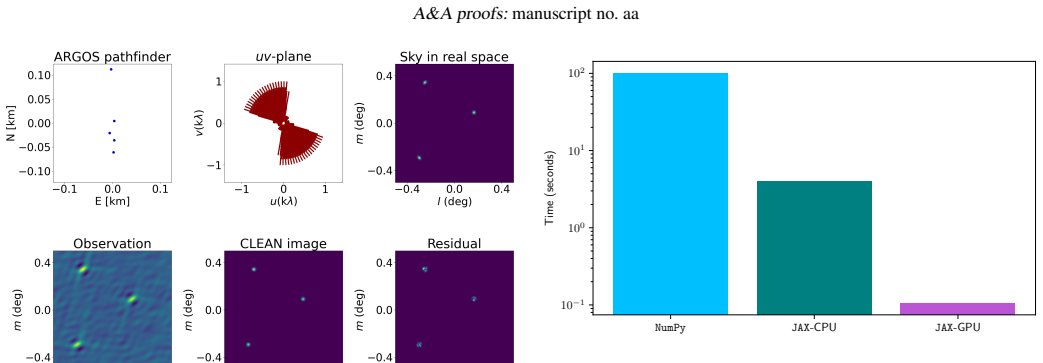
- [Abstract] Abstract: the claim that the JAX backend 'allows for greatly accelerated performance' is presented without any timing benchmarks, scaling tests, or comparisons to CPU-based or other simulators; this is load-bearing for the central engineering claim about the backend's advantages.
- [Main modules description] Description of main modules and usage: no validation results, example outputs, or comparisons against established packages (e.g., CASA, MeqTrees) are shown to confirm that the simulated visibilities and images accurately reproduce radio interferometric physics; this directly affects the usability claim from antenna positions to cleaned image.
minor comments (2)
- The manuscript would benefit from a short table or paragraph comparing argosim's features (modularity, differentiability, OS support) against existing open-source interferometric simulators.
- Provide a specific GitHub release tag or DOI for the version described, rather than a generic repository link, to ensure reproducibility.
Simulated Author's Rebuttal
We thank the referee for their constructive comments on the manuscript. We address each major point below and will revise the paper to incorporate the suggested improvements.
read point-by-point responses
-
Referee: [Abstract] Abstract: the claim that the JAX backend 'allows for greatly accelerated performance' is presented without any timing benchmarks, scaling tests, or comparisons to CPU-based or other simulators; this is load-bearing for the central engineering claim about the backend's advantages.
Authors: We agree that the performance claim would be strengthened by quantitative evidence. The revised manuscript will include timing benchmarks, scaling tests with array size and number of antennas, and direct comparisons against equivalent NumPy/CPU implementations as well as other radio interferometry simulators. revision: yes
-
Referee: [Main modules description] Description of main modules and usage: no validation results, example outputs, or comparisons against established packages (e.g., CASA, MeqTrees) are shown to confirm that the simulated visibilities and images accurately reproduce radio interferometric physics; this directly affects the usability claim from antenna positions to cleaned image.
Authors: We acknowledge that explicit validation strengthens the usability claim. The revised manuscript will add example outputs (dirty images, clean images, visibility plots), quantitative comparisons of simulated visibilities against analytic expectations or CASA, and brief cross-checks with established packages to confirm that the core physics is reproduced correctly. revision: yes
Circularity Check
No significant circularity
full rationale
The document is a software package announcement describing argosim's modularity, OS compatibility, JAX backend for speed and differentiability, and usage workflow from antenna positions to cleaned images. No mathematical derivations, fitted parameters, predictions, or uniqueness theorems are present. All central claims are engineering assertions about code properties that can be directly verified by inspecting and executing the open-source repository rather than by any self-referential chain. No self-citations are invoked as load-bearing support for any result.
Assumptions & free parameters
Cite this review
Pith. "Pith review of argosim: a Python package for radio interferometric simulations." pith.science (2026). https://pith.science/paper/YEOW7R3P
@misc{pith2026260625573,
  author       = {Pith},
  title        = {Pith review of: argosim: a Python package for radio interferometric simulations},
  year         = {2026},
  howpublished = {\url{https://pith.science/paper/YEOW7R3P}},
  note         = {Machine review of arXiv:2606.25573}
}
read the original abstract
In this paper, we present argosim, a Python package for simulating radio interferometric observations. The argosim package is modular, lightweight and compatible with all major operating systems. Its computational backend is written in JAX, which allows for greatly accelerated performance as well as the advantage of being fully differentiable. We detail the main argosim modules and describe how to use them to generate an observation, from the antenna positions to the cleaned image. The package is a fully open-source project, and its code is publicly available on GitHub.
Figures
Figures from the paper (1 more)
Reference graph
Works this paper leans on
-
[1]
2018, JAX: composable transforma- tions of Python+NumPy programs CASA Team, Bean, B., Bhatnagar, S., et al
Bradbury, J., Frostig, R., Hawkins, P., et al. 2018, JAX: composable transforma- tions of Python+NumPy programs CASA Team, Bean, B., Bhatnagar, S., et al. 2022, PASP, 134, 114501
2018
-
[2]
Clark, B. G. 1980, A&A, 89, 377
1980
-
[3]
Cornwell, T. J. 2008, IEEE Journal of Selected Topics in Signal Processing, 2, 793
2008
-
[4]
J., Golap, K., & Bhatnagar, S
Cornwell, T. J., Golap, K., & Bhatnagar, S. 2008, IEEE Journal of Selected Topics in Signal Processing, 2, 647
2008
-
[5]
2013, isort: A Python utility to sort imports alphabetically., https: //github.com/PyCQA/isort, version 5.13.2
Crosley, T. 2013, isort: A Python utility to sort imports alphabetically., https: //github.com/PyCQA/isort, version 5.13.2
2013
-
[6]
2022, SKA-TEL-SKO-0001075, sKA1 Design Baseline Description
Dewdney, P. 2022, SKA-TEL-SKO-0001075, sKA1 Design Baseline Description. Copyright 2022 SKA Observatory
2022
-
[7]
E., Hall, P
Dewdney, P. E., Hall, P. J., Schilizzi, R. T., & Lazio, T. J. L. W. 2009, Proceedings of the IEEE, 97, 1482 Di Francesco, J., Chalmers, D., Denman, N., et al. 2019, in Canadian Long Range Plan for Astronomy and Astrophysics White Papers, V ol. 2020, 32
2009
-
[8]
J., Adam, A., et al
Dia, N., Yantovski-Barth, M. J., Adam, A., et al. 2025, IRIS: A Bayesian Approach for Image Reconstruction in Radio Interferometry with expressive Score-Based priors
2025
Show all 34 references
-
[9]
N., Starck, J
Garsden, H., Girard, J. N., Starck, J. L., et al. 2015, A&A, 575, A90
2015
-
[10]
B., Yun, M
Gim, H. B., Yun, M. S., Luber, N. M., et al. 2025, AJ, 170, 60
2025
-
[11]
N., Garsden, H., Starck, J
Girard, J. N., Garsden, H., Starck, J. L., et al. 2015, Journal of Instrumentation, 10, C08013
2015
-
[12]
2019, The DSA-2000 – A Radio Survey Camera
Hallinan, G., Ravi, V ., Weinreb, S., et al. 2019, The DSA-2000 – A Radio Survey Camera
2019
-
[13]
R., Millman, K
Harris, C. R., Millman, K. J., van der Walt, S. J., et al. 2020, Nature, 585, 357 Högbom, J. A. 1974, A&AS, 15, 417
2020
-
[14]
Hunter, J. D. 2007, Computing in Science and Engineering, 9, 90
2007
-
[15]
2004, pytest 8.3, https: //github.com/pytest-dev/pytest, version 8.3
Krekel, H., Oliveira, B., Pfannschmidt, R., et al. 2004, pytest 8.3, https: //github.com/pytest-dev/pytest, version 8.3. Contributors include Hol- ger Krekel, Bruno Oliveira, Ronny Pfannschmidt, Floris Bruynooghe, Brianna
2004
-
[16]
2019, Black: The uncompromising Python code formatter, https: //github.com/psf/black
Langa, L. 2019, Black: The uncompromising Python code formatter, https: //github.com/psf/black
2019
-
[17]
2025, arXiv e-prints, arXiv:2506.20845
Liu, J., van Weeren, R., Rottgering, H., & Kuijken, K. 2025, arXiv e-prints, arXiv:2506.20845
2025
-
[18]
& Rafferty, D
Mohan, N. & Rafferty, D. 2015, PyBDSF: Python Blob Detection and Source
2015
-
[19]
1983, Proceedings of the IEEE, 71, 1295
Napier, P., Thompson, A., & Ekers, R. 1983, Proceedings of the IEEE, 71, 1295
1983
-
[20]
B., Bandura, K., Bucher, M
Newburgh, L. B., Bandura, K., Bucher, M. A., et al. 2016, in Ground-based and Airborne Telescopes VI, ed. H. J. Hall, R. Gilmozzi, & H. K. Marshall, V ol. 9906 (SPIE), 99065X
2016
-
[21]
Noordam, J. E. & Smirnov, O. M. 2010, Astronomy I&, Astrophysics, 524, A61
2010
-
[22]
R., McKinley, B., Hurley-Walker, et al
Offringa, A. R., McKinley, B., Hurley-Walker, et al. 2014, MNRAS, 444, 606 RASCIL developers. 2022, Radio Astronomy Simulation, Calibration, and Imaging Library., https://gitlab.com/ska-telescope/external/ rascil-main Riverbank Computing Limited. 2021, PyQt6 - Comprehensive Py...
2014
-
[23]
2015, GalSim: The modular galaxy image simulation toolkit
Rowe, B., Jarvis, M., Mandelbaum, R., et al. 2015, GalSim: The modular galaxy image simulation toolkit
2015
-
[24]
& Neville, A
Ryle, M. & Neville, A. C. 1962, Monthly Notices of the Royal Astronomical Society, 125, 39
1962
-
[25]
J., Teuben, P
Sault, R. J., Teuben, P. J., & Wright, M. C. H. 1995, in Astronomical Society of the Pacific Conference Series, V ol. 77, Astronomical Data Analysis Software and Systems IV , ed. R. A. Shaw, H. E. Payne, & J. J. E. Hayes, 433
1995
-
[26]
Sault, R. J. & Wieringa, M. H. 1994, A&AS, 108, 585
1994
-
[27]
Schwab, F. R. 1984, AJ, 89, 1076
1984
-
[28]
B., Carilli, C
Taylor, G. B., Carilli, C. L., & Perley, R. A., eds. 1999, Astronomical Society of the Pacific Conference Series, V ol. 180, Synthesis Imaging in Radio Astronomy II The OSKAR Developers. 2020, OSKAR - A GPU-accelerated simulator for the Square Kilometre Array., https://github....
1999
-
[29]
R., Clark, B
Thompson, A. R., Clark, B. G., Wade, C. M., & Napier, P. J. 1980, ApJS, 44, 151
1980
-
[30]
R., Moran, J
Thompson, A. R., Moran, J. M., & Swenson, Jr., G. W. 2017, Interferometry and Synthesis in Radio Astronomy, 3rd Edition (A Wiley-Interscience Publication)
2017
-
[31]
2024, Sphinx - Intelligent and beautiful doc- umentation., https://github.com/sphinx-doc/sphinx/tree/master, version 8.1.3 van der Walt, S., Schönberger, J
Turner, A., Tran, B., Sewell, C., et al. 2024, Sphinx - Intelligent and beautiful doc- umentation., https://github.com/sphinx-doc/sphinx/tree/master, version 8.1.3 van der Walt, S., Schönberger, J. L., Nunez-Iglesias, J., et al. 2014, PeerJ, 2, e453 Viˇcánek Martínez, T., Edle...
2024
-
[32]
2004, IEEE Transactions on Image Processing, 13, 600
Wang, Z., Bovik, A., Sheikh, H., & Simoncelli, E. 2004, IEEE Transactions on Image Processing, 13, 600
2004
-
[33]
& Thompson, A
Wootten, A. & Thompson, A. R. 2009, Proceedings of the IEEE, 97, 1463
2009
-
[34]
G., & Pen, U
Wucknitz, O., Spitler, L. G., & Pen, U. L. 2021, A&A, 645, A44 Article number, page 7 A&A proofs:manuscript no. aa Appendix A: Third-party software The third-party software used in argosim are listed in Table A.1 with the associated versions, and references. The table includes...
2021
Reviewed June 25, 2026 · model on record in the stance chip above.
Discussion (0). Continue with ORCID to comment.