The Cost of Removing Tunability in Quantum Data Re-Uploading
Pith reviewed 2026-06-25 21:22 UTC · model grok-4.3
The pith
Tunable quantum data re-uploading circuits can be approximated by fixed ones with polylogarithmic depth scaling.
A machine-rendered reading of the paper's core claim, the machinery that carries it, and where it could break.
Core claim
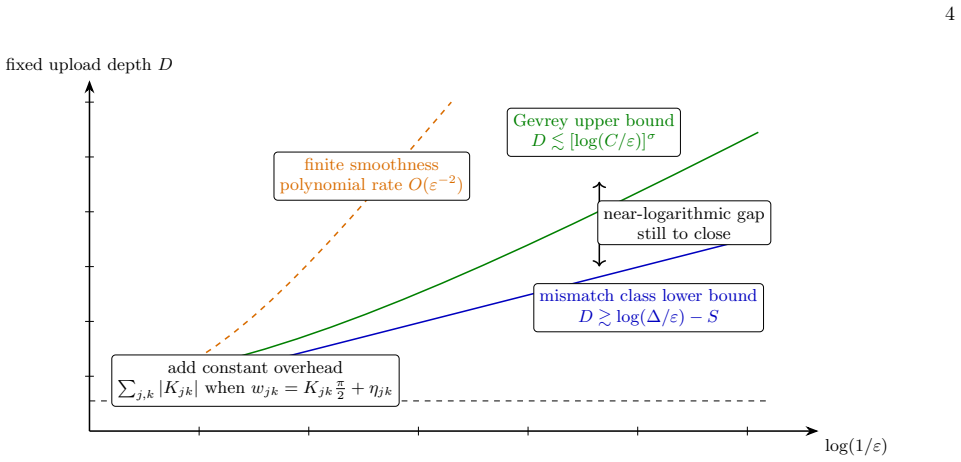
A tunable upload circuit can be approximated by a fixed upload circuit using depth D = O_σ[(log(1/ε))^σ] for every σ>1, with a target dependent constant overhead. The proof relies on an auxiliary extension approximation mechanism that combines Gevrey class construction, Jackson's theorem and the generalized quantum signal processing theorem. Fixed upload approximations also face a periodic mismatch obstruction that forces a logarithmic lower bound D = Ω(log(1/ε)) for targets in the mismatch class.
What carries the argument
Auxiliary extension approximation mechanism combining Gevrey class construction, Jackson's theorem, and generalized quantum signal processing theorem.
If this is right
- Expressive power lost by removing tunability is recovered using only polylogarithmic growth in circuit depth with target-dependent constant overhead.
- A periodic mismatch obstruction is intrinsic to fixed-upload approximations and forces logarithmic lower bounds for certain targets.
- Expressivity transfers from tunable frequencies into circuit depth under the stated scaling.
- The same auxiliary-extension technique yields a quantitative framework for approximation complexity in related quantum signal-processing models.
Where Pith is reading between the lines
- The polylogarithmic upper bound may be improvable to a true logarithmic scaling for broader classes of targets.
- Mismatch obstructions could appear in other fixed-parameter quantum learning architectures and limit their expressivity independently of depth.
- The Gevrey-class route may extend to approximation questions in classical neural networks that use fixed nonlinearities.
Load-bearing premise
The target function belongs to a class for which the auxiliary extension stays inside the Gevrey class and the generalized quantum signal processing theorem applies without additional restrictions on the spectrum.
What would settle it
An explicit target function in the mismatch class for which any fixed-upload approximation requires depth super-polylogarithmic in 1/ε.
Figures
read the original abstract
Fixed encoding data re-uploading quantum circuits provide a striking example of universality emerging from a highly constrained architecture. However, universality alone is insufficient for assessing the theoretical and practical value of fixed and tunable upload circuits. The resource cost of removing tunability remains poorly understood. In this work, we establish quantitative depth-error scaling for approximating tunable upload circuits with fixed upload circuits. We show that a tunable upload circuit can be approximated by a fixed upload circuit using depth \( D = O_\sigma\!\left[(\log(1/\varepsilon))^\sigma\right] \) for every \(\sigma>1\), with a target dependent constant overhead, thereby improving the previously known polynomial dependence on \(1/\varepsilon\) with the same overhead. Our proof is based on an auxiliary extension approximation mechanism that combines Gevrey class construction, Jackson's theorem and generalized quantum signal processing theorem. Thus, the expressive power lost by removing tunability can be recovered using only polylogarithmic growth in circuit depth with a target dependent constant overhead. We further identify a periodic mismatch obstruction intrinsic to fixed upload approximations and use Tur\'an-Nazarov inequalities to prove logarithmic lower bounds \( D = \Omega(\log(1/\varepsilon)) \) for the approximation of mismatch class target tunable upload circuits. Conceptually, our analysis reveals two structural mechanisms underlying approximation in fixed upload architectures: auxiliary extensions and mismatch obstructions. These results provide a quantitative understanding of how expressivity is transferred from tunable frequencies into circuit depth, and suggest a broader framework for studying approximation complexity in quantum signal processing and related quantum learning models.
Editorial analysis
A structured set of objections, weighed in public.
Referee Report
Summary. This manuscript claims that a tunable quantum data re-uploading circuit can be approximated by a fixed upload circuit to error ε using depth D = O_σ[(log(1/ε))^σ] for every σ>1 (with target-dependent constant overhead), improving on prior polynomial scaling in 1/ε. The upper bound is obtained via an auxiliary extension construction that keeps the target in a Gevrey class, invoking Jackson's theorem and a generalized quantum signal processing result. A matching lower bound D = Ω(log(1/ε)) is proved for a mismatch class of targets using Turán-Nazarov inequalities, with the analysis identifying auxiliary extensions and periodic mismatch obstructions as the two structural mechanisms transferring expressivity from tunable frequencies into depth.
Significance. If the central claims hold, the result supplies the first quantitative, polylogarithmic characterization of the cost of removing tunability in data re-uploading architectures, tightening the gap between upper and lower bounds and furnishing a concrete example of how classical approximation theory (Gevrey classes, Jackson, Turán-Nazarov) can be combined with generalized QSP to analyze quantum learning models. The explicit separation of auxiliary-extension and mismatch-obstruction mechanisms offers a reusable conceptual framework beyond the specific setting.
major comments (2)
- [Abstract] Abstract (proof mechanism paragraph): the assertion that the auxiliary extension keeps the target inside the Gevrey class 'without additional restrictions on the spectrum' is load-bearing for the claimed polylog depth bound. The construction (periodic mismatch, frequency re-mapping, extension operator) can change the effective spectrum support; the manuscript must verify that the resulting eigenvalues continue to satisfy the decay or isolation hypotheses required by the generalized QSP theorem, otherwise the reduction to Jackson's theorem fails and one reverts to polynomial scaling.
- [Abstract] Abstract (lower-bound paragraph): the invocation of Turán-Nazarov inequalities to obtain D = Ω(log(1/ε)) for mismatch-class targets requires an explicit statement of how the periodic mismatch obstruction is formalized as a function on the circle and why the inequality applies directly to the approximation error of the quantum circuit (rather than to a classical trigonometric polynomial).
minor comments (2)
- [Abstract] The σ-dependent big-O notation and the precise meaning of 'target dependent constant overhead' should be defined at first use rather than left implicit in the abstract.
- A short related-work paragraph contrasting the new polylog bound with the previously known polynomial dependence would help readers assess the improvement.
Simulated Author's Rebuttal
We thank the referee for the careful reading and constructive feedback. Below we respond point-by-point to the two major comments. We will incorporate the requested clarifications and verifications into the revised manuscript.
read point-by-point responses
-
Referee: [Abstract] Abstract (proof mechanism paragraph): the assertion that the auxiliary extension keeps the target inside the Gevrey class 'without additional restrictions on the spectrum' is load-bearing for the claimed polylog depth bound. The construction (periodic mismatch, frequency re-mapping, extension operator) can change the effective spectrum support; the manuscript must verify that the resulting eigenvalues continue to satisfy the decay or isolation hypotheses required by the generalized QSP theorem, otherwise the reduction to Jackson's theorem fails and one reverts to polynomial scaling.
Authors: We appreciate the referee's identification of this load-bearing step. The auxiliary extension is constructed via a frequency re-mapping that preserves the exponential decay of Fourier coefficients, thereby keeping the target in the same Gevrey class. Nevertheless, to make the preservation of the required spectral isolation and decay hypotheses fully explicit, we will add a short lemma in the revised manuscript that directly verifies the eigenvalues satisfy the hypotheses of the generalized QSP theorem. This addition will confirm that the reduction to Jackson's theorem remains valid and the polylogarithmic bound is not compromised. revision: yes
-
Referee: [Abstract] Abstract (lower-bound paragraph): the invocation of Turán-Nazarov inequalities to obtain D = Ω(log(1/ε)) for mismatch-class targets requires an explicit statement of how the periodic mismatch obstruction is formalized as a function on the circle and why the inequality applies directly to the approximation error of the quantum circuit (rather than to a classical trigonometric polynomial).
Authors: We agree that an explicit formalization would strengthen the presentation. In the revised manuscript we will add a dedicated paragraph (or short subsection) that (i) defines the periodic mismatch obstruction as a continuous function on the circle via the mismatch between the tunable frequencies and the fixed upload frequencies, and (ii) explains why the Turán-Nazarov inequality applies directly to the quantum circuit error: the fixed-upload circuit realizes a trigonometric polynomial whose uniform norm is bounded by the circuit approximation error, allowing the inequality to be invoked without intermediate classical reduction steps. revision: yes
Circularity Check
No circularity; derivation invokes external theorems without self-referential reduction
full rationale
The claimed polylog depth bound D = O_σ[(log(1/ε))^σ] is obtained by constructing an auxiliary extension that stays in the Gevrey class, then directly applying Jackson's theorem and the generalized quantum signal processing theorem (both presented as external results). The lower bound similarly invokes the external Turán-Nazarov inequalities. No equation or step reduces the target bound to a quantity fitted or defined inside the paper, no self-citation is load-bearing, and no ansatz or uniqueness claim is smuggled via prior author work. The argument is therefore self-contained against the cited external benchmarks.
Axiom & Free-Parameter Ledger
axioms (3)
- standard math Jackson's theorem supplies polynomial approximation rates for continuous functions on the circle
- domain assumption Generalized quantum signal processing theorem converts smooth function approximations into fixed-frequency quantum circuits
- standard math Turán-Nazarov inequalities bound the depth needed to overcome periodic mismatch obstructions
Reference graph
Works this paper leans on
-
[1]
Single tunable upload gate upper bound 16
-
[2]
Choosing the best auxiliary extension function class 19
-
[3]
Constructing a Gevrey auxiliary extension function 20
-
[4]
Proofs for lower bounds 23
Circuit wise upper bound 22 C. Proofs for lower bounds 23
-
[5]
Single residual tunable upload gate lower bound 23
-
[6]
Circuit wise lower bound 24
-
[7]
Beyond: Approximating multivariate functions 27 References 29 3 I
No universal lower bound 27 D. Beyond: Approximating multivariate functions 27 References 29 3 I. INTRODUCTION A central theme in approximation theory and machine learning is that highly expressive models can emerge from remarkably restricted architectures. Classical universal approximation theorems show that simple neural network architectures can approx...
1918
-
[8]
Intuitively, theγcomposition mismatch is a generalization of from one dimensional case to multidimensional case
Therefore, for multivariate approximation, we need a mismatch condition over these coordinate slice. Intuitively, theγcomposition mismatch is a generalization of from one dimensional case to multidimensional case. Continuous periodicity over[0,4] m requires the boundaries to agree. A coordinate slice mismatch witnesses the mismatch of the boundary. Theref...
-
[9]
Notic that our target is eiwxσz = eiwx 0 0e −iwx ,0≤x≤1.(B1) 17 For everywwe can writew=K π 2 +η, separatingwinto a π 2 integer part and a residual part
Single tunable upload gate upper bound We approximate one tunable upload gate over [0,1] with a fixed upload circuit in this subsection. Notic that our target is eiwxσz = eiwx 0 0e −iwx ,0≤x≤1.(B1) 17 For everywwe can writew=K π 2 +η, separatingwinto a π 2 integer part and a residual part. The integer part can be implemented by simply adding|K|overhead ga...
-
[10]
Corollary 23(Single tunable upload gate Jackson theorem).Letw∈R, and choose K∈Z, η=w−K π 2 ,|η| ≤ π 4 .(B17) LetAbe aC r 2[0,2]auxiliary extension fore iηx
Thus the same bound holds in all cases after replacing √ 12 by 4. Corollary 23(Single tunable upload gate Jackson theorem).Letw∈R, and choose K∈Z, η=w−K π 2 ,|η| ≤ π 4 .(B17) LetAbe aC r 2[0,2]auxiliary extension fore iηx. Then the tunable upload gatee iwxσz can be approximated uniformly on[0,1]to Frobenius error at mostεby a fixed upload circuit with upl...
-
[11]
The error toNscaling is determined by the regularity, or explicitly, property of the derivatives of auxiliary extension function, which we can design at our convenience
Choosing the best auxiliary extension function class The single tunable upload gate theorem reduces the upper bound to controlling δN ≲ A(r) ∞ (2N+ 2) r .(B24) This is a Jackson type approximation argument. The error toNscaling is determined by the regularity, or explicitly, property of the derivatives of auxiliary extension function, which we can design ...
-
[12]
Forσ >1, set α= 1 σ−1 .(B30) Thenσ= 1 + 1/α
Constructing a Gevrey auxiliary extension function In this subsection, we construct a Gevrey class auxiliary extension function by several layers of composition and verify that these compositions preserves the Gevrey property. Forσ >1, set α= 1 σ−1 .(B30) Thenσ= 1 + 1/α. Define ρσ(t) = ( exp(−t−α), t >0, 0, t≤0, (B31) and χσ(t) = ρσ(t) ρσ(t) +ρ σ(1−t) ,0≤...
-
[13]
Therefore A(k) η,σ ∞ ≤C σRk σ(k!)σ (B55) with constants depending only onσ
are bounded uniformly on this compactη-interval, and the analytic composition estimates are uniform on the corresponding bounded range. Therefore A(k) η,σ ∞ ≤C σRk σ(k!)σ (B55) with constants depending only onσ. The identity on [0,1] follows fromχ σ(x−1) = 0 there, and unit modulus is immediate. Proof of Theorem 11.Choose Gevrey class auxiliary extension ...
-
[14]
Write the tunable upload circuit and the fixed upload circuit as identical products except that each eiwjk xkσz is replaced by a fixed upload blockR (wjk ) Kjk ,N(xk)
Circuit wise upper bound Proof of Theorem 12.The Frobenius bound of Theorem 11 implies the same bound in operator norm for each tunable upload gate. Write the tunable upload circuit and the fixed upload circuit as identical products except that each eiwjk xkσz is replaced by a fixed upload blockR (wjk ) Kjk ,N(xk). The telescoping identity for products gi...
-
[15]
For delivering the upper bound for a single tunable upload gate we used two structural ingredients
Single residual tunable upload gate lower bound Here we first prove the depth-error lower bound for approximating a single residual tunable upload gate with fixed upload circuits. For delivering the upper bound for a single tunable upload gate we used two structural ingredients. The first is the restriction of the target domain and 2-periodic auxiliary ex...
-
[16]
We can replace each tunable upload gate separately and telescope the product error
Circuit wise lower bound In the upper bound theorems, once we have an upper bound for single tunable upload gate approximation, we can obtain an upper bound for the circuit wise approximation by a worst case argument. We can replace each tunable upload gate separately and telescope the product error. This separability is not true in general for all possib...
-
[17]
One cannot remove this dependence
No universal lower bound The theorem above applies to any tunable upload circuit with a mismatch obstruction, but the bound depends on the mismatch obstruction ∆ 4(U w L ). One cannot remove this dependence. Proof of Theorem 16.Take two non-integer residual tunable upload gates with opposite signs: U w L (t) =e iηtσz e−iηtσz , η /∈ π 4 Z.(C38) The whole p...
-
[18]
Cybenko, Approximation by superpositions of a sigmoidal function, Mathematics of Control, Signals and Systems2, 303 (1989)
G. Cybenko, Approximation by superpositions of a sigmoidal function, Mathematics of Control, Signals and Systems2, 303 (1989)
1989
-
[19]
Hornik, Approximation capabilities of multilayer feedforward networks, Neural Networks4, 251 (1991)
K. Hornik, Approximation capabilities of multilayer feedforward networks, Neural Networks4, 251 (1991)
1991
-
[20]
R. P. Feynman, Simulating physics with computers, International Journal of Theoretical Physics21, 467 (1982)
1982
-
[21]
P. W. Shor, Polynomial-time algorithms for prime factorization and discrete logarithms on a quantum computer, SIAM Journal on Computing26, 1484–1509 (1997)
1997
-
[22]
M. A. Nielsen and I. L. Chuang,Quantum Computation and Quantum Information: 10th Anniversary Edition(Cambridge University Press, 2010)
2010
-
[23]
Arunachalam and R
S. Arunachalam and R. de Wolf, Guest column: A survey of quantum learning theory, SIGACT News48, 41–67 (2017)
2017
-
[24]
Benedetti, E
M. Benedetti, E. Lloyd, S. Sack, and M. Fiorentini, Parameterized quantum circuits as machine learning models, Quantum Science and Technology4, 043001 (2019)
2019
-
[25]
P´ erez-Salinas, A
A. P´ erez-Salinas, A. Cervera-Lierta, E. Gil-Fuster, and J. I. Latorre, Data re-uploading for a universal quantum classifier, Quantum4, 226 (2020)
2020
-
[26]
A. P´ erez-Salinas, D. L´ opez-N´ u˜ nez, A. Garc´ ıa-S´ aez, P. Forn-D´ ıaz, and J. I. Latorre, One qubit as a universal approximant, Physical Review A104, 10.1103/physreva.104.012405 (2021)
-
[27]
T. Goto, Q. H. Tran, and K. Nakajima, Universal approximation property of quantum machine learning models in quantum- enhanced feature spaces, Phys. Rev. Lett.127, 090506 (2021)
2021
-
[28]
Dutta, A
T. Dutta, A. P´ erez-Salinas, J. P. S. Cheng, J. I. Latorre, and M. Mukherjee, Single-qubit universal classifier implemented on an ion-trap quantum device, Phys. Rev. A106, 012411 (2022)
2022
- [29]
-
[30]
S. Sim, P. D. Johnson, and A. Aspuru-Guzik, Expressibility and entangling capability of parameterized quantum circuits for hybrid quantum-classical algorithms, Advanced Quantum Technologies2, 10.1002/qute.201900070 (2019)
-
[31]
Du, M.-H
Y. Du, M.-H. Hsieh, T. Liu, and D. Tao, Expressive power of parametrized quantum circuits, Phys. Rev. Res.2, 033125 (2020)
2020
-
[32]
M. C. Caro and I. Datta, Pseudo-dimension of quantum circuits, Quantum Machine Intelligence2, 10.1007/s42484-020- 00027-5 (2020)
-
[33]
M. C. Caro, H.-Y. Huang, M. Cerezo, K. Sharma, A. Sornborger, L. Cincio, and P. J. Coles, Generalization in quantum machine learning from few training data, Nature Communications13, 10.1038/s41467-022-32550-3 (2022)
-
[34]
Manzano, D
A. Manzano, D. Dechant, J. Tura, and V. Dunjko, Approximation and Generalization Capacities of Parametrized Quantum Circuits for Functions in Sobolev Spaces, Quantum9, 1658 (2025)
2025
-
[35]
P´ erez-Salinas, M
A. P´ erez-Salinas, M. Yaghubi Rad, A. Barthe, and V. Dunjko, Universal approximation of continuous functions with minimal quantum circuits, Phys. Rev. Res.7, 043282 (2025)
2025
-
[36]
A. R. Barron, Universal approximation bounds for superpositions of a sigmoidal function, IEEE Trans. Inf. Theor.39, 930–945 (1993)
1993
-
[37]
H. N. Mhaskar, Neural networks for optimal approximation of smooth and analytic functions, Neural Comput.8, 164–177 (1996)
1996
-
[38]
Yarotsky, Error bounds for approximations with deep relu networks (2017), arXiv:1610.01145 [cs.LG]
D. Yarotsky, Error bounds for approximations with deep relu networks (2017), arXiv:1610.01145 [cs.LG]
Pith/arXiv arXiv 2017
-
[39]
Z. Yu, Q. Chen, Y. Jiao, Y. Li, X. Lu, X. Wang, and J. Z. Yang, Non-asymptotic approximation error bounds of parame- terized quantum circuits, inAdvances in Neural Information Processing Systems(2024) arXiv:2310.07528 [quant-ph]
arXiv 2024
-
[40]
G. H. Low and I. L. Chuang, Optimal hamiltonian simulation by quantum signal processing, Physical Review Letters118, 10.1103/physrevlett.118.010501 (2017)
-
[41]
G. H. Low and I. L. Chuang, Hamiltonian simulation by qubitization, Quantum3, 163 (2019)
2019
-
[42]
Motlagh and N
D. Motlagh and N. Wiebe, Generalized quantum signal processing, PRX Quantum5, 020368 (2024)
2024
-
[43]
J. M. Martyn, Z. M. Rossi, A. K. Tan, and I. L. Chuang, Grand unification of quantum algorithms, PRX Quantum2, 10.1103/prxquantum.2.040203 (2021)
-
[44]
Gily´ en, Y
A. Gily´ en, Y. Su, G. H. Low, and N. Wiebe, Quantum singular value transformation and beyond: exponential improvements for quantum matrix arithmetics, inProceedings of the 51st Annual ACM SIGACT Symposium on Theory of Computing, STOC ’19 (ACM, 2019) p. 193–204
2019
-
[45]
M. J. D. Powell,Approximation Theory and Methods(Cambridge University Press, Cambridge, 1981)
1981
-
[46]
K¨ uhn and M
T. K¨ uhn and M. Petersen, Approximation in periodic gevrey spaces, Journal of Complexity73, 101665 (2022)
2022
-
[47]
Gevrey, Sur la nature analytique des solutions des ´ equations aux d´ eriv´ ees partielles
M. Gevrey, Sur la nature analytique des solutions des ´ equations aux d´ eriv´ ees partielles. premier m´ emoire, Annales scien- tifiques de l’ ´Ecole Normale Sup´ erieure 3,35, 129 (1918)
1918
-
[48]
Rodino,Linear Partial Differential Operators in Gevrey Spaces(World Scientific, Singapore, 1993)
L. Rodino,Linear Partial Differential Operators in Gevrey Spaces(World Scientific, Singapore, 1993)
1993
-
[49]
Rainer and G
A. Rainer and G. Schindl, Composition in ultradifferentiable classes, Studia Mathematica224, 97 (2014)
2014
-
[50]
F. L. Nazarov, Local estimates for exponential polynomials and their applications to inequalities of the uncertainty principle type, Algebra i Analiz5, 3 (1993), english translation: St. Petersburg Math. J. 5(4), 663–717 (1994)
1993
-
[51]
O. Friedland and Y. Yomdin, An observation on the Tur´ an–Nazarov inequality (2013), arXiv:1107.0039 [math.FA]
Pith/arXiv arXiv 2013
discussion (0)
Sign in with ORCID, Apple, or X to comment. Anyone can read and Pith papers without signing in.