REVIEW 2 major objections 40 references
Falcon: Functional Assembly and Language for Compositional Reasoning in X-ray
T0 review · 2 major / 0 minor · reviewed 2026-06-30 · grok-4.3
Pith's one-line read Falcon improves compositional threat reasoning in X-ray images by injecting structured safety states into language models.
desk verdict Falcon frames compositional threat reasoning in X-ray screening via an injected structured safety state, but the abstract gives no results or ablations to show whether the structure actually changes model behavior. read the letter →
The pith
A machine-rendered reading of the paper's core claim, the machinery that carries it, and where it could break.
The reading
What carries the argument
The structured safety state (component presence, pairwise functional compatibility, scene-level risk) injected as an explicit intermediate interface to the language model.
What would settle it
A controlled test in which the structured state explicitly signals incompatible components and high risk, yet the model still produces an inconsistent low-risk output.
Extended reading notes
Core claim
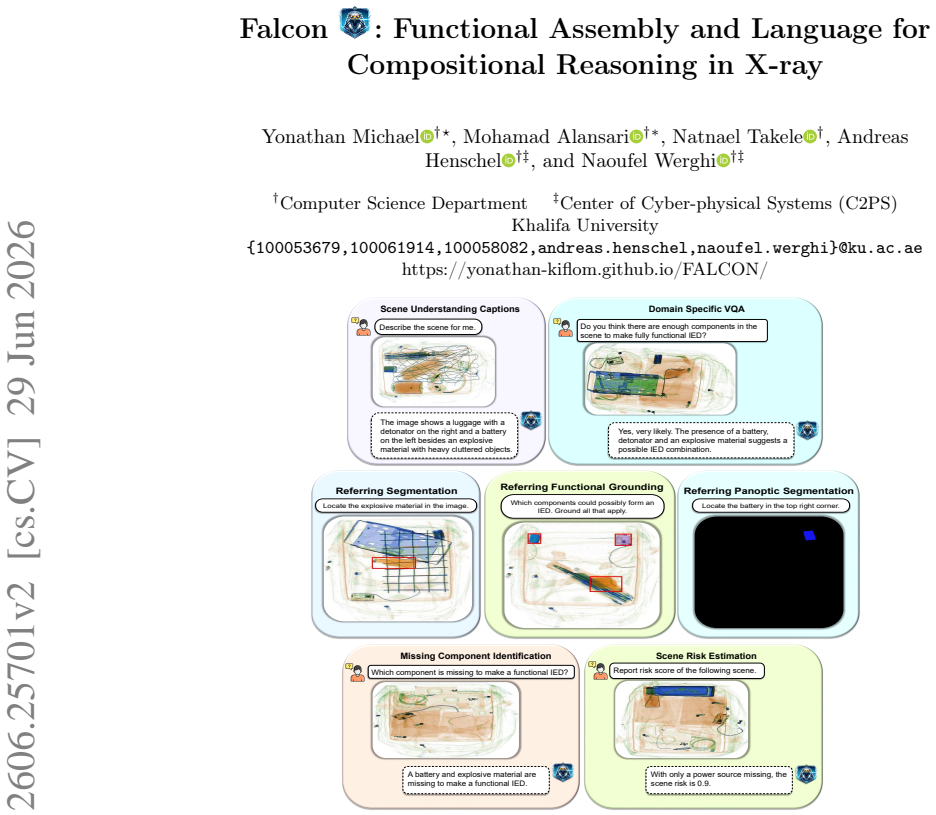
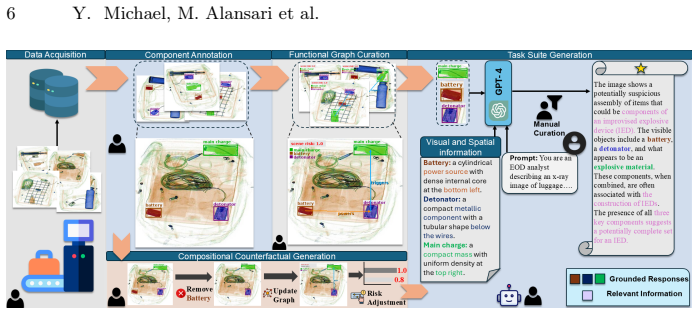
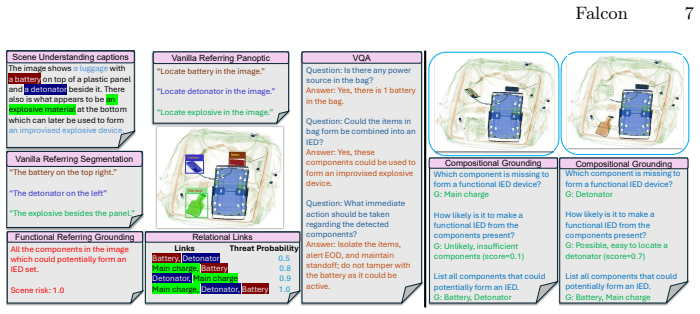
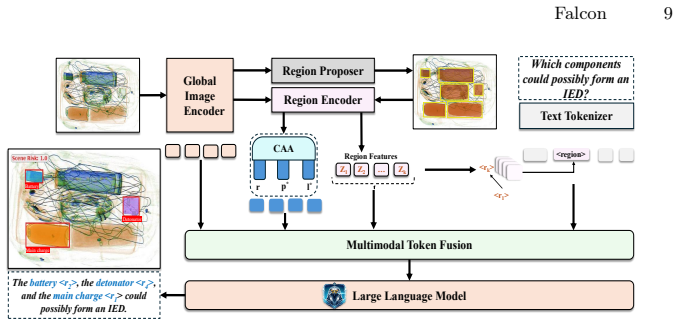
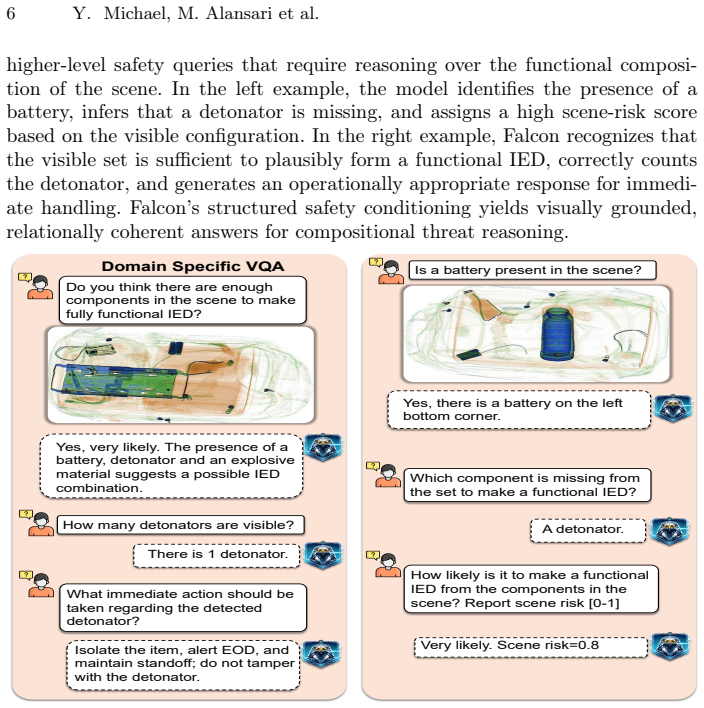
Falcon abstracts segmentation-aware region features into a structured safety state capturing component presence, pairwise functional compatibility, and scene-level risk. This structured representation is injected into the language model as an explicit intermediate interface, encouraging relationally consistent and safety-aware reasoning about threats that emerge from combinations of spatially dispersed components rather than from any single object.
Load-bearing premise
That the language model will actually use the injected structured safety state for reasoning rather than learning to ignore or override it.
Editorial extensions
If this is right
- Existing multimodal models adapt to appearance but struggle with compositional safety reasoning.
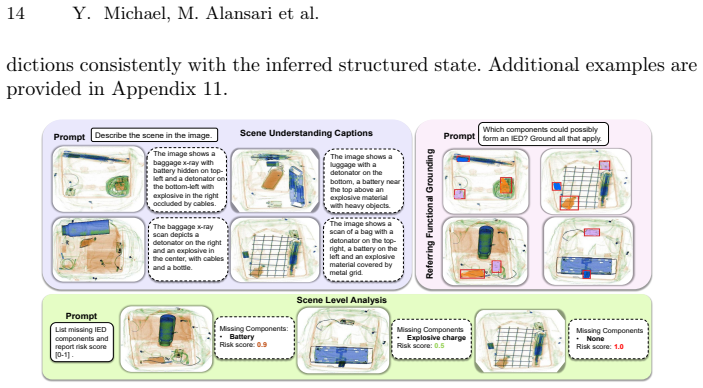
- Falcon improves functional grounding of components in cluttered X-ray imagery.
- Falcon produces more coherent threat assessments than appearance-only baselines.
- Compositional safety reasoning constitutes a distinct evaluation paradigm separate from standard object detection.
Reading between the lines
- The same state-injection pattern could be tested in other relational safety domains such as industrial inspection or medical imaging.
- An ablation that removes the explicit state after training would reveal whether the model has internalized the relational constraints or continues to rely on the injection.
- Extending the structured state to include temporal relations could address video-based screening scenarios.
Signed reviews
Editorial analysis
A structured set of objections, weighed in public.
Referee Report
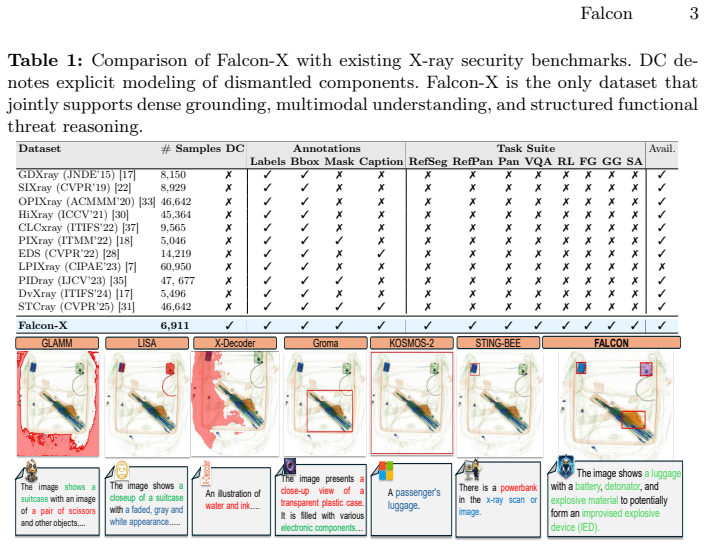
Summary. The paper introduces Falcon, a multimodal framework for compositional threat reasoning in X-ray baggage screening. It abstracts segmentation-aware region features into an explicit structured safety state (component presence, pairwise functional compatibility, scene-level risk) that is injected into the language model as an intermediate interface. The authors also present the Falcon-X benchmark unifying dense grounding with structured supervision over component completeness and risk inference. The central claim is that existing multimodal models adapt to appearance but struggle with compositional safety reasoning, while Falcon improves functional grounding and produces more coherent threat assessments, establishing compositional safety reasoning as a distinct evaluation paradigm.
Significance. If the empirical claims hold with rigorous validation, the work could define a new evaluation axis for multimodal systems focused on relational and functional reasoning in safety-critical domains rather than object-centric detection. The explicit injection of a structured safety state is a concrete architectural choice that could be tested for whether it enforces consistency beyond what appearance-only models achieve.
major comments (2)
- [Abstract] Abstract: the assertion that 'Experiments show that while existing multimodal models adapt to appearance, they struggle with compositional safety reasoning. Falcon improves functional grounding...' supplies no quantitative results, ablation studies, error analysis, dataset statistics, or baseline comparisons. Without these, the central claim that Falcon produces more coherent threat assessments cannot be evaluated.
- [Abstract] Abstract (and implied methods): the design assumes that explicit injection of the structured safety state will produce relationally consistent reasoning rather than being overridden or ignored by the language model. No implementation details, training procedure, or ablation isolating the effect of the injected state versus appearance features are referenced, leaving the weakest assumption untested.
Simulated Author's Rebuttal
We thank the referee for their thoughtful feedback on our manuscript. We address each major comment below with references to the full paper content.
read point-by-point responses
-
Referee: [Abstract] Abstract: the assertion that 'Experiments show that while existing multimodal models adapt to appearance, they struggle with compositional safety reasoning. Falcon improves functional grounding...' supplies no quantitative results, ablation studies, error analysis, dataset statistics, or baseline comparisons. Without these, the central claim that Falcon produces more coherent threat assessments cannot be evaluated.
Authors: The abstract is a concise high-level summary and does not contain quantitative details by standard convention. The full manuscript provides these elements in Section 4 (Experiments) and the appendix: quantitative results and baseline comparisons on Falcon-X, ablation studies on the structured safety state components, error analysis of threat assessments, and dataset statistics including component distributions and risk annotations. These support the central claim of improved functional grounding and coherent assessments. revision: partial
-
Referee: [Abstract] Abstract (and implied methods): the design assumes that explicit injection of the structured safety state will produce relationally consistent reasoning rather than being overridden or ignored by the language model. No implementation details, training procedure, or ablation isolating the effect of the injected state versus appearance features are referenced, leaving the weakest assumption untested.
Authors: The Methods section (Section 3) details the abstraction of segmentation-aware region features into the structured safety state (component presence, pairwise functional compatibility, scene-level risk) and its explicit injection into the language model as an intermediate interface. The training procedure, including fine-tuning with Falcon-X's structured supervision, is described. Ablation studies isolating the injected safety state versus appearance-only features appear in Section 4, showing gains in relational consistency. If these sections require expansion for clarity, we will revise accordingly. revision: no
Circularity Check
No significant circularity detected
full rationale
The provided manuscript text contains no equations, derivations, parameter fittings, or formal predictions that could reduce to their own inputs by construction. The central contribution is a new multimodal framework and benchmark whose claims rest on experimental comparisons against appearance-only baselines; these evaluations are independent of any self-referential definitions or self-citation chains. No load-bearing steps match the enumerated circularity patterns.
Assumptions & free parameters
assumptions (1)
- domain assumption Threat often emerges not from a single object but from the functional compatibility of spatially dispersed components.
invented entities (1)
-
structured safety state
Cite this review
Pith. "Pith review of Falcon: Functional Assembly and Language for Compositional Reasoning in X-ray." pith.science (2026). https://pith.science/paper/25ATGYAZ
@misc{pith2026260625701,
  author       = {Pith},
  title        = {Pith review of: Falcon: Functional Assembly and Language for Compositional Reasoning in X-ray},
  year         = {2026},
  howpublished = {\url{https://pith.science/paper/25ATGYAZ}},
  note         = {Machine review of arXiv:2606.25701}
}
read the original abstract
Conventional vision-language models are largely object-centric, focusing on detecting and describing individual entities. In safety-critical X-ray baggage screening, however, threat often emerges not from a single object but from the functional compatibility of spatially dispersed components, such as batteries, detonators, and explosive charges. We formalize this setting as \emph{compositional threat reasoning}, where risk is modeled as a relational property of grounded regions rather than an independent detection outcome. We introduce \textbf{Falcon}, a multimodal framework that abstracts segmentation-aware region features into a structured safety state capturing component presence, pairwise functional compatibility, and scene-level risk. This structured representation is injected into the language model as an explicit intermediate interface, encouraging relationally consistent and safety-aware reasoning. To evaluate this problem, we present \textbf{Falcon-X}, a benchmark that unifies dense grounding with structured supervision over component completeness and risk inference in cluttered X-ray imagery. Experiments show that while existing multimodal models adapt to appearance, they struggle with compositional safety reasoning. Falcon improves functional grounding and produces more coherent threat assessments, establishing compositional safety reasoning as a distinct evaluation paradigm for multimodal systems.
Figures
Figures from the paper (7 more)
Reference graph
Works this paper leans on
-
[1]
Cai, Z., Ke, F., Jahangard, S., Garcia de la Banda, M., Haffari, R., Stuckey, P.J., Rezatofighi, H.: Naver: A neuro-symbolic compositional automaton for vi- sual grounding with explicit logic reasoning. In: ICCV (2025)
work page 2025
-
[2]
Knowledge- Based Systems (2022)
Chang,A.,Zhang,Y.,Zhang,S.,Zhong,L.,Zhang,L.:Detectingprohibitedobjects with physical size constraint from cluttered x-ray baggage images. Knowledge- Based Systems (2022)
work page 2022
-
[3]
Shikra: Unleashing Multimodal LLM's Referential Dialogue Magic
Chen, K., Zhang, Z., Zeng, W., Zhang, R., Zhu, F., Zhao, R.: Shikra: Unleash- ing multimodal llm’s referential dialogue magic. arXiv preprint arXiv:2306.15195 (2023)
work page Pith review arXiv 2023
-
[4]
Chiang, W.L., Li, Z., Lin, Z., Sheng, Y., Wu, Z., Zhang, H., Zheng, L., Zhuang, S., Zhuang, Y., Gonzalez, J.E., Stoica, I., Xing, E.P.: Vicuna: An open-source chatbot impressing gpt-4 with 90%* chatgpt quality (March 2023),https://lmsys.org/ blog/2023-03-30-vicuna/
work page 2023
-
[5]
United States Patent Application US20160161228A1 (June 2016)
Eshetu, A., Burton, T.B., Howell, J.D., Rutter, M.F., Winnett, T.J.: Inert ied training kits. United States Patent Application US20160161228A1 (June 2016)
work page 2016
-
[6]
Garcia-Fernandez,P.,Vaquero,L.,Liu,M.,Xue,F.,Cores,D.,Sebe,N.,Mucientes, M., Ricci, E.: Superpowering open-vocabulary object detectors for x-ray vision. In: ICCV (2025)
work page 2025
-
[7]
He, C., Mu, T., Ren, W., Zhao, B.: Lpixray: A large-scale logistics prohibited item x-ray dataset for the application of deep learning in security inspection. CIPAE (2023)
work page 2023
-
[8]
He, K., Gkioxari, G., Dollár, P., Girshick, R.: Mask r-cnn. In: ICCV (2017) 16 Y. Michael, M. Alansari et al
work page 2017
Show all 40 references
-
[9]
In: ICLR (2022)
Hu, E.J., yelong shen, Wallis, P., Allen-Zhu, Z., Li, Y., Wang, S., Wang, L., Chen, W.: LoRA: Low-rank adaptation of large language models. In: ICLR (2022)
2022
-
[10]
In: ICCV (2025)
Lafon, M., Karmim, Y., Silva-Rodríguez, J., Couairon, P., Rambour, C., Fournier- Sniehotta, R., Ayed, I.B., Dolz, J., Thome, N.: Vilu: Learning vision-language uncertainties for failure prediction. In: ICCV (2025)
2025
-
[11]
In: CVPR (2024)
Lai, X., Tian, Z., Chen, Y., Li, Y., Yuan, Y., Liu, S., Jia, J.: Lisa: Reasoning segmentation via large language model. In: CVPR (2024)
2024
-
[12]
In: ICML (2023)
Li, J., Li, D., Savarese, S., Hoi, S.: Blip-2: bootstrapping language-image pre- training with frozen image encoders and large language models. In: ICML (2023)
2023
-
[13]
TNNLS36(2024)
Li, M., Jia, T., Wang, H., Ma, B., Lu, H., Lin, S., Cai, D., Chen, D.: Ao-detr: Anti-overlapping detr for x-ray prohibited items detection. TNNLS36(2024)
2024
-
[14]
In: ECCV (2014)
Lin, T.Y., Maire, M., Belongie, S.J., Hays, J., Perona, P., Ramanan, D., Dollár, P., Zitnick, C.L.: Microsoft coco: Common objects in context. In: ECCV (2014)
2014
-
[15]
In: CVPR (2023)
Liu, C., Ding, H., Jiang, X.: GRES: Generalized referring expression segmentation. In: CVPR (2023)
2023
-
[16]
Liu, H., Li, C., Wu, Q., Lee, Y.J.: Visual instruction tuning (2023)
2023
-
[17]
ITIFS19, 3866–3878 (2024)
Ma, B., Jia, T., Li, M., Wu, S., Wang, H., Chen, D.: Toward dual-view x-ray baggage inspection: A large-scale benchmark and adaptive hierarchical cross re- finement for prohibited item discovery. ITIFS19, 3866–3878 (2024)
2024
-
[18]
ITMM25, 4374–4386 (2022)
Ma, B., Jia, T., Su, M., Jia, X., Chen, D., Zhang, Y.: Automated segmentation of prohibited items in x-ray baggage images using dense de-overlap attention snake. ITMM25, 4374–4386 (2022)
2022
-
[19]
In: Leonardis, A., Ricci, E., Roth, S., Russakovsky, O., Sattler, T., Varol, G
Ma, C., Jiang, Y., Wu, J., Yuan, Z., Qi, X.: Groma: Localized visual tokenization for grounding multimodal large language models. In: Leonardis, A., Ricci, E., Roth, S., Russakovsky, O., Sattler, T., Varol, G. (eds.) Computer Vision – ECCV 2024. pp. 417–435. Springer Nature Sw...
2024
-
[20]
In: ICLR (2019)
Mao, J., Gan, C., Kohli, P., Tenenbaum, J.B., Wu, J.: The neuro-symbolic concept learner: Interpreting scenes, words, and sentences from natural supervision. In: ICLR (2019)
2019
-
[21]
Journal of Nondestructive Evaluation (2015)
Mery, D., Riffo, V., Zscherpel, U., Mondragón, G., Lillo, I., Zuccar, I., Lobel, H., Carrasco, M.: Gdxray: The database of x-ray images for nondestructive testing. Journal of Nondestructive Evaluation (2015)
2015
-
[22]
In: CVPR (2019)
Miao, C., Xie, L., Wan, F., Su, c., Liu, H., Jiao, j., Ye, Q.: Sixray: A large-scale security inspection x-ray benchmark for prohibited item discovery in overlapping images. In: CVPR (2019)
2019
-
[23]
In- formation Processing & Management63(1) (2026)
Michael, Y., Alansari, M., Ahmed, A., Werghi, N., Henschel, A.: X-ssl: Self- supervised x-ray threat detection with zero-shot and multi-modal learning. In- formation Processing & Management63(1) (2026)
2026
-
[24]
Transactions on Machine Learning Research (2024)
Oquab, M., Darcet, T., Moutakanni, T., Vo, H.V., Szafraniec, M., Khalidov, V., Fernandez, P., HAZIZA, D., Massa, F., El-Nouby, A., Assran, M., Ballas, N., Galuba, W., Howes, R., Huang, P.Y., Li, S.W., Misra, I., Rabbat, M., Sharma, V., Synnaeve, G., Xu, H., Jegou, H., Mairal, ...
2024
-
[25]
ArXiv abs/2306.14824(2023)
Peng, Z., Wang, W., Dong, L., Hao, Y., Huang, S., Ma, S., Wei, F.: Kosmos-2: Grounding multimodal large language models to the world. ArXiv abs/2306.14824(2023)
2023 arXiv
-
[26]
In: ICML (2021) Falcon 17
Radford, A., Kim, J.W., Hallacy, C., Ramesh, A., Goh, G., Agarwal, S., Sastry, G., Askell, A., Mishkin, P., Clark, J., Krueger, G., Sutskever, I.: Learning transferable visual models from natural language supervision. In: ICML (2021) Falcon 17
2021
-
[27]
CVPR (2024)
Rasheed, H., Maaz, M., Shaji, S., Shaker, A., Khan, S., Cholakkal, H., Anwer, R.M., Xing, E., Yang, M.H., Khan, F.S.: Glamm: Pixel grounding large multimodal model. CVPR (2024)
2024
-
[28]
In: ICLR (2026)
Robinson,I.,Robicheaux,P.,Popov,M.,Ramanan,D.,Peri,N.:RF-DETR:Neural architecture search for real-time detection transformers. In: ICLR (2026)
2026
-
[29]
In: CVPR (2022)
Tao, R., Li, H., Wang, T., Wei, Y., Ding, Y., Bowei Jin and, H.Z., Liu, X., Liu, A.: Exploring endogenous shift for cross-domain detection: A large-scale benchmark and perturbation suppression network. In: CVPR (2022)
2022
-
[30]
In: ICCV (2021)
Tao, R., Wei, Y., Jiang, X., Li, H., Qin, H., Wang, J., Ma, Y., Zhang, L., Liu, X.: Towards real-world x-ray security inspection: A high-quality benchmark and lateral inhibition module for prohibited items detection. In: ICCV (2021)
2021
-
[31]
In: ICCV (2021)
Tao, R., Wei, Y., Jiang, X., Li, H., Qin, H., Wang, J., Ma, Y., Zhang, L., Liu*, X.: Towards real-world x-ray security inspection: A high-quality benchmark and lateral inhibition module for prohibited items detection. In: ICCV (2021)
2021
-
[32]
In: CVPR (2025)
Velayudhan, D., Ahmed, A., Alansari, M., Gour, N., Behouch, A., Hassan, T., Wasim, S.T., Maalej, N., Naseer, M., Gall, J., et al.: Sting-bee: Towards vision- language model for real-world x-ray baggage security inspection. In: CVPR (2025)
2025
-
[33]
ACM Computing Surveys55(8) (2022)
Velayudhan, D., Hassan, T., Damiani, E., Werghi, N.: Recent advances in bag- gage threat detection: A comprehensive and systematic survey. ACM Computing Surveys55(8) (2022)
2022
-
[34]
In: ACMMM (2020)
Wei, Y., Tao, R., Wu, Z., Ma, Y., Zhang, L., Liu, X.: Occluded prohibited items detection:Anx-raysecurityinspectionbenchmarkandde-occlusionattentionmod- ule. In: ACMMM (2020)
2020
-
[35]
arXiv (2025)
Yuan, H., Li, X., Zhang, T., Huang, Z., Xu, S., Ji, S., Tong, Y., Qi, L., Feng, J., Yang, M.H.: Sa2va: Marrying sam2 with llava for dense grounded understanding of images and videos. arXiv (2025)
2025
-
[36]
IJCV (2023)
Zhang, L., Jiang, L., Ji, R., Fan, H.: Pidray: A large-scale x-ray benchmark for real-world prohibited item detection. IJCV (2023)
2023
-
[37]
In: Del Bue, A., Canton, C., Pont-Tuset, J., Tommasi, T
Zhang, S., Sun, P., Chen, S., Xiao, M., Shao, W., Zhang, W., Liu, Y., Chen, K., Luo, P.: Gpt4roi: Instruction tuning large language model on region-of-interest. In: Del Bue, A., Canton, C., Pont-Tuset, J., Tommasi, T. (eds.) Computer Vision – ECCV 2024 Workshops. pp. 52–70. Sp...
2024
-
[38]
ITIFS17, 998–1009 (2022)
Zhao, C., Zhu, L., Dou, S., Deng, W., Wang, L.: Detecting overlapped objects in x-ray security imagery by a label-aware mechanism. ITIFS17, 998–1009 (2022)
2022
-
[39]
scene-caption
Zhu, D., Chen, J., Shen, X., Li, X., Elhoseiny, M.: Minigpt-4: Enhancing vision- language understanding with advanced large language models. In: ICLR (2024) Falcon 1 Appendix –Additional Details on Falcon-X (section 9) –Additional Details on Falcon-X Task Suite Generation (sec...
2024
-
[40]
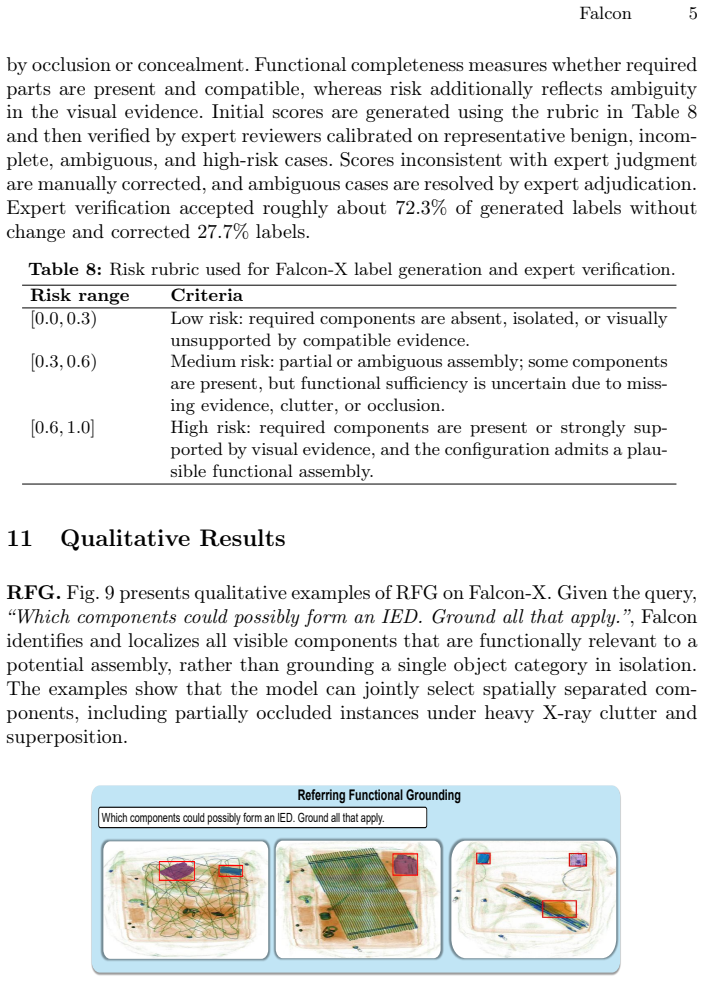
Which components could possibly form an IED. Ground all that apply
Scene captions must describe only visible components. 2. Referring instructions must be uniquely resolvable from spatial metadata. 3. VQA questions must be answerable from structured annotations. 4. Functional links must be inferred using spatial proximity and component types....
Reviewed June 30, 2026 · model on record in the stance chip above.
Discussion (0). Continue with ORCID to comment.