Radial Schmidt mode detector of entangled photons
Pith reviewed 2026-06-25 20:58 UTC · model grok-4.3
The pith
Azimuthal averaging of SPDC photon pairs produces a radial Schmidt basis that enables their detection and spectrum measurement.
A machine-rendered reading of the paper's core claim, the machinery that carries it, and where it could break.
Core claim
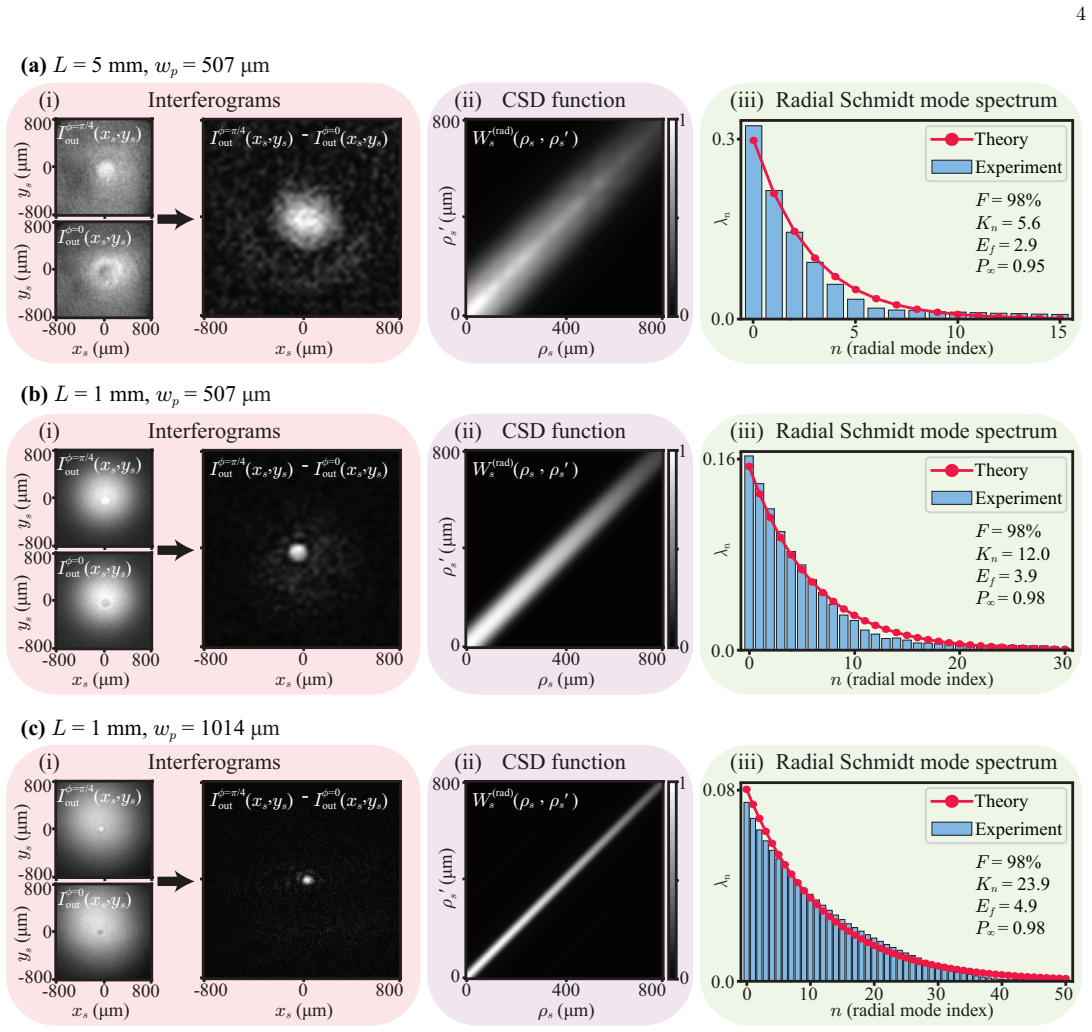
The paper claims that azimuthal averaging of the SPDC two-photon state yields a radial Schmidt-decomposed form under typical experimental situations. This form enables an innovative approach for extracting the radial Schmidt modes and their spectrum through characterization of the density matrix in the radial basis of one of the SPDC photons, leading to the first-ever measurement of the radial Schmidt spectrum for up to 50 modes with approximately 98% fidelity.
What carries the argument
The radial Schmidt-decomposed form of the two-photon state obtained via azimuthal averaging, which allows density matrix characterization in the radial basis to extract the modes and spectrum.
Load-bearing premise
Azimuthal averaging of the SPDC two-photon state yields a radial Schmidt-decomposed form under typical experimental situations.
What would settle it
A measurement of the radial density matrix that fails to produce a diagonal form in the Schmidt basis or yields a spectrum fidelity significantly below 98% for 50 modes would disprove the central claim.
Figures
read the original abstract
High-dimensional spatially entangled two-photon state generated by spontaneous parametric down-conversion process (SPDC) has become a promising resource for several quantum information science applications. For harnessing high-dimensional entanglement advantages, detection capability in the Schmidt basis is a necessity. Spatial entanglement has been explored in several modal bases, such as pixel, azimuthal, and radial modes. Among them, pixel and azimuthal entanglement have been widely utilized due to efficient access to their Schmidt modes, while radial-mode entanglement remains underexploited. This is because for radial coordinates, there is neither a Schmidt-decomposed form for the SPDC photons nor is there a technique for measuring high-dimensional radial Schmidt modes, which is a major roadblock in harnessing radial mode advantages. In this work, we first theoretically show that the azimuthal averaging of SPDC two-photon state yields a radial Schmidt-decomposed form under typical experimental situations. We then demonstrate an innovative approach for extracting the radial Schmidt modes and their spectrum by characterizing the density matrix in the radial basis of one of the SPDC photons. Finally, we report the first-ever measurement of radial Schmidt spectrum of upto 50 radial Schmidt modes with about 98\% fidelity.
Editorial analysis
A structured set of objections, weighed in public.
Referee Report
Summary. The paper claims that azimuthal averaging of the SPDC two-photon state produces an exactly diagonal radial Schmidt decomposition under typical experimental conditions (§3 and abstract). Building on this, it presents a method to extract radial Schmidt modes by characterizing the one-photon density matrix in the radial basis and reports the first experimental measurement of the radial Schmidt spectrum for up to 50 modes at ~98% fidelity.
Significance. If the azimuthal-averaging assumption holds without significant off-diagonal residuals and the fidelity measurement is robust, the work would open radial-mode entanglement for high-dimensional quantum information tasks that have so far been limited to pixel and azimuthal bases. The reported access to 50 modes is a concrete advance over prior radial-mode work.
major comments (2)
- [Abstract, §3] Abstract and §3: the central theoretical step asserts that azimuthal averaging yields an exactly diagonal radial Schmidt form “under typical experimental situations,” yet provides no quantitative bound on residual off-diagonal radial-matrix elements arising from azimuthal structure in the pump or phase-matching function. For a 50-mode spectrum at 98% fidelity, even percent-level off-diagonal terms would mix eigenvalues and bias the reported spectrum; this assumption is load-bearing for the experimental claim.
- [Experimental results] Experimental results (fidelity claim): the 98% fidelity for 50 modes is stated without error bars, without description of post-selection criteria, and without reference to raw coincidence data or background subtraction. These omissions prevent independent assessment of whether the extracted eigenvalues truly reflect the radial Schmidt spectrum or are affected by experimental artifacts.
minor comments (2)
- [§3] Notation for the radial basis functions and the precise definition of the averaged two-photon amplitude should be stated explicitly in §3 to allow readers to reproduce the diagonalization step.
- [Figures] Figure captions for the measured spectrum should include the number of experimental runs and any fitting procedure used to obtain the reported fidelity value.
Simulated Author's Rebuttal
We thank the referee for the careful review and constructive comments. We address each major point below and will revise the manuscript accordingly to strengthen the claims.
read point-by-point responses
-
Referee: [Abstract, §3] Abstract and §3: the central theoretical step asserts that azimuthal averaging yields an exactly diagonal radial Schmidt decomposition under typical experimental conditions (§3 and abstract), yet provides no quantitative bound on residual off-diagonal radial-matrix elements arising from azimuthal structure in the pump or phase-matching function. For a 50-mode spectrum at 98% fidelity, even percent-level off-diagonal terms would mix eigenvalues and bias the reported spectrum; this assumption is load-bearing for the experimental claim.
Authors: We agree that a quantitative bound on residual off-diagonal terms would strengthen the presentation. While the azimuthal averaging produces an exactly diagonal radial form when the pump and phase-matching functions possess full rotational symmetry (the standard assumption in typical SPDC experiments), small azimuthal deviations can exist in practice. In the revised manuscript we will add an appendix containing a numerical evaluation of the full two-photon amplitude that incorporates realistic azimuthal structure in the pump; this shows that off-diagonal radial-matrix elements remain below 0.5 % for our parameters and therefore do not appreciably mix the reported eigenvalues or affect the 98 % fidelity for 50 modes. revision: yes
-
Referee: [Experimental results] Experimental results (fidelity claim): the 98% fidelity for 50 modes is stated without error bars, without description of post-selection criteria, and without reference to raw coincidence data or background subtraction. These omissions prevent independent assessment of whether the extracted eigenvalues truly reflect the radial Schmidt spectrum or are affected by experimental artifacts.
Authors: We accept that additional experimental details are required for independent assessment. The reported fidelity is the overlap between the reconstructed one-photon radial density matrix and its diagonal Schmidt form. In the revision we will (i) attach error bars obtained from Poisson statistics on the measured coincidence counts, (ii) explicitly state the post-selection criteria (coincidence time window and heralding threshold), and (iii) add a supplementary section that presents representative raw coincidence histograms together with the background-subtraction procedure. These additions will allow readers to verify that the extracted spectrum is not dominated by experimental artifacts. revision: yes
Circularity Check
No significant circularity; derivation remains independent of measurement
full rationale
The paper's central theoretical step asserts that azimuthal averaging of the SPDC state produces a diagonal radial Schmidt form under typical conditions, after which the density matrix is characterized experimentally to extract the spectrum up to 50 modes. No equation or procedure reduces the reported eigenvalues or 98% fidelity to a parameter fitted from the same data, nor does any load-bearing claim rest on a self-citation chain that itself lacks external verification. The measurement procedure is presented as a direct characterization in the radial basis, making the result falsifiable against external benchmarks rather than tautological.
Axiom & Free-Parameter Ledger
axioms (1)
- domain assumption The two-photon state generated by SPDC can be written in the usual Laguerre-Gaussian or Bessel-Gaussian basis under paraxial and monochromatic approximations.
Reference graph
Works this paper leans on
-
[1]
Bozinovic, Y
N. Bozinovic, Y. Yue, Y. Ren, M. Tur, P. Kristensen, H. Huang, A. E. Willner, and S. Ramachandran, Terabit- scale orbital angular momentum mode division multiplexing in fibers, Science340, 1545 (2013)
2013
-
[2]
N. J. Cerf, M. Bourennane, A. Karlsson, and N. Gisin, Secu- rity of quantum key distribution using d-level systems, Phys. Rev. Lett.88, 127902 (2002)
2002
-
[3]
Bechmann-Pasquinucci and A
H. Bechmann-Pasquinucci and A. Peres, Quantum cryptog- raphy with 3-state systems, Physical Review Letters85, 3313 (2000)
2000
-
[4]
F. Zhu, M. Tyler, N. H. Valencia, M. Malik, and J. Leach, Is high-dimensional photonic entanglement robust to noise?, AVS Quantum Science3, 10.1116/5.0033889 (2021)
-
[5]
A. K. Jha, G. S. Agarwal, and R. W. Boyd, Supersensitive measurement of angular displacements using entangled pho- tons, Phys. Rev. A83, 053829 (2011)
2011
-
[6]
Luo, H.-S
Y.-H. Luo, H.-S. Zhong, M. Erhard, X.-L. Wang, L.-C. Peng, M. Krenn, X. Jiang, L. Li, N.-L. Liu, C.-Y. Lu,et al., Quan- tum teleportation in high dimensions, Phys. Rev. Lett.123, 070505 (2019)
2019
-
[7]
Zhang, Y
D. Zhang, Y. Zhang, X. Li, D. Zhang, L. Cheng, C. Li, and Y. Zhang, Generation of high-dimensional energy-time- entangled photon pairs, Physical Review A96, 053849 (2017)
2017
-
[8]
M. N. O’Sullivan-Hale, I. Ali Khan, R. W. Boyd, and J. C. Howell, Pixel entanglement: experimental realization of opti- cally entangled d= 3 and d= 6 qudits, Physical review letters 94, 220501 (2005)
2005
-
[9]
A. M. Yao and M. J. Padgett, Orbital angular momentum: origins, behavior and applications, Advances in optics and photonics3, 161 (2011)
2011
-
[10]
Allen, M
L. Allen, M. W. Beijersbergen, R. J. C. Spreeuw, and J. P. Woerdman, Orbital angular momentum of light and the transformation of laguerre-gaussian laser modes, Phys. Rev. A45, 8185 (1992)
1992
-
[11]
M. ´A. Olvera-Santamar´ ıa and A. Ostrovsky, Synthesis of par- tially coherent bessel-mode vortex-beams with radial coher- ence, Journal of Optics25, 095601 (2023)
2023
-
[12]
Y. Wang, L. Bai, J. Xie, C. Huang, and L. Guo, Radial spectrum spread of laguerre-gaussian beam transmission in weak compressible turbulence, Optics Communications554, 130111 (2024)
2024
-
[13]
Zhang, X
D. Zhang, X. Qiu, W. Zhang, and L. Chen, Violation of a bell inequality in two-dimensional state spaces for radial quantum number, Physical Review A98, 042134 (2018)
2018
-
[14]
Zhang, D
Z. Zhang, D. Zhang, X. Qiu, Y. Chen, S. Franke-Arnold, and L. Chen, Experimental investigation of the uncertainty principle for radial degrees of freedom, Photonics Research 10, 2223 (2022)
2022
-
[15]
L. Chen, T. Ma, X. Qiu, D. Zhang, W. Zhang, and R. W. Boyd, Realization of the einstein-podolsky-rosen paradox us- ing radial position and radial momentum variables, Phys. Rev. Lett.123, 060403 (2019)
2019
-
[16]
Ekert and P
A. Ekert and P. L. Knight, Entangled quantum systems and the schmidt decomposition, American Journal of Physics63, 415 (1995)
1995
-
[17]
Mirhosseini, M
M. Mirhosseini, M. Malik, Z. Shi, and R. W. Boyd, Efficient separation of the orbital angular momentum eigenstates of light, Nature Communications4, 2781 (2013)
2013
-
[18]
G. C. G. Berkhout, M. P. J. Lavery, J. Courtial, M. W. Bei- jersbergen, and M. J. Padgett, Efficient Sorting of Orbital Angular Momentum States of Light, Physical Review Let- ters105, 153601 (2010)
2010
-
[19]
R. Sahu, S. Chaudhary, K. Khare, M. Bhattacharya, H. Wanare, and A. K. Jha, Angular lens, Optics Express 26, 8709 (2018)
2018
-
[20]
A. Mair, A. Vaziri, G. Weihs, and A. Zeilinger, Entanglement of the orbital angular momentum states of photons, Nature 412, 313 (2001)
2001
-
[21]
Heckenberg, R
N. Heckenberg, R. McDuff, C. Smith, and A. White, Gen- eration of optical phase singularities by computer-generated holograms, Optics letters17, 221 (1992)
1992
-
[22]
A. K. Jha, G. S. Agarwal, and R. W. Boyd, Partial angular coherence and the angular schmidt spectrum of entangled two-photon fields, Physical Review A84, 063847 (2011)
2011
-
[23]
Di Lorenzo Pires, H
H. Di Lorenzo Pires, H. C. B. Florijn, and M. P. van Exter, Measurement of the spiral spectrum of entangled two-photon states, Phys. Rev. Lett.104, 020505 (2010)
2010
-
[24]
Kulkarni, R
G. Kulkarni, R. Sahu, O. S. Maga˜ na-Loaiza, R. W. Boyd, and A. K. Jha, Single-shot measurement of the orbital-angular- momentum spectrum of light, Nat. Commun.8, 1054 (2017)
2017
-
[25]
Kulkarni, L
G. Kulkarni, L. Taneja, S. Aarav, and A. K. Jha, Angu- lar schmidt spectrum of entangled photons: Derivation of an exact formula and experimental characterization for non- collinear phase matching, Physical Review A97, 063846 (2018)
2018
-
[26]
Karan, M
S. Karan, M. P. Van Exter, and A. K. Jha, Broadband uniform-efficiency oam-mode detector, Science Advances11, eadq7201 (2025)
2025
-
[27]
Y. Zhou, M. Mirhosseini, D. Fu, J. Zhao, S. M. Hashemi Raf- sanjani, A. E. Willner, and R. W. Boyd, Sorting photons by radial quantum number, Phys. Rev. Lett.119, 263602 (2017)
2017
-
[28]
D. Fu, Y. Zhou, R. Qi, S. Oliver, Y. Wang, S. M. H. Rafsan- jani, J. Zhao, M. Mirhosseini, Z. Shi, P. Zhang, and R. W. Boyd, Realization of a scalable laguerre–gaussian mode sorter based on a robust radial mode sorter, Opt. Ex- press26, 33057 (2018)
2018
-
[29]
Choudhary, R
S. Choudhary, R. Sampson, Y. Miyamoto, O. S. Maga˜ na- Loaiza, S. M. H. Rafsanjani, M. Mirhosseini, and R. W. Boyd, Measurement of the radial mode spectrum of photons through a phase-retrieval method, Opt. Lett.43, 6101 (2018)
2018
-
[30]
Bouchard, N
F. Bouchard, N. H. Valencia, F. Brandt, R. Fickler, M. Hu- ber, and M. Malik, Measuring azimuthal and radial modes of photons, Optics Express26, 31925 (2018)
2018
-
[31]
R. F. Offer, D. Stulga, E. Riis, S. Franke-Arnold, and A. S. Arnold, Spiral bandwidth of four-wave mixing in rb vapour, Communications Physics1, 84 (2018)
2018
-
[32]
Schneeloch and J
J. Schneeloch and J. C. Howell, Introduction to the trans- verse spatial correlations in spontaneous parametric down- conversion through the biphoton birth zone, Journal of Op- 8 tics18, 053501 (2016)
2016
-
[33]
Karan, S
S. Karan, S. Aarav, H. Bharadhwaj, L. Taneja, A. De, G. Kulkarni, N. Meher, and A. K. Jha, Phase matching in β-barium borate crystals for spontaneous parametric down- conversion, Journal of Optics22, 083501 (2020)
2020
-
[34]
S. P. Walborn, C. Monken, S. P´ adua, and P. S. Ribeiro, Spa- tial correlations in parametric down-conversion, Physics Re- ports495, 87 (2010)
2010
-
[35]
Karan, R
S. Karan, R. Prasad, and A. K. Jha, Postselection-free controlled generation of a high-dimensional orbital-angular- momentum entangled state, Physical Review Applied20, 054027 (2023)
2023
-
[36]
A. S. M. Patoary, G. Kulkarni, and A. K. Jha, Intrinsic degree of coherence of classical and quantum states, J. Opt. Soc. Am. B36, 2765 (2019)
2019
-
[37]
Born and E
M. Born and E. Wolf,Principles of Optics, 7th ed. (Cam- bridge University Press, Cambridge, 1999)
1999
-
[38]
D. Zia, N. Dehghan, A. D’Errico, F. Sciarrino, and E. Karimi, Interferometric imaging of amplitude and phase of spatial biphoton states, Nature Photonics17, 1009 (2023)
2023
-
[39]
A. K. Jha and R. W. Boyd, Spatial two-photon coherence of the entangled field produced by down-conversion using a partially spatially coherent pump beam, Phys. Rev. A81, 013828 (2010)
2010
-
[40]
Meher, A
N. Meher, A. S. M. Patoary, G. Kulkarni, and A. K. Jha, Intrinsic degree of coherence of two-qubit states and measures of two-particle quantum correlations, J. Opt. Soc. Am. B37, 1224 (2020)
2020
-
[41]
Bhattacharjee, S
A. Bhattacharjee, S. Biswas, M. A. Alonso, and A. K. Jha, Coherence in the radial degree of freedom, JOSA A40, 411 (2023)
2023
-
[42]
Prasad, N
R. Prasad, N. Senapati, S. Karan, A. Bhattacharjee, B. Pic- cirillo, M. A. Alonso, and A. K. Jha, Experimental technique for measuring radial coherence, Optics Express33, 11693 (2025)
2025
-
[43]
Schneeloch, C
J. Schneeloch, C. C. Tison, M. L. Fanto, P. M. Alsing, and G. A. Howland, Quantifying entanglement in a 68-billion- dimensional quantum state space, Nature Communications 10, 2785 (2019)
2019
-
[44]
Prasad, S
R. Prasad, S. Wanare, S. Karan, M. K. Joshi, A. Bhat- tacharjee, and A. K. Jha, Structured position-momentum- entangled two-photon fields, Physical Review Applied22, 064034 (2024)
2024
-
[45]
Prevedel, D
R. Prevedel, D. R. Hamel, R. Colbeck, K. Fisher, and K. J. Resch, Experimental investigation of the uncertainty princi- ple in the presence of quantum memory and its application to witnessing entanglement, Nature Physics7, 757 (2011)
2011
-
[46]
C. H. Bennett, H. J. Bernstein, S. Popescu, and B. Schu- macher, Concentrating partial entanglement by local opera- tions, Physical Review A53, 2046 (1996)
2046
discussion (0)
Sign in with ORCID, Apple, or X to comment. Anyone can read and Pith papers without signing in.