Exploring the physics of ram pressure stripping with radio continuum observations in the SKA era
Pith reviewed 2026-06-25 20:20 UTC · model grok-4.3
The pith
The Square Kilometre Array will extend radio studies of ram pressure stripping to the southern sky and to redshift 0.5.
A machine-rendered reading of the paper's core claim, the machinery that carries it, and where it could break.
Core claim
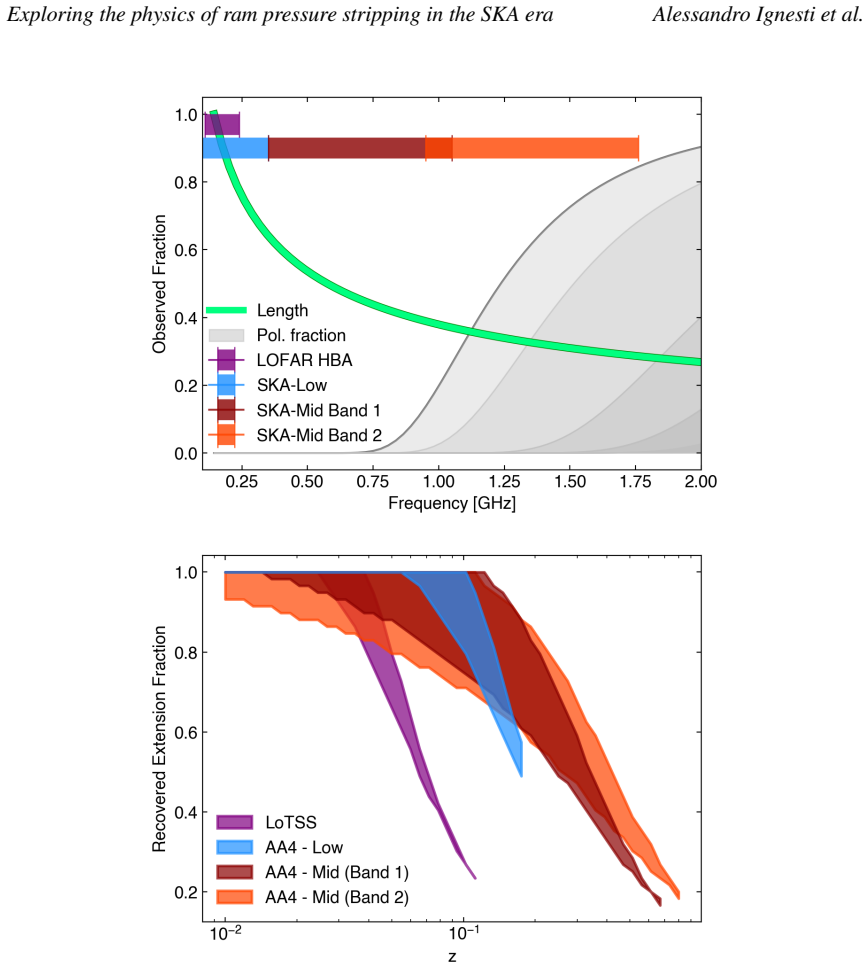
Continuum studies of the RPS effect are currently mostly carried out with LOFAR, limiting them to the northern hemisphere. SKA-Low will permit us to extend them to the southern sky, where they will synergize with the southern observatories and the upcoming ELT. The sub-arcsecond resolution provided by SKA-Mid will facilitate the exploration of the polarization and filamentary structure of RPS radio tails and allow us to detect them up to z≃0.5, advancing our understanding of the impact of RPS on satellite galaxies in clusters and groups.
What carries the argument
Synchrotron emission produced by magnetic fields and relativistic electrons in the stripped interstellar medium, observed at low radio frequencies.
If this is right
- RPS radio studies will cover the southern sky with SKA-Low.
- Multi-wavelength synergy will increase between radio data and southern optical and X-ray facilities including the ELT.
- Polarization and filamentary structure of RPS tails will become accessible with SKA-Mid.
- RPS tails will be detectable up to redshift approximately 0.5.
- Statistical understanding of RPS effects on satellite galaxies in clusters and groups will improve.
Where Pith is reading between the lines
- Polarization measurements could constrain the magnetic field geometry within the stripped tails.
- Southern-sky coverage may allow direct comparison of RPS efficiency across clusters with different dynamical histories.
- Detections at higher redshift could indicate whether RPS efficiency changes with look-back time.
Load-bearing premise
The synchrotron emission from stripped ISM is sufficiently bright, steep-spectrum, and morphologically distinct to be reliably detected and interpreted with SKA at the stated redshifts and resolutions.
What would settle it
Non-detection of the predicted steep-spectrum radio tails in southern clusters with SKA-Low or absence of resolved tails at z approximately 0.5 with SKA-Mid would falsify the expected performance.
Figures
read the original abstract
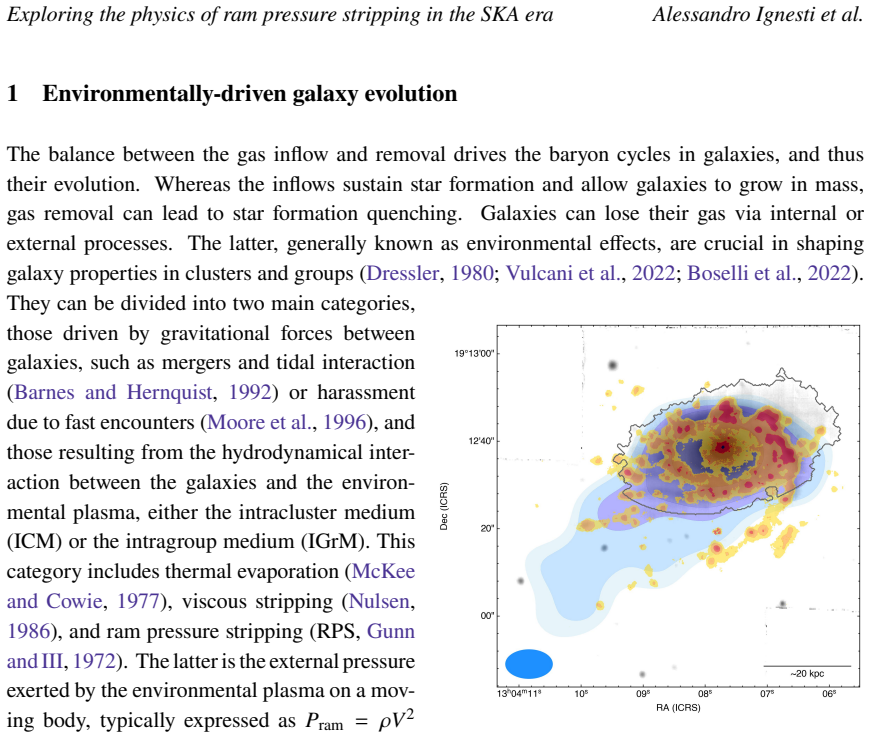
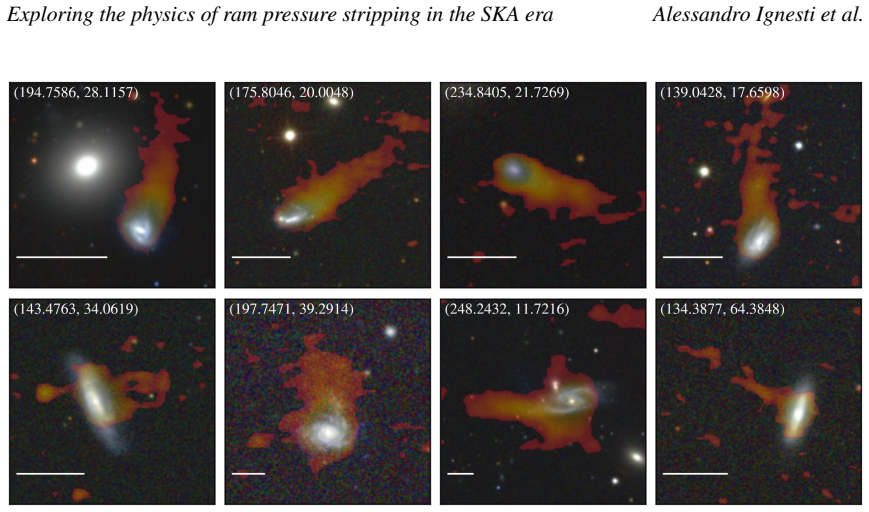
Satellite galaxies in clusters are significantly more likely to be red and passive than similar mass galaxies in the field. This fact is known as the environmental quenching of galaxy star formation, which is believed to be driven by ram pressure stripping (RPS). The large velocity differences between the infalling galaxies and the intracluster medium (ICM) result in a strong ram pressure on their interstellar medium (ISM), which can strip it from the stellar disk. The stripped ISM can be studied at various wavelengths, including the radio band, thanks to the synchrotron emission produced by the magnetic fields and relativistic electrons embedded in them. This emission is typically steep-spectrum and thus best observed at low frequencies. Thus, continuum studies of the RPS effect are currently mostly carried out with LOFAR, limiting them to the northern hemisphere. SKA-Low will permit us to extend them to the southern sky, where they will synergize with the southern observatories and the upcoming ELT. Lastly, the sub-arcsecond resolution provided by SKA-Mid will facilitate the exploration of the polarization and filamentary structure of RPS radio tails and allow us to detect them up to $z\simeq0.5$, advancing our understanding of the impact of RPS on satellite galaxies in clusters and groups.
Editorial analysis
A structured set of objections, weighed in public.
Referee Report
Summary. The manuscript argues that radio continuum observations of ram pressure stripping (RPS) tails via steep-spectrum synchrotron emission are currently limited to LOFAR in the northern sky. It claims that SKA-Low will extend such studies to the southern hemisphere for synergy with southern facilities and the ELT, while SKA-Mid's sub-arcsecond resolution will enable polarization and filamentary mapping of RPS tails and allow detections up to z≃0.5, thereby advancing understanding of environmental quenching in clusters and groups.
Significance. If the detectability assumptions hold, the perspective correctly identifies an important observational niche for SKA in multi-wavelength RPS studies and highlights synergies with upcoming southern facilities. However, the absence of any quantitative predictions or sensitivity analysis limits its immediate impact as a research contribution.
major comments (1)
- [Abstract] Abstract: The central claim that SKA-Mid sub-arcsecond resolution 'will ... allow us to detect them up to z≃0.5' is unsupported by any sensitivity scaling, flux-density extrapolation from published LOFAR RPS detections, or comparison against SKA-Mid noise curves after cosmological surface-brightness dimming ((1+z)^-4), steep-spectrum k-correction, and beam dilution at fixed physical scales. This quantitative gap is load-bearing for the paper's primary forward-looking assertion.
minor comments (1)
- The text is entirely prospective and would benefit from an explicit statement of the assumptions required for the z≃0.5 detection claim (e.g., minimum surface brightness, spectral index range, and morphological distinctness against ICM turbulence).
Simulated Author's Rebuttal
We thank the referee for their thoughtful review and for highlighting the need for quantitative support behind the forward-looking claims in our perspective article. We address the single major comment below and will revise the manuscript accordingly.
read point-by-point responses
-
Referee: [Abstract] Abstract: The central claim that SKA-Mid sub-arcsecond resolution 'will ... allow us to detect them up to z≃0.5' is unsupported by any sensitivity scaling, flux-density extrapolation from published LOFAR RPS detections, or comparison against SKA-Mid noise curves after cosmological surface-brightness dimming ((1+z)^-4), steep-spectrum k-correction, and beam dilution at fixed physical scales. This quantitative gap is load-bearing for the paper's primary forward-looking assertion.
Authors: We agree that the claim regarding detections up to z≃0.5 requires quantitative backing to be robust. In the revised manuscript we will add a dedicated subsection (likely in Section 3 or a new Section 4) that performs order-of-magnitude sensitivity calculations. These will extrapolate flux densities from published LOFAR RPS tail detections, apply the (1+z)^-4 surface-brightness dimming, include a steep-spectrum k-correction, account for beam dilution at fixed physical scales, and compare the resulting surface brightnesses against the expected SKA-Mid noise curves at the relevant frequencies and resolutions. This addition will directly support (or qualify) the z≃0.5 statement while preserving the perspective nature of the paper. revision: yes
Circularity Check
No circularity; paper contains no derivations, fits, or self-referential claims
full rationale
The manuscript is a forward-looking perspective on SKA capabilities for RPS studies. It states observational expectations (e.g., detection to z≃0.5) without any equations, parameter fitting, or reduction of claims to prior self-citations. No load-bearing steps reduce by construction to inputs. The absence of quantitative sensitivity calculations is a separate issue of evidence strength, not circularity.
Axiom & Free-Parameter Ledger
Reference graph
Works this paper leans on
-
[1]
2019 , eprint=
Anticipated Performance of the Square Kilometre Array -- Phase 1 (SKA1) , author=. 2019 , eprint=
2019
-
[2]
Dynamics of interacting galaxies. , keywords =. doi:10.1146/annurev.aa.30.090192.003421 , adsurl =
-
[3]
VICTORIA project: The LOFAR HBA Virgo Cluster Survey. , keywords =. doi:10.1051/0004-6361/202346458 , archivePrefix =. 2306.04513 , primaryClass =
-
[4]
Overview of the Euclid mission
Euclid: I. Overview of the Euclid mission. , keywords =. doi:10.1051/0004-6361/202450810 , archivePrefix =. 2405.13491 , primaryClass =
-
[5]
MICADO: the E-ELT Adaptive Optics Imaging Camera
MICADO: the E-ELT adaptive optics imaging camera. Ground-based and Airborne Instrumentation for Astronomy III , year = 2010, editor =. doi:10.1117/12.856379 , archivePrefix =. 1005.5009 , primaryClass =
work page internal anchor Pith review Pith/arXiv arXiv doi:10.1117/12.856379 2010
-
[6]
The effect of cluster dynamical state on ram-pressure stripping. , keywords =. doi:10.1093/mnras/stad2972 , archivePrefix =. 2309.15934 , primaryClass =
-
[7]
ViCTORIA project: The LOFAR view of environmental effects in Virgo cluster star-forming galaxies. , keywords =. doi:10.1051/0004-6361/202348301 , archivePrefix =. 2311.01904 , primaryClass =
-
[8]
2015 , publisher=
Advancing Astrophysics with the Square Kilometre Array (AASKA14) , author=. 2015 , publisher=
2015
-
[9]
LoCuSS: The slow quenching of star formation in cluster galaxies and the need for pre-processing
LoCuSS: The Slow Quenching of Star Formation in Cluster Galaxies and the Need for Pre-processing. , keywords =. doi:10.1088/0004-637X/806/1/101 , archivePrefix =. 1504.05604 , primaryClass =
work page internal anchor Pith review Pith/arXiv arXiv doi:10.1088/0004-637x/806/1/101
-
[10]
Abell , G. O. The Distribution of Rich Clusters of Galaxies. doi:10.1086/190036
-
[11]
arXiv e-prints , keywords =
Physical insights from the spectrum of the radio halo in MACS J0717.5+3745. arXiv e-prints , keywords =
-
[12]
High-resolution, High-sensitivity, Low-frequency uGMRT View of Coma Cluster of Galaxies. , keywords =. doi:10.3847/1538-4357/ac7a9b , archivePrefix =. 2207.06624 , primaryClass =
-
[13]
Ram pressure stripping of the multiphase ISM and star formation in the Virgo spiral galaxy NGC 4330
Ram pressure stripping of the multiphase ISM and star formation in the Virgo spiral galaxy NGC 4330. , keywords =. doi:10.1051/0004-6361/201117680 , archivePrefix =. 1111.5236 , primaryClass =
work page internal anchor Pith review Pith/arXiv arXiv doi:10.1051/0004-6361/201117680
-
[14]
The First Magnetic Fields. , keywords =. doi:10.1007/s11214-011-9833-5 , archivePrefix =. 1109.4052 , primaryClass =
work page internal anchor Pith review Pith/arXiv arXiv doi:10.1007/s11214-011-9833-5
-
[15]
Planck early results. XI. Calibration of the local galaxy cluster Sunyaev-Zeldovich scaling relations. , keywords =. doi:10.1051/0004-6361/201116458 , archivePrefix =. 1101.2026 , primaryClass =
work page internal anchor Pith review Pith/arXiv arXiv doi:10.1051/0004-6361/201116458 2026
-
[16]
Revised equipartition and minimum energy formula for magnetic field strength estimates from radio synchrotron observations. Astronomische Nachrichten , keywords =. doi:10.1002/asna.200510366 , archivePrefix =. astro-ph/0507367 , primaryClass =
work page internal anchor Pith review Pith/arXiv arXiv doi:10.1002/asna.200510366
-
[17]
HST imaging of star-forming clumps in 6 GASP ram-pressure stripped galaxies. arXiv e-prints , keywords =. doi:10.48550/arXiv.2302.10615 , archivePrefix =. 2302.10615 , primaryClass =
-
[18]
Radio synchrotron spectra of star-forming galaxies
Radio synchrotron spectra of star-forming galaxies. , keywords =. doi:10.1051/0004-6361/201731673 , archivePrefix =. 1710.03149 , primaryClass =
work page internal anchor Pith review Pith/arXiv arXiv doi:10.1051/0004-6361/201731673
-
[19]
The environmental dependence of rapidly quenching and rejuvenating galaxies. , keywords =. doi:10.1093/mnras/staa3267 , archivePrefix =. 2006.16307 , primaryClass =
-
[20]
Evidence for Mixing between ICM and Stripped ISM by the Analysis of the Gas Metallicity in the Tails of Jellyfish Galaxies. , keywords =. doi:10.3847/2041-8213/ac3664 , archivePrefix =. 2111.04755 , primaryClass =
-
[21]
HST viewing of spectacular star-forming trails behind ESO 137-001. , keywords =. doi:10.1093/mnras/stad963 , archivePrefix =. 2302.07270 , primaryClass =
-
[22]
GASP. XXI. Star Formation Rates in the Tails of Galaxies Undergoing Ram Pressure Stripping. , keywords =. doi:10.3847/1538-4357/aba3cb , archivePrefix =. 2006.16032 , primaryClass =
-
[23]
Extraction and self-calibration of individual LOFAR targets
LOFAR observations of galaxy clusters in HETDEX. Extraction and self-calibration of individual LOFAR targets. , keywords =. doi:10.1051/0004-6361/202039826 , archivePrefix =. 2011.02387 , primaryClass =
-
[24]
arXiv e-prints , keywords =
LOFAR observations of galaxy clusters in HETDEX. arXiv e-prints , keywords =
-
[25]
arXiv e-prints , keywords =
Diffuse Radio Emission from Galaxy Clusters in the LOFAR Two-metre Sky Survey Deep Fields. arXiv e-prints , keywords =
-
[27]
Long-slit spectroscopy of gas in the cores of X-ray luminous clusters. , keywords =. doi:10.1086/191081 , adsurl =
-
[28]
The nature of filamentary cold gas in the core of the Virgo Cluster
The Nature of Filamentary Cold Gas in the Core of the Virgo Cluster. , keywords =. doi:10.1088/0004-637X/767/2/153 , archivePrefix =. 1211.6722 , primaryClass =
work page internal anchor Pith review Pith/arXiv arXiv doi:10.1088/0004-637x/767/2/153
-
[29]
Science with the Cherenkov Telescope Array. doi:10.1142/10986 , adsurl =
-
[30]
Ubiquitous cold and massive filaments in cool core clusters. , keywords =. doi:10.1051/0004-6361/201935350 , archivePrefix =. 1902.09164 , primaryClass =
-
[31]
Allen , S. W. and Fabian , A. C. and Johnstone , R. M. and White , D. A. and Daines , S. J. and Edge , A. C. and Stewart , G. C. A ROSAT PSPC observation of Abell 478 - The distribution of X-ray absorbing matter in a massive cooling flow
-
[32]
Role of intracluster supernovae in radio mini-halos in galaxy clusters
Role of intracluster supernovae in radio mini-haloes in galaxy clusters. , keywords =. doi:10.1093/mnrasl/slz020 , archivePrefix =. 1902.02994 , primaryClass =
work page internal anchor Pith review Pith/arXiv arXiv doi:10.1093/mnrasl/slz020 1902
-
[33]
Allen , S. W. and Schmidt , R. W. and Fabian , A. C. The X-ray virial relations for relaxed lensing clusters observed with Chandra. doi:10.1046/j.1365-8711.2001.05079.x. arXiv:astro-ph/0110610
-
[34]
Akritas , M. G. and Bershady , M. A. Linear Regression for Astronomical Data with Measurement Errors and Intrinsic Scatter. doi:10.1086/177901. astro-ph/9605002
work page internal anchor Pith review Pith/arXiv arXiv doi:10.1086/177901
-
[35]
Anders , E. and Grevesse , N. Abundances of the elements - Meteoritic and solar. doi:10.1016/0016-7037(89)90286-X
-
[36]
X-ray observations of clusters of galaxies
Arnaud , M. X-ray observations of clusters of galaxies. Background Microwave Radiation and Intracluster Cosmology. arXiv:astro-ph/0508159
-
[37]
The beta-model of the intracluster medium
Arnaud , M. The beta-model of the intracluster medium. Commentary on: Cavaliere A. and Fusco-Femiano R., 1976, AA, 49, 137. doi:10.1051/0004-6361/200912150
-
[38]
Arnaud , M. and Evrard , A. E. The L\_X-T relation and intracluster gas fractions of X-ray clusters. doi:10.1046/j.1365-8711.1999.02442.x. arXiv:astro-ph/9806353
-
[39]
The origin of cold fronts in the cores of relaxed galaxy clusters
Ascasibar , Y. and Markevitch , M. The Origin of Cold Fronts in the Cores of Relaxed Galaxy Clusters. doi:10.1086/506508. astro-ph/0603246
work page internal anchor Pith review Pith/arXiv arXiv doi:10.1086/506508
-
[40]
Deep images of cluster radio halos
Bacchi , M. and Feretti , L. and Giovannini , G. and Govoni , F. Deep images of cluster radio halos. doi:10.1051/0004-6361:20030044. arXiv:astro-ph/0301206
work page internal anchor Pith review Pith/arXiv arXiv doi:10.1051/0004-6361:20030044
-
[41]
Bahcall , J. N. and Sarazin , C. L. Parameters and predictions for the X-ray emitting gas of Coma, Perseus, and Virgo. doi:10.1086/182418
-
[42]
Bahcall , J. N. and Sarazin , C. L. X-ray line spectroscopy for clusters of galaxies. I. doi:10.1086/155839
-
[43]
Baldi , A. and Ettori , S. and Mazzotta , P. and Tozzi , P. and Borgani , S. A Chandra Archival Study of the Temperature and Metal Abundance Profiles in Hot Galaxy Clusters at 0.1 \ z \ 0.3. doi:10.1086/520505. arXiv:0705.3865
work page internal anchor Pith review Pith/arXiv arXiv doi:10.1086/520505
-
[44]
Baldi , A. and Forman , W. and Jones , C. and Kraft , R. and Nulsen , P. and Churazov , E. and David , L. and Giacintucci , S. The Unusual X-Ray Morphology of NGC 4636 Revealed by Deep Chandra Observations: Cavities and Shocks Created by Past Active Galactic Nucleus Outbursts. doi:10.1088/0004-637X/707/2/1034. arXiv:0904.2569
work page internal anchor Pith review Pith/arXiv arXiv doi:10.1088/0004-637x/707/2/1034
-
[45]
An XMM-Newton spatially-resolved study of metal abundance evolution in distant galaxy clusters
Baldi , A. and Ettori , S. and Molendi , S. and Balestra , I. and Gastaldello , F. and Tozzi , P. An XMM-Newton spatially-resolved study of metal abundance evolution in distant galaxy clusters. doi:10.1051/0004-6361/201117836. arXiv:1111.4337
work page internal anchor Pith review Pith/arXiv arXiv doi:10.1051/0004-6361/201117836
-
[46]
Self-similarity of temperature profiles in distant galaxy clusters: the quest for a Universal law
Baldi , A. and Ettori , S. and Molendi , S. and Gastaldello , F. Self-similarity of temperature profiles in distant galaxy clusters: the quest for a universal law. doi:10.1051/0004-6361/201219555. arXiv:1206.6603
work page internal anchor Pith review Pith/arXiv arXiv doi:10.1051/0004-6361/201219555
-
[47]
Balogh , M. L. and Pearce , F. R. and Bower , R. G. and Kay , S. T. Revisiting the cosmic cooling crisis. doi:10.1046/j.1365-8711.2001.04667.x. arXiv:astro-ph/0104041
-
[48]
Balogh , M. L. and Babul , A. and Voit , G. M. and McCarthy , I. G. and Jones , L. R. and Lewis , G. F. and Ebeling , H. An analytic investigation of the scatter in the integrated X-ray properties of galaxy groups and clusters. doi:10.1111/j.1365-2966.2005.09917.x. arXiv:astro-ph/0511768
-
[49]
Barger , A. J. and Cowie , L. L. and Bautz , M. W. and Brandt , W. N. and Garmire , G. P. and Hornschemeier , A. E. and Ivison , R. J. and Owen , F. N. Supermassive Black Hole Accretion History Inferred from a Large Sample of Chandra Hard X-Ray Sources. doi:10.1086/323454. arXiv:astro-ph/0106219
work page internal anchor Pith review Pith/arXiv arXiv doi:10.1086/323454
-
[50]
Baum , S. A. and O'Dea , C. P. Multifrequency VLA observations of PKS 0745 - 191 - The archetypal 'cooling flow' radio source?
-
[51]
VLA observations of the multiple jet galaxy 3C 75. , keywords =. doi:10.1086/184514 , adsurl =
-
[52]
The global properties of a representative sample of 51 narrow-angle-tail radio sources in the directions of Abell clusters. , keywords =. doi:10.1086/113802 , adsurl =
-
[53]
arXiv e-prints , keywords =
Very Large Array observations of the mini-halo and AGN feedback in the Phoenix cluster. arXiv e-prints , keywords =
-
[54]
Begelman , M. C. and Blandford , R. D. and Rees , M. J. Massive black hole binaries in active galactic nuclei. doi:10.1038/287307a0
-
[55]
On the origin of X-shaped radio galaxies
On the origin of X-shaped radio galaxies. Research in Astronomy and Astrophysics , keywords =. doi:10.1088/1674-4527/12/2/002 , archivePrefix =. 1008.0789 , primaryClass =
work page internal anchor Pith review Pith/arXiv arXiv doi:10.1088/1674-4527/12/2/002
-
[56]
Dumbbell galaxies and precessing radio jets. , keywords =. doi:10.1086/113135 , adsurl =
-
[57]
Begelman , M. C. and Blandford , R. D. and Rees , M. J. Theory of extragalactic radio sources. Reviews of Modern Physics. doi:10.1103/RevModPhys.56.255
-
[58]
Begelman , M. C. and Fabian , A. C. Turbulent mixing layers in the interstellar and intracluster medium
-
[59]
Begelman , M. C. Impact of Active Galactic Nuclei on the Surrounding Medium. Gas and Galaxy Evolution. arXiv:astro-ph/0207656
-
[60]
Benson , A. J. and Bower , R. G. and Frenk , C. S. and Lacey , C. G. and Baugh , C. M. and Cole , S. What Shapes the Luminosity Function of Galaxies?. doi:10.1086/379160. arXiv:astro-ph/0302450
work page internal anchor Pith review Pith/arXiv arXiv doi:10.1086/379160
-
[61]
Best , P. N. and von der Linden , A. and Kauffmann , G. and Heckman , T. M. and Kaiser , C. R. On the prevalence of radio-loud active galactic nuclei in brightest cluster galaxies: implications for AGN heating of cooling flows. doi:10.1111/j.1365-2966.2007.11937.x. arXiv:astro-ph/0611197
-
[62]
Bharadwaj , V. and Reiprich , T. H. and Schellenberger , G. and Eckmiller , H. J. and Mittal , R. and Israel , H. ICM cooling, AGN feedback and BCG properties of galaxy groups-Five properties where groups differ from clusters. ArXiv e-prints. arXiv:1402.0868
-
[63]
and Tremaine , S
Binney , J. and Tremaine , S. Galactic dynamics. Princeton, NJ, Princeton University Press, 1987, 747 p
1987
-
[64]
A Systematic Study of Radio-Induced X-ray Cavities in Clusters, Groups, and Galaxies
B\^ rzan , L. and Rafferty , D. A. and McNamara , B. R. and Wise , M. W. and Nulsen , P. E. J. A Systematic Study of Radio-induced X-Ray Cavities in Clusters, Groups, and Galaxies. doi:10.1086/383519. arXiv:astro-ph/0402348
work page internal anchor Pith review Pith/arXiv arXiv doi:10.1086/383519
-
[65]
B\^ rzan , L. and McNamara , B. R. and Nulsen , P. E. J. and Carilli , C. L. and Wise , M. W. Radiative Efficiency and Content of Extragalactic Radio Sources: Toward a Universal Scaling Relation between Jet Power and Radio Power. doi:10.1086/591416. arXiv:0806.1929
work page internal anchor Pith review Pith/arXiv arXiv doi:10.1086/591416 1929
-
[66]
The Detectability of AGN Cavities in Cooling-Flow Clusters
B\^ rzan , L. and Rafferty , D. A. and McNamara , B. R. and Nulsen , P. E. J. and Wise , M. W. The Detectability of AGN Cavities in Cooling-Flow Clusters. American Institute of Physics Conference Series. doi:10.1063/1.3293061. arXiv:0909.0397
work page internal anchor Pith review Pith/arXiv arXiv doi:10.1063/1.3293061
-
[67]
Blanton , E. L. and Sarazin , C. L. and McNamara , B. R. and Wise , M. W. Chandra Observation of the Radio Source/X-Ray Gas Interaction in the Cooling Flow Cluster Abell 2052. doi:10.1086/323269. arXiv:astro-ph/0107221
work page internal anchor Pith review Pith/arXiv arXiv doi:10.1086/323269 2052
-
[68]
Blanton , E. L. and Sarazin , C. L. and McNamara , B. R. Chandra Observation of the Cooling Flow Cluster Abell 2052. doi:10.1086/345984. arXiv:astro-ph/0211027
work page internal anchor Pith review Pith/arXiv arXiv doi:10.1086/345984 2052
-
[69]
Blanton , E. L. and Sarazin , C. L. and McNamara , B. R. and Clarke , T. E. Chandra Observation of the Central Region of the Cooling Flow Cluster A262: A Radio Source That Is a Shadow of Its Former Self?. doi:10.1086/422677. arXiv:astro-ph/0405425
work page internal anchor Pith review Pith/arXiv arXiv doi:10.1086/422677
-
[70]
Blanton , E. L. and Randall , S. W. and Douglass , E. M. and Sarazin , C. L. and Clarke , T. E. and McNamara , B. R. Shocks and Bubbles in a Deep Chandra Observation of the Cooling Flow Cluster Abell 2052. doi:10.1088/0004-637X/697/2/L95. arXiv:0904.1610
work page internal anchor Pith review Pith/arXiv arXiv doi:10.1088/0004-637x/697/2/l95 2052
-
[71]
Signatures of multiple episodes of AGN activity in the core of Abell 1795
Signatures of multiple episodes of AGN activity in the core of Abell 1795. , keywords =. doi:10.1051/0004-6361/201833222 , archivePrefix =. 1807.11520 , primaryClass =
work page internal anchor Pith review Pith/arXiv arXiv doi:10.1051/0004-6361/201833222
-
[72]
Blanton , E. L. and Randall , S. W. and Clarke , T. E. and Sarazin , C. L. and McNamara , B. R. and Douglass , E. M. and McDonald , M. A Very Deep Chandra Observation of Abell 2052: Bubbles, Shocks, and Sloshing. ArXiv e-prints. arXiv:1105.4572
Pith/arXiv arXiv 2052
-
[73]
Double-peaked Narrow-Line Signatures of Dual Supermassive Black Holes in Galaxy Merger Simulations
Blecha , L. and Loeb , A. and Narayan , R. Double-peaked narrow-line signatures of dual supermassive black holes in galaxy merger simulations. doi:10.1093/mnras/sts533. arXiv:1201.1904
work page internal anchor Pith review Pith/arXiv arXiv doi:10.1093/mnras/sts533 1904
-
[74]
Boehringer , H. and Morfill , G. E. On the dynamical role of cosmic rays in cooling flows in clusters of galaxies. doi:10.1086/166497
-
[75]
and Hensler , G
B \"o hringer , H. and Hensler , G. Metallicity-dependence of radiative cooling in optically thin, hot plasmas
-
[76]
and Voges , W
Boehringer , H. and Voges , W. and Fabian , A. C. and Edge , A. C. and Neumann , D. M. A ROSAT HRI study of the interaction of the X-ray-emitting gas and radio lobes of NGC 1275
-
[77]
and Nulsen , P
Bohringer , H. and Nulsen , P. E. J. and Braun , R. and Fabian , A. C. The interaction of the radio halo of M87 with the cooling intracluster medium of the Virgo cluster
-
[78]
B \"o hringer , H. and Collins , C. A. and Guzzo , L. and Schuecker , P. and Voges , W. and Neumann , D. M. and Schindler , S. and Chincarini , G. and De Grandi , S. and Cruddace , R. G. and Edge , A. C. and Reiprich , T. H. and Shaver , P. The ROSAT-ESO Flux-limited X-Ray (REFLEX) Galaxy Cluster Survey. IV. The X-Ray Luminosity Function. doi:10.1086/338072
-
[79]
CHANDRA reveals galaxy cluster with the most massive nearby cooling core, RXCJ1504.1-0248
B \"o hringer , H. and Burwitz , V. and Zhang , Y.-Y. and Schuecker , P. and Nowak , N. Chandra Reveals Galaxy Cluster with the Most Massive Nearby Cooling Core: RXC J1504.1-0248. doi:10.1086/444584. arXiv:astro-ph/0507431
work page internal anchor Pith review Pith/arXiv arXiv doi:10.1086/444584
-
[80]
B \"o hringer , H. and Werner , N. X-ray spectroscopy of galaxy clusters: studying astrophysical processes in the largest celestial laboratories. doi:10.1007/s00159-009-0023-3
-
[81]
B \"o hringer , H. and Chon , G. and Collins , C. A. The extended ROSAT-ESO Flux Limited X-ray Galaxy Cluster Survey (REFLEX II) IV. X-ray Luminosity Function and First Constraints on Cosmological Parameters. ArXiv e-prints. arXiv:1403.2927
discussion (0)
Sign in with ORCID, Apple, or X to comment. Anyone can read and Pith papers without signing in.