Temporal Correlation Statistic for Intrinsic Phase Fluctuation in Double White Dwarf Gravitational-Wave Signals
Pith reviewed 2026-06-25 19:17 UTC · model grok-4.3
The pith
A minimal quadratic statistic isolates the temporal correlation of intrinsic phase fluctuations in double white dwarf gravitational wave signals observed by LISA.
A machine-rendered reading of the paper's core claim, the machinery that carries it, and where it could break.
Core claim
We present a framework to probe intrinsic stochastic fluctuation in the orbital phase evolution of long-lived double white dwarf binaries through gravitational-wave observations with LISA. To capture the essential structure of the fluctuation, we introduce a minimal quadratic statistic that isolates its temporal correlation. We derive a simple analytic scaling relation for the signal-to-noise ratio of this correlation statistic, explicitly showing its dependence on the total observation time and the intrinsic phase correlation time.
What carries the argument
A minimal quadratic statistic that isolates the temporal correlation of intrinsic phase fluctuations.
If this is right
- The signal-to-noise ratio of the correlation statistic scales analytically with the total observation time.
- The signal-to-noise ratio also depends on the characteristic intrinsic phase correlation time.
- The statistic provides a direct probe of the temporal structure of phase fluctuations in long-lived binary signals.
- Information about fluctuation properties can be extracted without assuming specific physical mechanisms for the phase noise.
Where Pith is reading between the lines
- The approach could be tested on mock LISA datasets to quantify how phase correlation times affect parameter estimation for white dwarf binaries.
- If fluctuations are detected, they may constrain models of binary evolution that predict different levels of stochastic phase noise.
- Similar quadratic statistics might apply to other long-duration gravitational wave sources where phase stability is a concern.
Load-bearing premise
The intrinsic phase fluctuation possesses a temporal correlation structure that a minimal quadratic statistic can isolate without significant contamination from other effects or model assumptions.
What would settle it
Application of the quadratic statistic to simulated LISA data for double white dwarf binaries yields a signal-to-noise ratio that deviates from the predicted analytic scaling with total observation time.
Figures
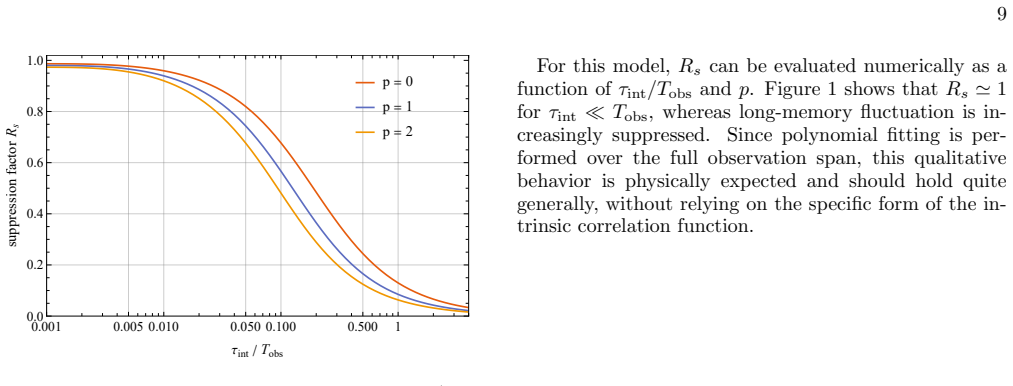
read the original abstract
We present a framework to probe intrinsic stochastic fluctuation in the orbital phase evolution of long-lived double white dwarf binaries through gravitational-wave observations with LISA. To capture the essential structure of the fluctuation, we introduce a minimal quadratic statistic that isolates its temporal correlation. We derive a simple analytic scaling relation for the signal-to-noise ratio of this correlation statistic, explicitly showing its dependence on the total observation time and the intrinsic phase correlation time.
Editorial analysis
A structured set of objections, weighed in public.
Referee Report
Summary. The paper presents a framework to probe intrinsic stochastic fluctuations in the orbital phase evolution of long-lived double white dwarf binaries observed by LISA. It introduces a minimal quadratic statistic designed to isolate the temporal correlation structure of these fluctuations and derives a simple analytic scaling relation for the signal-to-noise ratio of the statistic, explicitly depending on total observation time T and the intrinsic phase correlation time τ.
Significance. If the central derivation holds under the stated assumptions, the analytic SNR scaling provides a transparent, parameter-free tool for forecasting detectability of phase fluctuations without requiring full end-to-end simulations. This could be useful for mission planning and for distinguishing intrinsic fluctuations from other phase modulations. The explicit dependence on T and τ is a clear strength when the isolation step is valid.
major comments (1)
- [Abstract and derivation of SNR scaling] The derivation of the SNR scaling (abstract and the section presenting the quadratic statistic) assumes that the minimal quadratic form isolates the second-moment structure of a wide-sense stationary intrinsic phase process without contamination from LISA's deterministic time-varying response functions (orbital Doppler, arm-length variations). No explicit orthogonal projection onto the known response is described; without it, cross terms are expected that scale differently with T and τ, undermining the claimed simple analytic relation.
minor comments (1)
- [Abstract] Clarify in the abstract whether the phase fluctuation is modeled as wide-sense stationary and how the quadratic statistic is constructed from the phase time series.
Simulated Author's Rebuttal
We thank the referee for the careful reading and the constructive comment on the isolation of the quadratic statistic. We address the point below.
read point-by-point responses
-
Referee: [Abstract and derivation of SNR scaling] The derivation of the SNR scaling (abstract and the section presenting the quadratic statistic) assumes that the minimal quadratic form isolates the second-moment structure of a wide-sense stationary intrinsic phase process without contamination from LISA's deterministic time-varying response functions (orbital Doppler, arm-length variations). No explicit orthogonal projection onto the known response is described; without it, cross terms are expected that scale differently with T and τ, undermining the claimed simple analytic relation.
Authors: We agree that the manuscript does not provide an explicit description of an orthogonal projection step. The derivation assumes the quadratic statistic is formed from phase residuals after subtraction of the best-fit deterministic signal (which incorporates the known time-varying LISA response functions). To make this rigorous, we will revise the section on the quadratic statistic to include an explicit construction of the projection onto the subspace orthogonal to the deterministic modulations, showing that the cross terms vanish in the expectation and do not alter the leading T and τ scaling. revision: yes
Circularity Check
No circularity; SNR scaling follows directly from quadratic statistic definition
full rationale
The paper defines a minimal quadratic statistic to capture temporal correlations in the phase fluctuation, then derives the analytic SNR scaling with total time T and correlation time τ as a direct mathematical consequence of that definition under stationary-process assumptions. No load-bearing steps reduce to self-citations, fitted inputs renamed as predictions, or ansatzes imported from prior author work; the derivation is self-contained within the statistic's second-moment structure and standard expectation-value calculations.
Axiom & Free-Parameter Ledger
axioms (1)
- domain assumption Standard assumptions of stationary Gaussian noise and known binary waveform templates in LISA data analysis
Reference graph
Works this paper leans on
-
[1]
Polynomial phase fitting acts on the discretized noise through the linear projection operatorPintroduced in the main text, n′ =Pn,(A2) withP T =P=P 2
Detector noise Before phase fitting, the segment-level noise sequence nk is assumed to be stationary, zero-mean, and uncorre- lated, ⟨nk⟩= 0,⟨n knl⟩=σ 2 n δkl,(A1) whereσ 2 n denotes the variance per segment. Polynomial phase fitting acts on the discretized noise through the linear projection operatorPintroduced in the main text, n′ =Pn,(A2) withP T =P=P ...
-
[2]
The fitting again acts through the same projection oper- ator, s′ =Ps,(A8) but the resulting impact depends on the temporal covari- ance of the intrinsic process
Intrinsic phase fluctuation We next consider intrinsic stochastic phase fluctuation. The fitting again acts through the same projection oper- ator, s′ =Ps,(A8) but the resulting impact depends on the temporal covari- ance of the intrinsic process. We assume⟨s k⟩= 0 and denote ⟨sksk+m⟩=C |m|.(A9) After projection, the covariance becomes ⟨s′s′T⟩=P CP,(A10) ...
-
[3]
P. A. Seoaneet al.(LISA), Living Rev. Rel.26, 2 (2023), arXiv:2203.06016 [gr-qc]
Pith/arXiv arXiv 2023
-
[4]
Hu and Y.-L
W.-R. Hu and Y.-L. Wu, The taiji program in space for gravitational wave physics and the nature of gravity (2017)
2017
-
[5]
Luo, L.-S
J. Luo, L.-S. Chen, H.-Z. Duan, Y.-G. Gong, S. Hu, J. Ji, Q. Liu, J. Mei, V. Milyukov, M. Sazhin,et al., Classical and Quantum Gravity33, 035010 (2016)
2016
-
[6]
V. Korol, E. M. Rossi, P. J. Groot, G. Nelemans, S. Too- nen, and A. G. A. Brown, Mon. Not. R. Astron. Soc. 470, 1894 (2017), 1703.02555
Pith/arXiv arXiv 2017
-
[7]
Blanchet, Living reviews in relativity17, 2 (2014)
L. Blanchet, Living reviews in relativity17, 2 (2014)
2014
-
[8]
Poisson and C
E. Poisson and C. M. Will,Gravity: Newtonian, post- newtonian, relativistic(Cambridge University Press, 2014)
2014
-
[9]
Maggiore,Gravitational waves, Vol
M. Maggiore,Gravitational waves, Vol. 2 (Oxford univer- sity press, 2008)
2008
-
[10]
Takahashi and N
R. Takahashi and N. Seto, Astrophys. J.575, 1030 (2002)
2002
-
[11]
V. Gokhale, X. Peng, and J. Frank, Astrophys. J.655, 1010 (2007), arXiv:astro-ph/0605738 [astro-ph]
Pith/arXiv arXiv 2007
-
[12]
J. Fuller and D. Lai, Monthly Notices of the Royal As- tronomical Society420, 3126 (2012), arXiv:1107.4594 [astro-ph.SR]
Pith/arXiv arXiv 2012
-
[13]
T. E. Strohmayer, Astrophys. J. Lett.912, L8 (2021)
2021
-
[14]
T. E. Strohmayer, Astrophys. J. Lett.627, L53 (2005)
2005
-
[15]
R. T. Edwards, G. B. Hobbs, and R. N. Manchester, Mon. Not. R. Astron. Soc.372, 1549 (2006)
2006
-
[16]
W. Coles, G. Hobbs, D. J. Champion, R. N. Manchester, and J. P. W. Verbiest, Mon. Not. Roy. Astron. Soc.418, 2167 (2011), arXiv:1103.0576
Pith/arXiv arXiv 2011
-
[17]
G. B. Hobbs, R. T. Edwards, and R. N. Manchester, Mon. Not. R. Astron. Soc.369, 655 (2006)
2006
-
[18]
R. W. Hellings and G. S. Downs, Astrophys. J. Lett.265, L39 (1983)
1983
-
[19]
R. van Haasteren and Y. Levin, Monthly Notices of the Royal Astronomical Society428, 2489 (2013), arXiv:1202.5932 [astro-ph.IM]
Pith/arXiv arXiv 2013
- [20]
-
[21]
P. Jaranowski, A. Kr´ olak, and B. F. Schutz, Phys. Rev. D58, 063001 (1998), arXiv:gr-qc/9804014
Pith/arXiv arXiv 1998
-
[22]
C. Cutler and M. Vallisneri, Phys. Rev. D76, 104018 (2007), arXiv:0707.2982 [gr-qc]
Pith/arXiv arXiv 2007
-
[23]
C. R. Rao,Linear Statistical Inference and Its Applica- tions, 2nd ed. (John Wiley & Sons, New York, 1973)
1973
-
[24]
G. A. F. Seber and A. J. Lee,Linear Regression Analysis, 2nd ed. (John Wiley & Sons, Hoboken, NJ, 2003)
2003
-
[25]
In a real-valued formulation, this operation is equivalent to taking an inner product with a template whose phase is shifted byπ/2 relative to the original templateh, i.e., projecting onto the quadrature component that is orthog- onal tohin the real signal space
-
[26]
C. W. Gardiner,Stochastic Methods(Springer, 2009)
2009
-
[27]
L. Lentati, P. Alexander, M. P. Hobson, S. R. Tay- lor, and J. R. Gair, Phys. Rev. D87, 104021 (2013), arXiv:1210.3578 [astro-ph.IM]
Pith/arXiv arXiv 2013
-
[28]
B. Allen and J. D. Romano, Phys. Rev. D59, 102001 (1999), arXiv:gr-qc/9710117
Pith/arXiv arXiv 1999
-
[29]
J. D. Romano and N. J. Cornish, Living Reviews in Rel- ativity20, 2 (2017)
2017
-
[30]
Seto, Astrophys
N. Seto, Astrophys. J. Lett.677, L55 (2008)
2008
-
[31]
N. Tamanini and C. Danielski, Nature Astronomy3, 858 (2019), arXiv:1812.04330 [astro-ph.SR]
arXiv 2019
-
[32]
N. Seto and K. Kyutoku, Mon. Not. Roy. Astron. Soc. 514, 4669 (2022), arXiv:2201.02766 [astro-ph.HE]
arXiv 2022
discussion (0)
Sign in with ORCID, Apple, or X to comment. Anyone can read and Pith papers without signing in.