S²-FracMix: Label-Preserving Self-Saliency Mixup Augmentation
Pith reviewed 2026-06-25 20:53 UTC · model grok-4.3
The pith
Mixing multi-scale salient patches inside one image plus fractal self-similarity yields label-consistent augmentations that reach state-of-the-art across seven vision benchmarks.
A machine-rendered reading of the paper's core claim, the machinery that carries it, and where it could break.
Core claim
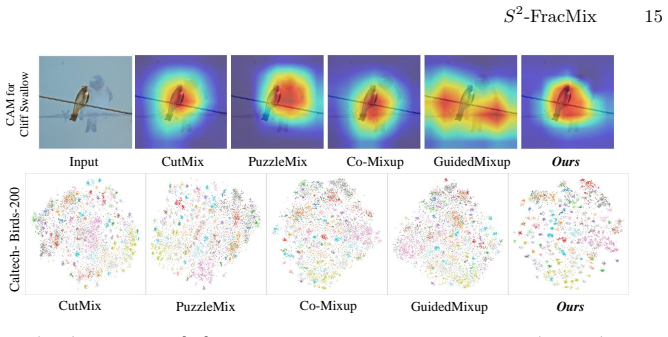
S²-FracMix enables simultaneous learning from fractal and non-fractal structures within a single image, yielding a targeted and structurally coherent augmentation strategy that achieves state-of-the-art performance in extensive evaluation with seven benchmarks across classification, robustness, calibration, object detection, and transfer learning tasks.
What carries the argument
S²-FracMix, the combination of self-saliency patch extraction and reinsertion with adaptive-ratio fractal pattern injection into salient regions of the same image.
If this is right
- Models learn scale-invariant features without semantic disruption from cross-sample mixing.
- The method reduces computational overhead compared with methods that interpolate across multiple images.
- Performance improves on both coarse and fine-grained classification tasks.
- Gains appear in robustness, calibration, object detection, and transfer learning settings.
- A single unified framework handles both fractal and non-fractal content inside each training example.
Where Pith is reading between the lines
- The intra-image constraint may encourage networks to discover features that are more stable under changes in object scale or viewpoint.
- Similar within-sample mixing could be tested on modalities such as video or point clouds where cross-sample blending also risks semantic damage.
- The explicit use of self-similarity patterns suggests a route for injecting natural-image priors directly into augmentation pipelines.
Load-bearing premise
Extracting multi-scale salient patches and reinserting them into non-salient regions of the same image produces samples that stay label-consistent yet are hard enough to drive scale-invariant feature learning.
What would settle it
If models trained with S²-FracMix show no accuracy, robustness, or calibration gains over standard mixup baselines when evaluated on the same seven benchmarks, the claimed advantage would be refuted.
Figures



read the original abstract
Data augmentation is known to improve generalization of deep visual models. Recent methods favor mixup strategies that generate interpolated samples to improve model performance. However, these techniques not only incur significant computational overhead, they also lead to semantic disruption of augmentation data due to cross-sample mixing. We first propose Self-Saliency ($S^2$) Mixup, which constructs challenging yet label-consistent samples by extracting multi-scale salient patches and reinserting them into non-salient regions of the same image. This promotes scale-invariant feature learning while avoiding cross-sample interference. To further enhance model robustness, we introduce FracMix, a mixing scheme that injects self-similarity patterns into salient regions using adaptive ratios. Collectively, our unified framework, $S^{2}$-FracMix, enables simultaneous learning from fractal and non-fractal structures within a single image, yielding a targeted and structurally coherent augmentation strategy. We theoretically analyze the advantage of our technique, and empirically establish its superiority over the existing methods by achieving state-of-the-art performance in extensive evaluation with seven benchmarks across classification (coarse and fine-grained), robustness, calibration, object detection, and transfer learning tasks. Project page is available at \href{https://fracmix-data-augmentation.github.io/}{fracmix-data-augmentation.github.io}
Editorial analysis
A structured set of objections, weighed in public.
Referee Report
Summary. The paper proposes S²-FracMix, a data augmentation framework for visual models. It introduces Self-Saliency (S²) Mixup, which extracts multi-scale salient patches from a single image and reinserts them into non-salient regions to create challenging yet label-preserving samples that encourage scale-invariant features without cross-sample mixing. It further adds FracMix, which adaptively injects fractal self-similarity patterns into salient regions. The unified method is claimed to support simultaneous learning from fractal and non-fractal structures, backed by a theoretical analysis of its advantages, and shown to achieve state-of-the-art results across seven benchmarks spanning classification (coarse/fine-grained), robustness, calibration, object detection, and transfer learning.
Significance. If the empirical results and theoretical analysis hold, the method offers a computationally lighter and semantically safer alternative to cross-sample mixup techniques by operating intra-image while incorporating fractal structures for improved robustness and scale invariance. This could meaningfully advance augmentation strategies in computer vision, particularly where label consistency and structural coherence are priorities.
minor comments (3)
- The abstract states that a theoretical analysis is provided, but the manuscript should explicitly state the key assumptions (e.g., on patch saliency extraction or fractal ratio adaptation) in §3 or §4 to allow readers to assess the scope of the claimed advantage.
- In the experimental section, the paper should report standard deviations or error bars for the SOTA claims across the seven benchmarks, as single-run results can be sensitive to random seeds in augmentation methods.
- Figure captions and method diagrams would benefit from clearer annotation of the adaptive ratio computation in FracMix and the multi-scale patch extraction process in S² Mixup to improve reproducibility.
Simulated Author's Rebuttal
We thank the referee for the positive summary, significance assessment, and recommendation of minor revision. The report correctly captures the core contributions of S²-FracMix, including the intra-image self-saliency mixing and fractal pattern injection for label-preserving augmentation. No major comments were raised in the report.
Circularity Check
No significant circularity in derivation chain
full rationale
The paper proposes a constructive data-augmentation pipeline (Self-Saliency Mixup followed by adaptive fractal injection) whose central claims rest on the explicit algorithmic construction and subsequent empirical evaluation across benchmarks. No equations, first-principles derivations, or fitted parameters are presented that reduce by definition to the method's own inputs; the mentioned theoretical analysis is not shown to rely on self-citation chains or uniqueness theorems imported from the authors' prior work. The approach is therefore self-contained against external benchmarks and receives the default non-circularity finding.
Axiom & Free-Parameter Ledger
Reference graph
Works this paper leans on
-
[1]
Data Augmentation Generative Adversarial Networks
Antoniou, A., Storkey, A., Edwards, H.: Data augmentation generative adversarial networks. arXiv preprint arXiv:1711.04340 (2017)
work page internal anchor Pith review Pith/arXiv arXiv 2017
-
[2]
Pattern Recognition109, 107594 (2021)
Baek, K., Bang, D., Shim, H.: Gridmix: Strong regularization through local context mapping. Pattern Recognition109, 107594 (2021)
2021
-
[3]
In: European Conference on Computer Vision
Bai, J., Yuan, L., Xia, S.T., Yan, S., Li, Z., Liu, W.: Improving vision transformers by revisiting high-frequency components. In: European Conference on Computer Vision. pp. 1–18. Springer (2022)
2022
-
[4]
ACM Computing Surveys57(2), 1–38 (2024)
Cao, C., Zhou, F., Dai, Y., Wang, J., Zhang, K.: A survey of mix-based data aug- mentation: Taxonomy, methods, applications, and explainability. ACM Computing Surveys57(2), 1–38 (2024)
2024
-
[5]
Journal of Machine Learning Research23(325), 1–31 (2022)
Carratino, L., Cissé, M., Jenatton, R., Vert, J.P.: On mixup regularization. Journal of Machine Learning Research23(325), 1–31 (2022)
2022
-
[6]
Ad- vances in neural information processing systems13(2000)
Chapelle, O., Weston, J., Bottou, L., Vapnik, V.: Vicinal risk minimization. Ad- vances in neural information processing systems13(2000)
2000
-
[7]
In: Proceedings of the IEEE/CVF conference on computer vision and pattern recognition
Chen, J.N., Sun, S., He, J., Torr, P.H., Yuille, A., Bai, S.: Transmix: Attend to mix for vision transformers. In: Proceedings of the IEEE/CVF conference on computer vision and pattern recognition. pp. 12135–12144 (2022)
2022
-
[8]
Improved Baselines with Momentum Contrastive Learning
Chen, X., Fan, H., Girshick, R., He, K.: Improved baselines with momentum con- trastive learning. arXiv preprint arXiv:2003.04297 (2020)
work page internal anchor Pith review Pith/arXiv arXiv 2003
-
[9]
Chen,X.,He,K.:Exploringsimplesiameserepresentationlearning.In:Proceedings of the IEEE/CVF conference on computer vision and pattern recognition. pp. 15750–15758 (2021)
2021
-
[10]
Sensors21(24), 8444 (2021)
Choi, J., Lee, C., Lee, D., Jung, H.: Salfmix: a novel single image-based data augmentation technique using a saliency map. Sensors21(24), 8444 (2021)
2021
-
[11]
A Downsampled Variant of ImageNet as an Alternative to the CIFAR datasets
Chrabaszcz, P., Loshchilov, I., Hutter, F.: A downsampled variant of imagenet as an alternative to the cifar datasets. arXiv preprint arXiv:1707.08819 (2017)
work page internal anchor Pith review Pith/arXiv arXiv 2017
-
[12]
Deng, J., Dong, W., Socher, R., Li, L., Li, K., Li, F.: Imagenet: A large-scale hierarchical image database (2009)
2009
-
[13]
In: Proceedings of the IEEE/CVF conference on computer vision and pattern recognition
Ghiasi, G., Cui, Y., Srinivas, A., Qian, R., Lin, T.Y., Cubuk, E.D., Le, Q.V., Zoph, B.: Simple copy-paste is a strong data augmentation method for instance segmentation. In: Proceedings of the IEEE/CVF conference on computer vision and pattern recognition. pp. 2918–2928 (2021)
2021
-
[14]
In:ProceedingsoftheAAAIConferenceonArtificialIntelligence.vol.33,pp.3714– 3722 (2019)
Guo,H.,Mao,Y.,Zhang,R.:Mixupaslocallylinearout-of-manifoldregularization. In:ProceedingsoftheAAAIConferenceonArtificialIntelligence.vol.33,pp.3714– 3722 (2019)
2019
-
[15]
arXiv preprint arXiv:2205.15955 (2022)
Han, J., Petersson, L., Li, H., Reid, I.: Cropmix: Sampling a rich input distribution via multi-scale cropping. arXiv preprint arXiv:2205.15955 (2022)
-
[16]
arXiv preprint arXiv:2002.12047 (2020)
Harris, E., Marcu, A., Painter, M., Niranjan, M., Prügel-Bennett, A., Hare, J.: Fmix: Enhancing mixed sample data augmentation. arXiv preprint arXiv:2002.12047 (2020)
-
[17]
He,K.,Zhang,X.,Ren,S.,Sun,J.:Deepresiduallearningforimagerecognition.In: Proceedings of the IEEE conference on computer vision and pattern recognition. pp. 770–778 (2016)
2016
-
[18]
Proceedings of the International Conference on Learning Representations (2019)
Hendrycks,D.,Dietterich,T.:Benchmarkingneuralnetworkrobustnesstocommon corruptions and perturbations. Proceedings of the International Conference on Learning Representations (2019)
2019
-
[19]
In: International Conference on Learning Representations (ICLR) (2020) S2-FracMix 17
Hendrycks, D., Mu, N., Cubuk, E.D., Zoph, B., Gilmer, J., Lakshminarayanan, B.: Augmix: A simple data processing method to improve robustness and uncertainty. In: International Conference on Learning Representations (ICLR) (2020) S2-FracMix 17
2020
-
[20]
In: Proceed- ings of the IEEE/CVF Conference on Computer Vision and Pattern Recognition
Hendrycks, D., Zou, A., Mazeika, M., Tang, L., Li, B., Song, D., Steinhardt, J.: Pixmix: Dreamlike pictures comprehensively improve safety measures. In: Proceed- ings of the IEEE/CVF Conference on Computer Vision and Pattern Recognition. pp. 16783–16792 (2022)
2022
-
[21]
In: Proceedings of the IEEE/CVF conference on computer vision and pattern recognition
Hong, M., Choi, J., Kim, G.: Stylemix: Separating content and style for enhanced data augmentation. In: Proceedings of the IEEE/CVF conference on computer vision and pattern recognition. pp. 14862–14870 (2021)
2021
-
[22]
In: 2007 IEEE Conference on computer vision and pattern recognition
Hou, X., Zhang, L.: Saliency detection: A spectral residual approach. In: 2007 IEEE Conference on computer vision and pattern recognition. pp. 1–8. Ieee (2007)
2007
-
[23]
Huang, S., Wang, X., Tao, D.: Snapmix: Semantically proportional mixing for augmentingfine-graineddata.In:ProceedingsoftheAAAIConferenceonArtificial Intelligence (2021)
2021
-
[24]
Advances in Neural Information Processing Systems36, 63660–63673 (2023)
Huang, Z., Bao, X., Zhang, N., Zhang, Q., Tu, X., Wu, B., Yang, X.: Ipmix: Label- preserving data augmentation method for training robust classifiers. Advances in Neural Information Processing Systems36, 63660–63673 (2023)
2023
-
[25]
In: ICLR 2025 Workshop on Navigating and Addressing Data Prob- lems for Foundation Models
Islam, K., AKHTAR, N.: Context-guided responsible data augmentation with dif- fusion models. In: ICLR 2025 Workshop on Navigating and Addressing Data Prob- lems for Foundation Models
2025
-
[26]
In: Proceedings of the IEEE/CVF Conference on Computer Vision and Pattern Recognition
Islam, K., Zaheer, M.Z., Mahmood, A., Nandakumar, K.: Diffusemix: Label- preserving data augmentation with diffusion models. In: Proceedings of the IEEE/CVF Conference on Computer Vision and Pattern Recognition. pp. 27621– 27630 (2024)
2024
-
[27]
arXiv preprint arXiv:2412.02366 (2024)
Islam, K., Zaheer, M.Z., Mahmood, A., Nandakumar, K., Akhtar, N.: Genmix: Effective data augmentation with generative diffusion model image editing. arXiv preprint arXiv:2412.02366 (2024)
-
[28]
arXiv preprint arXiv:2510.23479 (2025)
Jin, X., Li, S., Jian, S., Yu, K., Wang, H.: Mergemix: A unified augmen- tation paradigm for visual and multi-modal understanding. arXiv preprint arXiv:2510.23479 (2025)
-
[29]
arXiv preprint arXiv:2409.05202 (2024)
Jin, X., Zhu, H., Li, S., Wang, Z., Liu, Z., Yu, C., Qin, H., Li, S.Z.: A survey on mixup augmentations and beyond. arXiv preprint arXiv:2409.05202 (2024)
-
[30]
In: Proceedings of the AAAI Conference on Artificial Intelligence
Kang, M., Kim, S.: Guidedmixup: an efficient mixup strategy guided by saliency maps. In: Proceedings of the AAAI Conference on Artificial Intelligence. vol. 37, pp. 1096–1104 (2023)
2023
-
[31]
In: International Conference on Machine Learning
Kim, J.H., Choo, W., Song, H.O.: Puzzle mix: Exploiting saliency and local statis- tics for optimal mixup. In: International Conference on Machine Learning. pp. 5275–5285. PMLR (2020)
2020
-
[32]
In: Advances in Neural Information Processing Systems (NeurIPS) (2021)
Kim, J.H., Park, J., Hwang, S.: Co-mixup: Saliency-guided joint mixup with su- permodular diversity. In: Advances in Neural Information Processing Systems (NeurIPS) (2021)
2021
-
[33]
In: 4th International IEEE Workshop on 3D Representation and Recognition (3dRR-13)
Krause, J., Stark, M., Deng, J., Fei-Fei, L.: 3d object representations for fine- grained categorization. In: 4th International IEEE Workshop on 3D Representation and Recognition (3dRR-13). Sydney, Australia (2013)
2013
-
[34]
Master’s thesis, University of Tront (2009)
Krizhevsky, A.: Learning multiple layers of features from tiny images. Master’s thesis, University of Tront (2009)
2009
-
[35]
In: Proceedings of the IEEE/CVF conference on computer vision and pattern recognition workshops
Lee, J.H., Zaheer, M.Z., Astrid, M., Lee, S.I.: Smoothmix: a simple yet effective data augmentation to train robust classifiers. In: Proceedings of the IEEE/CVF conference on computer vision and pattern recognition workshops. pp. 756–757 (2020)
2020
-
[36]
arXiv preprint arXiv:2111.15454 (2021) 18 K
Li, S., Liu, Z., Wang, Z., Wu, D., Liu, Z., Li, S.Z.: Boosting discrimina- tive visual representation learning with scenario-agnostic mixup. arXiv preprint arXiv:2111.15454 (2021) 18 K. Islam et al
-
[37]
Li, S., Wang, Z., Liu, Z., Wu, D., Tan, C., Jin, W., Li, S.Z.: Openmixup: A com- prehensive mixup benchmark for visual classification (2022)
2022
-
[38]
Multimedia Tools and Applications84(8), 4343–4359 (2025)
Liu, X., Shen, F., Zhao, J., Nie, C.: Randomix: A mixed sample data augmentation method with multiple mixed modes. Multimedia Tools and Applications84(8), 4343–4359 (2025)
2025
-
[39]
Liu, Z., Lin, Y., Cao, Y., Hu, H., Wei, Y., Zhang, Z., Lin, S., Guo, B.: Swin transformer:Hierarchicalvisiontransformerusingshiftedwindows.In:Proceedings of the IEEE/CVF international conference on computer vision. pp. 10012–10022 (2021)
2021
-
[40]
In: Proceedings of the IEEE/CVF conference on computer vision and pattern recognition
Liu, Z., Mao, H., Wu, C.Y., Feichtenhofer, C., Darrell, T., Xie, S.: A convnet for the 2020s. In: Proceedings of the IEEE/CVF conference on computer vision and pattern recognition. pp. 11976–11986 (2022)
2022
-
[41]
Advances in Neural Information Processing Systems 36(2024)
Liu, Z., Li, S., Wang, G., Wu, L., Tan, C., Li, S.Z.: Harnessing hard mixed samples with decoupled regularizer. Advances in Neural Information Processing Systems 36(2024)
2024
-
[42]
In: European Conference on Computer Vision
Liu, Z., Li, S., Wu, D., Liu, Z., Chen, Z., Wu, L., Li, S.Z.: Automix: Unveiling the power of mixup for stronger classifiers. In: European Conference on Computer Vision. pp. 441–458. Springer (2022)
2022
-
[43]
Journal of machine learning research9(11) (2008)
Van der Maaten, L., Hinton, G.: Visualizing data using t-sne. Journal of machine learning research9(11) (2008)
2008
-
[44]
Fine-Grained Visual Classification of Aircraft
Maji, S., Rahtu, E., Kannala, J., Blaschko, M., Vedaldi, A.: Fine-grained visual classification of aircraft. arXiv preprint arXiv:1306.5151 (2013)
work page internal anchor Pith review Pith/arXiv arXiv 2013
-
[45]
In: Proceedings of the IEEE/CVF International Conference on Computer Vision
Parast, A.Y., Azam, B., Akhtar, N.: Ddb: Diffusion driven balancing to address spurious correlations. In: Proceedings of the IEEE/CVF International Conference on Computer Vision. pp. 17526–17535 (2025)
2025
-
[46]
arXiv preprint arXiv:2509.25178 (2025)
Parast, A.Y., Hosseini, P., Asadollahzadeh, H., Moakhar, A.S., Azam, B., Feizi, S., Akhtar, N.: Ghost: Hallucination-inducing image generation for multimodal llms. arXiv preprint arXiv:2509.25178 (2025)
-
[47]
arXiv preprint arXiv:2603.29313 (2026)
Parast, A.Y., Islam, K., Won, S., Azam, B., Akhtar, N.: Hsfm: Hard-set-guided feature-space meta-learning for robust classification under spurious correlations. arXiv preprint arXiv:2603.29313 (2026)
-
[48]
Advances in Neural Information Processing Systems35, 14608–14622 (2022)
Pinto, F., Yang, H., Lim, S.N., Torr, P., Dokania, P.: Using mixup as a regularizer can surprisingly improve accuracy & out-of-distribution robustness. Advances in Neural Information Processing Systems35, 14608–14622 (2022)
2022
-
[49]
Qin,H.,Jin,X.,Jiang,Y.,El-Yacoubi,M.,Gao,X.:Adversarialautomixup.In:The Twelfth International Conference on Learning Representations. pp. OpenReview, Spotlight (2024)
2024
-
[50]
In: European Conference on Computer Vision
Qin, H., Jin, X., Zhu, H., Liao, H., El-Yacoubi, M.A., Gao, X.: Sumix: Mixup with semantic and uncertain information. In: European Conference on Computer Vision. pp. 70–88. Springer (2025)
2025
-
[51]
arXiv preprint arXiv:2012.11101 (2020)
Qin, J., Fang, J., Zhang, Q., Liu, W., Wang, X., Wang, X.: Resizemix: Mixing data with preserved object information and true labels. arXiv preprint arXiv:2012.11101 (2020)
-
[52]
In- ternational journal of computer vision128, 336–359 (2020)
Selvaraju, R.R., Cogswell, M., Das, A., Vedantam, R., Parikh, D., Batra, D.: Grad- cam: visual explanations from deep networks via gradient-based localization. In- ternational journal of computer vision128, 336–359 (2020)
2020
-
[53]
In: International Con- ference on Learning Representations (2020) S2-FracMix 19
Uddin, A.S., Monira, M.S., Shin, W., Chung, T., Bae, S.H.: Saliencymix: A saliency guided data augmentation strategy for better regularization. In: International Con- ference on Learning Representations (2020) S2-FracMix 19
2020
-
[54]
Venkataramanan, S., Kijak, E., Amsaleg, L., Avrithis, Y.: Alignmixup: Improving representationsbyinterpolatingalignedfeatures.In:ProceedingsoftheIEEE/CVF conference on computer vision and pattern recognition. pp. 19174–19183 (2022)
2022
-
[55]
In: International Conference on Machine Learning
Verma, V., Lamb, A., Beckham, C., Najafi, A., Mitliagkas, I., Lopez-Paz, D., Ben- gio, Y.: Manifold mixup: Better representations by interpolating hidden states. In: International Conference on Machine Learning. pp. 6438–6447. PMLR (2019)
2019
-
[56]
Wah, C., Branson, S., Welinder, P., Perona, P., Belongie, S.: The Caltech-UCSD Birds-200-2011 Dataset. Tech. Rep. CNS-TR-2011-001, California Institute of Technology (2011)
2011
-
[57]
In: ICASSP 2020-2020 IEEEInternational Conference on Acoustics, Speech and Signal Processing (ICASSP)
Walawalkar, D., Shen, Z., Liu, Z., Savvides, M.: Attentive cutmix: An enhanced data augmentation approach for deep learning based image classification. In: ICASSP 2020-2020 IEEEInternational Conference on Acoustics, Speech and Signal Processing (ICASSP). pp. 3642–3646. IEEE (2020)
2020
-
[58]
In: Proceedings of the IEEE/CVF Conference on Computer Vision and Pattern Recognition
Wang, Z., Wei, L., Wang, T., Chen, H., Hao, Y., Wang, X., He, X., Tian, Q.: Enhance image classification via inter-class image mixup with diffusion model. In: Proceedings of the IEEE/CVF Conference on Computer Vision and Pattern Recognition. pp. 17223–17233 (2024)
2024
-
[59]
Neural Networks190, 107611 (2025)
Won, S., Bae, S.H., Kim, S.T.: Effects of mixed sample data augmentation on interpretability of neural networks. Neural Networks190, 107611 (2025)
2025
-
[60]
Image and Vision Com- puting p
Won, S., Kim, H.B., Ahn, Y.H., Lee, H.J., Kim, S.T.: Understanding adversarial robustness of deep neural networks via decision reliance. Image and Vision Com- puting p. 105743 (2025)
2025
-
[61]
In: Proceedings of the IEEE/CVF international conference on com- puter vision
Xiao, H., Zheng, W., Zhu, Z., Zhou, J., Lu, J.: Token-label alignment for vision transformers. In: Proceedings of the IEEE/CVF international conference on com- puter vision. pp. 5495–5504 (2023)
2023
-
[62]
In: Proceedings of the IEEE conference on computer vision and pattern recognition
Xie,S.,Girshick,R.,Dollár,P.,Tu,Z.,He,K.:Aggregatedresidualtransformations for deep neural networks. In: Proceedings of the IEEE conference on computer vision and pattern recognition. pp. 1492–1500 (2017)
2017
-
[63]
Advances in Neural Information Processing Systems35, 8427–8440 (2022)
Yang, L., Li, X., Zhao, B., Song, R., Yang, J.: Recursivemix: Mixed learning with history. Advances in Neural Information Processing Systems35, 8427–8440 (2022)
2022
-
[64]
In: International Con- ference on Computer Vision (ICCV) (2019)
Yun, S., Han, D., Oh, S.J., Chun, S., Choe, J., Yoo, Y.: Cutmix: Regularization strategy to train strong classifiers with localizable features. In: International Con- ference on Computer Vision (ICCV) (2019)
2019
-
[65]
In: International Conference on Learning Representations (ICLR) (2018)
Zhang, H., Cisse, M., Dauphin, Y.N., Lopez-Paz, D.: mixup: Beyond empirical risk minimization. In: International Conference on Learning Representations (ICLR) (2018)
2018
-
[66]
Advances in Neural Infor- mation Processing Systems33, 14435–14447 (2020)
Zhao, L., Liu, T., Peng, X., Metaxas, D.: Maximum-entropy adversarial data aug- mentation for improved generalization and robustness. Advances in Neural Infor- mation Processing Systems33, 14435–14447 (2020)
2020
-
[67]
In: Computer Vision–ECCV 2020: 16th European Conference, Glasgow, UK, August 23–28, 2020, Proceedings, Part XXVII 16
Zoph, B., Cubuk, E.D., Ghiasi, G., Lin, T.Y., Shlens, J., Le, Q.V.: Learning data augmentation strategies for object detection. In: Computer Vision–ECCV 2020: 16th European Conference, Glasgow, UK, August 23–28, 2020, Proceedings, Part XXVII 16. pp. 566–583. Springer (2020) 20 K. Islam et al. Overview of the Appendices This supplementary material compleme...
2020
discussion (0)
Sign in with ORCID, Apple, or X to comment. Anyone can read and Pith papers without signing in.