A Short Note on the Generators of Controlled Quantum Gates
Pith reviewed 2026-06-25 20:54 UTC · model grok-4.3
The pith
Closed-form Hamiltonians exist for generating arbitrary multi-qubit controlled gates under any control conditions.
A machine-rendered reading of the paper's core claim, the machinery that carries it, and where it could break.
Core claim
The authors derive closed-form expressions for the generating Hamiltonians of controlled gates that work for multiple controls, multiple targets, and arbitrary control conditions. These Hamiltonians produce the desired unitary evolution exactly when exponentiated, without requiring numerical fitting for each case.
What carries the argument
The closed-form analytical expressions for the time-independent Hamiltonians that generate the unitary controlled gates.
If this is right
- Quantum circuit simulations can incorporate decoherence and noise during the continuous application of gates rather than treating gates as instantaneous.
- The same closed forms apply uniformly to gates with any number of controls and targets.
- Arbitrary control conditions, not just the standard all-ones case, are covered by the expressions.
- The approach replaces case-by-case numerical approximation with direct analytical formulas.
Where Pith is reading between the lines
- The Hamiltonians could be used to derive effective noise models that act only during the gate duration.
- Similar closed forms might exist for other families of multi-qubit gates beyond controlled operations.
- One could verify the formulas by comparing the generated unitaries against matrix exponentiation for small numbers of qubits.
Load-bearing premise
Explicit closed-form Hamiltonians can be written down for every combination of control count, target count, and control condition.
What would settle it
A concrete multi-qubit controlled gate with specified control conditions whose exponentiated Hamiltonian deviates from the exact target unitary.
Figures
read the original abstract
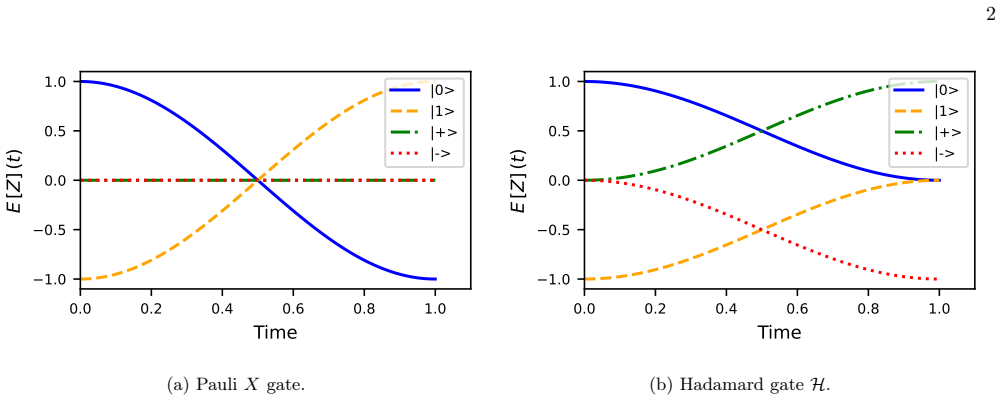
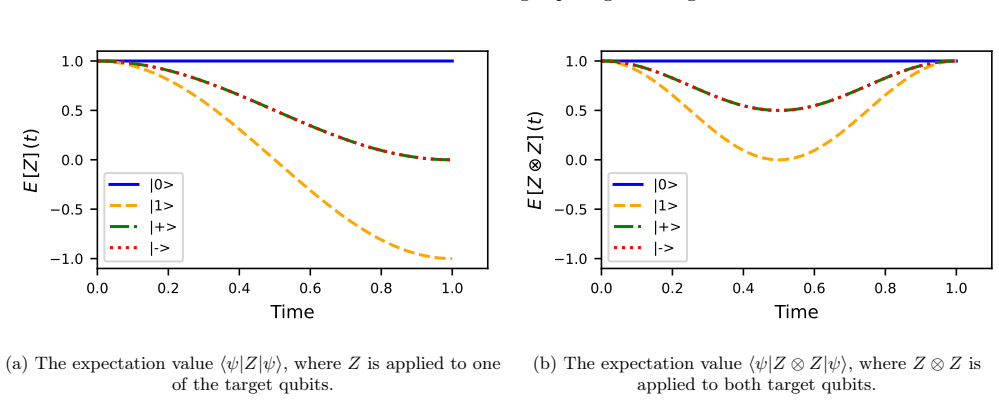
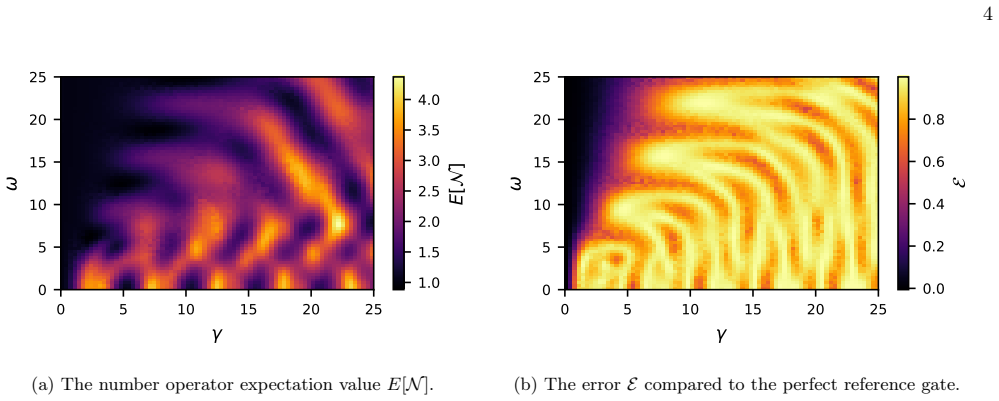
We present the analytical generators for arbitrary multi-qubit controlled gates. Closed forms for the generating Hamiltonians are given for gates with both multiple control and target qubits, as well as for arbitrary control conditions. This allows us to go beyond gate-based simulations of quantum circuits and incorporate decoherence and other noise in simulations of quantum computers. We exemplify this by simulating the impact of a harmonic oscillator interacting with two qubits during the application of a controlled NOT gate.
Editorial analysis
A structured set of objections, weighed in public.
Referee Report
Summary. The manuscript derives closed-form analytical expressions for the generating Hamiltonians of arbitrary controlled quantum gates, including multi-control and multi-target cases under general control conditions. The constructions rely on projectors onto the control subspace tensored with the appropriate target operator. An example application simulates the effect of a harmonic oscillator coupled to two qubits during a CNOT gate to incorporate decoherence.
Significance. If the closed forms are correct, the work supplies parameter-free analytical generators that enable continuous-time simulations of quantum circuits with noise, extending beyond gate-based Trotterization. The general-n,m projector approach is a clear strength, as it avoids case-by-case numerical fitting and directly supports falsifiable predictions for decoherence effects.
minor comments (3)
- [main derivation] The projector definitions in the main derivation section should explicitly state the normalization and the handling of the identity component to ensure the resulting unitary exactly matches the target gate at the chosen evolution time.
- [example simulation] In the harmonic-oscillator example, the coupling Hamiltonian and the numerical integration parameters (time step, truncation of oscillator levels) are not specified; adding these would allow reproducibility of the reported decoherence curves.
- [introduction] A brief comparison table or remark contrasting the new closed forms with existing matrix-exponential or numerical-generator methods would help readers assess the practical advantage.
Simulated Author's Rebuttal
We thank the referee for their positive assessment of the manuscript and for recommending minor revision. The work derives closed-form analytical Hamiltonians for arbitrary controlled multi-qubit gates using projectors, enabling continuous-time simulations that incorporate noise such as decoherence from a coupled harmonic oscillator.
Circularity Check
No significant circularity
full rationale
The manuscript derives explicit closed-form Hamiltonians for multi-control/multi-target gates via projector constructions on the control subspace tensored with target operators. These are presented as direct analytical expressions for general n and m without numerical fitting, parameter estimation from data, or load-bearing self-citations. The central claim of providing closed forms therefore stands as an independent derivation rather than a renaming or reduction of its own inputs.
Axiom & Free-Parameter Ledger
Reference graph
Works this paper leans on
-
[1]
Reed and B
M. Reed and B. Simon,Methods of modern mathemati- cal physics: Chapter VIII.4 Stone’s theorem, rev. and en- larged ed. (Academic press, San Diego New York Boston [etc.], 1980)
1980
-
[2]
M. A. Nielsen and I. L. Chuang,Quantum computation and quantum information: Chapter 4.3 Single qubit op- erations, 10th ed. (Cambridge; New York, 2010)
2010
-
[3]
R. Muradian and D. Frias, Generators and roots of quan- tumlogicgates,arXiv10.48550/arXiv.quant-ph/0511250 5 (2005)
Pith/arXiv arXiv 2005
-
[4]
Zee,Group theory in a nutshell for physicists: Chapter IV.5 SU(2): Double covering and the spinor,Inanutshell (Princeton University Press, Princeton, 2016)
A. Zee,Group theory in a nutshell for physicists: Chapter IV.5 SU(2): Double covering and the spinor,Inanutshell (Princeton University Press, Princeton, 2016)
2016
-
[5]
H. Neudecker, A note on Kronecker matrix products and matrix equation systems, SIAM Journal on Applied Mathematics17, 10.1137/0117057 (1969)
-
[6]
J. Chen, E. Stoudenmire, and S. R. White, Quantum Fourier transform has small entanglement, PRX Quan- tum4, 040318 (2023)
2023
-
[7]
H. Çakır, R. M. Milbradt, and C. B. Mendl, Opti- mal symbolic construction of matrix product operators and tree tensor network operators, Phys. Rev. B112, 10.1103/8993-8xn5 (2025)
-
[8]
A. Sander, M. Fröhlich, M. Ali, M. Eigel, J. Eis- ert, M. Hintermüller, C. B. Mendl, R. M. Mil- bradt, and R. Wille, Quantum circuit simulation with a local time-dependent variational principle, arXiv 10.48550/arXiv.2508.10096 (2025)
-
[9]
Breuer and F
H.-P. Breuer and F. Petruccione,The theory of open quantum systems(Oxford; New York, 2002)
2002
-
[10]
E. Mangaud, A. Jaouadi, A. Chin, and M. Desouter- Lecomte, Survey of the hierarchical equations of motion in tensor-train format for non-Markovian quantum dy- namics, The European Physical Journal Special Topics 232, 10.1140/epjs/s11734-023-00919-0 (2023)
-
[11]
Tree tensor network state approach for solving hierarchical equations of motion , volume =
Y. Ke, Tree tensor network state approach for solving hierarchical equations of motion, J. Chem. Phys.158, 10.1063/5.0153870 (2023)
-
[12]
R. M. Milbradt, Numerical Experiments for Generator- Based Quantum Gate Simulation (2026)
2026
discussion (0)
Sign in with ORCID, Apple, or X to comment. Anyone can read and Pith papers without signing in.