A Candidate Framework for Free-Space Quantum Key Distribution based on Geometrical-Configuration Modulation
Pith reviewed 2026-06-25 20:49 UTC · model grok-4.3
The pith
Varying the separation between two spatial modes of a split single photon supplies the modulation variable for a candidate free-space quantum key distribution protocol.
A machine-rendered reading of the paper's core claim, the machinery that carries it, and where it could break.
Core claim
By treating source separation R as the random variable that defines the prepared single-photon spatial state and the far-field coordinate x as the measurement outcome, the R-x model yields correlated data that can be processed into a candidate secret key once an upper bound on Eve's information is obtained from the observed conditional probabilities.
What carries the argument
The R-x protocol model, in which the tunable source separation R and the single-photon detection coordinate x serve as the two random variables whose joint statistics determine the raw key and the error rate.
If this is right
- Spatial degrees of freedom become a usable modulation resource without requiring polarization or time-bin encoding hardware.
- Soft-input reconciliation can be applied directly to the continuous-valued detection coordinate x.
- The R-Δx extension removes the need for active tracking of slow beam-center drift in free-space links.
- Candidate asymptotic key rates can be computed from measured R and x statistics once the missing Eve-information bound is supplied.
Where Pith is reading between the lines
- If the missing security bound can be derived, the same geometry-modulation approach could be tested on other continuous-variable spatial channels such as multimode fibers.
- The R-Δx difference variable suggests a natural way to incorporate temporal filtering against atmospheric turbulence that varies slower than the detection rate.
- Because the modulation acts on source geometry rather than on the photon state after emission, the scheme may tolerate certain classes of source-side imperfections that affect conventional modulators.
Load-bearing premise
That the far-field conditional probabilities arising from the R-x model can be turned into a composable secure key once an explicit upper bound on Eve's information is derived.
What would settle it
An experiment or calculation that produces an explicit upper bound on Eve's information larger than the mutual information between Alice and Bob, or that shows the observed R-x statistics yield a zero or negative asymptotic key rate under realistic free-space loss and noise.
Figures
read the original abstract
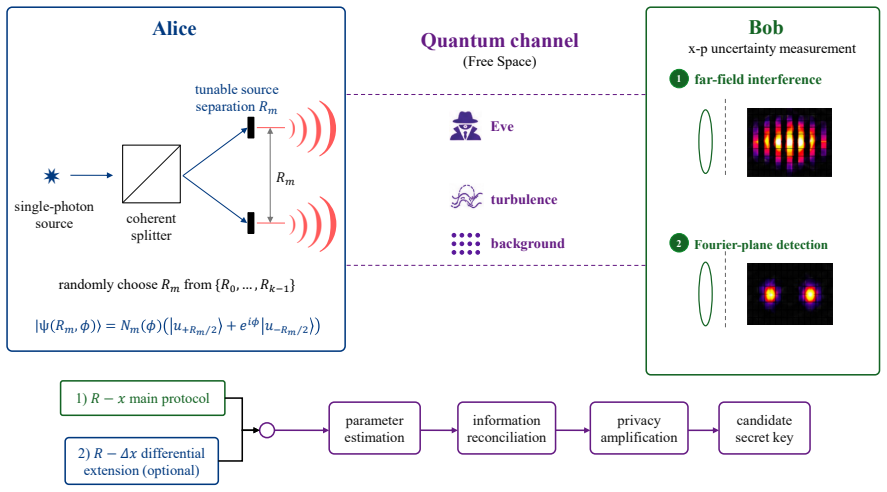
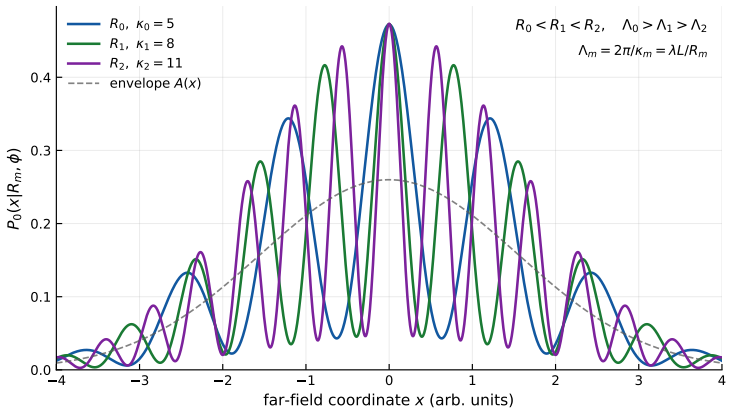
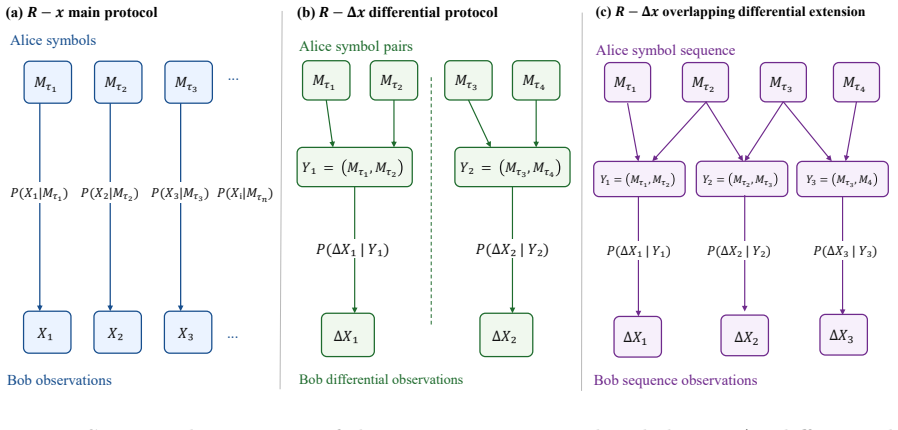
This paper proposes a candidate framework for free-space quantum key distribution (QKD) based on geometrical-configuration modulation (GM). In the minimal implementation considered here, Alice coherently splits a single photon emitted from one source into two spatial output modes with a tunable separation, and uses the source separation $R$ as the GM variable that defines the prepared single-photon spatial superposition state. Bob records the single-photon detection coordinate in the far field or Fourier plane, providing the correlated data used for soft-input information reconciliation. Based on this physical mechanism, we first establish an $R-x$ protocol model in which the source separation $R$ and the single-photon detection coordinate $x$ are random variables, and further propose an $R-\Delta x$ extension based on the difference variable $\Delta x$ between adjacent accepted detection events to mitigate slowly varying center drift in free-space links. The framework specifies state preparation, far-field conditional probabilities, soft-input information generation, parameter estimation, reconciliation, and asymptotic candidate key-rate formulas. A complete composable security analysis further requires derive an explicit computable upper bound on Eve's information from experimentally observed parameters, together with finite-key analysis and experimental validation under free-space conditions. The proposed candidate framework (GM-QKD) provides a modulation approach based on spatial degrees of freedom in which the source geometry serves as the modulation variable.
Editorial analysis
A structured set of objections, weighed in public.
Referee Report
Summary. The manuscript proposes a candidate framework for free-space quantum key distribution (QKD) called GM-QKD. Alice prepares single-photon spatial superposition states by coherently splitting a photon and using the tunable source separation R as the modulation variable. Bob records the far-field detection coordinate x (or difference Δx in the extension), yielding correlated data for soft-input reconciliation. The paper defines the R-x protocol model, far-field conditional probabilities, state preparation, parameter estimation, reconciliation steps, and asymptotic candidate key-rate formulas, while explicitly deferring a complete composable security analysis, explicit upper bound on Eve's information, finite-key analysis, and experimental validation.
Significance. If the missing security analysis can be supplied, the framework would supply a concrete starting model for a spatial-degree-of-freedom modulation technique in free-space QKD whose geometry serves as the information carrier. The provision of explicit far-field probabilities and an R-Δx drift-mitigation variant gives a clear foundation for subsequent work; the paper's upfront statement that security bounds remain future requirements is a positive feature that correctly scopes the contribution.
minor comments (3)
- [R-x protocol model] § on the R-x model: the far-field conditional probability p(x|R) is introduced as the basis for reconciliation but is not supplied with an explicit functional form or derivation; adding the expression (even if left symbolic) would make the subsequent candidate key-rate formulas easier to follow.
- [soft-input information generation] The description of soft-input information generation from the detection coordinate x does not specify how the continuous variable is discretized or quantized for the reconciliation step; a short paragraph or equation clarifying the binning or likelihood mapping would improve reproducibility.
- [R-Δx extension] The R-Δx extension is motivated by center-drift mitigation but lacks even a qualitative comparison (e.g., variance reduction) against the base R-x model under the slowly varying drift conditions typical of free-space links.
Simulated Author's Rebuttal
We thank the referee for the careful summary and positive assessment of the GM-QKD framework. The recommendation for minor revision is noted, and we confirm that the manuscript already explicitly scopes its contribution by deferring a full composable security analysis, finite-key effects, and experimental validation.
- Supplying a complete composable security analysis with an explicit computable upper bound on Eve's information, together with finite-key analysis and experimental validation under free-space conditions, as these elements are identified in the manuscript as requirements for future work.
Circularity Check
No significant circularity; framework is definitional only
full rationale
The paper explicitly frames GM-QKD as a candidate protocol model whose security analysis (explicit Eve bound, finite-key analysis) remains future work. It defines the R-x model, far-field probabilities, and candidate asymptotic formulas as starting points without deriving or fitting any key rate from data, without self-citation load-bearing claims, and without reducing any prediction to its own inputs by construction. The derivation chain therefore contains no load-bearing steps that collapse to the inputs.
Axiom & Free-Parameter Ledger
axioms (2)
- standard math Single-photon spatial superposition states prepared by coherent splitting obey standard quantum mechanics and far-field diffraction.
- domain assumption Bob's far-field detection coordinate x provides usable correlation with Alice's chosen R for information reconciliation.
Reference graph
Works this paper leans on
-
[1]
Charles H. Bennett and Gilles Brassard. Quantum cryptography: Public key distribution and coin tossing. Theoretical Computer Science , 560:7–11, 2014. doi: 10.1016/j.tcs.2014.0 5.025
-
[3]
C. H. Bennett, G. Brassard, C. Crepeau, and U. M. Maurer. Generalized privacy am- plification. IEEE Transactions on Information Theory , 41(6):1915–1923, 1995. doi: 10.1109/18.476316
-
[4]
Artur K. Ekert. Quantum cryptography based on bell’s theorem. Physical Review Letters , 67(6):661–663, 1991. doi: 10.1103/PhysRevLett.67.661
-
[5]
Decoy state quantum key distribution
Hoi-Kwong Lo, Xiongfeng Ma, and Kai Chen. Decoy state quantum key distribution. Physical Review Letters , 94(23):230504, 2005. doi: 10.1103/PhysRevLett.94.230504
-
[6]
Tight finite- key analysis for quantum cryptography
Marco Tomamichel, Charles Ci Wen Lim, Nicolas Gisin, and Renato Renner. Tight finite- key analysis for quantum cryptography. Nature Communications , 3(1):634, 2012. doi: 10.1038/ncomms1631
-
[7]
Beating the photon-number-splitting attack in practical quantum cryp- tography
Xiang-Bin Wang. Beating the photon-number-splitting attack in practical quantum cryp- tography. Physical Review Letters , 94(23):230503, 2005. doi: 10.1103/PhysRevLett.94.2 30503
-
[8]
Continuous variable quantum cryptography using coherent states
Frédéric Grosshans and Philippe Grangier. Continuous variable quantum cryptography using coherent states. Physical Review Letters , 88(5):057902, 2002. doi: 10.1103/PhysRe vLett.88.057902
-
[9]
Frédéric Grosshans, Gilles Van Assche, Jérôme Wenger, Rosa Brouri, Nicolas J. Cerf, and Philippe Grangier. Quantum key distribution using gaussian-modulated coherent states. Nature, 421(6920):238–241, 2003. doi: 10.1038/nature01289
-
[10]
Distributing secret keys with quantum continuous variables: Principle, security and implementations
Eleni Diamanti and Anthony Leverrier. Distributing secret keys with quantum continuous variables: Principle, security and implementations. Entropy, 17(9):6072–6092, 2015
2015
-
[11]
S. P. Walborn, D. S. Lemelle, M. P. Almeida, and P. H. Souto Ribeiro. Quantum key distribution with higher-order alphabets using spatially encoded qudits. Physical Review Letters, 96(9):090501, 2006. doi: 10.1103/PhysRevLett.96.090501. 21
-
[12]
Cerf, Mohamed Bourennane, Anders Karlsson, and Nicolas Gisin
Nicolas J. Cerf, Mohamed Bourennane, Anders Karlsson, and Nicolas Gisin. Security of quantum key distribution using d-level systems. Physical Review Letters , 88(12):127902,
-
[13]
doi: 10.1103/PhysRevLett.88.127902
-
[14]
H. Bechmann-Pasquinucci and W. Tittel. Quantum cryptography using larger alphabets. Physical Review A , 61(6):062308, 2000. doi: 10.1103/PhysRevA.61.062308
-
[15]
M. P. Almeida, S. P. Walborn, and P. H. Souto Ribeiro. Experimental investigation of quantum key distribution with position and momentum of photon pairs. Physical Review A, 72(2):022313, 2005. doi: 10.1103/PhysRevA.72.022313
-
[16]
Mhlambululi Mafu, Angela Dudley, Sandeep Goyal, et al. Higher-dimensional orbital- angular-momentum-based quantum key distribution with mutually unbiased bases. Phys- ical Review A , 88(3):032305, 2013. doi: 10.1103/PhysRevA.88.032305
-
[17]
Mohammad Mirhosseini, Omar S. Magaña-Loaiza, Malcolm N. O’Sullivan, et al. High- dimensional quantum cryptography with twisted light. New Journal of Physics , 17(3): 033033, 2015. doi: 10.1088/1367-2630/17/3/033033
-
[18]
Satellite-to-ground quantum key distribution
Sheng-Kai Liao, Wen-Qi Cai, Wei-Yue Liu, Liang Zhang, et al. Satellite-to-ground quantum key distribution. Nature, 549(7670):43–47, 2017. doi: 10.1038/nature23655
-
[19]
Progress in satellite quan- tum key distribution
Robert Bedington, Juan Miguel Arrazola, and Alexander Ling. Progress in satellite quan- tum key distribution. npj Quantum Information , 3(1):30, 2017. doi: 10.1038/s41534-017 -0031-5
-
[20]
Yu-Ming Bai, Ming-Han Ding, Yu-Xuan Liu, and Jun-Lin Li. Geometric-configuration modulation: A novel free-space optical communication paradigm for D/r0 ∼ 5 turbulence resistance. arXiv preprint arXiv:2604.26434 , 2026. doi: 10.48550/arXiv.2604.26434
work page internal anchor Pith review Pith/arXiv arXiv doi:10.48550/arxiv.2604.26434 2026
-
[21]
Mehul Malik, Malcolm O’Sullivan, Brandon Rodenburg, et al. Influence of atmospheric tur- bulence on optical communications using orbital angular momentum for encoding. Optics Express, 20(12):13195–13200, 2012. doi: 10.1364/OE.20.013195
-
[22]
Satellite-to-earth quantum key distribution via orbital angular momentum
Ziqing Wang, Robert Malaney, and Benjamin Burnett. Satellite-to-earth quantum key distribution via orbital angular momentum. Physical Review Applied , 14(6):064031, 2020. doi: 10.1103/PhysRevApplied.14.064031. 22
discussion (0)
Sign in with ORCID, Apple, or X to comment. Anyone can read and Pith papers without signing in.