Leptonic CP asymmetry and heavy neutrino searches in seesaw scenario
Pith reviewed 2026-06-25 20:08 UTC · model grok-4.3
The pith
In type-I seesaw, LHC sensitivity to light-heavy neutrino mixing improves by an order of magnitude for 60-80 GeV masses when same-sign to opposite-sign dilepton ratio is near one.
A machine-rendered reading of the paper's core claim, the machinery that carries it, and where it could break.
Core claim
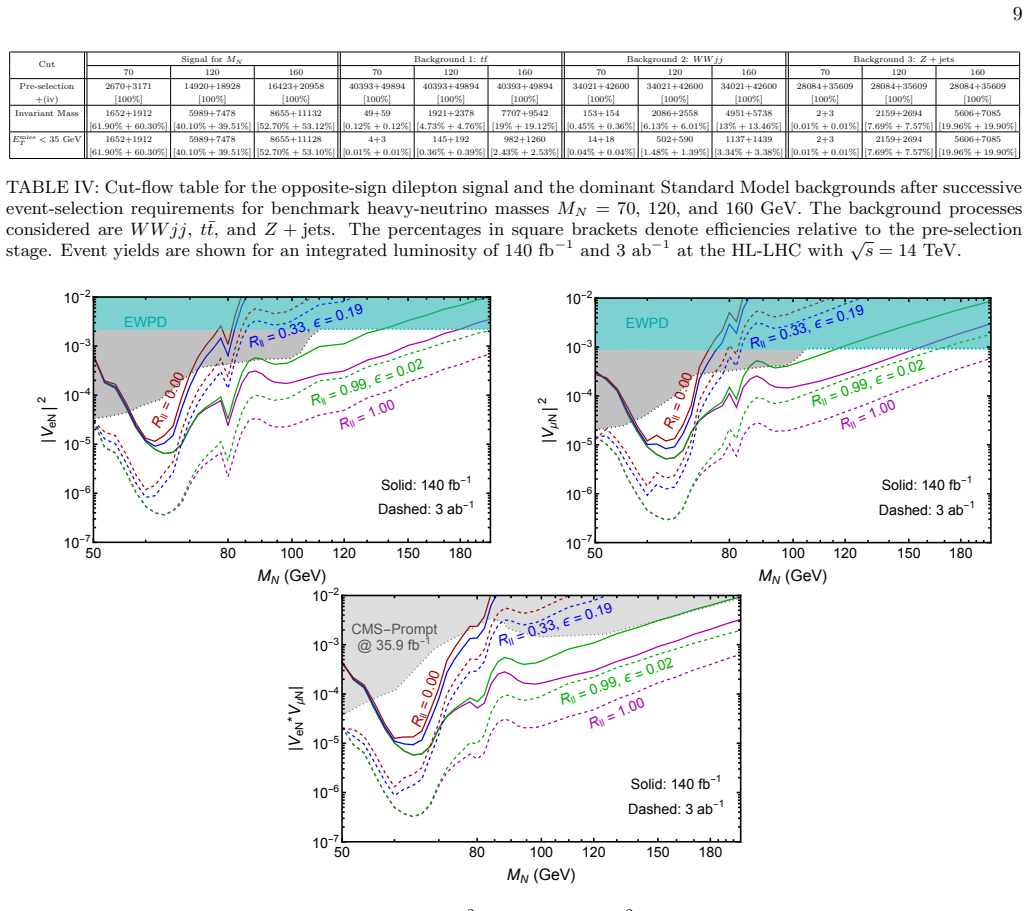
The central claim is that collider sensitivity to the light-heavy neutrino mixing in the type-I seesaw depends strongly on the ratio R_ll of same-sign to opposite-sign dilepton events; when R_ll is approximately one, the LHC at 140 fb^{-1} can set mixing limits an order of magnitude stronger than current bounds for M_N between 60 and 80 GeV, with further improvement at 3 ab^{-1}, while the sensitivity falls for smaller R_ll and the 50-100 GeV mass interval exhibits a direct correlation between reach, R_ll, and CP asymmetry.
What carries the argument
The ratio R_ll of same-sign to opposite-sign dilepton events, which encodes the leptonic CP asymmetry arising from the light-heavy neutrino mixing in the type-I seesaw.
If this is right
- For R_ll approximately 1 the mixing constraints improve by one order of magnitude at 140 fb^{-1} for M_N of 60-80 GeV.
- An additional order-of-magnitude gain is expected at the HL-LHC with 3 ab^{-1}.
- Sensitivity falls substantially once R_ll drops below one.
- In the 50-100 GeV mass window the collider reach is directly tied to the value of R_ll and the size of the CP asymmetry.
Where Pith is reading between the lines
- Precise measurement of R_ll would immediately translate into an expected sensitivity curve for mixing searches in the same dataset.
- The mass window 50-100 GeV is singled out as the region where R_ll and CP-asymmetry effects are strongest, suggesting targeted oscillation searches there.
Load-bearing premise
The cut-based analysis and background modeling in the detector-level simulation accurately capture the dominant Standard Model processes and detector efficiencies for the chosen final states.
What would settle it
If data at 140 fb^{-1} yields a number of same-sign and opposite-sign events that fails to produce the projected order-of-magnitude improvement in the upper limit on mixing when R_ll is near one, the claimed sensitivity gain would be ruled out.
Figures
read the original abstract
We investigate the prospects for probing heavy Majorana neutrinos in the type-I seesaw framework at the 14 TeV LHC. In this scenario, the light-heavy neutrino mixing enables the production of heavy neutrinos in association with charged leptons, followed by decays into dilepton plus dijet final states. We perform a detector-level cut-based analysis of both same-sign (SS) and opposite-sign (OS) dilepton channels and investigate the sensitivity as a function of the ratio $R_{ll}$ of SS to OS events. We derive projected constraints on the light-heavy neutrino mixing as a function of the heavy-neutrino mass. For $R_{ll} \simeq 1$, the sensitivity at $140~\rm{fb}^{-1}$ improves upon current LHC bounds by about one order of magnitude for $M_N \simeq 60-80~\rm{GeV}$, with a further order of magnitude improvement expected at the HL-LHC with $3~\rm{ab}^{-1}$. The sensitivity decreases substantially for smaller $R_{ll}$. We show that, for $50~\text{GeV} \lesssim M_N \lesssim 100~\text{GeV}$, the collider reach is strongly correlated with $R_{ll}$ and the associated CP asymmetry, providing additional motivation for future measurements of $R_{ll}$ and heavy-neutrino oscillations at colliders.
Editorial analysis
A structured set of objections, weighed in public.
Referee Report
Summary. The paper investigates prospects for probing heavy Majorana neutrinos in the type-I seesaw at the 14 TeV LHC via production in association with charged leptons and decays to dilepton+dijet final states. It performs a detector-level cut-based analysis in both same-sign (SS) and opposite-sign (OS) channels, derives projected constraints on the light-heavy neutrino mixing |V_lN|^2 as a function of heavy neutrino mass M_N, and shows that for R_ll ≃ 1 the sensitivity at 140 fb^{-1} improves current LHC bounds by ~1 order of magnitude for M_N ≃ 60-80 GeV (with further improvement at HL-LHC), while the reach for 50 GeV ≲ M_N ≲ 100 GeV is strongly correlated with R_ll and the associated CP asymmetry.
Significance. If the simulation-based projections are accurate, the work provides a concrete link between measurable collider observables (R_ll and leptonic CP asymmetry) and the sensitivity reach in the seesaw parameter space, offering additional motivation for dedicated measurements of these quantities at the LHC and HL-LHC.
major comments (1)
- [detector-level analysis and results sections] The central projected sensitivity improvement (abstract and § on results) for R_ll ≃ 1 at 140 fb^{-1} and M_N ≃ 60-80 GeV rests on the accuracy of the cut-based detector-level simulation for signal efficiencies and dominant SM backgrounds (W+jets, ttbar, diboson) in the SS/OS dilepton+dijet channels. No data-driven cross-check or direct comparison to existing LHC measurements in the same final states is presented, which is load-bearing because the signal kinematics overlap strongly with SM processes in this mass range; any background underestimation would directly inflate the quoted |V_lN|^2 limits.
minor comments (1)
- The abstract and main text should explicitly state the assumed integrated luminosities, parton-shower and detector simulation tools, and any systematic uncertainties assigned to the background modeling.
Simulated Author's Rebuttal
We thank the referee for the careful reading of our manuscript and the constructive comment. We address the major point below.
read point-by-point responses
-
Referee: [detector-level analysis and results sections] The central projected sensitivity improvement (abstract and § on results) for R_ll ≃ 1 at 140 fb^{-1} and M_N ≃ 60-80 GeV rests on the accuracy of the cut-based detector-level simulation for signal efficiencies and dominant SM backgrounds (W+jets, ttbar, diboson) in the SS/OS dilepton+dijet channels. No data-driven cross-check or direct comparison to existing LHC measurements in the same final states is presented, which is load-bearing because the signal kinematics overlap strongly with SM processes in this mass range; any background underestimation would directly inflate the quoted |V_lN|^2 limits.
Authors: We thank the referee for this observation. Our analysis is a Monte Carlo projection study employing standard tools (MadGraph5_aMC@NLO for generation, Pythia 8 for parton showering and hadronization, and Delphes 3 with the CMS card for detector simulation). Background normalizations follow NLO/NNLO predictions from the literature, and the kinematic selections are chosen to be consistent with published LHC searches in the same final states. We agree that an explicit data-driven cross-check or side-by-side comparison to existing Run-2 measurements would strengthen the presentation. In the revised version we will add a short subsection (in the detector-level analysis section) that (i) references the relevant ATLAS and CMS measurements in dilepton+dijet channels, (ii) states the level of agreement between our simulated distributions and those measurements where overlap exists, and (iii) quantifies the effect of a conservative 20-30% background normalization uncertainty on the projected |V_lN|^2 limits. This constitutes a partial revision; the core cut-based efficiencies and resulting sensitivity curves remain simulation-based, as is conventional for HL-LHC projections. revision: partial
Circularity Check
No circularity in forward simulation of projected LHC sensitivities
full rationale
The paper conducts a detector-level cut-based analysis of SS and OS dilepton+dijet channels to produce projected constraints on |V_lN|^2 versus M_N for different R_ll values. This is a standard forward Monte Carlo projection exercise that computes expected event yields and limits from assumed cross sections, efficiencies, and backgrounds; the output limits are not obtained by fitting any parameter to the target data and then relabeling the fit as a prediction. No equations reduce the claimed sensitivity gains to a self-defined quantity, no load-bearing self-citations close the central argument, and the derivation remains independent of the final numerical projections. The reader's assessment of score 2 is consistent with minor normal self-citation that does not affect the result.
Axiom & Free-Parameter Ledger
axioms (1)
- domain assumption Standard Model backgrounds and detector efficiencies can be modeled sufficiently accurately for cut-based selection in dilepton plus dijet final states.
Reference graph
Works this paper leans on
-
[1]
Horizontal Symmetry and Masses of Neutrinos,
T. Yanagida, “Horizontal Symmetry and Masses of Neutrinos,” Prog. Theor. Phys.64(1980) 1103
1980
-
[2]
µ→eγat a Rate of One Out of 10 9 Muon Decays?,
P. Minkowski, “µ→eγat a Rate of One Out of 10 9 Muon Decays?,” Phys. Lett. B67(1977) 421–428
1977
-
[3]
T. Yanagida, “Horizontal gauge symmetry and masses 12 Psudoscalar(P) mP (MeV) fP (MeV) VP Vector(V) mV (MeV) fV (MeV) VV π± 139.6 130.7 Vud ρ± 775.8 220 Vud K ± 493.7 159.8 Vus K ∗± 891.66 217 Vus η 547.8 164.7 – ω 782.59 195 – π0 135 130 – ρ0 776 220 – K 0 497.6 159 – K ∗0 896.1 217 – TABLE V: Masses and decay constants of pseudoscalar and vector mesons ...
1979
-
[4]
Complex Spinors and Unified Theories,
M. Gell-Mann, P. Ramond, and R. Slansky, “Complex Spinors and Unified Theories,” Conf. Proc. C790927 (1979) 315–321, [1306.4669]
Pith/arXiv arXiv 1979
-
[5]
The Future of Elementary Particle Physics,
S. L. Glashow, “The Future of Elementary Particle Physics,” NATO Sci. Ser. B61(1980) 687
1980
-
[6]
Neutrino Mass and Spontaneous Parity Nonconservation,
R. N. Mohapatra and G. Senjanovic, “Neutrino Mass and Spontaneous Parity Nonconservation,” Phys. Rev. Lett.44(1980) 912
1980
-
[7]
Neutrino Masses in SU(2) x U(1) Theories,
J. Schechter and J. W. F. Valle, “Neutrino Masses in SU(2) x U(1) Theories,” Phys. Rev. D22(1980) 2227
1980
-
[8]
Baryon and Lepton Nonconserving Processes,
S. Weinberg, “Baryon and Lepton Nonconserving Processes,” Phys. Rev. Lett.43(1979) 1566–1570
1979
-
[9]
Oscillating neutrinos and µ→e, γ,
J. A. Casas and A. Ibarra, “Oscillating neutrinos and µ→e, γ,” Nucl. Phys. B618(2001) 171–204, [hep-ph/0103065]
Pith/arXiv arXiv 2001
-
[10]
Unitarity of the Leptonic Mixing Matrix,
S. Antusch, C. Biggio, E. Fernandez-Martinez, M. B. Gavela, and J. Lopez-Pavon, “Unitarity of the Leptonic Mixing Matrix,” JHEP10(2006) 084, [hep-ph/0607020]
Pith/arXiv arXiv 2006
-
[11]
Low energy effects of neutrino masses,
A. Abada, C. Biggio, F. Bonnet, M. B. Gavela, and T. Hambye, “Low energy effects of neutrino masses,” JHEP12(2007) 061, [0707.4058]. [13]MEGCollaboration, J. Adam et al., “New limit on the lepton-flavour violating decayµ + →e +γ,” Phys. Rev. Lett.107(2011) 171801, [1107.5547]. [14]BaBarCollaboration, B. Aubert et al., “Searches for Lepton Flavor Violation...
Pith/arXiv arXiv 2007
-
[12]
Progress in electroweak baryogenesis,
A. G. Cohen, D. B. Kaplan, and A. E. Nelson, “Progress in electroweak baryogenesis,” Ann. Rev. Nucl. Part. Sci.43(1993) 27–70, [hep-ph/9302210]
Pith/arXiv arXiv 1993
-
[13]
CP violation and baryogenesis at the electroweak phase transition,
K. Funakubo, “CP violation and baryogenesis at the electroweak phase transition,” Prog. Theor. Phys.96 (1996) 475–520, [hep-ph/9608358]
Pith/arXiv arXiv 1996
-
[14]
M. Trodden, “Electroweak baryogenesis,” Rev. Mod. Phys.71(1999) 1463–1500, [hep-ph/9803479]. [20]CMSCollaboration, S. Chatrchyan et al., “Observation of a New Boson at a Mass of 125 GeV with the CMS Experiment at the LHC,” Phys. Lett. B716(2012) 30–61, [1207.7235]. [21]A TLASCollaboration, G. Aad et al., “Observation of a new particle in the search for th...
Pith/arXiv arXiv 1999
-
[15]
Baryogenesis Without Grand Unification,
M. Fukugita and T. Yanagida, “Baryogenesis Without Grand Unification,” Phys. Lett. B174(1986) 45–47
1986
-
[16]
Topology in the Weinberg-Salam Theory,
N. S. Manton, “Topology in the Weinberg-Salam Theory,” Phys. Rev. D28(1983) 2019
1983
-
[17]
A Saddle Point Solution in the Weinberg-Salam Theory,
F. R. Klinkhamer and N. S. Manton, “A Saddle Point Solution in the Weinberg-Salam Theory,” Phys. Rev. D 30(1984) 2212
1984
-
[18]
The Statistical Theory of Anomalous Fermion Number Nonconservation,
S. Y. Khlebnikov and M. E. Shaposhnikov, “The Statistical Theory of Anomalous Fermion Number Nonconservation,” Nucl. Phys. B308(1988) 885–912
1988
-
[19]
Resonant CP violation induced by particle mixing in transition amplitudes,
A. Pilaftsis, “Resonant CP violation induced by particle mixing in transition amplitudes,” Nucl. Phys. B504 (1997) 61–107, [hep-ph/9702393]
Pith/arXiv arXiv 1997
-
[20]
Resonant CP violation due to heavy neutrinos at the LHC,
S. Bray, J. S. Lee, and A. Pilaftsis, “Resonant CP violation due to heavy neutrinos at the LHC,” Nucl. Phys. B786(2007) 95–118, [hep-ph/0702294]
Pith/arXiv arXiv 2007
-
[21]
Neutrinos and Collider Physics,
F. F. Deppisch, P. S. Bhupal Dev, and A. Pilaftsis, “Neutrinos and Collider Physics,” New J. Phys.17 no. 7, (2015) 075019, [1502.06541]
Pith/arXiv arXiv 2015
-
[22]
Improved bounds on the heavy neutrino productions at the LHC,
A. Das and N. Okada, “Improved bounds on the heavy neutrino productions at the LHC,” Phys. Rev. D93 no. 3, (2016) 033003, [1510.04790]
Pith/arXiv arXiv 2016
-
[23]
Production of Heavy neutrino in next-to-leading order QCD at the LHC and beyond,
A. Das, P. Konar, and S. Majhi, “Production of Heavy neutrino in next-to-leading order QCD at the LHC and beyond,” JHEP06(2016) 019, [1604.00608]
Pith/arXiv arXiv 2016
-
[24]
Neutrinoless double beta decay versus other probes of heavy sterile neutrinos,
P. D. Bolton, F. F. Deppisch, and P. S. Bhupal Dev, “Neutrinoless double beta decay versus other probes of heavy sterile neutrinos,” JHEP03(2020) 170, [1912.03058]
arXiv 2020
-
[25]
Right-Handed Neutrinos at CERN LHC and the Mechanism of Neutrino Mass Generation,
J. Kersten and A. Y. Smirnov, “Right-Handed Neutrinos at CERN LHC and the Mechanism of Neutrino Mass Generation,” Phys. Rev. D76(2007) 073005, [0705.3221]
Pith/arXiv arXiv 2007
-
[26]
On lepton number violation in heavy neutrino decays at colliders,
M. Drewes, J. Klari´ c, and P. Klose, “On lepton number violation in heavy neutrino decays at colliders,” JHEP 11(2019) 032, [1907.13034]
arXiv 2019
-
[27]
TheνMSM, dark matter and baryon asymmetry of the universe,
T. Asaka and M. Shaposhnikov, “TheνMSM, dark matter and baryon asymmetry of the universe,” Phys. Lett. B620(2005) 17–26, [hep-ph/0505013]
Pith/arXiv arXiv 2005
-
[28]
Dark Matter, Baryogenesis and Neutrino Oscillations from Right Handed Neutrinos,
L. Canetti, M. Drewes, T. Frossard, and M. Shaposhnikov, “Dark Matter, Baryogenesis and Neutrino Oscillations from Right Handed Neutrinos,” Phys. Rev. D87(2013) 093006, [1208.4607]
Pith/arXiv arXiv 2013
-
[29]
Resonant production of the sterile neutrino dark matter and fine-tunings in the [nu]MSM,
A. Roy and M. Shaposhnikov, “Resonant production of the sterile neutrino dark matter and fine-tunings in the [nu]MSM,” Phys. Rev. D82(2010) 056014, [1006.4008]
Pith/arXiv arXiv 2010
-
[30]
Reexamination of generation of baryon and lepton number asymmetries by heavy particle decay,
J. Liu and G. Segre, “Reexamination of generation of baryon and lepton number asymmetries by heavy particle decay,” Phys. Rev. D48(1993) 4609–4612, [hep-ph/9304241]
Pith/arXiv arXiv 1993
-
[31]
Baryogenesis from a lepton asymmetric universe,
M. Flanz, E. A. Paschos, and U. Sarkar, “Baryogenesis from a lepton asymmetric universe,” Phys. Lett. B345 (1995) 248–252, [hep-ph/9411366]. [Erratum: 13 Phys.Lett.B 384, 487–487 (1996), Erratum: Phys.Lett.B 382, 447–447 (1996)]
Pith/arXiv arXiv 1995
-
[32]
Baryogenesis through mixing of heavy Majorana neutrinos,
M. Flanz, E. A. Paschos, U. Sarkar, and J. Weiss, “Baryogenesis through mixing of heavy Majorana neutrinos,” Phys. Lett. B389(1996) 693–699, [hep-ph/9607310]
Pith/arXiv arXiv 1996
-
[33]
Baryogenesis from mixed particle decays,
L. Covi and E. Roulet, “Baryogenesis from mixed particle decays,” Phys. Lett. B399(1997) 113–118, [hep-ph/9611425]
Pith/arXiv arXiv 1997
-
[34]
CP violation and baryogenesis due to heavy Majorana neutrinos,
A. Pilaftsis, “CP violation and baryogenesis due to heavy Majorana neutrinos,” Phys. Rev. D56(1997) 5431–5451, [hep-ph/9707235]
Pith/arXiv arXiv 1997
-
[35]
A. Pilaftsis and T. E. J. Underwood, “Resonant leptogenesis,” Nucl. Phys. B692(2004) 303–345, [hep-ph/0309342]
Pith/arXiv arXiv 2004
-
[36]
J. Alwall, M. Herquet, F. Maltoni, O. Mattelaer, and T. Stelzer, “MadGraph 5 : Going Beyond,” JHEP06 (2011) 128, [1106.0522]
Pith/arXiv arXiv 2011
-
[37]
A comprehensive guide to the physics and usage of PYTHIA 8.3,
C. Bierlich et al., “A comprehensive guide to the physics and usage of PYTHIA 8.3,” SciPost Phys. Codeb.2022(2022) 8, [2203.11601]. [45]DELPHES 3Collaboration, J. de Favereau, C. Delaere, P. Demin, A. Giammanco, V. Lemaˆ ıtre, A. Mertens, and M. Selvaggi, “DELPHES 3, A modular framework for fast simulation of a generic collider experiment,” JHEP02(2014) 0...
Pith/arXiv arXiv 2022
-
[38]
Quasi-Dirac neutrinos at the LHC,
G. Anamiati, M. Hirsch, and E. Nardi, “Quasi-Dirac neutrinos at the LHC,” JHEP10(2016) 010, [1607.05641]
Pith/arXiv arXiv 2016
-
[39]
Same Sign versus Opposite Sign Dileptons as a Probe of Low Scale Seesaw Mechanisms,
A. Das, P. S. B. Dev, and R. N. Mohapatra, “Same Sign versus Opposite Sign Dileptons as a Probe of Low Scale Seesaw Mechanisms,” Phys. Rev. D97no. 1, (2018) 015018, [1709.06553]
Pith/arXiv arXiv 2018
-
[40]
TASI 2006 Lectures on Leptogenesis,
M.-C. Chen, “TASI 2006 Lectures on Leptogenesis,” in Theoretical Advanced Study Institute in Elementary Particle Physics: Exploring New Frontiers Using Colliders and Neutrinos, pp. 123–176. 3, 2007. [hep-ph/0703087]
Pith/arXiv arXiv 2006
-
[41]
NuFit-6.0: updated global analysis of three-flavor neutrino oscillations,
I. Esteban, M. C. Gonzalez-Garcia, M. Maltoni, I. Martinez-Soler, J. P. Pinheiro, and T. Schwetz, “NuFit-6.0: updated global analysis of three-flavor neutrino oscillations,” JHEP12(2024) 216, [2410.05380]. [51]T2KCollaboration, K. Abe et al., “Measurements of neutrino oscillation parameters from the T2K experiment using 3.6×10 21 protons on target,” Eur. ...
Pith/arXiv arXiv 2024
-
[42]
Reconciling resonant leptogenesis and baryogenesis via neutrino oscillations,
J. Klari´ c, M. Shaposhnikov, and I. Timiryasov, “Reconciling resonant leptogenesis and baryogenesis via neutrino oscillations,” Phys. Rev. D104no. 5, (2021) 055010, [2103.16545]
arXiv 2021
-
[43]
A. Ibarra, E. Molinaro, and S. T. Petcov, “TeV Scale See-Saw Mechanisms of Neutrino Mass Generation, the Majorana Nature of the Heavy Singlet Neutrinos and (ββ) 0ν-Decay,” JHEP09(2010) 108, [1007.2378]
Pith/arXiv arXiv 2010
-
[44]
Low Energy Signatures of the TeV Scale See-Saw Mechanism,
A. Ibarra, E. Molinaro, and S. T. Petcov, “Low Energy Signatures of the TeV Scale See-Saw Mechanism,” Phys. Rev. D84(2011) 013005, [1103.6217]
Pith/arXiv arXiv 2011
-
[45]
D. N. Dinh, A. Ibarra, E. Molinaro, and S. T. Petcov, “Theµ−eConversion in Nuclei,µ→eγ, µ→3e Decays and TeV Scale See-Saw Scenarios of Neutrino Mass Generation,” JHEP08(2012) 125, [1205.4671]. [Erratum: JHEP 09, 023 (2013)]
Pith/arXiv arXiv 2012
-
[46]
Bounds on heavy Majorana neutrinos in type-I seesaw and implications for collider searches,
A. Das and N. Okada, “Bounds on heavy Majorana neutrinos in type-I seesaw and implications for collider searches,” Phys. Lett. B774(2017) 32–40, [1702.04668]
Pith/arXiv arXiv 2017
-
[47]
Complete NLO corrections to W +W+ scattering and its irreducible background at the LHC,
B. Biedermann, A. Denner, and M. Pellen, “Complete NLO corrections to W +W+ scattering and its irreducible background at the LHC,” JHEP10(2017) 124, [1708.00268]. [60]CMSCollaboration, S. Chatrchyan et al., “Identification of b-Quark Jets with the CMS Experiment,” JINST8(2013) P04013, [1211.4462]. [61]CMSCollaboration, A. M. Sirunyan et al., “Search for t...
Pith/arXiv arXiv 2017
-
[48]
Top Quark Pair Production beyond NNLO,
C. Muselli, M. Bonvini, S. Forte, S. Marzani, and G. Ridolfi, “Top Quark Pair Production beyond NNLO,” JHEP08(2015) 076, [1505.02006]
Pith/arXiv arXiv 2015
-
[49]
Vector Boson Pair Production at the LHC,
J. M. Campbell, R. K. Ellis, and C. Williams, “Vector Boson Pair Production at the LHC,” JHEP07(2011) 018, [1105.0020]. [65]A TLASCollaboration, G. Aad et al., “Search for heavy Majorana neutrinos with the ATLAS detector in pp collisions at √s= 8 TeV,” JHEP07(2015) 162, [1506.06020]. [66]CMSCollaboration, V. Khachatryan et al., “Search for heavy Majorana ...
Pith/arXiv arXiv 2011
-
[50]
Effects of new leptons in Electroweak Precision Data,
F. del Aguila, J. de Blas, and M. Perez-Victoria, “Effects of new leptons in Electroweak Precision Data,” Phys. Rev. D78(2008) 013010, [0803.4008]
Pith/arXiv arXiv 2008
-
[51]
Electroweak limits on physics beyond the Standard Model,
J. de Blas, “Electroweak limits on physics beyond the Standard Model,” EPJ Web Conf.60(2013) 19008, [1307.6173]
Pith/arXiv arXiv 2013
-
[52]
Improving Electro-Weak Fits with TeV-scale Sterile Neutrinos,
E. Akhmedov, A. Kartavtsev, M. Lindner, L. Michaels, and J. Smirnov, “Improving Electro-Weak Fits with TeV-scale Sterile Neutrinos,” JHEP05(2013) 081, [1302.1872]
Pith/arXiv arXiv 2013
-
[53]
Hagedorn, Relativistic kinematics: a guide to the kinematic problems of high-energy physics
R. Hagedorn, Relativistic kinematics: a guide to the kinematic problems of high-energy physics. Benjamin, New York, NY, 1963
1963
-
[54]
Nachtmann, Elementary Particle Physics: Concepts and Phenomena
O. Nachtmann, Elementary Particle Physics: Concepts and Phenomena. 1990
1990
-
[55]
Byckling and K
E. Byckling and K. Kajantie, Particle Kinematics: (Chapters I-VI, X). University of Jyvaskyla, Jyvaskyla, Finland, 1971
1971
-
[56]
Sensitivity of Lepton Number Violating Meson Decays in Different Experiments,
E. J. Chun, A. Das, S. Mandal, M. Mitra, and N. Sinha, “Sensitivity of Lepton Number Violating Meson Decays in Different Experiments,” Phys. Rev. D100no. 9, (2019) 095022, [1908.09562]
arXiv 2019
-
[57]
Right-handed neutrino production from Z’ interactions in forward search experiments,
S. K. A., S. Das, A. Das, and S. Mandal, “Right-handed neutrino production from Z’ interactions in forward search experiments,” Phys. Rev. D112no. 11, (2025) 115045, [2508.10734]. [81]Particle Data GroupCollaboration, K. Nakamura et al., “Review of particle physics,” J. Phys. G37 (2010) 075021. [82]CLEOCollaboration, M. Artuso et al., “Improved measuremen...
arXiv 2025
-
[58]
Exclusive semileptonic and nonleptonic decays of the Bc meson,
M. A. Ivanov, J. G. Korner, and P. Santorelli, “Exclusive semileptonic and nonleptonic decays of the Bc meson,” Phys. Rev. D73(2006) 054024, [hep-ph/0602050]
Pith/arXiv arXiv 2006
-
[59]
Quark structure of pseudoscalar mesons,
T. Feldmann, “Quark structure of pseudoscalar mesons,” Int. J. Mod. Phys. A15(2000) 159–207, [hep-ph/9907491]
Pith/arXiv arXiv 2000
-
[60]
Relativistic treatment of the decay constants of light and heavy mesons,
D. Ebert, R. N. Faustov, and V. O. Galkin, “Relativistic treatment of the decay constants of light and heavy mesons,” Phys. Lett. B635(2006) 93–99, [hep-ph/0602110]
Pith/arXiv arXiv 2006
discussion (0)
Sign in with ORCID, Apple, or X to comment. Anyone can read and Pith papers without signing in.