Impact of sintering conditions on the dielectric properties of TiO2 ceramics for metamaterialsapplications at terahertz frequencies
Pith reviewed 2026-06-25 20:09 UTC · model grok-4.3
The pith
Optimized spark plasma sintering of TiO2 produces bulk pellets with permittivity 103 and loss tangent 0.006 at THz frequencies.
A machine-rendered reading of the paper's core claim, the machinery that carries it, and where it could break.
Core claim
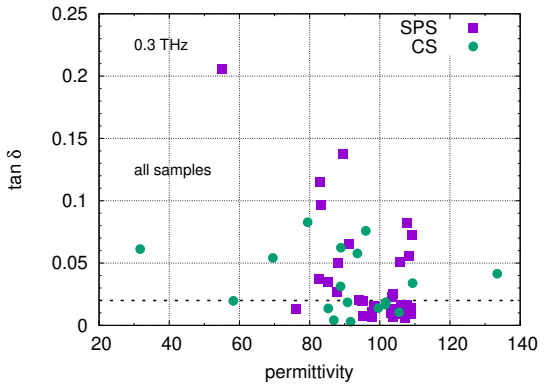
By switching from conventional sintering to spark plasma sintering and adding a post-sintering anneal, the authors obtain TiO2 pellets whose relative permittivity reaches 103 and whose loss tangent falls to 0.006 when measured by THz time-domain spectroscopy. These values satisfy the criteria previously identified in simulations for realizing two-dimensional all-dielectric metamaterials that display negative or near-zero effective refractive index in the terahertz range.
What carries the argument
Comparison of conventional sintering versus spark plasma sintering, with and without post-annealing, followed by direct THz-TDS measurement of permittivity and loss tangent on the resulting bulk pellets.
If this is right
- TiO2 processed by spark plasma sintering plus annealing meets the electromagnetic requirements for negative-index or near-zero-index all-dielectric metamaterials at terahertz frequencies.
- The electromagnetic performance of bulk TiO2 is shown to be strongly process-dependent rather than fixed by the chemistry alone.
- Numerical designs of 2D metamaterials become feasible once the measured loss tangent drops below 0.02 and permittivity sits near 100.
Where Pith is reading between the lines
- If the same process window works for other high-permittivity oxides, a wider palette of low-loss THz dielectrics could become available without new chemistry.
- The result suggests that any future metamaterial design using TiO2 should specify the exact sintering route rather than quoting literature values for the material.
- Direct measurement of the metamaterial effective index on a test structure would be the next logical step to confirm the bulk-to-device mapping.
Load-bearing premise
The dielectric constants measured on millimeter-thick bulk pellets will be representative of the local material response inside the much smaller features of a fabricated two-dimensional metamaterial.
What would settle it
Fabricate one of the simulated 2D all-dielectric metamaterial geometries from the best TiO2 pellet material and measure its effective index; if the index remains positive and greater than 1 across the target band, the bulk-to-device translation does not hold.
Figures
read the original abstract
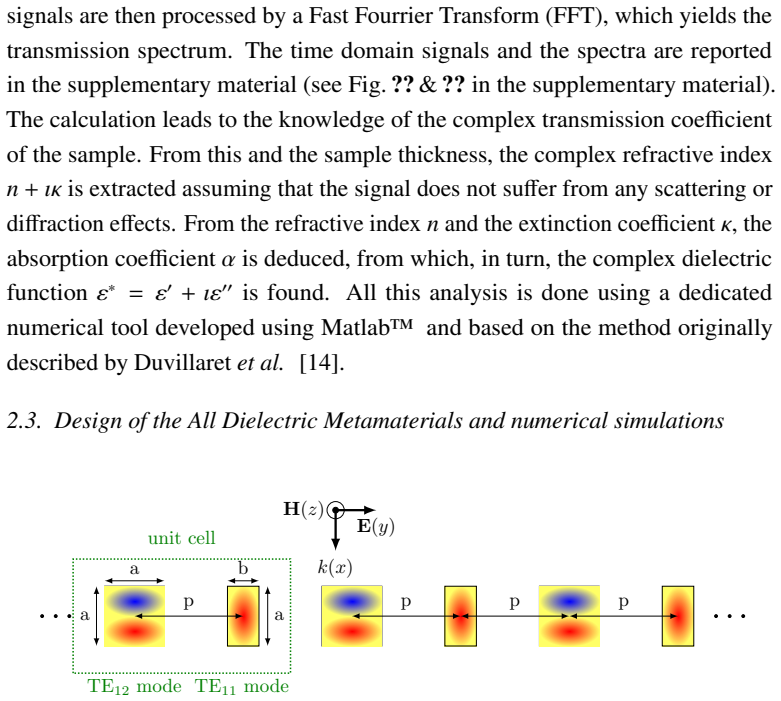
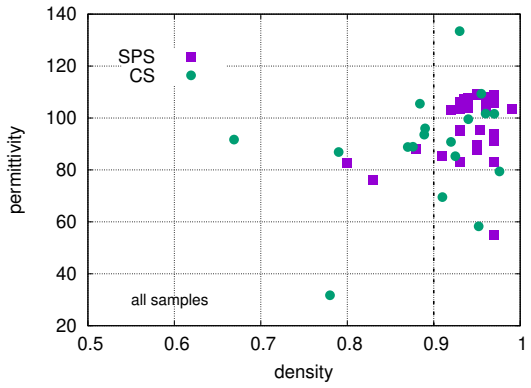
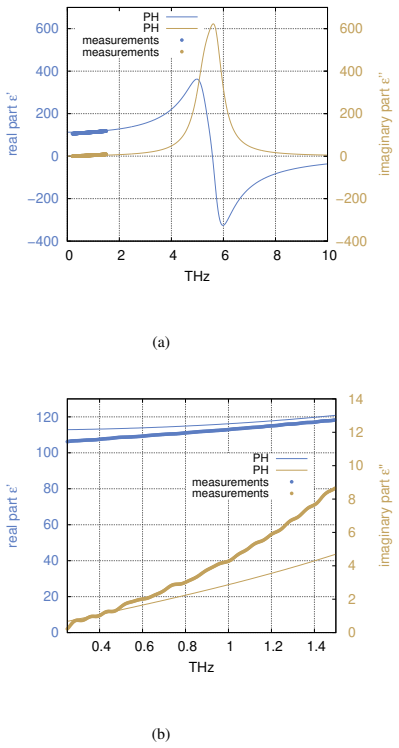
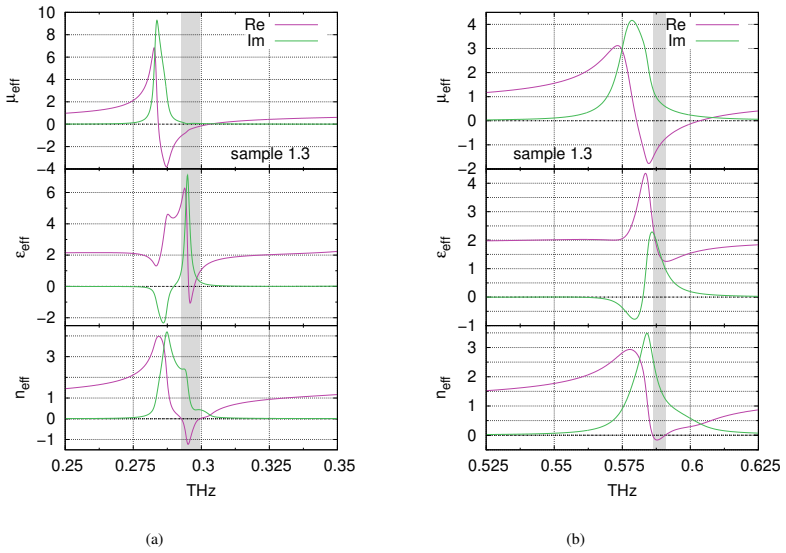
Titanium dioxyde (TiO2) is a promising dielectric material for the realization of metamaterials operating in the terahertz (THz) range. Indeed, these necessitate a high permittivity and low loss material. In this paper, we compare the processes of fabrication and the results of characterisation of bulk TiO2 pellets. From the results of this characterization, we have numerically designed 2D all dielectric metamaterials (ADM) showing that they may exhibit negative or near-zero effective index. Our previous simulations show that the relative permittivity epsilon has to be around 100, while the loss tangent has to be lower than 0.02. We have thus compared conventional sintering (CS) vs spark plasma sintering (SPS), and investigated the effect of post-sintering annealing on the loss to satisfy these two criteria. The samples were characterized by THz Time Domain Spectroscopy (THz-TDS). One of the samples exhibits a loss tangent as low as 0.006, with a permittivity epsilon = 103. These results highlight the importance of the fabrication process on the EM properties of bulk TiO2, and demonstrate that it is a promising material for the development of metamaterial in the THz band.
Editorial analysis
A structured set of objections, weighed in public.
Referee Report
Summary. The paper compares conventional sintering (CS) versus spark plasma sintering (SPS) of TiO2, with and without post-sintering annealing, and reports THz-TDS measurements on the resulting bulk pellets. One sample reaches ε = 103 and tanδ = 0.006. The authors state that these values satisfy thresholds from their prior simulations (ε ≈ 100, tanδ < 0.02) and that numerical designs of 2D all-dielectric metamaterials performed from the characterization results can exhibit negative or near-zero effective index.
Significance. If the bulk dielectric values translate directly to the metamaterial unit-cell performance, the work supplies a concrete fabrication route for high-permittivity, low-loss TiO2 ceramics and quantifies how sintering conditions control the electromagnetic response at THz frequencies.
major comments (2)
- [Abstract] Abstract: the statement that numerical designs were performed “from the results of this characterization” does not indicate whether the full frequency-dependent ε(ω) and tanδ(ω) spectra measured by THz-TDS were inserted into the 2D ADM unit-cell simulations or whether single-frequency constants were used; without this information the claim that the designs exhibit negative or near-zero index cannot be evaluated.
- [Numerical design section (inferred from abstract)] The manuscript provides no sensitivity study or geometry-specific validation showing that the homogeneous bulk pellet values remain valid when placed inside the 2D metamaterial lattice; possible additional scattering, grain-boundary losses, or effective anisotropy introduced by the metamaterial geometry are not addressed, yet these directly affect whether the effective index reaches the claimed regime.
minor comments (2)
- [Abstract] Abstract contains the spelling “dioxyde” instead of “dioxide”.
- [Results] The abstract reports specific numerical results (ε = 103, tanδ = 0.006) but the provided text contains no accompanying figures, error bars, or reproducibility details; these should be supplied in the results section for the central experimental claim.
Simulated Author's Rebuttal
We thank the referee for the detailed and constructive comments. We address each major point below and indicate the revisions we will make to improve clarity and address the concerns raised.
read point-by-point responses
-
Referee: [Abstract] Abstract: the statement that numerical designs were performed “from the results of this characterization” does not indicate whether the full frequency-dependent ε(ω) and tanδ(ω) spectra measured by THz-TDS were inserted into the 2D ADM unit-cell simulations or whether single-frequency constants were used; without this information the claim that the designs exhibit negative or near-zero index cannot be evaluated.
Authors: We agree the abstract is ambiguous on this point. The numerical designs used the measured permittivity (ε ≈ 103) and loss tangent (tanδ = 0.006) values at the target THz frequencies of interest, taken directly from the THz-TDS data at those frequencies rather than the full broadband spectra. These single-frequency constants were inserted into the 2D unit-cell simulations to demonstrate that the material properties satisfy the thresholds from our prior work and can yield negative or near-zero effective index. We will revise the abstract and add an explicit statement in the numerical design section clarifying the use of frequency-specific constants from the characterization. revision: yes
-
Referee: [Numerical design section (inferred from abstract)] The manuscript provides no sensitivity study or geometry-specific validation showing that the homogeneous bulk pellet values remain valid when placed inside the 2D metamaterial lattice; possible additional scattering, grain-boundary losses, or effective anisotropy introduced by the metamaterial geometry are not addressed, yet these directly affect whether the effective index reaches the claimed regime.
Authors: The referee is correct that the manuscript does not include a sensitivity study or explicit validation of how bulk properties translate to the metamaterial lattice. The numerical designs are illustrative, using the measured bulk values as homogeneous inputs to show the potential for negative or near-zero index under the assumptions of our prior simulations. The focus of the present work is the fabrication process and bulk characterization; geometry-specific effects such as scattering or anisotropy are outside the current scope. We will add a brief discussion paragraph acknowledging these assumptions and noting that future work will address lattice-specific validation. revision: partial
Circularity Check
No circularity: experimental characterization with independent measurements
full rationale
The paper reports fabrication processes (CS vs SPS, annealing), THz-TDS measurements on bulk pellets, and resulting values (ε=103, tanδ=0.006). It references prior simulations only to motivate target thresholds (ε≈100, tanδ<0.02) before stating that the measured samples meet them. No equations, fitted parameters, predictions, or derivations appear in the provided text; the central claims are direct experimental outcomes. The link to metamaterial performance is an application claim resting on external benchmarks, not a self-referential reduction within this work. This is a standard experimental materials study with no load-bearing circular steps.
Axiom & Free-Parameter Ledger
Reference graph
Works this paper leans on
-
[1]
W. Luo, S. Yan, J. Zhou, Ceramic-based dielectric metamaterials, Interdisci- plinary Materials 1 (1) (2022) 11–27
2022
-
[2]
K. Takano, Y . Yakiyama, K. Shibuya, K. Izumi, H. Miyazaki, Y . Jimba, F. Miyamaru, H. Kitahara, M. Hangyo, Fabrication and performance of TiO2-ceramic-based metamaterials for terahertz frequency range, IEEE Transactions on Terahertz Science and Technology 3 (6) (2013) 812–819. doi:10.1109/TTHZ.2013.2285521
-
[3]
V . G. Veselago, Electrodynamics of materials with negative index of refraction, Phys. Usp. 46 (7) (2003) 764–768. doi:10.1070/ PU2003v046n07ABEH001614. URLhttps://ufn.ru/en/articles/2003/7/k/
2003
-
[4]
Liberal, N
I. Liberal, N. Engheta, Zero-index platforms: Where light defies geometry, Opt. Photonics News 27 (7) (2016) 26–33
2016
-
[5]
Spitzer, R
W. Spitzer, R. C. Miller, D. Kleinman, L. Howarth, Far infrared dielectric dispersion in BaTiO3, SrTiO3, and TiO2, Physical Review 126 (5) (1962) 1710
1962
-
[6]
Barker Jr, Temperature dependence of the transverse and longitudinal optic mode frequencies and charges inSrTiO3 and BaTiO3, Physical Review 145 (2) (1966) 391
A. Barker Jr, Temperature dependence of the transverse and longitudinal optic mode frequencies and charges inSrTiO3 and BaTiO3, Physical Review 145 (2) (1966) 391. 16
1966
-
[7]
Dupas, S
C. Dupas, S. Guillemet-Fritsch, P.-M. Geffroy, T. Chartier, M. Baillergeau, J. Mangeney, J.-F. Roux, J.-P. Ganne, S. Marcellin, A. Degiron, et al., High permittivity processed SrTiO3 for metamaterials applications at terahertz frequencies, Scientific reports 8 (1) (2018) 15275
2018
-
[8]
D. A. Djemmah, P.-M. Geffroy, T. Chartier, J.-F. Roux, F. Bouamrane, É. Ak- mansoy, Processing high permittivity TiO2 for all-dielectric metamaterials applications at terahertz frequencies, in: Proceedings of the Sixth Interna- tional Symposium on Dielectric Materials and Applications (ISyDMA’6), Springer, 2022, pp. 177–183
2022
-
[9]
D. A. Djemmah, D. Gourdonnaud, F. Laourine, D. Bouville, F. Bouamrane, J.-F. Roux, P.-M. Geffroy, E. Akmansoy, From bulk toward micro-structured TiO2 ceramics for all-dielectric metamaterials at terahertz frequencies: what process?, International Journal of Microwave and Wireless Technologies (2025) 1–11doi:10.1017/S1759078725101931
-
[10]
Michel, L
F. Michel, L. Courard, Particle size distribution of limestone fillers: gran- ulometry and specific surface area investigations, Particulate Science and Technology 32 (4) (2014) 334–340
2014
-
[11]
Sasaki, E
H. Sasaki, E. Tokizaki, K. T. K. Terashima, S. K. S. Kimura, Density variation of molten silicon measured by an improved archimedian method, Japanese journal of applied physics 33 (7R) (1994) 3803
1994
-
[12]
D. Hakobyan, M. Hamdi, O. Redon, A. Ballestero, A. Mayaudon, L. Boyer, O. Durand, E. Abraham, Non-destructive evaluation of ceramic porosity using terahertz time-domain spectroscopy, Journal of the European Ceramic Society 42 (2) (2022) 525–533. doi:https://doi.org/10.1016/j.jeurceramsoc.2021.10.026. URL https://www.sciencedirect.com/science/article/pii/ ...
-
[13]
J.-F. Roux, F. Garet, J.-L. Coutaz, Principles and applications of THz time 17 domain spectroscopy, Physics and applications of terahertz radiation (2014) 203–231
2014
-
[14]
Duvillaret, F
L. Duvillaret, F. Garet, J.-L. Coutaz, A reliable method for extraction of material parameters in terahertz time-domain spectroscopy, IEEE Journal of selected topics in quantum electronics 2 (3) (1996) 739–746
1996
-
[15]
Lepetit, É
T. Lepetit, É. Akmansoy, J.-P. Ganne, Experimental evidence of resonant effective permittivity in a dielectric metamaterial, Journal of Applied Physics 109 (2) (2011) 023115
2011
-
[16]
Lepetit, É
T. Lepetit, É. Akmansoy, J.-P. Ganne, Experimental measurement of negative index in an all-dielectric metamaterial, Applied Physics Letters 95 (12) (2009) 121101
2009
-
[17]
S. B. Cohn, Microwave bandpass filters containing high-Q dielectric res- onators, IEEE Transactions on Microwave Theory and Techniques 16 (4) (1968) 218–227
1968
-
[18]
Akmansoy, Eric, Marcellin, Simon, Negative index and mode coupling in all-dielectric metamaterials at terahertz frequencies, EPJ Appl. Metamat. 5 (2018) 10.doi:10.1051/epjam/2018006. URLhttps://doi.org/10.1051/epjam/2018006
-
[19]
Z. Szabo, G.-H. Park, R. Hedge, E.-P. Li, A unique extraction of meta- material parameters based on kramers–kronig relationship, IEEE Transac- tions on Microwave Theory and Techniques 58 (10) (2010) 2646–2653. doi:10.1109/TMTT.2010.2065310
-
[20]
D. D. Marco, K. Drissi, N. Delhote, O. Tantot, P.-M. Geffroy, S. Verdeyme, T. Chartier, Dielectric properties of pure alumina from 8 GHz to 73 GHz, Journal of the European Ceramic Society 36 (14) (2016) 3355–3361. doi:https://doi.org/10.1016/j.jeurceramsoc.2016.05.047. URL https://www.sciencedirect.com/science/article/pii/ S0955221916302953 18
-
[21]
I. C. for Diffraction Data, Icdd file 01-089-4202 & icdd file 03-065-5714 (2022). URLhttps://www.icdd.com/
2022
-
[22]
N. Matsumoto, T. Hosokura, K. Kageyama, H. Takagi, Y . Sakabe, M. Hangyo, Analysis of dielectric response of TiO2 in terahertz frequency region by general harmonic oscillator model, Japanese Journal of Applied Physics 47 (9S) (2008) 7725.doi:10.1143/JJAP.47.7725. URLhttps://dx.doi.org/10.1143/JJAP.47.7725
-
[23]
J. G. Traylor, H. G. Smith, R. M. Nicklow, M. K. Wilkinson, Lattice dynam- ics of rutile, Phys. Rev. B 3 (1971) 3457–3472
1971
-
[24]
K. Kanehara, T. Hoshina, H. Takeda, T. Tsurumi, Terahertz permittivity of rutile TiO2 single crystal measured by anisotropic far-infrared ellipsometry, Journal of the Ceramic Society of Japan 123 (1437) (2015) 303–306. doi: 10.2109/jcersj2.123.303
-
[25]
M. Setvín, M. Wagner, M. Schmid, G. S. Parkinson, U. Diebold, Sur- face point defects on bulk oxides: atomically-resolved scanning probe microscopy, Chem. Soc. Rev. 46 (2017) 1772–1784. doi:10.1039/ C7CS00076F. URLhttp://dx.doi.org/10.1039/C7CS00076F
-
[26]
C. Yu, Y . Zeng, B. Yang, R. Donnan, J. Huang, Z. Xiong, A. Mahajan, B. Shi, H. Ye, R. Binions, N. V . Tarakina, M. J. Reece, H. Yan, Titanium dioxide engineered for near-dispersionless high terahertz permittivity and ultra-low-loss, Scientific Reports 7 (1) (2017) 6639
2017
-
[27]
Singh, J
K. Singh, J. Nowotny, V . Thangadurai, Amphoteric oxide semiconductors for energy conversion devices: a tutorial review, Chemical Society Reviews 42 (5) (2013) 1961–1972
2013
-
[28]
Nowotny, T
J. Nowotny, T. Bak, T. Burg, Electrical properties of polycrystallineTiO2 at elevated temperatures. electrical conductivity, physica status solidi (b) 244 (6) (2007) 2037–2054. 19
2007
-
[29]
Nowotny, T
M. Nowotny, T. Bak, J. Nowotny, Electrical properties and defect chemistry of TiO2 single crystal. i. electrical conductivity, The Journal of Physical Chemistry B 110 (33) (2006) 16270–16282
2006
-
[30]
Balachandran, N
U. Balachandran, N. Eror, Electrical conductivity in non-stoichiometric titanium dioxide at elevated temperatures, Journal of materials science 23 (8) (1988) 2676–2682
1988
-
[31]
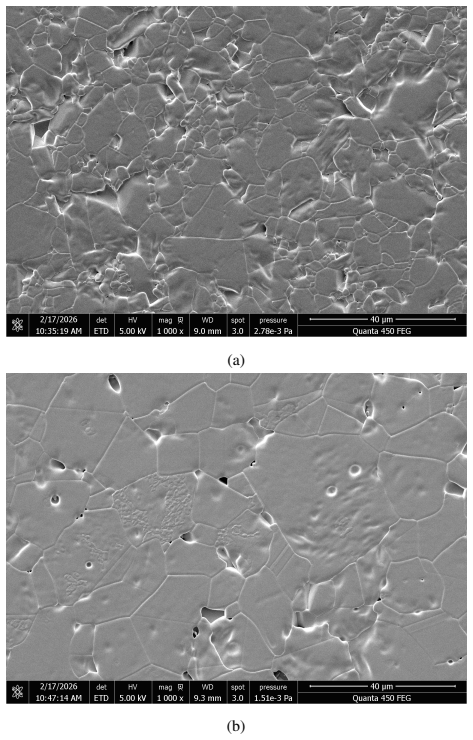
R. A. Depine, A. Lakhtakia, A new condition to identify isotropic dielectric- magnetic materials displaying negative phase velocity, Microwave and Opti- cal Technology Letters 41 (4) (2004) 315–316. 20 (a) (b) Figure 2: SEM microphotographies of TiO2 samples sintered (a) by spark plasma sintering (SPS) at 1100 °C and (b) by conventional sintering at 1550 ...
2004
discussion (0)
Sign in with ORCID, Apple, or X to comment. Anyone can read and Pith papers without signing in.