Single-dish HI Intensity Mapping with the SKAO: Precursor Progress with MeerKAT's Large Area Synoptic Survey (MeerKLASS)
Pith reviewed 2026-06-25 20:04 UTC · model grok-4.3
The pith
MeerKAT single-dish observations detect cosmological HI signals and validate the strategy for SKA-Mid.
A machine-rendered reading of the paper's core claim, the machinery that carries it, and where it could break.
Core claim
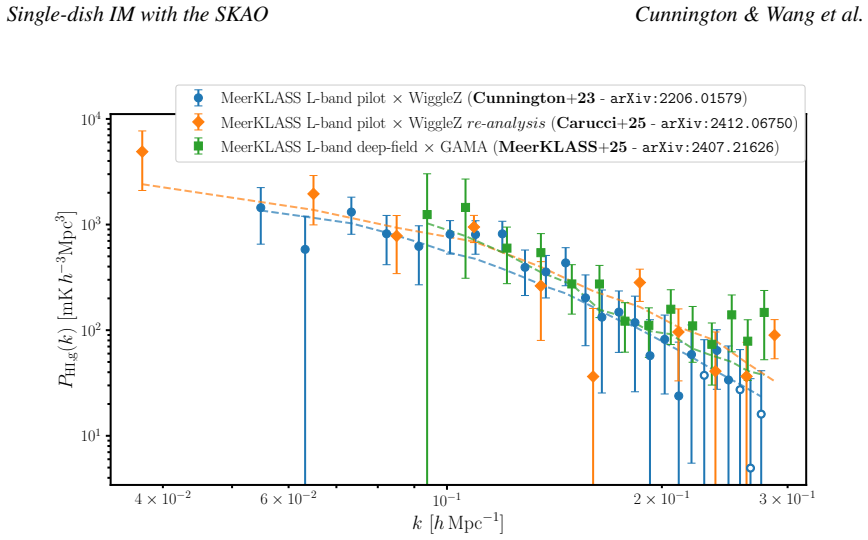
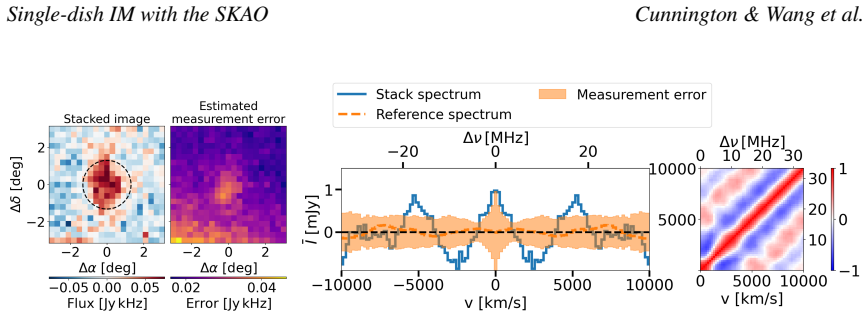
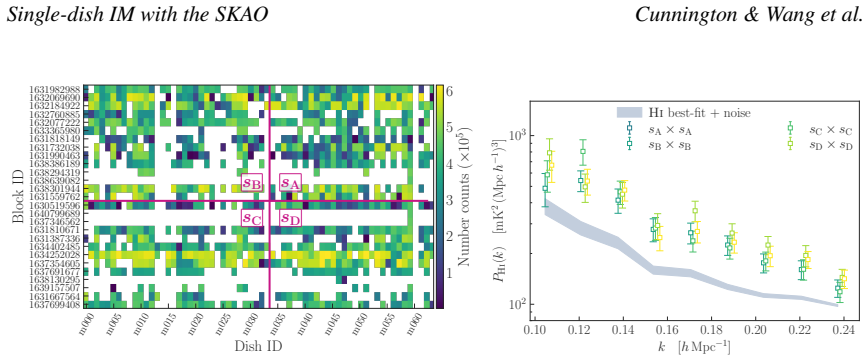
MeerKLASS has achieved multiple cosmological detections from single-dish HI intensity mapping, including high-significance cross-correlations with optical galaxy surveys and continually improving measurements of the HI auto-power spectrum. These results demonstrate that stable calibration, effective foreground mitigation, and statistical recovery of cosmological signal are all achievable with a large multi-dish telescope in total-power mode. The success of MeerKLASS therefore validates the observational strategies required for SKA-Mid and marks a key milestone in demonstrating the viability of single-dish HI intensity mapping for cosmology.
What carries the argument
Single-dish auto-correlation mode observations of the 21 cm line on a multi-dish array, enabling wide-sky total-power intensity mapping.
If this is right
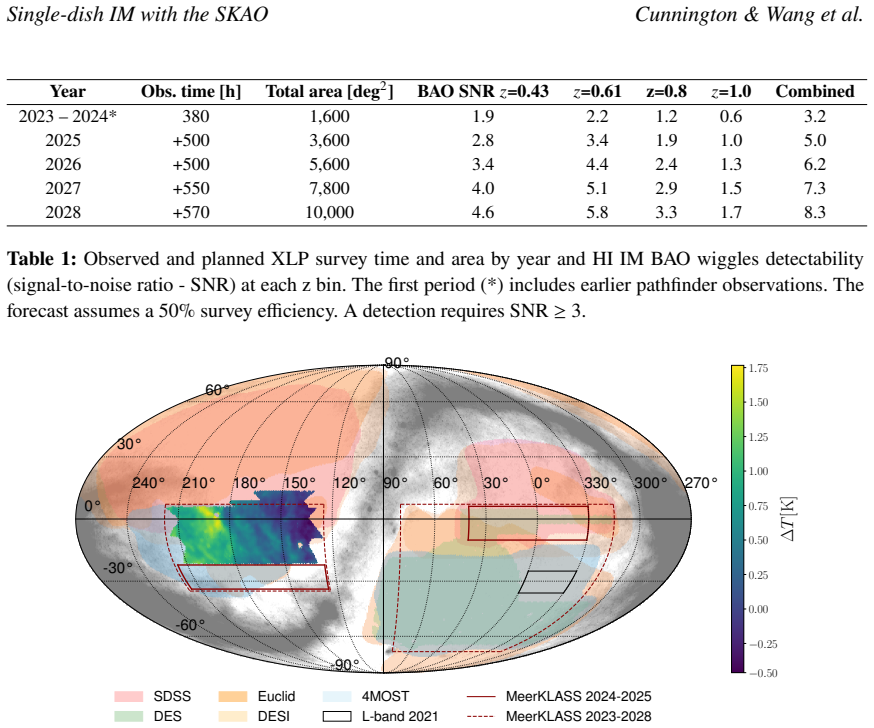
- SKA-Mid can apply the same single-dish methodology in Band 1 to reach redshifts up to z approximately 3.
- The approach will map cosmological volumes several orders of magnitude larger than those currently accessible.
- The refined techniques form the operational foundation for a large portion of the SKAO cosmology programme.
Where Pith is reading between the lines
- The single-dish route may prove complementary to interferometric surveys by more efficiently capturing the largest-scale modes needed for certain cosmological tests.
- Successful validation at MeerKAT wavelengths could accelerate planning for intensity-mapping campaigns on other existing or planned radio facilities.
- If foreground control continues to improve, the auto-power spectrum measurements alone may eventually yield competitive constraints on the HI bias and growth rate without requiring optical cross-matches.
Load-bearing premise
The reported cross-correlations and auto-power spectra arise from genuine cosmological HI rather than residual systematics or foreground leakage.
What would settle it
An independent re-analysis of the same MeerKAT data using an alternative foreground-cleaning pipeline that removes the reported cross-correlation signal at high significance.
Figures
read the original abstract
Using the SKAO to map the intensity of neutral hydrogen's 21cm emission line will be a golden opportunity to constrain models of cosmology. To access the largest cosmological scales, wide-sky surveys should ideally reach thousands of square degrees, requiring SKA-Mid's dishes to scan the sky in auto-correlation mode, so-called single-dish observations. In this chapter, we overview the latest results from MeerKAT's Large Area Synoptic Survey (MeerKLASS), which has been pioneering this single-dish observing strategy, and motivating its continuation with the SKA-Mid AA4 deployment. MeerKLASS, operating on the same Karoo site where the SKA-Mid is being built, has now achieved multiple cosmological detections from single-dish observations, including high-significance cross-correlations with optical galaxy surveys and continually improving measurements of the HI auto-power spectrum. These results demonstrate that stable calibration, effective foreground mitigation, and statistical recovery of cosmological signal are all achievable with a large multi-dish telescope in total-power mode. The success of MeerKLASS therefore validates the observational strategies required for SKA-Mid and marks a key milestone in demonstrating the viability of single-dish HI intensity mapping for cosmology. Looking ahead, SKA-Mid's increased sensitivity and Band 1 coverage (350-1050 MHz) will allow the same methodology to probe redshifts up to $z\,{\sim}\,3$, mapping volumes several orders of magnitude larger than currently accessible. The techniques refined with MeerKLASS thus form the operational and scientific foundation for a large portion of the SKAO's cosmology programme.
Editorial analysis
A structured set of objections, weighed in public.
Referee Report
Summary. The manuscript overviews results from MeerKAT's Large Area Synoptic Survey (MeerKLASS), reporting multiple cosmological detections via single-dish HI intensity mapping. These include high-significance cross-correlations with optical galaxy surveys and improving measurements of the HI auto-power spectrum. The central claim is that stable calibration, effective foreground mitigation, and statistical recovery of cosmological signal have been demonstrated, thereby validating observational strategies for SKA-Mid and establishing a foundation for its cosmology program up to z~3.
Significance. If the reported cross-correlations and auto-spectra are shown to be genuine cosmological HI signal, the work would represent a key empirical milestone for single-dish intensity mapping on a large multi-dish array. It would directly support the feasibility of wide-sky, total-power observations with SKA-Mid, enabling access to the largest cosmological scales in HI.
major comments (1)
- [Abstract] Abstract: The headline validation claim—that MeerKLASS 'validates the observational strategies required for SKA-Mid'—rests on the assertion of 'high-significance cross-correlations' and 'statistical recovery of cosmological signal.' However, the abstract supplies no quantitative significance levels, error bars, null-test results, simulation-based recovery fractions, or frequency-dependent leakage checks. This directly impacts the load-bearing assumption that the statistical signatures arise from genuine 21 cm signal rather than residual systematics or foreground leakage.
minor comments (1)
- [Abstract] The LaTeX rendering of redshift range (z\,{\sim}\,3) should be standardized for journal style.
Simulated Author's Rebuttal
We thank the referee for their detailed review and for highlighting the need for greater quantitative support in the abstract. We address the comment below and will make the requested revisions to strengthen the manuscript.
read point-by-point responses
-
Referee: [Abstract] Abstract: The headline validation claim—that MeerKLASS 'validates the observational strategies required for SKA-Mid'—rests on the assertion of 'high-significance cross-correlations' and 'statistical recovery of cosmological signal.' However, the abstract supplies no quantitative significance levels, error bars, null-test results, simulation-based recovery fractions, or frequency-dependent leakage checks. This directly impacts the load-bearing assumption that the statistical signatures arise from genuine 21 cm signal rather than residual systematics or foreground leakage.
Authors: We agree that the abstract would be strengthened by the inclusion of specific quantitative metrics. In the revised version we will update the abstract to report the measured significance levels of the cross-correlations (with associated error bars), reference the null-test results and simulation-based recovery fractions presented in the main body, and note the frequency-dependent leakage checks that have been performed. These additions will make the validation claim more self-contained while remaining within the abstract length constraints. revision: yes
Circularity Check
No significant circularity; results rest on external cross-correlations.
full rationale
The paper reports observational detections (cross-correlations with independent optical surveys and auto-power spectra) from MeerKLASS single-dish data. These measurements supply external grounding rather than internal fits or predictions. The validation claim for SKA-Mid follows directly from the reported statistical recovery and foreground mitigation, without any self-definitional loops, fitted inputs renamed as predictions, or load-bearing self-citations. No equations or derivation chains are present that reduce the central result to its own inputs by construction.
Axiom & Free-Parameter Ledger
Reference graph
Works this paper leans on
-
[1]
4MOSTCollaborationetal.TheMessenger,175:3–11,Mar.2019. doi:10.18727/0722-6691/5117. J.Akeretetal.AstronomyandComputing,18:8–17,Jan.2017. doi:10.1016/j.ascom.2016.11.001. M. Amiri et al.Astrophys. J. Supp., 261(2):29,
-
[2]
doi: 10.3847/1538-4365/ac6fd9. M. Amiri et al.Astrophys. J., 947(1):16,
-
[4]
doi: 10.3847/1538-4357/ad0f1d. M. Amiri et al.arXiv:, 11
-
[6]
Modelling MeerKAT L-band beams
doi: 10.1093/mnras/stab104. Astropy Collaboration et al.Astronomy & Astrophysics, 558:A33, Oct
-
[7]
doi: 10.1051/ 0004-6361/201322068. R.A.Battye,R.D.Davies,andJ.Weller.MNRAS,355:1339–1347,2004.doi:10.1111/j.1365-2966. 2004.08416.x. S. Bharadwaj, B. Nath, B. B. Nath, and S. K. Sethi.J. Astrophys. Astron., 22:21,
-
[8]
doi: 10.1007/BF02933588. C. Blake et al.Mon. Not. Roy. Astron. Soc., 406:803–821,
-
[10]
doi: 10.1103/PhysRevD.84.063505. A. Bracco, M. Padovani, and D. Galli.Astronomy & Astrophysics, 686:A52, June
-
[11]
doi: 10.1051/0004-6361/202449625. P. Bull, P. G. Ferreira, P. Patel, and M. G. Santos.Astrophys. J., 803(1):21,
-
[12]
doi: 10.1051/0004-6361/202453461. T.-C. Chang, U.-L. Pen, J. B. Peterson, and P. McDonald.Phys. Rev. Lett., 100:091303,
-
[13]
doi: 10.1103/PhysRevLett.100.091303. S. Chatterjee et al. InAdvancing Astrophysics with the SKA – II (AASKAII)
- [14]
-
[15]
CHIME Collaboration et al.APJ, 947(1):16, Apr
doi: 10.48550/arXiv.2504.03908. CHIME Collaboration et al.APJ, 947(1):16, Apr
-
[16]
doi: 10.3847/1538-4357/acb13f. S. Cunnington et al.MNRAS, 523(2):2453–2477, Aug
-
[17]
doi: 10.1093/mnras/stad1567. S. Cunnington et al.Mon. Not. Roy. Astron. Soc., 518(4):6262–6272,
-
[19]
doi: 10.1007/s10509-026-04547-7. N. Dalal, O. Dore, D. Huterer, and A. Shirokov.Phys. Rev. D, 77:123514,
-
[20]
D.I.L.deVilliers.IEEETransactionsonAntennasandPropagation,61(5):2457–2465,2013
doi: 10.1103/ PhysRevD.77.123514. D.I.L.deVilliers.IEEETransactionsonAntennasandPropagation,61(5):2457–2465,2013. doi: 10.1109/TAP.2013.2239953. DESI Collaboration et al. 10
-
[22]
doi: 10.1111/j.1365-2966.2010. 18188.x. S.P.Driveretal.Mon.Not.Roy.Astron.Soc.,513(1):439–467,2022. doi:10.1093/mnras/stac472. D. A. Dunne et al.APJ, 965(1):7, Apr
-
[23]
doi: 10.3847/1538-4357/ad2dfc. D. A. Dunne et al.arXiv e-prints, art. arXiv:2503.21743, Mar
-
[24]
doi: 10.48550/arXiv.2503. 21743. M. W. Eastwood et al.The Astronomical Journal, 156(1):32, July
-
[25]
doi: 10.3847/1538-3881/ aac721. D. J. Eisenstein and W. Hu.Astrophys. J., 496:605,
-
[26]
doi: 10.1086/305424. K. M. A. Elahi et al. InAdvancing Astrophysics with the SKA – II (AASKAII)
-
[28]
doi: 10.1088/0004-637X/734/1/5. J. Fonseca et al. InAdvancing Astrophysics with the SKA – II (AASKAII)
-
[29]
doi: 10.1016/j.physrep. 2006.08.002. A. E. Guzmán, J. May, H. Alvarez, and K. Maeda.Astronomy & Astrophysics, 525:A138, Jan
-
[30]
doi: 10.1051/0004-6361/200913628. C. G. T. Haslam, C. J. Salter, H. Stoffel, and W. E. Wilson.Astronomy & Astrophysicss, 47:1–143, Jan
-
[31]
W.Huetal.Mon.Not.Roy.Astron.Soc.,493(4):5854–5870,Apr.2020.doi:10.1093/mnras/staa650
doi: 10.1103/PhysRevD.76.083012. W.Huetal.Mon.Not.Roy.Astron.Soc.,493(4):5854–5870,Apr.2020.doi:10.1093/mnras/staa650. M. O. Irfan et al.MNRAS, 509(4):4923–4939, Feb
-
[32]
doi: 10.1093/mnras/stab3346. J.JonasandMeerKATTeam. InMeerKATScience:OnthePathwaytotheSKA,page1,Jan.2016. doi: 10.22323/1.277.0001. I. I. Khabibullin et al.MNRAS, 521(4):5536–5556, June
-
[33]
doi: 10.1093/mnras/stad818. E. D. Kovetz et al. 9
-
[34]
doi: 10.1088/0034-4885/79/4/046902. R. Lehmensiek and D. I. de Villiers. In2019 URSI Asia-Pacific Radio Science Conference (AP- RASC), pages 1–3,
-
[35]
doi: 10.23919/URSIAP-RASC.2019.8738133. Y. Li et al.Astrophys. J., 954(2):139,
-
[36]
doi: 10.3847/1538-4357/ace896. J. Liske et al.MNRAS, 452(2):2087–2126, Sept
-
[37]
MNRAS , year=2015, volume=452, pages=
doi: 10.1093/mnras/stv1436. A.LiuandJ.R.Shaw.Publ.Astron.Soc.Pac.,132(1012):062001,2020. doi:10.1088/1538-3873/ ab5bfd. LSST DESC et al. 9
-
[38]
doi: 10.2172/1471560. M. Lujan Niemeyer et al.APJl, 934(2):L26, Aug. 2022a. doi: 10.3847/2041-8213/ac82e5. M. Lujan Niemeyer et al.APJ, 929(1):90, Apr. 2022b. doi: 10.3847/1538-4357/ac5cb8. S. Manconi, A. Cuoco, and J. Lesgourgues.Physical Review Letters, 129(11):111103, Sept
-
[39]
doi: 10.1103/PhysRevLett.129.111103. S. Mangla et al. 12
-
[40]
P.McDonaldandU.Seljak.JCAP,2009(10):007,Oct.2009.doi:10.1088/1475-7516/2009/10/007
doi: 10.1088/2041-8205/763/1/L20. P.McDonaldandU.Seljak.JCAP,2009(10):007,Oct.2009.doi:10.1088/1475-7516/2009/10/007. 22 Single-dish IM with the SKAO Cunnington & Wang et al. MeerKLASS Collaboration et al.MNRAS, 537(4):3632–3661, Mar
-
[41]
C., Hoekstra, H., Joachimi, B., Johnston, H., Chisari, N
doi: 10.1093/mnras/ staf195. MeerKLASS Collaboration et al. in prep. T. J. Mozdzen et al.MNRAS, 483(4):4411–4423, Mar
-
[42]
doi: 10.1093/mnras/sty3410. S. K. Ocker, J. M. Cordes, S. Chatterjee, and M. R. Gorsuch.APJ, 934(1):71, July
-
[43]
A.R.Offringaetal.MNRAS,405(1):155–167,June2010
doi: 10.3847/1538-4357/ac75ba. A.R.Offringaetal.MNRAS,405(1):155–167,June2010. doi:10.1111/j.1365-2966.2010.16471.x. E. Orlando and A. Strong.MNRAS, 436(3):2127–2142, Dec
-
[44]
doi: 10.1093/mnras/stt1718. M. Padovani et al.arXiv e-prints, art. arXiv:2106.10929, June
-
[46]
ISSN 1432-0746. doi: 10.1051/ 0004-6361/201525967. URLhttp://dx.doi.org/10.1051/0004-6361/201525967. M. Santos et al. InAdvancing Astrophysics with the Square Kilometre Array (AASKA14), page 19, Apr
-
[47]
doi: 10.22323/1.215.0019. M. G. Santos et al. InMeerKAT Science: On the Pathway to the SKA, 9
-
[48]
doi: 10.1103/PhysRevD.70.083007. U. Seljak.Physical Review Letters, 102(2):021302, Jan
-
[49]
doi: 10.1103/PhysRevLett.102. 021302. F. Sinigaglia, E. Elson, G. Rodighiero, and M. Vaccari.MNRAS, 514(3):4205–4221, Aug
-
[50]
doi: 10.1093/mnras/stac1584. F. Sinigaglia et al.Astron. Astrophys., 704:A152,
-
[51]
SKAOCosmologySWGetal.Publ.Astron.Soc.Austral.,37:e007,2020
doi: 10.1051/0004-6361/202555928. SKAOCosmologySWGetal.Publ.Astron.Soc.Austral.,37:e007,2020. doi:10.1017/pasa.2019
-
[52]
D.TramonteandY.-Z.Ma.MNRAS,498(4):5916–5935,Nov.2020
doi: 10.1093/mnrasl/slt074. D.TramonteandY.-Z.Ma.MNRAS,498(4):5916–5935,Nov.2020. doi:10.1093/mnras/staa2727. D.Tramonte,Y.-Z.Ma,Y.-C.Li,andL.Staveley-Smith.MNRAS,489(1):385–400,Oct.2019. doi: 10.1093/mnras/stz2146. F. Villaescusa-Navarro et al.Astrophys. J., 866(2):135,
-
[53]
23 Single-dish IM with the SKAO Cunnington & Wang et al
doi: 10.3847/1538-4357/aadba0. 23 Single-dish IM with the SKAO Cunnington & Wang et al. J. Wang et al.MNRAS, 505(3):3698–3721, Aug
-
[54]
doi: 10.1093/mnras/stab1365. I. K. Wehus et al.Astronomy & Astrophysics, 597:A131, Jan
-
[55]
doi: 10.1051/0004-6361/ 201525659. M. White, Y.-S. Song, and W. J. Percival.MNRAS, 397(3):1348–1354, Aug
-
[56]
doi: 10.1111/j. 1365-2966.2008.14379.x. M. J. Wilensky, M. O. Irfan, and P. Bull.arXiv e-prints, art. arXiv:2409.06770, Sept
work page doi:10.1111/j 2008
-
[57]
doi: 10.48550/arXiv.2409.06770. T. L. Wilson, K. Rohlfs, and S. Hüttemeister.Tools of Radio Astronomy
-
[58]
doi: 10.1007/ 978-3-642-39950-3. L.Wolzetal. InAdvancingAstrophysicswiththeSKA–II(AASKAII).2026. arXivsearch:Report number AASKAII/Wolz01. L.Wolzetal.Mon.Not.Roy.Astron.Soc.,464(4):4938–4949,2017. doi:10.1093/mnras/stw2556. L.Wolzetal.Mon.Not.Roy.Astron.Soc.,510(3):3495–3511,2022. doi:10.1093/mnras/stab3621. S.Wyithe,A.Loeb,andP.Geil.MNRAS,383:1195,2008. ...
-
[59]
doi: 10.1007/978-3-642-32362-1_2. 24
discussion (0)
Sign in with ORCID, Apple, or X to comment. Anyone can read and Pith papers without signing in.