Epitaxial Strain Activates Altermagnetic Spin-Splitting Torques in RuO2(100)
Pith reviewed 2026-06-25 19:29 UTC · model grok-4.3
The pith
Epitaxial strain stabilizes altermagnetic spin splitting in RuO2 thin films, activating symmetry-selected spin torques that vanish in relaxed bulk-like films.
A machine-rendered reading of the paper's core claim, the machinery that carries it, and where it could break.
Core claim
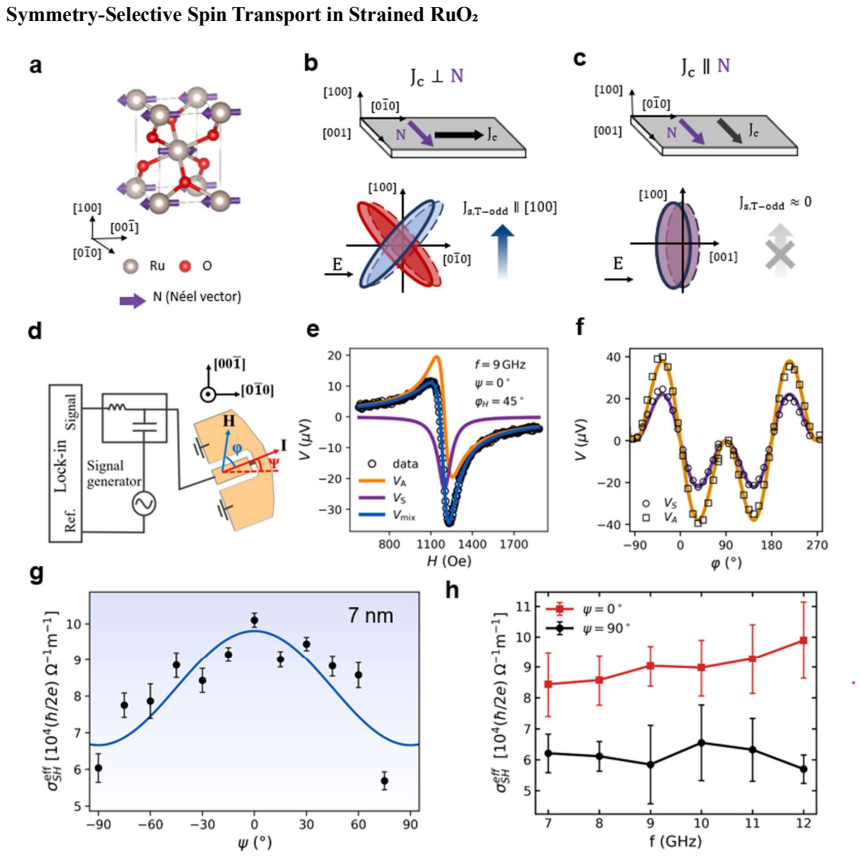
The authors establish that altermagnetic spin splitting in RuO2 is a strain-stabilized emergent state rather than an intrinsic bulk property. Angular-resolved spin-torque measurements reveal a symmetry-selected spin Hall response characteristic of altermagnetic spin splitting, strongest in the strained regime but progressively suppressed as the lattice relaxes toward the bulk limit. Complementary magnetic measurements show enhanced coercivity and exchange-bias behavior exclusively in strained films. First-principles calculations reproduce the strain-dependent evolution of the Neel order and spin-split electronic structure.
What carries the argument
strain-stabilized altermagnetic spin splitting, which generates a symmetry-selected spin Hall torque in the electronic structure
If this is right
- The spin-torque response is strongest under maximum epitaxial strain and is suppressed as films relax toward bulk lattice constants.
- Enhanced coercivity and exchange bias appear only in strained films and are absent in relaxed films.
- First-principles calculations tie the strain to changes in Neel order that produce the spin-split bands responsible for the torque.
- The strain dependence accounts for the difference between nearly nonmagnetic bulk observations and altermagnetic signatures in thin films.
Where Pith is reading between the lines
- Substrate choice could serve as a practical knob to switch altermagnetic torques on or off in RuO2-based devices.
- Similar strain activation may occur in other rutile-structure compounds that host debated altermagnetic states.
- Direct comparison of torque efficiency versus measured lattice parameter across a continuous strain series would provide a quantitative test of the activation threshold.
Load-bearing premise
The symmetry-dependent spin-torque and magnetic hysteresis signals arise specifically from altermagnetic spin splitting rather than from other strain-induced electronic or defect effects.
What would settle it
If angular-resolved photoemission on the same RuO2 films shows no spin-split bands with the predicted symmetry when strain is present, or if the spin-split bands persist unchanged after the lattice is fully relaxed, the strain-stabilized altermagnetism claim would be falsified.
Figures
read the original abstract
The altermagnetic nature of rutile RuO2 remains under active debate: bulk measurements indicate a nearly nonmagnetic ground state, whereas thin-film studies have reported symmetry-dependent transport signatures consistent with altermagnetism. Here, we provide experimental evidence that altermagnetic spin splitting in RuO2 is a strain-stabilized emergent state rather than an intrinsic bulk property. Angular-resolved spin-torque measurements reveal a symmetry-selected spin Hall response characteristic of altermagnetic spin splitting, which is strongest in the strained regime but progressively suppressed as the lattice relaxes toward the bulk limit. Complementary magnetic measurements further reveal enhanced coercivity and exchange-bias behavior exclusively in strained films, indicating the emergence of a strain-stabilized magnetic state. First-principles calculations reproduce the strain-dependent evolution of the Neel order and spin-split electronic structure, supporting the experimental observations. Together, these results establish altermagnetic spin splitting in RuO2 as a strain-stabilized emergent state and provide a unified explanation for the long-standing discrepancy between bulk and thin-film observations.
Editorial analysis
A structured set of objections, weighed in public.
Referee Report
Summary. The paper claims that altermagnetic spin splitting in RuO2 is a strain-stabilized emergent state rather than an intrinsic bulk property. Angular-resolved spin-torque measurements show a symmetry-selected spin Hall response strongest in strained epitaxial (100) films and progressively suppressed as the lattice relaxes toward bulk values. Complementary magnetic measurements indicate enhanced coercivity and exchange-bias exclusively in strained films. First-principles calculations reproduce the strain-dependent evolution of Néel order and spin-split electronic structure, providing a unified explanation for the discrepancy between bulk and thin-film observations.
Significance. If the altermagnetic assignment holds, the work resolves a long-standing debate by identifying epitaxial strain as the control parameter that activates the effect in thin films. The combination of angular-resolved transport, magnetic hysteresis data, and DFT calculations constitutes a coherent multi-probe approach; the explicit correlation between strain relaxation and suppression of the torque signal is a clear strength.
major comments (2)
- [Abstract and spin-torque section] Abstract and § on spin-torque measurements: the claim that the observed angular dependence is 'characteristic of altermagnetic spin splitting' and uniquely identifies it over strain-induced defects or interface reconstructions is load-bearing. The DFT results reproduce the assumed Néel order but do not provide quantitative bounds on the size of competing non-altermagnetic spin-orbit or orbital-Hall contributions expected in the same thin-film geometry.
- [Magnetic measurements section] Magnetic measurements section: enhanced coercivity and exchange-bias are reported only in strained films and linked to the emergence of a strain-stabilized magnetic state. Without explicit controls or error analysis that separate altermagnetic order from conventional defect- or interface-induced magnetism, this evidence does not independently secure the central interpretation.
minor comments (2)
- [Figures] Ensure all figures include quantitative error bars and direct overlays of the expected altermagnetic symmetry selection rules versus plausible defect models.
- [Notation] Standardize spelling of 'Néel' throughout the text and captions.
Simulated Author's Rebuttal
We thank the referee for the constructive feedback on our manuscript. The comments highlight important aspects of our interpretation that we address below with additional context from the data and calculations. We have revised the manuscript accordingly to strengthen the claims.
read point-by-point responses
-
Referee: [Abstract and spin-torque section] Abstract and § on spin-torque measurements: the claim that the observed angular dependence is 'characteristic of altermagnetic spin splitting' and uniquely identifies it over strain-induced defects or interface reconstructions is load-bearing. The DFT results reproduce the assumed Néel order but do not provide quantitative bounds on the size of competing non-altermagnetic spin-orbit or orbital-Hall contributions expected in the same thin-film geometry.
Authors: The angular dependence arises from the specific symmetry of the altermagnetic spin splitting under the (100) epitaxial constraint and the orientation of the Néel vector, which produces a torque response that matches the predicted selection rules and is absent in the relaxed bulk-like limit. This correlation with strain relaxation is difficult to reconcile with generic defect or interface effects. We agree that the manuscript would benefit from explicit discussion of competing contributions; the original DFT focused on reproducing the strain-dependent Néel order and spin splitting but did not include quantitative estimates of orbital-Hall or conventional spin-orbit terms. In revision we add a symmetry table and order-of-magnitude bounds drawn from literature values for RuO2, showing that such terms are expected to be substantially smaller and lack the observed angular selectivity. revision: partial
-
Referee: [Magnetic measurements section] Magnetic measurements section: enhanced coercivity and exchange-bias are reported only in strained films and linked to the emergence of a strain-stabilized magnetic state. Without explicit controls or error analysis that separate altermagnetic order from conventional defect- or interface-induced magnetism, this evidence does not independently secure the central interpretation.
Authors: The magnetic hysteresis data are presented as supporting, not standalone, evidence: the enhancements in coercivity and exchange bias appear exclusively in the strained regime and track the same strain dependence as the spin-torque signal. Multiple films with controlled relaxation serve as internal controls. We acknowledge that additional explicit error analysis and direct comparison to defect-induced magnetism would strengthen the section. The revised manuscript includes error bars on the magnetic parameters and a short discussion addressing possible conventional magnetic contributions while noting their incompatibility with the transport symmetry. revision: yes
Circularity Check
No significant circularity; experimental data and DFT are independent of the altermagnetic interpretation
full rationale
The paper's derivation rests on angular-resolved spin-torque measurements, magnetic hysteresis data, and first-principles calculations that model strain-dependent Néel order. These elements are presented as direct observations and standard DFT outputs rather than reductions to fitted parameters or self-citations. No self-definitional steps, fitted-input predictions, or load-bearing self-citation chains appear in the abstract or described claims. The symmetry-matching argument for altermagnetism is an interpretation of independent data, not a circular renaming or ansatz smuggling.
Axiom & Free-Parameter Ledger
axioms (1)
- domain assumption Symmetry-selected spin Hall response is a signature of altermagnetic spin splitting.
Reference graph
Works this paper leans on
-
[1]
& Sinova, J
Šmejkal, L., González-Hernández, R., Jungwirth, T. & Sinova, J. Crystal time-reversal symmetry breaking and spontaneous Hall effect in collinear antiferromagnets. Sci. Adv. 6, eaaz8809 (2020)
2020
-
[2]
Song, C. et al. Altermagnets as a new class of functional materials. Nat. Rev. Mater. 10, 473– 485 (2025)
2025
-
[3]
P., Brahimi, S
Tamang, R., Gurung, S., Rai, D. P., Brahimi, S. & Lounis, S. Altermagnetism and Altermagnets: A Brief Review. Magnetism 5, 17 (2025)
2025
-
[4]
& Jungwirth, T
Šmejkal, L., Sinova, J. & Jungwirth, T. Emerging Research Landscape of Altermagnetism. Phys. Rev. X 12, 040501 (2022)
2022
-
[5]
& Jungwirth, T
Šmejkal, L., Sinova, J. & Jungwirth, T. Beyond Conventional Ferromagnetism and Antiferromagnetism: A Phase with Nonrelativistic Spin and Crystal Rotation Symmetry. Phys. Rev. X 12, 031042 (2022)
2022
-
[6]
Bai, H. et al. Antiferromagnetism: An efficient and controllable spin source. Appl. Phys. Rev. 9, 041316 (2022)
2022
-
[7]
Dai, J. et al. Research progress and future prospects of altermagnets. Sci. Sin. Phys. Mech. Astron. 56, 227503 (2025)
2025
-
[8]
Berlijn, T. et al. Itinerant Antiferromagnetism in ${\mathrm{RuO}}_{2}$. Phys. Rev. Lett. 118, 077201 (2017)
2017
-
[9]
& Kuneš, J
Ahn, K.-H., Hariki, A., Lee, K.-W. & Kuneš, J. Antiferromagnetism in ${\mathrm{RuO}}_{2}$ as $d$-wave Pomeranchuk instability. Phys. Rev. B 99, 184432 (2019)
2019
-
[10]
Zhu, Z. H. et al. Anomalous Antiferromagnetism in Metallic ${\mathrm{RuO}}_{2}$ Determined by Resonant X-ray Scattering. Phys. Rev. Lett. 122, 017202 (2019)
2019
-
[11]
Keßler, P. et al. Absence of magnetic order in RuO2: insights from μSR spectroscopy and neutron diffraction. Npj Spintron. 2, 50 (2024)
2024
-
[12]
Hiraishi, M. et al. Nonmagnetic Ground State in ${\mathrm{RuO}}_{2}$ Revealed by Muon Spin Rotation. Phys. Rev. Lett. 132, 166702 (2024)
2024
-
[13]
Yumnam, G. et al. Constraints on magnetism and correlations in RuO2 from lattice dynamics and Mössbauer spectroscopy. Cell Rep. Phys. Sci. 6, 102852 (2025)
2025
-
[14]
Qian, T. et al. Determining the nature of magnetism in altermagnetic candidate ${\mathrm{RuO}}_{2}$. Phys. Rev. Res. 8, L012072 (2026)
2026
-
[15]
Wu, Z. et al. Fermi Surface of ${\mathrm{RuO}}_{2}$ Measured by Quantum Oscillations. Phys. Rev. X 15, 031044 (2025)
2025
-
[16]
Liu, J. et al. Absence of Altermagnetic Spin Splitting Character in Rutile Oxide ${\mathrm{RuO}}_{2}$. Phys. Rev. Lett. 133, 176401 (2024)
2024
-
[17]
Lin, Z. et al. Bulk band structure of Ru O 2 measured with soft x-ray angle-resolved photoemission spectroscopy. Phys. Rev. B 111, 134450 (2025)
2025
-
[18]
Osumi, T. et al. Spin-degenerate bulk bands and topological surface states associated with Dirac nodal lines in ${\mathrm{RuO}}_{2}$. Phys. Rev. B 113, 085116 (2026)
2026
-
[19]
Bose, A. et al. Tilted spin current generated by the collinear antiferromagnet ruthenium dioxide. Nat. Electron. 5, 267–274 (2022)
2022
-
[20]
Bai, H. et al. Observation of Spin Splitting Torque in a Collinear Antiferromagnet ${\mathrm{RuO}}_{2}$. Phys. Rev. Lett. 128, 197202 (2022)
2022
-
[21]
Feng, Z. et al. An anomalous Hall effect in altermagnetic ruthenium dioxide. Nat. Electron. 5, 735–743 (2022)
2022
-
[22]
Tschirner, T. et al. Saturation of the anomalous Hall effect at high magnetic fields in altermagnetic RuO2. APL Mater. 11, 101103 (2023)
2023
-
[23]
Guo, Y. et al. Direct and Inverse Spin Splitting Effects in Altermagnetic RuO2. Adv. Sci. 11, 2400967 (2024)
2024
-
[24]
Karube, S. et al. Observation of Spin-Splitter Torque in Collinear Antiferromagnetic ${\mathrm{RuO}}_{2}$. Phys. Rev. Lett. 129, 137201 (2022)
2022
-
[25]
Jung, H. et al. Reversible Spin Splitting Effect in Altermagnetic RuO2 Thin Films. Nano Lett. 25, 16985–16991 (2025)
2025
-
[26]
Chen, H. et al. Spin-Splitting Magnetoresistance in Altermagnetic RuO2 Thin Films. Adv. Mater. 37, 2507764 (2025)
2025
-
[27]
Zhang, Y. et al. Electrical manipulation of spin splitting torque in altermagnetic RuO2. Nat. Commun. 16, 5646 (2025)
2025
-
[28]
Jia, Q. et al. Correction of out-of-plane spin torque extracted from second harmonic Hall measurements: Role of antisymmetric planar Hall effects. Phys. Rev. B 112, 174409 (2025)
2025
-
[29]
Wu, Y. et al. Field-free spin–orbit switching of canted magnetization in Pt/Co/Ru/RuO2(101) multilayers. Appl. Phys. Lett. 126, 012401 (2025)
2025
-
[30]
Feng, X. et al. Incommensurate Spin Density Wave in Antiferromagnetic ${\mathrm{RuO}}_{2}$ Evinced by Abnormal Spin Splitting Torque. Phys. Rev. Lett. 132, 086701 (2024)
2024
-
[31]
Bai, H. et al. Efficient Spin-to-Charge Conversion via Altermagnetic Spin Splitting Effect in Antiferromagnet ${\mathrm{RuO}}_{2}$. Phys. Rev. Lett. 130, 216701 (2023)
2023
-
[32]
Liu, Y. et al. Inverse Altermagnetic Spin Splitting Effect-Induced Terahertz Emission in RuO2. Adv. Opt. Mater. 11, 2300177 (2023)
2023
-
[33]
Chu, R. Y. et al. Third-Order Nonlinear Hall Effect in Altermagnet ${\mathrm{RuO}}_{2}$. Phys. Rev. Lett. 135, 216703 (2025)
2025
-
[34]
Zhang, Y. et al. Simultaneous High Charge-Spin Conversion Efficiency and Large Spin Diffusion Length in Altermagnetic RuO2. Adv. Funct. Mater. 34, 2313332 (2024)
2024
-
[35]
Dai, J. et al. Thermal imaging of 180o domain contrast in altermagnetic RuO2. Natl. Sci. Rev. nwag203 (2026) doi:10.1093/nsr/nwag203
-
[36]
Zhou, X. et al. Crystal Thermal Transport in Altermagnetic ${\mathrm{RuO}}_{2}$. Phys. Rev. Lett. 132, 056701 (2024)
2024
-
[37]
Liao, C.-T., Wang, Y.-C., Tien, Y.-C., Huang, S.-Y. & Qu, D. Separation of Inverse Altermagnetic Spin-Splitting Effect from Inverse Spin Hall Effect in ${\mathrm{RuO}}_{2}$. Phys. Rev. Lett. 133, 056701 (2024)
2024
-
[38]
He, C. et al. Evidence for single variant in altermagnetic RuO2(101) thin films. Nat. Commun. 16, 8235 (2025)
2025
-
[39]
Jeong, S. G. et al. Altermagnetic polar metallic phase in ultrathin epitaxially strained RuO2 films. Proc. Natl. Acad. Sci. 123, e2526641123 (2026)
2026
-
[40]
Zhang, Y.-C. et al. Probing the Néel Order in Altermagnetic RuO2 Films via X-Ray Magnetic Linear Dichroism. Chin. Phys. Lett. 42, 027301 (2025)
2025
-
[41]
Fedchenko, O. et al. Observation of time-reversal symmetry breaking in the band structure of altermagnetic RuO2. Sci. Adv. 10, eadj4883 (2024)
2024
-
[42]
I., Garcia-Gassull, L
Smolyanyuk, A., Mazin, I. I., Garcia-Gassull, L. & Valentí, R. Fragility of the magnetic order in the prototypical altermagnet ${\mathrm{RuO}}_{2}$. Phys. Rev. B 109, 134424 (2024)
2024
-
[43]
Forte, J. D. S. et al. Strain Engineering of Altermagnetic Symmetry in Epitaxial RuO$_2$ Films. Preprint at https://doi.org/10.48550/arXiv.2510.26581 (2026)
work page internal anchor Pith review Pith/arXiv arXiv doi:10.48550/arxiv.2510.26581 2026
-
[44]
Qian, Z., Yang, Y., Liu, S. & Wu, C. Fragile unconventional magnetism in ${\mathrm{RuO}}_{2}$ by proximity to Landau-Pomeranchuk instability. Phys. Rev. B 111, 174425 (2025)
2025
-
[45]
Lee, S., Jeong, S. G., Wang, J.-P., Jalan, B. & Low, T. Strain-Driven Altermagnetic Spin- Splitting Effect in RuO2. Nano Lett. https://doi.org/10.1021/acs.nanolett.6c00768 (2026) doi:10.1021/acs.nanolett.6c00768
-
[46]
Wang, Y.-C. et al. Absence of Transport Altermagnetic Spin-Splitting Effect in RuO2. Nano Lett. 26, 2548–2554 (2026)
2026
-
[47]
Qiao, J. et al. Enhanced Damping-Like Torque through Strain Modulation in RuO2. Nano Lett. 26, 5873–5881 (2026)
2026
-
[48]
Yang, D. et al. Ferromagnetic Interface Engineering of Spin-Charge Conversion in ${\mathrm{RuO}}_{2}$. Phys. Rev. Lett. 136, 026702 (2026)
2026
-
[49]
Akashdeep, A. et al. Surface-localized magnetic order in RuO2 thin films revealed by low- energy muon probes. Appl. Phys. Lett. 128, 022406 (2026)
2026
-
[50]
Wadehra, N. et al. Strain-induced superconductivity in RuO2(100) thin-films. Commun. Mater. 6, 135 (2025)
2025
-
[51]
Wu, Y. et al. Perpendicular magnetic anisotropy in permalloy ultrathin film grown on RuO2(101) surface. Appl. Phys. Lett. 124, 162402 (2024)
2024
-
[52]
& Schuller, I
Nogués, J. & Schuller, I. K. Exchange bias. J. Magn. Magn. Mater. 192, 203–232 (1999). ACKNOWLEDGMENTS This work was supported partially by the National Science Foundation (NSF) through the University of Minnesota MRSEC under Award No. DMR-2011401. This project was also supported in part by NSF ASCENT program TUNA: No. 2230963. Parts of this work were car...
1999
discussion (0)
Sign in with ORCID, Apple, or X to comment. Anyone can read and Pith papers without signing in.