Paleomagnetic signatures of core-mantle interactions inferred from top-heavy thermochemical geodynamo simulations
Pith reviewed 2026-06-25 19:05 UTC · model grok-4.3
The pith
Simulations with heterogeneous outer boundary heat flux match observed longitudinal variations in geomagnetic inclination anomaly, unlike homogeneous cases.
A machine-rendered reading of the paper's core claim, the machinery that carries it, and where it could break.
Core claim
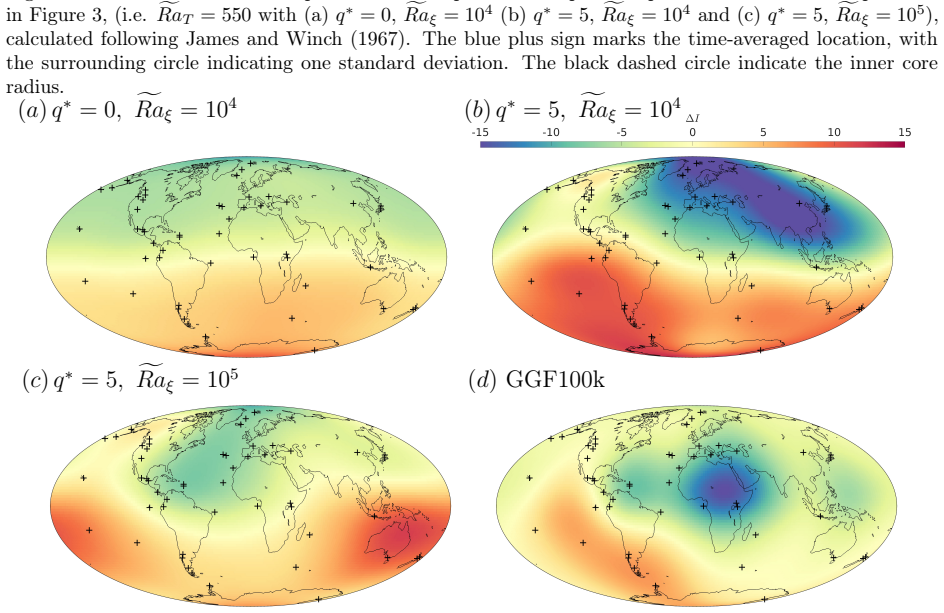
Top-heavy geodynamo simulations that include heterogeneous outer boundary thermal forcing produce longitudinal variations in the time-averaged inclination anomaly that match observational constraints from paleomagnetic records, whereas simulations with homogeneous mantle heat flux do not. Increasing chemical driving reduces these longitudinal structures without erasing them and promotes deeper polar minima in the radial magnetic field. The results imply that Earth's outer core experiences both strong heat flux heterogeneity at the core-mantle boundary and significant chemical driving, resulting in small but persistent departures from the geocentric axial dipole approximation.
What carries the argument
Top-heavy thermochemical geodynamo simulations with variable chemical driving strength and heterogeneous outer boundary heat flux, which separate equatorial thermal effects from polar chemical effects.
Load-bearing premise
The top-heavy thermochemical geodynamo model with the chosen ranges of chemical driving strength and boundary heat flux heterogeneity accurately represents the dominant buoyancy sources and boundary conditions in Earth's outer core.
What would settle it
A paleomagnetic compilation covering multiple intervals that shows no longitudinal variations in time-averaged inclination anomaly, even though independent evidence indicates heterogeneous mantle heat flux, would falsify the reported match.
Figures
read the original abstract
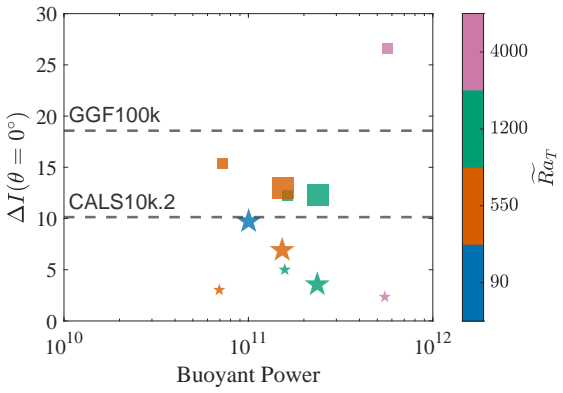
The time-averaged geomagnetic field provides crucial insights into deep Earth dynamics and thermal core-mantle interactions. Paleomagnetic observations and numerical dynamo simulations are equivocal regarding the longitudinal structure of the time-averaged field, though the latter have often considered a generic buoyancy source, which may obscure distinct signatures of thermal and chemical buoyancy that arise near the equator and poles, respectively. In this study, we present a new suite of top-heavy geodynamo simulations, varying the relative strengths of thermal and chemical driving and comparing the resultant magnetic signatures to observational field models spanning centuries to tens of thousands of years. None of the spatially-averaged measures of field morphology and variability we tested could robustly distinguish between different levels of chemical driving or the presence of heterogeneous outer boundary heat flux. On the other hand, observational constraints requiring longitudinal variations in time-averaged inclination anomaly are readily matched by simulations with heterogeneous outer boundary thermal forcing, in contrast to those with homogeneous mantle heat flux. Longitudinal field structures are reduced, but not erased, by elevated chemical driving, which also promotes the formation and deepening of polar minima in the radial magnetic field. Our simulations indicate that both the strong heat flux heterogeneity and chemical driving in Earth's core are likely to result in small but persistent departures from the geocentric axial dipole approximation.
Editorial analysis
A structured set of objections, weighed in public.
Referee Report
Summary. The paper presents a suite of top-heavy thermochemical geodynamo simulations that vary the relative strength of chemical versus thermal buoyancy while imposing either homogeneous or heterogeneous outer-boundary heat flux. Spatially averaged field morphology metrics fail to distinguish the cases, but simulations with heterogeneous boundary forcing reproduce the longitudinal variations in time-averaged inclination anomaly required by paleomagnetic field models spanning centuries to tens of kyr; elevated chemical driving reduces but does not eliminate these structures and deepens polar radial-field minima. The authors conclude that both strong mantle heat-flux heterogeneity and chemical driving are likely present in Earth’s core.
Significance. If the chosen buoyancy partitioning and boundary implementation are representative of the outer core, the work supplies a concrete mechanistic link between core-mantle thermal interactions and a specific, observationally testable paleomagnetic signature, moving beyond generic buoyancy assumptions common in earlier dynamo studies.
major comments (2)
- [Methods / Simulation Setup] The central claim—that heterogeneous outer-boundary heat flux produces longitudinal inclination-anomaly variations matching observations while homogeneous flux does not—rests on the fidelity of the selected ranges of chemical Rayleigh number, thermal driving strength, and imposed heat-flux heterogeneity. No quantitative justification for these ranges, no resolution or benchmark tests, and no sensitivity sweeps demonstrating that the heterogeneous-versus-homogeneous distinction survives changes in buoyancy partitioning are provided.
- [Results / Comparison to Observations] The abstract states that observational constraints on longitudinal inclination-anomaly variations are 'readily matched' by the heterogeneous cases. Without explicit description of how the time-averaged inclination anomaly is extracted from the simulations, which paleomagnetic field models are used, data exclusion criteria, or error quantification in the comparison, it is impossible to judge whether the reported match is robust or an artifact of post-processing choices.
minor comments (2)
- Notation for the relative chemical driving strength should be defined once in the text and used consistently; the abstract introduces the concept without a symbol or equation reference.
- Figure captions should state the exact time-averaging interval and number of realizations used for each reported field morphology metric.
Simulated Author's Rebuttal
We thank the referee for their constructive comments, which help clarify the presentation of our results. We respond to each major comment below.
read point-by-point responses
-
Referee: [Methods / Simulation Setup] The central claim—that heterogeneous outer-boundary heat flux produces longitudinal inclination-anomaly variations matching observations while homogeneous flux does not—rests on the fidelity of the selected ranges of chemical Rayleigh number, thermal driving strength, and imposed heat-flux heterogeneity. No quantitative justification for these ranges, no resolution or benchmark tests, and no sensitivity sweeps demonstrating that the heterogeneous-versus-homogeneous distinction survives changes in buoyancy partitioning are provided.
Authors: We agree that the manuscript would be strengthened by explicit justification and additional tests. The chosen ranges are motivated by estimates of chemical versus thermal buoyancy in Earth's core from prior literature, but we will add a new subsection in Methods providing quantitative rationale with references, along with resolution and benchmark tests. We will also include a sensitivity analysis (based on additional runs) showing the heterogeneous-versus-homogeneous distinction in longitudinal inclination anomalies persists across variations in buoyancy partitioning. These will be incorporated in the revised version. revision: yes
-
Referee: [Results / Comparison to Observations] The abstract states that observational constraints on longitudinal inclination-anomaly variations are 'readily matched' by the heterogeneous cases. Without explicit description of how the time-averaged inclination anomaly is extracted from the simulations, which paleomagnetic field models are used, data exclusion criteria, or error quantification in the comparison, it is impossible to judge whether the reported match is robust or an artifact of post-processing choices.
Authors: We acknowledge that the comparison procedure requires more detail for reproducibility. In the revised manuscript we will expand the relevant Results subsection to describe exactly how the time-averaged inclination anomaly is extracted (including averaging intervals and spatial binning), name the specific paleomagnetic field models used, state any exclusion criteria, and report quantitative metrics such as RMS misfit and correlation coefficients between simulated and observed longitudinal variations. This will permit direct evaluation of the robustness of the match. revision: yes
Circularity Check
No circularity: forward simulations compared to independent paleomagnetic observations
full rationale
The paper runs suites of top-heavy thermochemical geodynamo simulations, varying chemical Rayleigh number, thermal driving strength, and outer-boundary heat-flux heterogeneity, then directly compares the resulting time-averaged field morphologies (inclination anomaly, radial field minima, etc.) against external paleomagnetic field models that span centuries to tens of thousands of years. No quantity reported as a “prediction” or “signature” is obtained by fitting parameters to those same observational data sets; the simulations are forward integrations whose outputs are contrasted with independent data. No self-citation chain, uniqueness theorem, or ansatz imported from prior author work is invoked to justify the central distinction between heterogeneous and homogeneous cases. The derivation therefore consists of numerical modeling followed by external comparison and contains no reduction of outputs to inputs by construction.
Axiom & Free-Parameter Ledger
free parameters (2)
- relative strength of chemical driving
- parameters controlling heterogeneous outer boundary heat flux
axioms (2)
- standard math The Boussinesq approximation and standard MHD equations govern core fluid dynamics
- domain assumption Top-heavy buoyancy distribution is an appropriate idealization for Earth's outer core
Reference graph
Works this paper leans on
-
[1]
Amit, H., Deschamps, F., Choblet, G., 2015b
doi:10.1186/S40645-015-0056-3. Amit, H., Deschamps, F., Choblet, G., 2015b. Numerical dynamos with outer boundary heat flux inferred from probabilistic tomography—consequences for latitudinal distribution of magnetic flux. Geophys. J. Int. 203, 840–855. doi:10.1093/gji/ggv332. Aubert, J.,
-
[2]
Approaching earth’s core conditions in high-resolution geodynamo simulations. Geophys. J. Int. 219, S137–S151. doi:10.1093/gji/ggz232. Aubert, J., Gastine, T., Fournier, A.,
-
[3]
Spherical convective dynamos in the rapidly rotating asymptotic regime. J. Fluid Mech. 813, 558–593. doi:10.1017/jfm.2016.789. Aurnou, J., King, E.,
-
[4]
The cross-over to magnetostrophic convection in planetary dynamo systems. Proc. R. Soc. Lond. A Math Phys. Sci. 473, 20160731. doi:10.1098/rspa.2016.0731. Biggin, A.J., Davies, C.J., Mound, J.E., Lloyd, S.J., Engbers, Y.E., Thallner, D., Clarke, A.T., Bono, R.K.,
-
[5]
The effect of thermal core–mantle interactions on the palaeomagnetic secular variation. Philosophical Transactions of the Royal Society A: Mathematical, Physical and Engineering Sciences 358, 1171–1179. doi:10.1098/rsta.2000.0579. Bouffard, M., Choblet, G., Labrosse, S., Wicht, J.,
-
[6]
doi:10.3389/feart.2019.00099. Buffett, B.A., Seagle, C.T.,
- [7]
-
[8]
Quasi-geostrophic dynamo theory. Phys. Earth Planet. Inter. 276, 182–189. doi:10. 1016/j.pepi.2017.05.001. Calkins, M.A., Orvedahl, R.J., Featherstone, N.A.,
2017
-
[9]
Large-scale balances and asymptotic scaling behaviour in spherical dynamos. Geophys. J. Int. 227, 1228–1245. doi:10.1093/gji/ggab274. Cao, H., Yadav, R.K., Aurnou, J.M.,
-
[10]
Geomagnetic polar minima do not arise from steady meridional circulation. Proc. Natl. Acad. Sci. USA 115, 11186–11191. doi:10.1073/pnas.1717454115. Christensen, U., Aubert, J., Hulot, G.,
-
[11]
Conditions for earth-like geodynamo models. Earth. Planet. Sci. Lett. 296, 487–496. doi:10.1016/j.epsl.2010.06.009. Christensen, U., Olson, P.,
-
[12]
Secular variation in numerical geodynamo models with lateral variations of boundary heat flow. Phys. Earth Planet. Inter. 138, 39–54. doi:10.1016/S0031-9201(03)00064-5. Christensen, U.R., Wardinski, I., Lesur, V.,
-
[13]
Timescales of geomagnetic secular acceleration in satellite field models and geodynamo models. Geophys. J. Int. 190, 243–254. doi:10.1111/j.1365-246X.2012. 05508.x. Clarke, A.T., Davies, C.J., Mason, S.J., Naskar, S.,
-
[14]
Accessing the dipole-multipole transition in rapidly rotating spherical shell dynamos. Geophys. J. Int. , ggag092doi:10.1093/gji/ggag092. Constable, C., Korte, M., Panovska, S.,
-
[15]
Persistent high paleosecular variation activity in southern hemisphere for at least 10000 years. Earth Planet. Sci. Lett. 453, 78–86. doi:10.1016/j.epsl.2016.08
-
[16]
Psv10: A global data set for 0–10 ma time-averaged field and paleosecular variation studies. Geochemistry, Geophys. Geosystems 19, 1533–1558. doi:10.1002/2017GC007318. Dannberg, J., Gassmoeller, R., Thallner, D., LaCombe, F., Sprain, C.,
-
[17]
Changes in core–mantle boundary heat flux patterns throughout the supercontinent cycle. Geophys. J. Int. 237, 1251–1274. doi:10.1093/gji/ggae075. Davidson, P.A.,
-
[19]
Constraints from material properties on the dynamics and evolution of earth’s core. Nat. Geosci. 8, 678–685. doi:10.1038/ngeo2492. Davies, C.J., Constable, C.G.,
-
[20]
Insights from geodynamo simulations into long-term geomagnetic field behaviour. Earth Planet. Sci. Lett. 404, 238–249. doi:10.1016/j.epsl.2014.07.042. Davies, C.J., Greenwood, S.,
-
[21]
A buoyancy profile for the Earth’s core. Geophys. J. Int. 187, 549–563. doi:10.1111/j.1365-246X.2011.05144.x. Davies, C.J., Gubbins, D., Jimack, P.K.,
-
[22]
Scalability of pseudospectral methods for geodynamo simu- lations. Concurr. Comput. Pract. Exp. 23, 38–56. doi:10.1002/cpe.1593. Davies, C.J., Gubbins, D., Willis, A.P., Jimack, P.K.,
-
[23]
Time-averaged paleomagnetic field and secular variation: Predictions from dynamo solutions based on lower mantle seismic tomography. Phys. Earth Planet. Inter. 169, 194–203. doi:10.1016/j.pepi.2008.07.021. palaeomagnetism and the Earth’s Deep Interior. Deschamps, F., Guerrero, J.M., Amit, H., Terra-Nova, F., Hsieh, W.P.,
-
[24]
Nat.Geosci.doi:10.1038/s41561-026-02018-w
Negative core–mantle bound- aryheatfluxbeneathlow-shear-wave-velocityprovinces. Nat.Geosci.doi:10.1038/s41561-026-02018-w. Fan, W., Lin, Y.,
-
[25]
Journal of Geophysical Research: Planets 130, e2025JE008969
Dynamos driven by top-heavy double-diffusive convection in the strong-field regime. Journal of Geophysical Research: Planets 130, e2025JE008969. doi:10.1029/2025JE008969. e2025JE008969 2025JE008969. Frasson, T., Schaeffer, N., Nataf, H.C., Labrosse, S.,
-
[26]
Geomagnetic dipole stability and zonal flows controlled by mantle heat flux heterogeneities. Geophys. J. Int. 240, 1481–1504. doi:10.1093/gji/ ggae457. Gubbins, D.,
-
[27]
American Geophysical Union (AGU)
Thermal Core-Mantle Interactions: Theory and Observations. American Geophysical Union (AGU). pp. 163–179. doi:10.1029/GD031p0163. Gubbins, D.,
-
[28]
Earth, Planets and Space 59, 661–664
Geomagnetic constraints on stratification at the top of earth’s core. Earth, Planets and Space 59, 661–664. doi:10.1186/BF03352728. Gubbins, D., Willis, A.P., Sreenivasan, B.,
-
[29]
Correlation of earth’s magnetic field with lower mantle thermal and seismic structure. Phys. Earth Planet. Inter. 162, 256–260. doi:10.1016/j.pepi.2007.04
-
[30]
Mapping geomagnetic secular variation at the core–mantle boundary. Geophys. J. Int. 186, 521–528. doi:10.1111/j.1365-246X.2011.05066.x. Jackson, A., Jonkers, A.R.T., Walker, M.R.,
-
[31]
Four centuries of geomagnetic secular variation from historical records. Philosophical Transactions of the Royal Society A: Mathematical, Physical and Engi- neering Sciences 358, 957–990. doi:10.1098/rsta.2000.0569. James, R.W., Winch, D.E.,
-
[32]
Physics of the Earth and Planetary Interiors 128, 13–24
Definition of the Rayleigh number for geodynamo simulation. Physics of the Earth and Planetary Interiors 128, 13–24. doi:10.1016/S0031-9201(01)00274-6. Korte, M., Constable, C.G., Davies, C.J., Panovska, S.,
-
[33]
doi:10.3389/feart. 2022.957815. Kutzner, C., Christensen, U.R.,
-
[34]
From stable dipolar towards reversing numerical dynamos. Phys. 33 Earth Planet. Inter. 131, 29–45. doi:10.1016/S0031-9201(02)00016-X. Kutzner, C., Christensen, U.R.,
-
[35]
Simulated geomagnetic reversals and preferred virtual geomagnetic pole paths. Geophys. J. Int. 157, 1105–1118. doi:10.1111/j.1365-246X.2004.02309.x. Labrosse, S.,
-
[36]
Thermal evolution of the core with a high thermal conductivity. Phys. Earth Planet. Inter. 247, 36–55. doi:10.1016/j.pepi.2015.02.002. Laj, C., Kissel, C., Davies, C., Gubbins, D.,
-
[37]
Geomagnetic field intensity and inclination records from hawaii and the réunion island: Geomagnetic implications. Phys. Earth Planet. Inter. 187, 170–187. doi:10.1016/j.pepi.2011.05.007. special Issue: Planetary Magnetism, Dynamo and Dynamics. Landeau, M., Aubert, J., Olson, P.,
-
[38]
The signature of inner-core nucleation on the geodynamo. Earth Planet. Sci. Lett. 465, 193–204. doi:10.1016/j.epsl.2017.02.004. Lhuillier, F., Fournier, A., Hulot, G., Aubert, J.,
- [39]
-
[40]
Spatial power spectrum of the main geomagnetic field, and extrapolation to the core. Geophys. J. Int. 36, 717–730. doi:10.1111/j.1365-246X.1974.tb00622.x. Lézin, M., Amit, H., Terra-Nova, F., Wardinski, I.,
-
[41]
Mantle-driven north–south dichotomy in geomag- netic polar minima. Phys. Earth Planet. Inter. 337, 107000. doi:10.1016/j.pepi.2023.107000. Mason, S.J., Davies, C.J., Clarke, A.T., Constable, C.G.,
-
[42]
Insights into the last 100 ky of geomagnetic field variability using numerical dynamo simulations. Earth Planet. Sci. Lett. 646, 119011. doi:10.1016/ j.epsl.2024.119011. Masters, T.G., Johnson, S., Laske, G., Bolton, H.,
arXiv 2024
-
[43]
A shear-velocity model of the mantle. Philos. T. Roy. Soc. London A 354, 1385–1411. doi:10.1098/rsta.1996.0054. Matsui, H., Heien, E., Aubert, J., Aurnou, J.M., Avery, M., Brown, B., Buffett, B.A., Busse, F., Christensen, U.R., Davies, C.J., et al.,
-
[44]
Mound, J., Davies, C., Rost, S., Aurnou, J.,
Numerical dynamo simulations reproduce palaeomagnetic field behaviour doi:10.1002/essoar.10504074.2. Mound, J., Davies, C., Rost, S., Aurnou, J.,
-
[45]
Regional stratification at the top of earth’s core due to core–mantle boundary heat flux variations. Nat. Geosci. 12, 575–580. doi:10.1038/s41561-019-0381-z. Mound, J., Davies, C., Silva, L.,
-
[46]
Inner core translation and the hemispheric balance of the geomagnetic field. Earth Planet. Sci. Lett. 424, 148–157. doi:10.1016/j.epsl.2015.05.028. Mound, J.E., Davies, C.J.,
-
[47]
Heat transfer in rapidly rotating convection with heterogeneous thermal boundary conditions. J. Fluid Mech. 828, 601–629. doi:10.1017/jfm.2017.539. Mound, J.E., Davies, C.J.,
-
[48]
doi:10.1029/2020GL087715. Mound, J.E., Davies, C.J.,
-
[49]
Longitudinal structure of earth’s magnetic field controlled by lower mantle heat flow. Nat. Geosci. doi:10.1038/s41561-023-01148-9. Nakagawa, T., Davies, C.J.,
-
[50]
Naskar, S., Davies, C., Mound, J., Clarke, A.,
doi:10.1016/j.epsl.2022.117752. Naskar, S., Davies, C., Mound, J., Clarke, A.,
-
[51]
Force balances in spherical shell rotating convection. J. Fluid Mech. 1009, A70. doi:10.1017/jfm.2025.259. Naskar, S., Mound, J.E., Davies, C.J., Clarke, A.T.,
-
[52]
Asymptotic scaling relations for rotating spherical convection with strong zonal flows. J. Fluid Mech. 981, A22. doi:10.1017/jfm.2024.78. Nimmo, F.,
-
[53]
(Ed.), Treatise on Geophysics (Second Edition), Volume 8: Core Dynamics
Energetics of the Core, in: Olson, P. (Ed.), Treatise on Geophysics (Second Edition), Volume 8: Core Dynamics. Elsevier, pp. 27–56. doi:10.1016/B978-0-444-53802-4.00139-1. Olson, P.,
-
[54]
Mantle control of the geodynamo: Consequences of top-down regulation. Geochemistry, Geophys. Geosystems 17, 1935–1956. doi:10.1002/2016GC006334. Olson, P., Christensen, U.R.,
-
[55]
The time-averaged magnetic field in numerical dynamos with non- uniform boundary heat flow. Geophys. J. Int. 151, 809–823. doi:10.1046/j.1365-246X.2002.01818.x. 34 Olson, P., Deguen, R.,
-
[56]
Eccentricity of the geomagnetic dipole caused by lopsided inner core growth. Nat. Geosci. 5, 565–569. doi:10.1038/NGEO1506. Olson, P., Landeau, M., Reynolds, E.,
-
[57]
Dynamo tests for stratification below the core-mantle boundary. Phys. Earth Planet. Inter. 271, 1–18. doi:10.1016/j.pepi.2017.07.003. Olson, P., Landeau, M., Reynolds, E., 2018a. Outer core stratification from the high latitude structure of the geomagnetic field. Frontiers in Earth Science
-
[58]
Olson, P., Landeau, M., Reynolds, E., 2018b
doi:10.3389/feart.2018.00140. Olson, P., Landeau, M., Reynolds, E., 2018b. True dipole wander. Geophys. J. Int. 215, 1523–1529. doi:10.1093/gji/ggy349. Olson, P.L., Coe, R.S., Driscoll, P.E., Glatzmaier, G.A., Roberts, P.H.,
-
[59]
Geodynamo reversal frequency and heterogeneous core–mantle boundary heat flow. Phys. Earth Planet. Inter. 180, 66–79. doi:10.1016/ j.pepi.2010.02.010. O’Rourke, J.G., Stevenson, D.J.,
2010
-
[60]
Powering earth’s dynamo with magnesium precipitation from the core 529, 387–389. doi:10.1038/nature16495. Panovska, S., Constable, C.G.,
-
[61]
Geochemistry, Geophysics, Geosystems 18, 1366–1375
An activity index for geomagnetic paleosecular variation, excursions, and reversals. Geochemistry, Geophysics, Geosystems 18, 1366–1375. doi:10.1002/2016GC006668. Panovska, S., Constable, C.G., Korte, M.,
-
[62]
Extending global continuous geomagnetic field recon- structions on timescales beyond human civilization. Geochemistry, Geophys. Geosystems 19, 4757–4772. doi:10.1029/2018GC007966. Panovska, S., Korte, M., Constable, C.G.,
-
[63]
One hundred thousand years of geomagnetic field evolution. doi:10.1029/2019RG000656. Pozzo, M., Davies, C., Gubbins, D., Alfe, D.,
-
[64]
Feo content of earth’s liquid core. Phys. Rev. X. 9, 041018. doi:10.1103/PhysRevX.9.041018. Pružina, P., Cébron, D., Schaeffer, N.,
-
[65]
Planetary dynamos driven by semi-convection in stratified layers. Astron. Astrophys. 703, A135. URL:10.1051/0004-6361/202556134, doi:10.1051/0004-6361/ 202556134. Sahoo, S., Sreenivasan, B.,
-
[66]
Earth and Planetary Science Letters 549, 116507
Response of earth’s magnetic field to large lower mantle heterogeneity. Earth and Planetary Science Letters 549, 116507. doi:10.1016/j.epsl.2020.116507. Schwaiger, T., Gastine, T., Aubert, J.,
-
[67]
Force balance in numerical geodynamo simulations: a system- atic study. Geophys. J. Int. 219, S101–S114. doi:10.1093/gji/ggz192. Schwaiger, T., Gastine, T., Aubert, J.,
-
[68]
Relating force balances and flow length scales in geodynamo simulations. Geophys. J. Int. 224, 1890–1904. doi:10.1093/gji/ggaa545. Sprain, C.J., Biggin, A.J., Davies, C.J., Bono, R.K., Meduri, D.G.,
-
[69]
An assessment of long duration geodynamo simulations using new paleomagnetic modeling criteria (qpm). Earth Planet. Sci. Lett. 526, 115758. doi:10.1016/j.epsl.2019.115758. Stackhouse, S., Stixrude, L., Karki, B.B.,
-
[70]
Earth and Planetary Science Letters 427, 11–17
First-principles calculations of the lattice thermal conduc- tivity of the lower mantle. Earth and Planetary Science Letters 427, 11–17. doi:10.1016/j.epsl.2015. 06.050. Tassin, T., Gastine, T., Fournier, A.,
-
[71]
Geomagnetic semblance and dipolar-multipolar transition in top- heavy double-diffusive geodynamo models. Geophys. J. Int. 226, 1897–1919. doi:10.1093/gji/ggab161. Tauxe, L., Heslop, D., Gilder, S.A.,
-
[72]
1017/jfm.2023.332
doi:10. 1017/jfm.2023.332. Teed, R.J., Dormy, E.,
2023
-
[73]
Scaling of strong-field spherical dynamos. Geophys. Res. Lett. 52, e2025GL118078. doi:10.1029/2025GL118078. e2025GL118078 2025GL118078. Terra-Nova, F., Amit, H.,
-
[74]
doi:10.1038/s41598-024-59849-z. Turner, J.S.,
-
[75]
Evaluation of archeo- and paleomagnetic field models and their common features. Phys. Earth Planet. Inter. 366, 107399. doi:10.1016/j.pepi.2025.107399. Willis, A.P., Sreenivasan, B., Gubbins, D.,
-
[76]
Thermal core–mantle interaction: exploring regimes for ‘locked’ dynamo action. Phys. Earth Planet. Inter. 165, 83–92. doi:10.1016/j.pepi.2007.08.002. Wilson, A.J., Pozzo, M., Alfè, D., Walker, A.M., Greenwood, S., Pommier, A., Davies, C.J.,
-
[77]
Approaching a realistic force balance in geodynamo simulations. Proc. Natl. Acad. Sci. USA 113, 12065–12070. doi:10.1073/pnas. 1608998113. 36
discussion (0)
Sign in with ORCID, Apple, or X to comment. Anyone can read and Pith papers without signing in.