Toward a Systematic Understanding and Interactive Search of Lyapunov-Style Proofs in Optimization
Pith reviewed 2026-06-25 18:57 UTC · model grok-4.3
The pith
Tight analytic convergence proofs from computer search convert directly into equivalent Lyapunov function proofs via linear algebra.
A machine-rendered reading of the paper's core claim, the machinery that carries it, and where it could break.
Core claim
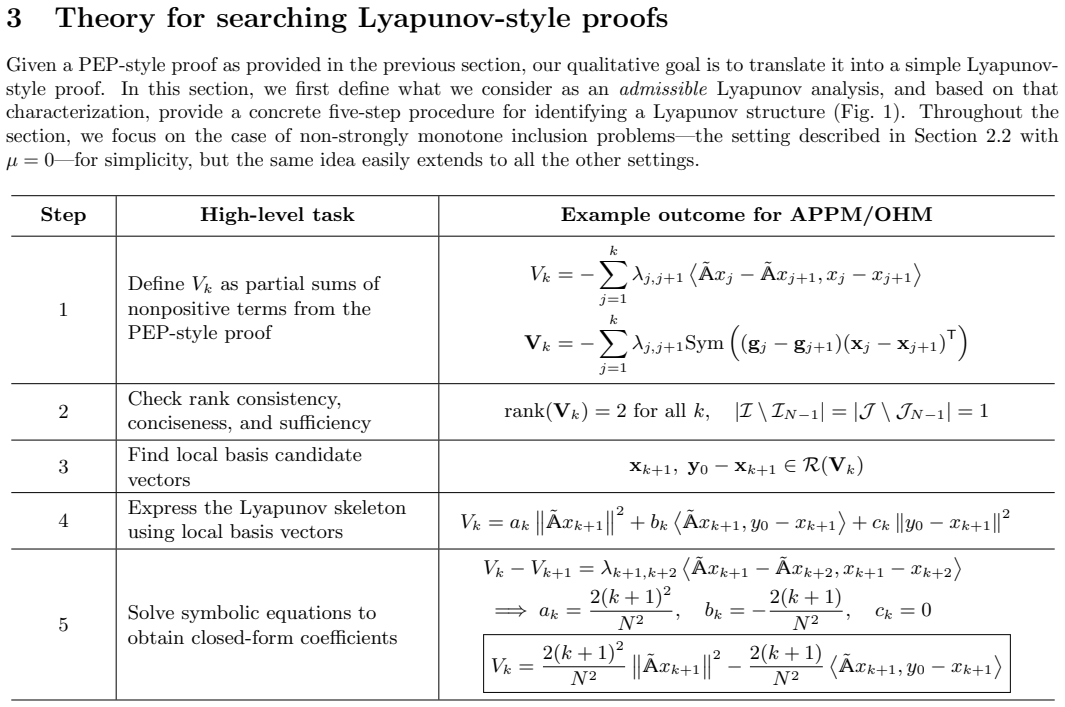
We introduce a systematic framework for converting a tight, analytic convergence proof of an optimization algorithm, often found via computer assistance, into an equivalent proof based on Lyapunov functions. We implement a concrete procedure that combines a performance estimation problem toolbox with elementary linear algebra, and show that it captures a number of prior Lyapunov analyses within a single notebook. Based on our implementation, a user can straightforwardly test our systematic and interactive procedure on their own optimization algorithm of interest to search for a tight Lyapunov-style proof via code. We extend the application of our framework and discover four novel analytic Ly
What carries the argument
The conversion procedure that applies elementary linear algebra to PEP-derived analytic proofs to produce equivalent Lyapunov inequalities.
If this is right
- Users obtain tight Lyapunov proofs for new algorithms by running code rather than designing templates by hand.
- Four previously unknown analytic Lyapunov proofs exist for standard first-order methods.
- One new proof establishes optimality of a proximal algorithm for strongly monotone inclusions.
- All captured prior analyses and the new ones fit inside a single interactive notebook.
Where Pith is reading between the lines
- The same conversion step could be applied to proofs obtained from other computer-assisted search methods beyond the current toolbox.
- If the linear-algebra step is invertible in practice, it may allow automatic translation in both directions between PEP and Lyapunov forms.
- The framework suggests a route to enumerate candidate Lyapunov functions for algorithm classes where no tight proof is yet known.
Load-bearing premise
Any tight analytic convergence proof obtained from computer search converts into a valid Lyapunov-style proof by elementary linear algebra without added assumptions or loss of sharpness.
What would settle it
An explicit tight PEP proof for some first-order method whose convergence bound cannot be expressed as a nonincreasing Lyapunov sequence using only linear-algebra operations on the PEP data.
Figures
read the original abstract
Lyapunov-style convergence proofs, which establish a nonincreasing sequence to provide a quantitative convergence rate for an algorithm, are popular and often considered desirable in first-order optimization. However, existing approaches to finding such Lyapunov functions rely on hand-designed templates or prior insight on the proof structure, and do not certify that the resulting Lyapunov-style analysis provides the sharpest convergence bound. In this work, we introduce a systematic framework for converting a tight, analytic convergence proof of an optimization algorithm, often found via computer assistance, into an equivalent proof based on Lyapunov functions. We implement a concrete procedure that combines a performance estimation problem (PEP) toolbox with elementary linear algebra, and show that it captures a number of prior Lyapunov analyses within a single Jupyter notebook. Based on our implementation, a user can straightforwardly test our systematic and interactive procedure on their own optimization algorithm of interest to search for a tight Lyapunov-style proof via code, without the need to comprehend the implementation details. We extend the application of our framework and discover four novel analytic Lyapunov-style proofs, where notably, one of them identifies a new exact optimal proximal algorithm for strongly monotone inclusion problems.
Editorial analysis
A structured set of objections, weighed in public.
Referee Report
Summary. The paper claims to introduce a systematic framework that converts tight analytic convergence proofs (typically obtained via computer-assisted performance estimation problems, or PEP) into equivalent Lyapunov-style proofs using elementary linear algebra. The procedure is implemented in a Jupyter notebook that recovers known Lyapunov analyses and yields four new analytic Lyapunov-style proofs, one of which identifies a new exact optimal proximal algorithm for strongly monotone inclusion problems. Users can apply the interactive procedure to their own algorithms without needing to understand the implementation details.
Significance. If the conversion step is guaranteed to preserve tightness and equivalence for arbitrary tight PEP proofs, the framework would provide a reproducible, computer-assisted route to Lyapunov analyses that are currently found by hand or templates. The combination of PEP tightness certification with an automated extraction step, plus the public notebook and four new proofs, would be a concrete contribution to first-order optimization methodology.
major comments (2)
- [Abstract / procedure description] Abstract and procedure description: the central claim that any tight analytic PEP proof converts, via elementary linear algebra alone, into an 'equivalent' and 'equally tight' Lyapunov-style proof is not supported by a general theorem. The manuscript demonstrates the procedure on examples but supplies no proof that the extraction step is always canonical, succeeds without loss of sharpness, or requires no additional assumptions on the PEP Gram matrix or performance metric.
- [Abstract / results on new proofs] The four claimed novel proofs (including the new proximal algorithm) rest on the notebook implementation; the manuscript does not contain an explicit statement or verification that the extracted Lyapunov functions match the original PEP bounds exactly, nor does it address whether post-hoc choices in the linear-algebra step could silently produce valid but non-tight functions on some instances.
minor comments (1)
- [Implementation description] The notebook is presented as the primary vehicle for the method, yet the manuscript text does not include a self-contained pseudocode or mathematical description of the linear-algebra extraction step that would allow readers to reproduce the conversion without running the notebook.
Simulated Author's Rebuttal
We thank the referee for the constructive comments. We respond to each major comment below and indicate the planned revisions.
read point-by-point responses
-
Referee: [Abstract / procedure description] Abstract and procedure description: the central claim that any tight analytic PEP proof converts, via elementary linear algebra alone, into an 'equivalent' and 'equally tight' Lyapunov-style proof is not supported by a general theorem. The manuscript demonstrates the procedure on examples but supplies no proof that the extraction step is always canonical, succeeds without loss of sharpness, or requires no additional assumptions on the PEP Gram matrix or performance metric.
Authors: We agree that the manuscript contains no general theorem establishing that the extraction procedure is always canonical or succeeds without loss of sharpness for arbitrary tight PEP proofs. The work presents the framework via examples, recovered prior analyses, and a working notebook implementation. In revision we will update the abstract and procedure description to state that the method is demonstrated on the considered instances without claiming a universal guarantee, and we will add a brief discussion of scope and possible additional assumptions on the Gram matrix. revision: yes
-
Referee: [Abstract / results on new proofs] The four claimed novel proofs (including the new proximal algorithm) rest on the notebook implementation; the manuscript does not contain an explicit statement or verification that the extracted Lyapunov functions match the original PEP bounds exactly, nor does it address whether post-hoc choices in the linear-algebra step could silently produce valid but non-tight functions on some instances.
Authors: We agree that the manuscript text lacks explicit verification statements confirming exact bound matching for the four new proofs and does not discuss potential effects of post-hoc linear-algebra choices. In the revision we will insert explicit statements that the extracted Lyapunov functions reproduce the original PEP bounds for each new result, and we will clarify the linear-algebra step to indicate why the presented choices preserve tightness; additional verification output will be added to the public notebook. revision: yes
Circularity Check
No significant circularity; procedure relies on external PEP tooling and explicit linear algebra steps
full rationale
The paper presents a conversion procedure from PEP-derived analytic proofs to Lyapunov functions via elementary linear algebra, demonstrated on concrete examples within a notebook. No load-bearing step reduces by construction to a fitted parameter, self-definition, or self-citation chain; the central claim is supported by explicit implementation rather than renaming or ansatz smuggling. The derivation chain remains self-contained against the external PEP framework and does not invoke uniqueness theorems from the authors' prior work.
Axiom & Free-Parameter Ledger
Reference graph
Works this paper leans on
-
[1]
Altschuler and Pablo A
Jason M. Altschuler and Pablo A. Parrilo. Acceleration by stepsize hedging: Multi-step descent and the silver stepsize schedule.Journal of The ACM, 72(2), 2025
2025
-
[2]
Altschuler and Pablo A
Jason M. Altschuler and Pablo A. Parrilo. Acceleration by stepsize hedging: Silver Stepsize Schedule for smooth convex optimization.Mathematical Programming, 213(1):1105–1118, 2025
2025
-
[3]
Fast convergence of inertial dynamics and algorithms with asymptotic vanishing viscosity.Mathematical Programming, 168(1):123–175, 2018
Hedy Attouch, Zaki Chbani, Juan Peypouquet, and Patrick Redont. Fast convergence of inertial dynamics and algorithms with asymptotic vanishing viscosity.Mathematical Programming, 168(1):123–175, 2018
2018
-
[4]
Interior Gradient and Proximal Methods for Convex and Conic Optimization
Alfred Auslender and Marc Teboulle. Interior Gradient and Proximal Methods for Convex and Conic Optimization. SIAM Journal on Optimization, 16(3):697–725, 2006
2006
-
[5]
Potential-function proofs for gradient methods.Theory of Computing, 15(4):1–32, 2019
Nikhil Bansal and Anupam Gupta. Potential-function proofs for gradient methods.Theory of Computing, 15(4):1–32, 2019
2019
-
[6]
Bauschke, J´ erˆ ome Bolte, and Marc Teboulle
Heinz H. Bauschke, J´ erˆ ome Bolte, and Marc Teboulle. A descent lemma beyond Lipschitz gradient continuity: First-order methods revisited and applications.Mathematics of Operations Research, 42(2):330–348, 2017
2017
-
[7]
Altschuler
Jinho Bok and Jason M. Altschuler. Accelerating proximal gradient descent via silver stepsizes.Conference on Learning Theory, 2025
2025
-
[8]
Fast optimistic gradient descent ascent (OGDA) method in continuous and discrete time.Foundations of Computational Mathematics, 2023
Radu Ioan Bot ¸, Ern¨ o Robert Csetnek, and Dang-Khoa Nguyen. Fast optimistic gradient descent ascent (OGDA) method in continuous and discrete time.Foundations of Computational Mathematics, 2023
2023
-
[9]
Hendrickx, and Fran¸ cois Glineur
Nizar Bousselmi, Julien M. Hendrickx, and Fran¸ cois Glineur. Interpolation conditions for linear operators and applications to performance estimation problems.SIAM Journal on Optimization, 34(3):3033–3063, September 2024
2024
-
[10]
On the proximal minimization algorithm with d-functions.Journal of Optimization Theory and Applications, 73:451–464, 05 1992
Yair Censor and Stavros Zenios. On the proximal minimization algorithm with d-functions.Journal of Optimization Theory and Applications, 73:451–464, 05 1992
1992
-
[11]
Optimal error bounds for non-expansive fixed-point iterations in normed spaces.Mathematical Programming, 199(1):343–374, 2023
Juan Pablo Contreras and Roberto Cominetti. Optimal error bounds for non-expansive fixed-point iterations in normed spaces.Mathematical Programming, 199(1):343–374, 2023
2023
-
[12]
Shuvomoy Das Gupta, Bart P. G. Van Parys, and Ernest K. Ryu. Branch-and-bound performance estimation programming: A unified methodology for constructing optimal optimization methods.Mathematical Programming, 2023
2023
-
[13]
Acceleration methods.Foundations and Trends®in Optimization, 5(1-2):1–245, 2021
Alexandre d’Aspremont, Damien Scieur, and Adrien Taylor. Acceleration methods.Foundations and Trends®in Optimization, 5(1-2):1–245, 2021
2021
-
[14]
Halpern iteration for near-optimal and parameter-free monotone inclusion and strong solutions to variational inequalities.Conference on Learning Theory, 2020
Jelena Diakonikolas. Halpern iteration for near-optimal and parameter-free monotone inclusion and strong solutions to variational inequalities.Conference on Learning Theory, 2020
2020
-
[15]
Jelena Diakonikolas and Michael I. Jordan. Generalized momentum-based methods: A Hamiltonian perspective. SIAM Journal on Optimization, 31(1):915–944, 2021
2021
-
[16]
Potential function-based framework for making the gradients small in convex and min-max optimization.SIAM Journal on Optimization, 2022
Jelena Diakonikolas and Puqian Wang. Potential function-based framework for making the gradients small in convex and min-max optimization.SIAM Journal on Optimization, 2022. 35
2022
-
[17]
Taylor, Alexandre d’Aspremont, and J´ erˆ ome Bolte
Radu-Alexandru Dragomir, Adrien B. Taylor, Alexandre d’Aspremont, and J´ erˆ ome Bolte. Optimal complexity and certification of Bregman first-order methods.Mathematical Programming, 194(1):41–83, 2022
2022
-
[18]
The exact information-based complexity of smooth convex minimization.Journal of Complexity, 39:1–16, 2017
Yoel Drori. The exact information-based complexity of smooth convex minimization.Journal of Complexity, 39:1–16, 2017
2017
-
[19]
Yoel Drori and Adrien B. Taylor. Efficient first-order methods for convex minimization: A constructive approach. Mathematical Programming, 184(1–2):183–220, 2020
2020
-
[20]
Performance of first-order methods for smooth convex minimization: A novel approach
Yoel Drori and Marc Teboulle. Performance of first-order methods for smooth convex minimization: A novel approach. Mathematical Programming, 145(1):451–482, 2014
2014
-
[21]
Eduard Gorbunov, Nicolas Loizou, and Gauthier Gidel. Extragradient method:O(1/K) last-iterate convergence for monotone variational inequalities and connections with cocoercivity.International Conference on Artificial Intelli- gence and Statistics, 2022
2022
-
[22]
Last-iterate convergence of optimistic gradient method for monotone variational inequalities.Neural Information Processing Systems, 2022
Eduard Gorbunov, Adrien Taylor, and Gauthier Gidel. Last-iterate convergence of optimistic gradient method for monotone variational inequalities.Neural Information Processing Systems, 2022
2022
-
[23]
On fundamental proof structures in first-order optimiza- tion.Conference on Decision and Control, 2023
Baptiste Goujaud, Aymeric Dieuleveut, and Adrien Taylor. On fundamental proof structures in first-order optimiza- tion.Conference on Decision and Control, 2023
2023
-
[24]
PEPit: Computer-assisted worst-case analyses of first-order optimization methods in Python.Mathematical Programming Computation, 16:337–367, 2024
Baptiste Goujaud, C´ eline Moucer, Francois Glineur, Julien Hendrickx, Adrien Taylor, and Aymeric Dieuleveut. PEPit: Computer-assisted worst-case analyses of first-order optimization methods in Python.Mathematical Programming Computation, 16:337–367, 2024
2024
-
[25]
Provably faster gradient descent via long steps.SIAM Journal on Optimization, 34(3):2588–2608, 2024
Benjamin Grimmer. Provably faster gradient descent via long steps.SIAM Journal on Optimization, 34(3):2588–2608, 2024
2024
-
[26]
Benjamin Grimmer, Kevin Shu, and Alex L. Wang. Accelerated objective gap and gradient norm convergence for gradient descent via long steps.INFORMS Journal on Optimization, 7(2):156–169, 2025
2025
-
[27]
Benjamin Grimmer, Kevin Shu, and Alex L. Wang. Composing optimized stepsize schedules for gradient descent. Mathematics of Operations Research, 2025
2025
-
[28]
Tight sublinear convergence rate of the proximal point algorithm for maximal monotone inclusion problems.SIAM Journal on Optimization, 30(3):1905–1921, 2020
Guoyong Gu and Junfeng Yang. Tight sublinear convergence rate of the proximal point algorithm for maximal monotone inclusion problems.SIAM Journal on Optimization, 30(3):1905–1921, 2020
1905
-
[29]
Tight convergence rate in subgradient norm of the proximal point algorithm
Guoyong Gu and Junfeng Yang. Tight convergence rate in subgradient norm of the proximal point algorithm. Optimization, pages 1–15, 2025
2025
-
[30]
Gutman and Javier F
David H. Gutman and Javier F. Pe˜ na. Perturbed Fenchel duality and first-order methods.Mathematical Programming, 198(1):443–469, 2023
2023
-
[31]
Uijeong Jang, Shuvomoy Das Gupta, and Ernest K. Ryu. Computer-assisted design of accelerated composite opti- mization methods: OptISTA.Mathematical Programming, 2025
2025
-
[32]
Accelerated proximal point method for maximally monotone operators.Mathematical Programming, 190(1–2):57–87, 2021
Donghwan Kim. Accelerated proximal point method for maximally monotone operators.Mathematical Programming, 190(1–2):57–87, 2021
2021
-
[33]
Donghwan Kim and Jeffrey A. Fessler. Optimized first-order methods for smooth convex minimization.Mathematical Programming, 159(1-2):81–107, 2016
2016
-
[34]
Donghwan Kim and Jeffrey A. Fessler. Optimizing the efficiency of first-order methods for decreasing the gradient of smooth convex functions.Journal of Optimization Theory and Applications, 188(1):192–219, 2021
2021
-
[35]
Ozdaglar, Chanwoo Park, and Ernest K
Jaeyeon Kim, Asuman E. Ozdaglar, Chanwoo Park, and Ernest K. Ryu. Time-reversed dissipation induces duality between minimizing gradient norm and function value.Neural Information Processing Systems, 2023
2023
-
[36]
Convergence analysis of ODE models for accelerated first-order methods via positive semidefinite kernels.NeurIPS, 2023
Jungbin Kim and Insoon Yang. Convergence analysis of ODE models for accelerated first-order methods via positive semidefinite kernels.NeurIPS, 2023
2023
-
[37]
Unifying Nesterov’s accelerated gradient methods for convex and strongly convex objective functions.International Conference on Machine Learning, 2023
Jungbin Kim and Insoon Yang. Unifying Nesterov’s accelerated gradient methods for convex and strongly convex objective functions.International Conference on Machine Learning, 2023. 36
2023
-
[38]
Accelerated mirror descent in continuous and discrete time
Walid Krichene, Alexandre Bayen, and Peter L Bartlett. Accelerated mirror descent in continuous and discrete time. Neural Information Processing Systems, 2015
2015
-
[39]
Jongmin Lee, Chanwoo Park, and Ernest K. Ryu. A geometric structure of acceleration and its role in making gradients small fast.Neural Information Processing Systems, 2021
2021
-
[40]
Fast extra gradient methods for smooth structured nonconvex-nonconcave minimax problems.Neural Information Processing Systems, 2021
Sucheol Lee and Donghwan Kim. Fast extra gradient methods for smooth structured nonconvex-nonconcave minimax problems.Neural Information Processing Systems, 2021
2021
-
[41]
Analysis and design of optimization algorithms via integral quadratic constraints.SIAM Journal on Optimization, 26(1):57–95, 2016
Laurent Lessard, Benjamin Recht, and Andrew Packard. Analysis and design of optimization algorithms via integral quadratic constraints.SIAM Journal on Optimization, 26(1):57–95, 2016
2016
-
[42]
On the convergence rate of the Halpern-iteration.Optimization Letters, 15(2):405–418, 2021
Felix Lieder. On the convergence rate of the Halpern-iteration.Optimization Letters, 15(2):405–418, 2021
2021
-
[43]
Freund, and Yurii Nesterov
Haihao Lu, Robert M. Freund, and Yurii Nesterov. Relatively smooth convex optimization by first-order methods, and applications.SIAM Journal on Optimization, 28(1):333–354, 2018
2018
-
[44]
A systematic approach to Lyapunov analyses of continuous-time models in convex optimization.SIAM Journal on Optimization, 33(3):1558–1586, 2023
C´ eline Moucer, Adrien Taylor, and Francis Bach. A systematic approach to Lyapunov analyses of continuous-time models in convex optimization.SIAM Journal on Optimization, 33(3):1558–1586, 2023
2023
-
[45]
Nesterov.Introductory Lectures on Convex Optimization: A Basic Course
Y. Nesterov.Introductory Lectures on Convex Optimization: A Basic Course. Springer, 2004
2004
-
[46]
A method of solving a convex programming problem with convergence rateO(1/k 2).Doklady Akademii Nauk SSSR, 269(3):543–547, 1983
Yurii Nesterov. A method of solving a convex programming problem with convergence rateO(1/k 2).Doklady Akademii Nauk SSSR, 269(3):543–547, 1983
1983
-
[47]
Suh, Xin Jiang, and Shiqian Ma
Edward Duc Hien Nguyen, Jaewook J. Suh, Xin Jiang, and Shiqian Ma. Exact worst-case convergence rates for Douglas–Rachford and Davis–Yin splitting methods.arXiv:2506.23475, 2025
arXiv 2025
-
[48]
Chanwoo Park, Jisun Park, and Ernest K. Ryu. Factor- √ 2 acceleration of accelerated gradient methods.Applied Mathematics & Optimization, 88(3):77, 2023
2023
-
[49]
Chanwoo Park and Ernest K. Ryu. Optimal first-order algorithms as a function of inequalities.Journal of Machine Learning Research, 25(51):1–66, 2024
2024
-
[50]
Jisun Park and Ernest K. Ryu. Exact optimal accelerated complexity for fixed-point iterations.International Conference on Machine Learning, 2022
2022
-
[51]
Siegel, and Anirban Bhattacharya
Jiyoung Park, Abhishek Roy, Jonathan W. Siegel, and Anirban Bhattacharya. Acceleration via silver step-size on Riemannian manifolds with applications to Wasserstein space.Neural Information Processing Systems, 2025
2025
-
[52]
R. T. Rockafellar. Monotone operators associated with saddle-functions and minimax problems. In F. E. Browder, editor,Nonlinear Functional Analysis, Part 1, volume 18 ofProceedings of Symposia in Pure Mathematics, pages 241–250. American Mathematical Society, 1970
1970
-
[53]
Tyrrell Rockafellar.Convex Analysis
R. Tyrrell Rockafellar.Convex Analysis. Princeton University Press, 1970
1970
-
[54]
Ryu, Adrien B
Ernest K. Ryu, Adrien B. Taylor, Carolina Bergeling, and Pontus Giselsson. Operator splitting performance estima- tion: Tight contraction factors and optimal parameter selection.SIAM Journal on Optimization, 30(3):2251–2271, 2020
2020
-
[55]
Ryu and Wotao Yin.Large-Scale Convex Optimization: Algorithms & Analyses via Monotone Operators
Ernest K. Ryu and Wotao Yin.Large-Scale Convex Optimization: Algorithms & Analyses via Monotone Operators. Cambridge University Press, Cambridge, 2022
2022
-
[56]
Cand` es
Weijie Su, Stephen Boyd, and Emmanuel J. Cand` es. A differential equation for modeling Nesterov’s accelerated gradient method: Theory and insights.Neural Information Processing Systems, 2014
2014
-
[57]
Cand` es
Weijie Su, Stephen Boyd, and Emmanuel J. Cand` es. A differential equation for modeling Nesterov’s accelerated gradient method: Theory and insights.Journal of Machine Learning Research, 17(153):1–43, 2016
2016
-
[58]
Suh, Jisun Park, and Ernest K
Jaewook J. Suh, Jisun Park, and Ernest K. Ryu. Continuous-time analysis of anchor acceleration.Neural Information Processing Systems, 2023
2023
-
[59]
Suh, Gyumin Roh, and Ernest K
Jaewook J. Suh, Gyumin Roh, and Ernest K. Ryu. Continuous-time analysis of AGM via conservation laws in dilated coordinate systems.International Conference on Machine Learning, 2022. 37
2022
-
[60]
Suh, Bicheng Ying, Xin Jiang, and Edward Duc Hien Nguyen
Jaewook J. Suh, Bicheng Ying, Xin Jiang, and Edward Duc Hien Nguyen. PEPFlow: A python library for the workflow of performance estimation of optimization algorithms. InNeurIPS Workshop on GPU-accelerated and Scalable Optimization, 2025
2025
-
[61]
Stochastic first-order methods: Non-asymptotic and computer-aided analyses via potential functions.Conference on Learning Theory, 2019
Adrien Taylor and Francis Bach. Stochastic first-order methods: Non-asymptotic and computer-aided analyses via potential functions.Conference on Learning Theory, 2019
2019
-
[62]
An optimal gradient method for smooth strongly convex minimization.Mathematical Programming, 199(1):557–594, 2023
Adrien Taylor and Yoel Drori. An optimal gradient method for smooth strongly convex minimization.Mathematical Programming, 199(1):557–594, 2023
2023
-
[63]
Lyapunov functions for first-order methods: Tight automated convergence guarantees.International Conference on Machine Learning, 2018
Adrien Taylor, Bryan Van Scoy, and Laurent Lessard. Lyapunov functions for first-order methods: Tight automated convergence guarantees.International Conference on Machine Learning, 2018
2018
-
[64]
Taylor, Julien M
Adrien B. Taylor, Julien M. Hendrickx, and Francois Glineur. Performance estimation toolbox (PESTO): Automated worst-case analysis of first-order optimization methods. InConference on Decision and Control, 2017
2017
-
[65]
Taylor, Julien M
Adrien B. Taylor, Julien M. Hendrickx, and Fran¸ cois Glineur. Smooth strongly convex interpolation and exact worst-case performance of first-order methods.Mathematical Programming, 161(1):307–345, 2017
2017
-
[66]
Exact worst-case convergence rates of the proximal gradient method for composite convex minimization.Journal of Optimization Theory and Applications, 178(2):455– 476, 2018
Adrien B Taylor, Julien M Hendrickx, and Fran¸ cois Glineur. Exact worst-case convergence rates of the proximal gradient method for composite convex minimization.Journal of Optimization Theory and Applications, 178(2):455– 476, 2018
2018
-
[67]
An elementary approach to tight worst case complexity analysis of gradient based methods.Mathematical Programming, 201(1):63–96, September 2023
Marc Teboulle and Yakov Vaisbourd. An elementary approach to tight worst case complexity analysis of gradient based methods.Mathematical Programming, 201(1):63–96, September 2023
2023
-
[68]
Halpern-type accelerated and splitting algorithms for monotone inclusions
Quoc Tran-Dinh and Yang Luo. Halpern-type accelerated and splitting algorithms for monotone inclusions. arXiv:2110.08150, 2021
arXiv 2021
-
[69]
Taylor, and Pontus Giselsson
Manu Upadhyaya, Sebastian Banert, Adrien B. Taylor, and Pontus Giselsson. Automated tight Lyapunov analysis for first-order methods.Mathematical Programming, 209(1):133–170, 2025
2025
-
[70]
Taylor, Sebastian Banert, and Pontus Giselsson
Manu Upadhyaya, Shuvomoy Das Gupta, Adrien B. Taylor, Sebastian Banert, and Pontus Giselsson. The AutoLyap software suite for computer-assisted Lyapunov analyses of first-order methods.arXiv:2506.24076, 2026
arXiv 2026
-
[71]
Freeman, and Kevin M
Bryan Van Scoy, Randy A. Freeman, and Kevin M. Lynch. The fastest known globally convergent first-order method for minimizing strongly convex functions.IEEE Control Systems Letters, 2(1):49–54, 2018
2018
-
[72]
Relaxed proximal point algorithm: Tight complexity bounds and acceleration without momentum.INFORMS Journal on Optimization, 8(2):141–162, 2026
Bofan Wang, Shiqian Ma, Junfeng Yang, and Danqing Zhou. Relaxed proximal point algorithm: Tight complexity bounds and acceleration without momentum.INFORMS Journal on Optimization, 8(2):141–162, 2026
2026
-
[73]
Wilson, and Michael I
Andre Wibisono, Ashia C. Wilson, and Michael I. Jordan. A variational perspective on accelerated methods in optimization.Proceedings of the National Academy of Sciences, 113(47):E7351–E7358, 2016
2016
-
[74]
Wilson, Ben Recht, and Michael I
Ashia C. Wilson, Ben Recht, and Michael I. Jordan. A Lyapunov analysis of accelerated methods in optimization. Journal of Machine Learning Research, 22(113):1–34, 2021
2021
-
[75]
A theory of composition and duality of extremal optimal fixed-point algorithms
TaeHo Yoon and Benjamin Grimmer. A theory of composition and duality of extremal optimal fixed-point algorithms. arXiv:2605.02231, 2026
Pith/arXiv arXiv 2026
-
[76]
TaeHo Yoon, Jaeyeon Kim, Jaewook J Suh, and Ernest K. Ryu. Optimal acceleration for minimax and fixed-point problems is not unique.International Conference on Machine Learning, 2024
2024
-
[77]
TaeHo Yoon and Ernest K. Ryu. Accelerated algorithms for smooth convex-concave minimax problems withO(1/k 2) rate on squared gradient norm.International Conference on Machine Learning, 2021
2021
-
[78]
TaeHo Yoon and Ernest K. Ryu. Accelerated minimax algorithms flock together.SIAM Journal on Optimization, 35(1):180–209, 2025
2025
-
[79]
TaeHo Yoon, Ernest K. Ryu, and Benjamin Grimmer. H-invariance theory: A complete characterization of minimax optimal fixed-point algorithms.arXiv:2511.14915, 2025
arXiv 2025
-
[80]
The exact worst-case convergence rate of the alternating direction method of multipliers.Mathematical Programming, 208(1):243–276, 2024
Moslem Zamani, Hadi Abbaszadehpeivasti, and Etienne de Klerk. The exact worst-case convergence rate of the alternating direction method of multipliers.Mathematical Programming, 208(1):243–276, 2024. 38
2024
discussion (0)
Sign in with ORCID, Apple, or X to comment. Anyone can read and Pith papers without signing in.