HierBias: Context-Conditioned Hierarchical Media Bias Detection with Multi-Task Type Classification
Pith reviewed 2026-07-01 08:24 UTC · model grok-4.3
The pith
Document context strictly reduces the error rate of sentence-level media bias classification when sentences share information.
A machine-rendered reading of the paper's core claim, the machinery that carries it, and where it could break.
Core claim
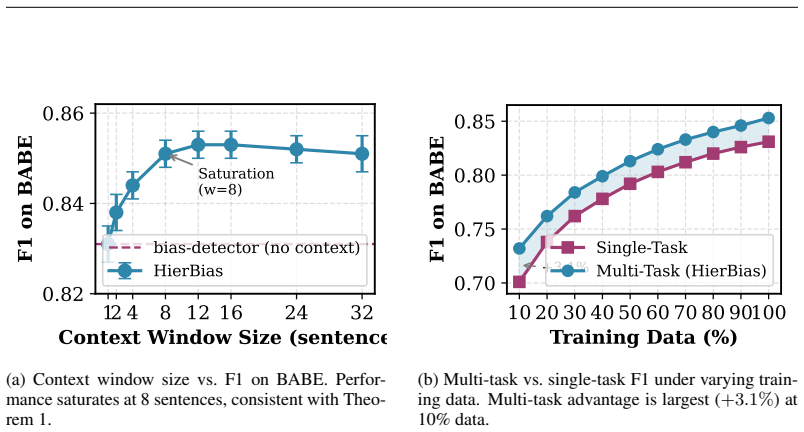
HierBias models the context-conditioned bias probability and proves that leveraging document context strictly reduces the Bayes error of sentence-level classification when inter-sentence mutual information is non-zero. A multi-task generalization bound establishes that jointly training binary bias detection and fine-grained bias type classification improves sample efficiency on small annotated corpora. The architecture pairs a sentence-level RoBERTa encoder with a cross-sentence Transformer aggregator and dual output heads, achieving 0.853 F1 and 0.723 MCC on BABE and BASIL while surpassing prior detectors.
What carries the argument
The context-conditioned bias probability, which incorporates document-level signals into each sentence prediction through a cross-sentence Transformer aggregator.
If this is right
- Sentence-level bias predictions become more accurate once conditioned on shared information from other sentences in the document.
- Joint training on bias type classification improves performance when only limited labeled data is available.
- Each added component of the hierarchical model contributes independently to the observed gains in F1 and MCC.
- The theoretical error reduction holds for any sentence classifier that can access nonzero inter-sentence mutual information.
Where Pith is reading between the lines
- The same context-conditioning step could be tested on other sentence-level tasks where documents contain internal dependencies, such as claim verification or stance detection.
- The multi-task bound might be checked on domains where bias type labels are cheaper to obtain than binary labels.
- Ablations isolating the aggregator could reveal whether simpler context mechanisms achieve similar error reductions.
Load-bearing premise
Inter-sentence mutual information is non-zero in typical media bias documents and the aggregator captures enough of it to realize the error reduction.
What would settle it
An experiment or dataset in which adding document context produces no measurable drop in sentence classification error, or in which measured mutual information between sentences is zero.
Figures

read the original abstract
Media bias detection is a critical task for ensuring fair and balanced information dissemination, yet existing sentence-level approaches classify each sentence independently, ignoring inter-sentence contextual signals that human annotators naturally exploit. We present \textbf{HierBias}, a hierarchical context-conditioned media bias detector that formally models document context in bias prediction. We introduce the \emph{context-conditioned bias probability} and prove theoretically that leveraging document context strictly reduces the Bayes error of sentence-level classification when inter-sentence mutual information is non-zero. A multi-task generalization bound further establishes that jointly training binary bias detection and fine-grained bias type classification improves sample efficiency on small annotated corpora. Architecturally, HierBias pairs a sentence-level RoBERTa encoder with a cross-sentence Transformer aggregator and dual output heads for binary detection and four-class type classification. Evaluated on BABE and BASIL, HierBias achieves 0.853 F1 and 0.723 MCC, surpassing the state-of-the-art bias-detector by $+2.6\%$ F1 and $+4.3\%$ MCC (McNemar's test, $p < 0.05$). Ablation experiments confirm that each theoretical component contributes independently and consistently.
Editorial analysis
A structured set of objections, weighed in public.
Referee Report
Summary. The paper introduces HierBias, a hierarchical context-conditioned model for media bias detection consisting of a sentence-level RoBERTa encoder, a cross-sentence Transformer aggregator, and dual heads for binary bias classification plus four-class type classification. It claims a theoretical proof that document context strictly reduces sentence-level Bayes error whenever inter-sentence mutual information is non-zero, a multi-task generalization bound showing improved sample efficiency, and empirical results on BABE and BASIL where HierBias reaches 0.853 F1 and 0.723 MCC, outperforming prior SOTA by +2.6% F1 and +4.3% MCC (McNemar's test, p<0.05), with ablations said to confirm independent contributions from each component.
Significance. If the derivation of the Bayes-error reduction is rigorous and the empirical gains can be causally attributed to context modeling rather than other factors, the work would supply a principled justification for hierarchical bias detection and a practical multi-task approach for small annotated corpora. The explicit theoretical proof and generalization bound are notable strengths that go beyond typical empirical NLP papers.
major comments (2)
- [Theoretical proof section] Theoretical proof section: the central claim that context strictly reduces Bayes error iff inter-sentence MI > 0 is load-bearing for attributing the +2.6% F1 gain to the proposed mechanism, yet the manuscript reports no estimate or test of inter-sentence mutual information on BABE or BASIL (or any corpus), leaving the applicability of the strict reduction unverified.
- [Ablation experiments] Ablation experiments: the reported ablations do not isolate the cross-sentence aggregator's contribution to modeling inter-sentence dependence from the effects of multi-task type classification or RoBERTa fine-tuning alone; without such an isolation the claim that 'each theoretical component contributes independently' cannot be substantiated.
minor comments (2)
- [Abstract] The abstract states McNemar's test p < 0.05 but does not name the exact baseline model or report the full contingency table; adding these details would improve reproducibility.
- [Notation] Notation for the context-conditioned bias probability is introduced without an explicit equation number or definition in the main text; cross-referencing it to the proof would aid readability.
Simulated Author's Rebuttal
We thank the referee for the detailed and constructive feedback. We address each major comment below and outline revisions to strengthen the manuscript.
read point-by-point responses
-
Referee: [Theoretical proof section] Theoretical proof section: the central claim that context strictly reduces Bayes error iff inter-sentence MI > 0 is load-bearing for attributing the +2.6% F1 gain to the proposed mechanism, yet the manuscript reports no estimate or test of inter-sentence mutual information on BABE or BASIL (or any corpus), leaving the applicability of the strict reduction unverified.
Authors: We agree that an empirical estimate of inter-sentence mutual information on the evaluation corpora would directly support the applicability of the theoretical result to the observed gains. The proof is conditional on MI > 0, and while the performance improvements and McNemar significance are consistent with the mechanism, we did not include a dataset-specific MI calculation. In revision we will add mutual-information estimates (using kNN-based estimators on sentence embeddings) for both BABE and BASIL, together with a brief discussion of the values obtained. revision: yes
-
Referee: [Ablation experiments] Ablation experiments: the reported ablations do not isolate the cross-sentence aggregator's contribution to modeling inter-sentence dependence from the effects of multi-task type classification or RoBERTa fine-tuning alone; without such an isolation the claim that 'each theoretical component contributes independently' cannot be substantiated.
Authors: We acknowledge the limitation in the current ablation design. The existing variants compare the full model against versions that remove the aggregator or the type-classification head, yet they do not fully disentangle the hierarchical aggregator from the multi-task objective. We will expand the ablation section with two additional controlled experiments: (1) a hierarchical single-task model versus a flat multi-task model, and (2) a non-hierarchical multi-task baseline versus the hierarchical multi-task model. These will allow clearer attribution of gains to the context aggregator independent of multi-task learning. revision: yes
Circularity Check
No circularity: theoretical Bayes-error reduction is a standard information-theoretic fact independent of model or data.
full rationale
The paper's central theoretical claim is a proof that context-conditioned classification strictly lowers Bayes error whenever inter-sentence mutual information is positive. This follows directly from the definitions of conditional probability, Bayes error, and mutual information; it does not rely on any fitted parameter, self-referential definition, or prior result authored by the same team. No equations in the provided text equate a prediction to its own input, rename an empirical pattern, or invoke a uniqueness theorem from self-citation. The multi-task generalization bound is likewise presented as a separate analytic result. Empirical gains on BABE/BASIL are reported separately and do not retroactively define the theoretical statement. The derivation chain is therefore self-contained against external mathematical benchmarks.
Axiom & Free-Parameter Ledger
axioms (1)
- domain assumption Inter-sentence mutual information is non-zero in the documents of interest
Reference graph
Works this paper leans on
-
[1]
Timo Spinde, Smi Hinterreiter, Fabian Haak, Terry Ruas, Helge Giese, Norman Meuschke, and Bela Gipp. The media bias taxonomy: A systematic literature review on the forms and automated detection of media bias.arXiv preprint arXiv:2312.16148,
-
[2]
In plain sight: Media bias through the lens of factual reporting
Lisa Fan, Marshall White, Eva Sharma, Ruisi Su, Joey Jiaxu Zhu, Mingshi Jiang, Franck Dernon- court, and Ruihong Huang. In plain sight: Media bias through the lens of factual reporting. InProceedings of the 2019 Conference on Empirical Methods in Natural Language Processing,
work page 2019
-
[3]
Jenny S. Wang, Samar Haider, Amir Tohidi, Anushkaa Gupta, Yuxuan Zhang, Chris Callison-Burch, David Rothschild, and Duncan J. Watts. Media bias detector: Designing and implementing a tool for real-time selection and framing bias analysis in news coverage. InProceedings of the 2025 CHI Conference on Human Factors in Computing Systems,
work page 2025
-
[4]
Media bias detection across families of language models
Iffat Maab, Edison Marrese-Taylor, Sebastian Pad´o, and Yutaka Matsuo. Media bias detection across families of language models. InProceedings of the 2024 Conference of the North American Chap- ter of the Association for Computational Linguistics: Human Language Technologies (Volume 1: Long Papers), pp. 4083–4098,
work page 2024
-
[5]
To bias or not to bias: Detecting bias in news with bias-detector.arXiv preprint arXiv:2505.13010,
Himel Ghosh, Ahmed Mosharafa, and Georg Groh. To bias or not to bias: Detecting bias in news with bias-detector.arXiv preprint arXiv:2505.13010,
-
[6]
RoBERTa: A Robustly Optimized BERT Pretraining Approach
Yinhan Liu, Myle Ott, Naman Goyal, Jingfei Du, Mandar Joshi, Danqi Chen, Omer Levy, Mike Lewis, Luke Zettlemoyer, and Veselin Stoyanov. Roberta: A robustly optimized bert pretraining approach.arXiv preprint arXiv:1907.11692,
work page internal anchor Pith review Pith/arXiv arXiv 1907
-
[7]
Neural media bias detection using distant supervision with babe – bias annotations by experts
Timo Spinde, Manuel Plank, Jan-David Krieger, Terry Ruas, Bela Gipp, and Akiko Aizawa. Neural media bias detection using distant supervision with babe – bias annotations by experts. InFindings of the Association for Computational Linguistics: EMNLP 2021,
work page 2021
-
[8]
Tomas Horych, Christoph Mandl, Terry Ruas, Andre Greiner-Petter, Bela Gipp, Akiko Aizawa, and Timo Spinde. The promises and pitfalls of llm annotations in dataset labeling: a case study on media bias detection. InFindings of the Association for Computational Linguistics: NAACL 2025,
work page 2025
-
[9]
Safari: Cross-lingual bias and factuality detection in news media and news articles
Dilshod Azizov, Zain Muhammad Mujahid, Hilal AlQuabeh, Preslav Nakov, and Shangsong Liang. Safari: Cross-lingual bias and factuality detection in news media and news articles. InFindings of the Association for Computational Linguistics: EMNLP 2024, pp. 12217–12231,
work page 2024
-
[10]
Visual in-context learning for large vision-language models
Yucheng Zhou, Xiang Li, Qianning Wang, and Jianbing Shen. Visual in-context learning for large vision-language models. InFindings of the Association for Computational Linguistics, ACL 2024, Bangkok, Thailand and virtual meeting, August 11-16, 2024, pp. 15890–15902. Association for Computational Linguistics,
work page 2024
-
[11]
Yucheng Zhou, Xiubo Geng, Tao Shen, Chongyang Tao, Guodong Long, Jian-Guang Lou, and Jianbing Shen. Thread of thought unraveling chaotic contexts.arXiv preprint arXiv:2311.08734,
-
[12]
Yucheng Zhou, Zhi Rao, Jun Wan, and Jianbing Shen. Rethinking visual dependency in long-context reasoning for large vision-language models.arXiv preprint arXiv:2410.19732,
-
[13]
Yucheng Zhou, Tao Shen, Xiubo Geng, Guodong Long, and Daxin Jiang. Claret: Pre-training a correlation-aware context-to-event transformer for event-centric generation and classification. In Proceedings of the 60th Annual Meeting of the Association for Computational Linguistics (Volume 1: Long Papers), pp. 2559–2575, 2022a. 9 Yucheng Zhou, Xiubo Geng, Tao S...
work page 2022
-
[14]
Tim Menzner and Jochen L. Leidner. Experiments in news bias detection with pre-trained neural transformers. InProceedings of ECIR 2024, Lecture Notes in Computer Science, 2024a. Tim Menzner and Jochen L. Leidner. Improved models for media bias detection and subcategoriza- tion. InProceedings of ECIR 2024, Lecture Notes in Computer Science, 2024b. Yejin Ba...
work page 2024
-
[15]
Shreya Adrita Banik, Niaz Nafi Rahman, Tahsina Moiukh, and Farig Sadeque. Bridging human and model perspectives: A comparative analysis of political bias detection in news media using large language models.arXiv preprint arXiv:2511.14606,
-
[16]
Improving zero-shot cross-lingual transfer for multilingual question answering over knowledge graph
Yucheng Zhou, Xiubo Geng, Tao Shen, Wenqiang Zhang, and Daxin Jiang. Improving zero-shot cross-lingual transfer for multilingual question answering over knowledge graph. InProceedings of the 2021 Conference of the North American Chapter of the Association for Computational Linguistics: Human Language Technologies, pp. 5822–5834,
work page 2021
-
[17]
Qianning Wang, He Hu, and Yucheng Zhou. Memorymamba: Memory-augmented state space model for defect recognition.arXiv preprint arXiv:2405.03673,
-
[18]
Bert: Pre-training of deep bidirectional transformers for language understanding
Jacob Devlin, Ming-Wei Chang, Kenton Lee, and Kristina Toutanova. Bert: Pre-training of deep bidirectional transformers for language understanding. InProceedings of the 2019 Conference of the North American Chapter of the Association for Computational Linguistics: Human Language Technologies, pp. 4171–4186,
work page 2019
discussion (0)
Sign in with ORCID, Apple, or X to comment. Anyone can read and Pith papers without signing in.