Large-N Carrollian Thermodynamics from AdS Black-Hole Phase-Space Contractions
Pith reviewed 2026-06-26 01:34 UTC · model grok-4.3
The pith
Contracting the AdS time generator and Newton constant produces a finite Carrollian first law with a large-N holographic interpretation.
A machine-rendered reading of the paper's core claim, the machinery that carries it, and where it could break.
Core claim
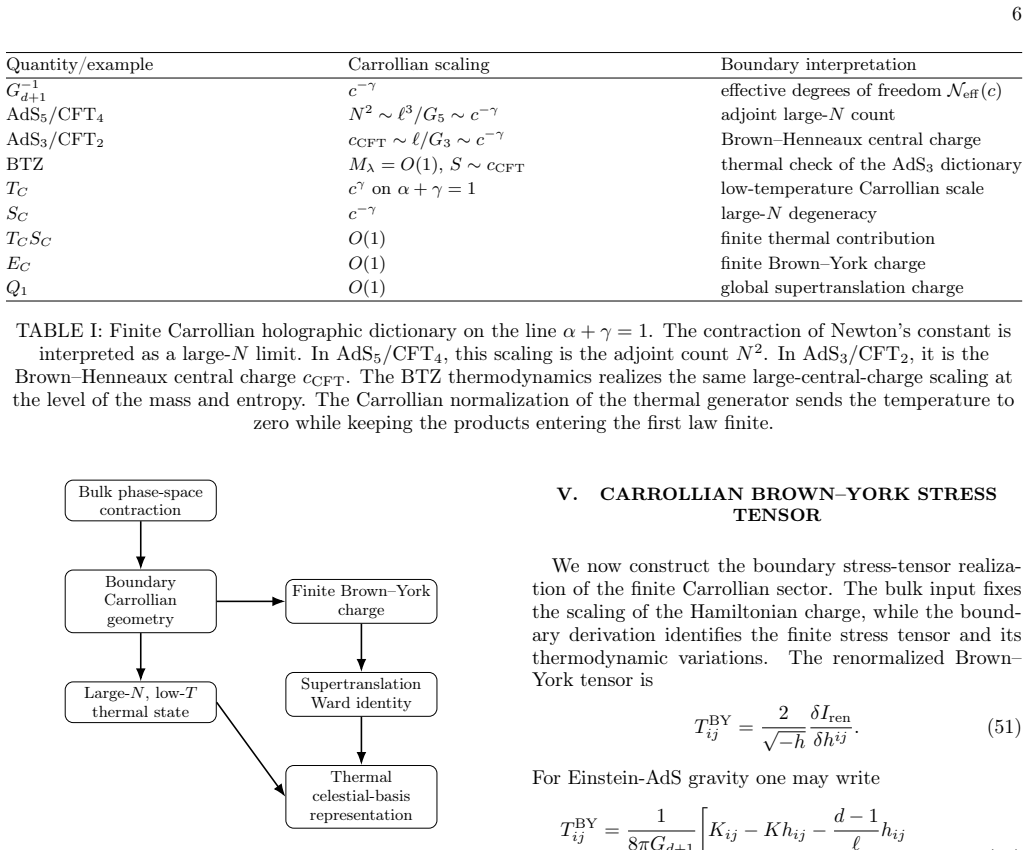
The finite first-law line obtained from the phase-space contraction has a holographic interpretation as a double-scaled low-temperature, large-N ensemble in which the Carrollian temperature decreases while the effective number of boundary degrees of freedom grows, leaving the thermodynamic products finite. This is anchored by AdS5/CFT4 normalization of adjoint degrees of freedom and Brown-Henneaux central charge in AdS3/CFT2. The boundary form of the first law is expressed using spatial volume and the holographic normalization, with the Hawking-Page locus as the zero of the conjugate chemical potential.
What carries the argument
The phase-space contraction of the time generator and Newton constant, which ensures the extended AdS first law has a finite Carrollian limit and allows mapping to a double-scaled boundary ensemble.
If this is right
- The finite Carrollian Brown-York stress tensor on the contracted AdS boundary has global energy charge equal to the finite bulk Hamiltonian.
- The boundary first law is written in terms of the spatial volume and the holographic degree-of-freedom normalization.
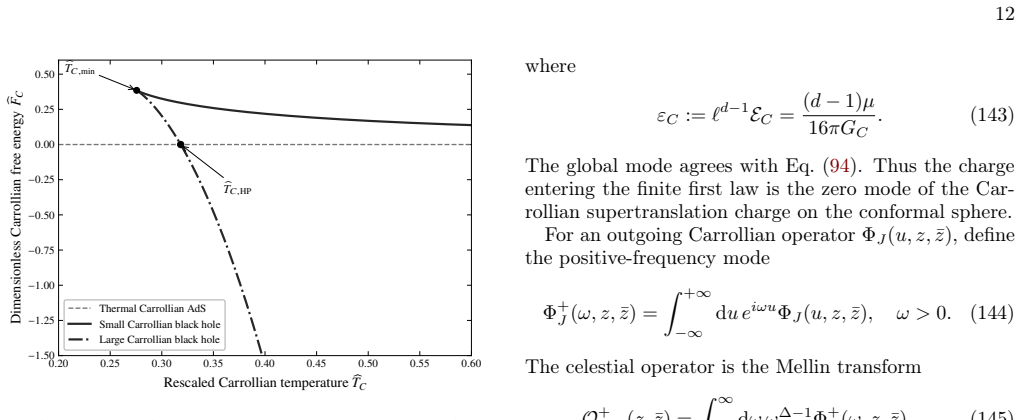
- The Hawking-Page locus is identified with the zero of the chemical potential conjugate to the count of degrees of freedom.
- The finite first law corresponds to the thermal zero-mode sector of the Carrollian Ward identity.
- The finite celestial-basis correlators are rescaled double-scaled correlators from the Fourier-Mellin transform combined with rescaled thermal frequency window.
Where Pith is reading between the lines
- This double-scaling procedure may extend to other holographic dualities involving Carrollian limits or ultrarelativistic regimes.
- Connecting to celestial holography suggests new ways to compute thermal correlators in Carrollian CFTs.
- The identification of supertranslation charges with thermodynamic quantities could link to asymptotic symmetries in flat space limits.
Load-bearing premise
The phase-space contraction of the time generator and Newton constant produces an extended AdS first law that possesses a finite Carrollian limit.
What would settle it
An explicit computation in a specific AdS black hole background showing that after contraction the first law diverges or fails to match the proposed large-N boundary counting would falsify the claim.
Figures
read the original abstract
We develop the boundary and celestial interpretation of finite Carrollian black-hole thermodynamics. The bulk input is the phase-space contraction of the time generator and Newton constant for which the extended AdS first law has a finite Carrollian limit. We show that this finite first-law line has a holographic interpretation as a double-scaled low-temperature, large-$N$ ensemble: the Carrollian temperature decreases while the effective number of boundary degrees of freedom grows, leaving the thermodynamic products in the first law finite. The large-$N$ dictionary is anchored by the standard $\mathrm{AdS}_5/\mathrm{CFT}_4$ normalization of adjoint degrees of freedom and by the Brown--Henneaux central charge in $\mathrm{AdS}_3/\mathrm{CFT}_2$. We construct the finite Carrollian Brown--York stress tensor on the contracted AdS boundary and show that its global energy charge is the finite bulk Hamiltonian. We then derive the boundary form of the first law in terms of the spatial volume and the holographic degree-of-freedom normalization. This identifies the Hawking--Page locus with the zero of the chemical potential conjugate to the count of degrees of freedom. The same charge is the global Carrollian supertranslation charge, so the finite first law is the thermal zero-mode sector of the Carrollian Ward identity. Finally, we construct the celestial conformal-primary representation of thermal Carrollian correlators. The finite celestial-basis correlators are rescaled double-scaled correlators obtained by combining the Fourier--Mellin transform with the rescaled thermal frequency window.
Editorial analysis
A structured set of objections, weighed in public.
Referee Report
Summary. The paper claims that a phase-space contraction of the time generator and Newton constant in AdS black holes produces a finite Carrollian limit of the extended first law. This finite first-law line is interpreted holographically as a double-scaled low-temperature, large-N ensemble in which Carrollian temperature decreases while the effective number of boundary degrees of freedom grows so that thermodynamic products remain finite. The large-N dictionary is fixed by standard AdS5/CFT4 adjoint dof counting and the Brown-Henneaux central charge. The work constructs the finite Carrollian Brown-York stress tensor (whose global energy equals the finite bulk Hamiltonian), derives the boundary first law in terms of spatial volume and dof normalization, identifies the Hawking-Page locus with vanishing chemical potential conjugate to dof count, shows that the same charge is the global Carrollian supertranslation charge (hence the first law is the thermal zero-mode sector of the Carrollian Ward identity), and constructs celestial conformal-primary representations of thermal Carrollian correlators via a Fourier-Mellin transform combined with a rescaled thermal frequency window.
Significance. If the contraction is shown to preserve the first-law identity without residual terms, the construction supplies a controlled route from AdS black-hole thermodynamics to finite Carrollian boundary structures, with explicit stress-tensor and celestial-correlator realizations that could be useful for flat-space holography and Carrollian CFT studies. The anchoring to standard AdS/CFT normalizations is a concrete strength.
major comments (1)
- [section deriving the finite Carrollian first law (phase-space contraction)] The central claim that the chosen contraction of the time generator and Newton constant yields a finite Carrollian first law rests on the assumption that the limit commutes with the exterior derivative δ. The manuscript must explicitly verify that no residual terms from the original AdS asymptotics appear after the contraction (i.e., that the thermodynamic identity is preserved without extra assumptions on the black-hole parameters). This verification is load-bearing for the finite-limit and holographic-ensemble statements.
minor comments (2)
- [introduction of contraction parameters] Notation for the contracted time generator and the rescaled Newton constant should be introduced with an explicit equation at first appearance to avoid ambiguity when the limit is taken.
- [abstract and §2] The abstract states the constructions but supplies no sample derivations or checks; a brief illustrative calculation (e.g., for the Schwarzschild-AdS case) in the main text would improve readability.
Simulated Author's Rebuttal
We thank the referee for the careful reading and constructive comments on our manuscript. We address the single major comment below.
read point-by-point responses
-
Referee: [section deriving the finite Carrollian first law (phase-space contraction)] The central claim that the chosen contraction of the time generator and Newton constant yields a finite Carrollian first law rests on the assumption that the limit commutes with the exterior derivative δ. The manuscript must explicitly verify that no residual terms from the original AdS asymptotics appear after the contraction (i.e., that the thermodynamic identity is preserved without extra assumptions on the black-hole parameters). This verification is load-bearing for the finite-limit and holographic-ensemble statements.
Authors: We agree that an explicit verification of the commutation between the phase-space contraction and the exterior derivative δ is required to confirm the absence of residual terms. In the revised manuscript we have inserted a new paragraph immediately following the definition of the contracted generators. There we first apply the scaling to the extended first-law identity (before δ acts), then take the simultaneous limit on each term separately. Because the contraction is linear in the generators and the Newton constant, and because the AdS asymptotic contributions that could produce non-vanishing residuals are multiplied by positive powers of the contraction parameter that are sent to zero, no extra terms survive. The calculation uses only the same black-hole parameter scalings already stated for the finite limit to exist; no additional assumptions are introduced. This step-by-step verification is now part of the main text and directly supports the subsequent holographic-ensemble statements. revision: yes
Circularity Check
No circularity; derivation anchored by external AdS/CFT benchmarks
full rationale
The paper selects a phase-space contraction of the time generator and Newton constant as the bulk input chosen specifically so that the extended AdS first law admits a finite Carrollian limit. The subsequent claim that this finite line corresponds to a double-scaled low-temperature large-N ensemble is then anchored by the standard AdS5/CFT4 normalization of adjoint degrees of freedom and the Brown-Henneaux central charge, both of which are independent external references rather than self-derived quantities. No quoted step reduces a prediction or first-principles result to a fitted parameter, self-citation chain, or definitional renaming; the thermodynamic products remain finite by the explicit scaling choice, but the holographic dictionary itself does not collapse to that choice. The derivation is therefore self-contained against external benchmarks.
Axiom & Free-Parameter Ledger
Reference graph
Works this paper leans on
-
[1]
Bekenstein,Black holes and entropy,Phys
J.D. Bekenstein,Black holes and entropy,Phys. Rev. D7(1973) 2333
1973
-
[2]
Bardeen, B
J.M. Bardeen, B. Carter and S.W. Hawking,The Four laws of black hole mechanics,Commun. Math. Phys. 31(1973) 161
1973
-
[3]
Hawking,Particle Creation by Black Holes, Commun
S.W. Hawking,Particle Creation by Black Holes, Commun. Math. Phys.43(1975) 199
1975
-
[4]
Gibbons and S.W
G.W. Gibbons and S.W. Hawking,Action Integrals and Partition Functions in Quantum Gravity,Phys. Rev. D15(1977) 2752
1977
-
[5]
Gibbons and S.W
G.W. Gibbons and S.W. Hawking,Cosmological Event Horizons, Thermodynamics, and Particle Creation, Phys. Rev. D15(1977) 2738
1977
-
[6]
Wald,Black hole entropy is the Noether charge, Phys
R.M. Wald,Black hole entropy is the Noether charge, Phys. Rev. D48(1993) R3427 [gr-qc/9307038]
Pith/arXiv arXiv 1993
-
[7]
V. Iyer and R.M. Wald,Some properties of Noether charge and a proposal for dynamical black hole entropy, Phys. Rev. D50(1994) 846 [gr-qc/9403028]
Pith/arXiv arXiv 1994
-
[8]
V. Iyer and R.M. Wald,A Comparison of Noether charge and Euclidean methods for computing the entropy of stationary black holes,Phys. Rev. D52 (1995) 4430 [gr-qc/9503052]
Pith/arXiv arXiv 1995
-
[9]
Maldacena,The LargeNlimit of superconformal field theories and supergravity,Adv
J.M. Maldacena,The LargeNlimit of superconformal field theories and supergravity,Adv. Theor. Math. Phys.2(1998) 231 [hep-th/9711200]
Pith/arXiv arXiv 1998
-
[10]
S.S. Gubser, I.R. Klebanov and A.M. Polyakov,Gauge theory correlators from noncritical string theory,Phys. Lett. B428(1998) 105 [hep-th/9802109]
Pith/arXiv arXiv 1998
-
[11]
Witten,Anti de Sitter space and holography,Adv
E. Witten,Anti de Sitter space and holography,Adv. Theor. Math. Phys.2(1998) 253 [hep-th/9802150]
Pith/arXiv arXiv 1998
-
[12]
M. Henningson and K. Skenderis,The Holographic Weyl anomaly,JHEP07(1998) 023 [hep-th/9806087]
Pith/arXiv arXiv 1998
-
[13]
V. Balasubramanian and P. Kraus,A Stress tensor for Anti-de Sitter gravity,Commun. Math. Phys.208 (1999) 413 [hep-th/9902121]
Pith/arXiv arXiv 1999
-
[14]
J. de Boer, E.P. Verlinde and H.L. Verlinde,On the holographic renormalization group,JHEP08(2000) 003 [hep-th/9912012]
Pith/arXiv arXiv 2000
-
[15]
S. de Haro, S.N. Solodukhin and K. Skenderis, Holographic reconstruction of space-time and renormalization in the AdS / CFT correspondence, Commun. Math. Phys.217(2001) 595 [hep-th/0002230]
Pith/arXiv arXiv 2001
-
[16]
Skenderis,Lecture notes on holographic renormalization,Class
K. Skenderis,Lecture notes on holographic renormalization,Class. Quant. Grav.19(2002) 5849 [hep-th/0209067]
Pith/arXiv arXiv 2002
-
[17]
I. Papadimitriou and K. Skenderis,AdS / CFT correspondence and geometry,IRMA Lect. Math. Theor. Phys.8(2005) 73 [hep-th/0404176]
Pith/arXiv arXiv 2005
-
[18]
Brown and M
J.D. Brown and M. Henneaux,Central Charges in the Canonical Realization of Asymptotic Symmetries: An Example from Three-Dimensional Gravity,Commun. Math. Phys.104(1986) 207
1986
-
[19]
Hawking and D.N
S.W. Hawking and D.N. Page,Thermodynamics of Black Holes in anti-De Sitter Space,Commun. Math. Phys.87(1983) 577
1983
-
[20]
Witten,Anti-de Sitter space, thermal phase transition, and confinement in gauge theories,Adv
E. Witten,Anti-de Sitter space, thermal phase transition, and confinement in gauge theories,Adv. Theor. Math. Phys.2(1998) 505 [hep-th/9803131]
Pith/arXiv arXiv 1998
-
[21]
D. Kastor, S. Ray and J. Traschen,Enthalpy and the Mechanics of AdS Black Holes,Class. Quant. Grav.26 (2009) 195011 [0904.2765]
Pith/arXiv arXiv 2009
-
[22]
M. Cvetic, G.W. Gibbons, D. Kubiznak and C.N. Pope,Black Hole Enthalpy and an Entropy Inequality for the Thermodynamic Volume,Phys. Rev. D84(2011) 024037 [1012.2888]
Pith/arXiv arXiv 2011
-
[23]
Dolan,Pressure and volume in the first law of black hole thermodynamics,Class
B.P. Dolan,Pressure and volume in the first law of black hole thermodynamics,Class. Quant. Grav.28 (2011) 235017 [1106.6260]
Pith/arXiv arXiv 2011
-
[24]
D. Kubiznak and R.B. Mann,P-V criticality of charged AdS black holes,JHEP07(2012) 033 [1205.0559]
Pith/arXiv arXiv 2012
-
[25]
D. Kubiznak, R.B. Mann and M. Teo,Black hole chemistry: thermodynamics with Lambda,Class. Quant. Grav.34(2017) 063001 [1608.06147]
Pith/arXiv arXiv 2017
-
[26]
A. Karch and B. Robinson,Holographic Black Hole Chemistry,JHEP12(2015) 073 [1510.02472]
Pith/arXiv arXiv 2015
-
[27]
Johnson,Holographic Heat Engines,Class
C.V. Johnson,Holographic Heat Engines,Class. Quant. Grav.31(2014) 205002 [1404.5982]
Pith/arXiv arXiv 2014
-
[28]
Y. Xiao, Y. Tian and Y.-X. Liu,Extended Black Hole Thermodynamics from Extended Iyer-Wald Formalism, Phys. Rev. Lett.132(2024) 021401 [2308.12630]
arXiv 2024
- [29]
-
[30]
A.M. Frassino, J.F. Pedraza, A. Svesko and M.R. Visser,Higher-Dimensional Origin of Extended Black Hole Thermodynamics,Phys. Rev. Lett.130 (2023) 161501 [2212.14055]
arXiv 2023
-
[31]
Mann,Recent Developments in Holographic Black Hole Chemistry,JHAP4(2024) 1 [2403.02864]
R.B. Mann,Recent Developments in Holographic Black Hole Chemistry,JHAP4(2024) 1 [2403.02864]
arXiv 2024
-
[32]
Lévy-Leblond,Une nouvelle limite non-relativiste du groupe de Poincaré,Ann
J.-M. Lévy-Leblond,Une nouvelle limite non-relativiste du groupe de Poincaré,Ann. Inst. H. Poincare Phys. Theor. A3(1965) 1
1965
-
[33]
Sen Gupta,On an analogue of the Galilei group, Nuovo Cim
N.D. Sen Gupta,On an analogue of the Galilei group, Nuovo Cim. A44(1966) 512
1966
-
[34]
C. Duval, G.W. Gibbons, P.A. Horvathy and P.M. Zhang,Carroll versus Newton and Galilei: two 16 dual non-Einsteinian concepts of time,Class. Quant. Grav.31(2014) 085016 [1402.0657]
Pith/arXiv arXiv 2014
-
[35]
C. Duval, G.W. Gibbons and P.A. Horvathy, Conformal Carroll groups and BMS symmetry,Class. Quant. Grav.31(2014) 092001 [1402.5894]
Pith/arXiv arXiv 2014
-
[36]
Hartong,Gauging the Carroll Algebra and Ultra-Relativistic Gravity,JHEP08(2015) 069 [1505.05011]
J. Hartong,Gauging the Carroll Algebra and Ultra-Relativistic Gravity,JHEP08(2015) 069 [1505.05011]
Pith/arXiv arXiv 2015
-
[37]
E. Bergshoeff, J. Figueroa-O’Farrill and J. Gomis,A non-lorentzian primer,SciPost Phys. Lect. Notes69 (2023) 1 [2206.12177]
arXiv 2023
-
[38]
Figueroa-O’Farrill,Non-lorentzian spacetimes, Differ
J. Figueroa-O’Farrill,Non-lorentzian spacetimes, Differ. Geom. Appl.82(2022) 101894 [2204.13609]
arXiv 2022
-
[39]
J. Hartong, N.A. Obers and G. Oling,Review on Non-Relativistic Gravity,Front. in Phys.11(2023) 1116888 [2212.11309]
arXiv 2023
-
[40]
D. Hansen, N.A. Obers, G. Oling and B.T. Søgaard, Carroll Expansion of General Relativity,SciPost Phys. 13(2022) 055 [2112.12684]
arXiv 2022
-
[41]
A. Campoleoni, M. Henneaux, S. Pekar, A. Pérez and P. Salgado-Rebolledo,Magnetic Carrollian gravity from the Carroll algebra,JHEP09(2022) 127 [2207.14167]
arXiv 2022
-
[42]
L. Ciambelli, R.G. Leigh, C. Marteau and P.M. Petropoulos,Carroll Structures, Null Geometry and Conformal Isometries,Phys. Rev. D100(2019) 046010 [1905.02221]
arXiv 2019
-
[43]
Herfray,Carrollian manifolds and null infinity: a view from Cartan geometry,Class
Y. Herfray,Carrollian manifolds and null infinity: a view from Cartan geometry,Class. Quant. Grav.39 (2022) 215005 [2112.09048]
arXiv 2022
-
[44]
L. Ciambelli and P. Jai-akson,Foundations of Carrollian Geometry,2510.21651
-
[45]
L. Donnay and C. Marteau,Carrollian Physics at the Black Hole Horizon,Class. Quant. Grav.36(2019) 165002 [1903.09654]
arXiv 2019
-
[46]
L. Freidel and P. Jai-akson,Carrollian hydrodynamics and symplectic structure on stretched horizons,JHEP 05(2024) 135 [2211.06415]
arXiv 2024
-
[47]
L. Freidel and P. Jai-akson,Carrollian hydrodynamics from symmetries,Class. Quant. Grav.40(2023) 055009 [2209.03328]
arXiv 2023
-
[48]
J. Redondo-Yuste and L. Lehner,Non-linear black hole dynamics and Carrollian fluids,JHEP02(2023) 240 [2212.06175]
arXiv 2023
-
[49]
S. Hüsnügil and L. Lehner,Sourced Carrollian fluids dual to black hole horizons,Phys. Rev. D112(2025) 104043 [2508.20284]
arXiv 2025
-
[50]
Bagchi, A
A. Bagchi, A. Banerjee, P. Dhivakar, S. Mondal and A. Shukla,The carrollian kaleidoscope,The European Physical Journal C86(2026)
2026
- [51]
-
[52]
P. Tadros and I. Kolář,Carrollian limit of quadratic gravity,Phys. Rev. D108(2023) 124051 [2307.13760]
arXiv 2023
-
[53]
A. Fontanella and O. Payne,A Carroll Limit of AdS/CFT: A Triality with Flat Space Holography?, 2508.10085
-
[54]
A. Fontanella and J.M. Nieto García,Nonrelativistic Holography from AdS5/CFT4,Phys. Rev. Lett.133 (2024) 151601 [2409.02267]
arXiv 2024
-
[55]
A. Fontanella and J.M. Nieto García,An Introduction to String Newton-Cartan Holography and Integrability, 2603.24657
-
[56]
Y. Xu and S. Chu,Phase-Space Contractions of Carrollian Black-Hole Thermodynamics,2604.27449
-
[57]
Bondi, M.G.J
H. Bondi, M.G.J. van der Burg and A.W.K. Metzner, Gravitational waves in general relativity. 7. Waves from axisymmetric isolated systems,Proc. Roy. Soc. Lond. A269(1962) 21
1962
-
[58]
Sachs,Gravitational waves in general relativity
R.K. Sachs,Gravitational waves in general relativity
-
[59]
Waves in asymptotically flat space-times,Proc. Roy. Soc. Lond. A270(1962) 103
1962
-
[60]
Sachs,Asymptotic symmetries in gravitational theory,Phys
R. Sachs,Asymptotic symmetries in gravitational theory,Phys. Rev.128(1962) 2851
1962
-
[61]
Newman and R
E. Newman and R. Penrose,An Approach to gravitational radiation by a method of spin coefficients, J. Math. Phys.3(1962) 566
1962
-
[62]
Newman and T.W.J
E.T. Newman and T.W.J. Unti,Behavior of Asymptotically Flat Empty Spaces,J. Math. Phys.3 (1962) 891
1962
-
[63]
Penrose,Asymptotic properties of fields and space-times,Phys
R. Penrose,Asymptotic properties of fields and space-times,Phys. Rev. Lett.10(1963) 66
1963
-
[64]
Penrose,Zero rest mass fields including gravitation: Asymptotic behavior,Proc
R. Penrose,Zero rest mass fields including gravitation: Asymptotic behavior,Proc. Roy. Soc. Lond. A284 (1965) 159
1965
-
[65]
Geroch,Asymptotic Structure of Space-Time, in Symposium on Asymptotic Structure of Space-Time, 1977, DOI
R. Geroch,Asymptotic Structure of Space-Time, in Symposium on Asymptotic Structure of Space-Time, 1977, DOI
1977
-
[66]
Ashtekar and M
A. Ashtekar and M. Streubel,Symplectic Geometry of Radiative Modes and Conserved Quantities at Null Infinity,Proc. Roy. Soc. Lond. A376(1981) 585
1981
-
[67]
Ashtekar,ASYMPTOTIC QUANTIZATION: BASED ON 1984 NAPLES LECTURES(1987)
A. Ashtekar,ASYMPTOTIC QUANTIZATION: BASED ON 1984 NAPLES LECTURES(1987)
1984
-
[68]
Ashtekar,Asymptotic Quantization of the Gravitational Field,Phys
A. Ashtekar,Asymptotic Quantization of the Gravitational Field,Phys. Rev. Lett.46(1981) 573
1981
-
[69]
T. Mädler and J. Winicour,Bondi-Sachs Formalism, Scholarpedia11(2016) 33528 [1609.01731]
Pith/arXiv arXiv 2016
-
[70]
Winicour,Characteristic Evolution and Matching, Living Rev
J. Winicour,Characteristic Evolution and Matching, Living Rev. Rel.12(2009) 3 [0810.1903]
Pith/arXiv arXiv 2009
-
[71]
R.M. Wald and A. Zoupas,A General definition of ’conserved quantities’ in general relativity and other theories of gravity,Phys. Rev. D61(2000) 084027 [gr-qc/9911095]
Pith/arXiv arXiv 2000
-
[72]
A. Ashtekar, C. Beetle and J. Lewandowski,Mechanics of rotating isolated horizons,Phys. Rev. D64(2001) 044016 [gr-qc/0103026]
Pith/arXiv arXiv 2001
-
[73]
G. Barnich and F. Brandt,Covariant theory of asymptotic symmetries, conservation laws and central charges,Nucl. Phys. B633(2002) 3 [hep-th/0111246]
Pith/arXiv arXiv 2002
-
[74]
G. Barnich and C. Troessaert,Aspects of the BMS/CFT correspondence,JHEP05(2010) 062 [1001.1541]
Pith/arXiv arXiv 2010
-
[75]
G. Barnich and C. Troessaert,BMS charge algebra, JHEP12(2011) 105 [1106.0213]
Pith/arXiv arXiv 2011
-
[76]
G. Barnich and C. Troessaert,Supertranslations call for superrotations,PoSCNCFG2010(2010) 010 [1102.4632]
Pith/arXiv arXiv 2010
-
[77]
M. Campiglia and A. Laddha,New symmetries for the Gravitational S-matrix,JHEP04(2015) 076 [1502.02318]
Pith/arXiv arXiv 2015
-
[78]
M. Campiglia and A. Laddha,Sub-subleading soft gravitons and large diffeomorphisms,JHEP01(2017) 036 [1608.00685]
Pith/arXiv arXiv 2017
-
[79]
G. Compère, A. Fiorucci and R. Ruzziconi,Superboost transitions, refraction memory and super-Lorentz charge algebra,JHEP11(2018) 200 [1810.00377]
arXiv 2018
-
[80]
G. Compère, A. Fiorucci and R. Ruzziconi,The 17 Λ-BMS4 charge algebra,JHEP10(2020) 205 [2004.10769]
arXiv 2020
discussion (0)
Sign in with ORCID, Apple, or X to comment. Anyone can read and Pith papers without signing in.