Magnetic monopole plasma oscillations and implications for TeV blazars
Pith reviewed 2026-06-26 01:54 UTC · model grok-4.3
The pith
Magnetic monopoles induce plasma oscillations that collimate charged particles and tighten bounds from TeV blazar observations.
A machine-rendered reading of the paper's core claim, the machinery that carries it, and where it could break.
Core claim
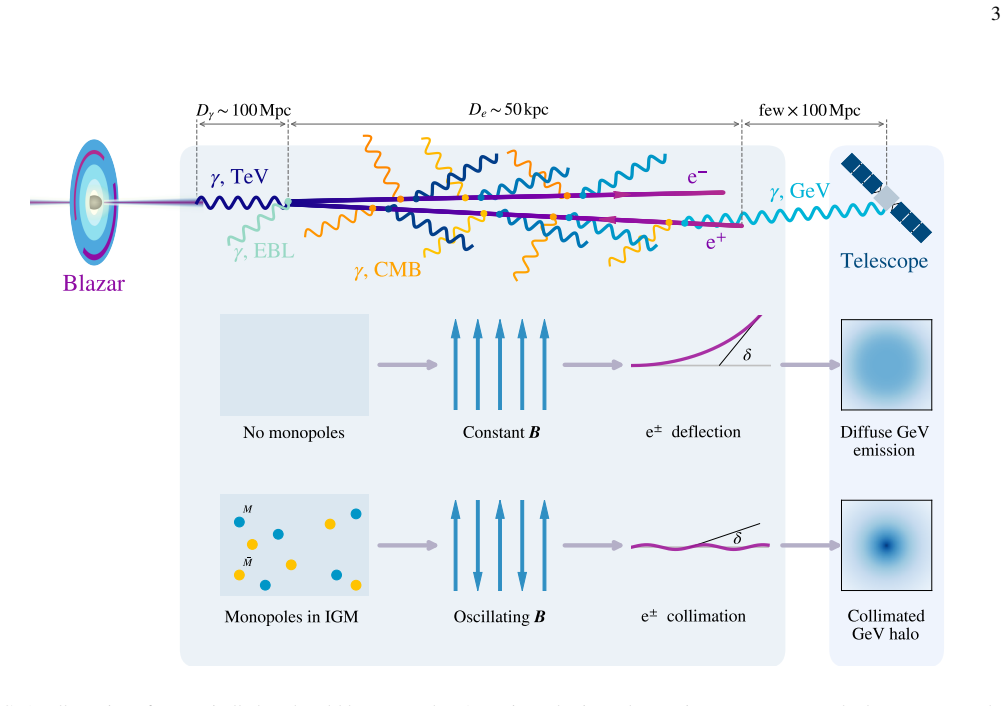
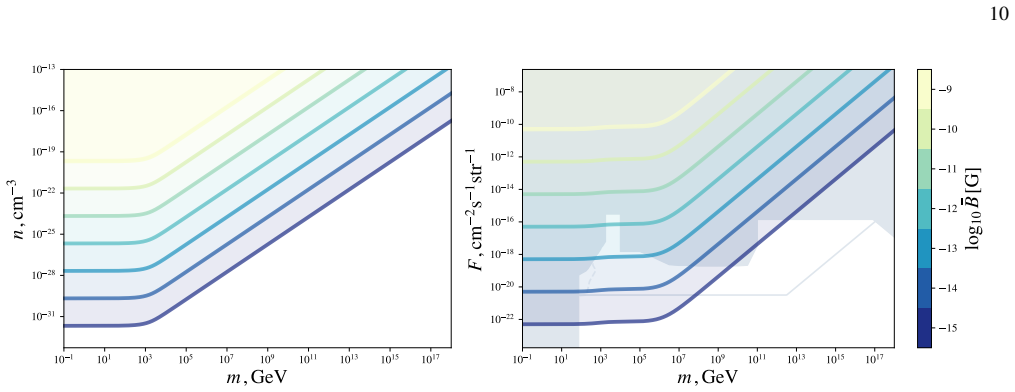
Monopole-induced oscillations of the intergalactic magnetic field lead to collimation of electrically charged particle trajectories, reducing the deflection angle in electromagnetic cascades of TeV blazars and decreasing the angular size of blazar secondary GeV halos. Constraints on the secondary halo angular size from combined H.E.S.S. and Fermi-LAT observations therefore translate into bounds on the magnetic monopole abundance, with the bound on the flux reaching F ≲ 6 × 10^{-23} cm^{-2} s^{-1} str^{-1} for low-mass monopoles m ≲ 10^6 GeV.
What carries the argument
Monopole-induced magnetic plasma oscillations that collimate trajectories of charged particles in the intergalactic magnetic field.
If this is right
- The deflection angle of charged particles in blazar cascades is reduced by the collimation effect.
- The angular size of secondary GeV halos around TeV blazars decreases.
- Upper bounds on monopole flux can be derived that are stronger than previous laboratory and astrophysical limits for low-mass monopoles.
- The lower bound on the strength of the intergalactic magnetic field inferred from TeV blazar observations must be revised to a higher value if monopoles are present at non-zero abundance.
Where Pith is reading between the lines
- If the collimation effect holds, similar impacts could appear in other high-energy astrophysical processes involving particle propagation through magnetic fields.
- Future measurements of intergalactic magnetic field strength will determine whether these monopole bounds remain competitive.
- Non-detection of the predicted halo size reduction would constrain the monopole abundance more tightly or falsify the oscillation mechanism in this context.
Load-bearing premise
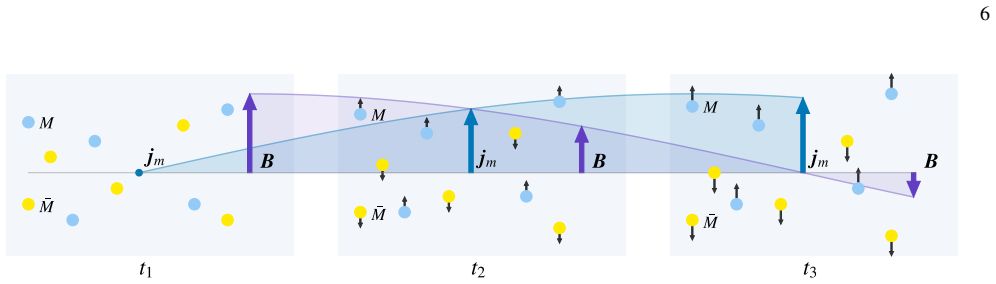
Monopoles in an astrophysical magnetic field induce a magnetic version of plasma oscillations that produce collimation of electrically charged particle trajectories.
What would settle it
An observation of the angular size of the GeV halo around blazar 1ES 0229+200 that matches the size expected from deflection by the intergalactic magnetic field without any additional collimation from monopoles.
Figures
read the original abstract
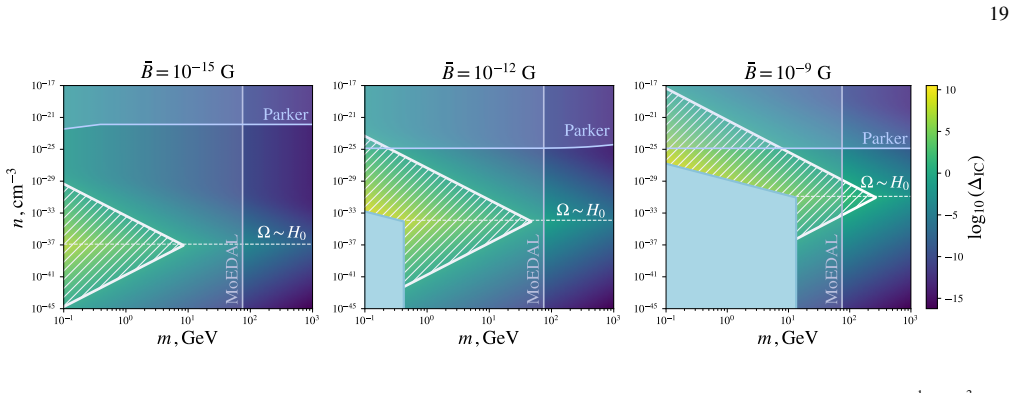
Magnetic monopoles arise in many beyond Standard Model scenarios, symmetrize Maxwell's equations, and their existence would be tied to the quantization of electric charge. It has been argued that, when placed in an astrophysical magnetic field, monopoles can induce a magnetic version of plasma oscillations. In this work, we explore monopole-induced oscillations of the intergalactic magnetic field (IGMF). We show that monopole-induced oscillations of the magnetic field lead to collimation of electrically charged particle trajectories, reducing the usual deflection by the magnetic field. The collimation effect impacts the deflection angle in the electromagnetic cascades of TeV blazars and leads to a decrease in the angular size of blazar secondary GeV halos. Therefore, the constraints on the secondary halo angular size from combined H.E.S.S. and Fermi-LAT observations translate into bounds on the magnetic monopole abundance. The bounds on the magnetic monopole flux obtained in this work from blazar 1ES 0229+200, depending on the IGMF strength, can be as strong as $F \lesssim 6 \times 10^{-23}\, \text{cm}^{-2} \text{s}^{-1} \text{str}^{-1}$ for low-mass monopoles $m \lesssim 10^6\, \text{GeV}$, stronger than existing laboratory and astrophysical bounds. The bound becomes subdominant to current constraints if the present-day IGMF value is stronger than $B \gtrsim 10^{-12}\, \text{G}$. At the same time, in the case of non-zero monopole abundance, the IGMF lower bound from TeV observations itself should be revised, resulting in a stronger lower bound at higher monopole number density.
Editorial analysis
A structured set of objections, weighed in public.
Referee Report
Summary. The manuscript claims that magnetic monopoles placed in the IGMF induce a magnetic version of plasma oscillations that collimate trajectories of electrically charged particles, thereby reducing the usual magnetic deflection angle in electromagnetic cascades initiated by TeV blazars. This reduced deflection decreases the angular size of secondary GeV halos. Constraints on halo angular size from combined H.E.S.S. and Fermi-LAT observations of 1ES 0229+200 are then translated into upper bounds on the monopole flux, reaching F ≲ 6 × 10^{-23} cm^{-2} s^{-1} str^{-1} for m ≲ 10^6 GeV (depending on the present-day IGMF strength B), which can be stronger than existing laboratory and astrophysical bounds; the bound weakens for B ≳ 10^{-12} G, and non-zero monopole density would require revising the IGMF lower bound from TeV data.
Significance. If the collimation mechanism is quantitatively valid and applicable at the relevant IGMF strengths (B ≲ 10^{-12} G), the derived monopole flux limits would be competitive with or exceed current constraints for low-mass monopoles, while also identifying an interplay between monopole abundance and IGMF bounds. The work provides a novel astrophysical probe that could be falsifiable with improved halo observations, but its impact hinges on verification of the oscillation-induced collimation effect.
major comments (2)
- [Abstract and §1] Abstract and §1: The central collimation effect is introduced only with the phrase 'it has been argued that' monopoles induce magnetic plasma oscillations leading to reduced deflection; no re-derivation, oscillation frequency, damping timescale, or explicit collimation factor is provided for IGMF values B ≲ 10^{-12} G or masses m ≲ 10^6 GeV. This step is load-bearing because the flux bound is obtained by mapping the reduced deflection directly onto the observed halo angular size of 1ES 0229+200.
- [Bounds derivation] Bounds derivation (likely §3–4): The quantitative mapping from monopole number density to halo-size reduction (and thus the specific limit F ≲ 6 × 10^{-23} cm^{-2} s^{-1} str^{-1}) cannot be verified without an explicit calculation of the oscillation-induced trajectory collimation; the bound is stated to depend strongly on the external IGMF parameter B, but the functional dependence remains unshown.
Simulated Author's Rebuttal
We thank the referee for their thorough review and valuable feedback on our manuscript. We appreciate the recognition of the potential significance of the work and address the major comments point by point below. We agree that additional details on the collimation mechanism would improve the clarity and verifiability of our results.
read point-by-point responses
-
Referee: [Abstract and §1] Abstract and §1: The central collimation effect is introduced only with the phrase 'it has been argued that' monopoles induce magnetic plasma oscillations leading to reduced deflection; no re-derivation, oscillation frequency, damping timescale, or explicit collimation factor is provided for IGMF values B ≲ 10^{-12} G or masses m ≲ 10^6 GeV. This step is load-bearing because the flux bound is obtained by mapping the reduced deflection directly onto the observed halo angular size of 1ES 0229+200.
Authors: The manuscript builds upon the established result from prior literature regarding monopole-induced magnetic plasma oscillations. Our focus is on the novel application to electromagnetic cascades from TeV blazars and the resulting constraints on monopole flux. We acknowledge that providing a brief re-derivation or explicit expressions for the oscillation frequency, damping timescale, and collimation factor in the relevant parameter range would strengthen the presentation. We will include this in a revised version of §1. revision: yes
-
Referee: [Bounds derivation] Bounds derivation (likely §3–4): The quantitative mapping from monopole number density to halo-size reduction (and thus the specific limit F ≲ 6 × 10^{-23} cm^{-2} s^{-1} str^{-1}) cannot be verified without an explicit calculation of the oscillation-induced trajectory collimation; the bound is stated to depend strongly on the external IGMF parameter B, but the functional dependence remains unshown.
Authors: We note that the dependence on the IGMF strength B is qualitatively described in the manuscript, with the bound becoming subdominant for B ≳ 10^{-12} G. However, we agree that an explicit functional form or additional details on how the monopole density maps to the reduced deflection angle would allow better verification of the quoted limit. In the revised manuscript, we will provide this mapping, either through an equation or a supplementary figure illustrating the dependence. revision: yes
Circularity Check
No significant circularity; bound is a standard observational constraint with external IGMF input
full rationale
The paper derives the monopole flux bound by requiring that the halo angular size (after incorporating reduced deflection from the claimed collimation effect) does not exceed the observed size for 1ES 0229+200. The IGMF strength B enters as an external parameter that is varied, not fitted to the monopole result. No quoted step equates a 'prediction' to a fitted input by construction, and the central mapping from monopole density to halo size is presented as an independent calculation rather than a renaming or self-referential definition. The introductory phrase 'it has been argued that' does not constitute a load-bearing self-citation chain that forces the final bound.
Axiom & Free-Parameter Ledger
free parameters (2)
- present-day IGMF strength B
- monopole mass m
axioms (2)
- domain assumption Monopoles in an astrophysical magnetic field induce plasma oscillations that collimate charged-particle trajectories
- domain assumption Observed angular size of blazar secondary GeV halos can be directly compared to the deflection angle modified by monopole collimation
Reference graph
Works this paper leans on
-
[1]
collimation
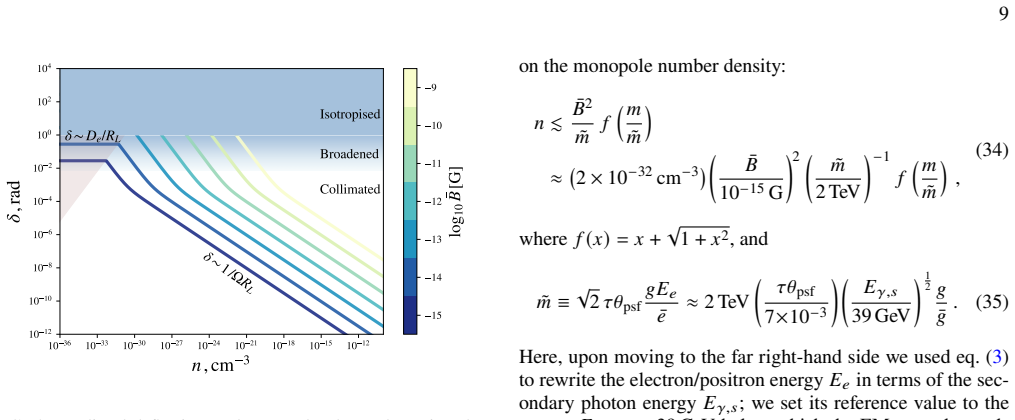
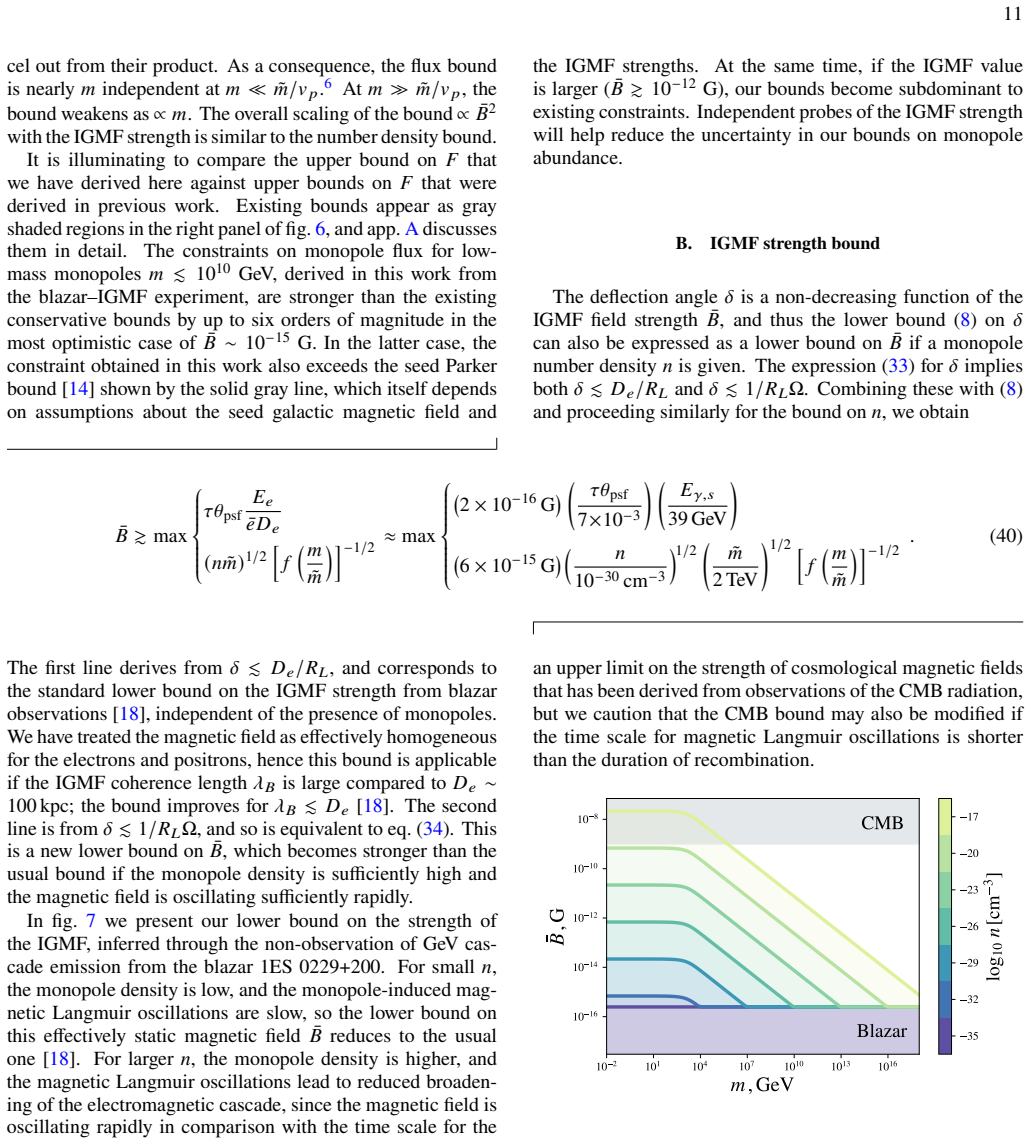
This is seen in the plot, however we ignored this in the approximate expression (39). anupperlimitonthestrengthofcosmologicalmagneticfields thathasbeenderivedfromobservationsoftheCMBradiation, but we caution that the CMB bound may also be modified if the time scale for magnetic Langmuir oscillations is shorter than the duration of recombination. 10 2 101 ...
-
[2]
6 assumes¯𝐵≲10 −10 G, while for ¯𝐵=10 −9 Gthe limit goes down to the position of the gray dashed line [53]
in the mass range from10 4 to10 11 GeV, while the Pierre Auger cosmic ray observatory constrains low mass monopoles𝑚≲10 3 GeVwith the flux bound going down to 𝐹≲10 −21cm−2 s−1 str−1 [52] (see [53] for the derivation of theapplicablemassrangesforbothlimits.) Thedetailedmass dependenceoftheAugerlimitdependsontheIGMFstrength, as the IGMFs affect the monopole...
-
[3]
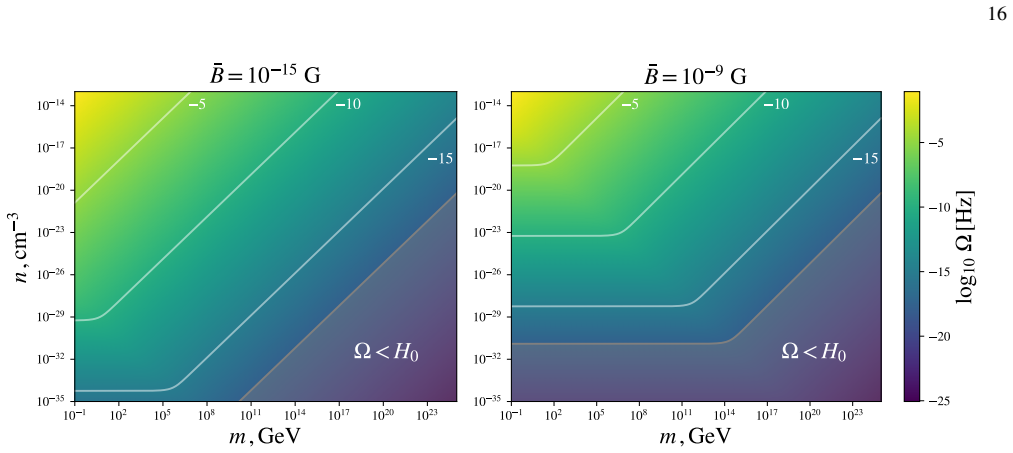
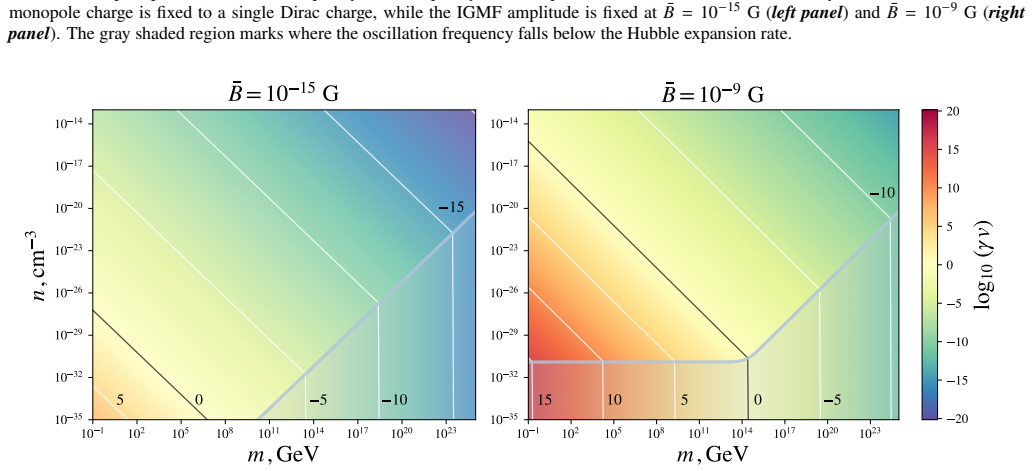
Here we discuss the velocityofmonopoleswithawiderangeofdensities,including cases where the plasma oscillation does not finish one cycle within a Hubble time
Plasma oscillation frequency and Hubble rate Upon deriving blazar limits on the monopole density in the main text, we were interested in densities large enough to source plasma oscillation periods shorter than the distance traveled by the electrons/positrons𝐷𝑒, which in turn is much shorter than the Hubble radius𝐻 −1 0 . Here we discuss the velocityofmono...
-
[4]
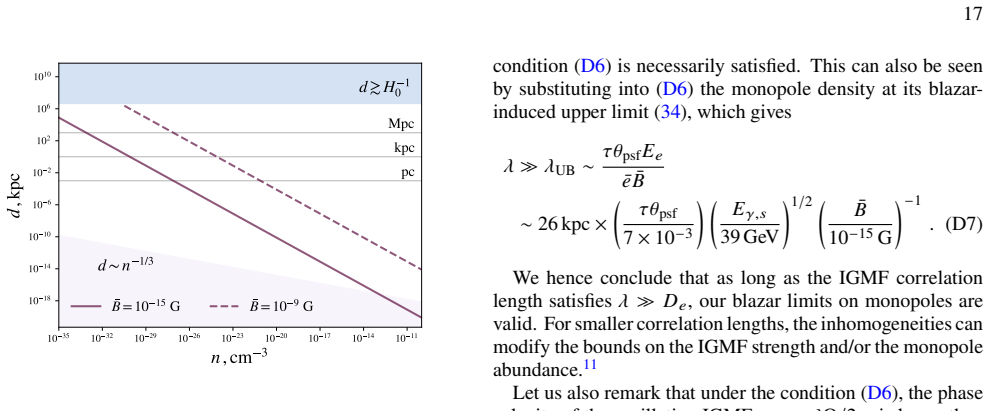
Monopole displacement and inter-monopole distance One characteristic spatial scale of monopole magnetic plasma oscillations, under the assumption of a spatially uni- form magnetic field, is the displacement of the individual monopoles during the oscillations, as derived in (B6). This can be rewritten as 𝑑= ¯𝐵 𝑔𝑛 ∼ 𝑔 ¯𝑔 −1 𝑛 10−30cm−3 −1 ¯𝐵 10−15G kpc.(C9)...
-
[5]
Inverse Compton scattering of CMB photons We begin by assessing the energy loss of monopoles via inverse Compton (IC) scattering of CMB photons. The IC radiationpowerofmagneticmonopolesisanalogoustothatof electrically charged particles and, in the Thomson regime 𝛾𝜖CMB ≪𝑚,(E1) it is given by [60]: 𝑃IC = 4 3 𝜎 𝑀 𝑇 𝑢CMB𝛾2𝑣 2 ,(E2) 11 Even if the IGMF is init...
-
[6]
Larmor radiation Magnetic monopoles placed in a magnetic field experience acceleration and therefore emit Larmor radiation, similarly to accelerating electrically charged particles. To evaluate the radiationemissionpowerofamonopole,weusetherelativistic version of the Larmor formula and replace the electric charge with the magnetic: 𝑃L = 𝑔2𝛾6 6𝜋 ( ¤𝒗) 2 − ...
-
[7]
These energy losses are dominated by electrons in the plasma, while contributions from protons and ions are suppressedbyafactorof𝑚 𝑒/𝑚 𝑝,𝑖
Coulomb-like scatterings of IGM We now estimate the energy dissipation in the monopole–magnetic field system due to Coulomb-like scat- terings between monopoles and electrically charged particles in the IGM. These energy losses are dominated by electrons in the plasma, while contributions from protons and ions are suppressedbyafactorof𝑚 𝑒/𝑚 𝑝,𝑖. Thecorres...
-
[8]
IVA do not apply if the energy of the monopole–IGMF system is significantly dissipated
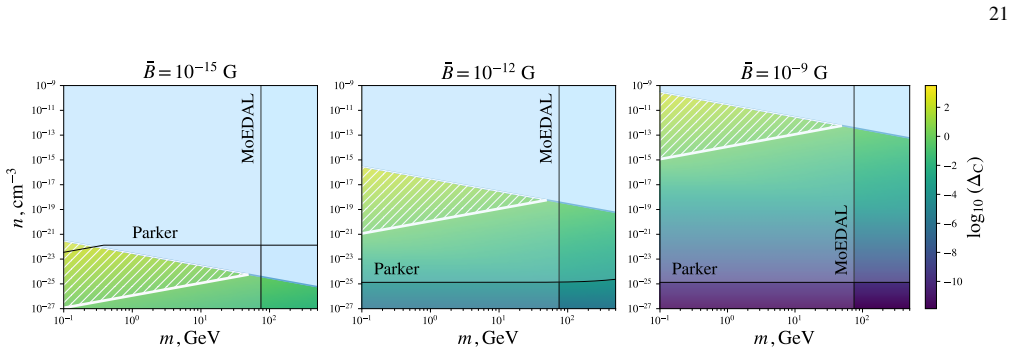
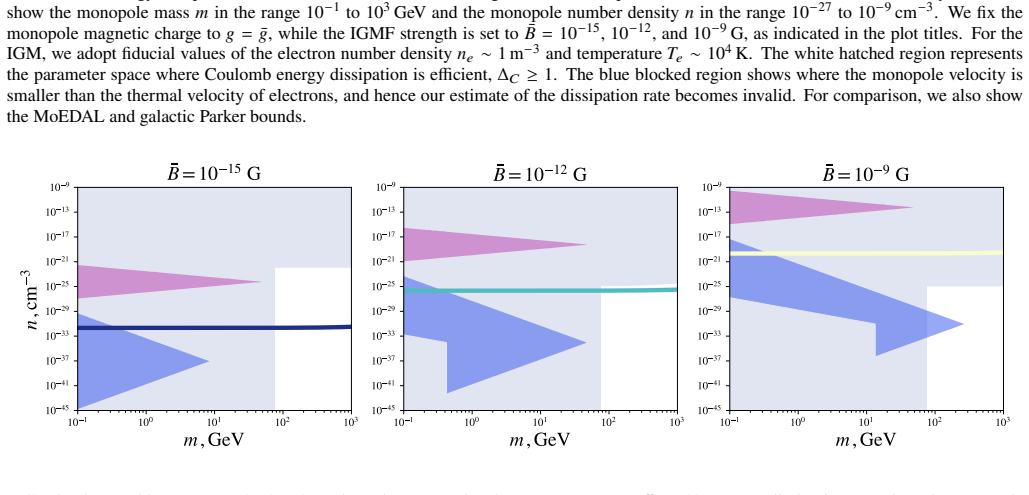
Dissipation impact on TeV blazar monopole bound The monopole abundance bounds from TeV blazar obser- vations presented in Sec. IVA do not apply if the energy of the monopole–IGMF system is significantly dissipated. The most efficient dissipation mechanisms are IC and Coulomb energylosses,asdiscussedabove. Bothmechanismsaremore efficient at lower monopole ...
-
[9]
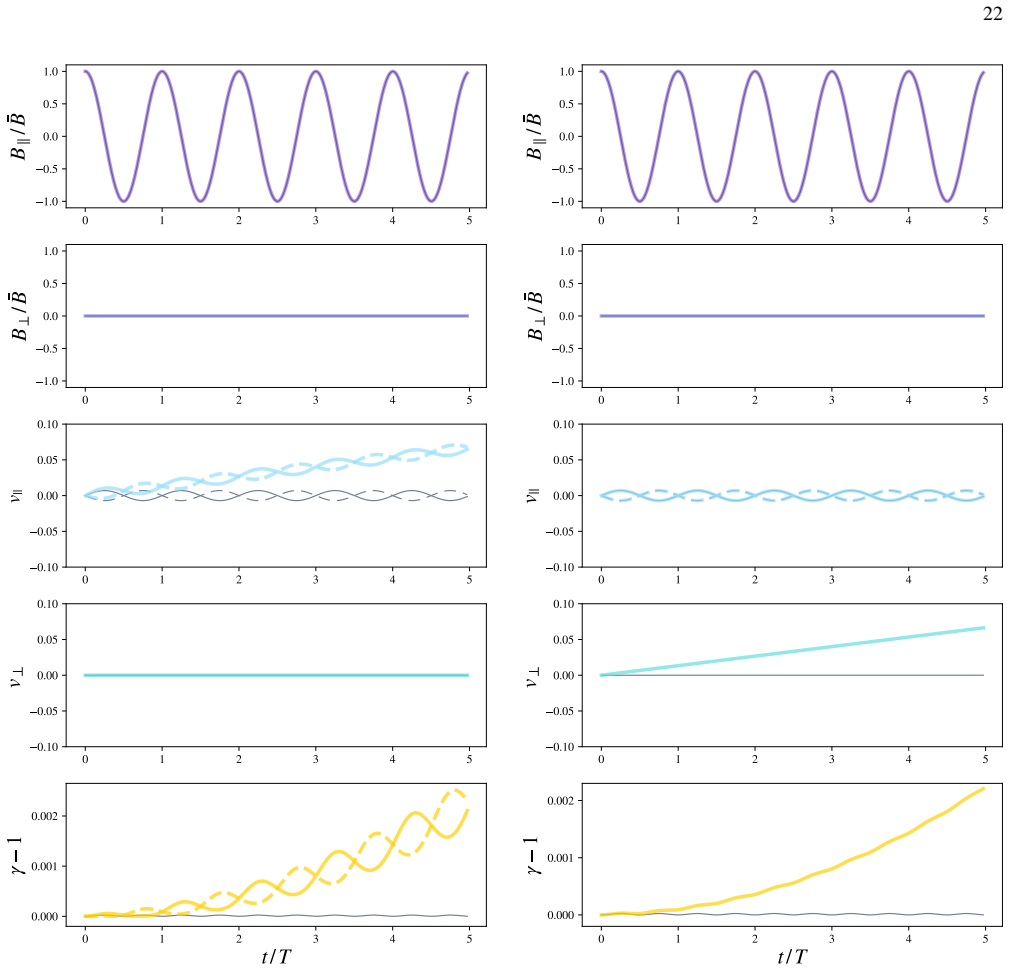
Parallel gravitational force First, we consider the impact of a parallel external force. Since we neglect the initial monopole velocity, and because monopoles are accelerated by both the magnetic field and the parallel external force, only the parallel component of the monopolevelocityispresent,𝒗=𝒗 ∥. Inthisscenario,eq.(F3) leads to an equation for magnet...
-
[10]
Perpendicular gravitational force Nowweconsidertheimpactofanexternalforceperpendic- ular to the initial direction of magnetic field𝑭=𝑭⊥. In this scenario,themonopolesdevelopbothparallelandperpendicu- larvelocitycomponents𝒗 M, ¯M =𝒗 ∥ M, ¯M +𝒗 ⊥ M, ¯M,andifthisleadsto the presence of a perpendicular current, a perpendicular com- ponent of the magnetic fiel...
-
[11]
Dirac,Quantised singularities in the electromagnetic field,,Proc
P.A.M. Dirac,Quantised singularities in the electromagnetic field,,Proc. Roy. Soc. Lond. A133(1931) 60
1931
-
[12]
’t Hooft,Magnetic Monopoles in Unified Gauge Theories, Nucl
G. ’t Hooft,Magnetic Monopoles in Unified Gauge Theories, Nucl. Phys. B79(1974) 276
1974
-
[13]
Polyakov,Particle Spectrum in Quantum Field Theory, JETP Lett.20(1974) 194
A.M. Polyakov,Particle Spectrum in Quantum Field Theory, JETP Lett.20(1974) 194
1974
-
[14]
Preskill,Magnetic monopoles,Annual Review of Nuclear and Particle Science34(1984) 461
J. Preskill,Magnetic monopoles,Annual Review of Nuclear and Particle Science34(1984) 461
1984
-
[15]
Milton,Theoretical and experimental status of magnetic monopoles,Reports on Progress in Physics69(2006) 1637–1711
K.A. Milton,Theoretical and experimental status of magnetic monopoles,Reports on Progress in Physics69(2006) 1637–1711
2006
-
[16]
E.J. Weinberg and P. Yi,Magnetic Monopole Dynamics, Supersymmetry, and Duality,Phys. Rept.438(2007) 65 [hep-th/0609055]
Pith/arXiv arXiv 2007
-
[17]
Rajantie,Introduction to Magnetic Monopoles,Contemp
A. Rajantie,Introduction to Magnetic Monopoles,Contemp. Phys.53(2012) 195 [1204.3077]
Pith/arXiv arXiv 2012
-
[18]
N.E. Mavromatos and V.A. Mitsou,Magnetic monopoles revisited: Models and searches at colliders and in the Cosmos, Int. J. Mod. Phys. A35(2020) 2030012 [2005.05100]. [9]Particle Data Groupcollaboration,Review of particle physics,Phys. Rev. D110(2024) 030001
arXiv 2020
-
[19]
Mitsou,Magnetic Monopoles – From Dirac to the Large Hadron Collider,2605.02869
V.A. Mitsou,Magnetic Monopoles – From Dirac to the Large Hadron Collider,2605.02869
-
[20]
Parker,Magnetic Monopole Plasma Oscillations and the Survival of Galactic Magnetic Fields,Astrophys
E.N. Parker,Magnetic Monopole Plasma Oscillations and the Survival of Galactic Magnetic Fields,Astrophys. J.321(1987) 349
1987
-
[21]
Parker,The Origin of Magnetic Fields,Astrophys
E.N. Parker,The Origin of Magnetic Fields,Astrophys. J.160 (1970) 383
1970
-
[22]
Turner, E.N
M.S. Turner, E.N. Parker and T.J. Bogdan,Magnetic monopoles and the survival of galactic magnetic fields,Phys. Rev. D26(1982) 1296
1982
-
[23]
Adams, M
F.C. Adams, M. Fatuzzo, K. Freese, G. Tarle, R. Watkins and M.S. Turner,Extension of the Parker bound on the flux of magnetic monopoles,Phys. Rev. Lett.70(1993) 2511
1993
-
[24]
A.J. Long and T. Vachaspati,Morphology of blazar-induced gamma ray halos due to a helical intergalactic magnetic field, JCAP09(2015) 065 [1505.07846]
Pith/arXiv arXiv 2015
-
[25]
Kobayashi and D
T. Kobayashi and D. Perri,Parker bounds on monopoles with arbitrary charge from galactic and primordial magnetic fields, Physical Review D108(2023)
2023
-
[26]
Perri, K
D. Perri, K. Bondarenko, M. Doro and T. Kobayashi, Monopole acceleration in intergalactic magnetic fields, Physics of the Dark Universe46(2024) 101704
2024
-
[27]
Neronov and I
A. Neronov and I. Vovk,Evidence for strong extragalactic magnetic fields from fermi observations of tev blazars,Science 328(2010) 73–75
2010
-
[28]
Takahashi, M
K. Takahashi, M. Mori, K. Ichiki and S. Inoue,Lower bounds on intergalactic magnetic fields from simultaneously observed gev-tev light curves of the blazar mrk 501,The Astrophysical Journal744(2011) L7
2011
-
[29]
Abramowski, F
A. Abramowski, F. Aharonian, F. Ait Benkhali, A.G. Akhperjanian, E. Angüner, G. Anton et al.,Search for extended𝛾-ray emission around agn with h.e.s.s. and fermi-lat, Astronomy & Astrophysics562(2014) A145
2014
-
[30]
Archambault, A
S. Archambault, A. Archer, W. Benbow, M. Buchovecky, V. Bugaev, M. Cerruti et al.,Search for magnetically broadened cascade emission from blazars with veritas,The Astrophysical Journal835(2017) 288
2017
-
[31]
Ackermann, M
M. Ackermann, M. Ajello, L. Baldini, J. Ballet, G. Barbiellini, D. Bastieri et al.,The search for spatial extension in high-latitude sources detected by the fermi large area telescope,The Astrophysical Journal Supplement Series237 (2018) 32
2018
-
[32]
P. Tiede, A.E. Broderick, M. Shalaby, C. Pfrommer, E. Puchwein, P. Chang et al.,Constraints on the intergalactic magnetic field from bow ties in the gamma-ray sky,The Astrophysical Journal892(2020) 123. [24]H.E.S.S., Fermi-LATcollaboration,Constraints on the Intergalactic Magnetic Field Using Fermi-LAT and H.E.S.S. Blazar Observations,Astrophys. J. Lett.9...
arXiv 2020
-
[33]
C.D. Dermer, M. Cavadini, S. Razzaque, J.D. Finke, J. Chiang and B. Lott,Time Delay of Cascade Radiation for TeV Blazars and the Measurement of the Intergalactic Magnetic Field, Astrophys. J. Lett.733(2011) L21 [1011.6660]
Pith/arXiv arXiv 2011
-
[34]
Broderick, P
A.E. Broderick, P. Chang and C. Pfrommer,The cosmological impact of luminous tev blazars. i. implications of plasma instabilities for the intergalactic magnetic field and extragalactic gamma-ray background,The Astrophysical Journal752(2012) 22
2012
-
[35]
Broderick, C
A.E. Broderick, C. Pfrommer, E. Puchwein and P. Chang, Implications of plasma beam instabilities for the statistics of thefermihard gamma-ray blazars and the origin of the extragalactic gamma-ray background,The Astrophysical Journal790(2014) 137
2014
-
[36]
Chang, A.E
P. Chang, A.E. Broderick, C. Pfrommer, E. Puchwein, A. Lamberts and M. Shalaby,The effect of nonlinear landau damping on ultrarelativistic beam plasma instabilities,The Astrophysical Journal797(2014) 110
2014
-
[37]
Chang, A.E
P. Chang, A.E. Broderick, C. Pfrommer, E. Puchwein, A. Lamberts, M. Shalaby et al.,The linear instability of dilute ultrarelativistic e±pair beams,The Astrophysical Journal833 (2016) 118
2016
-
[38]
Shalaby, A.E
M. Shalaby, A.E. Broderick, P. Chang, C. Pfrommer, A. Lamberts and E. Puchwein,Growth of beam–plasma instabilities in the presence of background inhomogeneity,The Astrophysical Journal859(2018) 45
2018
-
[39]
Broderick, P
A.E. Broderick, P. Tiede, P. Chang, A. Lamberts, C. Pfrommer, E. Puchwein et al.,Missing gamma-ray halos and the need for new physics in the gamma-ray sky,The Astrophysical Journal 868(2018) 87
2018
-
[40]
Shalaby, A.E
M. Shalaby, A.E. Broderick, P. Chang, C. Pfrommer, E. Puchwein and A. Lamberts,The growth of the longitudinal beam–plasma instability in the presence of an inhomogeneous background,Journal of Plasma Physics86(2020)
2020
-
[41]
Lamberts, E
A. Lamberts, E. Puchwein, C. Pfrommer, P. Chang, M. Shalaby, A. Broderick et al.,Constraining blazar heating with the2≲𝑧≲3lyman-𝛼forest,Monthly Notices of the Royal Astronomical Society512(2022) 3045–3059
2022
- [42]
-
[43]
A. Zucca, Y. Li and L. Pogosian,Constraints on Primordial Magnetic Fields from Planck combined with the South Pole TelescopeCMBB-modepolarizationmeasurements,Phys.Rev. D95(2017) 063506 [1611.00757]
Pith/arXiv arXiv 2017
-
[44]
K. Jedamzik and A. Saveliev,Stringent Limit on Primordial Magnetic Fields from the Cosmic Microwave Background Radiation,Phys. Rev. Lett.123(2019) 021301 [1804.06115]. 25
Pith/arXiv arXiv 2019
-
[45]
Aghanim, Y
N. Aghanim, Y. Akrami, M. Ashdown, J. Aumont, C. Baccigalupi, M. Ballardini et al.,Planck2018 results: Vi. cosmological parameters,Astronomy & Astrophysics641 (2020) A6
2020
-
[46]
Neronov and D.V
A. Neronov and D.V. Semikoz,Sensitivity of𝛾-ray telescopes for detection of magnetic fields in the intergalactic medium, Physical Review D80(2009)
2009
-
[47]
C.D. Arrowsmith et al.,Suppression of pair beam instabilities in a laboratory analogue of blazar pair cascades,Proc. Nat. Acad. Sci.122(2025) e2513365122 [2509.09040]
arXiv 2025
-
[48]
A.E. Broderick, P. Tiede, M. Shalaby, C. Pfrommer, E. Puchwein, P. Chang et al.,Bow Ties in the Sky I: The Angular Structure of Inverse Compton Gamma-ray Halos in the Fermi Sky,Astrophys. J.832(2016) 109 [1609.00387]
Pith/arXiv arXiv 2016
-
[49]
P. Tiede, A.E. Broderick, M. Shalaby, C. Pfrommer, E. Puchwein, P. Chang et al.,Bow Ties in the Sky. II. Searching for Gamma-Ray Halos in the Fermi Sky Using Anisotropy, Astrophys. J.850(2017) 157 [1702.02585]
Pith/arXiv arXiv 2017
-
[50]
B. Stern and I. Tkachev,New Method for Investigating the Presence of Extragalactic Magnetic Fields,2512.03192
-
[51]
F. Tavecchio, G. Ghisellini, L. Foschini, G. Bonnoli, G. Ghirlanda and P. Coppi,The intergalactic magnetic field constrained by Fermi/LAT observations of the TeV blazar 1ES 0229+200,Mon. Not. Roy. Astron. Soc.406(2010) L70 [1004.1329]
Pith/arXiv arXiv 2010
-
[52]
F.W. Stecker and S.T. Scully,The Spectrum of 1ES0229 + 200 and the Cosmic Infrared Background,Astron. Astrophys.478 (2008) L1 [0710.2252]
Pith/arXiv arXiv 2008
-
[53]
E. Aliu et al.,A three-year multi-wavelength study of the very-high-energy𝛾-ray blazar 1ES 0229+200,Astrophys. J. 782(2014) 13 [1312.6592]
Pith/arXiv arXiv 2014
-
[54]
Domínguez, J.R
A. Domínguez, J.R. Primack, D.J. Rosario, F. Prada, R.C. Gilmore, S.M. Faber et al.,Extragalactic background light inferred from aegis galaxy-sed-type fractions: Ebl from aegis galaxy-sed-type fractions,Monthly Notices of the Royal Astronomical Society410(2010) 2556–2578
2010
-
[55]
A.J. Long and T. Vachaspati,Implications of a Primordial Magnetic Field for Magnetic Monopoles, Axions, and Dirac Neutrinos,Phys. Rev. D91(2015) 103522 [1504.03319]
Pith/arXiv arXiv 2015
-
[56]
Acharya, J
B. Acharya, J. Alexandre, P. Benes, B. Bergmann, S. Bertolucci, A. Bevan et al.,Search for magnetic monopoles produced via the schwinger mechanism,Nature602(2022) 63–67
2022
-
[57]
M. Ambrosio et al.,Final results of magnetic monopole searches with the macro experiment,The European Physical Journal C25(2002) 511–522. [51]IceCubecollaboration,Search for Relativistic Magnetic Monopoles with Eight Years of IceCube Data,Phys. Rev. Lett. 128(2022) 051101 [2109.13719]. [52]Pierre Augercollaboration,Search for ultrarelativistic magnetic mo...
arXiv 2002
-
[58]
Perri, M
D. Perri, M. Doro and T. Kobayashi,Recasting experimental constraints on relativistic magnetic monopoles,Physics of the Dark Universe50(2025) 102134
2025
-
[59]
T.C. Arlen, V.V. Vassiliev, T. Weisgarber, S.P. Wakely and S.Y. Shafi,Intergalactic Magnetic Fields and Gamma Ray Observations of Extreme TeV Blazars,Astrophys. J.796(2014) 18 [1210.2802]
Pith/arXiv arXiv 2014
-
[60]
W. Essey, S. Ando and A. Kusenko,Determination of intergalactic magnetic fields from gamma ray data,Astropart. Phys.35(2011) 135 [1012.5313]
Pith/arXiv arXiv 2011
-
[61]
W. Essey, O. Kalashev, A. Kusenko and J.F. Beacom,Role of line-of-sight cosmic ray interactions in forming the spectra of distant blazars in TeV gamma rays and high-energy neutrinos, Astrophys. J.731(2011) 51 [1011.6340]. [57]MoEDAL Collaborationcollaboration,Search for highly ionizing particles in𝑝 𝑝collisions during lhc run 2 using the full moedal detec...
Pith/arXiv arXiv 2011
-
[62]
Witten,Baryons in the 1/N Expansion,Nucl
E. Witten,Baryons in the 1/N Expansion,Nucl. Phys. B160 (1979) 57
1979
-
[63]
Drukier and S
A.K. Drukier and S. Nussinov,Monopole Pair Creation in Energetic Collisions: Is It Possible?,Phys. Rev. Lett.49(1982) 102
1982
-
[64]
Osborne,Limits on magnetic monopole fluxes in the primary cosmic radiation from inverse compton scattering and muon-poor extensive air showers,Phys
W.Z. Osborne,Limits on magnetic monopole fluxes in the primary cosmic radiation from inverse compton scattering and muon-poor extensive air showers,Phys. Rev. Lett.24(1970) 1441
1970
-
[65]
Baines, N.E
S. Baines, N.E. Mavromatos, V.A. Mitsou, J.L. Pinfold and A. Santra,Monopole production via photon fusion and drell–yan processes: Madgraph implementation and perturbativity via velocity-dependent coupling and magnetic moment as novel features,The European Physical Journal C 78(2018)
2018
-
[66]
Leite, C
N. Leite, C. Evoli, M. D’Angelo, B. Ciardi, G. Sigl and A. Ferrara,Do cosmic rays heat the early intergalactic medium?,Monthly Notices of the Royal Astronomical Society 469(2017) 416–424
2017
discussion (0)
Sign in with ORCID, Apple, or X to comment. Anyone can read and Pith papers without signing in.