Double-real corrections to color singlet decay in a parton-shower inspired scheme
Pith reviewed 2026-06-26 01:44 UTC · model grok-4.3
The pith
Local subtraction with scalar radiators renders double-real corrections finite for color-singlet decays at NNLO.
A machine-rendered reading of the paper's core claim, the machinery that carries it, and where it could break.
Core claim
The authors introduce a local infrared subtraction method for NNLO QCD in color singlet decays. Counterterms are based on scalar radiators and pure splitting functions. Singularities are disentangled by partial fractioning and kinematics correspond to iterated NLO mappings. They verify that the double-real remainder for e+e- to q qbar is finite in single and double unresolved limits. The phase-space integrals of scalar counterterms are computed in the back-to-back configuration.
What carries the argument
The local infrared subtraction method based on scalar radiators and splitting functions with partial fractioning for overlapping singularities.
If this is right
- The subtracted double-real contribution can be integrated numerically with Monte Carlo methods.
- Phase space integrals of the counterterms can be evaluated both analytically and numerically in back-to-back kinematics.
- The scheme allows handling of overlapping singularities in multipole radiation patterns for color singlet processes.
- Finiteness holds in both single and double unresolved limits for the tested decay.
Where Pith is reading between the lines
- The scheme may extend to processes with initial-state radiation or more complex final states.
- It could facilitate consistent matching between fixed-order NNLO results and parton showers.
- Numerical convergence properties might be tested in applications beyond the back-to-back configuration.
Load-bearing premise
The counterterms from scalar radiators and splitting functions, after partial fractioning, cancel all infrared singularities in the double-real emissions for color singlet decays.
What would settle it
A numerical evaluation showing that the subtracted double-real remainder diverges in the double unresolved limit for the e+e- to q qbar process would falsify the claim.
Figures

read the original abstract
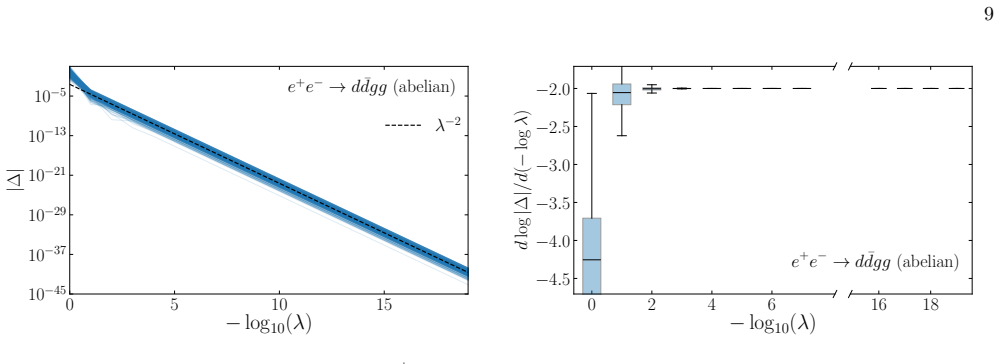
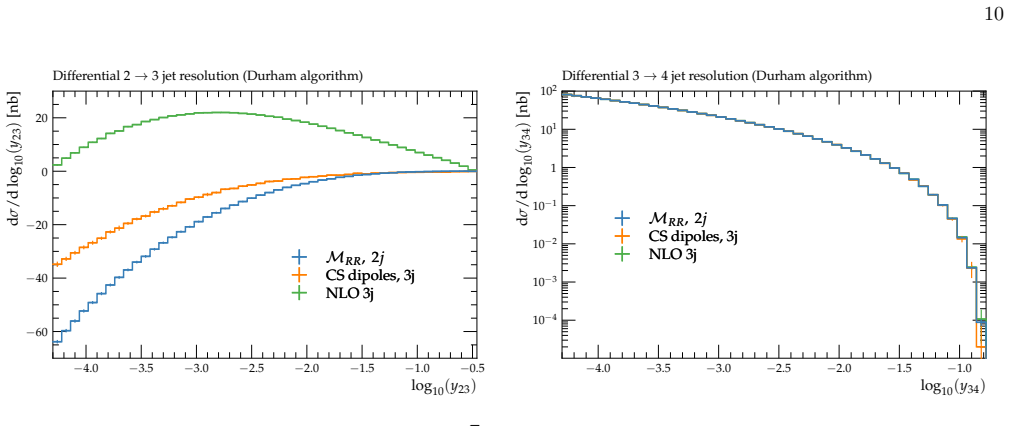
We introduce a local infrared subtraction method for next-to-next-to-leading order QCD calculations in color singlet decays, with counterterms based on scalar radiators and pure splitting functions. Overlapping singularities in the multipole radiation pattern are disentangled by partial fractioning, and the kinematics mapping corresponds to iterated next-to-leading order kinematics. We verify that the double-real remainder to $e^+e^-\to\;q\bar{q}$ is rendered finite in the single and double unresolved limits and investigate the numerical convergence of the Monte-Carlo integral. We compute the phase-space integrals of the scalar counterterms in the back-to-back configuration, both analytically and with the help of numerical techniques based on sector decomposition.
Editorial analysis
A structured set of objections, weighed in public.
Referee Report
Summary. The manuscript introduces a local infrared subtraction method for NNLO QCD calculations in color singlet decays, with counterterms constructed from scalar radiators and pure splitting functions. Overlapping singularities are handled via partial fractioning, and the kinematics mapping uses iterated NLO mappings. The central result is a verification that the double-real remainder to e+e−→q q¯ is finite in the single and double unresolved limits, together with analytic and numerical (sector-decomposition) evaluation of the scalar counterterm phase-space integrals in the back-to-back configuration and Monte-Carlo checks of numerical convergence.
Significance. If the cancellation holds, the scheme supplies a parton-shower-inspired local subtraction for double-real emissions in color-singlet processes, complementing existing dipole and antenna methods. Explicit analytic results for the counterterm integrals and the reported numerical convergence tests constitute concrete strengths that can be directly used or cross-checked by other groups.
minor comments (2)
- The description of the partial-fractioning procedure would benefit from an explicit example of how the overlapping double-unresolved terms are decomposed before the kinematics mapping is applied.
- A short table comparing the analytic expressions for the scalar counterterm integrals with the numerical sector-decomposition results would improve readability of the verification.
Simulated Author's Rebuttal
We thank the referee for their positive assessment of the manuscript and for recommending acceptance. No major comments were raised in the report.
Circularity Check
No significant circularity; derivation self-contained
full rationale
The paper constructs a local subtraction scheme from standard splitting functions and scalar radiators, applies partial fractioning and iterated NLO mappings, then verifies finiteness of the double-real remainder for e+e- -> q qbar via direct analytic phase-space integrals and Monte-Carlo checks. No equation reduces a claimed prediction to a fitted input by construction, no load-bearing self-citation chain is invoked, and the finiteness result is externally checkable against the matrix elements. This matches the default non-circular case.
Axiom & Free-Parameter Ledger
axioms (1)
- domain assumption Infrared singularities in double-real emissions for color singlet decays can be subtracted locally using scalar radiators and pure splitting functions after partial fractioning.
Reference graph
Works this paper leans on
-
[1]
The NLO case We begin the discussion with the simple example of an NLO calculation. The scalar radiator for the production of a single on-shell gluon from a QCD multipole formed by massless on-shell particles is given by [41, 71] Sg({p};q 1) = X i,k ˆTi ˆTk Si;k(q1),whereS i;k(q1) =− 4pipk p2 i1p2 k1 . (9) Note that we have used current conservation to el...
-
[2]
The NNLO case – Abelian contributions References [41, 72] discussed the process-independent form of the two-gluon soft / scalar radiators, which can be determined from the squared two-gluon current. The abelian component of the scalar radiator is given by S(ab) gg ({p}, q1, q2) = 2 X i,k X l,m n ˆTa i ˆTa l , ˆTb k ˆTb m o S(ab) i,k;l,m(q1, q2) + 2 X i,k ...
-
[3]
The NNLO case – Nonabelian contributions The non-abelian scalar radiator was computed in Ref. [41]. As in the abelian case, one can use charge conservation to simplify the expressions considerably. We obtain S(nab) gg ({p}, q1, q2) = X i,l CA ˆTc i ˆTc l h S(ab) i,i;l (q1, q2) +S (ab) l,l;i (q1, q2) + (1−2δ il)S (ab) i;l (q1, q2)− S (nab) i;l (q1, q2) i ....
-
[4]
(30) As in the case of gluon emissions discussed above, it is possible to eliminate gauge-dependent terms with the help of color conservation
The NNLO case – Emission of aq¯qpair The emission of a quark-antiquark pair from a pair of scalar radiators is described by the insertion operator [41, 72] Sq¯q({p};q 1, q2) = X i,k ˆTi ˆTk TR S(q¯q) i;k (q1, q2). (30) As in the case of gluon emissions discussed above, it is possible to eliminate gauge-dependent terms with the help of color conservation. ...
-
[5]
(14) S(q¯q) i;k (q1, q2) =− sik si12 sk12 4 s12 1−4 ϵik,f12 ϵ12,12 2 + 2 si12sk12 ,(32) 7 where ˜qµ 12 =q µ 12 +s 12/sik pµ ik
The singularities are made explicit by using the notation of Eq. (14) S(q¯q) i;k (q1, q2) =− sik si12 sk12 4 s12 1−4 ϵik,f12 ϵ12,12 2 + 2 si12sk12 ,(32) 7 where ˜qµ 12 =q µ 12 +s 12/sik pµ ik. The mapping to the individual collinear sectors can be performed by an angular partial fractioning of the form of Eq. (10), leading to partitioned radiatorsS (q¯q),...
-
[6]
Polarization vectors for color monopoles It is well known that axial gauges simplify the computation of collinear splitting functions and related quantities [74– 82]. The polarization tensor of an axial gauge dµν(q, n) =−g µν + qµnν +q νnµ nq − n2 qµqν (nq)2 ,(37) satisfies the physical requirements for on-shell gluons, namelyd µ µ(p, n) =D−2 andp µdµν(p,...
-
[7]
Spin-correlated subtraction terms Consider now an NLO counterterm comprised of ane +e− →q¯qgunderlying Born process, and ag→q¯qor a g→ggsplitting function. In both cases, we will have a component of the splitting function proportional to the dyadic product of two scalar interaction terms of the formd µ ν(q12, n)(q1 −q 2)ν, which arise from the “decay” of ...
1905
-
[8]
At NNLO, the technique is applied twice, with the successive assignment of the radiator performed according to the algorithms in Sec
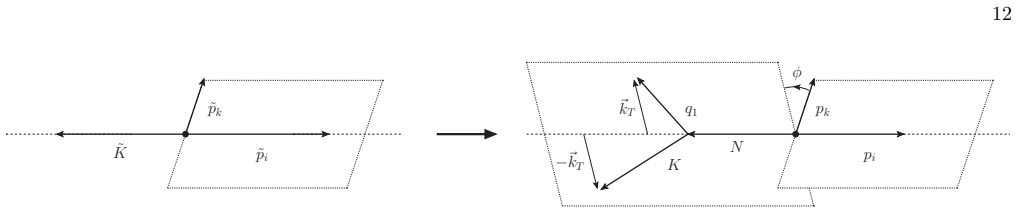
NLO kinematics Figure 3 shows the kinematics mapping we employ at NLO. At NNLO, the technique is applied twice, with the successive assignment of the radiator performed according to the algorithms in Sec. II C. The basic momentum 13 mapping was introduced in Sec. 5.6 of Ref. [64]. Beginning with Eq. (3), pµ i =z˜pµ i , N µ = ˜K µ + (1−z) ˜pµ i ,(A2) we ca...
-
[9]
NNLO kinematics The phase-space factorization at NNLO can be achieved in different ways. In a triple-collinear parametrization, the polar angle of both emitted partons is typically measured against the direction of ˜p µ i , and the longitudinal recoil is taken by partoni. We will begin by deriving theD-dimensional phase-space element in this case. A sketc...
-
[10]
F. Grosset al., Eur. Phys. J. C83, 1125 (2023), arXiv:2212.11107 [hep-ph]
arXiv 2023
-
[11]
A. Huss, J. Huston, S. Jones, and M. Pellen, J. Phys. G50, 043001 (2023), arXiv:2207.02122 [hep-ph]
arXiv 2023
-
[12]
A. Huss, J. Huston, S. Jones, M. Pellen, and R. R¨ ontsch, SciPost Phys. Comm. Rep.21(2026), 10.21468/SciPost- PhysCommRep.21, arXiv:2504.06689 [hep-ph]
work page internal anchor Pith review Pith/arXiv arXiv doi:10.21468/scipost- 2026
-
[13]
M. Benediktet al.(FCC), Eur. Phys. J. ST234, 5113 (2025), [Erratum: Eur.Phys.J.ST None, (2025)], arXiv:2505.00273 [physics.acc-ph]
arXiv 2025
-
[14]
M. Benediktet al.(FCC), Eur. Phys. J. ST234, 5713 (2025), arXiv:2505.00274 [physics.acc-ph]
arXiv 2025
-
[15]
M. Benediktet al.(FCC), Eur. Phys. J. C85, 1468 (2025), arXiv:2505.00272 [hep-ex]
Pith/arXiv arXiv 2025
-
[16]
Bloch and A
F. Bloch and A. Nordsieck, Phys. Rev.52, 54 (1937)
1937
-
[17]
Kinoshita, J
T. Kinoshita, J. Math. Phys.3, 650 (1962)
1962
-
[18]
T. D. Lee and M. Nauenberg, Phys. Rev.133, B1549 (1964)
1964
-
[19]
C. Anastasiou, K. Melnikov, and F. Petriello, Phys. Rev. D69, 076010 (2004), arXiv:hep-ph/0311311
Pith/arXiv arXiv 2004
-
[20]
C. Anastasiou, K. Melnikov, and F. Petriello, Nucl. Phys. B724, 197 (2005), arXiv:hep-ph/0501130
Pith/arXiv arXiv 2005
-
[21]
T. Binoth and G. Heinrich, Nucl. Phys. B693, 134 (2004), arXiv:hep-ph/0402265
Pith/arXiv arXiv 2004
-
[22]
K. Melnikov and F. Petriello, Phys. Rev. D74, 114017 (2006), arXiv:hep-ph/0609070
Pith/arXiv arXiv 2006
-
[23]
A. Gehrmann-De Ridder, T. Gehrmann, and E. W. N. Glover, Phys. Lett. B612, 49 (2005), arXiv:hep-ph/0502110
Pith/arXiv arXiv 2005
-
[24]
A. Gehrmann-De Ridder, T. Gehrmann, and E. W. N. Glover, JHEP09, 056 (2005), arXiv:hep-ph/0505111
Pith/arXiv arXiv 2005
-
[25]
A. Daleo, T. Gehrmann, and D. Maitre, JHEP04, 016 (2007), arXiv:hep-ph/0612257
Pith/arXiv arXiv 2007
-
[26]
A. Daleo, A. Gehrmann-De Ridder, T. Gehrmann, and G. Luisoni, JHEP01, 118 (2010), arXiv:0912.0374 [hep-ph]
Pith/arXiv arXiv 2010
-
[27]
A. Gehrmann-De Ridder, T. Gehrmann, and M. Ritzmann, JHEP10, 047 (2012), arXiv:1207.5779 [hep-ph]
Pith/arXiv arXiv 2012
-
[28]
J. Currie, E. W. N. Glover, and S. Wells, JHEP04, 066 (2013), arXiv:1301.4693 [hep-ph]
Pith/arXiv arXiv 2013
-
[29]
G. Somogyi, Z. Trocsanyi, and V. Del Duca, JHEP06, 024 (2005), arXiv:hep-ph/0502226
Pith/arXiv arXiv 2005
-
[30]
G. Somogyi, Z. Trocsanyi, and V. Del Duca, JHEP01, 070 (2007), arXiv:hep-ph/0609042
Pith/arXiv arXiv 2007
-
[31]
V. Del Duca, C. Duhr, A. Kardos, G. Somogyi, Z. Sz˝ or, Z. Tr´ ocs´ anyi, and Z. Tulip´ ant, Phys. Rev. D94, 074019 (2016), arXiv:1606.03453 [hep-ph]. 17
Pith/arXiv arXiv 2016
-
[32]
V. Del Duca, C. Duhr, L. Fekeshazy, F. Guadagni, P. Mukherjee, G. Somogyi, F. Tramontano, and S. Van Thurenhout, JHEP05, 151 (2025), arXiv:2412.21028 [hep-ph]
arXiv 2025
-
[33]
V. Del Duca, G. Somogyi, and F. Tramontano, (2025), arXiv:2512.05192 [hep-ph]
arXiv 2025
-
[34]
M. Czakon, Phys. Lett. B693, 259 (2010), arXiv:1005.0274 [hep-ph]
Pith/arXiv arXiv 2010
-
[35]
M. Czakon, Nucl. Phys. B849, 250 (2011), arXiv:1101.0642 [hep-ph]
Pith/arXiv arXiv 2011
-
[36]
R. Boughezal, K. Melnikov, and F. Petriello, Phys. Rev. D85, 034025 (2012), arXiv:1111.7041 [hep-ph]
Pith/arXiv arXiv 2012
-
[37]
M. Czakon and D. Heymes, Nucl. Phys. B890, 152 (2014), arXiv:1408.2500 [hep-ph]
Pith/arXiv arXiv 2014
-
[38]
F. Caola, K. Melnikov, and R. R¨ ontsch, Eur. Phys. J. C77, 248 (2017), arXiv:1702.01352 [hep-ph]
Pith/arXiv arXiv 2017
- [39]
- [40]
-
[41]
L. Magnea, E. Maina, G. Pelliccioli, C. Signorile-Signorile, P. Torrielli, and S. Uccirati, JHEP12, 062 (2018), arXiv:1809.05444 [hep-ph]
Pith/arXiv arXiv 2018
-
[42]
L. Magnea, E. Maina, G. Pelliccioli, C. Signorile-Signorile, P. Torrielli, and S. Uccirati, JHEP12, 107 (2018), [Erratum: JHEP 06, 013 (2019)], arXiv:1806.09570 [hep-ph]
Pith/arXiv arXiv 2018
- [43]
-
[44]
M. Cacciari, F. A. Dreyer, A. Karlberg, G. P. Salam, and G. Zanderighi, Phys. Rev. Lett.115, 082002 (2015), [Erratum: Phys.Rev.Lett. 120, 139901 (2018)], arXiv:1506.02660 [hep-ph]
Pith/arXiv arXiv 2015
-
[45]
J. Campbell, T. Neumann, and G. Vita, JHEP05, 172 (2025), arXiv:2408.05265 [hep-ph]
arXiv 2025
-
[46]
S. Catani and M. Grazzini, Phys. Rev. Lett.98, 222002 (2007), arXiv:hep-ph/0703012
Pith/arXiv arXiv 2007
-
[47]
R. Boughezal, X. Liu, and F. Petriello, Phys. Rev. D91, 094035 (2015), arXiv:1504.02540 [hep-ph]
Pith/arXiv arXiv 2015
-
[48]
R. Boughezal, C. Focke, X. Liu, and F. Petriello, Phys. Rev. Lett.115, 062002 (2015), arXiv:1504.02131 [hep-ph]
Pith/arXiv arXiv 2015
-
[49]
J. Gaunt, M. Stahlhofen, F. J. Tackmann, and J. R. Walsh, JHEP09, 058 (2015), arXiv:1505.04794 [hep-ph]
Pith/arXiv arXiv 2015
-
[50]
J. M. Campbell, S. H¨ oche, M. Knobbe, C. T. Preuss, and D. Reichelt, Phys. Rev. D113, 054031 (2026), arXiv:2505.10408 [hep-ph]
arXiv 2026
-
[51]
S. H¨ oche, M. LeBlanc, J. Roloff, and G. Whitman, Phys. Rev. D113, 054009 (2026), arXiv:2512.07025 [hep-ph]
arXiv 2026
-
[52]
J. M. Campbellet al., SciPost Phys.16, 130 (2024), arXiv:2203.11110 [hep-ph]
arXiv 2024
- [53]
-
[54]
B. Assi and S. H¨ oche, Phys. Rev. D109, 114008 (2024), arXiv:2307.00728 [hep-ph]
arXiv 2024
-
[55]
C. T. Preuss, JHEP07, 161 (2024), arXiv:2403.19452 [hep-ph]
arXiv 2024
-
[56]
S. H¨ oche, M. Hoppe, and D. Reichelt, Phys. Rev. D113, 074032 (2026), arXiv:2508.19018 [hep-ph]
arXiv 2026
- [57]
-
[58]
J. M. Campbell, S. H¨ oche, H. T. Li, C. T. Preuss, and P. Skands, Phys. Lett. B836, 137614 (2023), arXiv:2108.07133 [hep-ph]
arXiv 2023
-
[59]
B. K. El-Menoufi, C. T. Preuss, L. Scyboz, and P. Skands, JHEP11, 045 (2025), arXiv:2412.14242 [hep-ph]
arXiv 2025
-
[60]
H¨ oche and S
S. H¨ oche and S. Prestel, Phys. Rev.D96, 074017 (2017)
2017
-
[61]
Dulat, S
F. Dulat, S. H¨ oche, and S. Prestel, Phys. Rev.D98, 074013 (2018)
2018
-
[62]
A. Gehrmann-De Ridder, T. Gehrmann, and G. Heinrich, Nucl. Phys. B682, 265 (2004), arXiv:hep-ph/0311276
Pith/arXiv arXiv 2004
-
[63]
P. Maierh¨ ofer, J. Usovitsch, and P. Uwer, Comput. Phys. Commun.230, 99 (2018), arXiv:1705.05610 [hep-ph]
Pith/arXiv arXiv 2018
- [64]
-
[65]
E. Bothmann, W. Giele, S. H¨ oche, J. Isaacson, and M. Knobbe, SciPost Phys. Codeb.2022, 3 (2022), arXiv:2106.06507 [hep-ph]
arXiv 2022
-
[66]
E. Bothmann, T. Childers, W. Giele, F. Herren, S. H¨ oche, J. Isaacson, M. Knobbe, and R. Wang, SciPost Phys.15, 169 (2023), arXiv:2302.10449 [hep-ph]
arXiv 2023
-
[67]
E. Bothmann, T. Childers, W. Giele, S. H¨ oche, J. Isaacson, and M. Knobbe, SciPost Phys.17, 081 (2024), arXiv:2311.06198 [hep-ph]
arXiv 2024
-
[68]
Gleisberg, S
T. Gleisberg, S. H¨ oche, F. Krauss, M. Sch¨ onherr, S. Schumann, F. Siegert, and J. Winter, JHEP02, 007 (2009)
2009
-
[69]
Bothmannet al., SciPost Phys.7, 034 (2019)
E. Bothmannet al., SciPost Phys.7, 034 (2019)
2019
-
[70]
Bothmannet al.(Sherpa), JHEP12, 156 (2024), arXiv:2410.22148 [hep-ph]
E. Bothmannet al.(Sherpa), JHEP12, 156 (2024), arXiv:2410.22148 [hep-ph]
arXiv 2024
-
[71]
E. Bothmann, J. M. Campbell, S. H¨ oche, and M. Knobbe, Phys. Rev. D110, L071501 (2024), arXiv:2406.07671 [hep-ph]
arXiv 2024
-
[72]
A. Gehrmann-De Ridder, T. Gehrmann, and E. W. N. Glover, Nucl. Phys. B691, 195 (2004), arXiv:hep-ph/0403057
Pith/arXiv arXiv 2004
-
[73]
S. Catani and M. H. Seymour, Nucl. Phys. B485, 291 (1997), [Erratum: Nucl.Phys.B 510, 503–504 (1998)], hep- ph/9605323
arXiv 1997
-
[74]
V. V. Sudakov, Sov. Phys. JETP3, 65 (1956)
1956
-
[75]
S. H¨ oche, F. Krauss, and D. Reichelt, Phys. Rev. D111, 094032 (2025), arXiv:2404.14360 [hep-ph]
arXiv 2025
-
[76]
S. H¨ oche, F. Krauss, P. Meinzinger, and D. Reichelt, JHEP05, 219 (2026), arXiv:2507.22837 [hep-ph]
arXiv 2026
-
[77]
Marchesini and B
G. Marchesini and B. R. Webber, Nucl. Phys.B310, 461 (1988)
1988
-
[78]
Marchesini and B
G. Marchesini and B. R. Webber, Nucl. Phys. B330, 261 (1990)
1990
-
[79]
R. K. Ellis, D. A. Ross, and A. E. Terrano, Nucl. Phys. B178, 421 (1981)
1981
-
[80]
Bassetto, M
A. Bassetto, M. Ciafaloni, and G. Marchesini, Phys. Rept.100, 201 (1983)
1983
discussion (0)
Sign in with ORCID, Apple, or X to comment. Anyone can read and Pith papers without signing in.