Dirichlet, Neumann, Mixed and self-dual holography: (self-dual) Yang--Mills theory II
Pith reviewed 2026-06-26 00:55 UTC · model grok-4.3
The pith
Holographic three- and four-point correlators relate Yang-Mills, Chalmers-Siegel and self-dual Yang-Mills theories under AdS/CFT.
A machine-rendered reading of the paper's core claim, the machinery that carries it, and where it could break.
Core claim
Within the AdS/CFT correspondence, Yang-Mills, Chalmers-Siegel and self-dual Yang-Mills theories are related at the level of observables: the three- and four-point holographic correlators computed from the derived propagators coincide across the three theories once the appropriate boundary conditions are imposed.
What carries the argument
Bulk-to-bulk and boundary-to-bulk propagators in various gauges for Dirichlet, Neumann, mixed and self-dual boundary conditions, which are used to evaluate the holographic correlators.
If this is right
- The observables of Yang-Mills, Chalmers-Siegel and self-dual Yang-Mills become directly comparable through their holographic three- and four-point functions.
- Different boundary conditions select which of the three theories appears on the boundary.
- Self-dual boundary conditions isolate the self-dual Yang-Mills sector while still reproducing consistent correlators.
- The same propagators support correlator calculations in all three formulations, confirming internal consistency of the holographic setup.
Where Pith is reading between the lines
- The same propagator construction could be applied to compute higher-point correlators and test whether the relations persist beyond four points.
- Mixed boundary conditions may interpolate between the three theories, offering a continuous parameter that tunes the amount of self-duality.
- The approach suggests that self-dual Yang-Mills can serve as a simplified holographic model whose correlators still capture essential features of the full theory.
Load-bearing premise
The AdS/CFT correspondence applies directly to Chalmers-Siegel and self-dual Yang-Mills theories with the listed boundary conditions and that the derived propagators produce consistent correlators that can be compared across formulations.
What would settle it
A mismatch between the three-point holographic correlators computed in the three theories that cannot be reconciled by the choice of boundary conditions would show the claimed relations do not hold.
Figures

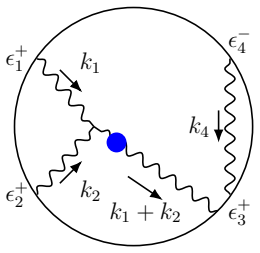
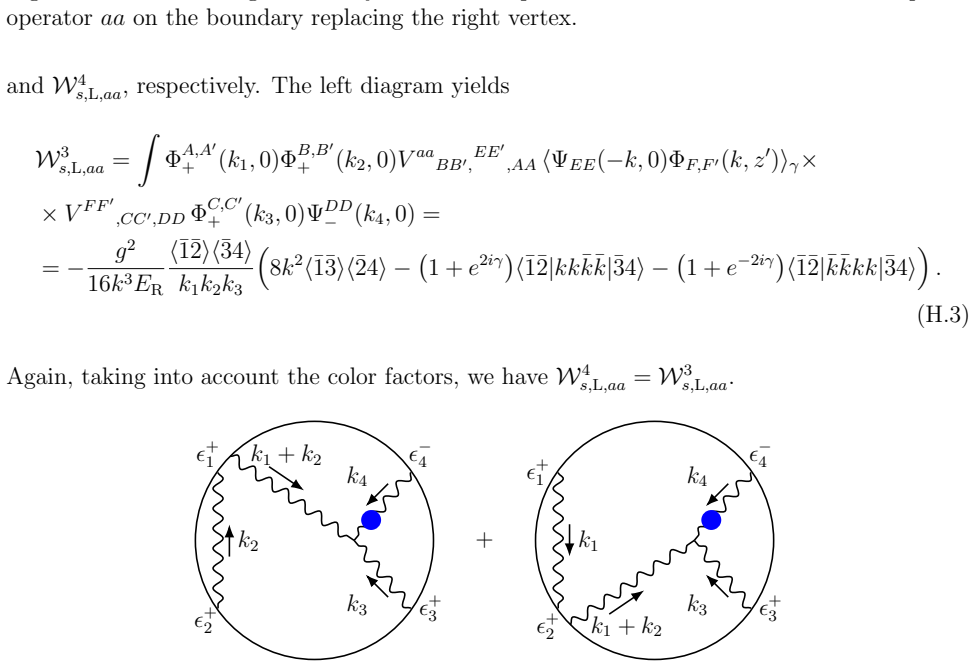
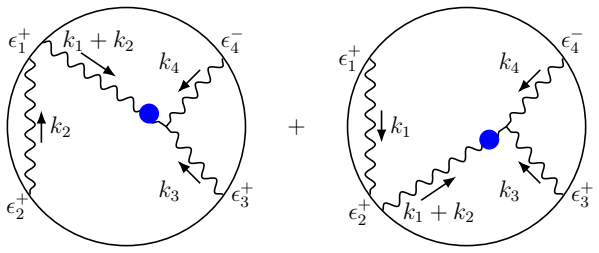
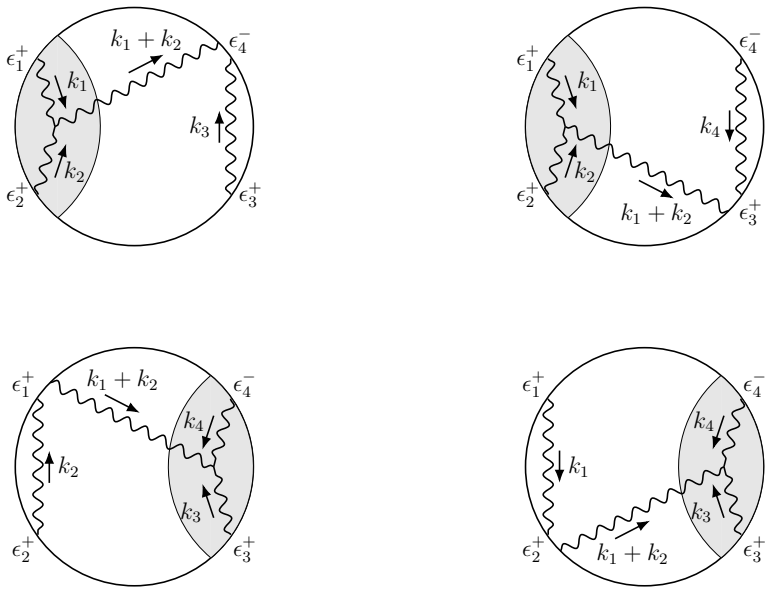
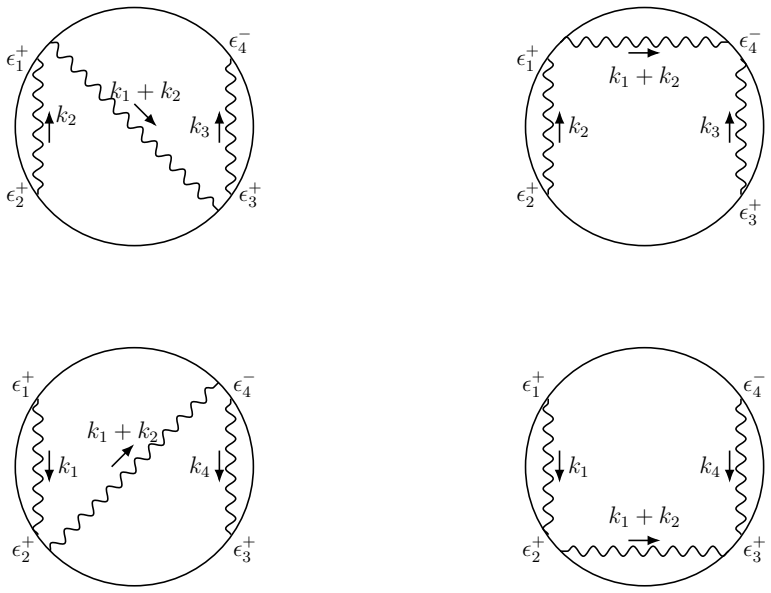
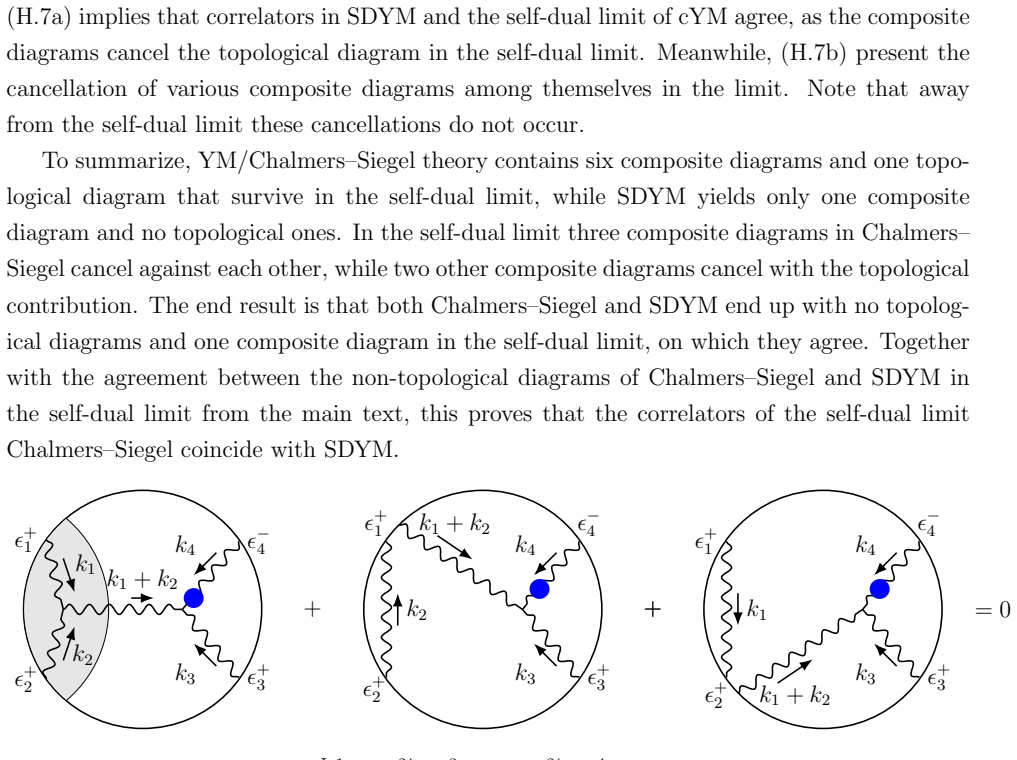
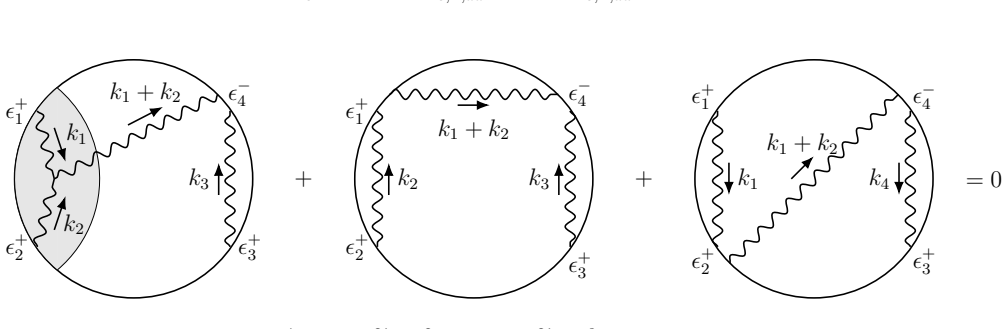
read the original abstract
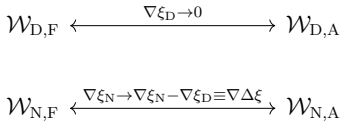
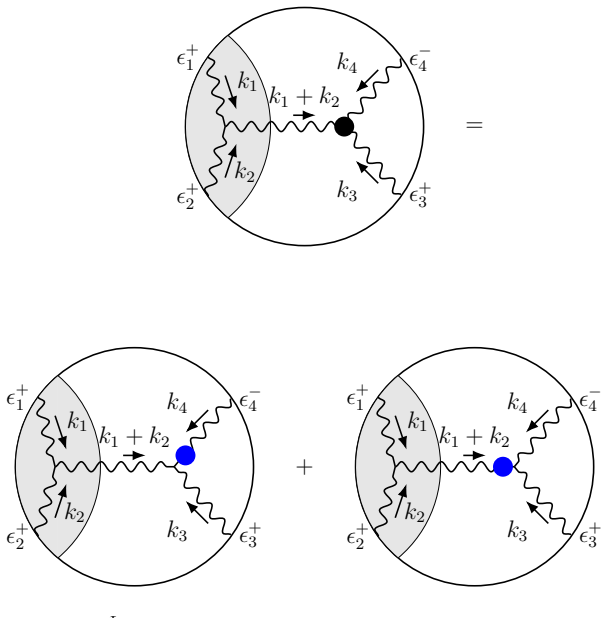
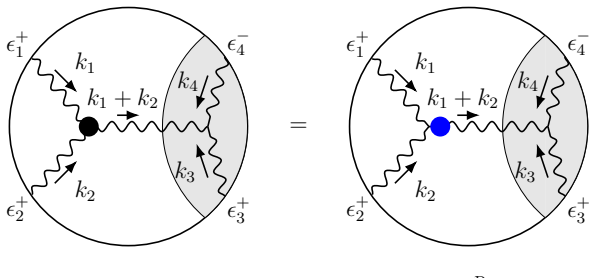
We consider Yang--Mills, Chalmers--Siegel and self-dual Yang--Mills (SDYM) theories within AdS/CFT correspondence. Bulk-to-bulk and boundary-to-bulk propagators are derived in various gauges and for Dirichlet, Neumann, mixed and self-dual boundary conditions. Three- and four-point holographic correlators are computed in the three theories to establish the relation between the observables thereof. This is a companion paper to [arXiv:2602.21658].
Editorial analysis
A structured set of objections, weighed in public.
Referee Report
Summary. The manuscript derives bulk-to-bulk and boundary-to-bulk propagators for Yang-Mills, Chalmers-Siegel, and self-dual Yang-Mills theories in AdS under Dirichlet, Neumann, mixed, and self-dual boundary conditions in various gauges. It then computes explicit three- and four-point holographic correlators in each theory to relate their observables. The work is presented as a companion to arXiv:2602.21658.
Significance. If the propagator derivations and correlator computations are correct and consistent, the paper supplies a concrete holographic dictionary relating observables across these gauge-theory formulations. The explicit three- and four-point results constitute a verifiable output that can be checked against known limits or the companion paper, which strengthens the contribution relative to purely formal statements.
minor comments (2)
- [Abstract] The abstract states that propagators and correlators are computed but supplies no schematic expressions or limit checks; adding one or two representative formulas (e.g., the form of the boundary-to-bulk propagator for the self-dual case) would improve readability without lengthening the manuscript.
- [Introduction] Because the paper is explicitly a companion, a short paragraph in the introduction that lists which results are new versus carried over from arXiv:2602.21658 would help readers assess the incremental advance.
Simulated Author's Rebuttal
We thank the referee for the positive assessment of the manuscript, the recognition of its contribution in providing explicit holographic dictionaries and verifiable correlators, and the recommendation for minor revision. No specific major comments appear in the report.
Circularity Check
No significant circularity; derivations self-contained
full rationale
The paper derives bulk-to-bulk and boundary-to-bulk propagators explicitly for Dirichlet/Neumann/mixed/self-dual conditions in YM, Chalmers-Siegel and SDYM, then computes three- and four-point correlators to relate observables. These are presented as direct calculations. The companion citation to arXiv:2602.21658 is noted but does not bear load for the central claims here; no equations reduce by construction to prior results, fitted parameters renamed as predictions, or self-citation chains. The work is self-contained against standard AdS/CFT benchmarks with no quoted reduction of outputs to inputs.
Axiom & Free-Parameter Ledger
axioms (2)
- domain assumption AdS/CFT correspondence holds for Yang-Mills, Chalmers-Siegel and self-dual Yang-Mills theories
- domain assumption Propagators exist and can be derived in the listed gauges and boundary conditions
Reference graph
Works this paper leans on
-
[1]
AdS / CFT correspondence and symmetry breaking,
I. R. Klebanov and E. Witten, “AdS / CFT correspondence and symmetry breaking,”Nucl. Phys. B556 (1999) 89–114,arXiv:hep-th/9905104
Pith/arXiv arXiv 1999
-
[2]
Multitrace operators, boundary conditions, and AdS / CFT correspondence,
E. Witten, “Multitrace operators, boundary conditions, and AdS / CFT correspondence,” arXiv:hep-th/0112258
-
[3]
SL(2,Z) action on three-dimensional conformal field theories with Abelian symmetry,
E. Witten, “SL(2,Z) action on three-dimensional conformal field theories with Abelian symmetry,” in From Fields to Strings: Circumnavigating Theoretical Physics: A Conference in Tribute to Ian Kogan, pp. 1173–1200. 7, 2003.arXiv:hep-th/0307041
Pith/arXiv arXiv 2003
-
[4]
SL(2,Z) action on three-dimensional CFTs and holography,
R. G. Leigh and A. C. Petkou, “SL(2,Z) action on three-dimensional CFTs and holography,”JHEP12 (2003) 020,arXiv:hep-th/0309177
Pith/arXiv arXiv 2003
-
[5]
A Note on AdS / CFT dual of SL(2,Z) action on 3-D conformal field theories with U(1) symmetry,
H.-U. Yee, “A Note on AdS / CFT dual of SL(2,Z) action on 3-D conformal field theories with U(1) symmetry,”Phys. Lett. B598(2004) 139–148,arXiv:hep-th/0402115
Pith/arXiv arXiv 2004
-
[6]
Electric-magnetic duality and deformations of three-dimensional CFT’s,
S. de Haro and P. Gao, “Electric-magnetic duality and deformations of three-dimensional CFT’s,”Phys. Rev. D76(2007) 106008,arXiv:hep-th/0701144
Pith/arXiv arXiv 2007
-
[7]
Holography of the N=1 higher spin theory on AdS(4),
R. G. Leigh and A. C. Petkou, “Holography of the N=1 higher spin theory on AdS(4),”JHEP06(2003) 011,arXiv:hep-th/0304217
Pith/arXiv arXiv 2003
-
[8]
Holography, duality and higher-spin theories,
A. C. Petkou, “Holography, duality and higher-spin theories,” in1st Solvay Workshop on Higher Spin Gauge Theories, pp. 65–78. 10, 2004.arXiv:hep-th/0410116
Pith/arXiv arXiv 2004
-
[9]
Setting the boundary free in AdS/CFT,
G. Compere and D. Marolf, “Setting the boundary free in AdS/CFT,”Class. Quant. Grav.25(2008) 195014,arXiv:0805.1902 [hep-th]
Pith/arXiv arXiv 2008
-
[10]
Dual Gravitons in AdS(4) / CFT(3) and the Holographic Cotton Tensor,
S. de Haro, “Dual Gravitons in AdS(4) / CFT(3) and the Holographic Cotton Tensor,”JHEP01(2009) 042,arXiv:0808.2054 [hep-th]
Pith/arXiv arXiv 2009
-
[11]
AdS Description of Induced Higher-Spin Gauge Theory,
S. Giombi, I. R. Klebanov, S. S. Pufu, B. R. Safdi, and G. Tarnopolsky, “AdS Description of Induced Higher-Spin Gauge Theory,”JHEP10(2013) 016,arXiv:1306.5242 [hep-th]
Pith/arXiv arXiv 2013
-
[12]
Double-trace deformations, mixed boundary conditions and functional determinants in AdS/CFT,
T. Hartman and L. Rastelli, “Double-trace deformations, mixed boundary conditions and functional determinants in AdS/CFT,”JHEP0801(2008) 019,arXiv:hep-th/0602106 [hep-th]
Pith/arXiv arXiv 2008
-
[13]
On Higher Spin Gauge Theory and the Critical O(N) Model,
S. Giombi and X. Yin, “On Higher Spin Gauge Theory and the Critical O(N) Model,”Phys. Rev. D85 (2012) 086005,arXiv:1105.4011 [hep-th]
Pith/arXiv arXiv 2012
-
[14]
Light-Front Bootstrap for Chern-Simons Matter Theories,
E. Skvortsov, “Light-Front Bootstrap for Chern-Simons Matter Theories,”JHEP06(2019) 058, arXiv:1811.12333 [hep-th]
arXiv 2019
-
[15]
Chiral higher spin gravity in (A)dS4 and secrets of Chern–Simons matter theories,
A. Sharapov and E. Skvortsov, “Chiral higher spin gravity in (A)dS4 and secrets of Chern–Simons matter theories,”Nucl. Phys. B985(2022) 115982,arXiv:2205.15293 [hep-th]
arXiv 2022
-
[16]
Hidden sectors of Chern-Simons matter theories and exact holography,
S. Jain, D. K. S, and E. Skvortsov, “Hidden sectors of Chern-Simons matter theories and exact holography,”Phys. Rev. D111no. 10, (2025) 106017,arXiv:2405.00773 [hep-th]. 169
arXiv 2025
-
[17]
A chiral limit for Chern-Simons-matter theories,
O. Aharony, R. R. Kalloor, and T. Kukolj, “A chiral limit for Chern-Simons-matter theories,”JHEP10 (2024) 051,arXiv:2405.01647 [hep-th]
arXiv 2024
- [18]
-
[19]
Single-minus gluon tree amplitudes are nonzero,
A. Guevara, A. Lupsasca, D. Skinner, A. Strominger, and K. Weil, “Single-minus gluon tree amplitudes are nonzero,”arXiv:2602.12176 [hep-th]
-
[20]
Dirichlet, Neumann, Mixed and self-dual holography: (self-dual) Yang-Mills theory,
E. Skvortsov and R. Van Dongen, “Dirichlet, Neumann, Mixed and self-dual holography: (self-dual) Yang-Mills theory,”arXiv:2602.21658 [hep-th]
-
[21]
On four point functions in the CFT / AdS correspondence,
H. Liu and A. A. Tseytlin, “On four point functions in the CFT / AdS correspondence,”Phys. Rev. D59 (1999) 086002,arXiv:hep-th/9807097
Pith/arXiv arXiv 1999
-
[22]
Gauge boson exchange in AdS(d+1),
E. D’Hoker and D. Z. Freedman, “Gauge boson exchange in AdS(d+1),”Nucl. Phys. B544(1999) 612–632,arXiv:hep-th/9809179
Pith/arXiv arXiv 1999
-
[23]
Graviton exchange and complete four point functions in the AdS / CFT correspondence,
E. D’Hoker, D. Z. Freedman, S. D. Mathur, A. Matusis, and L. Rastelli, “Graviton exchange and complete four point functions in the AdS / CFT correspondence,”Nucl. Phys. B562(1999) 353–394, arXiv:hep-th/9903196
Pith/arXiv arXiv 1999
-
[24]
AdS / CFT four point functions: How to succeed at z integrals without really trying,
E. D’Hoker, D. Z. Freedman, and L. Rastelli, “AdS / CFT four point functions: How to succeed at z integrals without really trying,”Nucl. Phys. B562(1999) 395–411,arXiv:hep-th/9905049
Pith/arXiv arXiv 1999
-
[25]
Four point functions of lowest weight CPOs in N=4 SYM(4) in supergravity approximation,
G. Arutyunov and S. Frolov, “Four point functions of lowest weight CPOs in N=4 SYM(4) in supergravity approximation,”Phys. Rev. D62(2000) 064016,arXiv:hep-th/0002170
Pith/arXiv arXiv 2000
-
[26]
Recursion Relations for AdS/CFT Correlators,
S. Raju, “Recursion Relations for AdS/CFT Correlators,”Phys. Rev. D83(2011) 126002, arXiv:1102.4724 [hep-th]
Pith/arXiv arXiv 2011
-
[27]
Four Point Functions of the Stress Tensor and Conserved Currents in AdS 4/CFT3,
S. Raju, “Four Point Functions of the Stress Tensor and Conserved Currents in AdS 4/CFT3,”Phys. Rev. D85(2012) 126008,arXiv:1201.6452 [hep-th]
Pith/arXiv arXiv 2012
-
[28]
New Recursion Relations and a Flat Space Limit for AdS/CFT Correlators,
S. Raju, “New Recursion Relations and a Flat Space Limit for AdS/CFT Correlators,”Phys. Rev. D85 (2012) 126009,arXiv:1201.6449 [hep-th]
Pith/arXiv arXiv 2012
-
[29]
Momentum-space formulae for AdS correlators for diverse theories in diverse dimensions,
S. Albayrak, S. Kharel, and X. Wang, “Momentum-space formulae for AdS correlators for diverse theories in diverse dimensions,”JHEP07(2024) 281,arXiv:2312.02154 [hep-th]
arXiv 2024
-
[30]
All plus four point (A)dS graviton function using generalized on-shell recursion relation,
S. Albayrak and S. Kharel, “All plus four point (A)dS graviton function using generalized on-shell recursion relation,”JHEP05(2023) 151,arXiv:2302.09089 [hep-th]
arXiv 2023
-
[31]
Color/kinematics duality in AdS 4,
C. Armstrong, A. E. Lipstein, and J. Mei, “Color/kinematics duality in AdS 4,”JHEP02(2021) 194, arXiv:2012.02059 [hep-th]
arXiv 2021
-
[32]
On graviton non-Gaussianities during inflation,
J. M. Maldacena and G. L. Pimentel, “On graviton non-Gaussianities during inflation,”JHEP09(2011) 045,arXiv:1104.2846 [hep-th]
Pith/arXiv arXiv 2011
-
[33]
Flat space physics from AdS/CFT,
E. Hijano, “Flat space physics from AdS/CFT,”JHEP07(2019) 132,arXiv:1905.02729 [hep-th]
arXiv 2019
-
[34]
Flat-space structure of gluons and gravitons in AdS spacetime,
Y.-Z. Li, “Flat-space structure of gluons and gravitons in AdS spacetime,”Phys. Rev. D107no. 12, (2023) 125018,arXiv:2212.13195 [hep-th]
arXiv 2023
-
[35]
Spinor-Helicity Formalism for Massless Fields in AdS 4,
B. Nagaraj and D. Ponomarev, “Spinor-Helicity Formalism for Massless Fields in AdS 4,”Phys. Rev. Lett. 122no. 10, (2019) 101602,arXiv:1811.08438 [hep-th]
Pith/arXiv arXiv 2019
-
[36]
Spinor-helicity formalism for massless fields in AdS 4. Part II. Potentials,
B. Nagaraj and D. Ponomarev, “Spinor-helicity formalism for massless fields in AdS 4. Part II. Potentials,”JHEP06(2020) 068,arXiv:1912.07494 [hep-th]. 170
arXiv 2020
-
[37]
Spinor-helicity formalism for massless fields in AdS 4 III: contact four-point amplitudes,
B. Nagaraj and D. Ponomarev, “Spinor-helicity formalism for massless fields in AdS 4 III: contact four-point amplitudes,”JHEP08no. 08, (2020) 012,arXiv:2004.07989 [hep-th]
arXiv 2020
-
[38]
On (spinor)-helicity and bosonization in AdS 4/CFT3,
E. Skvortsov and Y. Yin, “On (spinor)-helicity and bosonization in AdS 4/CFT3,”JHEP03(2023) 204, arXiv:2207.06976 [hep-th]
arXiv 2023
-
[39]
A new twist on spinning (A)dS correlators,
D. Baumann, G. Mathys, G. L. Pimentel, and F. Rost, “A new twist on spinning (A)dS correlators,” JHEP01(2025) 202,arXiv:2408.02727 [hep-th]
arXiv 2025
-
[40]
Spinning boundary correlators from (A)dS 4 twistors,
M. Carrillo Gonz´ alez and T. Keseman, “Spinning boundary correlators from (A)dS 4 twistors,”JHEP03 (2026) 131,arXiv:2510.00096 [hep-th]
arXiv 2026
-
[41]
Light-cone gauge cubic interaction vertices for massless fields in AdS(4),
R. R. Metsaev, “Light-cone gauge cubic interaction vertices for massless fields in AdS(4),”Nucl. Phys. B936(2018) 320–351,arXiv:1807.07542 [hep-th]
Pith/arXiv arXiv 2018
-
[42]
Self-Dual Gravity and Color-Kinematics Duality in AdS4,
A. Lipstein and S. Nagy, “Self-Dual Gravity and Color-Kinematics Duality in AdS4,”Phys. Rev. Lett. 131no. 8, (2023) 081501,arXiv:2304.07141 [hep-th]
arXiv 2023
-
[43]
Self-dual gravity in de Sitter space: Light-cone ansatz and static-patch scattering,
Y. Neiman, “Self-dual gravity in de Sitter space: Light-cone ansatz and static-patch scattering,”Phys. Rev. D109no. 2, (2024) 024039,arXiv:2303.17866 [gr-qc]
arXiv 2024
-
[44]
Higher-spin self-dual General Relativity: 6d and 4d pictures, covariant vs. lightcone,
Y. Neiman, “Higher-spin self-dual General Relativity: 6d and 4d pictures, covariant vs. lightcone,”JHEP 07(2024) 178,arXiv:2404.18589 [hep-th]
arXiv 2024
-
[45]
M. Carrillo Gonz´ alez, A. Lipstein, and S. Nagy, “Self-dual cosmology,”JHEP10(2024) 183, arXiv:2407.12905 [hep-th]
arXiv 2024
-
[46]
Light-cone actions and correlators of self-dual theories in AdS 4,
C. Chowdhury, G. Doran, A. Lipstein, R. Monteiro, S. Nagy, and K. Singh, “Light-cone actions and correlators of self-dual theories in AdS 4,”JHEP01(2025) 172,arXiv:2411.04172 [hep-th]
arXiv 2025
-
[47]
Causality of higher-spin interactions on the (A)dS lightcone, with application to the static patch,
J. Kozaki, J. Lang, and Y. Neiman, “Causality of higher-spin interactions on the (A)dS lightcone, with application to the static patch,”arXiv:2510.22532 [hep-th]
-
[48]
Universal structure in the interactions of massless fields on the lightcone,
J. Kozaki and Y. Neiman, “Universal structure in the interactions of massless fields on the lightcone,” arXiv:2606.17380 [hep-th]
-
[49]
The Selfdual sector of QCD amplitudes,
G. Chalmers and W. Siegel, “The Selfdual sector of QCD amplitudes,”Phys. Rev.D54(1996) 7628–7633,arXiv:hep-th/9606061 [hep-th]
Pith/arXiv arXiv 1996
-
[50]
K. Krasnov, “Self-Dual Gravity,”Class. Quant. Grav.34no. 9, (2017) 095001,arXiv:1610.01457 [hep-th]
Pith/arXiv arXiv 2017
-
[51]
Actions for Self-dual Higher Spin Gravities,
K. Krasnov, E. Skvortsov, and T. Tran, “Actions for Self-dual Higher Spin Gravities,” arXiv:2105.12782 [hep-th]
-
[52]
Chiral Higher Spin Theories and Self-Duality,
D. Ponomarev, “Chiral Higher Spin Theories and Self-Duality,”JHEP12(2017) 141,arXiv:1710.00270 [hep-th]
Pith/arXiv arXiv 2017
-
[53]
On classification of (self-dual) higher-spin gravities in flat space,
M. Serrani, “On classification of (self-dual) higher-spin gravities in flat space,”JHEP08(2025) 032, arXiv:2505.12839 [hep-th]
arXiv 2025
-
[54]
On effective field theories with celestial duals,
L. Ren, M. Spradlin, A. Yelleshpur Srikant, and A. Volovich, “On effective field theories with celestial duals,”JHEP08(2022) 251,arXiv:2206.08322 [hep-th]
arXiv 2022
-
[55]
Associativity of celestial OPE, higher spins and self-duality,
M. Serrani, “Associativity of celestial OPE, higher spins and self-duality,”arXiv:2508.16804 [hep-th]
-
[56]
B. Gripaios, H. D. Kim, R. Rattazzi, M. Redi, and C. Scrucca, “Gaugino mass in AdS space,”JHEP02 (2009) 043,arXiv:0811.4504 [hep-th]. 171
Pith/arXiv arXiv 2009
-
[57]
The Three Dimensional Dual of 4D Chirality,
M. Porrati and L. Girardello, “The Three Dimensional Dual of 4D Chirality,”JHEP11(2009) 114, arXiv:0908.3487 [hep-th]
Pith/arXiv arXiv 2009
-
[58]
Gauge Boson Mass Generation in AdS4,
R. Rattazzi and M. Redi, “Gauge Boson Mass Generation in AdS4,”JHEP12(2009) 025, arXiv:0908.4150 [hep-th]
Pith/arXiv arXiv 2009
-
[59]
S. Bolognesi and D. Tong, “Magnetic Catalysis in AdS4,”Class. Quant. Grav.29(2012) 194003, arXiv:1110.5902 [hep-th]
Pith/arXiv arXiv 2012
-
[60]
Superconformal Models for Graphene and Boundary Central Charges,
C. P. Herzog, K.-W. Huang, I. Shamir, and J. Virrueta, “Superconformal Models for Graphene and Boundary Central Charges,”JHEP09(2018) 161,arXiv:1807.01700 [hep-th]
Pith/arXiv arXiv 2018
-
[61]
Bulk reconstruction for spinor fields in AdS/CFT,
V. F. Foit, D. Kabat, and G. Lifschytz, “Bulk reconstruction for spinor fields in AdS/CFT,”JHEP02 (2020) 129,arXiv:1912.00952 [hep-th]
arXiv 2020
-
[62]
R. Ciccone, F. De Cesare, L. Di Pietro, and M. Serone, “QCD in AdS,”arXiv:2511.04752 [hep-th]
-
[63]
On the origin of supergravity boundary terms in the AdS / CFT correspondence,
G. E. Arutyunov and S. A. Frolov, “On the origin of supergravity boundary terms in the AdS / CFT correspondence,”Nucl. Phys. B544(1999) 576–589,arXiv:hep-th/9806216
Pith/arXiv arXiv 1999
-
[64]
Boundary terms in the AdS / CFT correspondence for spinor fields,
M. Henneaux, “Boundary terms in the AdS / CFT correspondence for spinor fields,” inInternational Meeting on Mathematical Methods in Modern Theoretical Physics (ISPM 98), pp. 161–170. 9, 1998. arXiv:hep-th/9902137
Pith/arXiv arXiv 1998
-
[65]
Bulk-to-bulk photon propagator in AdS,
R. N. Moga and K. Skenderis, “Bulk-to-bulk photon propagator in AdS,”arXiv:2510.23770 [hep-th]
-
[66]
On the null origin of the ambitwistor string,
E. Casali and P. Tourkine, “On the null origin of the ambitwistor string,”JHEP11(2016) 036, arXiv:1606.05636 [hep-th]
Pith/arXiv arXiv 2016
-
[67]
Ultraviolet Properties of the Self-Dual Yang-Mills Theory,
A. Losev, I. Polyubin, and A. Rosly, “Ultraviolet Properties of the Self-Dual Yang-Mills Theory,”JHEP 02(2018) 041,arXiv:1711.10026 [hep-th]
Pith/arXiv arXiv 2018
-
[68]
Chern-Simons Theory with Vector Fermion Matter,
S. Giombi, S. Minwalla, S. Prakash, S. P. Trivedi, S. R. Wadia, and X. Yin, “Chern-Simons Theory with Vector Fermion Matter,”Eur. Phys. J.C72(2012) 2112,arXiv:1110.4386 [hep-th]
Pith/arXiv arXiv 2012
-
[69]
Constraining conformal field theories with a slightly broken higher spin symmetry,
J. Maldacena and A. Zhiboedov, “Constraining conformal field theories with a slightly broken higher spin symmetry,”arXiv:1204.3882 [hep-th]
-
[70]
Correlation Functions of Large N Chern-Simons-Matter Theories and Bosonization in Three Dimensions,
O. Aharony, G. Gur-Ari, and R. Yacoby, “Correlation Functions of Large N Chern-Simons-Matter Theories and Bosonization in Three Dimensions,”JHEP12(2012) 028,arXiv:1207.4593 [hep-th]
Pith/arXiv arXiv 2012
-
[71]
Baryons, monopoles and dualities in Chern-Simons-matter theories,
O. Aharony, “Baryons, monopoles and dualities in Chern-Simons-matter theories,”JHEP02(2016) 093, arXiv:1512.00161 [hep-th]
Pith/arXiv arXiv 2016
-
[72]
W. Mueck and K. S. Viswanathan, “Conformal field theory correlators from classical field theory on anti-de Sitter space. 2. Vector and spinor fields,”Phys. Rev. D58(1998) 106006,arXiv:hep-th/9805145
Pith/arXiv arXiv 1998
-
[73]
M. Bianchi, D. Z. Freedman, and K. Skenderis, “Holographic renormalization,”Nucl. Phys. B631(2002) 159–194,arXiv:hep-th/0112119
Pith/arXiv arXiv 2002
-
[74]
Higher spin 3-point functions in 3d CFT using spinor-helicity variables,
S. Jain, R. R. John, A. Mehta, A. A. Nizami, and A. Suresh, “Higher spin 3-point functions in 3d CFT using spinor-helicity variables,”JHEP09(2021) 041,arXiv:2106.00016 [hep-th]
arXiv 2021
-
[75]
Holographic Aspects of Electric-Magnetic Dualities,
S. de Haro and A. C. Petkou, “Holographic Aspects of Electric-Magnetic Dualities,”J. Phys. Conf. Ser. 110(2008) 102003,arXiv:0710.0965 [hep-th]
Pith/arXiv arXiv 2008
-
[76]
Zero rest mass fields including gravitation: Asymptotic behavior,
R. Penrose, “Zero rest mass fields including gravitation: Asymptotic behavior,”Proc. Roy. Soc. Lond. A284(1965) 159. 172
1965
-
[77]
Spinors and the AdS / CFT correspondence,
M. Henningson and K. Sfetsos, “Spinors and the AdS / CFT correspondence,”Phys. Lett. B431(1998) 63–68,arXiv:hep-th/9803251
Pith/arXiv arXiv 1998
-
[78]
Boundary Conditions and New Dualities: Vector Fields in AdS/CFT,
D. Marolf and S. F. Ross, “Boundary Conditions and New Dualities: Vector Fields in AdS/CFT,”JHEP 11(2006) 085,arXiv:hep-th/0606113
Pith/arXiv arXiv 2006
-
[79]
R. R. Metsaev, “CFT adapted gauge invariant formulation of arbitrary spin fields in AdS and modified de Donder gauge,”Phys. Lett. B671(2009) 128–134,arXiv:0808.3945 [hep-th]
Pith/arXiv arXiv 2009
-
[80]
A CONFORMALLY INVARIANT MAXWELL GAUGE,
M. G. Eastwood and M. Singer, “A CONFORMALLY INVARIANT MAXWELL GAUGE,”Phys. Lett. A107(1985) 73–74
1985
discussion (0)
Sign in with ORCID, Apple, or X to comment. Anyone can read and Pith papers without signing in.